The University of Bradford Institutional
Repository
http://bradscholars.brad.ac.uk
This work is made available online in accordance with publisher policies. Please
refer to the repository record for this item and our Policy Document available from
the repository home page for further information.
To see the final version of this work please visit the publisher’s website. Where
available access to the published online version may require a subscription.
Author(s): Montgomery, Heather and Weiss, John, A.
Title: Can commercially-oriented microfinance help meet the Millennium
Development Goals? Evidence from Pakistan.
Publication year: 2011
Journal title: World Development.
ISSN: 0305-750X
Publisher: Elsevier
Link to original published version:
http://dx.doi.org/10.1016/j.worlddev.2010.09.001
Citation: Montgomery, H. and Weiss, J. (2011). Can commercially-oriented
microfinance help meet the Millennium Development Goals? Evidence from
Pakistan. World Development. Vol. 39, No. 1, pp. 87–109.
Copyright statement: © 2010 Elsevier. Reproduced in accordance with the
publisher's self-archiving policy.
Can commercially-oriented microfinance help meet the Millennium Development Goals? Evidence from Pakistan
Heather Montgomery
*and
John Weiss
***Associate Professor, International Christian University, 3-10-2 Osawa, Mitaka-shi, Tokyo 181-8585 Japan Phone: (81) (0422) 33-3277 E-mail: [email protected]
**
Professor of Development Economics, Associate Dean Research, University of Bradford, UK E-mail: [email protected] (corresponding author).
Abstract
The current emphasis in the microfinance industry is a shift from donor-funded to commercially sustainable operations. This article evaluates the impact of access to microloans from the Khushhali Bank – Pakistan‟s first and largest microfinance bank which operates on commercial principles. Using primary data from a detailed
household survey of nearly 3000 borrower and non-borrower households, a difference in difference approach is used to test for the impact of access to loans. Once the results are disaggregated between rural and urban areas there is a positive impact in rural areas on food expenditure and on some social indicators.
Keywords: Asia, Pakistan, Microfinance, Poverty, Impact, Empowerment, Millennium Development Goals.
Much of this research was completed while the authors were with the Asian Development Bank Institute in Tokyo, Japan, which provided the funding for the fieldwork. Ziyodullo Parpiev provided outstanding research assistance. The authors thank Brett Coleman for helpful discussions on sampling and application of the approach used in his 1999 study. They also acknowledge the comments of several anonymous referees. The authors thank Farzana Nuzhat and Asim Anwar of
I. Introduction
The Millennium Development Goals (MDGs) reflect ambitious development targets encompassing not only monetary measures of poverty, but also more comprehensive measures of development that quantify development in areas such as education,
gender equality and health.1 By providing small scale financial services to those on
low incomes, microfinance is seen by many as one of the most significant of the instruments to support these targets. Representing this hope, the United Nations declared 2005 the International Year of Microcredit with the goal of “Building Inclusive Financial Sectors to Achieve the Millennium Development Goals” (International Year of Microcredit, n.d.).
None the less, within the microfinance industry it is recognized that microfinance institutions (MFIs) that rely on aid funding will be subject to the vagaries of aid budgets and will never to able to expand to the scale that will make a major change in poverty and related social indicators at a national level. The response has been to shift the focus of MFI activity from donor-driven schemes that channel subsidized credit to borrowers to commercially-oriented operations charging interest rates that cover full costs and are thus financially self-reliant. This „commercialization of microfinance‟ has prompted considerable debate as to how far it is compatible with the original poverty reduction mission of MFIs (Montgomery and Weiss, 2005). One commentator has gone so far as to refer to „a battle for the soul of microfinance‟ (Harford, 2008). This question cannot be answered a-priori and empirical evidence is needed to clarify the extent to which there is indeed a trade-off between financial sustainability and achievement of the MDGs and related poverty targets. The trade- off can be examined in various ways. For example, one approach assesses the impact on borrowers of interest rate increases that accompany the shift to a commercially oriented microfinance sector (Dehejia et al, 2008 and Karlan and Zinman, 2008). Another examines a large sample of MFIs covering a variety of
institutional forms and lending methodologies to see how far any dilution of poverty focus (as proxied by loan size) can be associated with the MFI‟s lending
methodology, size or age. The authors conclude that for larger and older MFIs the results are consistent with the view that „as institutions mature and grow they focus increasingly on clients that can absorb larger loans.‟ (Cull et al, 2007 : 131?). This is not necessarily „mission drift‟ since more poor borrowers could still be served under a commercial model, but it is a warning that even NGO MFIs may not be focusing primarily on the very poor any more. Conducting detailed and rigorous impact studies is difficult and as one review paper has commented „thirty years into the microfinance movement we have little solid evidence that it improves the lives of clients in a measurable way‟ (Roodman and Murdoch 2009: 3-4).
This paper contributes to this debate by focusing on a case-study of a relatively new commercially-oriented microfinance bank. It reports the analysis of survey data collected in Pakistan in 2005 relating to the lending activity of the Khushhali Bank, the first licensed microfinance bank in the country and one designed to operate on commercial lines but with a social mission consistent with the MDGs, which in turn form the center-piece of the government‟s poverty reduction strategy (Government of
Pakistan 2003).The paper is distinct in a number of ways: it is based on a large
national survey of 2881 households, which is a far larger sample than is normal for this type of study; it focuses on a country in which the microfinance sector is relatively new and where little rigorous work has been conducted on the impact of microfinance; it applies a rigorous control group approach that addresses the main sources of bias; and it uses a wide range of outcome measures to capture the impact of lending on alternative dimensions of welfare.
Microfinance remains relatively little developed in Pakistan, although there has been rapid growth since 2000 starting from a low base. As of March 2008 there were estimated to be around 1.6 million active borrowers with an average loan size of Rs 11,000 (less than $150) as compared with Rs 460,000 in the banking sector as a whole. However, the potential market for microcredit is likely to be much larger than this and the microfinance strategy of the State Bank of Pakistan targeted a total of 3
million borrowers by 2010.2
The Khushhali bank was founded in 2000 as the first initiative of the Microfinance Development Program sponsored by the Asian Development Bank. It was an early version of a commercially-oriented microfinance intervention with its share capital drawn from 16 commercial banks. Whilst operating alongside more conventional aid funded MFIs, it has become the largest provider of microfinance in Pakistan, now providing a range of loan products to over 360,000 active borrowers (nearly 25% of the national total), whilst focusing on the core objective of operational self-sufficiency. It is not a perfect case-study of a commercially oriented microfinance bank since although its objectives are commercial it has not yet achieved full financial self-sufficiency. Even though its Annual Report for 2007 reports a profit before tax of Rs156 million and a return on equity of 5%, these calculations do not net out the effect of the substantial interest rate subsidy from the Asian Development Bank and independent estimates suggest that the operational self-sufficiency ratio is no more
than 80%.3 The most recent Annual Report for 2008 reports a profit after tax of Rs
103 million but again this fails to remove the effect of any financial subsidy. Hence what we are examining is the impact of the lending of a bank that is aiming for financial viability but which is not yet operating on fully commercial lines.
As part of its social mission Khushhali targets clients who are “poor” and “very poor”,
receive enough income to pay income tax. In the sample drawn for this study in 2005, more than 70% of the clients were below the official poverty line of the
Government of Pakistan and 20% were at less than half of the caloric consumption of
those defined as poor.4 When data for this study was collected in 2005, the bulk of
clients (60%) were in rural areas and roughly one-third were women, although according to the bank‟s more recent Annual Reports both of those ratios have declined as the bank has expanded in the past few years.
At the time of the survey the bank offered eligible clients uncollateralized micro-loans
of Rs3,000 – Rs 30,000.5 The first loan would be between Rs 3,000-10,000 and loan
sizes increase 20% with each cycle to a maximum of Rs 30,000. The terms of the microloan vary between 3-12 months, to be repaid with interest on declining balances in equal monthly installments or in one bullet payment, depending on the purpose of the loan. Loans were offered for investments in arable agriculture, in livestock or in micro-enterprises to establish a new business or to purchase assets or working capital for an existing business, but not for consumption. At the time of the survey in 2005 the interest rate was 20% and the average loan per borrower was $142. This was higher than that charged by other microfinance institutions and well above the average lending rate of 11% reported in the IMF International Financial Statistics, however it is well below earlier estimates of the cost of borrowing from informal credit sources (Arif 1999).
Although the bank has introduced an individual scoring report to screen and classify clients according to the above eligibility criteria, it uses a group lending methodology under which clients form groups called community organizations that can be male, female or mixed gender groups of between 3 to 25 members (usually 3-5 members in urban areas and 10-25 in rural) who provide personal guarantees to each other.
Loans are made directly to individuals in the group, but if any one member of the group defaults then all members of that group become ineligible for loans.
III. Research Methodology
The first question to be addressed in conducting any impact evaluation is: how to measure impact? Most microfinance programs are designed to encourage borrowers to invest their loans in their farms or microenterprises. The hope is that these
investments will lead to higher profits, which will in turn lead to higher household income, which will gradually lift client households out of poverty. Microfinance may also affect non-income measures of household welfare such as health, education or empowerment. Note that the effects of microfinance on these broader measures of welfare may not be expected to be all positive. On the one-hand, households with more profitable family farms or microenterprises may be able to afford textbooks for their school age children, or hire workers to help with duties previously required of family members. On the other hand, the extra time required of household members in running a newly-profitable family farm or microenterprise may also lead to lower enrollment rates for school age children who are encouraged to skip school or drop out all-together in order to contribute to the business.
In this study, we used the Khushhali Bank mandate of
“…providing micro-finance services to poor persons, particularly poor
women for mitigating poverty and promoting social welfare and economic justice through community building and social mobilization
with the ultimate objective of poverty alleviation.”(Status and Nature
as a guide in designing our study. Thus, we looked at what might be called
traditional, or at least, direct, impacts of microfinance on household business profits as well as broader measures of household welfare such as health, education, female empowerment and finally, poverty, as measured by food and non-food consumption-expenditure.
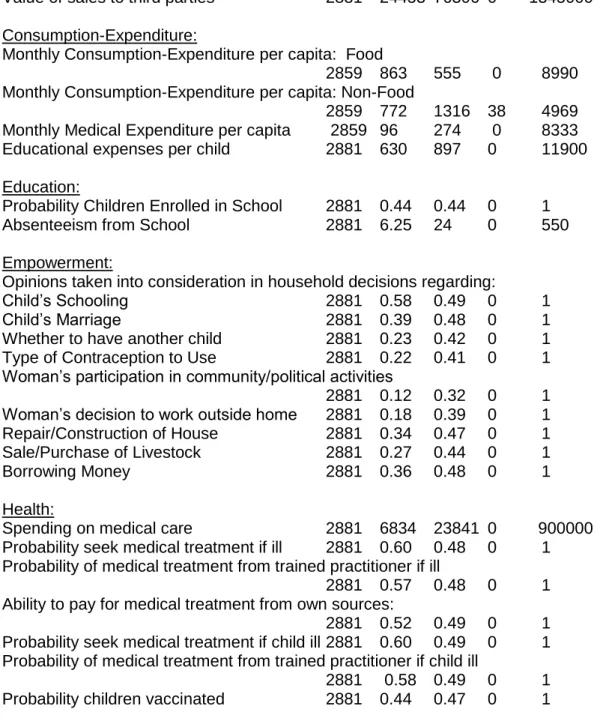
Table 1 reports the summary statistics for the measures of household welfare used in this study. Business profits for the different types of activities supported by Khushhali Bank loans – agriculture and livestock farming as well as microenterprise - are measured by reported profits and sales. Consumption-expenditure, the basis for measuring official poverty statistics in Pakistan, measured as food expenditures, non-food expenditures, medical expenditures and educational expenditures per child, indicates income effects of participation in the microfinance program. Non-income measures of household welfare are also included: the probability that children are in school, absenteeism from school, the probability of seeking medical treatment if ill and the quality of that treatment (as measured by the degree of training of the provider). Given the mandate to serve women particularly, we also looked at the impacts of participation in the microfinance program on the empowerment of women, as measured by the extent to which female respondents in each household felt their opinions were taken into account in household decisions on things such as the children‟s upbringing (their schooling and marriage), financial matters (whether or not to borrow money, sell or purchase livestock, repair the home) and the female
household member‟s decision to work outside the home or participate in community political activities.
Once the indicator of interest has been identified, a perfect impact evaluation needs to answer a counterfactual question: how does the status of participants in the
program as measured by those variables compare with how those same individuals would have fared in the absence of the program? The problem with cross-sections of data (observations on many individuals at a given point in time) is that at any given point in time, individuals are observed to be either participants or not. Even panels of data (observations on many individuals through time) are problematic since over time many other things have happened to the individuals in addition to program
participation and it is nearly impossible to separate out the impact of the program from all the other influences. In practice, researchers must settle for estimates of the average impact of the program on a group of participants – the treatment group – compared to a credible comparison group – a control group. The ideal control group is individuals who would have had outcomes similar to those in the treatment group if the members of the treatment group had not participated in the program.
Constructing a control group comparable to the treatment group is not straightforward. Participants in the program are usually different from non-participants in many ways: programs may be carefully placed in specific areas, participants within those areas may be screened for participation, and the final decision on whether or not to participate is usually voluntary. To the extent that these factors are known and can be measured, they can be controlled for in the empirical analysis, but in most cases the placement of the program and self-selection of participants in those areas into the program are based on unobservable factors. These unobservable factors lead to at least two kinds of bias in any empirical impact evaluation: program placement bias and self-selection bias.
Controlling for this bias – determining the effects of microfinance alone and
separating out the impact of microcredit from what would have happened to the same household without credit – is often the most difficult part of empirical impact studies. Well-run microfinance institutions do not randomize either the location of their
operations or their selection of clients. If MFIs tend to operate in areas that have relatively better or worse infrastructure such as access by roads or more or less active markets, then estimates of the impacts of the program on participants do not measure the effects just of microfinance, but of these other factors as well. Even within a given village, if, as studies by Hashemi (1997), Alexander (2001) and Coleman (2006) suggest, microfinance clients already have initial advantages over non-clients, then the impact of microfinance will be overestimated if these initial biases are not controlled for. Similarly, the impact of microfinance programs that
deliberately target relatively disadvantaged households in the areas they operate
may be underestimated if these biases are not controlled for.6
Armendáriz de Aghion and Morduch (2005) provide a compelling argument in favor of making the substantial investment required to conduct careful impact studies that control for these potential biases:
Unfortunately, this is not an esoteric concern that practitioners and policymakers can safely ignore. It is not just a difference between obtaining “very good” estimates of impacts versus “perfect” estimates
– the biases can be large. In evaluating the Grameen Bank, for
example, Signe-Mary McKernan (2002) finds that not controlling for selection bias can lead to overestimation of the effect of participation on profits by as much as 100 percent. In other cases …controlling for these biases reverses conclusions about impacts entirely.
There are three broad approaches that have been applied elsewhere in the microfinance literature. One is the use of a randomized study design to control for selection bias (Duflo and Kremer, 2005, World Bank, 2008, McKenzie, 2009). This approach eliminates selection bias by randomly selecting treatment (those who
receive microfinance) and control (those who do not) groups from a potential population of participants. With this type of study design, the researcher can be assured that on average those who are exposed to the program are no different than those who are not and thus that a statistically significant difference between the groups‟ outcomes can be confidently attributed to the program rather than to selection bias.
This randomized approach follows that adopted in clinical drugs trials and is seen by many as the best way of rigorously proving impact. A few studies applying this approach have been conducted or are ongoing. For example, Banerjee et al (2009) apply the approach to the expansion of MFIs in slum areas in Hyderabad, India, finding that in the short-term access to microcredit helps business start-up and to fund investment. However, it appears to have no impact on social indicators relating to female empowerment or family health or education. The qualification is that these are short-term effects and through higher investment future monetary and
non-monetary benefits may arise. The authors conclude that microfinance can be a useful means of helping the entrepreneurial poor, but it is not a miracle in the sense of transforming social conditions. Interestingly, some initial results from randomized work question key tenets of the microfinance literature. For example, a study on Sri Lanka finds far higher returns to male-headed as opposed to female-headed micro-enterprises (de Mel et al., 2008).
Well-designed randomized studies of this sort have the potential to rigorously address all kinds of potential biases, but their overall “acknowledged weakness is external validity – the ability to learn from an evaluation about how the specific intervention will work in other settings and at larger scales.” (Ravallion, 2009: 3) One limitation of small-scale randomized social experiments is that they can only estimate partial equilibrium treatment effects, which may differ from general equilibrium
treatment effects. In the case of microfinance, this means that if, for example, microfinance is introduced on a large scale, the functioning of financial markets may eventually be affected, thus yielding a different impact than the necessarily smaller-scale program introduced for the impact study. There is also the potential for spillovers that create external benefits, for example from treated villages or areas where microfinance operates to untreated ones it has yet to reach. There is thus the possibility that non-program participants may benefit indirectly from the gains of participants which will distort the impact assessment. The biggest problem for external validity of randomized studies is related to the issue of unobservable characteristics that affect both program placement and self-selection. A randomized
study will include in the treatment group individuals with and without these
unobservable characteristics to get a truly unbiased measure of impact. But when interventions such as microfinance are introduced on a large scale, the participants tend to have those characteristics. Thus, despite their scientific appeal, randomized studies are not always the most relevant for policy makers. (Ravallion, 2009 :.2).
Another, more practical, concern in attempting to apply randomized study design is that such studies require tremendous cooperation from the institutions being evaluated, which must be willing to allow researchers to randomize the
implementation of their services. Such studies are preferably longitudinal, making them costly, and it can be difficult to conduct research over a period long enough for some impacts to show up. Intellectual arguments aside, for these practical reasons the randomization approach was not applied in this study.
A simpler alternative is to identify a control group through some identifiable eligibility attribute. A well known study by Pitt and Khandker (1998) used land ownership. The authors sample participants and non-participants of microfinance programs in a number of treatment villages where group lending programs are operating as well as
randomly selected households from control villages without a program. They use village fixed effects to correct for the endogeneity of program placement and take advantage of the fact that the microcredit programs impose eligibility requirements on participants (households with land holdings of more than half an acre are ineligible) to determine eligible and ineligible households in the control villages. Impact is assessed using a difference-in-difference approach between eligible and ineligible households and between program and non-program villages. After controlling for other factors, such as various household characteristics, any remaining difference is attributed to the microfinance programs. The difficulty with this approach is that clear eligibility criteria for access to microfinance need to be identifiable and strictly
applied.7
Another approach to controlling for self-selection and placement bias is to include a sample of microcredit clients who have formed solidarity groups but have not yet received loans as the control group (Hulme and Mosley, 1996, Coleman, 1999 and 2006). In this approach, participating and non-participating households are again surveyed in treatment villages where the microcredit program is already operating and has already given loans. The controls are villages where the microcredit program will operate and households from the village which have already self-selected to
participate in the program but have not yet actually received loans.
Hulme and Mosley (1996) employed this approach in their major study of programs in a number of countries. However, arguably their study fails to control for the major source of bias – program placement bias – so part of the advantage of program participants relative to the control group may be due to unmeasured village attributes that affect both the supply and demand for credit. Using the same basic approach, Coleman (1999), addressed the placement bias issue by introducing observable village characteristics and village dummies in his study of a village banking program
in Thailand. Utilizing data on 455 households, including participating and
non-participating households in treatment villages where a village bank is already offering microcredit, and selected future participants and non-participants in control villages that have been identified to receive a village bank program but have not yet actually received funds, Coleman (1999) uses a difference-in-difference approach that compares the difference between income for participants and non-participants in program villages with the same difference in the control villages, where the programs were introduced later. The rationale is that the unobservable characteristics of bank members (such as entrepreneurial drive) will be shared by members who have taken out a loan and those who have applied but not yet received their loan. Then if other measurable household and village characteristics can be controlled for the remaining difference can be attributed to the receipt of the microcredit. Chowdhury et al (2005) used a similar approach in an analysis of Bangladesh.
The nature of the Khushhali Bank‟s operations lent itself to an impact assessment using the latter approach, of taking clients who had not yet accessed loans as the control group. In 2005 the bank was expanding rapidly into new villages and the number of active clients was increasing at a rate of approximately 20,000 clients every 3 months. These were mostly rural areas of Pakistan in which there were
previously no formal financial services provided.Bank management and staff were
willing to cooperate with surveyors in identifying new villages that had just received the service and within those villages identifying new clients, allowing them to be surveyed in the interim between their application and the approval to get a microloan and the actual disbursement of the money.
Concerns about this approach to impact study design center around program placement, selection, wealth effects and attrition bias. Each of these is addressed in our study design. From discussions with bank management, the sequence in which
the bank moved into villages did not appear to be driven systematically by an economic rationale, so that there is no deliberate attempt to provide services first to villages with an advantageous (or disadvantageous) location due either to climate, geography or infrastructure links. Hence “placement bias” did not appear to be a factor. However, as a check, village dummies are included in the regression models
to account for unobserved village effects8. Selection criteria of the bank was under
review, but no changes had been implemented at the time of the survey and since the control group of members who had not yet borrowed was drawn from villages just receiving the service, there is no reason to think that the self-selection criteria on the part of clients changed systematically over time, either. Thus, we have no reason to think the latent characteristics of our control group of borrowers are fundamentally different from those of the treatment group. However, significant for the external validity of this study, we do admit that these unobservable characteristics in both the treatment and control group of bank members may differ from the non-member population at large. There was only a short time period - typically just a few weeks - between loan approval and disbursement and the survey was carried out during that brief interval. Thus, while we recognize that a wealth effect – the fact that notification of approval for a loan may lead to increased household consumption even before actual receipt of the loan - may bias downward any impact findings using this
approach, the short time period in question should limit this effect. Also, overall, there is no significant relationship between bank membership and aggregate expenditure, which also suggests that a wealth effect may not present any serious problems in interpreting the results. Attrition bias – the fact that the control group of approved future borrowers includes potential future dropouts or graduates of the program, whereas the treatment group of older borrowers, who have remained active, may not
(Karlan, 2001)9 - can be ruled out here since the sample of clients analyzed here is
unusual in that it included clients from not only active groups, but also from groups that were in default, currently inactive for other reasons, or had completely
dropped-out of the program.10 Hence, whilst the control group of future borrowers contains potential drop-outs and defaulters, so does the treatment group, eliminating attrition bias.
In summary, at the time of survey the Khushhali Bank was expanding rapidly into new areas with many new members who had self-selected to join the Bank, but not yet taken out a loan. These circumstances provided a natural experiment in the form of a control group for whom outcomes could be compared with members who had already taken out and spent a Khushhali loan. Whilst the approach involves some implicit assumptions, for example on the absence of a wealth effect and on the unchanging nature of the unobservable characteristics of the treatment and control groups, the short time periods involved lessen their significance, thus allowing a relatively simple and practical means of assessing impact.
IV.
Data and Regression Framework
To conduct the empirical analysis, primary data was collected from 2,881 households – more than any other rigorous impact study on microfinance to date. A stratified random sample of 1,454 Khushhali Bank clients and future clients was drawn from 139 rural villages and 3 urban cities where the bank operates. A roughly equal number (1,427) of randomly selected non-clients from the same villages or
settlements were also surveyed. The survey covered 11 districts across all provinces in Pakistan, including Kashmir.
At the time the sample was drawn, the bank was operating in approximately 42 districts in Pakistan and had about 175,000 active clients, 37,000 of which were in the 11 districts finally sampled. Thus, the sample represented more than a quarter of the districts served by the bank and about 4% of the clients in the selected districts, but less than 1% of the total number of clients at that time. Roughly 40% of the sample of client households were female clients, meaning that the female in the household was the Khushhali Bank program member. This slightly over-represents female clients in the sample since at the time of the survey roughly 30% of Khushhali clients were women. But the advantage to this slight oversampling is that it may yield more robust estimates of gender issues – an important policy question for poverty reduction in Pakistan - in the empirical analysis.
One quarter (732, or 25%) of the total sample, were from urban areas. At the time of sampling, roughly 35% of the surveyed areas and approximately 15% of the total population of clients at that time were from urban areas. Loans for micro-enterprises were roughly one-third of the total, with the remainder divided between livestock rearing and arable farming, with some overlap between these two categories. In each household, both the male and female head of household were interviewed separately (regardless of the gender of the borrower). Thus, data collection involved nearly 6,000 individual surveys. As stated above, client households surveyed, both
borrowers and those who had not yet borrowed, were predominantly poor: 70% were living below the poverty line. Average household consumption expenditure per capita in the sample (including expenditure on food, consumer durables, heating, rent, transport, health and education) was less than $40 per month in nominal terms (see Table 1) and average years of education for the most well educated household member was less than six years for males and less than two and a half years for females (see Table 2). The Appendix gives more details on survey design and implementation.
Insert Table 1
Insert table 2
As described above, the methodology involves a form of difference-in-difference analysis comparing members of the bank and non-members and, within the group of members, borrowers and non-borrowers. Two sets of villages are compared – those where the Khushalli bank has already been in operation and those where it has decided to operate but not yet commenced lending. Within these villages two sets of households are compared, those who are not members of the bank and those who are. Members in the “old” villages where the bank is already in operation will have taken out loans (and hence are borrowers), whilst members in the “new” villages, where bank operations have not yet commenced will have been approved for a loan, but not yet received it (hence they are members but still non-borrowers). Members are assumed to share unobservable characteristics that will influence outcomes in the absence of microcredit. However, by separating those members who have received a loan from those who have not, and controlling for household
characteristics (like age, education, literacy, family size and so forth) and village fixed effects, the impact of microcredit alone on various outcome indicators can be
isolated.
Following this approach, the control group for existing borrowers is members in new villages, who have not yet actually received their loan, but who are taken to share the unobservable characteristics of current borrowers. Impact is estimated with a single equation: ij ij ij ij j ij ij X V M M T Y
1
2
3
4
(1)where Yij, is a vector of impact or outcome variables, Xijis a vector of household
characteristics,Vjrepresents village fixed effects, which control for observable and
unobservable variables that may influence program placement, Mij is a membership
dummy variable equal to 1 for any household that is a member of the bank and thus
able to borrow under the program and Tij is a dummy variable for treatment, which
reflects bank members who have already received a loan.
Thus, Tij takes a value of 1 for borrower households, who have already taken out a
loan, either currently or in the past. This excludes the control group of new bank members who have applied for and been approved to receive a loan, but have not
yet received the funds (for those households Tij is zero). The “treatment” group of
bank member households who have already participated in the program would have received their loan sometime between one and five years ago. The most recent entrants to the treatment group would have received their loans one year from the survey date and successful clients would therefore have fully repaid the loan. The oldest borrowers in the treatment group would have received their first loan as long
as five years before the survey date, when the bank opened its first branches. Tij
does not capture the degree of borrowing, so clients who borrowed the smallest loan size only once (and perhaps dropped out after that) are included in the treatment group in the same way as clients who joined the program five years earlier and who took and successfully repaid several loan cycles. This aggregation of borrowers does not inform us of the incremental impacts of borrowing – how much more impact comes from another loan cycle or a larger loan – but since unobservable factors that influence the degree of a client‟s participation are also likely to influence the outcome variables of interest, measuring treatment with simple participation rather than the degree of participation provides the preferred estimate of impact purely from the micro-lending..
The hypothesis tested is whether access to the microfinance program of the Khushhali Bank has a positive effect on the various outcome measures of welfare described above. Support for the hypothesis requires that the estimated coefficient
4 on the interaction term M*T in equation (1) is statistically significant (and, in most
cases, positive).
In terms of outcome variables under vector Y our concern is to test for the
contribution of microfinance to a broad set of indicators that roughly correspond to the millennium development goals of eradicating extreme poverty and hunger (MDG 1), achieving universal primary education (MDG 2), promoting gender equality and empowering women (MDG 3) and reducing child mortality (MDG 4). This broad agenda also corresponds to the goals set by the government of Pakistan for the bank. To this end we test for the program‟s impact on income variables,
consumption-expenditure variables, education variables, variables reflecting aspects of gender empowerment and health – especially child health - variables .
Table 1 presents summary statistics on the dependent variables in vector Y. Income variables measured include the sales and profits reported for the household‟s income generating activities: microenterprise, livestock raising or other agricultural activities. The consumption-expenditure variables include food consumption, which is the basis for calculating the official poverty line in Pakistan, and thus perhaps the most direct indicator of the program‟s impact on poverty. Note that the poverty measure is thus an objective indicator. The survey did not attempt to ascertain subjective or
perception measures of poverty from respondents. Educational objectives were measured by the probability of school age children being enrolled in school and absenteeism from school. Including measures of gender empowerment is unusual in a quantitative study of this type. The measures are derived from yes/no answers to
questions on whether the woman‟s opinion is taken into account in a series of household decisions ranging from children‟s schooling, their work outside the home, use of contraception to the economic activity of the family. Health impacts are measured by the probability of household members – adults and children - receiving treatment for illnesses and the quality of the treatment, as measured by the training of the provider. The survey also collected information on whether children in the household were vaccinated and received treatment (ORS) for diarrheal disease, which kills more than 50,000 children under the age of five in Pakistan each year
(UNICEF-WHO, 2009 :15).
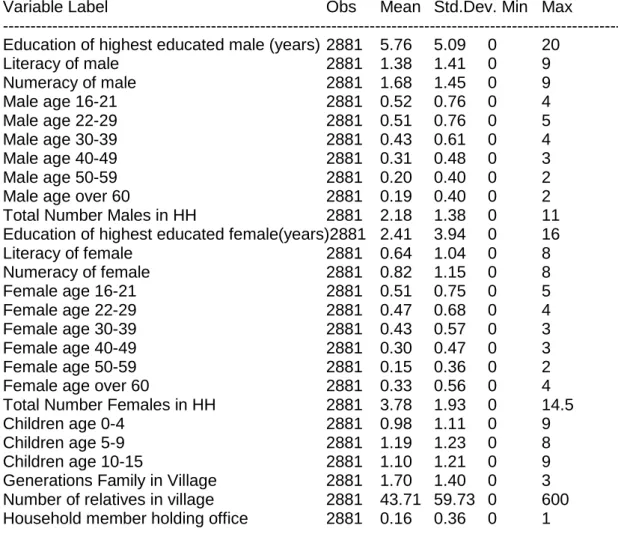
Table 2 sets out the summary statistics on the set of household characteristics used under vector X in equation (1).
For most of the empirical analysis, ordinary least squares analysis (OLS) was
applied. Regressions in which the outcome variable of interest was a yes/no dummy variable on qualitative information, logit estimation techniques were used. In addition to the aggregate results on the entire sample, heterogeneity is explored by splitting the sample into urban and rural households and exploring differential effects on households in which the borrower was the male or female head of household. Given the potential for the very poor or core poor to be left behind by microfinance,
particularly where, as in this case, commercial interest rates are charged, we also test for whether the relationship between access to funds and the various outcome indicators differs for borrowers in the bottom quintile as compared with the sample average.
Monetary indicators
The first millennium development goal is to eradicate extreme poverty and hunger, with some of the specific targets being to reduce the proportion of the population living on less than $1 a day and increasing the proportion of own-account and contributing family workers in total employment. The immediate objective of most micro-lending - to provide a source of financial intermediation for micro-enterprise and small farmers – is perhaps most directly related to these targets. Thus, we begin our discussion with the program‟s impact on monetary indicators of welfare.
Table 3a reports the impact of program participation on sales or profits of the income generating activity run by the household – livestock/animal raising, arable agricultural activities or micro-enterprise. For the full sample the impact of borrowing under the program is not evident in either sales or profits from livestock/animal raising activities or for arable farming. At the time the sample was drawn, around two-thirds of loans were for this type of activity. Neither is it evident for the sales or profits of
microenterprises. Additional variables on number of loan cycles, size of loans and number of months since taking a loan – not reported here - are also insignificant in most cases. This result suggests no income effect from taking out loans.
Insert Table 3a
Insert Table 3b
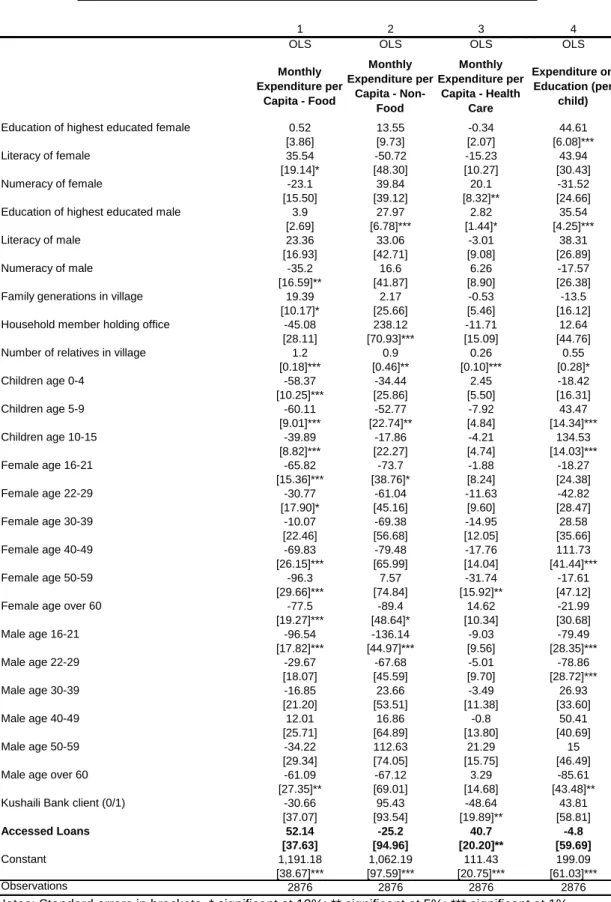
In addition to the analysis of income effects above, the impact on expenditure of drawing on Khushhali bank loans is also examined. The results for four separate expenditure variables are reported in table 4a. The first outcome variable, monthly consumption per capita, looks at the impact of the program on caloric consumption as measured by consumption-expenditure on food items. The items used in
calculating this variable correspond as closely as possible to the items used by the government of Pakistan in calculating the official poverty line. Separately, three other expenditure outcome variables are used; monthly per capita consumption of non-food items (heating, household durables, clothing, transport and so forth), monthly per capita expenditure on health care and annual educational expenditure per child in the household.
Insert Table 4a
Insert Table 4b
Insert table 4c
In general, there is no evidence of a quantitatively significant impact of program participation on poverty as indicated by consumption-expenditure. There is no
statistically significant relationship between program participation (M*T, or
“treatment”, in equation 1) and aggregate consumption expenditure on either food or non-food expenditures. Participation in the program also has no statistically
significant influence on household educational expenditures per child. Not
surprisingly, educational expenditures per child are determined principally by the education level of the highest-educated male and female in the household. Nonetheless in one specific area there is evidence that borrowing under the program has had an impact on expenditure. Table 4a reports a positive impact on health
expenditures, as indicated by the statistically significant positive coefficient estimate in column 3. Relative to the control group households borrowing under the program tend to have on average Rs 41 per month higher per capita expenditures on health care. Although this is small in absolute terms, since the bank‟s program does nothing explicit to encourage health awareness per se (and loans are supposed to be used for investment purposes), this suggests that poor households either prefer to or need to use any extra income generated by micro-credit on health care rather than on education or food consumption.
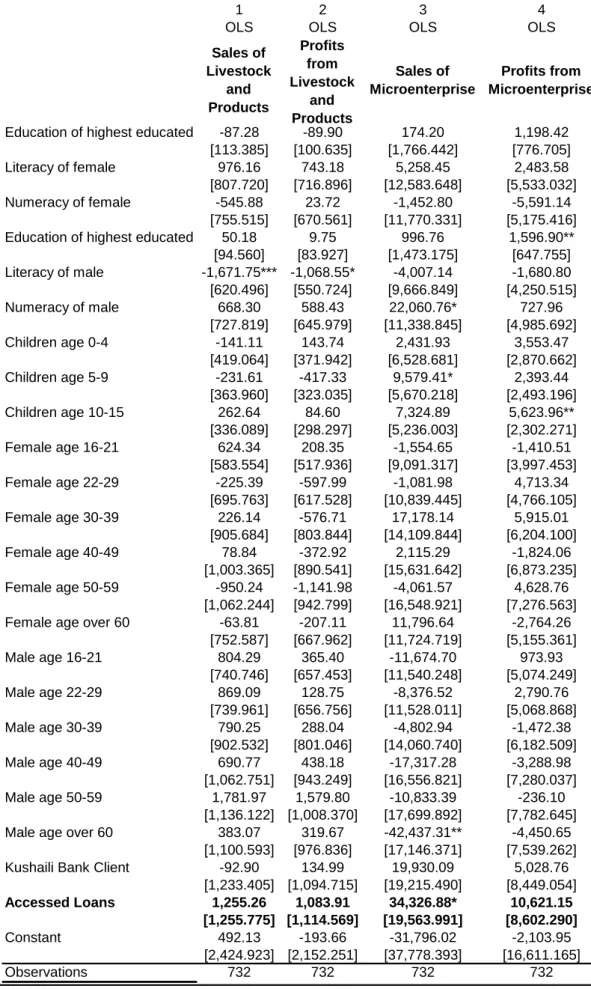
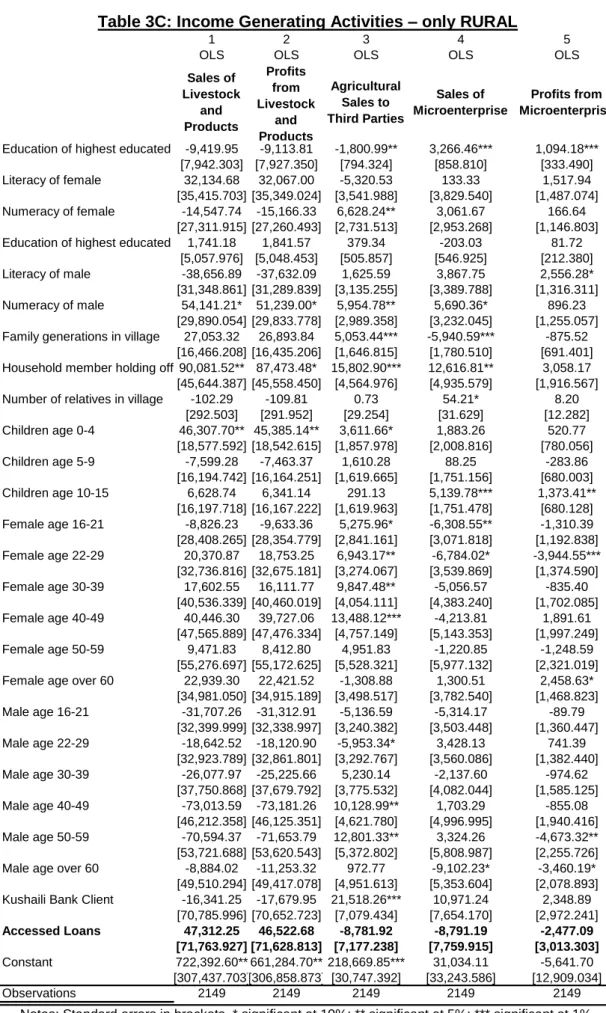
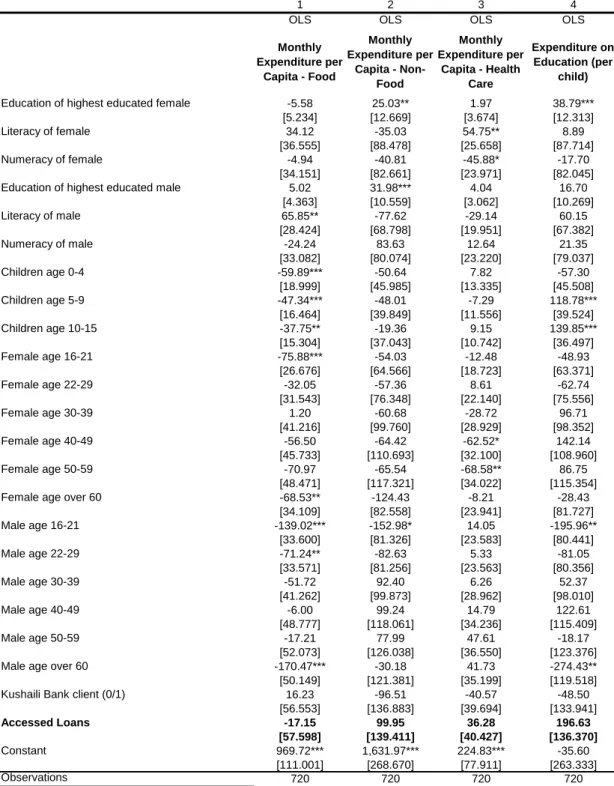
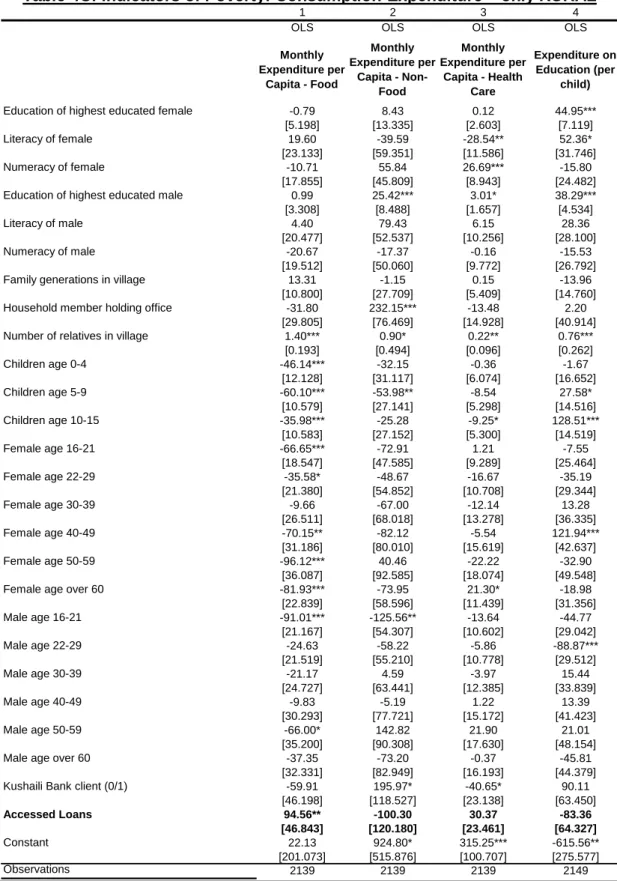
These results indicate a clear lack of impact of borrowing on income and most aspects of expenditure. The survey distinguishes between households (in both treatment and control groups) in rural and urban locations (on the basis of the location of the Khushhali bank offices) with about one quarter of borrowers from urban areas and the remainder from rural. Since borrowers may face different constraints and use the loans in different ways in rural and urban settings, the analysis sub-divides the sample into urban and rural households. Tables 3b and 3c report the urban and rural results respectively for income generating activities and tables 4b and 4c do the same for expenditure. In the analysis of sales and profits,there is very little change with the exception that there is statistically weak (at the 10% level) positive effect of taking out a loan on the sales of urban micro-enterprises (table 3b column 4). On the expenditure side, however, there is one significant notable effect, which is that in rural areas, taking out a loan is positively associated with higher food expenditure (table 4c, column 1). In contrast, the positive impact on household health expenditure found in the full sample does not show up in the analysis of the rural and urban sub-samples.
These results are disappointing for those seeking evidence of a positive impact of lending by the Khushhali bank on household income. There is little evidence of a
direct impact on income generation, the main intention of the bank. Considering broader monetary indicators, positive impacts are found for health and food expenditures, although the former result is not robust and the latter applies only to rural areas. These results may trouble purists who hold that microfinance should be granted for investment purposes only, not for consumption smoothing to meet short-term household expenditures on food and health. A more flexible view of the role of microfinance would allow these expenditures to be considered as part of household financial planning where fungible resources are allocated in line with household needs.
Social Indicators
Expenditure-based poverty measures can omit important non-monetary dimensions of welfare, as reflected in the millennium development goals to achieve universal primary education, empower women and reduce child mortality. Tables 5 and 6 look at the impact of microcredit on non-monetary social indicators relating to education, health and female empowerment.
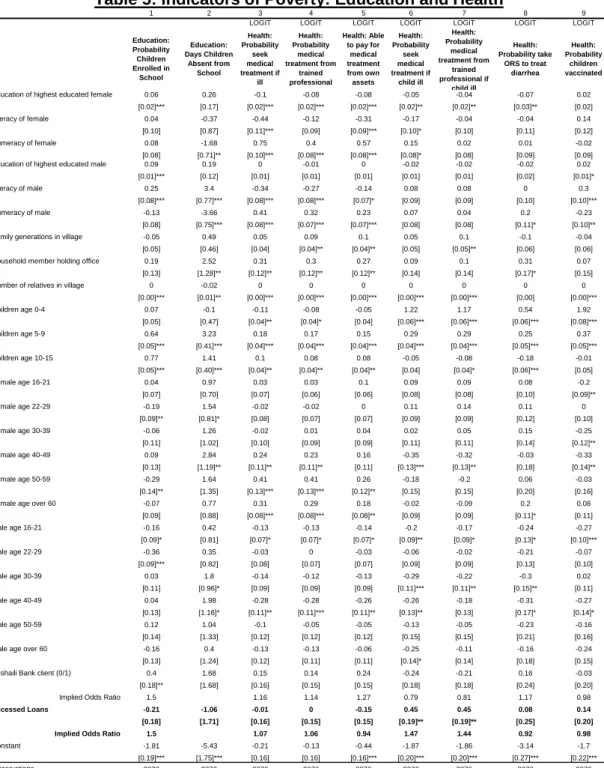
Turning first to table 5, there is little evidence of a positive impact of the program overall on education, Although children in Khushhali Bank member households are more likely to be enrolled in school than children in non-member households,
children in households already participating by taking out loans are no more likely to be enrolled in school and have the same rates of absenteeism as children in
households that are members of the bank but have not yet taken out loans.
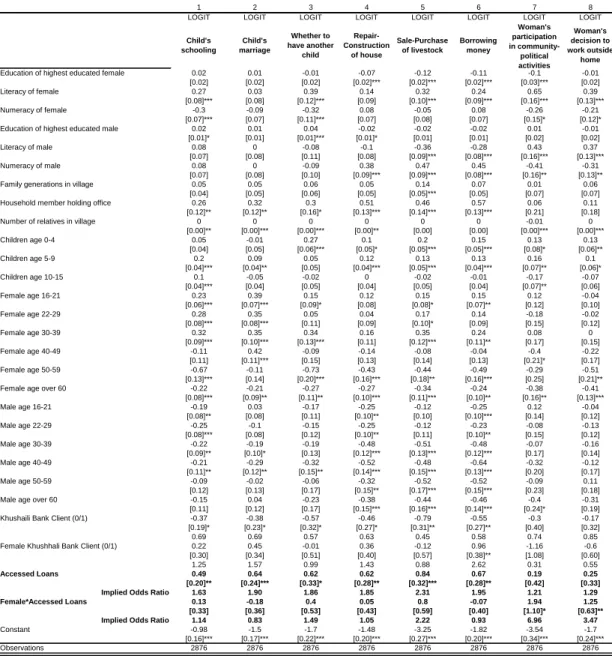
For health indicators, however, in line with the expenditure results there is evidence that households already participating in the program are more likely to get medical treatment for their children‟s illnesses, and that the treatment is more likely to come from a trained medical professional, as compared with non-borrowing members (see table 5 columns 6 and 7). The odds ratios from the logit regressions suggest that borrowing households are about one and a half times more likely to seek medical treatment when their children are ill. Of those households who seek treatment for their children‟s illnesses, participating households are one and a half times more likely than a not yet borrowing household to turn to a trained medical professional for that treatment.
As with the analysis of the monetary indicators, the sample is further divided by urban and rural households. The positive impact of the program on health indicators seems to be primarily enjoyed by rural households. For urban households no
significant results are obtained for the key education and health indicators, whilst for rural households the results from the general sample on the greater probability of seeking medical treatment for children and on the use of a trained health professional
associated with taking out a loan are confirmed.11
Female empowerment
An important aspect of the study design is to test whether borrowing under the program has an impact on female empowerment, as gauged through responses to questions on female involvement in family decision-making, political activity and work outside the home. The survey asks married females between the ages of 15-40 to grade answers to questions on their involvement in the various family decisions on a scale of 1 to 6 ranging from „always‟ to „never‟ and answers are grouped into yes/no categories to allow the application of logit analysis. In analyzing female
empowerment, we explore heterogeneity in the sample across households in which the bank member and borrower was male or female. These results are reported in table 6.
Insert Table 6
Table 6 confirms that, as expected, female Khushhali bank members are already more empowered than non-members, as evidenced by the highly significant positive parameter estimates on the coefficient estimates on a “Female Khushhali Bank client” dummy in specifications looking at the role of females in decisions on number of children, repair of property and borrowing money. However, unexpectedly, wives
of male bank members tend to be less empowered than women in non-member
households in a few areas – the decision on number of children and on property repair - as evidenced by the significant negative coefficient on the variable “Khushhali Bank client”. After member households actually receive a loan, the wives of male bank clients report being more empowered in several areas (see the significantly positive coefficients on the variable “Accessed Loans”), and these positive effects outweigh the negative bias that apparently exists in member households. Thus overall, accessing a loan does appear to make a difference to the sense of
empowerment: the negative coefficients on Khushhali Bank client in table 6 columns 3 and 4 are smaller and less significantly significant than the positive coefficients on the variable Accessed Loans. Female borrowers, however, do not report any major improvement in their sense of empowerment after taking out a loan. In most
instances the interaction term between a female client and accessing loans is
insignificant.12 This lack of impact on empowerment for female borrowers as opposed
to the wives of male borrowers may be due to their higher initial empowerment. Exploring heterogeneity in the sample, it again appears that rural households are driving the overall results (results for the urban and rural sub-sample, respectively
are not re[ported but are available from the authors). Urban households do not report much impact of program participation on female empowerment, with the exception of female borrowers, who report that accessing loans brings with it significantly more influence in household decisions as to whether or not to borrow money.
These results are interesting and may merit further examination since they counter conclusions of some earlier studies, which found that even when borrowers are
women, they do not necessarily exert influence over key family decisions.13 The
results here suggest that access to microfinance empowers women in the household, even if the woman herself is not the borrower.
Impact on the core poor
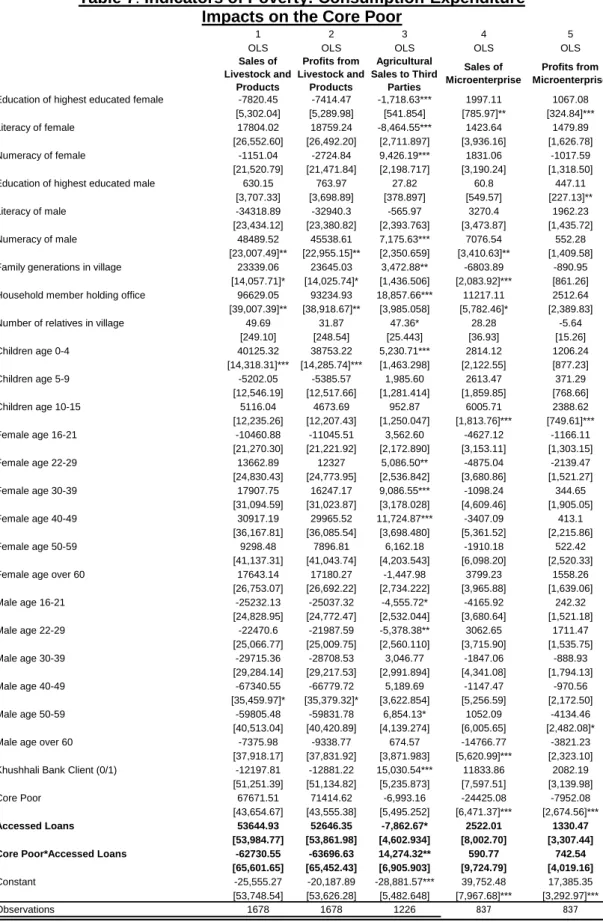
The millennium development goals are particularly concerned with the poorest quintile of the population – the core poor. But a common argument in the debate on commercially-oriented microfinance is that it cannot reach the core poor either because they are excluded by social networks or because they are too risk averse to participate to the same degree as other borrowers. To inform this debate, we look for heterogeneous impacts of the program on particularly poor households by
introducing a dummy variable that takes the value of 1 for households in the bottom quintile of consumption-expenditure for the sample. This dummy is interacted with M*T in equation (1) and the interaction term is introduced as an additional
explanatory variable.
The results are reported in tables 7 and 8 for the analysis of
expenditure-consumption and education and health impacts, respectively. Table 7 reports that, as expected, the expenditure of this group of core poor is significantly lower for three out of the four (all except health care!) measures of expenditure. Including the
interaction term for the bottom quintile indicates no statistically significant differences in impact of borrowing to this group of very poor borrowers for expenditure, with the exception that borrowing under the program has a statistically weak positive impact on educational expenditures per child for the very poor. It should be noted this is a differential effect relative to non-core borrowers and is not strong enough to offset the disadvantage the core poor have due to their lower income.
Insert Table 7
Insert Table 8
In relation to the education and health variables, as expected, the poorest
households are less likely than the average to have their children enrolled in school or to have them vaccinated. However for the core poor who borrow under the
program there is a positive effect on both of these probabilities that more than offsets this disadvantage. Table 8 shows that for columns 1 and 7 where the core poor access loans there is a significant positive coefficient estimate on the interaction between the core poor dummy and loan access, which is highly statistically significant and quantitatively larger than the negative coefficient estimates on the core poor dummy. Borrowing under the program also statistically significantly increases the probability that children in core poor households receive ORS treatment for diarrheal disease, a significant killer of children under 5 in Pakistan.
There is no evidence that for income generating activities in livestock rearing, arable farming or micro-enterprises there is any differential effect between core-poor
borrowers and other borrowers.14 Thus we find no evidence the very poor borrowers
are differentially affected in any major way relative to better-off borrowers in terms of monetary measures and access to loans appears to help in terms of their educational
and health status. This result challenges the applicability of some earlier research findings - where it has been found that it is the better-off poor who have most to gain
from microfinance15– to the case of Pakistan.
VI.
Conclusions
The form of microfinance practiced by the Khushhali bank involves small loans offered over short periods and at interest rates that are high relative to those in the formal banking sector. It is a clear example of second generation microfinance institutions that aim for financial sustainability to avoid reliance on donor funding. A key policy question is how far this commercial orientation dilutes the poverty reducing and welfare improving goals that are associated with the microfinance movement. This study addresses this issue empirically by linking the bank‟s lending activity with progress on a range of indicators that are consistent with progress towards the MDGs that form the center-piece of the government‟s poverty reduction strategy.
The empirical analysis here provides little evidence that access to the Khushhali Bank‟s microcredit program has had positive impacts on monetary measures of welfare on aggregate, although there is evidence that rural households participating in the program have higher food expenditure. However there is no impact on measures of income generating activities, either external sales or profits, for microenterprises or agricultural activities.
In relation to non-monetary measures, access to loans does appear associated with a higher probability of medical treatment for children in the household and a higher probability that the provider of that treatment is trained. This appears to be an explicit
household choice not influenced by training or advice associated with the loan, but one which is clearly in line with the Millennium Development Goal to reduce child mortality.
In terms of family dynamics, wives of male bank members who take out loans report greater empowerment in family decisions than wives of members who have not yet taken out a loan. The Millennium Development Goal to promote gender equality and female empowerment is particularly important in South Asia and this is evidence that microfinance in Pakistan is contributing towards this goal.
For the very poorest households – those in the bottom quintile of the sample, or at less than half the official poverty line – there is no special impact on monetary indicators, but there is evidence that the poorest households share in the
improvements in children‟s health care and even get some extra impacts. Amongst the very poor, borrowing increases the likelihood that children in the household are vaccinated and receive treatment (ORS) for diarrheal disease, a major killer of children under five in Pakistan. It also brings educational benefits, since the poorest borrowers report higher than expected educational expenditures per child and higher rates of children‟s enrollment in school. Here the loan or any additional income it creates appears to allow the poorest households to invest in children‟s health and education, again helping towards important MDG targets.
Overall, we find no evidence that at the time of the survey the Khushhali bank has made much progress towards the goal of stimulating self-sustaining household income growth through either urban microenterprises or rural agricultural activities. These results are of concern for all who view the goal of microfinance as stimulating small scale income-generating activity. The survey was conducted in 2005 only five
years after the first loans were made and it is possible that cumulative income effects may build up over time through frequent repeat borrowing and repayment.
However, we do find evidence that – at least in rural areas – the bank is contributing to the achievement of some of the MDGs by reducing poverty, empowering women and improving the health of children. The poorest households are also making progress on the goal of achieving universal primary education. Thus, these findings suggest that, given a supportive regulatory environment, it is possible for commercially-oriented microfinance banks to meet a “double bottom line” of simultaneously pursuing profits and a social mission to promote development.
Appendix : Details of Data Collection
Design of the survey followed international guidelines, in particular those laid out in
the three volume series by Grosh and Glewwe (2000) on the Living Standards and
Measurement Survey (LSMS). Full details of the questionnaire are in Montgomery
(2005).
i. Survey Instrument – Questionnaire
Design of the survey instrument, the questionnaire to be used in gathering data for the study, was primarily guided by the research question: what has been the impact of the microfinance program on household welfare? It was decided to include a relatively wide definition of welfare that includes non-economic measures of welfare such as education, health or empowerment.
Core components of the LSMS were incorporated, and the final questionnaire also drew upon the AIMS-SEEP Impact Survey Tools (Assessing the Impacts of
Microenterprise Services - Small Enterprise Education and Promotion Network ), impact assessment tools designed specifically for assessment of microfinance institutions, as well as several carefully designed questionnaires used in previous studies in Pakistan. The findings of a nationwide participatory poverty assessment (Government of Pakistan (2004)) were also consulted and results of focus group discussions with Khushhali Bank clients were incorporated.
Length of the questionnaire was limited to what could be reasonably delivered in a maximum of one hour if all components were asked. In the final administration, most questionnaires took substantially less than one hour since very few households would actually respond to all sections. The sequence of the questionnaire was
guided by the LSMS, and accordingly sensitive questions on finances or empowerment issues were administered last.
To increase the accuracy of the information gathered and to enable the survey to address gender issues such as empowerment, both the male and female head of household were interviewed separately for each household. The suitability of
different components of the questionnaire for the male or female version was decided based on the previous questionnaires listed above and confirmed in pre-testing. The questionnaire was prepared simultaneously in English and Urdu and then translated into two regional languages: Pushto and Sindhi. Accuracy of the translations was checked by back translation into the original language.
ii. Implementation
The survey was pre-tested on both client and non-client households and the final survey was implemented over an 8 week period after a major harvest when there would be many new villages and clients just getting access to Khushhali Bank
services for the first time, making it easier to collect data on a suitable control group.
The survey was carried out by an independent multinational survey company. Male surveys were conducted by male surveyors and female surveys by female surveyors. Surveyors and supervisors for each team were recruited from local areas and
interviews were conducted in local languages. Since many of the surveyors were new, one week of classroom training on administration of surveys, and field testing of the surveyors‟ skill in both rural and urban areas were conducted. Extra surveyors were trained in the event that any surveyor had to be replaced during the training, field-testing, or once the survey was underway, but that was not necessary.
iii. Quality Control
Survey teams spent 3-4 days in each village included in the survey to allow time for the team supervisor to edit all completed questionnaires and back-check 15% of the fieldwork. If any problems were discovered during back-checking, then 100% of that individual surveyors work was checked. An independent quality control department similarly carried out back-checking of each supervisors work. Data processing was not able to be conducted on-site due to cost considerations, and was instead done on edited questionnaires in a centralized location. A data program was designed to automatically check the consistency of answers and in addition 10% of the data entry and coding was randomly back-checked.
Table 1: Summary Statistics - Dependent Variables
Variable Label Obs Mean Std.Dev. Min Max
--- Income Generating Activities - Microenterprise:
Sales 2881 37437 109191 0 1024000
Profits-Reported 2881 13540 45040 0 700000
Income Generating Activities - Livestock:
Production/sales of livestock and products 2878 67931 278339 0 5549600
Profits-reported from livestock 2878 61498 273627 –513000 5485000
Income Generating Activities - Agriculture:
Value of sales to third parties 2881 24453 76306 0 1345000
Consumption-Expenditure:
Monthly Consumption-Expenditure per capita: Food
2859 863 555 0 8990
Monthly Consumption-Expenditure per capita: Non-Food
2859 772 1316 38 4969
Monthly Medical Expenditure per capita 2859 96 274 0 8333
Educational expenses per child 2881 630 897 0 11900
Education:
Probability Children Enrolled in School 2881 0.44 0.44 0 1
Absenteeism from School 2881 6.25 24 0 550
Empowerment:
Opinions taken into consideration in household decisions regarding:
Child‟s Schooling 2881 0.58 0.49 0 1
Child‟s Marriage 2881 0.39 0.48 0 1
Whether to have another child 2881 0.23 0.42 0 1
Type of Contraception to Use 2881 0.22 0.41 0 1
Woman‟s participation in community/political activities
2881 0.12 0.32 0 1
Woman‟s decision to work outside home 2881 0.18 0.39 0 1
Repair/Construction of House 2881 0.34 0.47 0 1
Sale/Purchase of Livestock 2881 0.27 0.44 0 1
Borrowing Money 2881 0.36 0.48 0 1
Health:
Spending on medical care 2881 6834 23841 0 900000
Probability seek medical treatment if ill 2881 0.60 0.48 0 1
Probability of medical treatment from trained practitioner if ill
2881 0.57 0.48 0 1
Ability to pay for medical treatment from own sources:
2881 0.52 0.49 0 1
Probability seek medical treatment if child ill 2881 0.60 0.49 0 1
Probability of medical treatment from trained practitioner if child ill
2881 0.58 0.49 0 1
Table 2: Summary Statistics - Individual Household Characteristics
Variable Label Obs Mean Std.Dev. Min Max
---
Education of highest educated male (years) 2881 5.76 5.09 0 20
Literacy of male 2881 1.38 1.41 0 9 Numeracy of male 2881 1.68 1.45 0 9 Male age 16-21 2881 0.52 0.76 0 4 Male age 22-29 2881 0.51 0.76 0 5 Male age 30-39 2881 0.43 0.61 0 4 Male age 40-49 2881 0.31 0.48 0 3 Male age 50-59 2881 0.20 0.40 0 2
Male age over 60 2881 0.19 0.40 0 2
Total Number Males in HH 2881 2.18 1.38 0 11
Education of highest educated female(years)2881 2.41 3.94 0 16
Literacy of female 2881 0.64 1.04 0 8 Numeracy of female 2881 0.82 1.15 0 8 Female age 16-21 2881 0.51 0.75 0 5 Female age 22-29 2881 0.47 0.68 0 4 Female age 30-39 2881 0.43 0.57 0 3 Female age 40-49 2881 0.30 0.47 0 3 Female age 50-59 2881 0.15 0.36 0 2
Female age over 60 2881 0.33 0.56 0 4
Total Number Females in HH 2881 3.78 1.93 0 14.5
Children age 0-4 2881 0.98 1.11 0 9
Children age 5-9 2881 1.19 1.23 0 8
Children age 10-15 2881 1.10 1.21 0 9
Generations Family in Village 2881 1.70 1.40 0 3
Number of relatives in village 2881 43.71 59.73 0 600
Table 3A: Income Generating Activities
Notes: Standard errors in brackets. * significant at 10%; ** significant at 5%; *** significant at 1%.
1 2 3 4 5
OLS OLS OLS OLS OLS
Sales of Livestock and Products Profits from Livestock and Products Agricultural Sales to Third Parties Sales of Microenterprise Profits from Microenterprise
Education of highest educated female-8,037.24 -7,648.64 -1,715.33 1,895.70 990.95 [5,299.45] [5,287.66] [541.60]*** [792.70]** [327.72]*** Literacy of female 16,079.04 16,898.63 -8,389.67 1,920.28 1,556.98
[26,518.75] [26,459.77] [2,710.19]*** [3,931.67] [1,625.43] Numeracy of female 373.87 -1,089.66 9,329.90 2,206.16 -706.91
[21,493.53] [21,445.73] [2,196.62]*** [3,222.45] [1,332.23] Education of highest educated male374.88 495.33 54.1 186.35 467.08
[3,703.89] [3,695.66] [378.53] [550.67] [227.66]** Literacy of male -34,912.72 -33,577.21 -529.82 2,893.08 1,789.02
[23,431.75] [23,379.64] [2,394.70] [3,473.62] [1,436.07] Numeracy of male 49,729.04 46,850.80 7,033.08 7,433.76 777.11
[22,995.09]** [22,943.95]** [2,350.07]*** [3,418.93]** [1,413.46] Family generations in village 22,621.43 22,881.38 3,523.30 -6,366.44 -820.91
[14,050.53] [14,019.28] [1,435.95]** [2,087.08]*** [862.84] Household member holding office97,140.27 93,757.29 18,761.91 12,410.47 2,972.30 [39,007.15]** [38,920.40]** [3,986.49]*** [5,782.82]** [2,390.74] Number of relatives in village 34.9 15.41 47.19 54.37 5.09
[248.32] [247.76] [25.38]* [37.34] [15.44] Children age 0-4 42,691.59 41,480.78 4,978.10 1,881.59 1,012.85 [14,218.26]***[14,186.64]*** [1,453.09]*** [2,121.00] [876.87] Children age 5-9 -4,114.45 -4,195.07 1,984.22 1821.97 159.04 [12,497.39] [12,469.60] [1,277.22] [1,852.22] [765.74] Children age 10-15 5,942.89 5,542.95 849.36 5,903.80 2,371.32 [12,224.27] [12,197.09] [1,249.31] [1,810.53]*** [748.51]*** Female age 16-21 -9,111.58 -9,604.08 3,503.41 -5,987.14 -1,652.97 [21,251.12] [21,203.86] [2,171.84] [3,151.55]* [1,302.91] Female age 22-29 14,139.35 12,870.64 5,186.28 -5,620.76 -2,402.94 [24,816.33] [24,761.14] [2,536.20]** [3,674.96] [1,519.30] Female age 30-39 18,058.68 16,462.14 9,256.75 -1,274.31 304.92 [31,075.80] [31,006.69] [3,175.91]*** [4,601.20] [1,902.23] Female age 40-49 33,096.96 32,329.28 11,653.38 -4,197.08 165.93 [36,120.24] [36,039.90] [3,691.45]*** [5,348.43] [2,211.15] Female age 50-59 11,723.19 10,546.64 6,223.90 -3,166.86 178.67 [41,069.01] [40,977.68] [4,197.21] [6,081.74] [2,514.32] Female age over 60 17,252.13 16,814.30 -1,265.34 3,884.98 1,587.88
[26,736.64] [26,677.18] [2,732.46] [3,958.82] [1,636.66] Male age 16-21 -23,761.67 -23,372.43 -4,436.85 -5,749.95 -265.05 [24,705.39] [24,650.44] [2,524.86]* [3,657.79] [1,512.20] Male age 22-29 -20,641.02 -20,019.49 -5,482.66 1,837.71 1,287.39 [25,029.46] [24,973.80] [2,557.98]** [3,706.75] [1,532.45] Male age 30-39 -29,463.27 -28,459.80 2,954.73 -1,646.90 -937.47 [29,283.60] [29,218.47] [2,992.75] [4,343.33] [1,795.62] Male age 40-49 -67,116.44 -66,535.77 5,290.36 -1,717.20 -1,342.02 [35,461.86]* [35,383.00]* [3,624.16] [5,270.72] [2,179.02] Male age 50-59 -60,074.16 -60,115.56 6,978.30 77.44 -4585.35 [40,515.53] [40,425.43] [4,140.64]* [6,011.15] [2,485.13]* Male age over 60 -6,357.66 -8,204.87 765.51 -15,562.28 -4,130.90
[37,895.99] [37,811.71] [3,872.93] [5,612.45]*** [2,320.30]* Kushaili Bank Client -11,360.84 -12,001.04 14,929.48 12,113.51 2,026.50
[51,252.12] [51,138.14] [5,237.91]*** [7,596.04] [3,140.36] Urban Client 12,746.88 15,131.12 [26,814.68] [11,085.74] Accessed Loans 39,248.24 37,989.37 -4,076.68 -9,926.26 -2,104.70 [52,020.57] [51,904.88] [5,316.45] [8,110.92] [3,353.22] Urban*Accessed Loans 49,282.35 14,862.33 [9,192.36]*** [3,800.31]*** Constant -17,568.54 -12,041.60 -30,411.01 1,091.67 -9,090.50 [53,186.66] [53,068.37] [5,435.62]*** [35,655.47] [14,740.70] Observations 1678 1678 1226 837 837