The Efficient Energy Aware Routing and Data
Aggregation in Multi-Hop Wireless Sensor
Network
Kiruthika.A
1, Sugandhi.N
2P.G. Student, Department of Electronics and Communication Engineering, Muthayammal Engineering College,
Namakkal, India1
Associate Professor, Department of Electronics and Communication Engineering, Muthayammal Engineering College,
Namakkal, India2
ABSTRACT: The Energy resource especially in wireless sensor networks (WSNs) are major concerned. Since sensor nodes are normally more dense of data sampled by sensor nodes have more redundant of data and data aggregation became an adorable method to ignore redundancy, reducing frequent of transmission and then to conserving energy. Many applications can be assigned in WSNs and different sensors are employed in nodes, the data implemented by heterogeneous sensors or various applications have various attributes. The packet from various attributes does not be aggregated or most of the data aggregation methods handle static routing protocols, which cannot be dynamically or intentionally forward packet corresponding to network state or data types. To make data aggregation more efficiently, in our proposed method using a energy aware routing to implement a data transmission on their network. Inspired by the concepts of energy aware routing technology along with data aggregation. The results estimate the performance in verifies that the routing ADA scheme can make the data improve the efficiency of data aggregation. In our future work have to use a secure routing and energy consumption model on their network. Take different parameters like throughput, delivery ratio, and delay and energy consumption on network.
KEYWORDS: Data Aggregation, WSN, Wireless, Nodes, Multihop , Sensor, Networks
I.INTRODUCTION
smart environments present the future enhancing step in concentrations utilities industries, home, transportation systems and shipboard systems automation. The surroundings relies first and foremost on sensor data from the world. Sensor nodes are deployed in geographical region to sense the environmental changes. The smart environment needs data from its surroundings as well as its interior workings. This is contribution in the hierarchy of sensing the respective quantity, monitoring and gathering the data, assessing and examining the data, setting up to valid user displays and also performing decision-making and alarm functions are hilarious. The main motive of WSNs is challenging in that it requires an emphasize level of information from an enormous methods of principles. WSNs have sensors that contains the physical transducer principles and commercial exploitation occurred in WSNs have a self-organization network, signal processing and decision-making at end of few request for home automation system. To knowledge and able to implement the sensor networks to make energy efficient network.
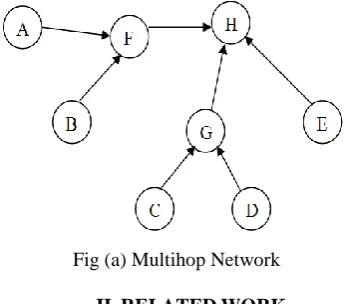
a) Network Topology
more interconnected subnets of different topologies. Networks are further classified into Local Area Networks (LAN), e.g. inside one building or Wide Area Networks (WAN), e.g. between land, building sites.
Fig (a) Multihop Network
II.RELATEDWORK
Major consideration in wireless sensor Network as implementation of energy aware routing and data aggregation in WSNs. The before method work on data aggregation in wireless sensor networks handles with the issue of finding and maintaining correct routes to the destination during mobility.
Our system two new proposed algorithms are used namely Energy Aware Routing of ADA algorithm and Data Aggregation. [1] A wireless network contains of a more number of tiny sensors with low-energy transceivers can be sufficient for collecting packet in a different of surrounding. The packet gathered by each sensor node communicated through the network to a single processing center that uses all reported packets to determined their data of the environment or detect an event. The communication transmitting process must be manage to conserve the compact power resources of the sensors. Group sensors into cluster of sensors communicate information only to cluster heads and then communicate the aggregated data to the processing center, may conserve power. In this paper proposed a contribution in randomized clustering protocol to maintain the sensors in a wireless sensor network into groups. Results in geometry are used to handle solutions for the valid of level of our protocol that reduced the whole power used in the network when all sensors sent data through the cluster heads to the processing system. Recent advances in wireless communications and systems have aimed the implementation of extreme tiny in size, inexpensive nodes that possess monitoring the signal processing and wireless communication ability. These sensors could be distributed in region at a inexpensive than ancient wired sensor systems.
The major motive of data aggregation algorithms is to collect and aggregate information in power effective manner so that network lifetime is improved. Wireless sensor networks (WSN) provides an greater adorable system for collecting information in distributed system architectures and dynamic access via wireless connectivity.
Wireless sensor networks [4] often contains a large number of inexpensive sensor nodes have strictly quite not in range of sensing region, process of computing and communication capabilities. Due to resource restriction in sensor node. it is necessary to reducing the large number of data transmission so that the average sensor nodes life time and the overall bandwidth usage are enhanced. Data aggregation is the process of monitoring and fusing sensor information in order to minimize the number of data transmission in the sensor network. Wireless sensor networks are generally distributed in remote and hostile regions to in term of sensitive data, sensor nodes are prone to node compromise against security attacks and security problem such as data confidentiality and integrity are more important method. Investigates the relation between routing and data aggregation performed in wireless sensor networks. Taxonomy of secure data aggregation algorithm is taken by existing the recent „„state-of-the-art” employing in this region. Moreover it is based on the existing research, the open research areas and fore-coming analysis way of in security, routing and data aggregation ideas are offered.
However this sequence data aggregation per formation enhances the bandwidth and power utilization. it may ruined other operation metrics such as packet delay, accuracy, fault-tolerance, and security. A secure data aggregation algorithm [5] for sensor networks that is strong to deceitful sensor nodes. The motive of this algorithm is to guarantee the important security requests (like source authentication, data confidentiality & data integrity) as well as to achieve less communication overhead and be fixed with different aggregation functions (like addition, average, maximum, minimum etc..) To effect this security requirements to uses symmetric encryption algorithm and message authentication code (MAC). Encryption has the data confidentiality while message authentication code ensures authentication and data integrity and digital signature. An anomaly identify protocol is ensure the anomaly and thus ignore the malicious packet from being included to the end of aggregated results. Simulation results show that algorithm improve the security of aggregated data with routing major opinion in WSNs.
A wireless sensor network (WSN) is a together of a large number of sensor nodes has restricted computing power, communication, energy and bandwidth resources. The number of packet sending could be reduced such that the lifetime of the sensor nodes and bandwidth utilization of the network can be enhanced.
Accuracy enhancing range is used to measure of with efficient and anomaly identify protocol operations. The standard deviation in the current of spiteful sensor nodes is greater than the standard deviation without of spiteful sensor nodes (after filtration of spiteful sensor nodes). Hence accuracy improved by energy efficiency in WSN network
III.METHOLOGY
DATA AGGREGATION
This paper proposes a model where the power usage of sensor nodes in a multi-hop Wireless Sensor Network (WSN) is optimized by using data aggregation, a technique which discards “unnecessary” packets so as to save the bandwidth. It does in two steps first of which uses and Exponential Weighted Moving Average (EWMA) data aggregation technique to compare the current data value with all the previous values before deciding whether to forward or drop the packets. The second step optimized the network even further by considering sensing from neighbouring sensors into the equations. Some flexibility have been designed in the protocol allowing the precision level to be adjusted based on the users requirements. Simulated outputs show that scheme reduces the amount of data transmitted and the normalized energy consumed by the node
b) Exponential
W
eighted Moving Average Algorithmgreater, the standard deviation will be greater and hence the chosen weight values will also be greater. Similarly lower variations will result in lower weight values. In this way the model will dynamically adjust the weight value in accordance to new incoming values. This weight value will be used to determine whether an incoming value will be forwarded or dropped. By dropping unwanted values the network is being optimized. it assumes that in a randomly distributed multi hop sensor network, readings form sensor nodes in a close by vicinity are highly correlated and usually redundant for the application i.e. if the packets are coming from nearby sensors, there are chances that they may be similar and it will be futile to further forward these packets towards the sink node. By discarding these readings data aggregation can be achieved without compensating the precision of the network. Packets and allows only the relevant data to pass through. The model is also incorporated with an additional provision which allows users to define the precision value and further optimize the data samples received at the sink node. This freedom is provided to allow adjustment based on different requirements of different networks.
c) Energy Aware Routing Protocol
A Wireless Sensor Network (WSN) is a gathering of wireless sensor nodes organizing not a permanent system without the help of any organized infrastructure or centralized administration. In such way that surroundings due to the certain range of every nodes wireless transmission, it may be needs for one sensor node to request for the help of another sensor nodes in transmitting a data to its sink node generally the base station. One major problem is when construct wireless sensor network is the routing algorithm to made the better use of the undesirable resource constraints presented by WSN especially the power consumption. In this paper proposed a new system called HCEAR: Hop Count Energy Aware Routing algorithm that makes uses of multipath alternately to prolong the life period of network. Routing algorithm in conventional wired networks generally use either distance vector or link state routing algorithms both of which needs periodic routing metrics to be broadcast by each router instead broadcasts to all other routers in the network its view of the status of each of its adjacent network links, and then each router computes the shortest distance to each host based on the complete picture of the network formed from the most recent link information from every routers. In it is use the wired networks, the basic distance vector algorithm has accept for routing wireless sensor networks (DSDV) specially act each dynamic nodes as a router.
IV. EXPERIMENTAL RESULTS
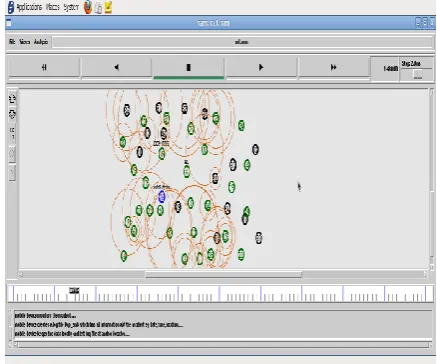
To implement the Project concept, first should have to construct a network which consists of „n‟ number of Nodes. This system is implemented to sensor node creation and greater 10 nodes arranged in certain distance. Wireless node deployed in neighbouring region. Every sensor node knows its owns areas corresponding to the base station. The received the packets then send acknowledge to transmitter. Sensor nodes are deployed in 1300m×1300m area. The simulation parameters are as follows:
Number of sensor nodes : 40 Simulation time : 10 [s]
Bandwidth : 10 [kbps]
Transmission range : 70 [m] Data packet size : 216 [bytes] Network area : 1300×1300 [m2] Data rate :100 [Kbps] Packet size :210[bytes]
d) Data Transmission
Fig (d) Node Creation
e) Data transmission between Source1 to Destination
The source 1 has the higher energy after the transmission the energy will be decreased. So the network searches the higher energy node and select source 2 as a sender under the process of data aggregation. Multipath routing was used to enhance the reliability of WSNs. The proposed scheme is useful for delivering data in unreliable environments. It is known that network reliability can be increased by providing several paths from source to destination and by sending the same packet on each path shown in Fig (e).
Fig (e) Data Transmission
f) Data transmission held through the data aggregation
adorable system for collecting information in distributed system architectures and dynamic access via wireless connectivity shown in Fig (f)
Fig (f) Data Aggregation
g) Data transmission between Source4 to Destination
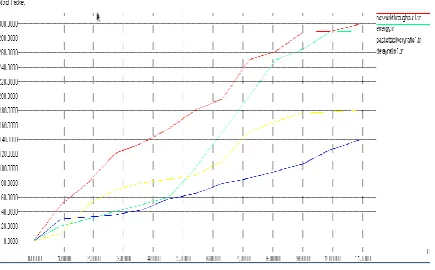
The comparison between the size of a network and the normalized energy consumed when simulating the proposed model with lamda values. The normalized energy consumed reduces as the number of nodes is increased. This shows that larger the network, greater the amount of energy saved. Upto 20 %energy is saved when the network has 40 sensor nodes shown in fig (H)
Fig (g) Comparison of existing system
VI. CONCLUSION
typologies may also be done. By solving the practical problems that may arrive in doing so, this model can be made inter operable with the new nodes
VII. FUTURE ENHANCEMENT
The paper proceed a distributed algorithm for deploying sensor nodes into a hierarchy of cluster nodes with routing protocol an goal of reducing the whole energy resource used in this method to conveying the packet collected by these sensor nodes to the data-processing units. wireless sensor nodes had been to detected the optimal setting value for these protocol that reducing the resource used in the network. In a contention-free environments, the protocol has been a time consumption of a especially enhancement over the more clustering protocol in the literature. This makes the new protocol fitted for sensor networks of greater amount of sensor nodes. In this paper proposed that the communication environments is contention and error free. in future we intent to consider an under the medium access protocol and investigate that could affect the optimal probabilities of becoming a cluster-head and the processing-time of the protocol.
REFERENCES
1. Antony‟s Alice Jeya Dr.K.Algarsamy., “An Efficient Data Aggregation and Query Optimization for Energy Efficiency in Wireless Sensor Network” in proc UbiComp, Orlando,FL,USA, Vol.2 No.5, pp.143-152, 2014.
2. Babu Karuppiah, S.Kannadhasan.A., “A Novel Approach to Detect the Shortest Path for Secure Data Aggregation Using Fuzzy Logic in Wireless Sensor Networks” in proc.sensvs,raleigh,NC,USA,Vol.5 No.3, pp.337-350, 2013.
3. Bhoopathy.V, R.M.S. Parathion., “Node Capture Attacks for Hierarchical Data Aggregation in Wireless Sensor Networks” proc.sensvs,Ralleigh,NC,USA,Vol.8, no.2, pp.187-197, 2012.
4. Mukesh Kumar Jha ,T. P. Sharma.,“A New Approach to Secure Data Aggregation protocol for Wireless Sensor Network” in proc. Pervasive, Newcastle,U.K.,Vol.3,No.1, pp-325-342,LNCS 7319, 2010.
5. Ramesh Rajagopalan, Pramod K. Varshney., “Data aggregation techniques in sensor networks: A survey”, in proc. UbiComp, Orlando,FL,USA, Vol.1 No.3, pp.21-30, 2006.
6. Sasikala.K, Geetha.M., “A Review On Energy Efficient Secure Routing For Data Aggregation In Wireless Sensor Networks” in proc UbiComp,Vol.3 No.4, pp.347-365, 2013.
7. Nandini. S.Patil, Prof. P. R. Patil. , “Data Aggregation in Wireless Sensor Network” 8. In proc.MobiCom, Boston, MA,USA,Vol.4 No.2, pp.32-43, 2010.
9. Seema Bandyopadhyay,Edward.J.Coyle., “An Energy efficient hierarchy clustering algorithm Wireless Sensor Networks” in proc.UbiComp,Orlando,FL,USA,Vol.2,no.5,pp.21-56, 2003.
10. Suat Ozdemir, Yang Xiao., “Secure data aggregation in wireless sensor networks: A comprehensive overview” in proc.Percom, Seattle,WA,USA,Vol.3 No.2, pp.54-62, 2009.