
Higgs Boson Physics at CMS
PredragCirkovic1,(on behalf of the CMS Collaboration)
1Institute of Physics Belgrade, Pregrevica 118, P.O. Box 68, 11080 Belgrade, Serbia
Abstract.An overview of the standard model Higgs boson analyses and beyond standard
model Higgs boson searches will be given. A data sample of proton-proton collisions at
√s
=13TeVcollected with the CMS detector at the LHC is used. The measurements of properties of the Higgs boson in the 4andγγdecay channels will be presented. The
future prospects will be covered.
1 Introduction
In this report, the subjects will be discussed in the three main sections. After a brief experimental and theoretical overview, a presentation of the latest results of the Standard Model (SM) Higgs boson measurements in the main analysis channels together with the measurements of the Higgs boson properties thereafter, will be discussed in section 2. The latest results of the searches for beyond the Standard Model (BSM) Higgs boson in terms of the charged, MSSM, doubly-charged, invisible and di-Higgs boson production, will be covered in section 3. The future prospects for the SM Higgs boson production in the 4andγγdecay channels will be described in section 4. The summary will be described at the end. The focus will be on the most recent results, such as the Higgs boson mass measurement in theH→4, fiducial cross section measurements in the 4and di-photon channels, the latest results onttH¯ , and the search for resonant and non-resonant di-Higgs boson production. Many of the searches at CMS [1] presented here have been updated with the full 2016 dataset corresponding to an integrated luminosity of 35.9f b−1.
2 Standard Model (SM) Higgs Boson Searches
Starting with the measurements of the Higgs boson production and decay rates with the combined 7 and 8TeVCMS dataset [2] and the combined ATLAS and CMS analysis of the LHC pp collision data at √s=7 and 8TeV [3], the measured signal strenghts, both the individual ones measured by CMS
and ATLAS alone and the combined one are compatible with 1.0. The largest uncertainties for the pro-duction modes appear in the channel with the lowest cross sections, such asttH¯ . Concerning decays, the smallest uncertainties are present in the channels with the cleanest signatures, e.g. H→γγand
H→WW, and the largest uncertainties inH→bb¯are caused mostly by the presence of large QCD background. Individual signal strengths (µ) have been also measured in the plane of their fermionic and bosonic parts, with the combined CMS [2] and the combined CMS and ATLAS [3] data from the
LHC pp collision at √s=7 and 8TeV. An overall agreement of the 2D maximum likelihood best fits
with the SM expectations has been achieved for all channels within 1σregion.
The same datasets used in Refs. [2] and [3] have been used to measure also the coupling between the Higgs boson and the other SM particles. The measurements of the coupling with muon,τ-lepton, b-quark,WandZbosons and top quark have been compared with their prediction, which are propor-tional to the particle mass. The coupling values range between very small values, featuring muons, up to the values close to unity, which characterize the top quark. An overall agreement between the measurements and the theoretical prediction has been noticed here as well. The Run I measurements already put constraints on the couplings and for the measurements with the Run II datasets it is ex-pected to get more stringent constraints. The fits in the 2D plane of the coupling modifiers for vector bosons (κV) and fermions (κF) show that the results are compatible with their SM expectations (1,1)
for all five Higgs boson decay channels and their combination within one standard deviation (1σ).
2.1 Higgs boson decaying to a pair of photons
H→γγ[4] represents one of the Higgs boson discovery channels, characterized by high resolution
with a very small uncertainty on di-photon mass, a clean final state, and a small branching ratio. Boosted decision tree is used for the photon identification, selection of di-photon vertices, and se-lection of di-photon events. Boosted Decision Tree (BDT) distribution has been flattened according to the totalγγsignal [4], which is composed of the four Higgs boson production mode components. In this report, the Fig. 5 (left) of [4] has been presented. The distribution of the transformed score of the di-photon multivariate (BDT) classifier for events with two photons satisfying the preselection requirements in data has been compared to the distribution of the simulated signal and simulated back-ground stacked together [4]. The correspondence between the data distribution and the distribution of the total signal plus background stack has been achieved. The score of the BDT classifier is used to select and divide the events into four ”untagged” categories according to the di-photon mass resolution and predicted signal over background ratio. The category of the events with the lowest BDT score has been discarded from the analysis. The signal is selected according to the highest transverse energy photons and the background is composed of the irreducibleγγcomponent, and the reducible fakes
that originate fromγ+jet and di-jet events. In Fig. 1 (left), a di-photon mass distribution is presented,
for the total signal and background (upper row in Fig. 1, left) and for the background component subtracted (bottom row in Fig. 1, left). The best fit mass is found atmH=125.4GeVwith statistical
uncertainty of approximately 0.15GeVand the systematic uncertainties preliminarily estimated to be between 0.2GeVand 0.3GeV(still under study) [4]. In Fig. 1 (right), the results of the signal strength measurements in theH→γγare presented. The signal strength measurement for the four categories combined provide the value of 1.16+0.15
−0.14, compatible with the SM prediction within≈1σ. The gluon
fusion signal strength is the most compatible one, while thettH¯ providing the signal strength of 2.2, corresponds to a 3.3σexcess with respect to the absence ofttH¯ production, and agrees with the SM prediction within 1.6σ.
The signal strength measured in bosonic and fermionic parts [4] is also consistent with the SM predictions, especially in its fermionic part, which is mostly driven by contribution from gluon fusion process. The 2D likelihood scans of the Higgs boson coupling modifiers have been also performed inH→γγ, but here for the couplings to photons and gluons, and couplings to vector bosons and
fermions [4]. Both fits are compatible with the SM predictions, within the range of 1σ.
The Fig. 2 summarizes the most recent results on the fiducial cross section measurements per-formed inH→γγchannel [5]: the differential fiducial cross section measurements for di-photonpT,
LHC pp collision at √s=7 and 8TeV. An overall agreement of the 2D maximum likelihood best fits
with the SM expectations has been achieved for all channels within 1σregion.
The same datasets used in Refs. [2] and [3] have been used to measure also the coupling between the Higgs boson and the other SM particles. The measurements of the coupling with muon,τ-lepton, b-quark,WandZbosons and top quark have been compared with their prediction, which are propor-tional to the particle mass. The coupling values range between very small values, featuring muons, up to the values close to unity, which characterize the top quark. An overall agreement between the measurements and the theoretical prediction has been noticed here as well. The Run I measurements already put constraints on the couplings and for the measurements with the Run II datasets it is ex-pected to get more stringent constraints. The fits in the 2D plane of the coupling modifiers for vector bosons (κV) and fermions (κF) show that the results are compatible with their SM expectations (1,1)
for all five Higgs boson decay channels and their combination within one standard deviation (1σ).
2.1 Higgs boson decaying to a pair of photons
H→γγ[4] represents one of the Higgs boson discovery channels, characterized by high resolution
with a very small uncertainty on di-photon mass, a clean final state, and a small branching ratio. Boosted decision tree is used for the photon identification, selection of di-photon vertices, and se-lection of di-photon events. Boosted Decision Tree (BDT) distribution has been flattened according to the totalγγsignal [4], which is composed of the four Higgs boson production mode components. In this report, the Fig. 5 (left) of [4] has been presented. The distribution of the transformed score of the di-photon multivariate (BDT) classifier for events with two photons satisfying the preselection requirements in data has been compared to the distribution of the simulated signal and simulated back-ground stacked together [4]. The correspondence between the data distribution and the distribution of the total signal plus background stack has been achieved. The score of the BDT classifier is used to select and divide the events into four ”untagged” categories according to the di-photon mass resolution and predicted signal over background ratio. The category of the events with the lowest BDT score has been discarded from the analysis. The signal is selected according to the highest transverse energy photons and the background is composed of the irreducibleγγcomponent, and the reducible fakes
that originate fromγ+jet and di-jet events. In Fig. 1 (left), a di-photon mass distribution is presented,
for the total signal and background (upper row in Fig. 1, left) and for the background component subtracted (bottom row in Fig. 1, left). The best fit mass is found atmH=125.4GeVwith statistical
uncertainty of approximately 0.15GeVand the systematic uncertainties preliminarily estimated to be between 0.2GeVand 0.3GeV(still under study) [4]. In Fig. 1 (right), the results of the signal strength measurements in theH→γγare presented. The signal strength measurement for the four categories combined provide the value of 1.16+0.15
−0.14, compatible with the SM prediction within≈1σ. The gluon
fusion signal strength is the most compatible one, while thettH¯ providing the signal strength of 2.2, corresponds to a 3.3σexcess with respect to the absence ofttH¯ production, and agrees with the SM prediction within 1.6σ.
The signal strength measured in bosonic and fermionic parts [4] is also consistent with the SM predictions, especially in its fermionic part, which is mostly driven by contribution from gluon fusion process. The 2D likelihood scans of the Higgs boson coupling modifiers have been also performed inH→γγ, but here for the couplings to photons and gluons, and couplings to vector bosons and
fermions [4]. Both fits are compatible with the SM predictions, within the range of 1σ.
The Fig. 2 summarizes the most recent results on the fiducial cross section measurements per-formed inH→γγchannel [5]: the differential fiducial cross section measurements for di-photonpT,
in Fig. 2 (left), and the number of additional hadronic jets, in Fig. 2 (right) [5]. For this measurement, CMS requires two high-pT isolated photons within the fiducial volume defined as: pT1/mγγ < 1/3,
S/(S+B) Weighted Events / GeV 0 2000 4000 6000 8000 10000 12000 14000 Data S+B fit B component σ 1 ± σ 2 ± S/(S+B) weighted All categories =1.16 µ =125.4 GeV, H m --Preliminary
CMS 35.9 fb-1 (13TeV)
γ γ → H (GeV) γ γ m
100 110 120 130 140 150 160 170 180
200
−
0 200 400
600 B component subtracted
µ
2
− 0 2 4 6 8
-1.0 +1.1 2.3 VH µ -0.8 +0.9 2.2 ttH µ -0.5 +0.6 0.5 VBF µ -0.18 +0.19 1.11 ggH µ 0.14 −0.15 +
= 1.16
combined µ profiled H m σ 1 ± Combined σ 1 ± Per process SM µ = µ Preliminary
CMS
γ γ → H TeV) (13 -1 35.9 fbFigure 1. Themγγdistribution (left) as weighted sum of all categories [4]. S and B represent the number of
signal and background events, respectively. Signal strength modifiers (right) measured for each process (black points) for profiledmH, compared to the overall signal strength (green band) and to the SM expectation (dashed
red line) [4].
[GeV] γ γ T p (fb/GeV) γγ T /dp fid σ d 3 − 10 2 − 10 1 − 10 1 10 2 10
Data ggH aMC@NLO + HX
ggH POWHEG + HX
HX aMC@NLO Preliminary
CMS 35.9 fb-1 (13TeV)
γγ T ) dp γγ T (p fid σ ∞ 350 ∫ 3 10 =125.09 GeV H
LHC HXSWG YR4, m
γ γ → H (GeV) γ γ T p
0 50 100 150 200 250 300 350 400
Ratio to aMC@NLO + HX 0
0.51
1.52
2.5 Nj (|ηj| < 2.5)
(fb)j /dN fid σ d 1 10 2 10 3 10
Data ggH aMC@NLO + HX
ggH POWHEG + HX
HX aMC@NLO Preliminary
CMS 35.9 fb-1 (13TeV)
2
10
×
=125.09 GeV
H
LHC HXSWG YR4, m
γ γ → H
| < 2.5)
j η
(|
j
N
0 1 2 3 ≥ 4
Ratio to aMC@NLO + HX 0
0.51
1.52
2.5
Figure 2. MeasuredH→γγdifferential cross-section (black points) for pTγγ (left) andNjets(right) [5]. The
measurements are compared to the theoretical predictions, combining the Higgs boson cross sections and branch-ing fraction as in the LHC Higgs Cross Section Workbranch-ing Group [6].
pT2/mγγ < 1/4,η1,2 < 2.5,Isogen1,2 < 10GeV(∆R = 0.3). No classification has been performed
production modes. The unfolding to particle-level cross sections is achieved by extracting the vector of fiducial cross sections directly from the likelihood fit. The result of the total fiducial cross section with the 13TeVdata, measured to be ˆσfiducial =84±11(stat)±7(syst)=84+13
−12[5] (and compared to
the result obtained with the 8TeVdata), shows no significant deviations from the SM predictions and represents the most precise fiducial measurement to date.
2.2 Higgs boson decaying to four leptons
The next important discovery channel isH→ZZ →4 [7], with the signature consisting of four
isolated leptons (electrons or muons), with excellent momentum resolution. The leptons are grouped into pairs where each of them contains the leptons of the same flavour and the mutually opposite sign of the charge. This channel is characterized by a fully reconstructed 4mass peak, shown in Fig. 3 (left), and a large signal over background ratio (S/B > 2 : 1). The main background, estimated from Monte Carlo, is irreducible SM production ofZZ, and the reducible background, estimated from data, isZ+X, which is dominated by fakes fromZ+jets. A kinematic discriminants (Dkin) based on
matrix element calculations is used for the signal extraction. The events are split into seven categories according to Higgs boson production modes and based on the number of leptons, number of (b-)jets, transverse missing energy and the selection on the kinematic discriminant. Signal strength in this channel is measured for each of the categories and each of the production modes providing consistent combined results [7], as well as in the plane of its fermionic and bosonic parts, in Fig. 3 (right). All the results show agreement between the measurements and the SM predictions within the present uncertainties.
(GeV) l 4 m
70 80 90 100 110 120 130 140 150 160 170
Events / 2 GeV
0 10 20 30 40 50 60 70
Data H(125)
*
γ
ZZ, Z
→
q q
*
γ
ZZ, Z
→
gg Z+X
(13 TeV)
-1
35.9 fb
CMSPreliminary
H t ggH,t
µ
0 0.5 1 1.5 2 2.5 3
VBF,VH
µ
0 0.5 1 1.5 2 2.5 3 3.5 4
l
4 → ZZ* → H
= 125.09 GeV
H
m
68% C.L. 95% C.L. best fit SM
(13 TeV)
-1
35.9 fb CMSPreliminary
Figure 3. Distribution of the reconstructed four-lepton invariant massm4in the low-mass range (left) [7]. Points
with error bars represent the data and stacked histograms represent expected signal and background distributions. Result of the 2D likelihood scan for theµggF,ttH¯ andµVBF,VH signal strength modifiers (right) [7], whereggF
production modes. The unfolding to particle-level cross sections is achieved by extracting the vector of fiducial cross sections directly from the likelihood fit. The result of the total fiducial cross section with the 13TeVdata, measured to be ˆσfiducial =84±11(stat)±7(syst)=84+13
−12[5] (and compared to
the result obtained with the 8TeVdata), shows no significant deviations from the SM predictions and represents the most precise fiducial measurement to date.
2.2 Higgs boson decaying to four leptons
The next important discovery channel isH→ZZ →4 [7], with the signature consisting of four
isolated leptons (electrons or muons), with excellent momentum resolution. The leptons are grouped into pairs where each of them contains the leptons of the same flavour and the mutually opposite sign of the charge. This channel is characterized by a fully reconstructed 4mass peak, shown in Fig. 3 (left), and a large signal over background ratio (S/B > 2 : 1). The main background, estimated from Monte Carlo, is irreducible SM production ofZZ, and the reducible background, estimated from data, isZ+X, which is dominated by fakes fromZ+jets. A kinematic discriminants (Dkin) based on
matrix element calculations is used for the signal extraction. The events are split into seven categories according to Higgs boson production modes and based on the number of leptons, number of (b-)jets, transverse missing energy and the selection on the kinematic discriminant. Signal strength in this channel is measured for each of the categories and each of the production modes providing consistent combined results [7], as well as in the plane of its fermionic and bosonic parts, in Fig. 3 (right). All the results show agreement between the measurements and the SM predictions within the present uncertainties.
(GeV) l 4 m
70 80 90 100 110 120 130 140 150 160 170
Events / 2 GeV
0 10 20 30 40 50 60 70 Data H(125) * γ ZZ, Z → q q * γ ZZ, Z → gg Z+X (13 TeV) -1 35.9 fb CMSPreliminary H t ggH,t µ
0 0.5 1 1.5 2 2.5 3
VBF,VH µ 0 0.5 1 1.5 2 2.5 3 3.5 4 l 4 → ZZ* → H
= 125.09 GeV
H m 68% C.L. 95% C.L. best fit SM (13 TeV) -1 35.9 fb CMSPreliminary
Figure 3. Distribution of the reconstructed four-lepton invariant massm4in the low-mass range (left) [7]. Points
with error bars represent the data and stacked histograms represent expected signal and background distributions. Result of the 2D likelihood scan for theµggF,t¯tH andµVBF,VH signal strength modifiers (right) [7], whereggF
(orggH) denotes gluon fusion production mode,ttH¯ denotes the production of the Higgs boson associated top quarks, VBF denotes vector boson fusion production, and VH denotes production of the Higgs boson associated to a (weak) vector boson. The solid and dashed contours show the 68% and 95% confidence level (CL) regions, respectively.
(H) [fb/GeV] T
/dp
fid
σ
d 10−3
2 − 10 1 − 10 1 (13 TeV) -1 35.9 fb CMSPreliminary
(H)>200 GeV)T
(p σ 50 1 sys. unc.) ⊕ Data (stat. Systematic uncertainty
H (POWHEG+JHUGen) + XH →
gg XH = VBF + VH + ttH
(H) [GeV]
T
p
0 50 100 150 200 250
Ratio to POWHEG 0.20 0.4 0.6 0.81 1.2 1.4 1.6 1.82 [fb] fid σ 2 − 10 1 − 10 1 10 2 10 (13 TeV) -1 35.9 fb CMSPreliminary |<2.5 η
>30 GeV, |
T p sys. unc.) ⊕ Data (stat. Systematic uncertainty
H (POWHEG+JHUGen) + XH →
gg XH = VBF + VH + ttH
N(jets)
0 1 2 ≥ 3
Ratio to POWHEG 0
0.51
1.5 2 2.5
(jet) [fb/GeV] T
/dp
fid
σ
d 10−3
2 − 10 1 − 10 1
10 (13 TeV)
-1
35.9 fb CMSPreliminary
|<2.5
η
>30 GeV, |
T p sys. unc.) ⊕ Data (stat. Systematic uncertainty
H (POWHEG+JHUGen) + XH →
gg XH = VBF + VH + ttH
(jet) [GeV]
T
p
50 100 150 200 250
Ratio to POWHEG 0 0.5 1 1.5 2
Figure 4. The results of the differential cross section measurement forpT(H) (top-left),N(jets) (top-right)
andpT(jet) (bottom). The acceptance and theoretical uncertainties in the differential bins are calculated using
POWHEG. The sub-dominant component of the signal (VBF+VH+ttH¯ ) is denoted asXH[7].
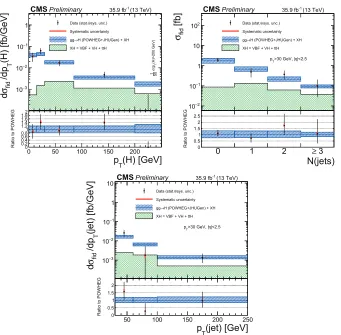
Fiducial cross section measurement has been performed in theH→ZZ →4channel. This mea-surement is characterized by minimal dependence on the assumptions of the relative fraction or kine-matic distributions of the separate production modes. The details about the fiducial volume definition in form of the lepton kinematics and isolation requirements and the event topology requirements, are summarized in the Tab. 4 of [7]. This definition is very similar to the one used for the fiducial cross section measurement performed at 7 and 8TeV [8], however the new measurement provides better agreement with the SM expectations and lower (statistics-dominated) uncertainties. The differential
cross sections has been measured inH→ZZ→4versuspTof the Higgs boson, jet multiplicity and pT of the jet. The dominant sources of systematic uncertainty are the experimental uncertainties of
the lepton identification efficiencies and luminosity measurement, and the theoretical uncertainties are
found to be sub-dominant. In order to asses the model dependence of the measurement, the unfold-ing procedure is repeated usunfold-ing different response matrices created by varying the relative fraction
cross section measurement in Fig. 4 show a relatively good agreement between data and gluon fusion dominated predictions from POWHEG [9–11] simulation.
2.3 Higgs boson mass and width measurements
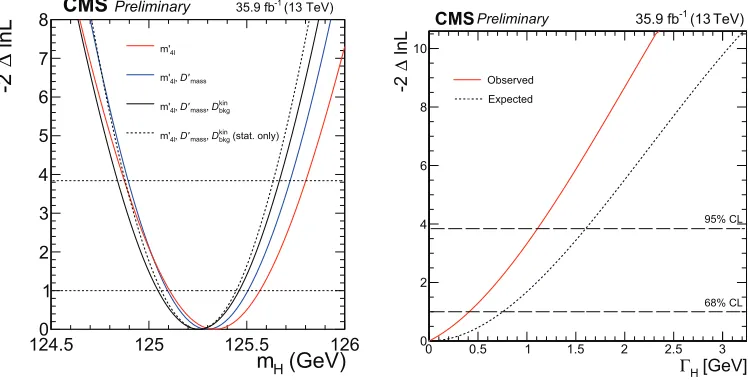
Mass measurement performed in 4channel [7] is based on one-, two- and three-dimensional fit on the following variables: invariant mass of the Higgs boson (m4), expected uncertainty on mass (Dmass)
and the kinematic discriminant (Dkin
bkg). In Fig. 5 (left), there is a comparison of the 1D likelihood scan as a function of mass for the 1D, 2D, and 3D measurement. The likelihood to be maximized is constructed using the reconstructed transverse momenta of the two leptons forming the Z candidate with the invariant mass closest to the nominal Z boson mass (Z1), the per lepton resolutions, the refitted transverse momentum and the invariant mass calculated from the refitted four momenta. For each event, the likelihood is maximized and the refitted transverse momenta are used to recalculate the four-lepton mass and mass uncertainty, which are denoted asm
4landDmass. These distributions
are then used in the definition of the likelihood to extract the Higgs boson mass [7]. Compared to the mass measurements performed with the CMS and ATLAS Run I data [12], which combination was already quite precise (less than 0.2%), the new result is even more precise (around 0.17%). The latest measurement presented in Fig. 5 (right), performed in the mass range between 105 and 140GeV, using the on-shell Higgs boson production and the floatingmHparameter, constrained the Higgs boson
width to be less than 1.1GeVat 95% C.L [7].
(GeV)
H
m
124.5 125 125.5 126
lnL
∆
-2
0 1 2 3 4 5 6 7 8
4l
m'
mass D' ,
4l
m'
bkg kin D ,
mass D' ,
4l
m'
(stat. only)
bkg kin D ,
mass D' ,
4l
m'
(13 TeV)
-1
35.9 fb
CMSPreliminary
[GeV]
H
Γ
0 0.5 1 1.5 2 2.5 3
lnL
∆
-2
0 2 4 6 8 10
35.9 fb-1 (13 TeV)
CMSPreliminary
68% CL 95% CL Observed
Expected
Figure 5. 1D likelihood scan as a function of mass for the 1D, 2D, and 3D measurement (left). The likelihood
scans are shown for the mass measurement using the refitted mass distribution withm(Z1) constraint. Solid lines represents the scan with full uncertainties included, dashed lines statistical uncertainty only [7]. Observed and expected likelihood scan ofΓHusing the signal range 105 < m4 < 140GeV, withmHfloated [7].
2.4 Higgs boson decaying to a pair of tau leptons
Higgs boson decaying toττ[13] is another discovery channel, because of the large event rate
cross section measurement in Fig. 4 show a relatively good agreement between data and gluon fusion dominated predictions from POWHEG [9–11] simulation.
2.3 Higgs boson mass and width measurements
Mass measurement performed in 4channel [7] is based on one-, two- and three-dimensional fit on the following variables: invariant mass of the Higgs boson (m4), expected uncertainty on mass (Dmass)
and the kinematic discriminant (Dkin
bkg). In Fig. 5 (left), there is a comparison of the 1D likelihood scan as a function of mass for the 1D, 2D, and 3D measurement. The likelihood to be maximized is constructed using the reconstructed transverse momenta of the two leptons forming the Z candidate with the invariant mass closest to the nominal Z boson mass (Z1), the per lepton resolutions, the refitted transverse momentum and the invariant mass calculated from the refitted four momenta. For each event, the likelihood is maximized and the refitted transverse momenta are used to recalculate the four-lepton mass and mass uncertainty, which are denoted asm
4landDmass. These distributions
are then used in the definition of the likelihood to extract the Higgs boson mass [7]. Compared to the mass measurements performed with the CMS and ATLAS Run I data [12], which combination was already quite precise (less than 0.2%), the new result is even more precise (around 0.17%). The latest measurement presented in Fig. 5 (right), performed in the mass range between 105 and 140GeV, using the on-shell Higgs boson production and the floatingmHparameter, constrained the Higgs boson
width to be less than 1.1GeVat 95% C.L [7].
(GeV)
H
m
124.5 125 125.5 126
lnL
∆
-2
0 1 2 3 4 5 6 7 8 4l m' mass D' , 4l m' bkg kin D , mass D' , 4l m' (stat. only) bkg kin D , mass D' , 4l m' (13 TeV) -1 35.9 fb CMSPreliminary [GeV] H Γ0 0.5 1 1.5 2 2.5 3
lnL ∆ -2 0 2 4 6 8 10
35.9 fb-1 (13 TeV)
CMSPreliminary
68% CL 95% CL Observed
Expected
Figure 5. 1D likelihood scan as a function of mass for the 1D, 2D, and 3D measurement (left). The likelihood
scans are shown for the mass measurement using the refitted mass distribution withm(Z1) constraint. Solid lines represents the scan with full uncertainties included, dashed lines statistical uncertainty only [7]. Observed and expected likelihood scan ofΓHusing the signal range 105 < m4 < 140GeV, withmHfloated [7].
2.4 Higgs boson decaying to a pair of tau leptons
Higgs boson decaying toττ[13] is another discovery channel, because of the large event rate
ex-pected in the SM with respect to the other leptonic decay modes, and the smaller contribution from
background events with respect to theH→bb¯channel. With the four final states (µτh,eτh,τhτh, and eµ), split into three categories (0-jet, VBF and boosted), the total number of categories reaches twelve. In each category the two variables are chosen to build two-dimensional (2D) distributions. The search for an excess of the signal events over the expected background involves a 2D global maximum like-lihood fit based in all channels, together with control regions for thett¯, QCD multijet, and W+jets
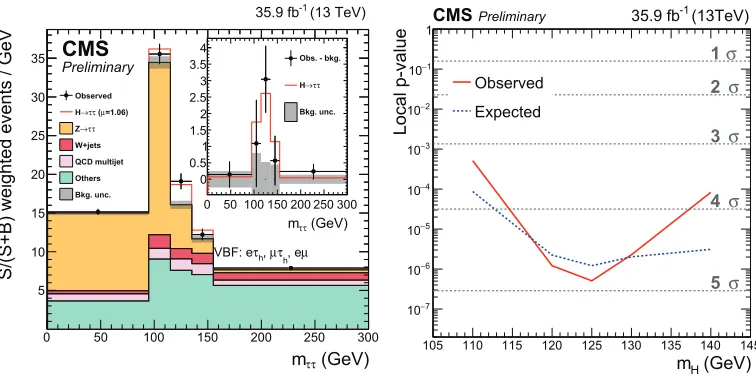
backgrounds. Combined observed and predictedmττdistributions that include the VBF category of theeµ,eτhandµτhchannels are shown in Fig. 6 (left). The signal is normalized to its best-fit signal
strength, while the normalization of the predicted background distributions (Z → ττ, W+jets, QCD
multijet and others) corresponds to the result of the global fit. The mass distributions for a constant range of the second dimension of the signal distributions are weighted according toS/(S +B).The
”others” background contribution includes events from diboson,tt¯, and single-top quark production, as well as scalar boson decays to a pair of W bosons and Z bosons decaying to a pair of light leptons. The background uncertainty band includes all systematic and statistical sources of background uncer-tainties, after the global fit. The inset in the top-right corner in Fig. 6 (left) shows the corresponding difference between the observed data and the sum of the expected signal and background distributions.
The final results are presented in the form of the plots of the signal strength per category and the signal strength per channel, with the combined best-fit on the signal strength of 1.06±0.25 [13].
A graph of the p-value versus mass of the Higgs boson, in Fig. 6 (right), presents the observation of decays of the SM scalar boson to pairs ofτleptons, with an observed significance of 4.9 and an expected significance of 4.7 standard deviations for a mass of 125GeV.
(GeV)
τ τ
m
0 50 100 150 200 250 300
S/(S+B) weighted events / GeV
5 10 15 20 25 30 35 Observed =1.06) µ ( τ τ → H τ τ → Z W+jets QCD multijet Others Bkg. unc. (13 TeV) -1 35.9 fb CMS Preliminary µ , e h τ µ , h τ VBF: e (GeV) τ τ m
0 50 100 150 200 250 300 0 0.51 1.5 2 2.5 3
3.54 Obs. - bkg.
τ τ → H Bkg. unc. (GeV) H m
105 110 115 120 125 130 135 140 145
Local p-value 7 − 10 6 − 10 5 − 10 4 − 10 3 − 10 2 − 10 1 − 10 1 σ 1 σ 2 σ 3 σ 4 σ 5 Observed Expected Preliminary
CMS 35.9 fb-1 (13TeV)
Figure 6. Combined observed and predictedmττdistributions, together with the inset showing the difference
between the observed data and the sum of the expected signal and background distributions (left) [13]. Local p-value and significance as a function of the SM scalar boson mass hypothesis (right). The observation (red) is compared to the expectation (blue) for a scalar boson with a massmH = 125GeV[13].
2.5 Production of the Higgs boson associated to top quarks
have been considered:ttH¯ withH→bb¯[14],ttH¯ withH→γγ[4],ttH¯ with aτlepton [15], 4[7]
and multilepton [16] in the final state. All except thettH¯ withH→bb¯ have been updated with the full 2016 dataset. InH→γγ, and thettH¯ to multilepton, the significance exceeds 3σ. The plot in Fig. 7 summarizes the results of the signal strength measurements performed with Run II data from all channels. The comparison with the combined result of the analyses obtained with the Run I CMS and ATLAS data is presented [3].
Figure 7. ThettH¯ analyses summary plot for the signal strengths relative to the SM prediction.
ThettH¯ analysis withH→bb¯ [14] considers the two following final state categories: di-lepton and lepton plus jets. Dilepton channel is characterized by minimal non-tt¯background and minimal jet combinatorics, while the lepton plus jets is characterized by high statistics. In Fig. 8 the results of the signals strength measurements and the 95% CL upper limits onµare shown.
ThettH¯ to multilepton [16] is performed with the Higgs boson decays toWW,ZZandτleptons
characterized into the three final state categories: two leptons same sign (2ss), three leptons (3)
and four leptons (4). Signal is extracted using the unrolled 2D BDT distributions, where the BDT
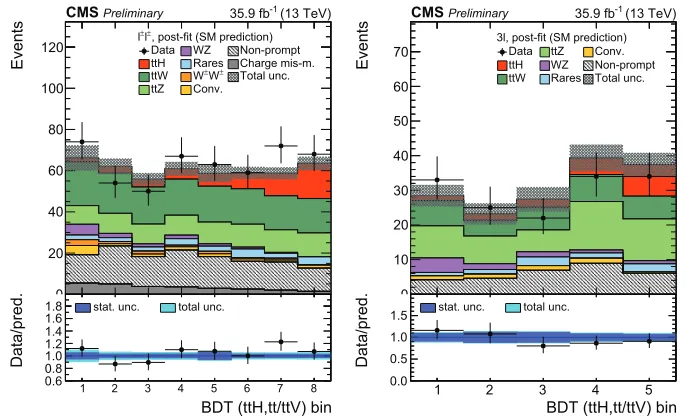
discriminators have been trained separately againsttt¯andttV¯ . This channel has provided an evidence for thettH¯ production, giving the result on the signal strength of about 1.5+/- 0.5, which could be
noticed from the excess of events in the di-lepton channel, in Fig. 9 (left), spread across the bins. Higgs boson decaying to at least oneτ[15] lepton in the final state is one of thettH¯ channels complementary to thettH¯ to multilepton channels. It considers the 1+2τh, 2ss+1τhand 3+1τh
event categories, with thettZ/W¯ and electroweak background, as well as the fakes coming from the non-prompt leptons, jets toτhand the charge-flips as the main background components. The results
have been observed with the significance of 1.4σ, while the expected significance is 1.8σ. The upper limit on the signal rate of 2.0 times the SMttH¯ production rate at 95% CL is set [15].
have been considered:ttH¯ withH→bb¯[14],ttH¯ withH→γγ[4],ttH¯ with aτlepton [15], 4[7]
and multilepton [16] in the final state. All except thettH¯ withH→bb¯ have been updated with the full 2016 dataset. InH→γγ, and thettH¯ to multilepton, the significance exceeds 3σ. The plot in Fig. 7 summarizes the results of the signal strength measurements performed with Run II data from all channels. The comparison with the combined result of the analyses obtained with the Run I CMS and ATLAS data is presented [3].
Figure 7. ThettH¯ analyses summary plot for the signal strengths relative to the SM prediction.
ThettH¯ analysis withH→bb¯ [14] considers the two following final state categories: di-lepton and lepton plus jets. Dilepton channel is characterized by minimal non-tt¯background and minimal jet combinatorics, while the lepton plus jets is characterized by high statistics. In Fig. 8 the results of the signals strength measurements and the 95% CL upper limits onµare shown.
ThettH¯ to multilepton [16] is performed with the Higgs boson decays toWW,ZZandτleptons
characterized into the three final state categories: two leptons same sign (2ss), three leptons (3)
and four leptons (4). Signal is extracted using the unrolled 2D BDT distributions, where the BDT
discriminators have been trained separately againsttt¯andttV¯ . This channel has provided an evidence for thettH¯ production, giving the result on the signal strength of about 1.5+/- 0.5, which could be
noticed from the excess of events in the di-lepton channel, in Fig. 9 (left), spread across the bins. Higgs boson decaying to at least oneτ[15] lepton in the final state is one of thettH¯ channels complementary to thettH¯ to multilepton channels. It considers the 1+2τh, 2ss+1τhand 3+1τh
event categories, with thettZ/W¯ and electroweak background, as well as the fakes coming from the non-prompt leptons, jets toτhand the charge-flips as the main background components. The results
have been observed with the significance of 1.4σ, while the expected significance is 1.8σ. The upper limit on the signal rate of 2.0 times the SMttH¯ production rate at 95% CL is set [15].
The search for the Higgs boson is also performed in the channel with a single top quark associated to the Higgs boson. This production is characterized by a relatively low cross section with respect to the totalttH¯ cross section. In SM, this is the consequence of a destructive interference of the production with the coupling to theW boson and the production with the coupling to the top quark. The analysis oftHproduction is performed to expose the relative sign oft-H(andW-H) couplings via this interference. The signal withH→bb¯in the final state is defined as a lepton (electron or muon) plus 3 or 4 b-tagged jets and one non-tagged jet. BDT is used to find jet assignment for thetHqsignal
= 125 GeV H
at m SM
σ / σ = µ Best fit 2
− 0 2 4 6
Combined Lepton+jets Dilepton
Preliminary
CMS
(13 TeV)
-1
11.4 - 12.9 fb
syst.
stat.
tot.
µ
-1.06 +1.01
-0.96 +1.05
-1.39 +1.50
-0.04
-0.87 +0.88
-0.52 +0.51
-1.02 +1.02
-0.43
-0.68 +0.66
-0.44 +0.45
-0.81 +0.80
-0.19
= 125 GeV H
at m SM
σ / σ = µ
95% CL limit on 1 10 Combined
Lepton+jets Dilepton
Preliminary
CMS
(13 TeV)
-1
11.4 - 12.9 fb
σ
1
±
Expected
σ
2
±
Expected =1) injected
µ
H( tt Observed
Figure 8. Best-fit values of the signal strength modifiersµwith their±1σconfidence intervals, also split into
their statistical and systematic components (left), and median expected and observed 95% CL upper limits onµ
(right). The expected limits are displayed together with±1σand±2σconfidence intervals. Also shown are the limits in case of an injected signal ofµ =1 [14].
and thett¯, which represents the main background process. The final results obtained for SM scenario provide 113.7 (98.6) and for the inverted top coupling scenario: 6.0 (6.4), for the observed (and the expected) 95% CL upper limit on the cross section for the SMtHproduction, respectively [17]. In the multilepton final state [18], the strategy is to analyse the events with a single-top quark associated Higgs boson, which decays toWW,ZZorττ, split into the two categories: two lepton same sign and
three lepton. The main irreducible backgrounds arett+¯ X (where X can takeW,Z,H, orγ∗), photon
conversion, diboson, tri-bosons, and rare SM processes. Reducible backgrounds include fakes from non-prompt leptons and misidentified objects passing lepton selection, as well as the charge flips from charge mis-IDs and the opposite-sign processes (such astt/¯Z+jets). ThetHqprocess can benefit from
a greatly enhanced production cross section in case of anomalous top-Higgs couplings, and the results published in [17] and [18] are used to constrain these couplings.
2.6 VBF production of the Higgs boson
VBFproduction mode withH→bb¯is characterized by significantly larger cross section with respect toVHorttH¯ , and a very large QCD multijet background. BDT is used for identification of theVBF -like events with four jets out of which one or two are b-tagged. The analysis, performed with the 2.3f b−1 of data collected at the energy of 13TeV, provided the signal strength ofµ = −3.7, and
the other measurement, performed with the 13TeV data combined with the 8TeV data of roughly 19f b−1, provided the signal ofµ = 1.3 [19]. The observed (and expected) upper limits in the absence
Events
0 20 40 60 80 100
120 l±l±Data, post-fit (SM prediction)WZ Non-prompt
ttH Rares Charge mis-m.
ttW W±W± Total unc.
ttZ Conv.
Preliminary
CMS 35.9 fb-1 (13 TeV)
BDT (ttH,tt/ttV) bin
1 2 3 4 5 6 7 8
Data/pred.
0.6 0.8 1.0 1.2 1.4 1.6
1.8 stat. unc. total unc.
Events
0 10 20 30 40 50 60
70 3l, post-fit (SM prediction)Data ttZ Conv.
ttH WZ Non-prompt
ttW Rares Total unc.
Preliminary
CMS 35.9 fb-1 (13 TeV)
BDT (ttH,tt/ttV) bin
1 2 3 4 5
Data/pred.
0.0 0.5 1.0
1.5 stat. unc. total unc.
Figure 9. Combination of the BDT classifier outputs in the bins used for signal extraction, for the same-sign
di-lepton (left) and three-lepton (right) channels. The distributions are shown after the fit to the data, with all processes constrained to the SM expectation [16].
h
τ 1l+2
< 2.6 (3.4 exp) µ
h
τ 2lss+1
< 2.4 (1.4 exp) µ
h
τ 3l+1
< 4.0 (2.7 exp) µ
Combined
< 2.0 (1.1 exp) µ
SM σ / σ = µ 95% CL upper limit on
0 5 10
Observed Expected
Expected
σ
1 ±
Expected
σ
2 ±
CMSPreliminary 35.9 fb-1 (13 TeV)
SM σ / σ = µ Best fit
2
− 0 2
Best fit SM Expectation
CMSPreliminary 35.9 fb-1 (13 TeV)
h
τ 1l+2
-1.47 +1.50 = -1.20
µ
h
τ 2lss+1
-0.66 +0.79 = 0.86
µ
h
τ 3l+1
-1.01 +1.33 = 1.22
µ
Combined -0.53 +0.62 = 0.72
µ
Figure 10. 95% CL upper limits on thettH¯ signal rate (left), obtained in each of the categories 2ss+1τh,
3+1τh, and 1+2τhindividually and for the combination of all three event categories. The expected limits are
computed for the background-only (µ = 0) hypothesis. Signal ratesµ(right), in units of the SMttH¯ production rate, measured in each of the categories 2ss+1τh, 3+1τh, and 1+2τhindividually and for the combination
of all three categories [15].
3 Beyond the Standard Model (BSM) Higgs Boson Searches
Discovery of another scalar boson, neutral or charged, would represent unambiguous evidence for an extended Higgs boson sector. Neutral and charged Higgs bosons appear in many extensions of the SM, of which the simplest are the two Higgs boson doublet models (2HDMs). In a 2HDM, the following five Higgs bosons are predicted: two charged Higgs bosons,H±, two neutral scalar (CP-even) Higgs
Events 0 20 40 60 80 100
120 l±l±, post-fit (SM prediction)Data WZ Non-prompt
ttH Rares Charge mis-m.
ttW W±W± Total unc.
ttZ Conv.
Preliminary
CMS 35.9 fb-1 (13 TeV)
BDT (ttH,tt/ttV) bin
1 2 3 4 5 6 7 8
Data/pred. 0.6 0.8 1.0 1.2 1.4 1.6
1.8 stat. unc. total unc.
Events 0 10 20 30 40 50 60
70 3l, post-fit (SM prediction)Data ttZ Conv.
ttH WZ Non-prompt
ttW Rares Total unc.
Preliminary
CMS 35.9 fb-1 (13 TeV)
BDT (ttH,tt/ttV) bin
1 2 3 4 5
Data/pred.
0.0 0.5 1.0
1.5 stat. unc. total unc.
Figure 9. Combination of the BDT classifier outputs in the bins used for signal extraction, for the same-sign
di-lepton (left) and three-lepton (right) channels. The distributions are shown after the fit to the data, with all processes constrained to the SM expectation [16].
h
τ 1l+2
< 2.6 (3.4 exp) µ
h
τ 2lss+1
< 2.4 (1.4 exp) µ
h
τ 3l+1
< 4.0 (2.7 exp) µ
Combined
< 2.0 (1.1 exp) µ SM σ / σ = µ 95% CL upper limit on
0 5 10
Observed Expected Expected σ 1 ± Expected σ 2 ±
CMSPreliminary 35.9 fb-1 (13 TeV)
SM σ / σ = µ Best fit 2
− 0 2
Best fit SM Expectation
CMSPreliminary 35.9 fb-1 (13 TeV)
h τ 1l+2 -1.47 +1.50 = -1.20 µ h τ 2lss+1 -0.66 +0.79 = 0.86 µ h τ 3l+1 -1.01 +1.33 = 1.22 µ Combined -0.53 +0.62 = 0.72 µ
Figure 10. 95% CL upper limits on thettH¯ signal rate (left), obtained in each of the categories 2ss+1τh,
3+1τh, and 1+2τhindividually and for the combination of all three event categories. The expected limits are
computed for the background-only (µ =0) hypothesis. Signal ratesµ(right), in units of the SMttH¯ production rate, measured in each of the categories 2ss+1τh, 3+1τh, and 1+2τhindividually and for the combination
of all three categories [15].
3 Beyond the Standard Model (BSM) Higgs Boson Searches
Discovery of another scalar boson, neutral or charged, would represent unambiguous evidence for an extended Higgs boson sector. Neutral and charged Higgs bosons appear in many extensions of the SM, of which the simplest are the two Higgs boson doublet models (2HDMs). In a 2HDM, the following five Higgs bosons are predicted: two charged Higgs bosons,H±, two neutral scalar (CP-even) Higgs
bosons,handH, and one neutral pseudoscalar (CP-odd) Higgs boson,A. The 2HDM models can be classified into types, depending on the Higgs boson coupling to fermions. In the Type-I 2HDM only one of the Higgs boson doublets couples to fermions, while in a Type-II 2HDM one doublet couples to up-type fermions and the other one to down-type fermions. As a consequence, in Type-I 2HDM the coupling of the charged Higgs bosons to charged leptons and neutrinos is proportional to cotβ, and in Type-II 2HDM , it is proportional to tanβ, where tanβrepresents the ratio of the vacuum expectation values of the two Higgs boson doublets.
The minimal supersymmetric standard model (MSSM), as a special case of a Type-II 2HDM, in-corporates a symmetry between bosons and fermions, introducing additional heavier partners for the existing particles, and allowing for possible cancellation of the quadratically divergent self-energy corrections to the Higgs boson mass at high energy, so-called supersymmetry (SUSY). Two free pa-rameters are used to express the MSSM at tree level: the tanβandmA (the mass of the pseudoscalar
Higgs boson). Concerning the values of the tanβparameter, while small and medium values
repre-sent the models where the gluon fusion is the dominant production mode, a large value means that couplings to down-type fermions are enhanced. This leads to enhanced rate of decays intoτleptons,
and a second dominant production mode, b associated production. Radiative corrections lead to large modifications of the behaviour beyond tree level, which can depend on a large number of different
SUSY parameters. These parameters are fixed to choices that result in different benchmark scenarios,
which must produce MSSM models consistent with the discovered 125GeV Higgs boson. The two scenarios considered in [20] are themmod+
h andhMS S M. In the case of themmodh +scenario, choices are
made for the SUSY parameters which allow the majority of themA-tanβplane to be consistent with a
125GeVscalar Higgs boson. In the case of thehMS S Mscenario, the condition ofmH=125GeVis
fixed across the whole plane and the radiative corrections adjusted accordingly.
Another direction would lead to the search for a doubly-charged Higgs boson. The experimental observation of a non-zero neutrino masses [21] contradicts the standard model (SM) assumption of a massless neutrino. There are several models that attempt to expand the SM and accommodate neutrino masses. The minimal Type II seesaw mechanism [22] extends the SM particle spectrum with a scalar triplet withS U(2)L×U(1)Yquantum numbersΦ. The triplet has a doubly-charged component Φ±±, a singly-charged componentΦ±, and a neutral componentΦ0. The analysis documented in this
summary is specific to the left-handed doubly-charged Higgs boson.
A number of models for the physics beyond the SM allow for invisible decay modes of the Higgs boson, such as decays to neutralinos in supersymmetric models [23], graviscalars in models with extra spatial dimensions [24]. More generally, invisible Higgs boson decays can be realized through interactions between the Higgs boson and dark matter (DM) [25]. In Higgs-portal models [26], the Higgs boson acts as a mediator between SM and DM particles allowing for direct production of DM at the LHC. Furthermore, cosmological models proposing that the Higgs boson played a central role in the evolution of the early universe motivate the study of the relationship between the Higgs boson and DM [27].
The BSM physics effects can appear either via anomalous couplings of the Higgs boson or via
new particles that can be directly produced or enter in the quantum loop at production. The exper-imental signature would be an enhancement of the Higgs boson pair (di-Higgs boson) production cross section at a specific invariant mass value (resonant production) or over the whole invariant mass spectrum (non resonant production). The resonant production is predicted by many extensions of the SM such as the Singlet model [28], the Two Higgs boson Doublet Model (2HDM) [29], the minimal supersymmetric standard model (MSSM) [30], and the Warped Extra Dimensions (WED) [31] model. Although the physics motivations and the phenomenology of these theories are very different, the
sig-nal is represented as a CP-even scalar particle (S) decaying into a Higgs boson pair, with an intrinsic width that is often negligible with respect to the detector resolution. In the non resonant case, the BSM
physics is modeled with an effective Lagrangian by extending the SM Lagrangian with dimension-6
operators [32].
A brief overview of the recent results of the BSM Higgs boson searches, essential for the hunt for new physics, follows in the next sections.
3.1 Search for the charged Higgs boson
This section summarizes the results of the search for a charged Higgs boson in decays to aτlepton
and a neutrino based on 12.9f b−1 recorded in 2016 at √s =13TeV [33]. The analysis considers
the production mode pp→tbH± (pp→H±W∓bb) for masses larger (smaller) than the top quark
(mH±>mt−mb) and focuses on the fully hadronic final state. In this analysis, transverse mass of the
Higgs boson has been used for signal extraction. The model independent 95% CL limits and MSSM
mmod+
h exclusion limits inmH+−tanβplane have been presented, where no excess has been observed
in the mass range from 80GeV−3TeVand the possibility of the existence of the charge Higgs boson has been excluded in most of the region of interest.
3.2 MSSM Higgs boson with subsequent decays to a pair of tau leptons
In the search for the neutral MSSM Higgs boson with the decays intoττwith 12.9f b−1 of data at
√s
=13TeV[20] the following final states:τhτh,µτh,eτhandeµ, and the two event categories based
on the number of b-tagged jets have been considered. Main backgrounds areZ/γ∗ττ, QCD andtt¯, and
the total transverse mass is used for the signal extraction. The results have been presented in form of the model independent 95% CL limits and the exclusion limits in themA−tanβplane, in the context
of themmod+
h andhMS S Mscenario. No excess has been found in the mass range 100GeV − 3TeV,
and with the complete 2016 dataset, a larger part of themA−tanβplane has been excluded.
3.3 Doubly-charged Higgs boson searches
A search for doubly-charged Higgs boson production in three and four lepton final states at √s =
13TeV is performed for a narrow di-lepton resonance in pair production and associated production modes:qq¯→Z0/γ→Φ++Φ−−→+
i+j−k−l, andqq→W±→Φ±±Φ∓→±i±jk∓νl. Measuring the
branching fractions of the doubly-charged Higgs boson would give access to neutrino parameters such as the masses (m1,m2,m3), the Majorana Phases (α1,α2, or∆α=|α1−α2|), the CP-violating angleδ,
and the Higgs boson triplet vacuum expectation value. Since the branching fractions are not fixed by the model, model independent limits are set assuming 100%Φ++decays to a single pair of leptons:
ee,eµ,µµ,eτ,µτ, andττ. Limits have been also set for four benchmark points that target different
neutrino mass hierarchies. As the final result of this search, no significant excess has been observed. Lower bounds on theΦ±±mass are extended to between 800GeVand 820GeVfor final states with
100% decays toee,eµ, andµµ, and to 714GeVand 643GeVfor final states with 100% decays toeτ
andµτ, respectively. Final states with 100% decays toττare excluded up to 535GeV. In addition, benchmark points of the type II seesaw model targeting four possible neutrino mass hypotheses are also probed, with lower bounds between 716GeVand 761GeV[34].
3.4 Invisible Higgs boson
Analyses of the invisible Higgs boson decays target different Higgs boson production modes: VBF
physics is modeled with an effective Lagrangian by extending the SM Lagrangian with dimension-6
operators [32].
A brief overview of the recent results of the BSM Higgs boson searches, essential for the hunt for new physics, follows in the next sections.
3.1 Search for the charged Higgs boson
This section summarizes the results of the search for a charged Higgs boson in decays to aτlepton
and a neutrino based on 12.9f b−1 recorded in 2016 at √s = 13TeV [33]. The analysis considers
the production mode pp→tbH± (pp→H±W∓bb) for masses larger (smaller) than the top quark
(mH±>mt−mb) and focuses on the fully hadronic final state. In this analysis, transverse mass of the
Higgs boson has been used for signal extraction. The model independent 95% CL limits and MSSM
mmod+
h exclusion limits inmH+−tanβplane have been presented, where no excess has been observed
in the mass range from 80GeV−3TeVand the possibility of the existence of the charge Higgs boson has been excluded in most of the region of interest.
3.2 MSSM Higgs boson with subsequent decays to a pair of tau leptons
In the search for the neutral MSSM Higgs boson with the decays intoττwith 12.9f b−1 of data at
√s
=13TeV[20] the following final states:τhτh,µτh,eτhandeµ, and the two event categories based
on the number of b-tagged jets have been considered. Main backgrounds areZ/γ∗ττ, QCD andtt¯, and
the total transverse mass is used for the signal extraction. The results have been presented in form of the model independent 95% CL limits and the exclusion limits in themA−tanβplane, in the context
of themmod+
h andhMS S Mscenario. No excess has been found in the mass range 100GeV − 3TeV,
and with the complete 2016 dataset, a larger part of themA−tanβplane has been excluded.
3.3 Doubly-charged Higgs boson searches
A search for doubly-charged Higgs boson production in three and four lepton final states at √s =
13TeV is performed for a narrow di-lepton resonance in pair production and associated production modes:qq¯→Z0/γ→Φ++Φ−− →+
i+jk−−l, andqq→W±→Φ±±Φ∓→±i±j∓kνl. Measuring the
branching fractions of the doubly-charged Higgs boson would give access to neutrino parameters such as the masses (m1,m2,m3), the Majorana Phases (α1,α2, or∆α=|α1−α2|), the CP-violating angleδ,
and the Higgs boson triplet vacuum expectation value. Since the branching fractions are not fixed by the model, model independent limits are set assuming 100%Φ++decays to a single pair of leptons:
ee,eµ,µµ,eτ,µτ, andττ. Limits have been also set for four benchmark points that target different
neutrino mass hierarchies. As the final result of this search, no significant excess has been observed. Lower bounds on theΦ±± mass are extended to between 800GeV and 820GeV for final states with
100% decays toee,eµ, andµµ, and to 714GeVand 643GeVfor final states with 100% decays toeτ
andµτ, respectively. Final states with 100% decays toττare excluded up to 535GeV. In addition, benchmark points of the type II seesaw model targeting four possible neutrino mass hypotheses are also probed, with lower bounds between 716GeVand 761GeV[34].
3.4 Invisible Higgs boson
Analyses of the invisible Higgs boson decays target different Higgs boson production modes: VBF
production with two forward jets,VHproduction withZ →ee/µµ[35],Z →bb¯,W/Z→qq¯, or gluon
Table 1.Comparison table of the 13TeVnon-resonant observed (expected)σ/σS M95% CL limits for
bb¯ττ[37],bb¯νν[38],bb¯γγ[39] andbbb¯ b¯[40] channels.
channel limit integrated luminosity
bbττ¯ 28 (25) 35.9f b−1 bbνν¯ 79 (89) 35.9f b−1 bbγγ¯ 91 (90) 2.7f b−1 bbb¯ b¯ 342 (308) 2.3−2.7f b−1
fusion in association with the initial state radiation have been presented. The observed/expected upper
limits at 95% CL on B(H→invisible) of 0.24/0.23 for the combination of 7, 8 and 13TeV with the 2015 dataset measurements, then 0.40/0.42 for theZ(ll)+MET analysis and 0.53/0.40 for the
monojet andV(j j) analyses updated with full 2016 dataset [36] have been shown in this report.
3.5 Di-Higgs boson
In CMS, both di-Higgs boson productions, resonant and non-resonant, have been investigated. Many BSM models predict resonant X→ HH production, while non-resonant SM di-Higgs boson pro-duction provides a crucial test of electroweak symmetry breaking. The results of the following five searches for the Higgs boson pair production in proton-proton collisions at √s=13TeVhave been
reported. The search for pair production of Higgs bosons in the twoτleptons and two bottom quarks final state [37], the search for resonant and non-resonant Higgs boson pair production in thebbνν¯
final state [38] and the search forH(bb¯)H(γγ) decays [39], besides a pair of leptons or photons in the final state, require a decay ofH→bb¯ to keep branching fraction higher. The highest branching fraction is obtained in the search for resonant pair production of Higgs bosons decaying to two bottom quark-antiquark pairs [41] and the search for heavy resonances decaying to a pair of Higgs bosons in the four b quark final state [42], where the first one targets low mass resonances between 260 and 1200GeV, and the other one targets the masses between 800 and 3000GeV.
The current status of the results on 13TeV non-resonant observed (expected)σ/σS M 95% CL
limits (where [37] and [38] have been updated with the full 2016 datasets) is shown in the Tab. 1. A comparison between the summary of the Run-IIσ(gg→X)×B(X→HH) 95% CL upper limits from the five resonant di-Higgs boson searches [43] and the results of the corresponding Run I analyses has been presented in this report.
4 Higgs Boson Searches Prospects
This section is related to the updates on projections of physics reach with the upgraded CMS detector for HL-LHC [44]. Selected measurements in Higgs boson physics, highlighting the performance of the planned upgrades of the CMS detector, have been presented. Public results are extrapolated to larger data sets 300 and 3000f b−1. In order to summarize the future physics potential of the
CMS detector at the HL-LHC, extrapolations have been made under different uncertainty scenarios:
S1, S1+, S2 and S2+, where S1 denotes the scenario with all systematic uncertainties kept constant
with integrated luminosity, and S2 denotes theoretical uncertainties scaled down by a factor 1/2 and
experimental systematic uncertainties scaled down by the square root of the integrated luminosity (until they reach a defined lower limit based on estimates of the achievable accuracy with the upgraded detector). The ”+” denotes taking into account the effects of higher pileup conditions and detector
unchanged with respect to the reference analysis. In the following text the future prospects for the SM Higgs boson production in theH→γγandH→ZZ →4analysis channels have been described.
According to the measurements of Higgs boson properties using the H→γγ decay, with 12.9f b−1of data collected in 2016 [45], the following projections from the analysis have been made:
the signal strength (inclusively and per production mode, presented in this report), Higgs boson cou-pling strength modifiers and the fiducial cross section measurement [44]. Projected symmetrized uncertainties for theH→γγsignal strength relative to the standard model (µγγ), inclusively and per production mode (VBF,ttH¯ andggH) are shown. No projections for the VH signal strength is given because the reference analysis [45] was not sensitive to it. For the 3000f b−1case the effect of the
high pileup conditions of the HL-LHC has been taken into account as degradations to the photon iden-tification efficiency and vertex identification efficiency. In each case the uncertainty for the inclusive
signal strength is shown split into statistical uncertainties, experimental systematic uncertainties and theoretical systematic uncertainties component. In S2 and S2+, the experimental uncertainty on the
integrated luminosity is reduced to 1.5%.
According to the measurements of Higgs boson properties usingH→ZZ→4with 12.9f b−1of
data collected in 2016 [46], the following projections from the analysis have been made: the signal strength per production mode (presented in this report), differential cross section measurement for pT(H) and the constraints on anomalousH→ZZcouplings [44]. The projected 68% CL uncertainties
on the Higgs boson signal strength for different production modes at 300 and 3000f b−1, with S1 and
S2 have been presented. In S2, the experimental uncertainties on the integrated luminosity and the lepton identification efficiency are reduced to 1.5% and 1% per lepton, respectively. The projections
for 3000f b−1 use different lepton efficiencies and misidentification rates to account for the higher
pileup at the HL-LHC.
The uncertainties are in general dominated by statistical component, resulting in 3-4 times lower total uncertainties with respect to the ones from the Run I measurements for 300f b−1, and 5-10 times
lower for the high luminosity measurements, with 3000f b−1. Further information on the projections
made for top physics, heavy flavor physics, searches for dark matter and new heavy particles can be found in the CMS Detector Performance Summary [44].
5 Summary
As a conclusion from the presented results of the SM Higgs boson searches it follows that the precision of theH→γγandH→ZZ→4analyses has been improved and the SM processH→ττhas been
observed. The sensitivity of the search for the production of the Higgs boson associated to top quarks has been increased and no significant deviations from the SM, neither extra Higgs bosons, nor a sign of the BSM physics have been yet found. As for the outlook, the updates of several important analyses with the full 2016 dataset are expected, looking forward for around 100f b−1of data to be collected
by the end of the LHC Run II.
References
[1] CMS Collaboration, JINST 3 S08004 (2008) [2] CMS Collaboration, Eur. Phys. J.C75, 5, 212 (2015) [3] CMS and ATLAS Collaboration, JHEP,08, 045 (2016)
[4] CMS Collaboration, CMS-PAS-HIG-16-040 (2017), http://cds.cern.ch/record/2264515
[5] CMS Collaboration, CMS-PAS-HIG-17-015 (2017), http://cds.cern.ch/record/2257530
unchanged with respect to the reference analysis. In the following text the future prospects for the SM Higgs boson production in theH→γγandH→ZZ →4analysis channels have been described.
According to the measurements of Higgs boson properties using the H→γγ decay, with 12.9 f b−1of data collected in 2016 [45], the following projections from the analysis have been made:
the signal strength (inclusively and per production mode, presented in this report), Higgs boson cou-pling strength modifiers and the fiducial cross section measurement [44]. Projected symmetrized uncertainties for theH→γγsignal strength relative to the standard model (µγγ), inclusively and per production mode (VBF,ttH¯ andggH) are shown. No projections for the VH signal strength is given because the reference analysis [45] was not sensitive to it. For the 3000f b−1 case the effect of the
high pileup conditions of the HL-LHC has been taken into account as degradations to the photon iden-tification efficiency and vertex identification efficiency. In each case the uncertainty for the inclusive
signal strength is shown split into statistical uncertainties, experimental systematic uncertainties and theoretical systematic uncertainties component. In S2 and S2+, the experimental uncertainty on the
integrated luminosity is reduced to 1.5%.
According to the measurements of Higgs boson properties usingH→ZZ→4with 12.9f b−1of
data collected in 2016 [46], the following projections from the analysis have been made: the signal strength per production mode (presented in this report), differential cross section measurement for pT(H) and the constraints on anomalousH→ZZcouplings [44]. The projected 68% CL uncertainties
on the Higgs boson signal strength for different production modes at 300 and 3000f b−1, with S1 and
S2 have been presented. In S2, the experimental uncertainties on the integrated luminosity and the lepton identification efficiency are reduced to 1.5% and 1% per lepton, respectively. The projections
for 3000f b−1 use different lepton efficiencies and misidentification rates to account for the higher
pileup at the HL-LHC.
The uncertainties are in general dominated by statistical component, resulting in 3-4 times lower total uncertainties with respect to the ones from the Run I measurements for 300f b−1, and 5-10 times
lower for the high luminosity measurements, with 3000f b−1. Further information on the projections
made for top physics, heavy flavor physics, searches for dark matter and new heavy particles can be found in the CMS Detector Performance Summary [44].
5 Summary
As a conclusion from the presented results of the SM Higgs boson searches it follows that the precision of theH→γγandH→ZZ→4analyses has been improved and the SM processH→ττhas been
observed. The sensitivity of the search for the production of the Higgs boson associated to top quarks has been increased and no significant deviations from the SM, neither extra Higgs bosons, nor a sign of the BSM physics have been yet found. As for the outlook, the updates of several important analyses with the full 2016 dataset are expected, looking forward for around 100f b−1of data to be collected
by the end of the LHC Run II.
References
[1] CMS Collaboration, JINST 3 S08004 (2008) [2] CMS Collaboration, Eur. Phys. J.C75, 5, 212 (2015) [3] CMS and ATLAS Collaboration, JHEP,08, 045 (2016)
[4] CMS Collaboration, CMS-PAS-HIG-16-040 (2017), http://cds.cern.ch/record/2264515
[5] CMS Collaboration, CMS-PAS-HIG-17-015 (2017), http://cds.cern.ch/record/2257530
[6] LHC Higgs Cross Section Working Group, arXiv:1610.07922 (2016)
[7] CMS Collaboration, CMS-PAS-HIG-16-041 (2017), http://cds.cern.ch/record/2272260
[8] CMS Collaboration, JHEP 1604 (2016) 005
[9] Alioli, Simone and Nason, Paolo and Oleari, Carlo and Re, Emanuele, JHEP,07, 060 (2008) [10] Nason, Paolo, JHEP,11, 040 (2004)
[11] Frixione, Stefano and Nason, Paolo and Oleari, Carlo, JHEP,11, 070 (2007) [12] ATLAS and CMS Collaborations, Phys.Rev.Lett. 114 (2015) 191803
[13] CMS Collaboration, CMS-PAS-HIG-16-043 (2017), http://cds.cern.ch/record/2276465
[14] CMS Collaboration, CMS-PAS-HIG-16-038 (2016), http://cds.cern.ch/record/2231510
[15] CMS Collaboration, CMS-PAS-HIG-17-003 (2017), http://cds.cern.ch/record/2257067
[16] CMS Collaboration, CMS-PAS-HIG-17-004 (2017), http://cds.cern.ch/record/2256103
[17] CMS Collaboration, CMS-PAS-HIG-16-019 (2016), http://cds.cern.ch/record/2204925
[18] CMS Collaboration, CMS-PAS-HIG-17-005 (2017), http://cds.cern.ch/record/2264553
[19] CMS Collaboration, CMS-PAS-HIG-16-003 (2016), http://cds.cern.ch/record/2160154
[20] CMS Collaboration, CMS-PAS-HIG-16-037 (2016), http://cds.cern.ch/record/2231507
[21] Olive, K. A. and others, Chin. Phys.,C38, 090001 (2014) [22] Raidal, M. and others, Eur. Phys. J.,C57, 13-182 (2008)
[23] Belanger, G. and Boudjema, F. and Cottrant, A. and Godbole, R. M. and Semenov, A., Phys. Lett.,B519, 93-102 (2001)
[24] Giudice, Gian F. and Rattazzi, Riccardo and Wells, James D., Nucl. Phys.,B595, 250-276 (2001) [25] Shrock, Robert E. and Suzuki, Mahiko, Phys. Lett.,110B, 250 (1982)
[26] Baek, Seungwon and Ko, P. and Park, Wan-Il and Senaha, Eibun, JHEP,05, 036 (2013) [27] Servant, Geraldine and Tulin, Sean, Phys. Rev. Lett.,111, 151601 (2013)
[28] Binoth, T. and van der Bij, J. J., Z. Phys.,C75, 17-25 (1997)
[29] Branco, G. C. and Ferreira, P. M. and Lavoura, L. and Rebelo, M. N. and Sher, Marc and Silva, Joao P., Phys. Rept.,516, 1-102 (2012)
[30] Fayet, Pierre,B90, 104-124 (1975)
[31] Agashe, Kaustubh and Davoudiasl, Hooman and Perez, Gilad and Soni, Amarjit, Phys. Rev., D76, 036006 (2007)
[32] Goertz, Florian and Papaefstathiou, Andreas and Yang, Li Lin and Zurita, Jose, JHEP,04, 167 (2015)
[33] CMS Collaboration, CMS-PAS-HIG-16-031 (2016), http://cds.cern.ch/record/2223865
[34] CMS Collaboration, CMS-PAS-HIG-16-036 (2017), http://cds.cern.ch/record/2242956
[35] CMS Collaboration, CMS-PAS-EXO-16-052 (2017), http://cds.cern.ch/record/2264690
[36] CMS Collaboration, JHEP,02, 135 (2017)
[37] CMS Collaboration, CMS-PAS-HIG-17-002 (2017), http://cds.cern.ch/record/2273798
[38] CMS Collaboration, CMS-PAS-HIG-17-006 (2017), http://cds.cern.ch/record/2278570
[39] CMS Collaboration, CMS-PAS-HIG-16-032 (2016), http://cds.cern.ch/record/2207960
[40] CMS Collaboration, CMS-PAS-HIG-16-026 (2017), http://cds.cern.ch/record/2209572
[41] CMS Collaboration, CMS-PAS-HIG-16-002 (2016), http://cds.cern.ch/record/2141024
[42] CMS Collaboration, CMS-PAS-B2G-16-026 (2017), http://cds.cern.ch/record/2264684
[43] Higgs PAG Summary Plots, http://twiki.cern.ch/twiki/bin/view/CMSPublic/SummaryResultsHIG
[44] CMS Collaboration, CMS-DP-2016-064 (2016), http://cds.cern.ch/record/2221747
[45] CMS Collaboration, CMS-PAS-HIG-16-020 (2016), http://cds.cern.ch/record/2205275
![Figure 1.Thesignal and background events, respectively. Signal strength modifiers (right) measured for each process (blackpoints) for profiled mγγ distribution (left) as weighted sum of all categories [4]](https://thumb-us.123doks.com/thumbv2/123dok_us/8127362.1354330/3.482.54.423.349.531/thesignal-background-respectively-modiers-blackpoints-proled-distribution-categories.webp)



![Table 1. Comparison table of the 13 TeV non-resonant observed (expected) σ/σS M 95% CL limits forbb¯ττ [37], bb¯ℓνℓν [38], bb¯γγ [39] and bbb¯b¯ [40] channels.](https://thumb-us.123doks.com/thumbv2/123dok_us/8127362.1354330/13.482.148.333.108.172/table-comparison-resonant-observed-expected-limits-nn-channels.webp)
