The Study on the Customer Value and Loyalty for E-Shopping
1
Pin-Fenn Chou*, 2Ying-Chun Wang
1Department of Business Administration, Far East University, Tainan City, Taiwan, R.O.C.
Department of Airline and Transport Service Management, National Kaohsuing University of Hospitality and Tourism, Kaohsiung City, Taiwan, R.O.C.
Abstract
Nowaday, consumers always can use the convenience of internet, which provide their to
search or purchase products.This study aims to explore the relationships between
consumers' value, satisfaction, and loyalty, which through the behavior of consumers'
purchase e-product. This study adopt the questionnaire to interview the e-buyer. The
results shown that the consumers' value had a significant and positive effect to
satisfaction and loyalty, separately. In addition, the satisfaction also had a significant
positive effect to loyalty.
Keywords: consumer value, satisfactory, loyalty, e-shopping
Motivation
Internet shopping, or named e-shopping,
is a retail business of virtual services,
that is also a new shopping channel.
Due to rapid protrusions, and they may
be have majority of potential buyers,
which are make a attraction for sellers
to joined the competition in this market.
A numbers of sellers, the kinds of goods
sold had difference by different sellers.
Thus, that making the consumers have
more choices for e-shopping websites,
but also caused the online sellers of the
competition are very intensely.
A diversified competitive environment
in today's business society, the
consumers are can to master the
adequate choose for the e-products. The
intention of the future repurchase, the
customers will depend on the consumer
value after e-shopping and the
perception the satisfaction. For the
evaluation of e-shopping products, are
also to produce the effect of word of
mouth spread.
following:
1. To understand the consumers' percept
of value, satisfaction, and loyalty
on e-shopping.
2. To provide and discuss the cause
relationships on value, satisfaction, and
loyalty.
Literatures and Research Hypotheses
Assumption
Value, is a balance which that
between the perceived quality and price
(Cronin et al., 2000). Value is an
interactive, relative, and preferred
experience; and is a relative concept on
each other things (Holbrook, 1994).
Monroe (1990) argues that the
definition of value is the mutual arrived
relationship, which that between the
perceived benefits and sacrifice of the
consumers.
The consumer value after
customers shopping, that will affect
their satisfaction with the use of the
product, also will also affect their
shopping intention in the future.
Hartline and Jounes (1996) study
pointed that, in the hotel industry, the
customers perceived value for services
of hotels will positively affects the word
of mouth recommendation. Thus, if the
customers perceived more satisfied,
which usually may maintain long
loyalty, that is a key to keeping
customers (Kotler, 1991). Heskett et al
(1994) present that, the business hopes
to can enhance customer satisfaction,
and to promote the customer's purchase
products willingness, finally, lead to
buy and to improve customers' loyalty.
Loyalty, it is a drives, for
consumer behavior to buy to increase
business performance (Bloemer et al.,
1999). de Ruyter et al. (1998) argues
that the definition of customer loyalty,
are consumers to encourage or
recommend to others to consume
services, or provide the promise to
consumes the services by the service
provider. Loyalty, can be seen as a
behavior of re-purchase for a customer
(Morgan and Hunt, 1994). Selnes (1998)
defines customer loyalty as a
continuous purchase behavior, which
are for customer buy the products and
services with the same company.
In addition, Ranaweera and Prabhu
(2003) study is also found that customer
satisfaction will positively affect
customer intentions. Baloglu et al.
(2003) the study to explores the
relationship between the passengers'
satisfaction and behavioral intentions,
the study confirms that passenger
satisfaction also has a positively impact
on behavioral intentions.
Based on the above literature
review, this study inference the
H1: The customers' perception value
has a positively and significantly on
satisfaction.
H2: The customers' perception value
has a positively and significantly on
loyalty.
H3: The customers' perception
satisfaction has a positively and
significantly on loyalty.
Research Empirical Analysis
After the questionnaires were collected,
the data through statistical analysis,
present the consumers go shopping
e-products on website that always
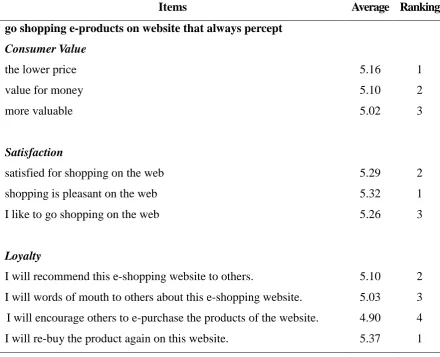
perception, the item of "the lower price"
is the most of agree for e-buyer. This
means that the consumers think of that
their percept the highest value is lower
of the price of the product on the
website (Table 1).
In addition, the most of agree item in satisfaction is "shopping is pleasant on the web". This is an important factor for consumers consider to e-purchase on this website. In loyalty, " I will re-buy the product again on this website" item present it had the highest score in loyalty concept, and it also is the most of agree item for the consumers.
Table 1 Consumers percept the value, satisfaction, and loyalty for e-shopping
Items Average Ranking
go shopping e-products on website that always percept
Consumer Value
the lower price 5.16 1
value for money 5.10 2
more valuable 5.02 3
Satisfaction
satisfied for shopping on the web 5.29 2
shopping is pleasant on the web 5.32 1
I like to go shopping on the web 5.26 3
Loyalty
I will recommend this e-shopping website to others. 5.10 2
I will words of mouth to others about this e-shopping website. 5.03 3
I will encourage others to e-purchase the products of the website. 4.90 4
For the model, this study test the
reliability and validity of the concepts
are verified. In reliability of the model, the Cronbach's α value concept in the
model is 0.80, the satisfaction is 0.76,
and the loyalty is 0.84, they are all reached to the acceptable level (α>
0.7). Moreover, in the validity of this
model, the CR value of consumer is
0.71, the satisfaction is 0.76, and the
loyalty CR is 0.87. The CR value of
each concept are all greater than 0.7,
and also expressed reached to
acceptable level (Baggzo and Yi, 1988).
Further, this study to proceed the
path analysis to verify whether
supported the hypotheses. Each of indicators, there are χ2/df =4.84, =32,
CFI=0.97,GFI=0.96,AGFI=0.93,
RMR=0.05,RMSEA=0.07. After the
model tested, the results show that CFI,
GFI, AGFI coefficient is higher than the
acceptable value, RMR value less than
0.5, and RMSEA value of less than 0.8,
they are also reached an acceptable
value, and also argue this model is get
the best fit.
For the research hypotheses
empirical results, in the whole model,
according to the loading value of each
hypotheses path, it shown the most
efficiency is the path of value on
satisfaction (β = 0.64); following are the path of value on loyalty (β = 0.61) and satisfaction on loyalty (β = 0.20).
The hypotheses of the model, the
value on satisfaction and loyalty,
respectively, that were effect of
positively and significantly, and
satisfaction for loyalty also obtained a
positively and significantly.
Conclusion
For the research hypothesis, presented
are all supported by empirical in this
study. The implications means that
customer awareness of consumer value
is an important factor for e-loyalty.
Especially, the value of consumption
will affect the customer's satisfaction
with e-shopping, because the value has
the most of impact on satisfaction.
E-shopping is not only the
improvement of service quality, also
be taken seriously the consumer
shopping products for the perception. In
the past, many studies stressed that the
industry in order to improve customer
re-care, most of the attention to the
improvement of service quality, but
cannot ignore the value of customer
consumption is also a important key
factor of loyalty. The managers must to
understand the customer's percept
consumer value, in order to obtain the
intention of customers re-consumption.
Reference
the evaluation of structural equation
models. Journal of the Academy of
Marketing Science, 16(1), 79-94 .
2. Baloglu, S., Pekcan, A., Chen, S. L.,
& Santos, J. (2003). The
relationship between destination
performance, overall satisfaction,
and behavioral intention for distance
segments. Journal of Quality
Assurance in Hospitality & Tourism,
4(3/4), 149-165.
3. Cronin, J. J., Jr., Brady, M. K., &
Hult, G. T. M. (2000) Assessing the
effects of quality, value, and
customer satisfaction on consumer
behavioral intentions in service
environments. Journal of Retailing,
76(2), 193-218.
4. Hartline, M. D. & Jones, K. C.
(1996) Employee performance cues
in a hotel service environment:
Influence on perceived service
quality, value, and word-of-mouth
intentions. Journal of Business
Research, 35(3), 207-215.
5. Heskett, J. L., Jones, T. O.,
Loveman, G. W., Sasser, W. E. Jr.
& Schlesinger, L. A. (1994) Putting
the service-profit chain to work.
Harvard Business Review, 72(2),
164-74.
6. Holbrook, M. B. (1994). The nature
of customer value in Rust. R. T., &
Oliver, R. L. Service Quality, New
Directions in Theory and Practice.
Sage Publications, London, 21-71.
7. Kotler, P. (1991). Marketing
management: analysis, planning,
implementation and control 7th ed.
NJ, Prentice-Hall, Englewood
Cliffs.
8. Industry Management, 9(5),
436-453 .
9. Monroe, K. B. (1990). Pricing:
Making profitable decision. New
York, McGraw-Hill.
10.Morgan, R. M. & Hunt, S. D. (1994).
The commitment-trust theory of
relationship marketing. Journal of
Marketing, 58(3), 20-38.
11.Ranaweera, C. & Prabhu, O. (2003).
The influence of satisfaction, trust
and switching barriers on customer
retention in continuous purchasing
setting. International Journal of
Service Industry Management,
14(3/4), 374-395.
12.Ruyter, de K., Wetzels, M., &
Bloemer, J. (1998). On the
relationship between perceived
service quality, service loyalty and
switching costs. International
Journal of Service Selnes, F. (1993).
An examination of the effect of
product performance on brand
reputation, satisfaction and loyalty.
European Journal of Marketing,