A HYBRID VANET-WSN SYSTEM FOR DRIVING
SAFETY USING EFFICIENT COMMUNICATION
PROTOCOL
Pushpender Singh
1, Amit Ashthana
2, Manik Chandra Pandey
31
PG Student, Department of Computer Science & Engg.,
Swami Vivekanand Subharti University Meerut, (India)
2,3
Assit. Professor, Department of Computer Science & Engg.,
Swami Vivekanand Subharti University Meerut, (India)
ABSTRACT
Every Year, Millions of people around the world die in car accidents and many more are stricken. Executions of
safety information such as speed limits and road conditions are used in many parts of the world but still more work
is remained. Vehicular Ad Hoc Networks should, upon implementation, collect and distribute safety information to
massively reduce the number of accidents by warning drivers about the danger before they actually face it. Such
networks comprise of sensors and On Board Units installed in the car as well as Road Side Units. The data
collected from the sensors on the vehicles can be displayed to the driver, sent to the RSU or even broadcasted to
other vehicles depending on its nature and importance. However, the VANET does not give guarantee for timely
detection of dangerous road conditions or maintain communication connectivity when the probability of low density
of road side units (e.g., in rural highways), probability of low density of vehicles (e.g., at mid night in rural areas)
and high mobility of vehicles, which may create a big problem to safety in driving. To overcome this serious
problem, we propose to hybrid the VANET with the inexpensive wireless sensor network. Therefore, sensor nodes
are deployed along the roadside to sense road conditions, and to store and forward information about dangerous
conditions to vehicles regardless of the density or connectivity of the VANET. But wireless sensor networks are
subject to energy and processing constraints. So, providing battery powered in rural areas where lack of power
supply is a big problem to do so, we can use Rechargeable Solar Batteries as an additional power resource. Along
with the concept of VANET-WSN Hybrid, new challenges occurs and should be overcome. In this paper, we find out
these challenges and propose schemes to overcome these challenges and also create an efficient vehicle-sensor and
sensor-sensor communication protocol among Hybrid VANET-WSN System.
Keywords: VANET (Vehicular Ad Hoc Network), WSN (Wireless Sensor Network), SN (Sensor Node),
RSB (Rechargeable Solar Batteries), RSU (Road Side Units), Hybrid.
I INTRODUCTION
the loss of as many as 40,000 people and economic losses are more than $230 billion. These numbers have motivated both academician and industrial researches to find out a solution. However, Vehicular networks have received deep of research work in the recent years due to the wide range of services they provide. Vehicular Ad Hoc Network (VANET) is the most important part of Intelligent Transportation System (ITS) [2], in which vehicles are fitted with some short-range and medium-range wireless communication (IEEE 802.11). In VANET two types of communication are imagined: Vehicle-to-Vehicle (V2V) and Vehicle-to-road side units (V2R), where the RSUs might be cellular base station for example. From the concept of VANET, a salient challenge is mandatory. Suppose at the mid-night in some rural area, a vehicle has a very important data packet (i.e. detection of an accident) which should be forwarded to the following vehicles immediately. The probability of low density of vehicles in the rural areas at mid-night is very high. So, in this situation the packet will be lost due to lack of presence of other vehicles or lack of presence of RSUs to receive and forward it, and arrival of the coming vehicles in the accident area is unavoidable.
The VANET is combination of highly mobile vehicles and roadside units (RSUs), each fitted with wireless communication devices and optionally with sensing units. Wireless communication can be applied between vehicles and roadside stations. On top of the VANET, applications have been developed to receive, process, share and forward real-time information about road conditions.
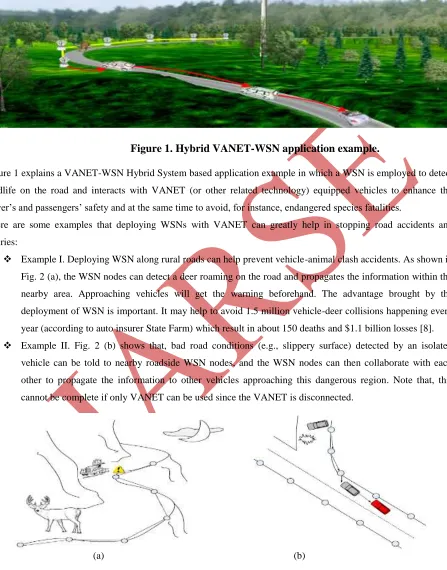
Figure 1. Hybrid VANET-WSN application example.
Figure 1 explains a VANET-WSN Hybrid System based application example in which a WSN is employed to detect wildlife on the road and interacts with VANET (or other related technology) equipped vehicles to enhance the driver’s and passengers’ safety and at the same time to avoid, for instance, endangered species fatalities.
There are some examples that deploying WSNs with VANET can greatly help in stopping road accidents and injuries:
Example I. Deploying WSN along rural roads can help prevent vehicle-animal clash accidents. As shown in Fig. 2 (a), the WSN nodes can detect a deer roaming on the road and propagates the information within the nearby area. Approaching vehicles will get the warning beforehand. The advantage brought by the deployment of WSN is important. It may help to avoid 1.5 million vehicle-deer collisions happening every year (according to auto insurer State Farm) which result in about 150 deaths and $1.1 billion losses [8].
Example II. Fig. 2 (b) shows that, bad road conditions (e.g., slippery surface) detected by an isolated vehicle can be told to nearby roadside WSN nodes, and the WSN nodes can then collaborate with each other to propagate the information to other vehicles approaching this dangerous region. Note that, this cannot be complete if only VANET can be used since the VANET is disconnected.
(a) (b)
In Hybrid VANET-WSN System, the sensors are deployed along the road to monitor and gather information regarding the weather conditions (ice fall, rain), traffic congestion on a road segment, hidden obstacles, etc. Later on, the passing vehicles are warned about the detected danger if any, through the warning messages sent by the WSN sink (Gateway). The receiver vehicle (usually the leader of a group of vehicles organized in cluster) spreads these messages to the other vehicles using the well known dissemination protocols for inter-vehicles communication. As soon as the driver is aware of the danger, he will adapt his driving skills and speed to prevent or at least alleviate the accident fatalities.
In order to contribute to efficiency of Hybrid VANET-WSN System, we mainly focus, in this paper, on the design of an architecture that provides reliable and timely dissemination of the detected dangers from the roadside sensors towards the passing by vehicles. To this end, our Hybrid VANET-WSN System must fulfill the following desirable requirements:
The proposed system should attained quality of services that proof low delay and reliable transmission from WSN towards VANETs that should be delivered to related vehicles in a timely fashion to ensure driving safety.
The proposed system should be scalable, considering the large scale of highway system in the world.
The proposed system should be flexible to changes in the real world. WSN nodes may fail or lose time synchronization, the highways may be extended or reshaped, and traffic pattern may change from time to time. It is desired that the deployment and the working parameters of VANET-WSN system can be adjusted with low overhead as the above changes happen.
Design of energy efficient & reliable protocol for inter-sensors communication.
To fulfill the above requirements, we adopted following concept are as follows:
We adopt the concept of group-based modular design to achieve scalability and flexibility. In our design, the roadside SNs are made up of sensor groups with group head that is WSN Gateway or AIN (Accident Investing Node). Each group works asynchronously and autonomously, and adjacent groups interact with each other through a WSN gateway node. Deployment or redeployment of a group does not affect others; topology and working parameter adjustments conducted within each group do not affect others, either.
The aim of energy efficiency and quality of service are achieved by (i) an event-driven duty cycle scheduling strategy which leverages the VANET to minimize energy consumption in the WSN, and (ii) we propose low-delay and low-contention communication protocols (Algorithm 1 & Algorithm 2) which ensure contention-less intra-group transmission and can reduce inter-group contentions with certain coordination costs.
II RELATED WORK
Recently, different consortiums have been created in Europe [9, 10, 11, 12, 13] which aim to make safer vehicles and roads. These consortiums are mainly integrated by car manufacturers, researchers and the European Commission. Among other projects, we highlight the following.
The CAR 2 CAR [11] communication consortium is a nonprofit industrial driven organization initiated by European vehicle manufacturers supported by fitted suppliers, research organizations and other partners. Their objective is to increase road safety and driving efficiency by means of cooperative intelligent transportation systems (ITS), vehicle to vehicle (V2V) and vehicle to infrastructure (V2I) communications.
The CVIS (Cooperative Vehicle-Infrastructure Systems) [9] project deals with intelligent co-operative systems that are based on V2V and V2I communications to achieve improvements both in the efficiency of the transport systems and in the safety of all road users. The expected benefits stem from the increased information that is available of the vehicle and its environment. With CVIS, drivers will influence the traffic control system directly and get guidance to the quickest route to their target. Road sign information will be available wirelessly and be shown on a display in the vehicle nodes. Such display units can also warn drivers of coming emergency vehicles, allowing urgent manpower to reach accidents faster with less danger for themselves and for cars along their path.
CARLINK [12] seeks to develop intelligent service platforms for vehicles. The primary application of this project is to offer real time local weather information, transit reports and other
broadcast applications. Vehicles are equipped with transceivers that are able to communicate with base stations and with other nodes of the ad hoc network. The goals of this project aim at improving car industry, telecommunication operators, private drivers, public transportation, truck traffic and other road users. New cars are foreseen to include new safety features and new kind of telecommunication services related to ITS, which will bring new kind of business opportunities to telecommunication operators.
Regarding HSVNs, several research [16, 17, 18, 19] studies have been made whose principal challenges are the architecture design. HSVNs need to include a reliable communication protocol between VANETs and WSNs, which have to interchange dynamic and static data from their respective nodes.
III SYSTEM AND PROTOCOL ARCHITECTURE
While VANETs and WSNs have common features, such as network self-organization, they also have important odds. VANET nodes are typically fitted with relatively powerful computing devices called OBUs (On Board Units). Next, since we know that VANETs node are connected to the power supply of vehicles or are located at the roadside units, they usually do not have pressure on energy consumption. In contrast, sensor nodes have extremely small physical dimensions and strong constraint in the processing and energy capabilities. For battery-powered sensor nodes, IEEE 802.15.4 [1] is a well-established radio technology that permits embedded systems to function up to years on a simple pair of AA batteries. But for providing battery powered in rural areas where lack of power supply is a big obstacle to do so, we can use RSB (Rechargeable Solar Batteries) as an additional power source.
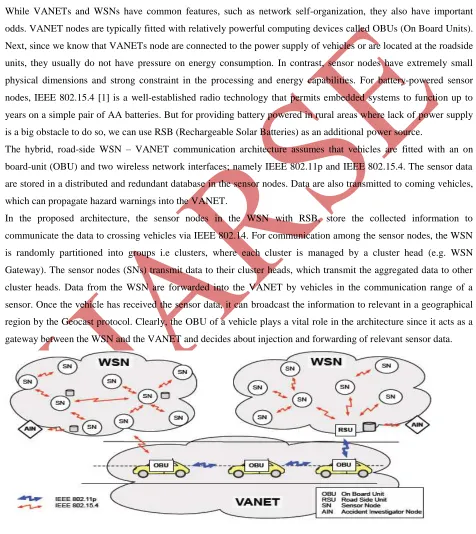
The hybrid, road-side WSN – VANET communication architecture assumes that vehicles are fitted with an on board-unit (OBU) and two wireless network interfaces; namely IEEE 802.11p and IEEE 802.15.4. The sensor data are stored in a distributed and redundant database in the sensor nodes. Data are also transmitted to coming vehicles, which can propagate hazard warnings into the VANET.
In the proposed architecture, the sensor nodes in the WSN with RSB, store the collected information to communicate the data to crossing vehicles via IEEE 802.14. For communication among the sensor nodes, the WSN is randomly partitioned into groups i.e clusters, where each cluster is managed by a cluster head (e.g. WSN Gateway). The sensor nodes (SNs) transmit data to their cluster heads, which transmit the aggregated data to other cluster heads. Data from the WSN are forwarded into the VANET by vehicles in the communication range of a sensor. Once the vehicle has received the sensor data, it can broadcast the information to relevant in a geographical region by the Geocast protocol. Clearly, the OBU of a vehicle plays a vital role in the architecture since it acts as a gateway between the WSN and the VANET and decides about injection and forwarding of relevant sensor data.
3.1 Network Deployment
The proposed system consists of vehicle nodes and sensor nodes. Each vehicle node has two communication interfaces: a IEEE 802.11 interface for communication with other vehicle nodes; and a IEEE 802.15.4 interface for communication with roadside WSNs. In our framework, each vehicle node is an onboard unit with an embedded IEEE 802.11 interface and an attached Telosb mote [25] as an IEEE 802.15.4 interface.
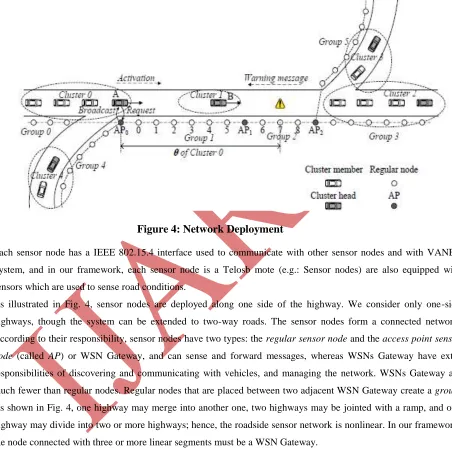
Figure 4: Network Deployment
Each sensor node has a IEEE 802.15.4 interface used to communicate with other sensor nodes and with VANET System, and in our framework, each sensor node is a Telosb mote (e.g.: Sensor nodes) are also equipped with sensors which are used to sense road conditions.
As illustrated in Fig. 4, sensor nodes are deployed along one side of the highway. We consider only one-side highways, though the system can be extended to two-way roads. The sensor nodes form a connected network. According to their responsibility, sensor nodes have two types: the regular sensor node and the access point sensor node (called AP) or WSN Gateway, and can sense and forward messages, whereas WSNs Gateway have extra responsibilities of discovering and communicating with vehicles, and managing the network. WSNs Gateway are much fewer than regular nodes. Regular nodes that are placed between two adjacent WSN Gateway create a group. As shown in Fig. 4, one highway may merge into another one, two highways may be jointed with a ramp, and one highway may divide into two or more highways; hence, the roadside sensor network is nonlinear. In our framework, the node connected with three or more linear segments must be a WSN Gateway.
Event Driven Duty Cycle Scheduling and Message Forwarding
A connected portion of vehicular nodes on a highway forms a group i.e. called cluster. Formation of cluster has been widely studied. Each cluster maintains a cluster head, a vehicular node which is running at the front of the cluster. It is responsible for communicating with roadside sensors on behalf of the whole cluster. As shown in Fig. 4, there are five clusters, where cluster 2 and cluster 3 are connected but they are on different highways.
Figure 5: Big Picture of the Hybrid VANET-WSN System
As illustrated in Fig. 5, each AP periodically broadcasts a beacon message. If the AP has stored some safety-related information that its neighboring vehicles should be aware of, it will piggyback these messages in its beacon message. When a passing cluster head hears the message, it sends its registration request to the AP.
In response to the request, the AP activates sensor nodes that are within a certain number (denoted as Ф, a system parameter) of sensor nodes along the moving direction of this cluster (called forward direction hereafter), if these sensor nodes have not been activated yet. By this, these waken-up SNs will be able to proactively monitor the conditions of the roads.
To save energy, a roadside sensor is active only when there is a vehicle cluster approaching to its sensing range within Ф hops. If there is no vehicle approaching this sensor, the sensor does not need to work.
If a dangerous condition is detected (e.g., a deer is roaming on the road), the detecting sensor node will create a warning message and forward it along the direction opposite to the moving direction of the vehicles (called
backward direction hereafter) until the message reaches the heads of all incoming clusters that requested the activation of the sensor nodes. Then, the warning message can be propagated within the clusters of vehicles by using a certain data dissemination protocol such as [26]–[28]. This way, VANET nodes are leveraged whenever possible to reduce the workload of the roadside WSN to save its energy.
3.2 VANET-WSN Communication Protocol
Sensors to Sensors communication aim to ensure reliable event detection and fast event report to WSN-Gateway.
Inter Vehicle-WSN communication is responsible for timely report of any detected event to the coming vehicles which in their turn send back the received warning messages to other WSN-Gateways on the road to their destinations. So, this will allow redundant storage of warning messages and increase the level of prevention. For example, the stored messages are used to warn the coming vehicles before they reach the dangerous area.
Vehicles to Vehicles communication ensures the dissemination of the warning messages gathered from WSN-Gateways to the whole VANET.
3.2.1 Sensors to Sensors Communication
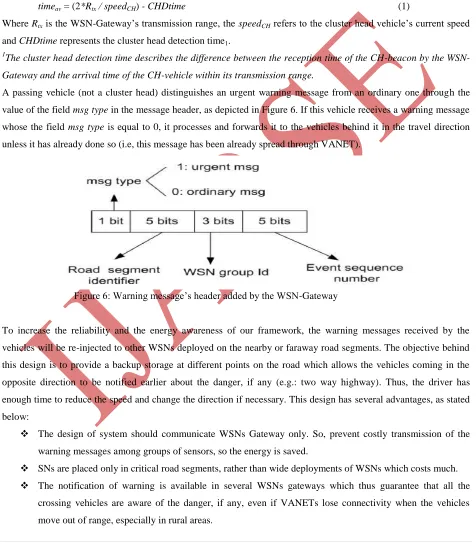
Here, we use warning message header shown in Figure 6 is exclusively added by the WSN-Gateway then the intermediate sensors relaying the detector sensor with WSN-Gateway forward a smaller packet format. As a result, the transmission delay and the consumption of energy are decreased.
To reduce the end to end delay of warning messages transmission from a detector sensor towards the cluster head vehicle, we should first minimize the maximum delay induced from the transmission of this message from the event detector sensor to the WSN-Gateway. To this end, we propose to use directional antennas rather than the Omni-directional ones. This choice is motivated by the results of the study done in [20], where the authors have demonstrated that the use of directional antenna can extend the transmission range by a factor equals to (4/ tan2Ф/2)2/α , where Ф is an angle representing the main beam width of the directional antenna and α is the path loss factor, as compared to the case of Omni-directional antenna. Hence, this allows us to monitor the events on a given road segment with less number of deployed sensors, which leads to significant decrease of the transmission delay since this metric is proportional to the number of sensors separating a reporting sensor and the WSN-Gateway.
3.2.2 Vehicle to Sensor and Sensor To Vehicle Communication
Many ITS applications are built on two key messages: namely beacon and event-driven warning. Beacon messages are periodically broadcasted by each vehicle to inform its neighbors about its presence and status. In our framework, we use this beacon message, in addition to its previous role, as a notification of arrival from the vehicles’ cluster head to the WSN-Gateway. This notification is transmitted through the IEEE802.15.4 interface of the vehicle nodes since it is equipped with two interfaces (i-e, IEEE802.11P for Vehicle to Vehicle (V2V) communication and IEEE802.15.4 to communicate with the WSN-Gateway).
In order to decrease the time taken for connection establishment between the WSN-Gateway and the vehicles’ cluster head we modify the format of the beacon broadcasted by the cluster head by adding the following fields:
Its current speed (the field is calculated as multiple of 5, so we need 5 bits to represent a speed of maximum 130km/h).
Its Id (identifier)
Notice that this modification aims at increasing the time devoted for transmitting useful information from the WSN-Gateway towards the cluster head and reciprocally. Therefore, a larger number of data bytes can be exchanged as compared to the schemes proposed in [21] and [22] which require a longer delay for connection establishment. Upon reception of the cluster head’s beacon, the WSN-Gateway starts counting down a timer equal to the ”time av” value
calculated in Equation. 1. Based on the cluster head vehicle speed, the WSN Gateway calculates the available time for information exchange with the cluster head as follows:
timeav= (2*Rtx / speedCH) - CHDtime (1)
Where Rtxis the WSN-Gateway’s transmission range, the speedCHrefers to the cluster head vehicle’s current speed
and CHDtime represents the cluster head detection time1.
1The cluster head detection time describes the difference between the reception time of the CH-beacon by the
WSN-Gateway and the arrival time of the CH-vehicle within its transmission range.
A passing vehicle (not a cluster head) distinguishes an urgent warning message from an ordinary one through the value of the field msg type in the message header, as depicted in Figure 6. If this vehicle receives a warning message whose the field msg type is equal to 0, it processes and forwards it to the vehicles behind it in the travel direction unless it has already done so (i.e, this message has been already spread through VANET).
Figure 6: Warning message’s header added by the WSN-Gateway
To increase the reliability and the energy awareness of our framework, the warning messages received by the vehicles will be re-injected to other WSNs deployed on the nearby or faraway road segments. The objective behind this design is to provide a backup storage at different points on the road which allows the vehicles coming in the opposite direction to be notified earlier about the danger, if any (e.g.: two way highway). Thus, the driver has enough time to reduce the speed and change the direction if necessary. This design has several advantages, as stated below:
The design of system should communicate WSNs Gateway only. So, prevent costly transmission of the warning messages among groups of sensors, so the energy is saved.
SNs are placed only in critical road segments, rather than wide deployments of WSNs which costs much.
To prevent unnecessary messages processing and storage, when a WSN-Gateway receives a warning message from a vehicle, it first checks if it has been already received or not through comparison of its header with the headers of the stored messages. Moreover, to limit the number of stored messages the WSN-Gateway checks the field”Event sequence number” (see Figure 6) of the received message to ascertain that it contains latest information. If so, then the message is
stored and the oldest ones among the stored messages are discarded if the storage capacity has reached its limit. Otherwise, it is removed.
3.2.3 Vehicle to vehicle (V2V) communication:
V2V (vehicle to vehicle) communication is an emergent paradigm that necessitates careful analysis and design to fulfill the expected results. In our framework, the role of V2V communication is to ensure large dissemination of the warning messages. To this end, we use a cluster based routing protocol since the vehicles are already organized in clusters for their communication with WSN-Gateways. These clusters are created using the well known clustering algorithms designed for VANETs such as Clustering for Open IVC Networks (COIN) algorithm [23] and LORA CBF [24].
As for MAC layer, the Wireless Access in Vehicular Environments (IEEE 802.11P) protocol is used to distribute spectrum for vehicular communication. However, IEEE 802.11P does not provide sufficient spectrum for reliable exchange of safety related information (like event driven warning messages) among the vehicles. To overcome this weakness of IEEE 802.11P, we are currently exploring the possibilities of applying cognitive radio technology to increase the spectrum allocated to the control channel (CCH) by WAVE, where all safety messages are transmitted. Moreover, as a perspective of this work we plan to propose a robust congestion control mechanism that ensures fast dissemination of the event-driven warning messages received from the WSN-Gateways even in case of high density or traffic jam in the highways.
IV TECHNOLOGY COMPONENTS
This section gives the core technological components used in Hybrid VANET-WSN System architecture.
IEEE 802.11p.
-
IEEE 802.11p is a extension to the IEEE 802.11 standard dedicated to vehicular environments. It is derived from IEEE 802.11a standard, but PHY and MAC layers are modified to support low-latency communication among vehicles. IEEE 802.11p operates at a frequency band specifically allocated for road safety, such as 5.850–5.925 GHz (75 MHZ) in the US and 5.875–5.90 GHz (30 MHz) in Europe with possible future extension, defines data rates from 3 to 27 MHz for 10 MHz channels (optionally 6 to 54 MHz for 20 MHz channels), OFDM modulation and maximum power levels of 44.8dBm. The basic MAC is the same as the well known IEEE 802.11 Distributed Coordination Function (DCF). It adopts concepts from Enhanced Distributed Channel Access (EDCA) of 802.11e, like Access Category (AC) and Arbitrary Inter-Frame Space (AIFS), in order to differentiate priorities among applications. IEEE 802.11p is designed as a multi-channel scheme, where nodes can switch between channels (US) or transceiver on multiple channels simultaneously (dual transceiver in Europe). For advanced networking algorithms, we use standard-compatible extensions to control radio parameters (transmit power and others) on a per-packet basis.V CONCLUSION & FUTURE WORK
An Hybrid WSN system was proposed in this paper to overcome the inherent limitations of pure VANET-based system. Those protocols were designed for efficient vehicle-sensor and sensor-sensor interactions. In our framework, we have provided a design guideline for Hybrid VANET-WSN System aiming to delegate the heavy tasks (in terms of energy consumption and computation) to the vehicles while alleviating the tasks performed by the sensors nodes (SNs). Likewise, we have devised a sleep/active mode scheduling scheme, carried out by the WSN-Gateway, which requests a given sensor to wake up or go to sleep according to the assessed danger level of the area around it. So, this ensures high efficiency of events detection and saves the energy as it is consumed only if necessary.As future work, we would like to introduce the beacon congestion problem in VANETs in order to prevent delaying the dissemination of the warning messages among the vehicles.
REFERENCES
[1] IEEE, “MAC and PHY Specifications for Low Rate Wireless Personal Area Networks IEEE 802.15.4- 2006,” July 2006.
[2] F. Akyildiz , Y. S. Subramaniam, W. Su and E. Cayirci, “A Survey on Sensor Networks,” IEEE
Communications Magazine, vol. 40, no. 8, pp. 102-114, August 2002.
[3] CROSSBOW TECHNOLOGY INC., “WSN,” http://www.xbow.com/, web Link.
[4] E. LLC, “Wieye - sensor board for wireless surveillance applications,” http://www.easysen.com/WiEye.htm. [5] F. Kargl and E. Weingatner, “A Prototype Study on Hybrid Sensor-Vehicular Networks,” ”Wireless
Sensor Networks”, 2007.
[7] B. Zhou , U. Lee, M. Gerla, E. Magistretti, P. Bellavista, and A. Corradi, “Mobeyes: smart mobs for urban monitoring with a vehicular sensor network,” IEEE, Wireless Communications ,Oct. 2006.
[8] State Farm, “State Farm Statistics,” http://www.philadelphiaaccident- lawyers.com/auto-car-accidents/deer-roadsafety. html, 2005, web Link.
[9] CVIS. Cooperative Vehicular -Infrastructure Systems. http://www.cvisproject.org/
[10] COME. Co-operative Intelligent Road Transport Systems: Vehicle-to-Vehicle and Vehicle-to- Infrastructure communications.
[11] C2C. Car-To-Car Communication Consortium
[12] CARLINK. Wireless Traffic Service Platform for Linking Cars. [Online] http://carlink.lcc.uma.es/.[13] eSafety Forum. [Online] http://www.esafetysupport.org/
[14] INFOTRANSIT. Reial Automòbil Club de Catalunya (RACC). [Online] http://infotransit.es. [15] Google Maps. http://maps.google.com/.
[16] J. Tan. and F. Kong, “A Collaboration-based Hybrid Vehicular Sensor Network Architecture”. IEEE International Conference on Information and Automation. Zhangjiajie, China, 2008.
[17] F. Kargl. , E. Weingärtner “A Prototype Study on Hybrid Sensor Vehicular Networks”. Germany. 2007. [18] O. Ugus, J. Bohli, D. Westhoff. “A Secure and Resilient WSN Roadside Architecture for Intelligent
Transport System”. ACM Workshop on Wireless Security. Alexandria, Virginia, USA, 2008.
[19] G. Chow, E. Hossain, V. Leung, R. McLeod, J. Mišic, V. Wong, O. Yang. “Vehicular telematics over heterogeneous wireless networks: A survey. Computer Communications”. pp. 775–793. Elsevier 2010.
[20] Hong-Ning Dai, ”Throughput and Delay in Wireless Sensor Networks using Directional Antennas”, In Proc. of the 5th International Conference on Intelligent Sensors, Sensor Networks and Information Processing (ISSNIP 2009), Melbourne, Australia, Dec. 7-10, 2009.
[21] Y. Wang, H. Qin, Z. L, , X. Lu and W. Zhang, ”An integrated Network of Roadside Sensors and Vehicles for Driving Safety: Concept, Design and Experiments”, In Proc. of IEEE International Conference on Pervasive Computing and Communications, (PerCom), Mannheim, Germany, Mar. 29 - Apr. 2, 2010. [23] J. Blum, A. Eskandarian, and L. Hoffman, ”Mobility management in IVC networks”, In Proc. of IEEE
Intelligent Vehicles Symposium, Columbus, Ohio, USA, Jun. 9-11, 2003.
[24] R. A. Santos, A. Edwards, R. Edwards, and L. Seed, ”Performance evaluation of routing protocols in vehicular adhoc networks”, The International Journal of Ad Hoc and Ubiquitous Computing, vol. 1, no. 1/2, pp. 80-91, 2005.
[25] CROSSBOW TECHNOLOGY INC., “WSN,” http://www.xbow.com/, web Link.
[26] P. Costa, I. Leontiadis, and C. Mascolo, “Persistent Content based Information Dissemination in Hybrid Vehicular Networks,” PerCom ’09.
[27] D. Frey, P. Costa, M. Migliavacca, , and L. Mottola, “Towards Lightweight Information Dissemination in Inter-Vehicular Networks,” VANET ’06.
[28] N. Wisitpongphan, O. Tonguz, F. Bai, P. Mudalige, and V. Sadekar, “Broadcasting in VANET,”