Cryptanalysis of a public key cryptosystem based on
Diophantine equations via weighted LLL reduction
Jintai Ding
∗Momonari Kudo
†Shinya Okumura
‡Tsuyoshi Takagi
‡Chengdong Tao
§April 7, 2016
Abstract
Post-quantum cryptography now plays a central role in cryptography. Many candidates of post-quantum cryptosystems (PQC) have been already proposed but require public keys of large sizes. Constructing PQC with public keys of small sizes is strongly desired. In [Oku15], Okumura proposed a public key cryptosystem based on the difficulty of solving Diophantine equations of degree increasing type (DEC for short). DEC is proposed as an analogue of the Algebraic Surface Cryptosystem [AGM09]. DEC has been expected to avoid the analogues of all attacks against ASC (and the previous versions of ASC). Moreover, DEC has been expected to be a candidate of PQC and to achieve the high security with public keys of small sizes, e.g., about 1,200 bits with 128 bit security.
In this paper, we propose a polynomial time attack against DEC. We show that the security of DEC depends on the difficulty of finding special (relatively) short vectors in some lattices obtained from a public key and a ciphertext. The most important target vector in our attack is not necessarily a shortest vector in a lattice of low rank but only some entries are relatively small. In our attack, the LLL algorithm with respect to well-known norms such as thep-norms (1≤p≤ ∞) does not seem to work well for finding such vectors. The most technical point of our method is to heuristically find a special norm, which we call a weighted norm, such that the most important target vector becomes a (nearly) shortest vector in a lattice of low rank. We call the LLL algorithm with respect to a weighted norm the “weighted LLL algorithm” in this paper. Our experimental results by a standard PC with Magma suggest that our attack via the weighted LLL algorithm can break the one-wayness of DEC for 128 bit security proposed in [Oku15] with sufficiently high probability.
Key words—Weighted LLL reduction, Public-key cryrtosystem, Post-quantum cryptosystem, Diophantine equation
∗Department of Mathematical Sciences, University of Cincinnati.
Contents
1 Introduction 3
1.1 Our Contribution . . . 3
1.2 Weighted LLL . . . 4
1.3 Experimental Verification of Our Attack . . . 4
2 Description of Weighted LLL Reduction 6 2.1 Definition of Weighted Lattice . . . 6
2.2 Weighted LLL Reduction . . . 6
3 Overview of DEC 7 3.1 Polynomials of Degree Increasing Type . . . 7
3.2 Key Generation . . . 8
3.3 Encryption . . . 9
3.4 Decryption . . . 9
3.5 Parameter Size . . . 10
3.6 Toy Example of DEC . . . 11
4 Attack against DEC in Polynomial Time via Weighted LLL Reduction 11 4.1 Idea of Our Attack . . . 12
4.1.1 Step 1: Determination of s′j forj = 1 and 2 . . . 12
4.1.2 Step 2: Fixing of A Candidate off . . . 13
4.1.3 Step 3: Recovery ofme . . . 14
4.2 Algorithm of Our Attack . . . 15
4.3 Cryptanalysis of Toy Example . . . 16
4.3.1 Step 1: Determination of s′j =sj −sj+1 forj= 1 and 2 . . . 17
4.3.2 Step 2: Fixing of A Candidate off . . . 18
4.3.3 Step 3: Recovery ofme . . . 18
5 Complexity Analysis 20 5.1 The Complexity of Step 1 . . . 21
5.2 The Complexity of Step 2 . . . 22
5.3 The Complexity of Step 3 and The Total Complexity of Our Attack . . . 22
6 Experimental Results on Our Attack 24
7 Conclusion 25
1
Introduction
Post-quantum cryptography is now receiving a great amount of attention. Moreover, it is announced that National Security Agency [NSA] is planning for transitioning to quantum resistant algorithms, and National Institute of Standards and Technology [NIST] published a draft of the report on post-quantum cryptography NISTIR 8105. Many candidates of post-post-quantum cryptosystems (PQC) have been proposed up to the present, e.g., lattice-based cryptosystems, code-based cryptosystems and multivariate public key cryptosystems (see [BBD08, DGS06] for details). However, these PQC require public keys of large sizes, and thus it is very important task that we find computationally-hard problems for constructing PQC with public keys of small sizes.
The Diophantine problem is well-known to be a hard problem (see [DMR76]) and has been ex-pected to be used to construct PQC. (The Diophantine problem here means that given multivariate polynomials with integer coefficients, find common integral or rational zeros of them.) In fact, a public key cryptosystem [LCL95] and key exchange protocols [BHHKP14, HP13, Yos11] based on the difficulty of the Diophantine problem have been already proposed. However, the one-wayness of the cryptosystem in [LCL95] is broken (see [Cus95]), and the protocols in [BHHKP14, HP13, Yos11] are said to be impractical (see Proposition 2 in [HP13]).
The Diophantine problem is generalized to problems over arbitrary rings. The Algebraic Surface Cryptosystem (ASC) proposed in [AGM09] is based on the difficulty of the Diophantine problem over global function fields which is proved to be unsolvable in general [Phe91, Vid94]. In [AGM09], it is analyzed that we may use public keys of sizes of about only 500 bits. However, the one-wayness of ASC is broken by the ideal decomposition attack proposed in [FS10].
In [Oku15], Okumura proposed a public key cryptosystem based on the difficulty of solving Diophantine equations of degree increasing type overZ(see Section 3 in this paper for the definition of a polynomial of degree increasing type). We refer to the cryptosystem as DEC for short. In Remark 3.2 of [Oku15], Okumura shows that Diophantine equations of degree increasing type are generally unsolvable. DEC is proposed as a number field analogue of ASC and a candidate of PQC. The main ideas to avoid the analogues of all attacks [FS10, Iwa08, UT07, Vol07] against ASC (and the previous versions [AG04, AG06, AG08] of ASC) are to twist a plaintext by using some modular arithmetic and to use some random polynomials with large coefficients in the encryption process. In Section 4 of [Oku15], it is analyzed that by the above ideas, the number of possible parameters increases, and thus finding the correct plaintext will become infeasible. In addition, the reason why polynomials of degree increasing type are adopted in DEC is to decode a plaintext uniquely even if the plaintext is twisted. In Section 3, we give a brief review of DEC and the recommended parameters for DEC.
Another advantage of DEC is that sizes of public keys are small, e.g., about 1,200 bits with 128 bit security (see Remark 3.5.1), as desired in post-quantum cryptography. Note that well-known efficient candidates of PQC [LPR10, MTSB13, TSTD13] require public keys whose sizes are about 10 times larger than 1,200 bits to achieve 128 bit security. Thus it is important to analyze the security of DEC.
1.1 Our Contribution
have a linear system and need to find its appropriate solution, which is equivalent to a problem of finding an appropriate vector in the lattice obtained by solving the linear system. We use a solution obtained in the first (resp. second) step to construct a linear system in the second (resp. third) step. After finding appropriate solutions of the linear systems in all the steps, it is possible to recover a plaintext with sufficiently high probability by applying Babai’s nearest plane algorithm [Bab86] and some modular arithmetic.
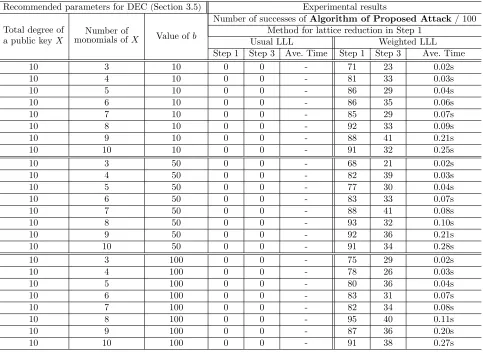
Our experimental results on our attack in Section 6 show that finding a correct solution in the first step allows us to break DEC with sufficiently high probability. More precisely, after we find a correct solution in the first step, we can solve the linear systems in the second and third steps (note that in the third step, we may use an incorrect solution obtained in the second step). Thus, the key point of our attack is whether the first step succeeds or not.
The lattice obtained in the first step of our attack has low rank, (e.g., 3-rank in many cases), and thus finding a target vector in the lattice seems to be performed by basis reduction algorithms such as the LLL algorithm [LLL82]. However, in Section 4.3, we show an example that the usual LLL algorithm fails in finding the target vector in the first step. Our heuristic analysis on the failure of the example is as follows: the target vector is not necessarily shortest in the lattice of low rank but only some entries are relatively small, i.e., the target vector is a relatively short vector with entries of unbalanced sizes.
1.2 Weighted LLL
In order to deal with such situations, we apply the weighted LLL algorithm, which is the LLL algorithm with respect to a special norm called weighted norm for some weight, to our attack. We find heuristically a new weighted norm so that the target vector becomes (nearly) shortest in some lattice of low rank with respect to this new norm. By a weighted norm for a vectora= (a1, ..., an),
we mean the norm:
∥a∥=
√
(a1w1)2+. . .+ (anwn)2,
wherewi’s are positive real numbers, which we call the weight factors. Note that as we will see in
Sec-tion 4.3, using other well-known norms, e.g., thep-norms (1≤p≤ ∞)∥a∥p := (|a1|p+. . .+|an|p)
1
p,
in the LLL algorithm does not seem to be effective in finding the target vector. Our method can be also viewed as changing the scale of a lattice to carefully control the entries of a LLL reduced basis of the lattice. Such a method has been used in Coppersmith’s method [Cop97] (see also Chapter 19 of [Gal12]) and in [FGR13]. In particular, we consider 2-power integers as wi (1≤i≤n) to use
the knowledge of the bit length of our target vector, such as [FGR13].
1.3 Experimental Verification of Our Attack
This paper is organized as follows: In Section 2, we give the definition of a weighted norm and describe the weighted LLL algorithm. In Section 3, we give a brief review of DEC. In Section 4, we describe the outline and some assumptions of our attack, and we also give an algorithm of our attack and a toy example to illustrate our attack. In Section 5, we analyze the complexity on our attack. In Section 6, we give some experimental results on the attack.
Acknowledgements The authors deeply thank Shun’ichi Yokoyama for many helpful comments,
corrections, suggestions on this research, and discussions in the implementations on Magma. The authors also thank Steven Galbraith for helpful comments on Coppersmith’s method and thank Masaya Yasuda, the supervisor of the second author, for helpful comments and corrections. This work was supported by CREST, JST.
Notation
Throughout this paper, we denote by R[x] := R[x1, . . . , xn] the polynomial ring with n variables
over a ring R. For every i = (i1, . . . , in) ∈ (Z≥0)n and (a1, . . . , an) ∈ Rn, we denote the element
ai1
1 · · ·ainn ∈R, the monomialx i1
1 · · ·xinn ∈R[x] and the value
∑n
k=1ikbyai,xi and
∑
i, respectively. We can write any element f(x) = f(x1, . . . , xn) ∈R[x]∖{0} (sometimes we also write f simply)
in a unique way as a sum of terms:
f(x) =∑
i∈Λ
cixi,
where Λ is the finite subset of (Z≥0)n and ci ∈ R∖{0} for i∈ Λ. We then write ci(f) := ci for
i∈Λf := Λ. We call Λf the support off. We denote bywf the total degree off. For every element
a= (a1, . . . , an)∈Rn and invertible elementd∈R×, we denote the element (a1/d, . . . , an/d)∈Rn
by a/d. Then we denote the value of f(x) at a/d by f(a1/d, . . . , an/d) or f(a/d). In addition, if
R= ZorQ, then we use the following notation: Γf := {
(
i, bi
)
∈Λf ×Z>0 ; 2bi−1 ≤ |ci(f)|<2bi},
H(f) := max{|ci(f)|; i∈Λf}.
We callH(f) the height off. In addition, if for a polynomialf ∈Z[x], the support Λf ={i1, . . . , iq}
is ordered by the order coming from the lexicographical order on the monomials off, then we denote the sequence of the ordered coefficients of f by the vectorf =
(
ci1(f), . . . , ciq(f)
)
.
Anm-dimensional lattice is defined as a discrete additive subgroup of anm-dimensional vector space over R. It is well-known that for any lattice L, there exist R-linearly independent vectors generating L as a Z-module. The rank ofL is its rank as a Z-module. For any lattice in Rm and its basis {b1, . . . ,br}, letU be an r×m matrix whosei-th row vector coincides withbi for each i.
Then we callU the basis matrix of the lattice. Let⟨·,·⟩:Rn×Rn→Rbe the natural inner product for somen∈Z>0. For a vectorv∈Rn, we denote the Euclidean norm ofvby ∥v∥. We define the
rounding function ⌊·⌉:R→ Zas⌊c⌉:=⌊c+ 12⌋ for anyc∈R. Let M be an m×nmatrix over Z and φM the homomorphism as additive groups between Zm →Zn defined byv 7→vM. Then the
2
Description of Weighted LLL Reduction
In this section, we define weighted norms and weighted lattices, and give the weighted LLL algo-rithm.
2.1 Definition of Weighted Lattice
Basically, a norm on the lattices in Rm means the p-norm for some p >0 (the 2-norm is the same as the Euclidean norm). On the other hand, a weighted lattice is defined as a lattice endowed with a special norm which we call a weighted norm. The formal definitions of weighted norms and weighted lattices are as follows:
Definition 2.1.1 For a vector w= (w1, . . . , wm)∈(R>0)m, we define the map∥ · ∥w:Rm→Ras
follows:
∥a∥w:=
√
(a1w1)2+· · ·+ (amwm)2 (a= (a1, . . . , am)∈Rm). (2.1.1)
Then ∥ · ∥w is a norm on Rm, and we call it the weighted norm forw. We define aweighted lattice
for w in Rm as a lattice endowed with the weighted norm for w. For any lattice L ⊂ Rm and a vectorw∈(R>0)m, we denote Lby Lw if we consider L as a weighted lattice for w.
It is easy to show the following lemma.
Lemma 2.1.2 Let L ⊂Rm be a lattice and w = (w1, . . . , wm) ∈ (R>0)m a vector. We setW as
the following diagonal matrix:
W :=
w1
. .. . ..
wm
. (2.1.2)
We define the isomorphism fW : Rm −→ Rm by x 7→ xW. Then the following are equivalent for
any x∈ Lw:
(1) The vector xis a shortest vector in Lw.
(2) The vector xW is a shortest vector infW (L) with respect to the Euclidean norm.
Remark 2.1.3 Lemma 2.1.2 shows that we can find a shortest vector in Lw if we find a shortest vector in fW(L) with respect to the Euclidean norm.
2.2 Weighted LLL Reduction
In this subsection, we define a weighted LLL reduced basis and give an algorithm to find such a basis.
Definition 2.2.1 Let L, W and fW be as in Lemma 2.1.2. We call an ordered basis B =
{b1, . . . ,bn} of L a weighted LLL reduced basis if fW(B) = {b1W, . . . ,bnW} is an LLL reduced
We give an algorithm to find a weighted LLL reduced basis.
The weighted LLL algorithm
Input: a vector wand a basis B={b1, . . . ,bn} ofL.
Output: a weighted LLL reduced basis B′ ={b1′, . . . ,b′n}of L.
(1) Compute the basis{b1W, . . . ,bnW}of the latticefW(L), whereW andfW are as in Lemma
2.1.2.
(2) Compute an LLL reduced basis Bw={bw1 , . . . ,bwn} of fW(L) with respect to the Euclidean
norm.
(3) Computeb′i:=bwi W−1 (1≤i≤n), and returnB′ ={b′1, . . . ,b′n}.
In our cryptanalysis (Section 4), the most important vector is not necessarily a shortest vector in a lattice of low rank but only some entries are relatively small. In order to find such a vector, we use the weighted LLL algorithm which can carefully control the entries of a weighted LLL reduced basis (see Section 4.3).
Remark 2.2.2 Controlling the entries of a basis output by the LLL algorithm have been used in Coppersmith’s method [Cop97] (see also Chapter 19 of [Gal12]) and in [FGR13]. In their method, the scale of a lattice (or equivalently an inner product used in the LLL algorithm) is changed by heuristic ways. Changing the scale of a lattice or an inner product is equivalent to changing a norm from the Euclidean norm to a weighted norm. In particular, our method for choosing a weighted norm is the same as the method in [FGR13] (see Step 1-2 of our algorithm in Section 4.2).
3
Overview of DEC
In this section, we give a brief review of DEC (see Section 3 in [Oku15] for details). As we mentioned in Section 1, DEC has been expected to be one of candidates of post-quantum cryptosystems which has public keys of small sizes, e.g., about 1,200 bits with 128 bit security (see Remark 3.5.1). Note that 1,200 bits is about 10 times smaller than sizes of public keys of efficient candidates of PQC [LPR10, MTSB13, TSTD13].
3.1 Polynomials of Degree Increasing Type
Definition 3.1.1 A polynomialX(x)∈Z[x]∖{0}is of degree increasing typeif the map ΛX −→Z≥0 ; i7→
∑
i
is injective, where we recall that ∑i=∑1≤k≤nik fori= (i1, . . . , in).
Remark 3.1.2 LetX(x) be a polynomial in Z[x]∖{0}.
(1) The polynomial X(x) is of degree increasing type if and only if the total degrees of the monomials of X(x) are different each other.
(2) IfXis of degree increasing type, then the support ΛX is a totally ordered set by the following
order≻: for two elements (i1, . . . , in) and (j1, . . . , jn) in ΛX, we have (i1, . . . , in)≻(j1, . . . , jn)
Throughout this paper, for a polynomial X of degree increasing type, we endow ΛX with the
total order described in Remark 3.1.2 (2).
Example 3.1.3 The polynomialX(x, y, z) := 3x3y2z−4x2y2−xyz+ 5yz+y+ 11∈Z[x, y, z] is of degree increasing type.
Now, we describe the DEC scheme according to [Oku15]. Note that although in [Oku15] the security parameter is not suggested, here let us set the security parameter λ.
3.2 Key Generation
Secret Key :
• A vector a:= (a1, . . . , an)∈Zn.
Public Key :
(1) An integerdsuch that gcd (ai, d) = 1 for all 1≤i≤n.
(2) An integeresuch that gcd (e, φ(d)) = 1, whereφ is the Euler function.
(3) An irreducible polynomialX(x)∈Z[x] of degree increasing type such that X(a/d) = 0 and #ΛX ≤wX, where ΛX and wX denote the support and the total degree of X, respectively. Construction of X(x) :
(1) Choose a finite subset Λ ⊂(Z≥0)n such that #{
∑
i ; i ∈ Λ} = #Λ≥ 3 and 0 ∈ Λ, where 0 := (0, . . . ,0)∈(Z≥0)n.
(2) Let k be the maximal element in Λ (note that Λ is a totally ordered set with respect to the order described in Remark 3.1.2 (2)). Choose a random non-zero integer ci for each
i∈Λ∖{k,0}. For a choice ofci, see Remark 3.5.1 (2).
(3) Choose random integers ck and c0 such that
ckak+c0dw = −
∑
i∈Λ∖{k,0}
ciaidw−
∑
i, (3.2.1)
where w:= max{∑i; i∈Λ}. (4) Set ΛX := Λ and X(x) :=
∑
i∈ΛXcix i.
For a choice of X and sizes of e,dand ai (i= 1, . . . , n), see Section 3.5 below.
Remark 3.2.1 There exist integersck and c0 such that the equality (3.2.1) is satisfied because ai
3.3 Encryption
Plaintext : A polynomialm∈Z[x1, . . . , xn] such that
(a) Λm= ΛX,
(b) 1< ci1,...,in(m)< dfor all (i1, . . . , in)∈Λm,
(c) gcd (ci1,...,in(m), d) = 1 for all (i1, . . . , in)∈Λm. Encryption Process :
(1) Choose an integer N ∈ Z>0 uniformly such that N d >2λH(X). For an upper bound ofN,
see Section 3.5 below.
(2) Construct the twisted plaintextme (x)∈Z[x] by putting Λme := Λmandci(me) :=ci(m)e (modN d)
(0< ci(me)< N d,i∈Λme).
(3) Choose a random f(x)∈Z[x] uniformly such that (a) Λf = ΛX,
(b) H(me)< ck(f)< N dand gcd
(
ck(f), d
)
= 1, wherek is the maximal element in Λf.
(4) Choose random polynomials sj(x), rj(x) ∈ Z[x] uniformly with Γsj = ΓX and Γrj = Γf
(j∈ {1,2,3}).
(5) Put cipher polynomialsF1(x), F2(x) and F3(x) as follows:
Fj(x) := me(x) +sj(x)f(x) +rj(x)X(x) (1≤j ≤3).
Finally, send (F1(x), F2(x), F3(x), N).
3.4 Decryption
Decryption Process :
(1) By substituting a/d, a zero of X(x), into Fj(x) (j∈ {1,2,3}), we obtain
hj :=Fj(a/d) =me(a/d) +sj(a/d)f(a/d) (1≤j ≤3).
Compute
H1 := (h1−h2)d2wX = (s1(a/d)−s2(a/d))f(a/d)d2wX,
H2 := (h1−h3)d2wX = (s1(a/d)−s3(a/d))f(a/d)d2wX.
(2) Computeg:= gcd (H1, H2). If gcd (g, d)>1, then let d′ be the smallest factor of gsatisfying
gcd (d, g/d′) = 1 and replaceg by g/d′.
(3) ComputeH :=h1d2wX (modg) andµ:=Hd−wX(modg).
(4) Obtain the plaintext polynomial m(x) from µ or µ−g by using an algorithm described in Sections 3.4 and 3.5 of [Oku15].
3.5 Parameter Size
In Section 5 of [Oku15], the sizes of public/secret keys and the ciphertext are estimated so that DEC can be expected to have 128 bit security under some assumptions. In the following, we give their sizes under the same assumptions as [Oku15] to analyze the complexity of our attack.
(1) The sizes of a,d,eand N:
2λ2 ≤d <2
λ
2+1, (λ+ 1) + (λ
2 + 1)wX ≤e <2
(
(λ+ 1) + (λ
2 + 1)wX
)
,
2⌈nλ−1⌉
φ(d) d≤ |ai|<
2⌈nλ−1⌉+1
φ(d) d(i∈ {1, . . . , n}), 2
λ+(λ2+1)(wX−1) ≤N <2λ+1+(λ2+1)(wX−1).
We assume that |ci(X)|<2b for any i∈ΛX ∖{k,0}, where kis the maximal element in ΛX (cf.
[Oku15], Section 5).
(2) The size of a secret key is at most
(
⌈ λ
n−1⌉+ 1
)
n+⌈log2 d−log2 φ(d)⌉
bits.
(3) The size of a public key is at most
(
⌈ λ
n−1⌉+ (
λ
2 + 2 +b) +⌈log2 d−log2 φ(d)⌉
)
wX+ (λ+ 1) +⌈log2 e⌉
bits.
(4) The size of a ciphertext is at most
3 2
(
wX2+wX
)
(λ+ 1 + (λ+ 2)wX +⌈log2 wX⌉) +λ+ 1 + (
λ
2 + 1) (wX −1) (3.5.1) bits. Note that the size of each coefficient ofFi is at most λ+ 1 + (λ+ 2)wX+⌈log2 wX⌉bits
fori= 1, 2, and 3.
Remark 3.5.1 (1) In Section 4.5 of [Oku15], it is pointed out that we should use a polynomialX
satisfyingwX ≥5,n≥3 and some conditions as a public key in order to avoid finding rational
solutions to X = 0. However, polynomials of degree increasing type are in a special class of polynomials, and finding rational zeros of such polynomials may be easier than finding those of general polynomials. Moreover, although finding rational zeros of polynomials of higher degree seems to be difficult in general, we should consider sizes of public keys and ciphertexts. Thus we recommend to useX of degree 10 as a public key.
(2) In Section 5 of [Oku15], it is pointed out that for a public keyX, we may choose ci(X)≤210
(i∈ΛX∖{k,0}), wherekis the maximal element in ΛX. However, since solving Diophantine
equations of degree increasing type may be easier than solving more general Diophantine equations as we mentioned above, we should also consider using largerci(X) (i∈ΛX∖{k,0})
(3) When λ = 128, wX = #ΛX and b = 10, we generated 100 public keys X randomly and
measured their sizes. As a result, their average size is about 1,200 bits which is about 10 times smaller than sizes of public keys in well-known efficient candidates of PQC [LPR10, MTSB13, TSTD13].
3.6 Toy Example of DEC
In the following, we give a toy example of DEC in the case ofn= 2.
Secret Key : a= (a, b) = (47,49)∈Z2.
Public Key :
(d, e, X) = (5,17,125x3+ 675y−110438).
(ΛX ={(3,0),(0,1),(0,0)},k= (3,0), H(X) = 110438.)
Plaintext : m(x) =m(x, y) = 3x3+ 3y+ 2.
Objects for Encryption :
(1) N = 353408 (N d= 1767040).
(2) me(x) =me(x, y) = 146243x3+ 146243y+ 131072 (H(me) = 146243).
(3) f(x) =f(x, y) = 949843x3+ 1324952y+ 1109775.
(ck(f) = 949843,H(me) = 146243< ck(f) = 949843<1767040 =N d.)
(4) sj and rj (1≤j≤3) :
s1 = 115x3+ 924y+ 126337, s2 = 82x3+ 962y+ 89939,
s3 = 67x3+ 977y+ 121816, r1= 691019x3+ 1363650y+ 1329029,
r2 = 852655x3+ 1584164y+ 2007688, r3 = 940020x3+ 2016302y+ 1144882.
(5) Cipher Polynomials: Fj(x) :=me(x) +sj(x)f(x) +rj(x)X(x) (1≤j ≤3).
F1 = 195609320x6+ 1666918487x3y+ 43979457762x3+ 2144719398y2+ 18714355042y−6569529455, F2 = 184469001x6+ 1795957655x3y−8395474520x3+ 2343914524y2−53364106711y−121912862547, F3 = 181141981x6+ 1903319645x3y+ 12109757546x3+ 2655481954y2−59418815676y+ 8750004156.
4
Attack against DEC in Polynomial Time via Weighted LLL
Re-duction
In this section, we present an algorithm of our attack against DEC via the weighted LLL al-gorithm. We use the following notation described in Notation of Section 1: for a polynomial
h =∑i∈Λ
hci(h)x
i ∈ Z[x], we define h := (c
i1(h), . . . , ci#Λh(h)
)
, where Λh ={i1, . . . , i#Λh} is the
support of h. Note that Λh is an ordered set (see Notation in Section 1).
Recall from Sections 3.2 and 3.3 that a public key and a ciphertext are (d, e, X)∈Z2×(Z[x]) and (F1, F2, F3, N)∈(Z[x])3×Z, respectively. Letm∈Z[x] be a plaintext. Note thatFj =me+sjf+rjX
uniformly according to Section 3.3, respectively. We fix ΛX ={i1, . . . , iq}withi1≻ · · · ≻iq, where
the total order ≻on ΛX is given in Remark 3.1.2 (2). Throughout this section, putq:= #ΛX Let
kbe the maximal element in ΛX. Note that it is sufficient for recovering the plaintextm to recover
e
m, and that the supports ofm,me,sj,rj andf (1≤j ≤n) are the same as ΛX. This condition on
the supports of polynomials allows us to assume ΛF1 = ΛF2 = ΛF3.
4.1 Idea of Our Attack
Before we give an algorithm of our attack, we describe the idea of our attack. Recall from Section 3 that in DEC, we use the cipher polynomials of the forms
Fj(x) :=me(x) +sj(x)f(x) +rj(x)X(x) for 1≤j≤3.
We reduce recovering me to finding special solutions of linear systems obtained from the public key
X and the ciphertext (F1, F2, F3, N) by linearization techniques described below.
We have the following equalities forj= 1 and 2 from the way to construct the cipher polynomials:
Fj(x)−Fj+1(x) = (sj(x)−sj+1(x))f(x) + (rj(x)−rj+1(x))X(x). (4.1.1)
Since the cipher polynomials F1(x), F2(x), F3(x) and the public key X(x) are known, we may
obtain f(x) if we determine s1(x)−s2(x) ands2(x)−s3(x). We set
s′j(x) := sj(x)−sj+1(x),
r′j(x) := rj(x)−rj+1(x),
Fj′(x) := Fj(x)−Fj+1(x)
= s′j(x)f(x) +rj′(x)X(x) (j= 1 and 2), g(x) := s′2(x)r′1(x)−s′1(x)r′2(x).
We then have the following equalities:
F1′(x) = s′1(x)f(x) +r′1(x)X(x), (4.1.2)
F2′(x) = s′2(x)f(x) +r′2(x)X(x), (4.1.3)
g(x)X(x) = s′2(x)F1′(x)−s′1(x)F2′(x). (4.1.4)
4.1.1 Step 1: Determination of s′j for j= 1 and 2
Here, we describe how to determine s′j forj= 1 and 2. (As we mentioned in Section 1, the vectors
s′j (j = 1 and 2) are the most important target vectors). In the equality (4.1.4), we regard the coefficients ofs′j(x) andg(x) as variables. We then obtain the linear system uA=0, whereAis a ((2q+ #ΛX2)×#ΛX3) matrix. We denote by L′1 the kernel lattice of A, where the kernel lattice
of A is defined as the nullspace of A (see Notation in Section ??). Let L1 be the lattice spanned
by the vectors consisting of the 1-(2q)th entries of the elements in L′1. Experimentally, the rank of L1 is equal to 3 in many cases (see Remark 6.0.1 in Section 6). Thus, we assume the following
condition:
Moreover, as we will see in Section 4.3, the correct (s′1,s′2) has the property described in Sections 1 and 2 so that the usual LLL algorithm does not work well to find (s′1,s′2). Note that this is true in many cases because of the construction of X (cf. Section 3.2). Thus, we use the weighted LLL algorithm for a weightw described below. Putw′=(w′1, . . . , wq′) as follows:
wj′ :=
1
(
cij(X) =H(X)
)
,
2
⌊
log2
(
H(X)
cij
)⌋
(otherwise),
where X := (ci1(X), . . . , ciq(X)) denotes the vector of the coefficients of X(x). We set w :=
(
w′1, . . . , w′q, w′1, . . . , w′q). Assume the following condition.
Assumption 4.1.2 The (s′1,s′2) is a shortest vector inLw1 .
Let fW be the isomorphism described in Section 2 from R2q to R2q as R-vector spaces. From
Assumption 4.1.1, the rank of fW(L1) is equal to 3. This means that we can expect the weighted
LLL algorithm for the weight wto output a shortest vector in Lw1 with high probability. Thus it is expected to find the correct (s′1,s′2) via the weighted LLL algorithm for the weightwbecause of Lemma 2.1.2 and Assumption 4.1.2.
Remark 4.1.3 We may fail in determining s′j (j = 1,2) if we apply the LLL algorithm with respect to the p-norm (1≤p≤ ∞) to the latticeL1 as we will see in Section 4.3. Thus, the above
assumptions and applying the weighted LLL algorithm to L1 are crucial for our attack.
4.1.2 Step 2: Fixing of A Candidate of f
Here, we describe how to determine a candidate of f. We substitute s′1(x) and s′2(x) obtained in Step 1 into (4.1.2) and (4.1.3). In a similar way to Step 1, by regarding the coefficients of f(x) and r′j(x) for j = 1 and 2 as variables, we have the linear system. We then fix f′(x) such that (4.1.2) and (4.1.3) hold and that f′(x) is close to the correct f(x), i.e., the absolute values of all coefficients of the polynomialf′(x)−f(x) are small. Note that f′(x) does not necessarily coincide with the correctf(x) to recoverme (cf. Remark 4.1.9 and Steps 3-3 and 3-4 in Section 4.2).
Remark 4.1.4 In Step 2, any solution (f′, r′′1) of the linear system can be written asf′ =f+aX
and r1′′=r1′ −as′1, respectively (a∈Z) if gcd (X, s′1) = 1 and if the solution in Step 1 is the correct (s′1, s′2). In fact, by putting p:=f′−f andq :=r1′′−r′1, we have
F1′ = s′1f′+r1′′X
= s′1(f+p) +(r1′ +q)X
= (s′1f +r1′X)+(s′1p+qX)
= F1′+(s′1p+qX).
It follows that s′1p=−qX. Thus if gcd (X, s′1) = 1, there exists an integera∈Zsuch thatp=aX
(−s′1,−s′2), then (f′, r′′1) can be written as f′ = −f +aX and r′′1 = r1′ −as′1, respectively (a∈Z) by the same argument. Note that since X is irreducible from the construction of X in Section 3.2, we have gcd(X, s′1) = 1 with high probability.
4.1.3 Step 3: Recovery of me
Here, we describe how to recoverme. It is sufficient for recoveringme (x) to finds1 (cf. Remark 4.1.9
and Steps 3-3 and 3-4 in Section 4.2). From the form of the ciphertext (see Section 3.3), we consider the following equality:
F1(x) = me(x) +s1(x)f′(x) +r1(x)X(x), (4.1.5)
where f′(x) is the polynomial obtained in Step 2 and other polynomials me(x), s1(x) and r1(x)
are unknown. Note that if we have the correct solution in Step 1 and gcd (X, s′1) = 1, then there exists a unique polynomialr(x) such that the correctme (x),s1(x) andf′(x) (not necessarilyf(x))
satisfy the equality F1 =me +s1f′+rX (cf. Remark 4.1.9). In a similar way to Steps 1 and 2, by
regarding the coefficients ofme (x),s1(x) andr1(x) as variables, we have the linear systemwC =c,
where C is a (3q×#ΛX2) matrix and c∈ Z#ΛX2. We denote byL3 the kernel lattice of C. The
rank of L3 is equal to 3 with high probability (see Remark 6.0.1). From this, we assume the rank
of L3 as follows:
Assumption 4.1.5 The rank ofL3 is equal to 3.
Let w0 be one solution of wC = c and {w1,w2,w3} a basis of L3. Note that every integral
solution of the system is represented as w0+a1w1 +a2w2+a3w3 (ai ∈Z, i = 1,2 and 3). The
1-#ΛX-th entries of w0, w1, w2 and w3 correspond to the coefficients of me. We also note that wC =0 has a solution w′ such that its 1-#ΛX-th entries are equal to 0 (see Remark 4.1.8). We
choose such a solution as w3. Assume the following condition:
Assumption 4.1.6 The vectors1 coincides with the vector consisting of the (#ΛX + 1)-2#ΛX-th
entries ofw0+w3−z, wherez is a closest vector in L′3:=⟨w1,w2⟩Z tow0+w3.
The rank ofL′3is equal to 2, and thus we can expect to finds1in polynomial time by Babai’s nearest
plane algorithm [Bab86] for solving CVP with sufficiently high probability under Assumption 4.1.6.
Remark 4.1.7 The reason why we assume Assumption 4.1.6 is the following: From the choice of
s1, the absolute values of the entries ofs1 are sufficiently smaller than those of me andr1. Thus we can expect that the value of ∥w0+w3 −(a1w1+a2w2)∥ is sufficiently small if certain entries of w0+w3−(a1w1+a2w2) coincide with those ofs1.
Remark 4.1.8 In Step 3, the linear system wC = 0 has a solution w′ such that its 1-#ΛX-th
entries are equal to 0. Let (m′,s′,r′) be one solution of wC =c, i.e., F1 =m′+s′f′+r′X. The
vector (m′,s′,r′) + (0,X,−f′) is also a solution ofwC =c. In fact, we have
(
m′+ 0)+(s′+X)f′+(r′−f′)X=(m′+s′f′+r′X)+Xf′−f′X =F1.
Remark 4.1.9 If we succeed in finding the correct s1 in Step 3 and gcd(X, s′1) = 1, there exists
r satisfying the equality F1 −s1f′ = me +rX. In fact, f′ obtained in Step 2 can be written as
f′ =f+aX orf′ =−f+aX (a∈Z) from Remark 4.1.4. We may assume thatf′ =f+aX. Then we have
F1−me −s1f′ = s1f +r1X−s1f′
= s1
(
f′−aX)+r1X−s1f′
= (r1−as1)X.
Thus we have F1−s1f′=me +rX by putting r :=r1−as1.
4.2 Algorithm of Our Attack
We write down an algorithm of the attack based on the idea described in Section 4.1. Recall from Section 3 that a public key and a ciphertext are (d, e, X) ∈Z2×(Z[x]) and (F1, F2, F3, N)∈
(Z[x])3×Z, respectively. Letm∈Z[x] be a plaintext. Note thatFj =me +sjf+rjX, whereme,f,
sj andrj are the twisted plaintext and random polynomials chosen uniformly according to Section
3.3, respectively. We also recall that ΛX and wX denote the support of X and the total degree of
X, respectively (see Notation in Section 1). Let k be the maximal element in ΛX with respect to
the order described in Remark 3.1.2 (2).
Algorithm of Proposed Attack
Input: a public key (d, e, X) and a ciphertext (F1, F2, F3, N).
Output: a twisted plaintextme(x).
Step 1. Determination ofs′j :=sj−sj+1 forj= 1 and 2
Step 1-1. PutFj′ :=Fj−Fj+1, rj′ :=rj−rj+1 (1≤j ≤2) andg := s′2r′1−s′1r′2. Solve the linear
system uA=0 obtained by comparing the coefficients of the equality
s′2F1′ −s′1F2′ = gX, (4.2.1) whereA is a (2#ΛX+ #ΛX2)×#ΛX3 matrix. Let {u′1,u′2,u′3}be the basis of the kernel lattice of
A.
Step 1-2. Letuibe the vector consisting of the 1-(2#ΛX)-th entries ofu′i fori= 1, 2 and 3. Execute
the weighted LLL algorithm for the weight described in Section 4.1 to the latticeL1:=⟨u1,u2,u3⟩,
and then obtains′1 and s′2.
Step 2. Fixing of a candidate off
Step 2-1. Solve the linear system vB =b obtained by comparing the coefficients of the equalities
F1′ =s′1f +r1′X, F2′ = s′2f +r2′X, (4.2.2) where B is a (3#ΛX×#ΛX2) matrix. Let v0 be a solution of vB = b and {v1} a basis of the
kernel latticeL2 ofB. Note that if gcd(X, s′1) = 1, thenL2 is always a lattice of 1-rank (cf. Remark
Step 2-2. Let v′0 := v0− ⌊⟨v0,v1⟩/⟨v1,v1⟩⌉v1 be the other solution of vB = b. Let v′′0 be the vector consisting of the 1-(#ΛX)-th entries of v′0. Construct f′(x) ∈ Z[x] so that f′ =v′′0. Note
thatv′0 provides the polynomial closer to the correct f thanv0 in many cases (cf. Step 2 in Section
4.3).
Step 3. Recovery of me
Step 3-1. Solve the linear system wC=c obtained by comparing the coefficients of the equality
F1 = me +s1f′+r1X, (4.2.3)
where C is a (3#ΛX ×#ΛX2) matrix andf′ is the polynomial obtained in Step 2-2. Let w0 be a
solution of wC=c and {w1,w2,w3}a basis of the kernel lattice L3 of C.
Step 3-2. Execute Babai’s nearest plane algorithm to find a closest vector z in the lattice L′3 :=
⟨w1,w2⟩Z to w0 + w3. Let s1 be the vector consisting of the (#ΛX + 1)-2#ΛX-th entries of
w0+w3−z.
Step 3-3. Solve the linear system xH=h obtained by comparing the coefficients of the equality
F1−me −s1f′ = rX, (4.2.4)
where the coefficients of me and r are variables and H is a (2#ΛX ×#ΛX2) matrix. Let x be a
solution of xH = h. Let r′ be the vector consisting of the entries corresponding to r of x. Then we obtain a polynomial r′ whose coefficients coincide with those of r except the constant part, i.e.,
r =r′+tfor somet∈Z.
Step 3-4. Compute
e′ := e−1 (modφ(d)), H1 := F1−s1f′−r′X,
µ := ck(H1),
ck
(
m′) := µe′ (modd) (0< ck
(
m′)< d), ck(me) :=
(
ck
(
m′))e (modN d) (0< ck(me)< N d
)
, t := (µ−ck(me)
)
/ck(X),
e
m := F1−s1f′−
(
r′+t)X.
Outputme (x).
Remark 4.2.1 In Step 3-4 of the above algorithm, we use the fact that ck(X) is divisible by dto
compute an integer t(see (3.2.1) for the divisibility ofck(X)).
4.3 Cryptanalysis of Toy Example
4.3.1 Step 1: Determination of s′j =sj−sj+1 for j= 1 and 2
Here, we determine s′j =sj−sj+1 forj = 1 and 2. Compute
F1′(x, y) := F1(x, y)−F2(x, y)
= 11140319x6−129039168x3y+ 52374932282x3−199195126y2+ 72078461753y+ 115343333092, F2′(x, y) := F2(x, y)−F3(x, y)
= 3327020x6−107361990x3y−20505232066x3−311567430y2+ 6054708965y−130662866703.
We put
s′j(x, y) := c(1j)x3+c(2j)y+c(3j) (j= 1 and 2),
g(x, y) := c(1g)x6+c2(g)x3y+c3(g)x3+c(4g)y2+c5(g)y+c(6g),
where c(ij)’s and ci(g)’s are variables. By comparing the coefficient of xi for each i ∈ ΛX3 in the
equation (4.1.4), we have the linear system uA′ =0, where A′ is a (9×9) matrix.
The rank of the kernel latticeL′1 ofA′ is equal to 3. Compute a basis{u′1,u′2,u′3}ofL′1, and let uj
be the vector of the 1-6th entries ofu′j forj= 1, 2 and 3. We then have
uu21
u3
=
10 1146427025 −−34752268194204 800 120005520 2328055916415 0 0 0 125 675 −110438
.
By applying the LLL algorithm to the lattice L1 spanned by u1,u2,u3, we have an LLL reduced
basis
a1a2
a3
=
−15681792 −39274488 −99528708 −515435 −50854365 −−67898018 3841 9499 15250 −1095 −10905 −1034
.
However, actually, the target vector (s′1,s′2) defined by the coefficients of s′1 and s′2 is
(
s′1,s′2) = (33,−38,36398,15,−15,−31877).
Thus ai does not coincide with both of (s′1,s′2) and −(s′1,s′2) for any 1 ≤ i≤ 3. Note that 1-2nd
and 4-5th entries of the correct (s′1,s′2) are much smaller than its other entries. This is true in many cases from the constructions of X, s′1 and s′2 described in Section 3 of [Oku15] and Section 4.2 in this paper. On the other hand, the absolute values of all entries of ai have almost the same
sizes for 1 ≤ i ≤ 3. Moreover, it is easy to see ∥(s1′,s′2)∥p > max{∥a1∥p,∥a2∥p,∥a3∥p} for any
1 ≤ p ≤ ∞, where ∥ · ∥p denotes the p-norm. For example, we have ∥(s1′,s′2)∥2 ≈ 48383.47 >
max{∥a1∥2,∥a2∥2,∥a3∥2} ≈21418.08. This means that our target vector (s′1,s′2) is not shortest in
L1 of 3-rank with respect to thep-norm for any 1≤p≤ ∞. Thus, it seems that the LLL algorithm
with respect to well-known norms such as the p-norms (1≤p≤ ∞) does not work well for finding (s′1,s′2).
To obtain (s′1,s′2), we apply the weighted LLL algorithm for the weight w described below to
L1 since the above situation is good for the weighted LLL algorithm (see Section 4 in [FGR13]).
Recall that X= (125,675,−110438). We have
(
H(X) 125 ,
H(X) 675 ,
H(X) 110438
)
=
(
110438 125 ,
110438 675 ,1
)
Put
w =
(
2⌊log2(110438125 )⌋,2⌊log2(110438675 )⌋,1,2⌊log2(110438125 )⌋,2⌊log2(110438675 )⌋,1
)
=(29,27,1,29,27,1).
We obtain the following weighted LLL reduced basis of Lw1 :
b1b2
b3
=
−3333 −3838 −3639836398 11015 −69015 −−3187778561
−158 −637 74040 −15 15 31877
.
Note thatb1 coincides with the target vector (s′1,s′2).
4.3.2 Step 2: Fixing of A Candidate of f
Here, we fix a candidate of f. We set
f(x, y) := c(1f)x3+c(2f)y+c(3f),
r′j(x, y) := c(1j)x3+c(2j)y+c(3j) (j= 1 and 2),
wherec(if)’s andci(j)’s are variables. By substitutings′1 ands′2 obtained in Step 1 into the equalities (4.1.2) and (4.1.3), and by comparing the coefficient of xi for each i ∈ ΛX2, we have the linear
system vB =b, where B is a (9×6) matrix. The rank of the kernel lattice L2 of B is equal to 1.
We obtain a solution v0 of vB =b and a basis {v1} ofL2 as follows:
(
v0
v1
)
=
(
−32 −3804373 840328137 89131 −509276 275909743 26620 −546123 −241370517
125 675 −110438 −33 38 −36398 −15 15 31877
)
.
Compute another solution v0′ := v0 − ⌊⟨v0,v1⟩/⟨v1,v1⟩⌉v1 of vB = b. Let v0′′ be the vector
consisting of the 1-3rd entries of v0′. We then have
v′′0 = (950468,1328327,557585).
We set
f′(x, y) := 950468x3+ 1328327y+ 557585. (4.3.1) Note that the polynomialf′ obtained fromv0′′is closer to the correctf than the one obtained from
v0. We also note that it is possible to proceed to the next step even if f′ does not coincide withf
(cf. Remark 4.1.9).
4.3.3 Step 3: Recovery of me
Finally, we recover me(x, y). We finds1(x, y) before recovering me(x, y). Put
e
m(x, y) := c1x3+c2y+c3, (4.3.2)
s1(x, y) := c4x3+c5y+c6, (4.3.3)
where ci’s are variables. By substituting f′ obtained in Step 2 into the equalities (4.1.5), and by
comparing the coefficient of xi for each i∈ΛX2, we have the linear system wC =c, where C is a
(9×6) matrix. The rank of the kernel lattice L3 of C is equal to 3. We fix a solution w0 of the
system and a basis {w1,w2,w3} ofL3 as follows:
w0 w1 w2 w3 =
225204073068 315361848743 −6569529455 −10 249 0 1640912 2687357 0
1 163580614 −36132895073 0 0 43 0 0 −326961
0 475525025 −105037483109 0 0 125 0 0 −950468
0 0 0 125 675 −110438 −950468 −1328327 −557585
.
We find a vector z of the lattice ⟨w1,w2⟩Z close to w0+w3 by applying Babai’s nearest plane
algorithm. We then have the matrix (
225203926700 315361701825 −6569550089 0 0 −236775 0 0 −1254928 146368 146918 20634 115 924 126337 690444 1359030 697343
) ,
where 1st and 2nd rows are the vectorsz and w0+w3−z, respectively. The vector consisting of the 4-6th entries of w0+w3−zis equal to the correct s1.
Next, we compute r(x, y) satisfyingF1(x, y)−me (x, y)−s′1(x, y) =r(x, y)X(x, y). Note that
there exists a polynomial r satisfying the above equality, and that we can recover me if we obtain such an r (cf. Remark 4.1.9 and Step 3-4 in Section 4.2). We set
r(x, y) := c1x3+c2y+c3, (4.3.5)
e
m(x, y) := c4x3+c5y+c6, (4.3.6)
whereci’s are variables. In the equality F1(x, y)−s1(x, y)f′(x, y) =me(x, y) +r(x, y)X(x, y), by
comparing the coefficient of xi for eachi∈ΛX2, we have the linear systemxH =h, where H is a
(6×6) matrix. The rank of the kernel latticeL4 ofH is equal to 1. We fix a solutionx0 ofxH =h
and a basis {x1} ofL4 as follows:
( x0 x1 ) = (
2591380 4015684 0 226710493 1223593193 −200170290060
0 0 1 −125 −675 110438
)
.
We set
r′(x, y) := 2591380x3+ 4015684y+ 1. (4.3.7) There exists a unique t ∈Z such that r(x, y) =r′(x, y) +t. Our aim is to find such an integer t
(cf. Steps 3-3 and 3-4 in Section 4.2). Let kbe the maximal element in ΛX. Put
e′ := e−1 (mod φ(d)) = 1,
H1(x, y) := F1(x, y)−s1(x, y)f′(x, y)−r′(x, y)X(x, y)
= 226710368x3+ 1223592518y−200170179622, µ := ck(H1)
= −200170179622, ck
(
m′) := µe′ (modd) (0< ck
(
m′)< d)
= 3, ck(me) =
(
ck
(
m′))e (modN d) (0< ck(me)< N d
)
t = (µ−ck(me)
)
/ck(X)
= 1812513,
e
m(x, y) = F1(x, y)−s1(x, y)f′(x, y)−
(
r′(x, y) +t)X(x, y) = 146243x3+ 146243y+ 131072.
We succeeded in recovering me(x, y) in Section 3.6.
5
Complexity Analysis
In this section, we investigate the complexity of the algorithm in Section 4.2. We analyze our attack according to the parameter sizes in Section 3.5 (cf. Section 5 in [Oku15]). Let X∈Z[x] be a public key of DEC. LetwX and ΛX denote the total degree and the support ofX, respectively. To simplify
the notations, we set w := wX, assume w = #ΛX and fix b, where b is the maximum of the bit
length of the coefficients of X except its leading and constant terms. We show that the attack performs in polynomial time with respect to the parameters wand λ. The parametersdand eare
O(2λ)andO(wλ), respectively. Note that the size of each coefficient ofFj isO(wλ) bits forj = 1,
2 and 3 (see Section 3.5 for the representation of the parameters byw and λ).
Remark 5.0.1 First, let us determine the bit complexity of the computation of polynomials with integer coefficients in the algorithm. We suppose the arithmetic operations of addition and subtrac-tion of two polynomials F, G∈Z[x] areO(min{qF, qG}) inZ, where qF and qG are the number of
the terms of F and G, respectively. Moreover, the arithmetic operations of multiplication of them are O
(
(max{qF, qG})2
)
in Z. We computeF1′ :=F1−F2 and F2′ :=F2−F3 at the beginning of
the algorithm. Note that the number of the terms ofFj is at mostw2 for each 1≤j≤3. The sizes
of the coefficients ofFj areO(wλ) forj= 1, 2 and 3. Thus the arithmetic complexity of computing
F1′ and F2′ is O(w2), and its bit complexity is
O(w2(wλ)) = O(w3λ). (5.0.1) We do such computations in (4.2.1)-(4.2.4). The arithmetic complexity of (4.2.1)-(4.2.4) is O(w4) and thus the bit complexity is
O
(
w4(wλ)2
)
= O(w6λ2) (5.0.2)
since the sizes of the coefficients of the polynomials appearing in (4.2.1)-(4.2.4) areO(wλ) bits. Note that we regard the coefficients of certain polynomials as variables. (For example, in (4.2.1), we regard the coefficients ofs1′,s2′ andg as variables.) On the other hand, we computeH1 :=F1−s1f′−rX
in Step 3-4. In this case, we do not regard any coefficient as variables. Since for each of s1, f′, r
and X, the number of its terms is w, we require O(w2) arithmetic operations for computing s1f′
and rX. In addition, for each of F1, s1f′ and rX, the number of its terms is O(w2). Here recall
that the size of each coefficient of the polynomials F1, s1f′ and rX is O(wλ) bits. Thus the bit
complexity of computing H1 is
O
(
w2(wλ)2
)
Remark 5.0.2 Second, we solve one or two linear systems in each step of our attack. Then, we obtain one solution and the kernel lattice for each linear system. We assume that the bit complexity of solving a non-homogeneous linear system is equivalent to the bit complexity of computing the Hermite Normal Form (HNF) of the augmented matrix of the system. According to Chapter 2 in [Gal12], we assume that the computation of the HNF of an n×m matrix M = (Mi,j)i,j requires
O(nm4(log(∥M∥∞))2) bit operations, where ∥M∥∞ := maxi,j{|Mi,j|}. On the other hand, we assume that a homogeneous linear system is solved by the Gaussian elimination.
To simplify the notations, we assume the sizes of the entries of one solution and an output basis of the kernel lattice of each linear system are O(ℓ) bits if the sizes of the entries of its augmented matrix are O(ℓ) bits.
Remark 5.0.3 Third, we discuss the size of the norm of a vector with integer entries. Let a = (a1, . . . , ak) ∈ Zk be a vector with |ai| ≤ 2l for 1 ≤ i ≤ k. Since ∥a∥ ≤
√
k22l, the size of ∥a∥
is bounded by log
(√
k22l) = log(k1/2)+l = O(log (k) +l) bits. Similarly, the size of ∥a∥2 is
O(log (k) +l) bits.
5.1 The Complexity of Step 1
Step 1-1. We estimate the bit complexity for solving the linear systemuA=0with at most 2w+w2
variables and w3 equations. Since this linear system is homogeneous, the arithmetic complexity in
Z of solving the linear system is O(w6) (see Remark 5.0.2). The size of each entry ofA is O(wλ) bits, and thus Step 1-1 requires
O(w8λ2) (5.1.1)
bit operations. In addition, we note that the sizes of the entries of u′1,u′2 and u′3, that are basis vectors of the kernel lattice L′1 ofA, areO(wλ) bits from Remark 5.0.2.
Step 1-2. In the beginning of this step, we compute U W, where U is a basis matrix of L1 with
3×2w entries and W is a (2w×2w) diagonal matrix. The arithmetic complexity of multiplying these matrices is 3·(2w) = O(w). Since the size of each entry of U and W is O(wλ) bits, the multiplying runs in
O
(
w·(wλ)2
)
= O(w3λ2) (5.1.2)
bit operations. We note that the size of each entry of U W is O(wλ) bits. After the mul-tiplying, we execute the LLL algorithm to the 2w-dimensional lattice fW(L1) of 3-rank with
the basis matrix U W. According to [LLL82], the computation of the LLL algorithm requires
O
(
35(2w)(log(2w·22wλ))3
)
bit operations in this case because the norms of the row vectors of
U W are O
(√
2w·22wλ). Thus the LLL algorithm of this step runs in
O(w4λ3) (5.1.3)
bit operations. Any entry of the vectors of the LLL reduced basis is O(√3 (w·22wλ))because the
rank offW(L1) is equal to 3, and because∥uiW∥2=O
(