More Efficient Oblivious Transfer Extensions with
Security for Malicious Adversaries
∗Gilad Asharov† Yehuda Lindell‡ Thomas Schneider§ Michael Zohner‡
November 21, 2017
Abstract
Oblivious transfer (OT) is one of the most fundamental primitives in cryptography and is widely used in protocols for secure two-party and multi-party computation. As secure com-putation becomes more practical, the need for practical large scale oblivious transfer protocols is becoming more evident. Oblivious transfer extensions are protocols that enable a relatively small number of “base-OTs” to be utilized to compute a very large number of OTs at low cost. In the semi-honest setting, Ishai et al. (CRYPTO 2003) presented an OT extension protocol for which the cost of each OT (beyond the base-OTs) is just a few hash function operations. In the malicious setting, Nielsen et al. (CRYPTO 2012) presented an efficient OT extension protocol for the setting of active adversaries, that is secure in the random oracle model.
In this work, we present an OT extension protocol for the setting of malicious adversaries that is more efficient and uses less communication than previous works. In addition, our protocol can be proven secure in both the random oracle model, and in the standard model with a type of correlation robustness. Given the importance of OT in many secure computation protocols, increasing the efficiency of OT extensions is another important step forward to making secure computation practical.
Note (November 21, 2017): This version includes an important fix of the protocol for the case of a corrupted sender.
Keywords: Oblivious transfer extensions, concrete efficiency, secure computation
∗
This work was partially supported by the European Union’s Seventh Framework Program (FP7/2007-2013) grant agreement n. 609611 (PRACTICE).
†
School of Computer Science and Engineering, The Hebrew University of Jerusalem, Jerusalem, Israel. Supported by the Israeli Centers of Research Excellence (I-CORE) Program (Center No. 4/11). [email protected]
‡
Department of Computer Science, Bar-Ilan University, Israel. Supported by the European Research Council under the European Union’s Seventh Framework Programme (FP/2007-2013) / ERC consolidators grant agreement n. 615172 (HIPS)[email protected]
§
Department of Computer Science, TU Darmstadt, Darmstadt, Germany. Supported by the DFG as part of project E4 within the CRC 1119 CROSSING, by the German Federal Ministry of Education and Research (BMBF) within EC SPRIDE and CRISP, and by the Hessian LOEWE excellence initiative within CASED.
{thomas.schneider,michael.zohner}@crisp-da.de
c
1
Introduction
1.1 Background
Oblivious Transfer (OT), introduced by Rabin [Rab81], is a fundamental cryptographic protocol in-volving two parties, a sender and a receiver. In the most commonly used 1-out-of-2 version [EGL85], the sender has a pair of messages (x0, x1) and the receiver has a selection bitr; at the end of the pro-tocol the receiver learnsxr (but nothing aboutx1−r) and the sender learns nothing at all aboutr.
Oblivious transfer is a fundamental tool for achieving secure computation, and plays a pivotal role in the Yao protocol [Yao86] where OT is needed for every bit of input of the client, and in the GMW protocol [GMW87] where OT is needed for every AND gate in the Boolean circuit computing the function.
Protocols for secure computation provide security in the presence of adversarial behavior. A number of adversary models have been considered in the literature. The most common adversaries are: passive orsemi-honest adversaries who follow the protocol specification but attempt to learn more than allowed by inspecting the protocol transcript, and active or malicious adversaries who run any arbitrary strategy in an attempt to break the protocol. In both these cases, the security of a protocol guarantees that nothing is learned by an adversary beyond its legitimate output. Another notion is that of security in the presence of covert adversaries; in this case the adversary may follow any arbitrary strategy, but is guaranteed to be caught with good probability if it attempts to cheat. The ultimate goal in designing efficient protocols is to construct protocols that are secure against strong (active or covert) adversaries while adding very little overhead compared to the passive variant. In our paper, we focus primarily on the case of active adversaries, but also provide a variant for covert security.
OT extensions. As we have mentioned, OT is used extensively in protocols for secure compu-tation. In many cases, this means several millions of oblivious transfers must be run, which can become prohibitively expensive. Specifically, the state-of-the-art protocol for achieving OT with security in the presence of active adversaries of [PVW08] achieves approximately 350 random OTs per second on standard PCs. However, a million OTs at this rate would take over 45 minutes. In order to solve this problem, OT extensions [Bea96] can be used. An OT extension protocol works by running a small number of “base-OTs” depending on the security parameter (e.g., a few hundred) that are used as a base for obtaining many OTs via the use of cheap symmetric cryp-tographic operations only. This is conceptually similar to public-key encryption where instead of encrypting a large message using RSA, which would be too expensive, a hybrid encryption scheme is used such that the RSA computation is only carried out to encrypt a symmetric key, which is then used to encrypt the large message. Such an OT extension can be achieved with extraordinary efficiency; specifically, the protocol of [IKNP03] for passive adversaries requires only three hash function computations per OT (beyond the initial base-OTs). In [ALSZ13], by applying additional algorithmic and cryptographic optimizations, the cost of OT extension for passive adversaries is so low that essentially the communication is the bottleneck. To be concrete, 10,000,000 OTs on random inputs (which suffices for many applications) can be carried out in just 2.62 seconds over a LAN with four threads [ALSZ13].
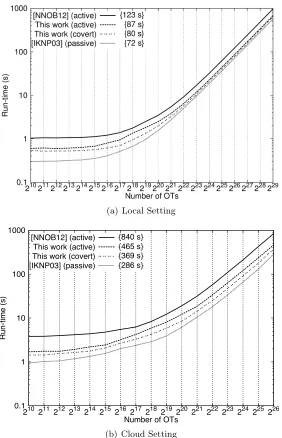
needed for every OT in the extension, and the bandwidth. Relative to the passive OT extension of [IKNP03], the run-time of [NNOB12] is approximately 4 times longer spent on the base-OTs, 1.7 times the cost for each OT in the extension, and 2.7 times the communication. Asymptotically, regarding the number of base-OTs, for security parameter κ (e.g., κ = 128), it suffices to run κ base-OTs in the passive case. In contrast, [NNOB12] required8
3κebase-OTs.
Applications of OT for malicious adversaries. Most prominently, OT is heavily used in to-day’s most efficient protocols for secure computation that allow two or more parties to securely evaluate a function expressed as Boolean circuit on their private inputs. Examples include Yao’s garbled circuits-based approaches such as [LP07, LPS08, PSSW09, KSS12, FN13, SS13, LR14,
HKK+14, FJN14] where OTs are needed for each input, or the Tiny-OT [NNOB12,LOS14] and MiniMac protocols [DZ13,DLT14] where OTs are needed for each AND gate. Additional applica-tions include the private set intersection protocol of [DCW13] which is based purely on OT, and the Yao-basedzero-knowledge protocol of [JKO13] which allows a party to prove in zero-knowledge a predicate expressed as Boolean circuit, and needs one OT per bit of the witness.
In many of the above applications, the number of oblivious transfers needed can be huge. For instance, for many applications of practical interest, the two-party and multiparty protocols of [NNOB12, LOS14, DZ13, DLT14, DCW13] can require several hundred millions of OTs, making the cost of OT the bottleneck in the protocol. Thus, improved OT extensions immediately yield faster two-party and multi-party protocols for secure computation. We give concrete examples for typical applications requiring a large number of OTs next:
Example 1.1 The AES circuit has ∼ 10,000 AND gates (cf. [NNOB12]) and uses ∼ 219 OTs when evaluated with TinyOT (≥40 OTs (aBits) per AND gate [LOS14]).
Example 1.2 The PSI circuit (Sort-Compare-Shuffle) of [HEK12] has O(bnlogn) AND gates and for n= 65,536elements with b= 32-bits the circuit has 225 AND gates and takes ∼230 OTs when evaluated with TinyOT.
Example 1.3 The malicious PSI protocol of [DCW13] needs1.44knmalicious OTs, forn= 65,536 elements and security parameterk= 128, this amounts to∼12·106 OTs (∼180OTs per element).
1.2 Our Contributions
of our protocol over [NNOB12] in the cloud setting (between US East and Europe and thus with higher latency), is even greater with approximately 45% of the time of the base-OTs and 55% of the time for each OT in the extension.
Comparing our protocol to the passive OT extension of [IKNP03], our actively secure protocol in the local (LAN) setting costs only 133% more run-time in the base-OTs, 20% more run-time for each OT in the extension, and 50% more communication. In the cloud setting, the cost for each OT in the extension is 63% more than [IKNP03] (versus 293% more for [NNOB12]). Finally, we obtain covert security at only a slightly higher cost than passive security (just 10% more for each OT in the extension in the local setting, and 30% more in the cloud setting). Our protocol reduces the number of base-OTs that are required to obtain malicious security from 83κ for [NNOB12] to κ+ρ, where ρ is the statistical security parameter (e.g., ρ=40) and ≥ 1 is a parameter for trading between computation and communication. To be concrete, for κ=128-bit security, our protocol reduces the number of base-OTs from 342 to 190 in the local and to 174 in the cloud setting.
Prot. Security Run-Time Communication
Local Cloud Local Cloud
[IKNP03] passive 0.3s+1.07µs·t 0.7s+4.24µs·t 4KB+128bit·t
This covert 0.6s+1.18µs·t 1.2s+5.48µs·t 21KB+166bit·t
[Lar14] active - - 42KB+106,018bit·t
[PVW08] active 2975.32µs·t 4597.27µs·t 0.3KB+1,024bit·t
[NNOB12] active 1.2s+1.82µs·t 2.9s+12.43µs·t 43KB+342bit·t
This active 0.7s+1.29µs·t 1.3s+6.92µs·t 24KB+191bit·t 22KB+175bit·t
Table 1: Run-time and communication fortrandom OT extensions withκ=128-bit security (amor-tized over 226 executions; [PVW08] amortized over 214 executions). 1KB= 8,192bit.
In addition to being more efficient, we can prove the security of a variant of our protocol with a version of correlation robustness (where the secret value is chosen with high min-entropy, but not necessarily uniformly), and do not require a random oracle (see §3.3). In contrast, [NNOB12] is proven secure in the random oracle model. 1
1.3 Related Work
The first efficient OT extension protocol for semi-honest adversaries was given in [IKNP03]. Im-provements and optimizations to the protocol of [IKNP03] were given in [KK13,ALSZ13].
Due to its importance, a number of previous works have tackled the question of OT extensions with security for malicious/active adversaries. There exist several approaches for achieving security against active adversaries for OT extensions. All of the known constructions build on the semi-honest protocol of [IKNP03], and add consistency checks of different types to the OT extension protocol, to ensure that the receiver sent consistent values. (Note that in [IKNP03], the sender cannot cheat and so it is only necessary to enforce honest behavior for the receiver.)
The first actively-secure version of OT extension used a cut-and-choose technique and was already given in [IKNP03]. This cut-and-choose technique achieves a security of 2−nby performing nparallel evaluations of the basic OT extension protocol.
This was improved on by [Nie07,HIKN08], who show that active security can be achieved at a much lower cost. Their approach works in the random oracle model and ensures security against a malicious receiver by adding a low-cost check per extended OT, which uses the uncertainty of the receiver in the choice bit of the sender. As a result, a malicious receiver who wants to learn p choice bits of the sender risks being caught with probability 2−p. However, this measure allows a malicious sender to learn information about the receiver’s choice bits. They prevent this attack by combiningS∈ {2,3,4}OTs and ensuring the security of one OT by sacrificing the remainingS−1 OTs. Hence, their approach adds an overhead of at least S ≥2 compared to the semi-honest OT extension protocol of [IKNP03] for a reasonable number of OTs (withS = 2 and approximately 107 OTs, they achieve security except with probability 2−25, cf. [Nie07]). However, the exact complexity for this approach has not been analyzed.
An alternative approach for achieving actively-secure OT extension was given in [NNOB12]. Their approach also works in the random oracle model but, instead of performing checks per ex-tended OT as in [Nie07,HIKN08], they perform consistency checks per base-OT. Their consistency check method involves hashing the strings that are transferred in the base-OTs and is highly ef-ficient. In their approach, they ensure the security of a base-OT by sacrificing another base-OT, which adds an overhead of factor 2. In addition, a malicious receiver is able to learn p choice bits of the sender with probability 2−p. [NNOB12] shows that this leakage can be tolerated by increasing the number of base-OTs from κ to d4
3κe. Overall, their approach increases the number of base-OTs that has to be performed by a multiplicative factor of 83. The [NNOB12] protocol has been optimized and implemented on a GPU in [FN13]. We give a full description of the [NNOB12] protocol with optimizations of [FN13] in Appendix§B.
An approach for achieving actively-secure OT extension that works in the standard model has recently been introduced in [Lar14]. Their approach achieves less overhead in the base-OTs at the expense of substantially more communication during the check routine (cf. Table1), and is therefore considerably less efficient. Nevertheless, we point out that the work of [Lar14] is of independent interest since it is based on the original correlation robustness assumption only.
Since it is the previous best, we compare our protocol to that of [NNOB12]. Our approach reduces the number of base-OTs by removing the “sacrifice” step of [NNOB12] (where one out of every 2 base-OTs are opened) but increases the workload in the consistency check routine. Indeed, we obtain an additive factor of a statistical security parameter, instead of the multiplicative increase of [NNOB12]. This can be seen as a trade-off between reducing communication through fewer base-OTs while increasing computation through more work in the consistency check routine. We empirically show that this results in a more efficient actively secure OT extension protocol, which only has 20% more time and 50% more communication than the passively secure OT extension protocol of [IKNP03] in the local setting.
The above works all consider the concrete efficiency of OT extensions. The theoretical feasibility of OT extensions was established in [Bea96], and further theoretical foundations were laid in [LZ13].
2
Preliminaries
2.1 Notation
in time poly(κ), except with probability µ(κ) + 2−ρ. (Formally, the output distribution of a real protocol execution can be distinguished from the output distribution of an ideal execution of the OT functionality with probability at most µ(κ) + 2−ρ. See [LP11] for a formal definition of secure computation with both a statistical and computational security parameter.) In our experiments we set κ= 128 andρ= 40, which is considered to be secure beyond 20202.
2.2 Oblivious Transfer
Oblivious transfer (OT) was first introduced by Rabin [Rab81] as a function where a receiver receives a message, sent by a sender, with probability 1/2, while the sender remains oblivious whether the message was received. It was later re-defined to the functionality more commonly used today by [EGL85], where a sender inputs two messages (x0, x1) and the receiver inputs a choice bit r and obliviously receives xr without learning any information about x1−r. Formally,
the 1-out-of-2 OT functionality on n bit strings is defined as OTn((x0, x1), r) = (λ, xr) where λ
denotes the empty string and x0, x1 ∈ {0,1}n. In this paper we focus on the general (and most applicable) functionality, which is equivalent to m invocations of the 1-out-of-2 OT functionality on nbit strings. That is, the sender holds as inputm pairs of n-bit strings (xj0, x1j) for 1≤j≤m and the receiver holdsmselection bitsr= (r1, . . . , rm). The output of the receiver is (xr11, . . . , xrmm)
while the sender has no output. We denote this functionality as m×OTn. The parties are called
senderPS and receiver PR.
Several protocols for OT based on different cryptographic assumptions and attacker models were introduced. Most notable are the passive-secure OT protocol of [NP01] and the active-secure OT protocol of [PVW08], which are among the most efficient today. However, the impossibility result of [IR88] showed that OT protocols require costly asymmetric cryptography, which greatly limits their efficiency.
2.3 OT Extension
In his seminal work, Beaver [Bea96] introduced OT extension protocols, which extend few costly base-OTs using symmetric cryptography only. While the first construction of [Bea96] was inefficient and mostly of theoretical interest, the protocol of [IKNP03] showed that OT can be extended efficiently and with very little overhead.
Recently, the passively secure OT extension protocol of [IKNP03] was improved by [KK13,
ALSZ13] who showed how the communication from PR toPS can be reduced by a factor of two.
Furthermore, [ALSZ13] implemented and optimized the protocol and demonstrated that the main bottleneck for semi-honest OT extension has shifted from computation to communication. We give the passively secure OT extension protocol of [IKNP03] with optimizations from [ALSZ13,KK13] in Protocol1.
2.4 On the Malicious Security of [IKNP03]
The key insight to understanding how to secure OT extension against malicious adversaries is to understand that a malicious party only has very limited possibilities for an attack. In fact, the original OT extension protocol of [IKNP03] already provides security against a malicious PS. In
addition, the only attack for a malicious PR is in Step 2a of Protocol 1, wherePR computes and
sends ui = ti⊕G(k1i)⊕r (cf. [IKNP03]). A malicious PR could choose a different r for each ui
(for 1≤i≤`), and thereby extract PS’s choice bits s. Hence, malicious security can be obtained
ifPRcan be forced to use the same choice bitsr in all messagesu1, . . . ,u`.
PROTOCOL 1 (Passive-secure OT extension protocol of [IKNP03])
• Input ofPS: mpairs (x0j, x1j) ofn-bit strings, 1≤j≤m.
• Input ofPR: mselection bitsr= (r1, . . . , rm).
• Common Input: Symmetric security parameterκand`=κ.
• Oracles and cryptographic primitives: The parties use an ideal`×OTκfunctionality,
pseu-dorandom generatorG:{0,1}κ→ {0,1}m and a correlation robust-functionH : [m]× {0,1}`→
{0,1}n
(see§3.3).
1. Initial OT Phase:
(a) PSinitializes a random vectors= (s1, . . . , s`)∈ {0,1}`andPRchooses`pairs of seedsk0i,k1i
each of sizeκ.
(b) The parties invoke the`×OTκ-functionality, wherePSacts as thereceiver with inputsand PR acts as thesender with inputs (k0i,k1i) for every 1≤i≤`.
For every 1≤i≤`, letti=G(k0i). LetT = [t1|. . .|t`] denote them×`bit matrix where itsith
column istifor 1≤i≤`. Lettj denote thejth row ofT for 1≤j≤m.
2. OT Extension Phase:
(a) PR computesti=G(k0i) andui=ti⊕G(k1i)⊕r, and sendsuitoPS for every 1≤i≤`.
(b) For every 1≤i≤`,PS definesqi= (si·ui)⊕G(ksii). (Note thatq i
= (si·r)⊕ti.)
(c) LetQ= [q1|. . .|q`] denote them×`bit matrix where itsith column isqi. Letq
j denote
thejth row of the matrixQ. (Note thatqi= (si·r)⊕tiandqj= (rj·s)⊕tj.)
(d) PS sends (y0j, yj1) for every 1≤j≤m, where:
yj0=x
0
j⊕H(j,qj) and yj1=x
1
j⊕H(j,qj⊕s)
(e) For 1≤j≤m,PRcomputesxj=y rj
j ⊕H(j,tj).
3. Output: PR outputs (xr11, . . . , x
rm
m );PShas no output.
3
Our Protocol
In order to achieve security for malicious adversaries, we add a consistency check of the values r
that are sent in Step 2a of the semi-honest protocol (Protocol 1), and we increase the number of base-OTs. Let ri = ti ⊕G(k1i)⊕ui, i.e., the value that is implicitly defined by ui. We observe that if the receiver PR uses the same choice bits ri and rj for some distinct i, j ∈ [`]2, they
cancel out when computing their XOR, i.e., ui⊕uj = (ti⊕G(k1
i)⊕ri)⊕(tj ⊕G(k1j)⊕rj) =
G(k0i)⊕G(k1i)⊕G(k0j)⊕G(k1j). After the base-OTs, PS holdsG(ksii) andG(k sj
j ) and in Step2aof
Protocol1,PRcomputes and sendsui =G(k0i)⊕G(k1i)⊕rianduj =G(k0j)⊕G(k1j)⊕rj. Now note
thatPS can compute the XOR of the strings he received in the base-OTsG(ksii)⊕G(k sj
j ) as well as
the “inverse” XOR of the strings received in the base-OTsG(ksi
i )⊕G(k sj
j ) =G(k si
i )⊕G(k sj
j )⊕ui⊕uj
is correct, since it has no information about G(ksi
i ) and G(k sj
j ) (this is due to the security of the
base-OTs that guarantees thatPS receives the keysksii,k sj
i only, and learns nothing aboutk si
i ,k sj
j ).
PRcannot give these values toPSsince this will totally break the secrecy of its choice bits. However,
the PR can send the hashes of these inverse values. Specifically, the PR commits to the XORs of
all strings hp,qi,j =H(G(kpi)⊕G(kqj)), for all combinations ofp, q∈ {0,1}. Now, givenhsi,sj
i,j ,h si,sj
i,j ,
PS checks that h si,sj
i,j = H(G(k si
i )⊕G(k sj
j )), and that h si,sj
i,j = H(G(k si
i )⊕G(k sj
i )⊕ui⊕uj) =
H(G(ksi
i )⊕G(k sj
j )). This check passes ifri =rj andh p,q
i,j were set correctly.
If a malicious PR tries to cheat and has chosen ri 6= rj, it has to convince PS by computing
hp,qi,j = H(G(kpi)⊕G(kqj)⊕ri⊕rj) for all p, q ∈ {0,1}. However, PS can check the validity of
hsi,sj
i,j =H(G(k si
i )⊕G(k sj
j )) whilePR remains oblivious to si, sj. Hence,PR can only convincePS
by guessing si, sj, computing h si,sj
i,j correctly and set h si,sj
i,j =H(G(k si
i )⊕G(k sj
j )⊕ri⊕rj), which
PR cannot do better than with probability 1/2. This means that PR can only successfully learn
ρ bits but will be caught except with probability 2−ρ. The full description of our new protocol is given in Protocol2. We give some more explanations regarding the possibility of the adversary to cheat during the consistency check in §3.1.
We note that learning few bits of the secretsdoes not directly break the security of the protocol once|s|> κ. In particular, the values{H(tj⊕s)}j are used to mask the inputs{x
1−rj
j }j. Therefore,
when H is modelled as a random oracle and enough bits of s remain hidden from the adversary, each value H(tj ⊕s) is random, and the adversary cannot learn the input x
1−rj
j . For simplicity
we first prove security of our protocol in the random-oracle model. We later show that H can be replaced with a variant of a correlation-robustness assumption.
The advantage of our protocol over [NNOB12] is thatPSdoes not need to reveal any information
aboutsi, sj when checking the consistency betweenri andrj (as long asPRdoes not cheat, in which
case it risks getting caught). Hence, it can forcePR to check that ri equals anyrj, for 1≤j ≤`
without disclosing any information.
PROTOCOL 2 (Our active-secure OT extension protocol)
• Input ofPS: mpairs (x0j, x1j) ofn-bit strings, 1≤j≤m.
• Input ofPR: mselection bitsr= (r1, . . . , rm).
• Common Input: Symmetric security parameter κ and statistical security parameter ρ. It is assumed that`=κ+ρ.
• Oracles and cryptographic primitives: The parties use an ideal`×OTκfunctionality,
pseu-dorandom generator G : {0,1}κ → {0,1}m+κ, and random-oracleH (see §3.3 for instantiation
ofH.)
1. Initial OT Phase:
(a) PSinitializes a random vectors= (s1, . . . , s`)∈ {0,1}`andPRchooses`pairs of seedsk0i,k1i
each of sizeκ.
(b) The parties invoke the`×OTκ-functionality, wherePSacts as thereceiver with inputsand PR acts as thesender with inputs (k0i,k1i) for every 1≤i≤`.
For every 1≤i≤`, letti=G(k0i). LetT = [t1|. . .|t`] denote the (m+κ)×`bit matrix where
itsith column isti for 1≤i≤`. Lett
jdenote thejth row ofT for 1≤j≤m.
2. OT Extension Phase (Part I):
(a) PR chooses a random stringτ ∈ {0,1}κ, and definesr0=r||τ.
(b) PR computesti=G(k0i) andui=ti⊕G(k1i)⊕r 0
, and sendsuitoP
S for every 1≤i≤`.
3. Consistency Check of r0: (the main change from Protocol1)
(a) For every pairα, β⊆[`]2,PRdefines the four values:
h0α,β,0 =H(G(k0α)⊕G(k0β)) h0α,β,1 =H(G(k
0
α)⊕G(k1β)), h1α,β,0 =H(G(k1α)⊕G(k
0
β)) h
1,1
α,β=H(G(k
1
α)⊕G(k
1
β)).
It then sendsHα,β= (h0α,β,0, h
0,1
α,β, h
1,0
α,β, h
1,1
α,β) toPS.
(b) For every pairα, β⊆[`]2,PSknowssα, sβ,ksαα,k sβ
β ,u α
,uβ and checks that:
i. hsα,sβ
α,β =H(G(k sα
α )⊕G(k sβ
β )).
ii. hsα,sβ
α,β =H(G(k sα
α )⊕G(k sβ
β )⊕u
α⊕uβ) (=H(G(ksα
α )⊕G(k sβ
β )⊕r
α⊕rβ)).
iii. uα6=uβ.
In case one of these checks fails,PS aborts and outputs⊥.
4. OT Extension Phase (Part II):
(a) For every 1≤i≤`,PS definesqi= (si·ui)⊕G(ksii). (Note thatq i= (s
i·r)⊕ti.)
(b) LetQ= [q1|. . .|q`] denote the (m+κ)×`bit matrix where itsith column isqi. Let qj
denote thejth row of the matrixQ. (Note thatqi= (si·r)⊕ti andqj= (rj·s)⊕tj.)
(c) PS sends (y0j, yj1) for every 1≤j≤m, where:
yj0=x
0
j⊕H(j,qj) and yj1=x
1
j⊕H(j,qj⊕s)
(d) For 1≤j≤m,PRcomputesxj=y rj
j ⊕H(j,tj).
5. Output: PR outputs (xr11, . . . , x
rm
3.1 The Security of Our Protocol
Malicious sender. The original OT extension protocol of [IKNP03] already provides security against a malicious PS. In an earlier version of this paper, we claimed that our checks in Step 3
of the protocol do not provide a malicious PS with any new capabilities, and we derived security
directly from the semi-honest case with no further proof.
However, as pointed out by [Sch], adding the checks for consistency of r provides an “oracle” for checking whether a particular candidate ˜ris the input of the receiver or not. In fact, givenuα, G(ksα
α ) andG(k sβ
β ) (note that ksαα and k sβ
β are sent to the sender during the base OT stage), the
malicious sender can check whether r = ˜r or not, by first computing tsα
α =uα⊕G(ksαα)⊕˜r and
then checking whether hsα,βα,sβ =H(tsα
α ⊕G(k sβ
β )).
In order to prevent this subtle attack, we modify the protocol such that PR first appends tor
some random stringτ ∈ {0,1}κresulting in a stringr0 =r||τ (this is Step2ain the protocol). This
adds entropy to the choice of r and therefore prevents the above attack. Note that in the second part of the OT extension phase, the transfer is done on only the first m rows of the matrix Q and not m+κ. In Appendix Cwe formally prove that the protocol is secure in the presence of a malicious sender, assuming that the function H is modeled as κ-min-entropy strongly correlation robust (see §3.10regarding this assumption). We also note that the change in the efficiency of the protocol is minor, as mκ.
Simulating a malicious receiver. In the case of a malicious receiver, the adversary may not use the samerin the messagesu1, . . . ,u`, and as a result learn some bits from the secret s. Therefore, we add a consistency check ofrto the semi-honest protocol of [IKNP03]. However, this verification of consistency ofris not perfectly sound, and the verification may still pass even when the receiver sends fewu’s that do not define the samer. This makes the analysis a bit more complicated.
For every 1 ≤ i ≤ `, let ri def= ui⊕G(k0i)⊕G(k1i) that is, the “input” ri which is implicitly defined byui and the base-OTs.
We now explore how the matrices Q, T are changed when the adversary uses inconsistent r’s. Recall that when the receiver uses the samer, thenqi = (si·r)⊕ti andqj = (rj·s)⊕tj. However,
in case of inconsistent r’s, we get that qi = (si ·ri)⊕ti. The case of qj is rather more involved;
letR =
r1 |. . .|r`
denote them×`matrix where itsith column isri, and letrj denote the jth
row of the matrix R. For two strings of the same length a= (a1, . . . , ak),b= (b1, . . . , bk), let a∗b
define the entry-wise product, that is a∗b = (a1·b1, . . . , ak·bk). We get thatqj = (rj∗s)⊕tj
(note that in an honest execution, rj is the same bit everywhere). The sender masks the inputs
(x0j, x1j) with (H(j,qj), H(j,qj⊕s)).
In order to understand better the value qj, let r = (r1, . . . , rm) be the string that occurs the
most from the set{r1, . . . ,r`}, and letU ⊂[`] be the set of all indices for whichri =rfor alli∈ U.
Let B = [`]\ U be the complementary set, that is, the set of all indices for which for everyi∈B it holds that ri 6=r. As we will see below, except with some negligible probability, the verification phase guarantees that |U | ≥`−ρ. Thus, for every 1≤j≤m, the vector rj (which is the jth row
of the matrixR), can be represented asrj = (rj·1)⊕ej, where 1is the all one vector of size`, and
ej is some error vector with Hamming distance at most ρ from 0. Note that the non-zero indices
inej are all inB. Thus, we conclude that:
Recall that in an honest executionqj = (rj·s)⊕tj, and therefore the only difference is the term
(s∗ej). Moreover, note thats∗ej completely hides all the bits ofs that are inU, and may expose
only the bits that are in B. Thus, the consistency check ofrguarantees two important properties: First, that almost all the inputs are consistent with some implicitly defined stringr, and thus the bits rj are uniquely defined. Second, the set of inconsistent inputs (i.e., the set B) is small, and
thus the adversary may learn only a limited amount of bits of s.
The consistency checks of r. We now examine what properties are guaranteed by our consistency check, for a single pair (α, β). The malicious receiverPRfirst sends the set of keysK={k0i,k1i}to
the base-OT protocol, and then sends all the values (u1, . . . ,u`) and the checksH={Hα,β}α,β. In the simulation, the simulator can choose sonly after it receives all these messages (this is because the adversary gets no output from the invocation of the OT primitive). Thus, for a given set of messages that the adversary outputs, we can ask what is the number of secrets s for which the verification will pass, and the number for which it will fail. If the verification passes for some given
T = (K,u1, . . . ,u`,H) and some secret s, then we say that T is consistent with s; In case the verification fails, we say thatT is inconsistent.
The following Lemma considers the values that the adversary has sent regarding some pair (α, β), and considers the relation to the pair of bits (sα, sβ) of the secrets. We have:
Lemma 3.1 Let Tα,β = {Hα,β,uα,uβ,{kb
α}b,{kbβ}b} and assume that H is a collision-resistant
hash-function. We have:
1. If rα6=rβ andTα,β is consistent with (sα, sβ), then it is inconsistent with (sα, sβ).
2. If rα=rβ andTα,β is consistent with (sα, sβ), then it is consistent also with (sα, sβ).
Proof: For the first item, assume that rα6=rβ and thatTα,β is consistent both with (sα, sβ) and
(sα, sβ). Thus, from the check of consistency of (sα, sβ):
hsα,βα,sβ =H
G(ksα
α )⊕G(k sβ
β )
, hsα,βα,sβ =H
G(ksα
α )⊕G(k sβ
β )⊕u
α⊕uβ ,
and thatuα6=uβ. In addition, from the check of consistency of (s
α, sβ) it holds that:
hsα,sβ
α,β =H
G(ksα
α )⊕G(k sβ
β )
, hsα,sβ
α,β =H
G(ksα
α )⊕G(k sβ
β )⊕u
α⊕uβ ,
and thatuα6=uβ. This implies that:
HG(ksα
α )⊕G(k sβ
β )
=hsα,sβ
α,β =H
G(ksα
α )⊕G(k sβ
β )⊕u
α⊕uβ ,
and from the collision resistance property of H we get that:
G(ksα
α )⊕G(k sβ
β ) =G(k sα
α )⊕G(k sβ
β )⊕u
α⊕uβ .
Recall that rαdef= uα⊕G(k0α)⊕G(k1α), and rβ def= uβ⊕G(k0β)⊕G(k1β). Combining the above, we get that rα =rβ, in contradiction.
For the second item, once rα = rβ, we get that uα⊕uβ = G(k0α)⊕G(k1α)⊕G(k0β)⊕G(k1β) and it is easy to see that if the consistency check of (sα, sβ) holds, then the consistency check of
Lemma3.1implies what attacks the adversary can do, and what bits ofsit can learn from each such an attack. In the following, we consider a given partial transcriptTα,β= ((k0
α,k1α,k0β,k1β),(uα,uβ),Hα,β)
and analyze what the messages might be, and what the adversary learns in case the verification passes. Letrα=uα⊕G(kα0)⊕G(k1α) and rβ defined analogously. We consider 4 types:
1. Type 1: correct. In this case, it holds that rα = rβ, and for every (a, b) ∈ {0,1}2: ha,bα,β =HG(kaα)⊕G(kbβ). The verification passes for every possible value of (sα, sβ).
2. Type 2: rα = rβ, but Hα,β is incorrect. In this case, the adversary sent uα,uβ that define the same r. However, it may send hashes Hα,β that are incorrect (i.e., for some (a, b) ∈ {0,1}2, it may send: ha,b
α,β 6= H(G(kαa) ⊕G(kbβ))). However, from Lemma 3.1, if
rα=rβ and H
α,β is consistent with (sα, sβ) then it is also consistent with (sα, sβ).
Thus, a possible attack of the adversary, for instance, is to send correct hashes for some bits (0,0) and (1,1), but incorrect ones for (0,1) and (1,0). The verification will pass with probability 1/2, exactly if (sα, sβ) are either (0,0) or (1,1), but it will fail in the other two
cases (i.e., (1,0) or (0,1)). We therefore conclude that the adversary may learn the relation sα⊕sβ, and gets caught with probability 1/2.
3. Type 3: rα 6= rβ and Hα,β is incorrect in two positions. In this case, for instance, the adversary can set the values h0α,β,0, h0α,β,1 correctly (i.e., hα,β0,0 = H(G(k0α)⊕G(k0β)) and h0α,β,1 = H(G(k0α)⊕G(k1β))) and set values h1α,β,0, h1α,β,1, accordingly, such that the verification will pass for the cases of (sα, sβ) = (0,0) or (0,1). That is, it sets:
h1α,β,0 =H(G(k0α)⊕G(k1β)⊕uα⊕uβ)
(and it sets h1α,β,1 in a similar way). In this case, the adversary succeeds with probability 1/2 and learns that sα = 0 in case the verification passes. Similarly, it can guess the value of
sβ and set the values accordingly. For conclusion, the adversary can learn whether its guess
was correct, and in which case it learns exactly one of the bits sα or sβ but does not learn
anything about the other bit.
4. Type 4: rα6= rβ and Hα,β is incorrect in three positions. In this case, the adversary
may guess both bits (sα, sβ) = (a, b) and set ha,bα,β correctly, set ha,bα,β accordingly (i.e., such
that the verification will pass for (a, b)), but will fail for any one of the other cases. In this case, the adversary learns the values (sα, sβ) entirely, but succeeds with probability of at most
1/4.
Note that whenever rα 6= rβ, the adversary may pass the verification of the pair (α, β) with probability of at most 1/2. This is because it cannot send consistent hashes for all possible values of (sα, sβ), and must, in some sense, “guess” either one of the bits, or both (i.e., Type3or Type4).
in both checks. The adversary will pass these two checks if it guessessβ correctly, with probability
1/2.
Proving security of the protocol. Before proceeding to the full proof of security, we first sketch the proof. The simulatorSinvokes the malicious receiver and plays the role of the base-OT trusted party and the honest sender. It receives from the adversary its inputs to the base-OTs, and thus knows the values {k0
i,k1i}`i=1. Therefore, it can compute all the values r1, . . . ,r` when it receives the messages u1, . . . ,u`. It computes the set of indices U, and extracts r. It then performs the same checks as an honest sender, in Step3 of Protocol2, and aborts the execution if the adversary is caught cheating. Then, it sends the trusted party the value r that it has extracted, and learns the inputs xr1
1 , . . . , xrmm. It computes qj as instructed in the protocol (recall that these qj may
contain the additional “shift”s∗ej) and use some random values for all{y rj
j }mj=1. Since the values{yrj
j }mj=1are random in the ideal execution, and equal{x
rj
j ⊕H(j,qj⊕s)}in the
real execution, a distinguisher may distinguish between the real and ideal execution once it makes a query of the form (j,qj⊕s) to the random oracle. We claim, however, that the probability that
the distinguisher will make such a query is bounded by (t+ 1)/|S|, wheretis the number of queries it makes to the random oracle, and S is the set of all possible secrets s that are consistent with the view that it receives. Thus, once we show that|S|>2κ, the probability that it will distinguish between the real and ideal execution is negligible in κ.
However, the above description is too simplified. First, if the adversary performs few attacks of Type 2, it learns information regarding s from the mere fact that the verification has passed. Moreover, recall that yrj
j =x rj
j ⊕H(j,tj ⊕(s∗ej)), and that the adversary can control the values
tj and ej. Recall that ej is a vector that is all zero in positions that are in U, and may vary in
positions that are inB. This implies that by simple queries to the random oracle, and by choosing the vectors ej cleverly, the adversary can totally reveal the bitssB quite easily. We therefore have
to show that the set B is small, while also showing that the set of consistent secrets is greater than 2κ(that is,|S| ≥2κ). We now proceed to a formal statement of the theorem and formal proof of security, where there we prove the two informal claims that were just mentioned.
Theorem 3.2 Assuming that H is a random oracle, G is a pseudo-random generator, Protocol 2 with ` = κ+ρ securely computes the m×OTn functionality in the `×OTκ-hybrid model in the
presence of a static malicious adversary, where κ is the symmetric security parameter and ρ is the statistical security parameter.
Proof: Since we already gave some proof sketch, we start directly with a formal description of the simulatorS:
The simulator S.
1. The simulator invokes the adversaryA on the auxiliary input z.
2. Initial OT phase: The adversary A outputs` pairs of κ-bits each {k0
i,k1i}`i=1 as input to the`×OTκ-functionality. It receives no output from this invocation.
3. First part of OT extension phase: The adversary Aoutputs` stringsu1, . . . ,u`.
4. Consistency check of r:
(b) The simulator chooses a strings uniformly at random from {0,1}`.
(c) Given the values{{k0
i,k1i}`i=1,u1, . . . ,u`,{Hα,β}α,β} and the chosen secret s, the
simu-lator can perform all the needed checks as the honest sender in the real execution. In case where one of the verification fails, the simulator halts.
5. Second part of the OT extension phase:
(a) The simulator computes the matrices T, Q and R, where for every i, ti = G(k0i),
qi= (si·ri)⊕ti and ri =G(k0i)⊕G(k1i)⊕ui.
(b) From all the vectorsr1, . . . ,r`, letrbe the vector that is mostly repeated (as we will see, the verification process guarantees that there exists a vector that is repeated at least `−ρ times).
(c) Send r to the trusted party, and receive xr1
1 , . . . , xrmm. Define the values ej for every
1≤j≤m (explicitly, define the matrix R as the matrix for which its ith column is ri, and let rj denote its jth row. Then, ej = (rj·1)⊕rj. Then, for every 1≤j≤m, set
yrj
j =x rj
j ⊕H(j,tj ⊕(s∗ej)), and sety rj
j uniformly at random. Send {(y0j, yj1)}mj=1 to the adversaryA, output whatever it outputs and halt.
Let T = {{k0
i,k1i}`i=1,u1, . . . ,u`,{Hα,β}α,β}, i.e., the values that the adversary gives during
the execution of the protocol. Observe that the simulator chooses the secret s only after T is determined (since the adversary receives no output from the execution of the OT primitive, we can assume that). We divide all possible T into two sets, Tgood and Tbad, defined as follows:
Tgood =nT |Pr
s [consistent(T,s) = 1]>2
−ρo and T
bad =
n T |Pr
s [consistent(T,s) = 1]≤2
−ρo .
where consistent(T,s) is a predicate that gets 1 when the verification passes for the transcript T
and the secret s, and 0 otherwise. The probability is taken over the choice of s. For a given T, let S(T) be the set of all possible secrets s∈ {0,1}`, that are consistent with T. That is: S(T) =
{s∈ {0,1}`|consistent(T,s) = 1}. Therefore, it holds that:
Pr
s [consistent(T,s) = 1] =
|S(T)|
2`
and thus |S(T)| = 2` ·Pr [consistent(T,s) = 1]. As a result, for every T ∈ Tgood, it holds that
|S(T)|>2`·2−ρ= 2`−ρ= 2κ. That is, in case a transcript T ∈ Tgood passes the consistency check of r, there are at least 2κ different secretss that are consistent with the given transcript, each are likely with the same probability, and thus the adversary may guess s with probability of at most 2−κ.
Let U be the largest set of indices such that for every i, j ∈ U, ri =rj. Let B be the compli-mentary set, that is, B = [`]\ U. From the definition of the sets, for every α ∈ U and β ∈ B, it holds thatrα6=rβ.
We claim that if |U |< `−ρ (i.e.,|B|> ρ), then it must hold that T ∈ Tbad and the adversary gets caught with high probability. That is:
Claim 3.3 Let T be as above, and letU be the largest set of indices such that for every α, β ∈ U,
rα=rβ. Assume that |U |< `−ρ. Then:
Pr
s [consistent(T,s) = 1]≤2
−ρ
We will prove the claim below. Let T ∈ Tgood, and let U and B be as above. Using the claim above, we have that |B|< ρ. We now focus on the set of secrets s that are consistent with this transcript T, i.e., the set S(T). We claim that the bitssB are common to all the secrets in S(T),
and thus, even when we give the adversary the bitssBin the clear once the verification is completed,
the adversary still has to guesss from a set of at least 2κ secrets. Formally:
Claim 3.4 Let T ∈ Tgood, and let U and B as above. Then, there exists a string w ∈ {0,1}|B|, such that for every s0∈S(T), it holds that: s0B =w.
Proof: From the definition of the setsB andU, it holds that for everyα ∈ U andβ ∈B,rα 6=rβ. Consider two secrets s,s0 that are consistent withT (since T ∈ Tgood, there are many such T’s). We show the following:
• IfsB6=s0B thensU =s0U.
• IfsU 6=s0U thensB=s0B.
We show the first claim. Assume that sB 6=s0B, thus, there must exist an index β ∈B such that
sβ 6=s0β, i.e.,s0β =sβ. Now, consider some α∈ U, we show that sα =s0α and thussU =s0U. From
Lemma3.1, sinceT is consistent with (sα, sβ), it is inconsistent with (sα, sβ) = (sα, s0β). Therefore,
in order to have consistency between s0 and T, we must have that s0α =6 sα, and so s0α =sα. The
second claim is proven analogously.
We now claim that the set S(T) either shares the same sB for all its elements, or shares the
same sU for all elements (and of course, not both). In order to see this, let S(T) ={s1, . . . ,sn}.
Assume, without loss of generality, that s1
U 6= s2U (and so, s1B = s2B). We now claim that all the
other elements share the same bits in B. If not, that is, if there exists si such that siB 6= s1B, it must hold thatsiU =s1U 6=s2U, which implies that siB =s2B =s1B, in contradiction.
We further claim that the set S(T) must share the same sB and cannot share the same sU.
This is a simple counting argument: Since |B|< ρ, a set S(T) that shares the same sU has size of at most 2|B| ≤ 2ρ. However, since T ∈ Tgood, it holds that |S(T)| >2κ. Therefore, the set must share the samesB, and the claim follows.
We now show that the distinguisher cannot distinguish between the ideal and real executions, even when it asks the oracleH as (polynomially) many queries as it wishes.
First, assume that the distinguisher cannot make any queries to H. We claim that the distri-butions of the real and ideal executions are statistically close. Intuitively, if the adversary outputs
T ∈ Tbad, then clearly the distinguisher may succeed only if the consistency check fails, which happens with probability of at most 2−ρ. On the other hand, in case where the adversary out-puts T ∈ Tgood, then, except for negligible probability (in ρ) it holds that |U | ≥ `−ρ = κ, and
|S(T)| ≥2κ, where all the elements inS(T) share the same bitssB. Thus, even if the distinguisher
receivessB in the clear, the valuesH(j,qj), H(j,qj⊕s) that are used for masking the inputs are
uniformly random and independent of each other. Therefore, the simulation is indistinguishable. Now, assume that the distinguisher can also make queries to the random oracleH. In this case, we claim that the distinguisher can distinguish only if it makes a “critical query”. That is, for every 1≤j ≤m, let t0j = (rj·s)⊕tj ⊕(s∗ej), and recall that t0j is known to the adversary (and
in fact, it can even choose (tj, rj,ej)). A critical query is a query of the form (j,t0j⊕s) for somej,
the receiver) never queries such a critical query and that sU 6= 0, the distributions of the real and ideal executions are statistically close. On the other hand, the probability that they make such a query is bounded by (t+ 1)/|S(T)| ≤(t+ 1)·2−κ, wheretis the number of queries that are made by the receiver or the distinguisher. This is because as long as sU 6= 0, and as long as no such a query is made, the answers of the queries are independent of the value of s, and the distinguisher does not learn anything new from the queries themselves. This completes the proof.
We now restate Claim 3.3 and prove it. This claim is in fact, an analysis of the consistency check phase of the protocol.
Claim 3.5 (Claim 3.3, restated) Let T be as above, and let U be the largest set of indices such that for every α, β∈ U, rα =rβ. Assume that |U |< `−ρ. Then:
Pr
s [consistent(T,s) = 1]≤2
−ρ
and thus, T ∈ Tbad.
Proof: Let T be the values that the adversary outputs, i.e., the values
T =
{k0i,k1i}i,{ui}i,{Hα,β}α,β
For a pairα ∈ U,β∈B, we claim that the adversary passes the verification of the pair (α, β) with probability of at most 1/2. This is because rα 6=rβ and due to Lemma 3.1, if T is consistent with some (sα, sβ) then it is inconsistent with (sα, sβ). Thus, there are at most 2 possible values (sα, sβ)
that are consistent withT, and the adversary gets caught for the 2 other values.
We define the inconsistency graph Γ = (V, E) as follows. The set of vertices is the set [`]. The set of edges contains all the pairs that define different r’s, that is, there exists an edge (α, β) if
rα 6= rβ. Note that since (α, β) are not consistent, the adversary gets caught in the check (α, β) with probability of at least 1/2. We sometimes consider the complement graph (or, the consistency graph) Γ = (V, E). In Γ, each edge represents that the two vertices define the same implicit inputr.
We now analyze the size of the set U.
1. Case 1: ρ ≤ |U | < `−ρ. In this case, we have a large enough set which is consistent within itself, but is inconsistent with all the others. We claim that in this case, the adversary will get caught with probability 1−2−ρ.
In order to see this, consider the setB = [`]\U. SinceB∪U = [`], we have thatρ <|B| ≤`−ρ as well.
Moreover, consider the inconsistency graph Γ, and remove all the edges that are between two elements ofB (this can be interpreted as follows: although there is some possibility that the adversary gets caught because of these checks, we ignore them and do not consider these inconsistencies as cheating). As a result, we have a bipartite graph where the set of vertices is divided toB and U. Moreover, when considering the complement graph for the resulting graph, we have two cliques,B and U, and the maximal clique in this graph is at most`−ρ.
Each edge in the graph represents a check where the adversary gets caught with probability of at least 1/2. Since there are at leastρedges in the maximal matching in the inconsistency graph, there are at least ρ pairs for which the adversary gets caught with probability of at least 1/2. Moreover, since we have a matching, each pair and check are independent. We therefore conclude that the adversary succeeds in its cheating with probability of at most 2−ρ, and therefore it gets caught with probability of at least 1−2−ρ.
2. Case 2: |U | < ρ. Similarly to the previous case, we can just find a superset U0 that containsU of size at leastρ for which we assume (artificially) that is all consistent. That is, for this set U0 we just ignore the checks between the elements in this set and assume that
they are all consistent. After we obtain this clique (by ignoring some of the checks), we are back to the previous case.
For conclusion, we have the following: if T is such that |U |< `−ρ, then :
Pr
s [consistent(T,s) = 1]<2
−ρ
3.2 Reducing the Number of Checks
In Protocol 2, in the consistency check of r, we check all possible pairs (α, β) ∈ [`]2. In order to achieve higher efficiency, we want to reduce the number of checks.
Let G= (V, E) be a graph for which V = [`], and an edge (α, β) represents a check between
rα and rβ. In Protocol 2 the receiver asks for all possible edges in the graph (all pairs). In order to achieve better performance, we would like to reduce the number of pairs that we check. In particular, the protocol is changed so that in Step 3 of Protocol 2 the sender chooses some set of pairs (edges)E0⊆V2, and the receiver must respond with the quadruplesHα,βfor every (α, β)∈E0 that it has been asked for. The sender continues with the protocol only if all the checks have passed successfully.
Observe that after sending the values u1, . . . ,u`, the sets U and B (which are both subsets of [`]) are implicitly defined. In case that the set B is too large, we want to catch the adversary cheating with probability of at least 1−2−ρ. In order to achieve this, we should have ρ edges betweenB and U that are pairwise non-adjacent. That is, in case the adversary definesB that is “too large”, we want to choose a set of edgesE0 that contains a matching betweenB andU of size of at least ρ.
Note, however, that the sender chooses the edges E0 with no knowledge whatsoever regarding the identities of U and B, and thus it needs to choose a graph such that (with overwhelming probability), for any possible choice of a largeB, there will be a ρ-matching betweenB and U.
PROTOCOL 3 (Modification for Protocol 2, Fewer Checks)
The parties run Protocol2with the following modifications:
Step 3–Consistency Check ofr: (modified)
1. PSchoosesµfunctionsφ0, . . . , φµ−1uniformly at random, whereφi: [`]→[`]. It sendsφ0, . . . , φµ−1 to the receiverPR.
2. For every pairα∈[`], i∈[µ], let (α, β) = (α, φi(α)).PR defines the four values:
h0α,β,0 =H(G(k0α)⊕G(k0β)) h0α,β,1 =H(G(k
0
α)⊕G(k1β)), h1α,β,0 =H(G(k1α)⊕G(k
0
β)) h
1,1
α,β=H(G(k
1
α)⊕G(k
1
β)).
It then sendsHα,β= (h0α,β,0, h
0,1
α,β, h
1,0
α,β, h
1,1
α,β) toPS.
3. PS checks that it receives Hα,φi(α) for every α ∈ [`] and i∈ [µ]. Then, for each pair (α, β) = (α, φ(α)) it checks that:
(a) hsα,sβ
α,β =H(G(k sα
α )⊕G(k sβ
β )).
(b) hsα,sβ
α,β =H(G(k sα
α )⊕G(k sβ
β )⊕u
α⊕uβ) (=H(G(ksα
α )⊕G(k sβ
β )⊕r
α⊕rβ)).
(c) uα6=uβ.
In case one of these checks fails,PS aborts and outputs⊥.
In our modified protocol, the adversary again first outputs T = {{k0
i,k1i}`i=1,u1, . . . ,u`}. Then, the set of checks Φ = {φ0, . . . , φµ−1} is chosen, and the adversary responds with H =
{{Hα,φi(α)}α,φi}. We can assume that the actual secret s is chosen only after T,Φ and H are determined. Similarly to the proof of Theorem3.2, for a given transcript (T,Φ,H) and a secrets, we define the predicate consistent((T,Φ,H),s) that gets 1 if and only if the verification is passed for the secrets (that is, that the sender does not output⊥). For a given T and set of checks Φ, let
HT,Φ be the set of responds that maximizes the probability to pass the verification, that is:
HT,Φ def
= argmaxH{Pr [consistents((T,Φ,H),s) = 1]} .
We separate all possible transcripts (T,Φ) to two sets Tgood and Tbad such that:
Tgood ={(T,Φ)|Prs[consistent((T,Φ,HT,Φ),s) = 1]>2−ρ} and
Tbad ={(T,Φ)|Prs[consistent((T,Φ,HT,Φ),s) = 1]≤2−ρ} .
Observe that if a pair (T,Φ) ∈ Tbad, then no matter what set H the adversary sends, it gets caught with probability of at least 1−2−ρ.
The following claim is the analogue of Claim 3.3, and it bounds the size of the setB. It states that if the adversary A outputsT that defines |U |< κ, then with probability 1−2−ρ the sender will choose Φ such that (T,Φ)∈ Tbad.
Claim 3.6 Let T be as above, and letU be the largest set of indices such that for every α, β ∈ U,
rα=rβ. Assume that |U |< κ. Then, for appropriate choice of parameters |B|, µ, it holds that:
Pr
Φ [(T,Φ)∈ Tbad]≥1−2
−ρ.
[µ]}, we have a bipartite graph (B ∪U, E0) where each vertex has at least µ out edges. We want to show that with probability 1−2−ρ (over the choice of Φ), there exists a ρ-matching betweenU
and B. Once there is a ρ-matching, the adversary passes the verification phase with probability of at most 2−ρ, and thus the pair (T,Φ) is inTbad.
In order to show that in a graph there is a ρ-matching betweenB andU, we state the following theorem which is a refinement of Hall’s well-known theorem (see [LP86]). LetNU(S) denote the set
of neighbours in U, for some set of verticesS ⊆B, that is,NU(S) ={u∈ U | ∃v ∈S, s.t.(u, v)∈
E0}. We have:
Theorem 3.7 There exists a matching of sizeρbetweenB andU if and only if, for any setS⊆B,
|NU(S)| ≥ |S| − |B|+ρ.
Note that we need to consider only subsets S ⊆ B for which |S| ≥ |B| −ρ (otherwise, the condition holds trivially).
The choice of Φ is equivalent to choosing µ out edges for each vertex uniformly. We will show that for every subset of S⊆B with|S| ≥ |B| −ρ, it holds that |NU(S)| ≥ |S| − |B|+ρ.
Let S ⊆ B and T ⊂ U. Let XS,T be an indicator random variable for the event that all the
out-edges fromS go toB∪T, and all the out-edges ofU \T do not go to S (we use the term “out edges” even though the graph is not directed; our intention is simply the edges connecting these parts). As a result,|NU(S)| ≤ |T|. Then, the probability that XS,T equals 1 is the probability that
all the µ· |S| out edges ofS go toB ∪T only, and all theµ·(|U | − |T|) out edges of U \T go to
{`} \S only. Since we have independency everywhere, we have:
Pr [XS,T = 1] =
|B|+|T|
`
|S|·µ
·
`− |S|
`
(|U |−|T|)·µ
We are interested in the event P
XS,T for all S ⊆ B, T ⊆ U s.t. |B| −ρ ≤ |S| ≤ |B|,|T| ≤
|S| − |B|+ρ (denote this condition by (?)), and we want to show that it is greater than 0 with very low probability. We have:
Pr
X
S,T, s.t.(?)
XS,T >0
≤ X
S,T s.t.(?)
Pr [XS,T = 1] (1)
≤ X
S,T s.t.(?)
|B|+|T|
`
|S|·µ
·
`− |S|
`
(|U |−|T|)·µ
(2)
=
|B| X
|S|=|B|−ρ
|S|−|B|+ρ
X
|T|=0
|B| |S|
·
|U | |T|
·
|B|+|T|
`
|S|·µ
·
`− |S|
`
(|U |−|T|)·µ
We do not provide an asymptotic analysis for this expression since we loose accuracy by using any upper bound for any one of the terms in it. We next compute this expression for some concrete choice of parameters. We note that the use of the union bound in Eq. (2) already reduces the tightness of our analysis, which may cause more redundant checks or base-OTs than actually needed.
Corollary 3.8 Assuming thatH is a random oracle, G is a pseudo-random generator, Protocol 3 with appropriate choice of parameter (`, µ) security computes the m×OTn functionality in the
`×OTκ-hybrid model in the presence of a static malicious adversary.
Proof: The proof is based on the proof of Theorem 3.2. The simulator is the same, except for the fact that it chooses the set of checks Φ as the honest Sender in the real execution, send it to the malicious receiver and receives back the set of hashes H. It then continues with the simulation as the previous proof.
Note that the verification does not pass with the same probability in the real and in the ideal executions. If (T,Φ) ∈ Tbad, then the verification passes with probability at most 2−ρ. On the other hand, if the verification passes and (T,Φ)∈ Tgood, then the number of consistent secrets with (T,Φ,H) is at least 2κ. Moreover, from Claim 3.6, |U |> κ and it holds also that|U |>|B|. This implies that Claim 3.4 holds here as well. This implies that even if we give the distinguisher the bits sB, still there are more than 2κ possible secrets and the simulation is indistinguishable from
the same reasons as previously.
Concrete choice of parameters. Claim 3.6 states that the bound is achieved for an appro-priate choice of parameters. We numerically computed the probability in Eq. (1) for a variety of parameters, and obtained that the probability is less than 2−ρ with ρ = 40, for the following parameters:
κ 128 80
|B| 62 49 46 44 43 42 41 53 48 46 42
µ 2 3 4 5 6 8 15 3 4 5 10
` 190 177 174 172 171 170 169 133 128 125 122 #-checks 380 531 696 860 1,026 1,360 2,535 399 512 625 1,220
In Section 4.2, we run empirical tests to see which parameters perform best in which setting. We recall that in case we check all pairs (i.e., Protocol2), we have either`=κ+ρ= 128 + 40 = 168 base-OTs with `2= 14,028 checks, or`=κ+ρ= 80 + 40 = 120 base-OTs with 7,140 checks.
3.3 Correlation Robustness Instead of a Random Oracle
In this section, we show how a correlation robustness assumption (with respect to a high min-entropy source) suffices for proving the security of our protocol.
Correlation robust function. We first recall the standard definition of a correlation robust function from [IKNP03], as well as a stronger version of the assumption. LetU` denote the uniform
distribution over strings of length `.
Definition 3.9 (Correlation Robustness) An efficiently computable function H : {0,1}κ →
{0,1}n is correlation robust if it holds that:
{t1, . . . ,tm, H(t1⊕s), . . . , H(tm⊕s)}
c
≡ {Um·κ+m·n}
where t1, . . . ,tm,s∈ {0,1}κ are uniformly and independently distributed. H is strongly correlation
robust if for every t1, . . . ,tm ∈ {0,1}κ it holds that:
{H(t1⊕s), . . . , H(tm⊕s)}
c
≡ {Um·n}
Another way of looking at this is as a type of pseudorandom function. Specifically, define Fs(t) =H(t⊕s). Then,H is correlation robust if and only ifF is a weak pseudorandom function, and H is strongly correlation robust if and only if F is a (non-adaptive) pseudorandom function. For proving the security of our protocol, we need to consider the above notions but where s is chosen from a high min-entropy source. Thus, we consider the case where H is also somewhat an extractor.
LetX be a random variable taking values from{0,1}`. Themin-entropyofX, denotedH
∞(X),
is: H∞(X)def= minx
n
logPr[X1=x]
o
=−log (maxx{Pr [X =x]}).If a sourceX has a min entropy κ
we say that X is a “κ-source”. For instance, a κ-source may be κ uniform and independent bits, together with some `−κ fixed bits (in an arbitrary order), or κ uniform bits with some `−κ bits that dependent arbitrarily on the first random bits. We are now ready to define min-entropy correlation robustness.
Definition 3.10 (Min-Entropy Correlation Robustness) An efficiently computable function H :{0,1}` → {0,1}n is κ-min-entropy correlation robust if for all (efficiently samplable) κ-sources
X on{0,1}` it holds that:
{t1, . . . ,tm, H(t1⊕s), . . . , H(tm⊕s)}
c
≡ {Um·`+m·n}
where t1, . . . ,tm are chosen uniformly and independently at random from {0,1}`, and s← X. H
is κ-min-entropy strongly correlation robust if for all (efficiently samplable) κ-sources X on {0,1}`
and every (distinct) t1, . . . ,tm ∈ {0,1}` it holds that:
{H(t1⊕s), . . . , H(tm⊕s)}
c
≡ {Um·n}
where s← X.
In Protocol 2, the values that are used to mask the inputs of the sender are H(tj), H(tj⊕s)
(or,H(tj⊕(s∗ej)), H(tj⊕(s∗ej)⊕s) in case the adversary uses different ri’s). Since the receiver
is the one that effectively chooses the tj’s values, it may choose values that are not distributed
uniformly or even choose them maliciously. As a result, we prove the security of Protocol2 in its current form using the strong κ-min-entropy correlation robustness assumption.
However, it is also possible to modify the protocol and rely only on κ-min-entropy correlation robustness, as follows. In Step 4c (of Protocol 2), in each iteration 1≤j≤m, the sender chooses a random valuedj ∈ {0,1}`, and sends the values (dj, yj0, yj1), where:
y0j =x0j ⊕H(j,qj⊕dj) and y1j =x1j⊕H(j,qj⊕dj⊕s) .
Then, PR computes xj = y rj
j ⊕H(j,tj ⊕dj). Since the dj values are chosen last, this ensures
that the values used inside H are always uniformly distributed. Thus, κ-min-entropy correlation robustness suffices.
Theorem 3.11
1. Assume thatH is stronglyκ-min-entropy correlation robust,his a collision resistant function andκ-min-entropy correlation robust, and Gis a pseudo-random generator. Then, Protocol2 securely computes the m×OTn functionality in the `×OTκ-hybrid model in the presence of
a static malicious adversary.
2. Assume that H is κ-min-entropy correlation robust, h is a collision resistant function and κ-min-entropy correlation robust, and G is a pseudo-random generator. Then, the above-described modified protocol securely computes them×OTn functionality in the`×OTκ-hybrid
model in the presence of a static malicious adversary.
Proof: We prove the first item in the theorem. The second is proven in almost the same way. Moreover, we consider for now the original protocol (i.e., Protocol2, where the checks of all pairs are performed). We later show how to consider the protocol with the reduced number of checks.
We conclude security for the corrupted sender as in Claim C.1in AppendixC.1.
Recall that in both the ideal and real executions, the outputs of the execution consist of the randomness of the adversary, its view (the messages it receives during the execution) and the output of the honest party. The randomness of the adversary uniquely defines the messages it sends in the first round T ={k0
i,k1i}`i=1,u1, . . . ,u`,Hα,β}. The view of the adversary consists of the messages
it receives in the last round of the protocol, that is, {y0
i, y1i}mi=1. We now consider two cases; the first in which the randomness of the adversary defines T for which T ∈ Tbad and the second case whereT ∈ Tgood.
AoutputsT ∈ Tbad. In such a case, in both executions the adversary gets caught with probability 1−2−ρ. This is because both the simulator in the ideal execution and the honest sender in the real execution choose a secrets uniformly at random in {0,1}`, and it holds that:
Pr [consistent(T,s) = 1]≤2−ρ
In case the verification does not pass, both the simulator in the ideal execution and the honest sender in the real execution halt the execution immediately and do not transfer the values{yi0, yi1}`
i=1. As a result, the two execution are clearly identical, since the adversary has no view and the output of the honest party in both cases are⊥. The only possibility of failure is in case where the verification passes although T ∈ Tbad, which happens with probability 2−ρ.
A outputs T ∈ Tgood. Even though T ∈ Tgood, there is still a noticeable probability that the verification will not pass. Since the secrets is chosen exactly the same way in both executions, the verification passes or fails with the exact same probability.
If the verification does not pass, i.e., s6∈ S(T), then in both the real and the ideal executions there is no transmission, and therefore the both executions are identical as above.
We left with the case whereT ∈ Tgood and thats∈ S(T). In such a case, there is a transmission in both executions. We show that the two are indistinguishable by a mental experiment and consider the following three executions:
1. The real execution, conditioned on the event where T ∈ Tgood and s∈ S(T).
3. The ideal execution, conditioned on the event thatT ∈ Tgood ands∈ S(T).
The only difference between execution2and execution 3are the values {y1−rj
j }mj=1. We recall that in the ideal execution, these values are uniform and independent, whereas in the real execution for j= 1, . . . , m, it holds that y1j−rj =xj1−rj⊕H(t0j⊕s). However, from the fact that H is a strongly κ-min entropy correlation robust (as in Definition 3.10), executions 2 and 3 are computationally-indistinguishable.
The only difference between execution1 and2 is the waysis chosen. In the real execution, we condition on the case wheres∈ S(T), and thuss is distributed uniformly inS(T). In execution2,
s is chosen uniformly from the set S(T). These two executions are distributed identically.
The case of Protocol 3. We now consider the protocol with the fewer number of checks. Again, the messagesT ={{k0
i,k1i}`i=1,u1, . . . ,u`}depends only on the randomness ofAand therefore are the same in both executions. Both the honest sender in the real execution, and the simulator in the ideal execution, choose the functions Φ with the same distribution, and therefore the hashes
H = {Hα,φ(α)}α∈[`],φ∈Φ have the same distribution. As the previous protocol, the case where (T,Φ)∈ Tbad happens with the same probability in both executions and the view of the adversary is the same in both executions.
Given (T,Φ,H), the case of (T,Φ)∈ Tgood, but for which s6∈ S(T,Φ,H), where S(T,Φ,H) =
{s∈ {0,1}` | consistent((T,Φ,H),s) = 1} also occurs with the same probability, and the view of
the adversary and the output of the honest party are clearly the same in both execution.
The case where (T,Φ) ∈ Tgood and s ∈ S(T,Φ,H) is handled as in the equivalent case above. Specifically, consider an execution where s is chosen from the source X(T,Φ,H) is defined be-low. This execution is identical to the real, and by the correlation robustness property of H, this execution is indistinguishable from the real, sinceH is a stronglyκ-min entropy correlation robust.
Claim 3.12 For any given transcript T ∈ Tgood, there exists an efficient procedure that samples a uniform secret s fromS(T). This procedure is a κ-source.
Proof: We want to show that given the transcript that the adversary has outputted, we can extract the constraints that are defined by these values, and the bits that are learned from the fact that the verification has passes. This will give us the ability to sample a value from S(T). Note that just sampling a randoms∈ {0,1}`, and performing the same checks as in the honest execution
is not enough, since there are {0,1}` possible secrets overall, whereas |S(T)| may be an order of
2κ. As a result, the probability that a random s∈ {0,1}` is a consistent secret may be too small.
For a pair (α, β), consider Hα,β = (h0α,β,0, h
0,1
α,β, h
1,0
α,β, h
1,1
α,β). Let correctp,q(Hα,β) ∈ {0,1}4 be a
predicate that its value is 1 if and only ifhp,qα,β=H(G(kpα)⊕G(kqβ)). Finally, let
correct(Hα,β)def= (correct0,0(Hα,β),correct0,1(Hα,β),correct1,0(Hα,β),correct1,1(Hα,β)) .
We also assume that in cases where rα 6=rβ, whenever the adversary sets hp,qα,β that is incorrect, it sets its value to beH(G(kpα)⊕G(kqβ)⊕uα⊕uβ) in order to maximizes the success probability of
![Table 1: Run-time and communication for t random OT extensions with κ=128-bit security (amor-tized over 226 executions; [PVW08] amortized over 214 executions)](https://thumb-us.123doks.com/thumbv2/123dok_us/7948085.1319113/4.612.82.529.270.379/table-communication-random-extensions-security-executions-amortized-executions.webp)