Format-Preserving Encryption
Mihir Bellare1, Thomas Ristenpart1, Phillip Rogaway2, and Till Stegers2
1 Dept. of Computer Science & Engineering, UC San Diego, La Jolla, CA 92093, USA 2 Dept. of Computer Science, UC Davis, Davis, CA 95616, USA
Abstract. Format-preserving encryption (FPE) encrypts a plaintext of some specified format into a ciphertext of identical format—for example, encrypting a valid card number into a valid credit-card number. The problem has been known for some time, but it has lacked a fully general and rigorous treatment. We provide one, starting off by formally defining FPE and security goals for it. We investigate the natural approach for achieving FPE on complex domains, the “rank-then-encipher” approach, and explore what it can and cannot do. We describe two flavors of unbalanced Feistel networks that can be used for achieving FPE, and we prove new security results for each. We revisit the cycle-walking approach for enciphering on a non-sparse subset of an encipherable domain, showing that the timing information that may be divulged by cycle walking is not a damaging thing to leak.
1 Introduction
Background. During the last few years, format-preserving encryption (FPE) has emerged as a useful tool in applied cryptography. The goal is this: under the control of a symmetric key K, de-terministically encrypt a plaintextXinto a ciphertextY that has the sameformat asX. Examples include encryption of US social security numbers (SSNs), credit card numbers (CCNs) of a given length, 512-byte disk sectors, postal addresses of some particular country, and jpeg files of some given length. In our formalization of FPE, the format of a plaintextX will be a nameN describing a finite setXN over which the encryption function induces a permutation. For example, with SSNs this is the set of all nine-decimal-digit numbers.
The FPE goal is actually quite old. For one thing, a blockcipher itself can be seen as one kind of FPE: each N-bit string, where N is the block size, is mapped to some N-bit string. But what makes FPE an interesting and powerful idea is that the notion reaches far beyond blockciphers, which normally encipher strings of some one, convenient length.
Some prior work.In FIPS 74 (1981) [29], a DES-based approach is described to encipher strings over some fixed alphabet, say the decimal digits D={0,1, . . . ,9}. Each plaintext X ∈DN would be mapped to a ciphertextY ∈DN. Here each plaintextX∈D∗ has a unique format N =|X|and we must encipherX relative to the set XN =DN.
Brightwell and Smith (1997) [6] considered a more general scenario, identifying what they termeddatatype-preserving encryption.They wanted to encrypt database entries of some particular datatype without disrupting that datatype. A field containing an SSN (a nine-digit decimal string) should get mapped to another SSN. The authors colorfully explain the difficulty of doing this, saying that, with conventional encryption schemes, a “Ciphertext. . . bears roughly the same resemblance to plaintext . . .as a hamburger does to a T-bone steak. A social security number, encrypted using the DES encryption algorithm, not only does not resemble a social security number but will likely not contain any numbers at all” [6, p. 142]. The authors provide a proposed solution, though, as with FIPS 74, definitions or proofs for it are not likely or claimed.
clearly intend that ciphers with domains ofZN be used to construct schemes with other domains, like the set of valid CCNs of a given length.
The term format-preserving encryption is due to Terence Spies, Voltage Security’s CTO [42]. Voltage, Semtek and other companies have been active in productizing FPE and explaining its utility [41]. FPE can enable a simpler migration path when encryption is added to legacy systems and databases, as required, for example, by the payment-card industry’s data security standard (PCI DSS) [36]. Use of FPE enables upgrading database security in a way transparent to many applications, and minimally invasive to others. Spies has gone on to submit to NIST a proposed mechanism, FFSEM, that combines cycle walking and an AES-based balanced Feistel network [43].
Syntax. The current paper aims to help cryptographic theory “catch up” with cryptographic practice in this FPE domain. We initiate a general treatment of the problem, doing this within the provable-security tradition of modern cryptography.
We begin with a very general definition for FPE. Unlike a conventional cipher, an FPE scheme has associated to it acollectionof domains,{XN}N∈N. We call eachXN aslice (the overall domain is their union,X=S
NXN). The setNis theformat space. For every keyK, formatN, and tweakT the FPE schemeE names a permutationEKN,T onXN. We are careful to make FPEs tweakable [22] because, in this context, use of a tweak can significantly enhance security.
Returning to the CCN example, suppose we want to do FPE of CCNs with a zero Luhn-checksum [20]. Let’s assume that the map should be length-preserving and that the possible lengths range from 12 to 19 decimal digits. Then we could letN={12, . . . ,19}and let XN be the set of all
N-digit numbersXsuch thatLuhnOK(X) istrue. Now an FPE schemeE with slices{XN}N∈Ndoes the job. You encrypt CCNXwith keyKand tweakT by lettingY =EKN,T(X), whereN =len(X).
Security notions.We define multiple notions of security for FPE schemes. Our strongest adapts the traditional PRP notion to capture the idea that FPE is a good approximation for a family of uniform permutations on the slices. Our weaker notions are denoted SPI, MP, and MR. SPI (single-point indistinguishability) is a variant of the PRP notion in which there is a only a single challenge point. MP (message privacy) lifts semantic security to the FPE setting by adapting earlier notions of deterministic encryption [2, 5]. MR (message recovery) formalizes an adversary’s inability to recover a challenge message, in its entirety, from the message’s ciphertext. All of these notions can be made with respect to an adaptive or nonadaptive adversary, and can also be strengthened to allow chosen-ciphertext attacks (for PRP, this would result in what is called a strong PRP).
Why bother with SPI, MP, and MR when they are implied by PRP? SPI is useful because it is easy to work with and implies MP and MR with a tight bound. MP and MR are interesting because they, even in their nonadaptive form, are what an application will most typically need. An attack against the PRP notion may be no threat in practice, and achieving good PRP security may be overkill. Good concrete security bounds become particularly a focus when slices are small: a bound permitting q≈2n/4 queries provides limited assurance when n= 20 bits.
We will show how to build ranking functions for any FPE problem whose domain is a regular language (the slices being strings of each possible length). This includes many practical problems. This can be extended to domains that are context-free languages having unambiguous grammars.
Our starting point for building integer FPEs is the construction of Black and Rogaway [4], which combines a generalization of an unbalanced Feistel network (the left and right hand side are numbers in Za and Zb rather than strings) and a technique the authors call cycle walking, a method apparently going back to the rotor machines of the early 1900’s [39]. We extend their work to handle multiple slices with the same key, and to incorporate tweaks.
The type of unbalanced Feistel network that was extended in [4] is the type due to Lucks [24]. It is not the only kind of unbalanced Feistel network. An equally natural possibility is the unbalanced Feistel design of Schneier and Kelsey [38]. Extended to ZN where N = ab, we call this a type-1 Feistel, as opposed to thetype-2 unbalanced Feistel network of [4, 24]. Our FPE schemes FE1 and FE2, based on type-1 and type-2 unbalanced Feistel networks, comprise a flexible, efficient, and customizable means for enciphering domains ZN where N =ab is the product of integers greater than one. Its round function can be based, for example, on AES. Combining FE1 or FE2 with the rank-then-encipher approach lets one achieve FPE in a wide variety of contexts.
Security. Ideally, we would like to prove good bounds on the strong-PRP security for FE1 and FE2, assuming the round function to be a good PRF. But we run into a limitation, namely that the proven strength of Feistel ciphers [4, 23, 26, 28, 30–35], in terms of quality of bounds, falls short of what is wanted, and what appears to be the actual strength of the techniques. We address this in a couple of ways.
First, proofs have always targeted PRP. Instead, we target MP and MR, thereby getting better bounds more easily. We prove that FE2 with only three rounds hides all partial information with respect to a nonadaptive chosen-plaintext attack: one achieves nonadaptive SPI, MP, and MR security with reasonable bounds. Even then, we feel that being guided purely by what can be proved would lead to an overly quite pessimistic security estimate. The most realistic picture may be obtained by also assessing resistance to attacks. We consider known attacks and discuss their implications for our parameter choices (principally the number of rounds). We also provide a novel attack against (heavily) unbalanced type-2 Feistel networks, one that achieves message recovery with success probability exponentially small in the number of rounds. The attack is damaging if the number of rounds is too small.
Finally, reaching beyond PRP/SPI/MP/MR security, we consider a particular kind of side-channel attack. The use of cycle-walking in the rank-then-encipher approach raises the fear of timing attacks: might the number of times one has to apply the underlying cipher leak adversarially valuable information? We prove that cycle-walking willnot, on its own, give rise to timing attacks. This is because the correct distribution on the number of iterations of the cipher on any input can be computed by a simulator that does not attend to the inputs.
2 FPE Syntax
Syntax.A scheme forformat-preserving encryption (FPE) is a functionE: K×N×T ×X→X∪{⊥} where the sets K, N, T, and X are called the key space, format space, tweak space, and domain, respectively. All of these sets are nonempty and ⊥ 6∈X. We write EN,T
K (X) = E(K, N, T, X) for the encryption of X with respect to key K, format N, and tweak T. We require that whether or notEKN,T(X) =⊥depends only on N, X and not on K, T, and let
XN ={X∈X: EN,T
K (X)∈ X for all (K, T)∈K× T }
be the N-indexed slice of the domain. We demand that a point X ∈ X live in at least one slice,
X∈XN for someN (ifX is in no slice it should not be included inE’s domain). We demand that there be finitely many points in each slice, meaning XN is finite for all N ∈ N. We require that
EKN,T(·) be a permutation onXN for any (K, T)∈K× T. Its inverseD: K×N× T ×X→X∪ {⊥} is defined by DKN,T(Y) =D(K, N, T, Y) =X ifEN,TK (X) =Y. In summary, an FPE enciphers the points within each of the (finite) slices that collectively comprise its domain.
A practical FPE schemeE: K×N×T ×X→X∪{⊥}must be realizable by efficient algorithms: an algorithmE to encrypt, an algorithmDto decrypt, and an algorithm to sample uniformly from the key spaceK. Thus K,N,T, andXshould consist of strings or points easily encoded as strings, and E andD should return⊥when presented a point outside ofK ×N× T ×X. We will not draw any distinction between an integer element ofX, say, and a string that encodes such a point.
The format of a point. LetE: K×N×T ×X→X∪{⊥}be an FPE scheme. Then we can speak of X ∈ X as having format N if X ∈ XN. One could associate to E a format function ϕ: X →
P(N)\ {∅} that maps eachX∈Xto its possible formats; formally,ϕ(X) ={N ∈N: X∈XN}. Note that, under our definitions, a point may have multiple formats. But often this will not be the case: each X ∈ X will belong to exactly one XN. In that case we can regard the format function as mappingϕ: X→Nand interpretϕ(X) as the format ofX. FPE is somewhat simpler to understand for such unique-format FPEs: you can examine an X and know from it the slice Xϕ(X) on which you mean to encipher it. For a unique format FPE one can write ET
K(X) rather thanEKN,T(X) since N is determined byX.
Specifications.An FPE problem, as needed by some application, will specify the desired collection of slices, {XN}N∈N. It will also specify the desired tweak spaceT. Typically it is easy to support whatever tweak space one wants, but it may be quite hard to support a given collection of slices
{XN}N∈N (indeed it may be hard to accommodate a single slice, depending on what it is). We therefore call the collection of slices{XN}N∈N thespecification for an FPE scheme. We will write X={XN}N∈Nfor a specification, only slightly abusing notation because the domainXis the union
of slices in{XN}N∈N. The question confronting the cryptographer ishow to design an FPE scheme with a given specification. We now provide some example possibilities.
Examples. (1) AES-128 can be regarded as an FPE with a single slice,{0,1}128. The key space
isK={0,1}128 and the format space and tweak space are trivial (have size one).(2) To encipher 16-digit decimal numbers, take X = {0,1, . . . ,9}16 and just the one slice. (3) To encipher
512-byte disk sectors using an 8-512-byte sector index as the tweak, let X ={0,1}4096,T ={0,1}64, and
just the one slice. (4) Suppose you want to encipher CCNs of 12–19 digits with a proper Luhn checksum, the ciphertext having the same length as the plaintext. Then the specification could be X= {XN}N∈N where N ={12,13, . . . ,18,19} and XN is the set of all strings X ∈ {0,1, . . . ,9}N satisfying the predicate LuhnOK(X). Here |XN| = 10N−1. (5) One nice FPE has slices that are
be all valid C-programs on N bytes. Designing an efficient FPE with this specification might be impossible. All of the examples just given are unique-format FPEs. The following example is not.
Integer FPEs.The specification for a particularly handy kind of FPE is the following. The slices are XN = ZN, for N ∈ N ⊆ N. This allows enciphering natural numbers with respect to any permitted modulus N. Assuming the tweak space is similarly rich, say T = {0,1}∗, we call such scheme an integer FPE. When used within the rank-then-encipher paradigm, integer FPEs enable the construction of FPEs with quite complex specifications.
3 FPE Security Notions
Games. Our definitions and proofs use code-based games [1], so we first review that material. A game has an Initializeprocedure, an optionalFinalize procedure, and any number of additional procedures. A game G is executed with an adversary A as follows. First, Initialize executes, possibly returning an output s, and then A(run, s) is run (s= ε if Initialize returns no string). AsAexecutes it may call any procedure G (but notInitializeorFinalize) provided by G. If there is no Finalize procedure, the output of A is the output of the game. If the game does specify a Finalize, then, whenAterminates,A’s output isFinalize’s input and the game’s output is that of Finalize. Game procedures may callA(identifier[, x]), which invokes an instance of the caller with distinct coins for each distinctidentifier. Conceptually, then, each identifier thus names a separate adversarial algorithm. State is not shared among them. Let GA ⇒ y denote the event that the game outputsy. We writeS ∪
←x as shorthand forS←S∪ {x}. Later we writec +
←dforc←c+d. Boolean variables, including bad, are silently initialized to false, set variables to ∅, integer variables to 0. Games G and H are said to be identical-until-bad if their code differs only in the sequel of statements that first set bad to true. We say that “GA setsbad” for the event that game G, when executed with adversary A, sets bad totrue. If G,H are identical-until-bad and A is an adversary then Pr
GAsetsbad
= Pr
HAsetsbad
. It is also standard (“the fundamental lemma”) that if G,H are identical-until-badthen Pr
GA⇒y −Pr
HA ⇒y ≤Pr
GAsetsbad
.
Security notions. We will extend the standard PRP notion to our setting, but we will also describe notions weaker than it, because they can be achieved with better proven concrete security for the same efficiency and, at the same time, they suffice for typical applications. Coming at it from the latter perspective, the most basic and often sufficient requirement is security against message recovery (MR), under either an adaptive or nonadaptive attack. We define this as well as a stronger notion of message privacy (MP) that requires that partial information about the message is not leaked by the ciphertext. We also consider a weakening of the PRP notion that we call SPI. The reason for considering this notion is that it is simpler than MP and MR to work with yet implies them; at the same time, it can be achieved with better concrete security bounds than we currently know how to get for the ordinary PRP notion.
In the following let E: K×N×T ×X→X∪ {⊥}be an FPE scheme. We consider the games in Figure 1. It is assumed that any query of the form (N, T, X) satisfiesN ∈N,X∈XN, and T ∈ T.
PRP security. The standard notion of PRP security is extended to FPE schemes via game PRPE and the corresponding adversary advantage is
AdvprpE (A) = 2·Pr
PRPAE ⇒true −1.
In the game Perm(XN) is the set of all permutations on XN.
Initialize // Game PRPE
b←{$ 0,1}; K←$K for (N, T)∈N× T
doπN,T
$
←Perm(XN)
Enc(N, T, X)
if b= 1 then retEN,TK (X) if b= 0 then retπN,T(X)
Finalize(b′
) ret (b=b′
)
Initialize // Game SPIE
b←{$ 0,1}; K←$K
Enc(N, T, X)
if (N, T, X)∈S then ret⊥
S ∪
←(N, T, X) retEKN,T(X)
Test(N∗
, T∗
, X∗
) if (N∗
, T∗
, X∗
)∈S then ret⊥
S ∪
←(N∗
, T∗
, X∗
) ifb= 1 thenY∗
←EN∗,T∗
K (X
∗
) elseY∗ $
←XN∗
retY∗
Finalize(b′
) ret (b=b′
)
Initialize// Game MPE
K←$K (N∗
, T∗
, X∗
)←A$ (dist) Y∗
←EN∗,T∗
K (X
∗
) ret (N∗
, T∗
)
Enc(N, T, X) retEKN,T(X)
Eq(X) ret (X =X∗
)
Test
retY∗
Finalize(Z) ret (Z=A(func, X∗
))
Initialize// Game MRE
K←$K (N∗
, T∗
, X∗
)←A$ (dist)
Y∗
←EKN∗,T∗(X
∗
) ret (N∗
, T∗
)
Enc(N, T, X) retEN,T
K (X)
Eq(X) ret (X=X∗
)
Test
retY∗
Finalize(X) ret (X=X∗
)
Fig. 1. Games used for defining FPE security notions SPRP, PRP, SPI, MP, and MR. Procedure A, invoked by games MP and MR, denotes the caller of the game.
given adaptive access to a true encryption oracle. The formalization is based on game SPIE. An adversary A is allowed to make only a single Test query, and this must be its first oracle query. Its associated advantage is
AdvspiE (A) = 2·Pr
SPIAE ⇒true −1.
Let game SPI1E (resp. SPI0E) be the same as SPIE except thatbis set to 1 (resp. 0) inInitialize. A standard argument gives that
AdvspiE (A) = Pr
SPI1AE ⇒true −Pr
SPI0AE ⇒false .
The SPI notion is closely related to (and inspired by) a definition originally from [13], variants of which were also considered in [10, 27]. It is easy to see that PRP security implies SPI security, but there is an additive loss of q/M in the advantage bound, where q is the number of queries by the adversary andM is the minimum size ofXN over allN ∈N. This is perhaps unfortunate, but SPI is only used as a tool anyway. A hybrid argument following [10, 13] shows that SPI security likewise implies PRP security. Here, AdvspiE (A) ≤ q ·AdvprpE (B) +q2/M where q is the number of Enc queries of starting prp adversaryA, and constructed spi adversaryB makesq−1 Encqueries.
Message recovery. An FPE scheme secure against message recovery is one for which an adversary is unable to recover plaintexts from ciphertexts, even given an encryption oracle and a favorable distribution of plaintexts, formats, and tweaks. If the encryption were randomized we would require that the target ciphertext Y∗ and encryption oracle EK be of no use in recovering the plaintext, but this is too much to ask for with a deterministic encryption scheme, as an adversary can always encrypt candidate messagesX1, . . . , Xq to ciphertextsY1, . . . , Yq and, if Yi =Y∗ for somei, it will know that the target plaintext is X∗ = Xi. Our security definition will formalize that this attack is (up to the adversary’s advantage) the best one possible.
The idea is formalized as game MRE in Figure 1. An MR-adversary Amust begin with aTest query and haveQTest(A) = 1 and QEq(A) = 0, while a simulatorS forAis an adversary that has S(dist) =A(dist),QTest(S) =QEnc(S) = 0 andQEq(S) =QEnc(A). HereQProc(C) is the maximum
and all possible oracle responses. The MR-advantage of adversary Ais then defined as AdvmrE (A) = Pr
MRAE ⇒true −pA where pA = maxSPrMRSE ⇒true
with the maximum over all simulators S for A. Translating our formalism into English, an adversary making a Test query and some number of Enc-queries could do just as well forgoing itsTestquery and trading its Encqueries for Eqqueries.
In our experiment definingpAit is easy to seewhat strategy an optimalSshould use: it makesq Eq-queries,X1, . . . , Xq, whereX1 is a most likely point output byA(dist) for the known (N∗, T∗); X2 is a second most likely point (X2 6= X1); X3 is a third most likely point (X3 6∈ {X1, X2}); and so on. If the Eq-oracle returns true for someXi then S callsFinalize(Xi); otherwise, it calls Finalize(Xq+1) where Xq+1 ∈ {/ X1, . . . , Xq} is the next most likely point afterXq. In this way S will win with probability pA=Pqi=1+1pi wherepi = Pr[A(dist)⇒(N, T, Xi)| (N, T) = (N∗, T∗)].
Message privacy.In message privacy we are trying to measure the ability of an adversary with an encryption oracle to compute some function of a challenge plaintext X∗ from its encryption C∗. If the encryption is randomized we would require that the challenge ciphertext C∗ is of no use in such an attack. The formalization of this is semantic security [14]. For deterministic encryption, the intuition we aim to capture is that the adversary should do no better than it could if the encryption were ideal. In this case, the encryption oracle provides no more than the capability of testing whether a message of the adversary’s choice equals the challenge message.
Our formalization closely resembles that for MR. A difference is that A is asked not only to come up with the distribution on plaintexts, but also the function on which it hopes to do well. See game MP in Figure 1. An MP-adversary A must begin with a Test query and have
QTest(A) = 1 andQEq(A) = 0, while a simulatorS forAis an adversary that hasS(dist) =A(dist), QTest(S) =QEnc(S) = 0,QEq(S) =QEnc(A) andS(func) =A(func). The advantage ofAis defined
as
AdvmpE (A) = Pr
MPAE ⇒true −pA where pA = maxSPrMPSE ⇒true
with the maximum over all simulators S for A. Translating our formalism into English, an adversary making a Test query and some number of Enc-queries could do just as well in guessing Z = A(func, X∗) forgoing its Test query and trading its Enc queries forEqqueries. Note that MR-security amounts to a special case of MP-security where the functionA(func,·) is the identity function.
Relations between notions. One can pictorially describe the relationships between our four security notions like this:
PRP SPI MP MR
Proposition 1. [SPI ⇒ MP] Let E: K×N× T ×X→X∪ {⊥}be an FPE scheme and letA be an MP adversary. Then there is an SPI adversary B such that
AdvmpE (A)≤AdvspiE (B).
In addition, adversary B runs in time that ofA and QEnc(B) =QEnc(A).
Proof. LetAbe an MP adversary. Without loss of generality we assumeAnever repeats an oracle query. We first construct an SPI adversaryBusingA. First,BrunsA(dist) to get triple (N∗, T∗, X∗). Then, B queries Test(N∗, T∗, X∗) to get ciphertext Y∗ and runs A(N∗, T∗), returning Y∗ in re-sponse to its Testquery. Upon query Enc(N, T, X), firstB checks if (N, T, X) = (N∗, T∗, X∗). If so, then B returns Y∗. Otherwise it queries its own oracle Enc(N, T, X) and returns the result. WhenAhalts without outputZ, adversaryBreturns 1 ifZ =A(func, X∗) and returns 0 otherwise. In the case that B is run in game SPI1E, we have that Bsimulates for A exactly the environment of MPE. Thus
Pr
SPI1BE ⇒true
= Pr
MPAE ⇒true
. (1)
We now specify a simulator S for A. We let S(dist) = A(dist) and S(func) = A(func). When executed on inputs N∗, T∗, the simulator first selects a key K←$K and a random value Y∗←$XN∗.
It then runs A(N∗, T∗). When A queries Test, S returns Y∗. When A queries Enc(N, T, X), S first queries Eq(X). If the returned value is true and (N, T) = (N∗, T∗) then S returns Y∗ to
A. Otherwise it computes and returns E(K, N, T, X). Finally, when A halts with output Z, S
outputs Z. Since S is such that QEnc(S) = QTest(S) = 0 and QEq(S) = QEnc(A) we have that pA ≥Pr[MPSE ⇒true]. By design MPSE and SPI0BE simulate the same environment forA. Therefore,
pA ≥Pr[SPI0BE ⇒false] and combining this with (1) and the definition ofAdv
mp
E (A) yields the proposition statement.
Nonadaptive security, strong security.We expect that nonadaptive adversaries (the “static” security setting) are sufficient for many applications of FPE—the constructed scheme is not so much a tool as an end. We consider the class of static adversaries S. An adversaryA ∈ S, on input run, decides at the beginning of its execution the sequence of queries it will ask, their number and their kind being fixed. The relations between the non-adaptive notions of security remain the same as for their adaptive counterparts as described above.
In the other direction, the notions can be strengthened to require CCA-security. This is done by adding to the games a decryption procedure. In the PRP case, procedure Dec(N, T, Y) would return DKN,T(Y) if b = 1 and πN,T−1(Y) otherwise, where D = E−1 denotes the inverse of E, as
defined earlier. The resulting notion is the FPE analog of what is sometimes called strong-PRP (SPRP). In the games for SPI, MP and MR, Dec(N, T, Y) would return DKN,T(Y). The adversary is not allowed to call it on inputs N∗, T∗, Y∗ and the simulator is not allowed to call it at all.
4 The Rank-then-Encipher Approach
The idea.Suppose we want to build an FPE schemeEthe slices of which may be quite complex. As an example, we might want to do length-preserving encryption of credit cards of various lengths, the CCNs of each length having a particular checksum and satisfying specified constraints on allowable substrings. It would be undesirable to design an encryption schemes whose internal workings were tailored to the specialized task in hand. Instead, what one can do is this. First, arbitrarily order and then number the points in each slice, XN = {X0, X1, . . . , Xn−1} where n = |XN|. Then, to encipher X∈XN, find its index iin the enumeration, encipheri toj in Zn using an integer FPE scheme, and then return Xj as the encryption of X. We call this strategy the rank-then-encipher approach. The method will be efficient if there is an efficient way to map each pointXto its indexi, to encipheritoj, and to mapj back to the corresponding pointXj. Details now follow, attending more closely to formats and tweaks, and also allowing the enumeration used for mapping j toXj to differ from that used for ranking.
Definitions. To formalize RtE encryption, we first define a ranking and an unranking function for a specification X = {XN}. A ranking function is a map rank: N×X → N∪ {⊥} for which
rankN(·) = rank(N,·) is a bijection from XN to Z|XN|. In addition, rankN(X) = ⊥ if N 6∈ N or
X 6∈ XN. An unranking function is a map unrank: N×N → X∪ {⊥} for which unrankN(·) =
unrank(N,·) is a bijection fromZ|X
N| toXN. In addition,unrankN(i) =⊥ifi6∈Z|XN|.
For the asymptotic tradition, we say that a specification X = {XN} can be efficiently ranked if there are (deterministic) polynomial-time computable ranking and unranking functions for X=
{XN}. Polynomiality is in the sum of the input lengths. Note that the security parameter is not an input to the ranking or unranking functions, but it is already built in that larger slices may take more time to rank and unrank, as the input to these functions includes the format N.
The scheme. Suppose one aims to create an FPE scheme E with specification X = {XN}N∈N. Let the desired tweak space for E be the set T. LetN0 ={|XN|: N ∈N} ⊆Nbe the sizes of the different slices. Then we can construct our desired FPE schemeE if we have in hand:(1)an integer FPE scheme E: K×N0 × {0,1}∗ → N (it enciphers points in Zn for each n ∈ N0), and (2) a ranking function rank and an unranking function unrank forX={XN}N∈N. Given such objects, defineE = RtE[E,rank,unrank] as the map E: K ×N× T ×X→X∪ {⊥}with
EKN,T(X) =unrankN(E|
XN|,hN,Ti
K (rankN(X))) when X ∈XN, and EN,T
K (X) = ⊥otherwise. We call this rank-then-encipher approach. In words: convert the N-formatted string X to its corresponding number i; encipher i ∈ Z|X
N| to some j ∈ Z|X
N|, employing a tweak that encodes both the format N of X and the tweak of E; finally,
convert j back to a domain point in Y ∈XN using a possibly unrelated enumeration of points. We will omit formalizing and proving the rather obvious statements that, if E is secure with respect to the strong-PRP, PRP, SPI, MP, or MR notion of security, then so too will be the FPE scheme E = RtE[E,rank,unrank], the reduction being tight and having time complexity that is approximately the sum of the times to perform the ranking and unranking.
By way of the rank-then-encipher approach, one can take an integer FPE (based, e.g., on the techniques described in [4]) and create from it an FPE with a quite intricate specification X={XN}N∈N.
algorithm BuildTable(n) forq∈Qdo
ifq∈F thenT[q,0]←1 fori←1, . . . , ndo
forq∈Qdo fora∈Σdo
T[q, i]←+T[δ(q, a), i−1]
algorithmrank(X)
q←q0; c←0 ; n← |X| fori←1, . . . , ndo
forj←1, . . . ,ord(X[i])−1 do c←+T[δ(q, aj), n−i]
q←δ(q, X[i]) retc
algorithmunrank(c)
X←ε; q←q0; j←1 fori←1, . . . , ndo
whilec≥T[δ(q, aj), n−i] do
c←c−T[δ(q, aj), n−i] ; j←+1
X[i]←aj; q←δ(q, X[i]) ; j←1 retX
Fig. 2. Middle:Algorithm for computing the rank of a word in the regular languageLof a DFAM = (Q, Σ, δ, q0, F).
Left:Initializing the tableT. EachT[·,·] starts at zero.Right:How to compute the inverse of the ranking function.
5 FPE for Arbitrary Regular Languages
The problem. LetΣbe a (finite) alphabet and letL⊆Σ∗ be a language over it. We say that an FPE schemeE: K×N×T ×X→X∪ {⊥}is an FPE schemefor LifX=L,N=N, and the slices areXn=Ln=L∩Σn for alln∈N. In this section we show how to build an FPE for an arbitrary regular languageLby describing how to compute a corresponding ranking and unranking function. Why attend to regular languages? Many FPE specifications can be cast as asking for an FPE for a regular language. This is trivially true when the domain is finite. Some important domains are finite and without an easily summarized structure; a domain like “a valid postal address” is likely to be defined by a database such as the US Address Information System (AIS) and, given such a database, ranking is easy. Other finite domains are large but have a concise description as a regular language, either in terms of a regular expression or a DFA. For example, a US social security number is a string in the regular language (0∪1∪ · · ·∪9)9. Alternatively, one may subtract
from this any set of numbers that have not been assigned, such as those starting with an 8 or 9, having 0000 as the last four digits, or having 00 as the preceding two digits, but the resulting set will again have a concise description. For credit card numbers, a simple 20-state DFAM recognizes the language LuhnR of strings that are the reversals of numbers with a valid Luhn checksum [20]. Namely, the DFA isM = (Q, Σ, δ, q0, F) with states Q=Z10×Z2, final statesF ={0} ×Z2, start
stateq0 = (0,0), and transition ruleδ((a, b), d) = (a+ 2d+a⌈d/5⌉mod 10,1−b). We will continue
to use theM = (Q, Σ, δ, q0, F) syntax below, following the convention of Sipser’s book [40].
Rank computation for regular languages.We will describe efficient ranking and unranking functions for the specification X = {XM} where M is a DFA and XM = L(M) is its language. First impose a total order a1 ≺ · · · ≺ a|Σ| on the elements of the alphabet Σ ={a1, . . . , a|Σ|} and extend this to the lexicographic order≺on eachΣn. Fora∈Σ letord(a) be the indexisuch that
a=ai and for everyn∈Nlet the ranking function be given byrankL(X) =|{Y ∈L:|X|=|Y|=
nand Y ≺X}|. We omit the argument n =|X| because it is determined by X. Assume we have an integer FPE scheme E. Provided that we can efficiently compute each rankL(·) and its inverse
unrankL(·), applying the RtE paradigm gives a practical FPE E = RtE[E,rankL,unrankL] with
E: K×N× T ×L→L∪ {⊥}.
Let M = (Q, Σ, δ, q0, F) be a DFA recognizing the regular language L⊆ Σ∗. Let X[i] denote the i-th character of X ∈ Σ∗ (numbering from the left and starting at 1). Extend δ to Q×Σ∗
so that δ(q, X) is the state we end up in by starting from q and following X ∈ Σ∗. Formally, set
δ(q, ǫ) =q for allq∈Qand recursively defineδ(q, x) =δ(δ(q, X[1]· · ·X[n−1]), X[n]) for allq ∈Q
and all X∈Σ∗ withn=|X| ≥1.
accepting paths of lengthjthat start atq. The rank of a word inLcan be computed based onT as shown by the second algorithm in Figure 2. The third algorithm in the figure computes the inverse, deriving a word in L by its rank. In the unit-cost model of computation, where arbitrary integer multiplications and additions are performed in unit time, rankM and unrankM can be computed inO(|Σ| ·n) time, while the preprocessing step BuildTable(n) takes timeO(|Q| · |Σ| ·n) time.
We comment that ranking can be further sped up to require about nsums instead of n|Σ| by precomputing the needed partial sums, adding a third coordinate to T. The unranking function would need a binary search, or some other method, to map a number into the corrected (precom-puted) interval [0..β1),[β1..β2), . . . ,[βσ−1, βσ) that contains it, where σ=|Σ|. Regardless, ranking and unranking are linear-time for any regular language L, with modest constants in terms of the DFA representation of L.
On the importance of representations. It is important that we represented our regular language in terms of a DFA; hadLbeen represented in terms of an NFA or a regular expression, we could not have efficiently computed the ranking and unranking functions. In particular, remember that it is NP-hard (even PSPACE-hard) to decide if the language of an NFA M (or a regular expression α) is Σ∗ [11, #AL1], [15]. Consequently, if P6= NP, we can’t compute unrank(2n−1) efficiently for alln, as such functionality would provide immediate means to decide ifL(M) =Σ∗. Formally, if P=NP then6 XM can’t be efficiently ranked, where XM =L(M) is the language of the NFA M. Note, however that this does not imply an inability to make an efficient FPE scheme for this specification—it only means that such a scheme could not use the RtE approach.
Ranking non-regular languages. Beyond regular languages, we can also apply the RtE ap-proach with M¨akinen’s ranking algorithm for the language generated by an unambiguous context-free grammar [25]. Efficient ranking algorithms exist for various other classes of combinatorial objects. For example, if we wish to encrypt the domain Xn! consisting of the set of permutations on n elements, the Lucas-Lehmer encoding [18] provides an efficient ranking. Other examples are spanning trees of a graph [8], B-trees [21], and Dyck languages [19]. Efficient rankings have also been studied in coding theory, starting with [9].
6 FPE without Ranking
Given the ease of ranking regular languages and beyond, it is natural to ask ifevery language for which there is an efficient FPE scheme admits an RtE-style one. In this section we show that the answer is no. More specifically, we exhibit a specification X = {XN}N∈N where efficient FPE is possible but efficient ranking is not. This assumes the existence of a one-way function. We warn up front that our result in not practical, in the sense that nobody would ever want to do format-preserving encryption on our chosen specification {XN}N∈N. We leave it as an interesting open problem to find a practicable specification for which efficient FPE is possible but ranking is not.
A specification that can’t be ranked. We will let each format G ∈ N specify a (simple, undirected) graphG= (V, E). Slice XG consists of all properκ-colorings of G, where κ = 2∆+ 1 and∆= maxv∈V d(v) is the maximum degree of any vertex. Recall that a coloring is an assignment of colors to vertices, and a coloring is proper if it uses only allowed colors and adjacent vertices never receive the same color. A coloring color∈XG on the n-vertex graph Gcan be regarded as a mapcolor: {1, . . . , n} → {0, . . . , κ−1} where the vertices have names 1, . . . , nand the colors have names 0,1, . . . , κ−1. The value of colorcould be conveniently represented by a string color∈ Cn
whereC={0,1, . . . , κ−1}.
other words, efficient ranking and unranking ofX={XG}is at least as hard counting the elements of each XX. But a result of Bubley, Dyer, Greenhill, and Jerrum [7, Section 6] says that it is #P-complete to count the number of proper κ-colorings of a maximum-degree-∆graph, even for a fixedκ, ∆≥3. As a consequence, one can’t FPE via RtE on our specificationX={XG}assuming P6= #P. Note that P6= NP, or the existence of a one-way function, already implies that P6= #P.
How to FPE on this specification. A classical paper by Jerrum [16] shows how to efficiently produce an almost-uniform properκ-coloringcolorof then-vertex graphG= (V, E) (where, as we have assumed already, thatκ ≥2∆+ 1). Beginning with an arbitrary proper coloring color of G, repeat the following, for iterationst= 1, . . . ,ntimes:
(1) Uniformly select v←{$ 1, . . . , n}and c←{$ 0, . . . , κ−1}.
(2) Let color∗ be identical tocolorexcept for setting color∗(v) =c. (3) If color∗ is a proper coloring then replacecolorby color∗.
The final value of coloris the coloring produced. Jerrum shows thatntimes=κ/(κ−2∆)nln(n/ε) repetitions is enough so that no adversary can distinguish the resulting coloring from a uniform one with advantage exceedingε(the original language is in terms of stopping times and total-variation distance). For our choice of κ = 2∆+ 1, one needs at most ntimes = 2n2ln(n/ε) repetitions to ensure an advantage of at most ε.
The procedure above cannot directly be used to encrypt because it is not computationally reversible. What we mean by this is the following. Suppose that the transition function of a Markov chain is described by an (efficiently computable) function f: when the Markov chain is in state q
and coins c←$Ω are selected, the next state is q′ = f(q, c). Then f is computationally reversible if there exists an (efficiently computable) function g such that q = g(q′, c). In such a case, if the chain goes from an initial state ofq0 to a final state of qt using coins c1, . . . , ct, then knowledge of the final stateqt and the coinsc1, . . . , ctallows recovery ofq0. Now to make our transition function
efficiently recoverable for the Jerrum chain, just replace step (2), above, by
(2) Let color∗ be identical tocolorexcept for settingcolor∗(v) = (color(v) +c) modκ.
Formally, the Markov chain is completely unchanged: one transitions from q to q′ with the same probability as before. But with this alternative description, transitions can readily be reversed, by settingκ(v) = (κ(v′)−c) modκ. This provides the basis of a simple encryption scheme. First define a pseudorandom function F that, keyed by key K of lengthk, maps the numbers t, n, κto an output in{1, . . . , n} × {0, . . . , κ}. Use F to generate the needed coins in step t. Run the chain for 2n2klgnsteps. It is easy to see that if F is indeed a PRF then, using the result of Jerrum, we have constructed a secure FPE for the specified domain. We summarize our finding as follows.
Theorem 1. Suppose there exists a one-way function. Then there is a specificationX={XN}that admits a PRP-secure FPE scheme but for which {XN} cannot be efficiently ranked.
An alternative approach to FPE without ranking is provided by cycle walking. Suppose, for example, that one defines a 1-bit pseudorandom functionF on strings and declares thatX={Xn} where Xn ={x ∈ {0,1}n: FK(x) = 1}. The set is easy to encrypt (in efficient expected time) but, one would expect, computationally inefficient to rank and unrank.
7 Feistel-Based Integer FPEs
We present two Feistel-based constructions of integer FPE schemesE: K×N× T ×X→X∪ {⊥} with format space N = N×N and X such that XN = Zab for N = (a, b) with a ≤ b. Both are parameterized by the following: (1) a round functionF: K×N×T ×N×N→N; and (2) a function
r: N→Nspecifying the number of rounds.
Figure 3 defines encryption and decryption for the two integer FPE schemes FE1 and FE2. We refer to Feistel networks, such as FE1, that utilize the same kind of round function every round as type-1. Type-1 Feistel networks were previously treated in [28, 38] for the case of bit strings. We refer to Feistel networks, such as FE2, that alternate the kind of round function as type-2. Type-2 Feistel networks for the case of bit strings are due to Lucks [24]. Type-2 Feistel networks with modular arithmetic were first used in [4].
Round functions. The round functions should be PRFs. It is not clear what this means when the range is the infinite set N. To specify a round function, we will first specify a range function
w: N→Nsuch that for allN ∈Nwe havew(N)≥bwhereN = (a, b). The PRF advantage of an adversaryA is then defined by
AdvprfF (A) = PrhAF(K,·,·,·,·)⇒1i−PrhA$(·,·,·,·)⇒1i
where A’s oracle in the second case returns a random point in Zw(N) in response to a query
N, T, i, X. Adversary Ais not allowed to repeat an oracle query.
In cases of practical interest, we can build suitable round functions based on block ciphers (e.g. 3DES or AES) or cryptographic hash functions (e.g. SHA-256). See Appendix A for example instantiations. We also discuss there the use of precomputation for speed improvements (deriving from the fact that several of the inputs toF are the same across all rounds).
Discussion. The round function takes as input the format and tweak, which effectively provides “separate” instances of the cipher for each format, tweak pair. To ensure independence between rounds, the round number is also input into the PRF.
FE1 and FE2 support domains of the form Zab and only provide security when a > 1. To handle arbitrary Zn one can choose N = (a, b) so thatab > N and then utilize the cycle walking technique with FE1 or FE2 (see [4] for a treatment). Alternatively, one might utilize the off-by-one construction (see [4]) to avoid cycle-walking. But for typical applications like the encryption of credit card numbers, the requisite domains will beZn for whichn=abforaandb that are almost balanced.
8 Security of Feistel FPEs
algorithmFE1N,TK (X)
(a, b)←N; X0←X fori= 1, . . . , r(N) do
Li−1←Xi−1divb
Ri−1←Xi−1modb
Wi←(Li−1+FK(N, T, i, Ri−1)) moda
Xi←aRi−1+Wi retXr(N)
algorithmFE2N,TK (X)
(a, b)←N
L0←Xdivb; R0←Xmodb fori= 1, . . . , r(N) do
Ifimod 2 = 1 thens←aelses←b Li←Ri−1
Ri←(Li−1+FK(N, T, i, Ri−1)) mods
retsLr(N)+Rr(N)
algorithmFD1N,TK (Y)
(a, b)←N; Yr(N)←Y fori=r(N), . . . ,1 do
Wi←Yimoda
Ri−1←Yidiva
Li−1←(Wi−FK(N, T, i, Ri−1)) moda
Yi−1←bLi−1+Ri−1 retY0
algorithmFD2N,TK (Y)
(a, b)←N
Ifr(N) mod 2 = 1 thens←aelses←b Rr(N)←Y mods; Lr(N)←Ydivs fori=r(N), . . . ,1 do
Ifimod 2 = 1 thens←aelses←b Ri−1←Li
Li−1←(Ri−FK(N, T, i, Ri−1)) mods
retbL0+R0
Fig. 3. Top:Encryption and decryption algorithms for the integer FPE scheme FE1 (left) and FE2 (right), where
K ∈ K, T ∈ T, N ∈ N, and X, Y ∈ XN. Here xdivy means ⌊x/y⌋. Bottom: The corresponding decryption algorithms.
FK
L0 R0
1
FK
L1 R1
2
FK
L2 R2
3
L3 R3
L0 R0
R1 L1
L2 R2
R3 L3
1
FK
FK
FK 2
3
Fig. 4. Diagrams depicting three rounds of type-1 Feistel (left) or three rounds of type-2 Feistel (right). Here
N= (a, b) = (2a,2b), inputX∈Zab, andF
K maps points inZa to points inZb.
computational security, so that it is not a practical threat. Computational security against an attack is what’s relevant in practice. An information-theoretic attack is not an indication of a practical weakness but, due to the fact that proofs (so far) use information-theoretic techniques, is interesting because it tells us how good a bound we can hope to prove.
8.1 Security of FE1
Minimal number of rounds.Consider anyN = (a, b)∈N. Letp(a, b) =⌈log
required to implement a full pass, as per the terminology in [27]. Security mandates that at the least r((a, b)) ≥ p(a, b) + 1. Otherwise a simple PRP adversary can successfully distinguish with just a few queries. For example consider whenr((a, b)) =p(a, b). LetX, X′ be such that (Xdivb)6= (X′divb) and (Xmodb) = (X′ modb). Then necessarily (FE1N,T
K (X) divb)−(FE1 N,T
K (X′) divb) = (Xdivb)−(X′divb). But this relation only holds with probability a−1 when FE1 is replaced by a
random function.
Patarin’s attack. In [30], Patarin gave a simple distinguishing attack against the PRP security of balanced Feistel networks using ideal round functions. In the attack, the adversary A queriesq
distinct messages. ThenAchecks if there exists a set of round functions that, when used within the Feistel network, map the q inputs to theq outputs. If no such set of rounds exists, thenA knows that its oracle is a random permutation. This attack easily generalizes to the type-1 Feistel network of FE1 and we discuss its implications for the choice of the number of rounds. The bottom line is that information-theoretic security against Patarin’s attack requires rather a lot of rounds. But the attack is computationally expensive, and computational security requires few rounds. Additionally, the attack is a PRP one but not an MR one. For these reasons, the attack is not a practical threat. We now try to detail the analysis.
Fix some format N = (a, b), let n =ab, and let r =r(N). We let R be the set of all possible round functions, so that |R| = ab. Each vector r ∈ Rr of r round functions specifies a Feistel permutation that we denote Fer. The number of such vectors is arb. The adversary A queries
its oracle on q ≤ n distinct inputs x[1], . . . ,x[q] to get outputs y[1], . . . ,y[q]. We say that y is compatible with r if Fer(x[i]) = y[i] for all 1≤i≤ q. If there is some r∈ Rr that is compatible
withy thenA returns 1, else 0.
The running time of the attack is at least arb. In practice we are safe if this is not more than, say, 280, meaning r needs to be at least 80/(blga). Encrypting 2-digit numbers with a = 10, we need only three rounds to counter the attack, and this number does not increase if we encrypt more digits, regardless of the balance.
To reduce the running time, the adversary may mount the attack using only some subset of the vectors, say an ǫfraction of them. In this case, it achieves advantage at most ǫwith time ǫarb. In such a setting the right metric of adversarial effort is work factor, meaning the ratio of its running time to its advantage, which continues to bearb. So this change in the attack has not bought the adversary anything.
That’s the computational security. Now let’s consider information-theoretic security, where the picture is quite different. The prp-advantage α of A is 1−p wherep is the probability that, for a random vector ywith distinct entries, there existsr∈ Rr which is compatible withy. We want to ensure thatα is small, meaning pis close to 1. Let
p∗ = a rb
n!/(n−q)! . (2)
This is a good approximation to p so we will endeavor to choose r to make it 1. (The quantity p∗
is definitely an upper bound onp, but may not equal it because there may be different vectorsr,r′ for which Fer = Fer′. We are assuming this happens seldom, which is likely true if q ≥a, so let’s
assume this.) Let’s say we want security up toq=nqueries. In this case, the equationp∗ = 1 gives us arb = n!≈ √2πn(n/e)n, whence r ≈ (nlnn)/(blna). If we are encrypting 9-digit numbers in an almost balanced way, meaninga= 104 andb= 105, this means we need almost 22,500 rounds. Things get better with more imbalance: ifa= 10 and b= 108 thenr = 90.
PRP attacks requiring q ≈ 2m/2 for 4 rounds, q ≈ 2m for 5 rounds, and q ≈ 22m for 6 rounds. When p≥4 they give PRP attacks requiringq ≈2(2i−1)m/2 forp+irounds with 1≤i < p. These
attacks require time approximately q2 and aren’t even applicable afterr moves beyond 2p.
Prior security bounds.Naor and Reingold gave results regarding the security of type-1 Feistel networks in the case3 where α = log
2a ∈ N and β = log2b ∈ N [28]. They showed that when
(say)r= 3p any PRP adversary’s advantage when round functions are random functions is upper bounded by
α+β
2α · q2
b + q2
n .
In the extreme case whena= 2 security up to almost√nqueries is proven. More recently, Morris, Stegers and Rogaway [27] considered the case a= 2 and log2b∈ N, corresponding to the Thorpe shuffle, and proved non-adaptive PRP security up to aboutn/8 log2(n) queries, wheren=ab= 2b, if one usesr≥2plog2(n) = 2 log22nrounds. (Adaptive security requires twice as many rounds.) As an example, this means 1,800 rounds when encrypting a 30-bit string. (30 is about the number of bits in a 9-digit number but here we needba power of 2 so can’t work directly over digits.) Patarin’s attacks says that information-theoretic security here (which is what is proved) would require 60 rounds, so the truth is somewhere in between. Computational security requires at least 30 rounds in this case by our first attack.
Proofs in general mean greater assurance, but lack of a proof for fewer rounds does not mean there is an attack in that case. Right now, there is a fairly large gap between the security indicated by attacks and proofs. Which you follow depends on how conservative you want to be and how much you are willing to pay in processing.
Non-adaptive SPI security.We provide a new security bound for FE1 by proving non-adaptive SPI security wheneverp(a, b) is a whole number (i.e.b=ak fork∈Nandk=p(a, b)−1) and when
r((a, b))≥p(a, b) + 1. As discussed above, this number of rounds is minimal, and so our theorem shows that this number of rounds also achieves SPI security up to the indicated bounds.
Theorem 2. Let the FE1 FPE scheme be parameterized by F: K×N× T ×N×N → N and
r: N → N where r(N) = p(N) + 1 for all N ∈ N. Let A be a non-adaptive SPI adversary that makes q encrypt queries with formats N = (a, b) with 2 ≤ a ≤ b and where p(a, b) = logaab is a whole number. Let Nm = (am, bm) be the format N = (a, b) queried by A with minimal a. Let
pm =p(am, bm). Then there exists a PRF adversaryB such that
AdvspiFE1(A) ≤ 2·AdvprfF (B) +pmq
am
.
B runs in time that ofA and makesP
1≤i≤qp(Ni)queries whereNi is the format of the i-thquery.
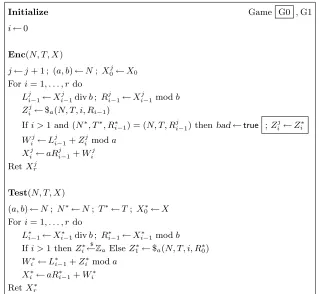
Proof. We assume without loss of generality thatA never makes a query for which ⊥is returned. Our proof proceeds in steps, using intermediate games G0 and G1 with behaviors between that of SPI1FE1 and SPI0FE1. Game G0 (shown in Figure 5, boxed statements included) is the same
as SPI1FE1 except that F is replaced by random functions. Game G1 (shown in Figure 5, boxed
statements excluded) is the same as G0 except that the random values used in responding to the Test query are no longer used when responding toEnc queries. The result of this change is that Test responds with a random, independent point. To see this, note that the values W∗
2, . . . , Wr∗ are uniformly distributed inZa due to the random choices of Z2∗, . . . , Zr∗. By assumption, we have
Initialize Game G0 , G1
i←0
Enc(N, T, X)
j←j+ 1 ; (a, b)←N; Xj 0←X0 Fori= 1, . . . , rdo
Lji−1←X j
i−1divb; R j i−1←X
j
i−1modb
Zj
i←$a(N, T, i, Ri−1)
Ifi >1 and (N∗
, T∗
, R∗
i−1) = (N, T, R j
i−1) thenbad←true ;Z j i←Z
∗
i
Wj i ←L
j i−1+Z
j i moda
Xij←aR j i−1+W
j i RetXj
r
Test(N, T, X)
(a, b)←N; N∗
←N; T∗
←T; X∗
0←X Fori= 1, . . . , rdo
L∗
i−1←X
∗
i−1divb; R
∗
i−1←X
∗
i−1modb Ifi >1 thenZ∗
i
$
←Za ElseZ∗
1←$a(N, T, i, R∗0)
W∗
i ←L
∗
i−1+Z
∗
i moda
X∗
i ←aR
∗
i−1+W
∗
i RetX∗
r
Fig. 5.Games used in the proof of Theorem 2. Each function $xmaps every input to an independently and uniformly sampled point inZx.
thatab=ap for some number p. (Equivalently, that p= logaabis a whole number.) The returned valueXr∗ can therefore be written as ap−1W2∗+· · ·+a·Wr∗−1+Wr∗ which is distributed uniformly overZab.
We have that
AdvspiFE1(A) ≤ Pr
SPI1AFE1⇒true−Pr
G0A⇒1
+ Pr
G0A⇒1 −Pr
G1A ⇒1
+ Pr
G1A⇒1 −Pr
SPI1AFE1⇒false .
A standard reduction bounds the first and last differences each by AdvprfF (B) for an adversary B
using the resources indicated in the theorem statement. To bound the second difference, we use that game G0 and G1 are identical-until-bad with the fundamental lemma of game playing [1] to get that
Pr
G0A⇒1 −Pr
G1A⇒1 ≤Pr
G1Asetsbad
where “G1Asetsbad” is the event thatbad is set during execution of G1A. Recall that Ais non-adaptive, meaning has fixed queries independent of all other random choices in the game. The flag
bad is set if, for some i∈[2.. r] and some j ∈[1.. q] it is the case that R∗i−1 =Rij−1. We split the argument into two cases, depending on whether the flag bad is set when i = 2 or i > 2. For the
i= 2 case, note that if R∗0 =Rj0 for some j thenR∗1 6=Rj1 (we have disallowed pointless queries). IfR∗0 6=Rj0, then for bad to be set it must be that
where (a, b) is the format of thei-thEncquery. But this equality holds with probability at mosta−1
m (taken over the coins used to choose Z∗
i) because a≥am by assumption. For the case that i >2, we have thatR∗i−1= (aR∗i−2+Wi∗−1) modbwhere Wk∗ is uniformly and independently distributed for all k∈[2.. r]. Thus the probability thatR∗i−1 =Rji−1 is at most a−m1.
Taking a union bound over all i, j we have that Pr[G1Asetsbad]≤p
mq/am.
8.2 Security of FE2
As one would expect, Patarin’s attack also applies to type-2 unbalanced Feistel networks. Its success and running time can be easily adapted from the discussion for FE1 given above. In the following, we describe a novel PRP attack for type-2 Feistel networks, a variant of it that allows message recovery, and then provable security bounds for FE2.
A new distinguishing attack. Highly unbalanced Feistel networks are susceptible to highly efficient attacks that succeed with exponentially vanishing probability as the number of rounds increases. Still, for small, fixed round number, the attacks could be dangerous. We present a PRP adversaryAagainst FE2 for some formatN = (a, b) and arbitrary tweakT. Denoter(N) byr and assume r is even (the attack easily extends to the case that r is odd). Then adversary A works as described below.
adversary AEnc(·,·,·)
L0 $
←Za; L′
0←L0; R0 $
←Zb; R′
0 $
←Zb\{R0}
Y ←Enc(N, T, b·L0+R0) ; Y′←Enc(N, T, b·L′0+R′0) D←Y modb; D′←Y′modb
ifD−R0≡D′−R′0 (modb) then ret 1 else ret 0
Let game PRP0 (resp. PRP1) be the same as game PRP (Figure 1) except b in Initialize is assigned 0 (resp. 1). First we analyze Pr[PRPA ⇒ 1]. AdversaryA outputs 1 exactly when D− R0 +R′0 ≡D′ (modb). Thus Pr[PRP0A ⇒ 1] = a(b1−1) +aab−1. We next analyze Pr[PRP1A ⇒ 1]. Let d=r/2. This is the number of times a value Ri is assigned in FE2 for i >0 and even. (Refer to Figure 3.) LetZ1, . . . , Zr be the outputs of the round functionF for rounds 1 tor(respectively) when evaluating FE2 on pointb·L0+R0 in response to A’s first query. Similarly letZ1′, . . . , Zr′ be the outputs of the round functionF for rounds 1 tor(respectively) when evaluating FE2 on point
b·L′0+R′0 in response to A’s second query. Consider the situation in which Zi =Zi′ for all i >0 and i even. This occurs with probability at least a−d. (This is true because the inputs to each of the relevant dround function applications will collide with probability 1/a.) Then in this case it holds with probability one thatD−R0≡D′−R′0 (modb) since
D≡Rr≡R0+ X
i≤r ieven
Zi (modb) and D′ ≡R′r ≡R0′ + X
i≤r ieven
Zi′ (mod b).
Therefore we have Pr[PRP1A ⇒1]≥a−d. Combining this with the upper bound on Pr[PRP0A⇒1] given above we get that the PRP advantage of Ais
AdvprpFE2(A)≥ 1
ad − 1
a(b−1)−
a−1
ab .
For certain values of a, b, r this is large. Say r = 7, a = 2 and b is large. Then A’s advantage is 1/3−1/(2b−2)−1/(2b).
Message recovery attack. We can extend the attack above to enable message recovery. The distinguishing attack establishes a relationshipD−R0 ≡D′−R′0 (mod b) for distinct messages with
Initialize Game G0 , G1
i←0
Enc(N, T, X)
i←i+ 1 ; (a, b)←N; Li
0←Xdivb; Ri0←Xmodb
Li
1←R0i; Z1i←$a(N, T,1, R0i) ; Ri1←Z1i+Li0moda
Li
2←R1i; Z2i←$b(N, T,2, Ri1) If (N, T, Ri
1) = (N
∗
, T∗
, R∗
1) thenbad1←true ;Z2i←Z
∗
2
Ri
2←Z2i+Li1modb
Li
3←R2i; Z3i←$a(N, T,3, Ri2) If (N, T, Ri
2) = (N
∗
, T∗
, R∗
2) thenbad2←true ;Z3i←Z
∗
3
Ri
3←Z3i+Li2moda Reta·Li
3+Ri3
Test(N, T, X)
(a, b)←N; N∗
←N; T←T∗
; L∗
0←Xdivb; R
∗
0←Xmodb
L∗
1←R
∗
0; Z
∗
1←$a(N, T,1, R
∗
0) ; R
∗
1←Z
∗
1+L
∗
0moda
L∗
2←R
∗
1; Z
∗
2
$
←Zb; R∗2←Z2∗+L∗1modb
L∗
3←R∗2; Z3∗
$
←Za; R∗
3←Z3∗+L∗2moda Reta·L∗
3+R
∗
3
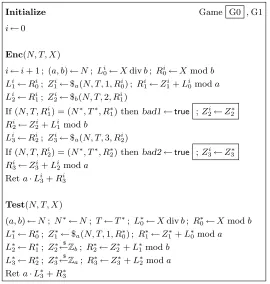
Fig. 6.Games used in the proof of Theorem 3. Each function $xmaps every input to an independently and uniformly sampled point inZx.
single known-plaintext and its associated ciphertext, which will have the desired collisions with the unknown plaintext with probabilitya−d. From the known plaintext, ciphertext pair one can recover the unknown plaintext portionR0. ThenL0 can be guessed (with probability of success 1/a) or the
adversary can try all apotential values of L0 by appropriate queries toEnc. The attack then runs
in time that to compute R0 (two modular additions), uses at mostaEnc queries, and succeeds in
recovering the full plaintext with probability at leasta−d.
Non-adaptive SPI security.We prove the following theorem, which is analagous to Theorem 2. It establishes non-adaptive SPI security of FE2 up toq≈awhen using just 3 rounds. Note that it is easy to give attackers against 2 rounds, and so this is the minimal number of rounds for which one can expect security.
Theorem 3. Let the FE2 FPE scheme be parameterized by F: K×N× T ×N×N → N and
r: N → N where r(N) = 3 for all N ∈ N. Let A be a non-adaptive SPI adversary that makes q encrypt queries with formats N = (a, b) with2≤a≤b. Let am be the maximal value such that for all formats N = (a, b) queried by A it holds that am ≤ a. Then there exists a PRF adversary B such that
AdvspiFE2(A)≤2·AdvprfF (B) + 2q
am
.
B runs in time that of Aand makes 3q queries.