Available online: https://edupediapublications.org/journals/index.php/IJR/ P a g e | 923
Effect of Material Proportions on the Engineering Properties of Pervious Concrete
PECHETTI DILIP SAI B. GANESH
PG Student prof. & HOD
Dept, of civil engineering Dept. of civil engineering Lenora engineering college Lenora engineering college
RAMPACHODAVARAM RAMPACHODAVARAM
[email protected] [email protected]
Abstract— The term pervious cement
ordinarily depicts an almost zero-droop,
open-evaluated material comprising of portland
bond, coarse total, next to zero fine total,
admixtures, and water. The blend of these
fixings will deliver a solidified material with
associated pores, extending in estimate from
0.08 to 0.32 in. (2 to 8 mm), that enable water
to go through effectively. The goal was to
examine the impacts of level of fine totals and
bond to coarse total proportion on the
imperative designing properties of pervious
cement. According to the test outcomes, most
extreme compressive quality of pervious
cement was accomplished by utilizing the
20mm evaluated total and 1:4 bond: add up to
total proportion. The most extreme solid shape
compressive quality accomplished at 7 days
was 17.91 N/mm2 and 27.1 N/mm2 at 28 days.
Most extreme water penetrability of request
3.39 X10 - 4 cm/sec was accomplished which
is around 3.4 times more porous than high
porousness concrete.
Index Terms — Pervious Concrete, no fines
solid, block compressive quality, chamber
compressive quality, split elasticity, flexural
quality and penetrability.
I.INTRODUCTION
Pervious cement was an extraordinary high
permeable cement utilized for flatwork
applications that permit water from
precipitation and different sources to go
through, in this way diminishing the overflow
from a site and Recharging ground water
levels. Its void substance went from 18 to 35 %
with compressive qualities of 400 to 4000 psi
(28 to 281 kg/cm2)[1]. Normally, pervious
cement had practically no fine total and had
quite recently enough cementitious glue to coat
the coarse total particles while saving the
interconnectivity of the voids. Exploiting the
relating diminished thickness, the solid was
inconceivably porous while still ready to give a
Available online: https://edupediapublications.org/journals/index.php/IJR/ P a g e | 924
(e.g. rain/snow soften) running off the surface
on a level plane, for all intents and purposes all
tempest water falling onto pervious cement
instantly depleted straightforwardly down
through the asphalt to the sub review, disposing
of overflow while giving filtration and ground
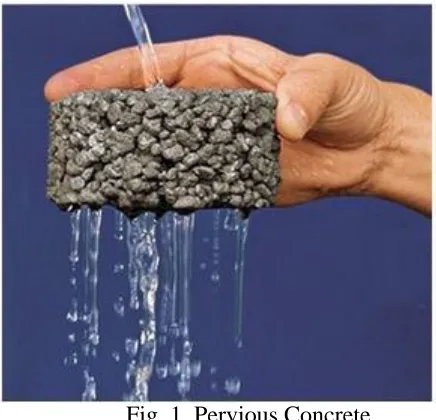
water revive. Pervious cement looked like an
open-cell material with an appearance some of
the time portrayed as that of a "Rice Krispies"
treat. By the by, the item could be
indispensably hued, painted, or generally
changed to be stylishly tuned in to the venture
condition in an indistinguishable routes from
traditional cement. It could even be made
acceptably smooth for good shopping basket
portability by the methods for quickly
progressing putting strategies, hardware, and
solid blend outline innovation while as yet
keeping up a non - slip surface.
Fig. 1. Pervious Concrete
A. Historical Background
The utilization of no-fines concrete as an
asphalt material had been amazingly
constrained and had just as of late been created
for this specific application. Be that as it may,
no-fines concrete had been utilized broadly as
an auxiliary building material in Europe,
Australia and the Middle East for more than 70
years (Macintosh et al. 1965)[2]. The
utilization of no-fines concrete turned out to be
impressively more across the board amid the
material deficiencies after World War II, for
cast set up stack bearing dividers of single and
multi-story structures. As of late no-fines
concrete had been utilized as a heap bearing
material in tall structures up to ten-story. The
most striking utilization of this type of cement
was embraced in Stuttgart, Germany where a
tall structure was developed utilizing
customary cement for the six base story and
no-fines for the staying thirteen upper stories
(Malhotra 1976)[3]. Offenberg expressed that
the principal mainstream use of pervious
cement was in post-World War II England
where it was utilized as a part of two-story
homes known as the Wimpey Houses [4].
No-fine cement was then utilized as a part of a few
sections of the dividers by Wimpey draftsmen
and specialists to diminish the cost. A portion
of the applications for pervious cement
included private streets, carport, walkways,
parking garages, low water intersections,
Available online: https://edupediapublications.org/journals/index.php/IJR/ P a g e | 925
obstructions, tennis court, swimming pool
decks, and zoo regions.
B. Benefits and Problems of Pervious Concrete Mix
One of the essential employments of pervious
cement is in storm water administration.
Because of its high porosity, pervious cement
can catch storm water and give a pathfor water
to stream into the subsoil, serving to normally
alter the ground water level. Besides, pervious
cement is substantially cooler than black-top
and traditional cement. The light shading
reflects more bright beams from sun and
assimilates less warmth than black-top.
Pervious solid demonstrates a few focal points
on activity. The a lot of voids in pervious
cement are helpful to decreasing movement
commotion. Pervious solid upgrades the
wellbeing of driving amid down-pouring on
account of the disposal of ponding. High
porosity is the vital condition that makes
pervious cement porous, and is the primary
valuable normal for pervious cement. In any
case it can cause issues that cutoff the usage of
pervious cement. The bearing limit of pervious
cement is diminished due to the presence of a
lot of air voids. The low quality confines the
usage of pervious cement to parking areas,
walkways, and other low-volume movement
roadways. Scraped area of pervious cement
may confine its use. Raveling may happen if
total isn't adequately covered with concrete
glue. Stopping up is an unavoidable issue
because of the presence of voids in pervious
cement. The open voids are very inclined to be
stopped up amid the usage of pervious solid
asphalt after some time. Normally, the
underlying expense of pervious cement is more
prominent than that of regular cement. In any
case, in light of the fact that the life expectancy
of pervious cement is longer than that of the
normal solid, a portion of the additional cost is
balanced. The high introductory cost of
pervious cement is incompletely caused by the
development of the sub review.
C. Recommended Design of Pervious Concrete Mix
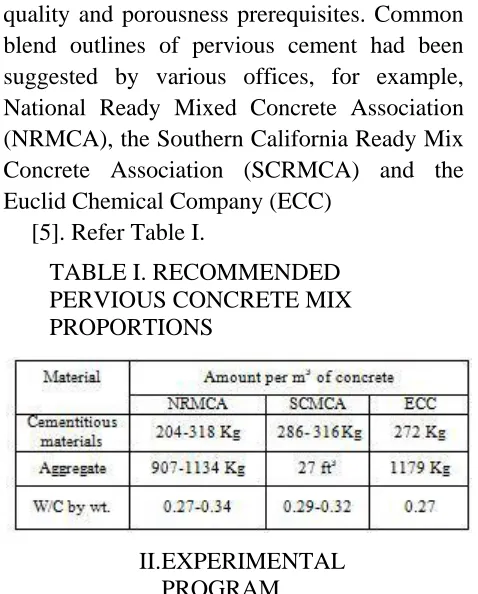
Pervious solid blend configuration had produced bunches that fulfill compressive quality and porousness prerequisites. Common blend outlines of pervious cement had been suggested by various offices, for example, National Ready Mixed Concrete Association (NRMCA), the Southern California Ready Mix Concrete Association (SCRMCA) and the Euclid Chemical Company (ECC)
[5]. Refer Table I.
TABLE I. RECOMMENDED PERVIOUS CONCRETE MIX PROPORTIONS
II.EXPERIMENTAL PROGRAM
The test program was wanted to examine the
Available online: https://edupediapublications.org/journals/index.php/IJR/ P a g e | 926
A. Physical Properties of Materials Used
The constituent materials which were utilized for making pervious cement were tried according to IS codal arrangements and were observed to agree to the codal necessities. In the present examination, conventional portland bond of 43 review from a solitary cluster complying with IS: 10262:2009 was utilizedfor all solid blends. The fine totals were gotten from ghaggar stream and were first sieved through 4.75 mm sifter to evacuate any particles more noteworthy than 4.75 mm and it was observed to consent to Zone III. The particular gravity of fine totals was 2.60 and fineness modulus as 2.13. The coarse total utilized were smashed 20mm reviewed total with particular gravity of 2.6. Consumable faucet water was utilized for throwing and curing of example.
B. Final Mix Proportions Selected
In view of the trial blends comes about, the bond content in the pervious cement was settled as 400Kg/m3. The water bond proportion was additionally settled as 0.3. The relating blend extents for the chose blends of pervious cement are appeared in Table II.
TABLE II. MIX PROPORTIONS OF DIFFERENT MIXES
C. Preparation of Test Specimens.
The throwing was completed utilizing a tilted
drum sort solid blender to guarantee uniform
blending of fixings. The examples were thrown
in steel forms and compacted on a table
vibrator. Curing was improved the situation 28
days by keeping the examples totally inundated
in consumable water. The test outcomes
announced in this paper speaks to the normal
esteem acquired from at least three examples.
III. ANALYSIS OF TEST RESULTS
The solid examples were tried following 7 days
and 28 days of throwing. The aftereffects of
different test performed on the solid blends are
talked about in the succeeding areas.
A. Cube Compressive Strength
Cube compressive strength of mixes at various ages is given in Table III.
TABLE III. CUBE COMPRESSIVE STRENGTH AT VARIOUS AGES
Effect of Percentage of Fine Aggregate
For 1:4 bond: add up to total proportion blends
(C1,C2,C3) without any fines the block
compressive quality at 7 days was observed to
be 11.63 N/mm2, with 5 % fine totals the
quality expanded by around 5 %. With 10 %
fine totals the 3D shape compressive quality
expanded by around 50 %. The most extreme
solid shape compressive quality accomplished
Available online: https://edupediapublications.org/journals/index.php/IJR/ P a g e | 927
1:5 bond: add up to total proportion blends
(C4,C5,C6) with 5 % fine totals the block
compressive quality diminished by around 10
% - 15 %. Though with expansion of 10 % fine
totals the quality diminished by around 10 %.
Impact of Cement: Total Aggregates Ratio For
1:4 proportion blends gave the quality
accomplished was more than 1:5 proportion
blends. There was around 70 % expansion in
shape compressive quality at 7 days and around
45 % increment in quality at 28 days in 1:4
blends when contrasted with 1:5 blends.
B. Cylinder Compressive Strength
Cylinder compressive strength of mixes at various ages is given in Table IV.TABLE IV. CYLINDER COMPRESSIVE STRENGTH AT VARIOUS AGES
Effect of Percentage of Fine Aggregate
For 1:4 concrete: add up to total proportion
(C1,C2,C3) without any fines the quality at 28
days was observed to be 9.12 N/mm2, with 10
% fine totals the chamber compressive quality
variety was not huge. For 1:5 bond: add up to
total proportion blends (C4,C5,C6) with 10 %
fine totals the barrel compressive quality
diminished by around 50 %. The greatest barrel
compressive quality accomplished at 7 days
was 4.6 N/mm2 and at 28 days it was 6.4
N/mm2 for C4 blend.
Impact of Cement: Total Aggregates Ratio It
was seen that quality expanded by changing
proportion of concrete: add up to totals from
1:5 to 1:4. 1:4 proportion blends gave more
quality than 1:5 proportion blends. With 0%
fine totals there was around 30% expansion in
barrel compressive quality at 7 days and around
40% increment at 28 days for 1:4 (bond: add up
to total) blends when contrasted with 1:5
(concrete: add up to total) blends.
C. Split Tensile Strength
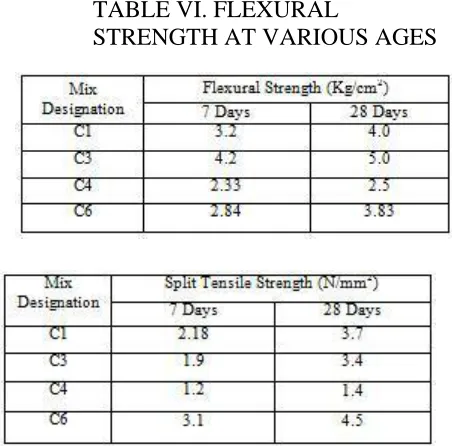
Split Tensile strength of mixes at various ages is given in Table V.
TABLE V. SPLIT TENSILE STRENGTH AT VARIOUS AGES
Effect of Percentage of Fine Aggregate
For 1:4 (concrete: add up to total proportion)
blends (C1,C2,C3) without any fines the 3D
shape compressive quality at 28 days was
observed to be 3.7 N/mm2 with 10 % fine
totals the split elasticity diminished by around
80 %. For 1:5 (bond: add up to total proportion)
blends (C4, C5, C6) with 10 % fine totals the
split elasticity was expanded by around 220 %.
The most extreme split elasticity accomplished
at 7 days was 3.1 N/mm2 and at 28 days it was
4.5 N/mm2 for C6 blend.
Available online: https://edupediapublications.org/journals/index.php/IJR/ P a g e | 928
Split elasticity expanded by changing
proportion of (concrete: add up to total) 1:4 to
1:5. At 7 days there was around 43 %
expansion in split elasticity when 1:5 blends
were utilized as a part of place of 1:4 blends
and at 28 days there was around 46 %
increase in split rigidity by changing the
bond: add up to total proportion from 1:4 to 1:5
proportion.
D. Flexural Strength
Flexural strength of mixes at various ages is given in Table VI.
TABLE VI. FLEXURAL
STRENGTH AT VARIOUS AGES
Effect of Percentage of Fine Aggregate
For 1:4 (bond: add up to total) blends
(C1,C2,C3) without any fines concrete the
quality was observed to be 4.0 kg/cm2, with
option of 10 % fine totals the flexural quality
expanded by around 30 %. For 1:5 bond: add
up to total proportion blends (C4,C5,C6) with
option of 10 % fine totals the flexural quality
expanded by around 50 % when contrasted
with when no fine totals was included. The
most extreme flexural quality accomplished at
7 days was 2.84 N/mm2 and at 28 days it was
3.83 N/mm2 for C6 blend.
Impact of Cement: Total Aggregates Ratio
In 1:4 (concrete: add up to total) blends, there
was 48% expansion in quality at 7 days and
around 31% increment in quality at 28 days
when contrasted with 1:5(cement: add up to
total) blends.
E. Penetrability
Water penetrability trial of pervious cement
was directed by IS: 3085 – 1965. Territory (A)
was kept consistent as 225cm2. H/L proportion
was additionally figured as 112500. Fig 2
demonstrates the water penetrability of
different blends.
Fig. 2. Water Permeability of Pervious Concrete
CONCLUSIONS
Compressive quality expanded by expansion of
5% fine totals however the quality diminished
Available online: https://edupediapublications.org/journals/index.php/IJR/ P a g e | 929
totals. Compressive quality diminished with
increment in concrete: add up to total
proportion. Henceforth 1:4 blend extents gave
better quality when contrasted with 1:5 blend
extents. Split elasticity for 1:5 concrete: add up
to total blend expanded by around 220% with
option of 10% fine total when contrasted and
blend having no fine totals. Flexural quality of
pervious cement expanded by half with
expansion of 10% fine totals when contrasted
with blend having no fine totals.
REFERENCES
[1] American Concrete Institute (ACI).
(2006) "Pervious Concrete, ACI 522
Committee Report, Farmington Hills, MI:
ACI".
[2] Carolinas Ready Mixed Concrete
Association, Inc. (2003) "Pervious Concrete
Installation Course Information Packet".
Carolinas Ready Mixes Concrete Association
Inc. Reexamined July 2003.
[3] Kevern, J. T., (2006) "Blend Design
Development for Portland Cement Pervious
Concrete in Cold Weather Climates." M.S.
Proposition. Ames, IA: Iowa State University.
[4] Malhotra, V. M. 1976. "No-Fines
Concrete – Its Properties and Applications".
[5] Journal of the American Concrete
Institute. Vol 73. No. 11.
[6] Meininger, Richard C. 1988. "No-Fines
Pervious Concrete for Paving Concrete".
[7] International: Design and Construction.
Vol 10. No. 8. Admirable.
[8] Neville, A. M. 1996. "Properties of
Concrete". John Wiley and Sons. Inc. New
York. USA.
[9] Ghafoori, Nader and Dutta, Shivaji.
1995. "Building and NonPavement