Superposition Attacks on Cryptographic Protocols
Ivan Damg˚ard?, Jakob Funder, Jesper Buus Nielsen??, Louis Salvail? ? ?
Dept. of Computer Science, Aarhus University, Universit´e de Montreal
Abstract. Attacks on cryptographic protocols are usually modeled by allowing an adversary to ask queries to an oracle. Security is then defined by requiring that as long as the queries satisfy some constraint, there is some problem the adversary cannot solve, such as compute a certain piece of information. Even if the protocol is quantum, the queries are typically classical. In this paper, we introduce a new model of quantum attacks on protocols, where the adversary is allowed quantum access to the primitive, i.e, he may ask several classical queries in quantum superposition. This is a strictly stronger attack than the standard one, and we consider the security of several primitives in this model. We show that a secret-sharing scheme that is secure with thresholdtin the standard model is secure against superposition attacks if and only if the threshold is lowered tot/2. This holds for all classical as well as all known quantum secret sharing schemes. We then consider zero-knowledge and first show that known protocols are not, in general, secure in our model by designing a superposition attack on the well-known zero-knowledge protocol for graph isomorphism. We then use our secret-sharing result to design zero-knowledge proofs for all of NP in the common reference string model. While our protocol is classical, it is sound against a cheating unbounded quantum prover and computational zero-knowledge even if the verifier is allowed a superposition attack. Finally, we consider multiparty computation and give a characterization of a class of protocols that can be shown secure, though not necessarily with efficient simulation. We show that this class contains non-trivial protocols that cannot be shown secure by running a classical simulator in superposition.
1 Introductiont
Attacks on cryptographic protocols are usually modeled by allowing an adversary to query an oracle that represents the primitive he attacks, for instance the adversary specifies a message he wants to have signed, a challenge he wants a prover to answer, or a subset of players he wants to corrupt Security is then defined by requiring that as long as the queries satisfy some constraint, there is some problem the adversary cannot solve, such as compute a certain piece of information.
Several previous works consider what happens to security of classical protocols if we allow the adversary to be quantum. The model usually considered is that the adversary is now a quantum machine, but otherwise plays exactly the same game as in a normal attack, i.e., he still communicates classically with the protocol he attacks. One example of this is the work of Watrous [Wat06], showing that a large class of zero-knowledge protocols are also zero-knowledge against a quantum verifier.
In this paper, we introduce a new model of quantum attacks on classical as well as quantum cryptographic protocols, where the adversary is allowed to ask several classical queries to the oracle in quantum superposition. In more concrete terms, we ask, for multiparty protocols: what happens if the adversary can be in superposition of having corrupted several different subsets? or, for zero-knowledge protocols: what happens if a quantum verifier can be in superposition of having
?
The first three authors acknowledge support from the Danish National Research Foundation and The National Science Foundation of China (under the grant 61061130540) for the Sino-Danish Center for the Theory of Interactive Computation, within which part of this work was performed; and also from the CFEM research center (supported by the Danish Strategic Research Council) within which part of this work was performed.
??
Partially supported by European Research Council Starting Grant 279447. Partially supported by DFF Starting Grant 10-081612.
? ? ?Supported by Quebec’s INTRIQ, Canada’s NSERC strategic program FREQUENCY, and Canada’s NSERC
issued several different challenges to the prover, and receive the responses in superposition? As we will argue below, we believe such superposition attacks to be a valid physical concern, but they also form a very natural generalization from a theory point of view: in the literature on black-box quantum computing, quantum black-black-box access to a function is usually defined by extending classical black-box access such that queries are allowed to contain several inputs in superposition. Our superposition attacks extend conventional attacks in the same way.
There is recent work [BDF+11,Zha12b] that considers the random oracle model and shows security of various schemes even if the adversary has quantum access to the random oracle. These result are quite different from ours in that they are are concerned with allowing everything “in the adversary’s brain” to be quantum, rather than considering his communication with the rest of the world as we do. To the best of our knowledge our work is the first to consider adversaries that have quantum access to the cryptographic primitive or protocol under attack 1 but we emphasize that in independent work [Zha12a,BZ12] superposition attacks are also considered, on pseudorandom functions and message authentication codes.
At first sight, superposition attacks may seem rather exotic. However, it is not hard to see that in several scenarios, it is very natural to consider these attacks:
Consider first protocols that handle quantum data, such as in several previous works on quantum secret sharing and multiparty computation (e.g., Ben-Or et al. [BCG+05]). Such a protocol requires players to communicate quantum information and keep throughout the game a joint entangled quantum state that involves all the players. If the players can do this, we should assume that the adversary can do something of similar technological difficulty. It therefore seems fair to allow the adversary to be in superposition of having interacted with different subsets of players. Note here that “interacting with a player” does not have to be a macroscopic process: the adversary could attempt to communicate with the player in a way that is physically different from what the implementation of the protocol expected, and in this way get more information about the private state of the player than he was supposed to. For instance, the effect of sending on a different frequency or a different number of particles than expected may be hard to predict and may depend heavily on the way the protocol is implemented. Several known attacks on quantum key distribution work in this way. Now, if the communication defined by the protocol is quantum in the first place, we see no reason why such an attack cannot be performed in superposition against different players.
Second, what about classical protocols? One might think that here, superposition attacks cannot be mounted. The argument would be that since honest players are classical, they would “automati-cally” do a measurement of anything they receive, thus forcing a collapse of any quantum state they are given. However, this may be a dangerous assumption in the future, considering the fact that classical computing equipment becomes smaller and approaches the quantum limit. If an adversary captures such a device containing a secret key, he may be able to cool it down, for instance, and get some quantum effects to happen during communication. On top of this, even honest players may in the future use quantum computing and communication, but may sometimes need to execute a classical protocol. Having to always do this on separate classical hardware would be an unpleasant limitation.
So if we cannot be sure that hardware always behaves classically, perhaps an easy solution would be to require explicitly in the protocol that every incoming message is measured? However, such an idea seems problematic from a practical point of view: an instruction to measure an incoming message makes little sense to someone implementing the protocol on a classical machine, so we have to trust that someone else responsible for the physical implementation will put equipment
1a preliminary announcement of some of our results was made in an invited talk by one of the authors at the ICITS
in place to do the measurement. Moreover, making sure the measurement is actually done is not as straightforward as one might think: most physicists today subscribe to an interpretation of quantum mechanics where the belief is that the wave function never actually collapses even when a measurement is done. Instead, information is transferred to (a part of) the environment and this is experienced as a collapse to a party who does not have access to the environment. In our case, this means that if the adversary were to get access to this environment, then from his point of view no measurement took place. Hence, equipment that seeks to enforce that a measurement is done from the adversary’s point of view must in some sense keep information away from the adverary, and this may be non-trivial if we are dealing with microscopic equipment.
In the face of these problems, we believe the most natural and elegant solution is to ask for pro-tocols that are secure regardless of whether any measurement is performed on incoming messages, which exactly means we need security even if the adversary has quantum access to the primitive.
Contributions of the paper. We first show that any classical secret-sharing scheme that is perfectly secure with threshold t in the standard model is perfectly secure against superposition attacks if and only if the adversary’s superposition is constrained to contain subsets of size at mostt/2. If this condition is not satisfied, not only does perfect security fail, we show examples where the adversary may even learn the secret with certainty. We also consider quantum secret sharing schemes and show that the same results hold for a large class of schemes derived from classical linear secret sharing, this includes essentially all known schemes.
We then consider (classical) zero-knowledge protocols and first give strong evidence that known protocols are not, in general, secure against superposition attacks. We give such an attack on the well-known graph isomorphism protocol, showing how to extract from the prover the number of fixed points of the prover’s secret permutation. A simple reduction shows that if this attack could be simulated, then there is an efficient quantum algorithm computing the isomorphism between two graphs, as long as the isomorphism is unique. Thus the protocol can only be zero-knowledge if graph isomorphism in most cases is easy on a quantum computer.
We then use our result on classical secret-sharing to construct zero-knowledge proofs for all of NP in the common reference string (CRS) model. While our protocol is classical, it is sound against a cheating unbounded quantum prover and computational zero-knowledge against a quantum verifier, even if the verifier is allowed a superposition attack2. Since our simulation is straight-line, the protocol is also secure under concurrent composition. We stress that our construction does not make assumptions beyond what we need to protect against standard attacks, nor is it less efficient than known constructions. Therefore this construction is an affirmative answer to our question above: we can indeed have protocols that are secure, regardless of whether incoming messages are measured or not.
Finally, we consider classical multiparty computation and we define a UC-style model for static and passive superposition attacks on classical MPC protocols. Given our result on secret-sharing schemes, it is natural to speculate that classical MPC protocols that are secure againsttcorruptions, are secure against superposition attacks corruptingt/2 players. The situation turns out to be more complicated, however: We show that for the model that gives the adversary the most power (and hence is the most hostile to the simulator), simulation based security is not possible at all. However,
2
putting a natural constraint on the adversary, we are able to give a characterization of a class of protocols that can be shown secure, though not necessarily with efficient simulation. We show that this class contains non-trivial protocols, where by non-trivial, we mean that although the protocol is secure against a classical attack, we can show that it cannot be proved secure against a superposition attack by simply running the classical simulator in superposition. The simulator that does exist is in some sense “more quantum” .
Whether more general positive results hold in this constrained model remains an open question. Likewise, the very natural question of security ofquantummultiparty computation protocols against superposition attacks remains open. Note, however, that existing work on quantum multiparty computation is typically based on quantum secret sharing, where the adversary’s choice of subset to corrupt is classical. The negative part of our result on secret sharing described above shows that such protocol are not necessarily secure against superposition attacks as they stand.
2 Preliminaries
We will model players in protocols in two different ways: when we are not interested in computa-tional limitations on parties, a player will be specified by a series of unitary transforms where the i’th transform is done on all qubits available to the party, after the i’th message has been received (in the form of a quantum register), and then some designated part of the storage is sent as the next outgoing message. We are limiting ourselves to perfect unitary transformation of the party’s register because we are exactly considering the situation where an attacker manages to prevent coupling between the party and the environment.
In cases where we want to bound the computational complexity of a player, we consider players to be an infinite family of interactive quantum circuits, as in the model from [FS09], and then the complexity is the circuit size.
2.1 Running functions in superposition
Consider any function,f :X →Y and a register of qubits, |ψi=X
x
αx|xi|0i ∈ HX ⊗ HY, where
dim(HX) = |X| and dim(HY) = |Y|. To run f on |ψi means to apply the unitary transforma-tion, Uf, such that Uf
X
x
αx|xi|0i =
X
x
αx|xi|f(x)i. In general the register in HY, called the
response register, can contain any superposition of values, not just 0. In this case, we have that, Uf
X
x,a
αx,a|xi|ai=
X
x,a
αx,a|xi|f(x)⊕ai where⊕is the bitwise xor.
3 Secret sharing
In (classical) secret sharingn parties are sharing some secret values∈Susing randomnessr∈ R, where S and R are the sets of possible secrets and randomness. We name the parties P1, . . . , Pn.
Let [n] ={1, . . . , n}. Each party,Pi, receives ashare vi(s, r) ∈ {0,1}k, also called his private view
. That is, vi:S× R → {0,1}k.
For A⊂[n], letvA(s, r) ={vi(s, r)}i∈Abe the string containing the concatenation of views for
parties Pi withi∈A. For convenience in the following we assume that each such string is padded,
so that they have the same length regardless of the size of A. That is, vA :S× R → {0,1}t. An
adversary structure of the secret sharing scheme is the maximal F ⊆2[n] for which the scheme is perfectly secure against F attacks. We will only consider so-called perfect secret-sharing schemes, where it holds for all A 6∈ G that vA(s, r) uniquely determines the secret s. I.e., in a perfectly
secure, perfect secret-sharing scheme a set of shares either carry no information on the secret or fully determines the secret.
We will model any passive attack on the scheme as a one-time query to an corruption oracle. The corruption oracle for a specific run of a secret sharing scheme O(s, r, A) = vA(s, r) is the
function that for a specific choice of secret, randomness and set of parties, returns the private view of those parties. That is, O:S⊗ R ⊗F → {0,1}t.
3.1 Two-party bit sharing example
Before we present the full model for secret sharing we start with a small example. We consider the case of 2 parties sharing a single bit, b∈ {0,1}, using a random bit,r ∈ {0,1}. Here [n] ={1,2}, F ={(1),(2)},v1(b, r) =b⊕r,v2(b, r) =r.
This scheme is of course secure against a classical attack, which we can model by giving an adversary one-time access to an oracle that will return one share (r orr⊕b) on request. However, it is well known from the Deutch-Jozsa algorithm that given quantum access to such an oracle, one can compute the xor of the two bits from only one query. Hence the scheme is not secure against a superposition attack. In the following we consider what happens in the general case.
3.2 Model for secret sharing
We will now give the full technical description of the model for superposition attacks on general secret sharing. To do this we first consider the state spaces needed to run the protocol and the attack on the protocol. First is the space that contains the shares for all the parties, Hparties. The state in the register for this space is unchanged throughout the attack and is
|partiesip= X
s∈S,r∈R √
ps
√
pr
s, r, v[n](s, r)
p=
X
s∈S,r∈R √
ps
√
pr|s, ri n
O
i=1
|vi(s, r)i ,
where |s, ri is the purification of the secret and randomness choice. This is purely for technical reasons and does not matter for the adversary as he never sees it (and hence they might as well be considered measured). Secondly is the space for the environment, Henv, which the adversary can use to choose his query and use as potential auxiliary register. The initial state for the environment is a general (pure) state,
|ψie=X
x
αx|xie∈ Henv ,
wherex is in some set of arbitrary, but finite size. We will ommit this for readability.
Finally is the space holding the adversary’s query to the corruption oracle,Hquery. This is initially a ’blank’ state,
|ωiq=|0,0iq∈ Hquery.
The space for the entire model is hence, Htotal=Hparties⊗ Henv⊗ Hquery, and the intial state is,
|initit= X
s∈S,r∈R
√
ps
√
pr
s, r, v[n](s, r)
p⊗
X
x
αx|xie⊗ |0,0iq∈ Htotal.
will corrupt and associated values for the response registers. This is an arbitrary unitary operation. We will denote it, Uqueryadv,F,
Uqueryadv,F :Henv⊗ Hquery→ Henv⊗ Hquery .
After this unitary operation the state is
|queryit=Uadv,F query|initit
= X
s∈S,r∈R √
ps
√
pr
s, r, v[n](s, r)
p⊗
X
x,A∈F,a∈{0,1}t
αx,A,a|xie⊗ |A, aiq
where we assume it is the identity onHparties. Next the oracle, O(s, r, A), is run. Let
UO:Hparties⊗ Hquery → Hparties⊗ Hquery
denote the unitary applying this function. The state afterwards isUO|queryit, which equals
X
s∈S,r∈R
√
ps
√
pr
s, r, v[n](s, r)
p⊗
X
x,A∈F,a∈{0,1}t
αx,A,a|xie⊗ |A, a⊕vA(s, r)iq
where we assumeUO is padded with appropriate identities. Consider the final state the adversary
sees for a specific secret, s,
ρadv,Fs =X
r∈R pr
ψadv,Fr
ψadv,Fr ,
where|ψadv,Fr i=
X
x,A∈F,a∈{0,1}t
αx,A,a|xie⊗ |A, a⊕vA(s, r)iq.
Definition 1. A secret sharing scheme S is perfectly secure against superposition F-attacks if, and only if, for all unitary matrices, Uqueryadv,F :Henv⊗ Hquery→ Henv⊗ Hquery and all possible pairs
of inputs, s, s0 ∈S it holds that ρadv,Fs =ρadv,Fs0 .
3.3 (In)security against Superposition Attacks on Classical Secret-Sharing
For an adversary structure F, we define F2 ={A| ∃B, C ∈F :A=B∪C}.
Theorem 1. Let G be the classical adversary structure for S. S is perfectly secure against super-positionF-attacks if and only if F2 ⊆G.
Proof. For the forward direction, consider the adversary’s final state,
ρadv
s =
X
r∈R
pr|ψadvr ihψradv|,
which equals
X
r,x,x0,A,A0,a,a0
prαx,A,aα∗x0,A0,a0|xie
x0
e⊗ |A, a⊕vA(s, r)iq
A0, a0⊕vA0(s, r)
q .
Now, for any fixedA,A0,a,a0 and s, consider the matrix
X
r∈R
pr|A, a⊕vA(s, r)iq
A0, a0⊕vA0(s, r)
The crucial observation now is that this matrix is in 1-1 correspondence with the joint distribution of vA(s, r) and vA0(s, r). Namely, its entries are indexed by pairs of strings (α, β), where α,β are
strings of the same length. And furthermore the (α, β)’th entry is the probability that the events vA(s, r) =α⊕aand vA0(s, r) =β⊕a0 occur simultaneously, where the probability is taken over a
randomr. Now, ifF2 ⊆G, we have thatS is perfectly secure against classicalF2-attacks. Therefore the joint distribution ofvA(s, r) andvA0(s, r) does not depend ons, consequently each matrix
X
r∈R
pr|A, a⊕vA(r, s)iq
A0, a0⊕vA0(s, r)
q
is independent of sas well. Hence∀s, s0 ∈S:ρadv,Fs =ρadv,Fs0 as required.
For the only-if part, assume for contradiction that F2 6⊆ G, i.e., there exist A0, A1 such that A0∪A16∈G. It follows that a secret shared usingS is uniquely determined from shares inA0∪A1. Then consider the query |ωαi= (|Ai|0i+|A0i|0i)/
√
2. By the same computation as above, we see thatρadv
s contains a submatrix of form
X
r∈R
|aA⊕vA(s, r)ihaA0 ⊕vA0(s, r)|, that corresponds to the
joint distribution of shares in A and A0. But since the secret is uniquely determined from these shares, it follows that this submatrix is different for different secrets, and hence we get that there exists a measurement with non-zero bias towards the secret, and soS is not perfectly secure against superpositionF-attacks. This is exactly the result we saw in the small example in Section 3.1. ut
Alternative models for secret sharing Here we take a closer look at how the response register in handled during a superposition attack: When the adversary runs a classical component in super-position, and sends it a message, then the reply will in general be a supersuper-position, nevertheless the reply might be computed in different ways. In general quantum information processing, the stan-dard assumption is that the result is xor’ed into a response registerasupplied along with the input, e.g., if the component computes a functionf, then on input|xi|ai, the output is|xi|a⊕f(x)i. This ensures that the components acts unitarily when the input is quantum. We call this the supplied response register model.
When considering the case of an adversary attacking a protocol one may be able to argue that the adversary will not have enough control to be able to decide the a priori content of the response register. It may be more reasonable to assume that the component the adversary talks to will create the response register and return it to the adversary. We model this setting of created response registers by restricting the more general setting by allowing onlya= 0, in which case the adversary will always receive|xi|f(x)i. Note that Theorem 1 applies in this setting as well.
3.4 Attacks on Secret Sharing
Theorem 1, tells us that we cannot have perfect security if the condition F2 ⊆G is violated, but nothing about how much information the adversary can actually gain on the secret in this case. Of course, ifF 6⊆G, the adversary can trivially learn the secret. But ifF ⊆Gone might hope that the adversary only learns a small amount of information, and even that this could become negligible by increasing the amount of randomness used to create the shares. However, in the lemma below we show that, under a simple assumption on the secret sharing scheme, an attacker can distinguish between two possible secrets with considerable bias. The attack works even in the restricted setting of created response registers.
uniquely determine the choice of randomness,r ∈ R, then the following holds: For any two secrets s, s0 ∈ S : s 6= s0, there exists a query (with a = 0) that will allow an adversary to distinguish between sand s0 with probabilitypguess, where pguess ≥ 34.
Proof. The adversary will need no auxiliary register, so let his state simply be the query register. He constructs the following (pure state) query
|ωi= √1
2(|A0,0i+|A1,0i) ,
where |ωi ∈ Hquery and A0 6=A1 are subsets chosen according to the lemma. The final state the adversary sees for different secrets is then
ρadv
s =
X
r∈R
pr|ψadvr ihψadvr |,
where|ψadv r i=
X
A∈{A0,A1} 1
√
2|A, vA(s, r)iq andr ∈ R.
It is well-known that the adversary’s probability of distinguishing between two such states,ρsadv and ρs0
adv, is pguess =
1 2 +
1
4 × |ρsadv −ρ s0
adv|tr, where |. . .|tr denotes the trace norm. Define the
difference between the two states as the matrix ∆.
∆=ρsadv−ρsadv0
= 1 2
X
A,A0∈{A
0,A1},r∈R
pr|A, vA(s, r)iq
A0, vA0(s, r)
q− 1 2
X
A,A0∈{A
0,A1},r∈R pr
A, vA(s0, r)
q
A0, vA0(s0, r)
q
= 1 2
X
A,A0∈{A
0,A1}
|Ai
A0 X
r∈R
pr|vA(s, r)iqhvA0(s, r)|
q−
X
r∈R pr
vA(s0, r)
q
vA0(s0, r)
q
!
.
Since the distribution of vA(s, r) (for A∈ {A0, A1}) is independent of the secret we have that for all s, s0 ∈S
X
r∈R
|vA(s, r)ihvA(s, r)|=
X
r∈R
vA(s0, r)
vA(s0, r)
,
which means we only need to consider A, A0∈ {A0, A1} whereA6=A0. So,
∆= 1
2|A0ihA1| ⊗
X
r∈R
pr|vA0(s, r)iqhvA1(s, r)|q−
X
r∈R pr
vA0(s0, r)
q
vA1(s 0, r)
q
!
+ 1
2|A1ihA0| ⊗
X
r∈R
pr|vA1(s, r)iqhvA0(s, r)|q−
X
r∈R pr
vA1(s0, r)
q
vA0(s 0, r)
q
!
.
Now define the two submatrices,
S=X
r∈R
pr|vA0(s, r)iqhvA1(s, r)|q−
X
r∈R pr
vA0(s0, r)
q
vA1(s 0, r)
q (1)
S†= X
r∈R
pr|vA1(s, r)iqhvA0(s, r)|q−
X
r∈R pr
vA1(s0, r)
q
vA0(s 0
, r)
such that∆is the 2×2t by 2×2t matrix
∆= 1 2
0 S S† 0
. (2)
It is well-known that if ∆ is of the form (2) and 12S has singular values s1 ≥ · · · ≥ sp then ∆
has eigenvalues ±s1, . . . ,±sp. Since ∆ is Hermitian, the trace norm is the sum of the absolute
eigenvalues. From this we conclude that |∆|tr = |S|tr and we can reduce the problem to that of finding the trace norm of S. Let
S=Ms−Ms0
Ms=
X
r∈R
pr|vA0(s, r)ihvA1(s, r)|.
Note that for the state to be normalized it must be that
X
i,j∈{0,1}t
[Ms]i,j =
X
i,j∈{0,1}t,r
prδvA0(s,r),iδvA1(s,r),j = 1 .
Now, define the matrix, ˜Ms,
˜ Ms=
X
r∈R
|vA0(s, r)ihvA1(s, r)|+ 2t−1
X
i=|R|
|iihi|.
It’s straightforward to check that ˜MsM˜sT =I,
X
r∈R
|vA0(s, r)ihvA1(s, r)|+ 2t−1
X
i=|R|
|iihi|
×
X
r0∈R
vA1(s, r0)
vA0(s, r 0)
+
2t−1
X
i=|R|
|iihi|
= X
r,r0∈R
|vA0(s, r)i
vA0(s, r 0)
hvA1(s, r)|
vA1(s, r0)
+ 2t−1
X
i=|R|
|iihi|
=X
r∈R
|vA0(s, r)ihvA0(s, r)|+ 2t−1
X
i=|R|
|iihi|=I ,
where we used that both|vA0(s, r)i and|vA1(s, r)ihas a 1-1 correspondence tor ∈ R(for fixeds).
Note that 2t−1
X
i=|R|
|iihi|is simply used to pad the subspace to ensure that the matrix is unitary. It will
not be of any importance in the following calculations and can simply be ignored. It is well-known that
|S|tr=maxU{|tr(SU)|},
where U is any unitary matrix. That is, any specific matrix U is going to give a lower bound on the trace norm. Both ˜Ms and ˜MsT are such unitary matrices,
|S|tr=maxU{|tr(SU)|} ≥ |tr(SM˜sT)|
=|tr((Ms−Ms0) ˜MsT)|
=| X
i,j∈{0,1}t
[Ms]i,j[ ˜Ms]i,j−
X
i,j∈{0,1}t
[Ms0]i,j[ ˜Ms]i,j|
=|1− X
i,j∈{0,1}t
Now note that
X
i,j∈{0,1}t
[Ms0]i,j[ ˜Ms]i,j =
X
i,j∈{0,1}t,r,r0∈R
pr×δvA0(s,r),i×δvA1(s,r),j×δvA0(s0,r0),i×δvA1(s0,r0),j .
However, the pair (vA0(s, r), vA1(s, r)) uniquely defines s and hence the sum is 0 unless s = s 0.
Therefore fors6=s0 :|S|tr≥1. Putting it together we get,
pguess =
1 2+
1
4|∆|tr = 1 2+
1
4|S|tr ≥ 1 2+
1 4 ×1 =
3 4 ,
which completes the proof. ut
An example of a scheme satisfying the conditions in the above lemma is the Shamir secret sharing scheme that is classically secure against t corrupted players. Here any subset oft players combined with the secret will give t+ 1 points on a polynomial of degree at most t and hence uniquely determine the choice of randomness.
4 Quantum Secret Sharing
In this section we study the security ofquantum secret sharing against superposition attacks. The situation turns out to be more complicated than for the classical case, and security depends on the exact model for what the adversary is allowed to do.
The model we will use for quantum secret sharing is that a secret is a quantum state |seci =
P
s∈Sαs|si, i.e., some superposition over the possible classical choices of secret. The secret sharing
scheme is then a unitary transform that maps each basis state |si plus an ancilla of appropriate size to a state
|Φsi=
X
v1,...,vn∈{0,1}k
αv1,...,vn|v1i · · · |vni,
where we think of the content of the i’th register as the share of the i’th player. A quantum secret sharing scheme is secure against adversary structure F, if any subset of shares corresponding to a subsetA∈F contains no information on the secret state, but any subset of sharesB whereB 6∈F allows reconstruction of the secret. It follows from the no-cloning theorem that security can only hold ifF has the property that for anyB 6∈F, the complement ¯B is inF.
An example of quantum secret sharing can be derived from Shamir’s secret sharing scheme. Here we assume that n= 2t+ 1, and the adversary structure contains all subsets of size at most t, and S=Fp for the finite fieldFp. We then define |Φsi= √1M Pf∈Ps|f(1)i · · · |f(n)i,where Ps is the set of polyomials of degree at most twithf(0) =s, and M the number of such polynomials.
There are several ways to define what it means that an adversary gets access to some of the shares. The simplest form of attack we consider is called ashare capture attack, where the adversary essentially steals a subset of the shares (or subsets of shares in superposition). Since it seems natural to assume that some evidence of the absence of shares would be left after this, we assume that the players whose shares are captured are left with erasure symbols⊥instead of shares. Some notation to describe this more formally: we will letv =v1, . . . , vn in the following, and|vAi will stand for
the basis state|vAi=|w1i · · · |wni, wherewi =vi ifi∈A andwi =⊥otherwise. Likewise, for the
Shamir based example, we let|f(A)i=|u1i · · · |uniwhereui =f(i) ifi∈Aand ui =⊥otherwise.
In an F-share capture attack, a query P
A∈FαA|Ai|⊥i · · · |⊥i is prepared, where the last part
shares and the adversary’s query. U is specified by the following action on basis states for shares and player subsets:
U(|v1i · · · |vni|Ai|⊥i · · · |⊥i) =|vA¯i|Ai|vAi .
We define U to act as the identity on all basis vectors not involved in the above expression. This clearly makes U be unitary. In the actual attack,
U(|Φsi
X
A∈F
αA|Ai|⊥i · · · |⊥i)
is computed and the adversary is given the last two registers, containing the corrupted set(s) and the captured shares. We say that the scheme is secure againstF-share capture attacks if it always holds that the state the adversary gets is independent of|si. By linearity, security trivially extends to superpositions over different|si’s.
Proposition 1. Any quantum secret sharing scheme that is secure for adversary structure F is also secure against F-share capture attacks.
Proof. The state the adversary gets after the attack can be computed by taking the global state
U(|Φsi
X
A∈F
αA|Ai|⊥i · · · |⊥i)
and tracing out the part that the players keep. Note that this part is a superposition over basis states of form |vA¯i. From such a state, the set A is determined by the positions of the ⊥’s. Note also that after we trace out the players, their part can be assumed to be measured without loss of generality. This will therefore collapse the adversary’s superposition over subsets to some particular choice ofA. It follows that the attack is equivalent to choosing subsetA∈F with probability|αA|2
and asking for shares in this subset only. This reveals no information by the assumed security. ut
A more interesting result emerges if we allow the adversary slightly more power. We will consider what we call a capture-and-replace attack. Here, the adversary prepares a query as before and U is executed. Now, the adversary does some local computation. For convenience and without loss of generality for our result, we assume that a unitary transformV is applied by the adversary to the shares captured |vAia (wherea denotes the registers held by the corrupted players) together with an ancilla in state |0iz: V|vAia|0iz = |φAiaz. Finally, the adversary keeps register Z before U is executed again on the remaining registers. Note that U = U†, so the second transformation puts the shares back in place. It seems hard to argue that the adversary would be limited to only one application ofU, so there is good motivations to consider this attack. We talk aboutF -capture-and-replace attacks in the same way as above. It is easy to see that capture attacks are a special case of capture-and-replace attacks. In this more general case however, it turns out that superposition attacks help the adversary, and for the Shamir based scheme, we get a result similar to what we have for classical secret sharing. It turns out that for a successful attack, it suffices to request the shares ofA andA0 in superposition such that #(A∪A0)> tand where V simply copies classically the shares returned by the query.
Proof. Let us first prove the if part of the statement: IfF2 ⊆G then the Shamir based quantum secret sharing scheme is perfectly secure against F-capture-and-replace attacks. We first consider the global state |Ψ˜si after the attack, assuming basis state |si has been shared, which using the
above notation is:
˜ Ψs E
= √1
M
X
f∈Ps,A∈F
αA(U†⊗11z)
f( ¯A)
¯
a|Ai ⊗V|f(A)ia|0iz
= √1
M
X
f∈Ps,A∈F
αA(U†⊗11z)
f( ¯A)
¯ a|Ai
φf(A)
az
:= √1
M
X
A∈F
αA|Ai
˜ ΨA,s E ¯ aaz.
Let us denote by p =a∪¯a the register containing the shares of all players where the shares in a
are possibly corrupted by the adversary when the transform V was applied. To get the state ρs
actually held by the adversary, we trace out the part held by the players:
ρs = trp
˜ Ψs ED ˜ Ψs = 1 M X
A,A0∈F
αAα∗A0|Ai
A0⊗trp
˜ ΨA,s ED ˜ ΨA0,s
pz . (3)
We now compute the partial trace explicitly. As usual, we suppose that each share belongs to the same finite field Sthan the secrets. In the following, we assume #S=q and that all polynomials
in Ps are of degree d: #Ps =qd. Let {|ei}e∈Sn be the computational orthonormal basis for Hp ∼=
Ha⊗ H¯a ∼=Ha0⊗ H¯a0. Fore=e1, e2, . . . , en∈SnandA= (i1, i2, . . . , it) an ordered subset of [n], we
denote by eA:= ei1, ei2, . . . , eit the substring of e corresponding to its elements located at indices inA. Let a=|A|and a0 =|A0|. Then, we have:
trp ˜ ΨA,s ED ˜ ΨA0,s
pz = 1
M trp
X
f,f0∈P
s
f( ¯A)
¯ a
f0( ¯A0)
¯ a0 ⊗
φf(A)
az
φf0(A0)
a0z = 1 M X e
he|p
X
f,f0∈P
s
f( ¯A)
¯ a
f0( ¯A0)
¯ a0⊗
φf(A)
az
φf0(A0)
a0z
|eip
= 1
M
X
e
X
f,f0∈P
s
eA¯f( ¯A)
f0( ¯A0)eA¯0
⊗
eA
φf(A)
φf0(A0) eA0
(4) = 1 M X e X
z∈Sa
z0∈ Sa
0 heA|
V|zi
z0V†
|eA0i X
f,f0∈Ps
f(A)=z f0(A0)=z0
eA¯f( ¯A)
f0( ¯A0)eA¯0
, (5)
where (4) follows from the fact that |eAi and |eA0i are tensor product states. In this case, for any
partitionings (A,A¯) of Ha⊗ H¯a and (A0,A¯0) of Ha0⊗ H¯a0, where Hp∼ Ha⊗ H¯a ∼ Ha0 ⊗ H¯a0, we
have thathe|pA|eip=heAA¯|A|eA0A¯0i=heA¯|(heA|A|eA0i)|eA¯0i.
Now, we look at the rightmost sum in (5), which evaluates to an integer. We show that this integer is independent of the secret shared value s ∈ S. It will then follow easily that the whole
and z0 ∈Sa0
, we have:
X
f,f0∈Ps
f(A)=z f0(A0)=z0
eA¯f( ¯A)
f0( ¯A0)eA¯0
=heA¯|
X
f∈Ps
f(A)=z
f( ¯A)
X
f0∈Ps
f0(A0)=z0
f0( ¯A0)
|eA¯0i
=
0 ife /∈Ps∩PA,z∩PA0,z0,
1 ife∈Ps∩PA,z∩PA0,z0, (6)
where for z∈ Sa,P
A,z := {f ∈P0∪P1 :f(A) =z}. Notice that (6) follows from the fact thateA¯ fixes n−a values for polynomial f ∈ Ps with f(A) =z, which fixes all n values. In other words
only one f ∈Ps such that f(A) =z can possibly have nonzero inner product witheA¯.
Let ˆA:=A∪A0 and ˆa:= # ˆA. We can re-write (5) using (6) and the fact that ˆA⊆G, resulting in: trp ˜ ΨA,s ED ˜ ΨA0,s
pz = 1 M X
z∈Sa
z0∈Sa 0
X
e∈Sn
e∈Ps∩PA,z∩PA0,z0
heA|
V|zi
z0V†
|eA0i (7)
= q
d−ˆa
M
X
z∈Sa
z0∈Sa 0
X
w∈Sˆa hwA|
V|zi
z0V†
|wA0i (8)
= q
d−ˆa
M
X
w∈Sˆa hwA|
X
z∈Sa
z0∈Sa 0
V|zi
z0V†
|wA0i (9)
:=ρA,A0, (10)
where (7) follows from (6) and (5). Equation (8) is a consequence of the fact that ˆA⊆Gand that the number of polynomials of degreedwith ˆa+ 1 (one value corresponding tof(0) =s) fixed values isqd−ˆa. Equation (10) follows from the fact that (9) is independent ofs. Using (10) in (3) completes the proof of the if-part of the statement:
ρs =
1 M
X
A,A0∈F
αAα∗A0|Ai
A0⊗ρA,A0 =ρs0,
for all s, s0 ∈ S. Since ρs = ρs0 for all basis secrets s, s0 ∈ S, the state of the adversary remains
independent of any quantum secret |σi=P
s∈Sαs|siwith hσ|σi= 1.
For the only-if part, we consider that the adversary could simply “copy” the shares, that is, defineV such that V|f(A)ia|0iz=|f(A)ia|f(A)iz, and set the query to be (|Ai+|A0i)/√2 for sets A, A0 whereA∪A0 has size larger than t. Now,sis uniquely determined from |f(A)i,|f(A0)i and hence the matrices trp(|Ψ˜A,sihΨ˜A0,s|
pz) are different from different values ofs, so we can distinguish
(with some probability) between sharings of different basis states. ut
5 Zero-Knowledge
In this section we first give evidence that standard ZK protocols are not, in general, secure against superposition attacks. We then present a construction in the CRS model that leads to ZK protocols for NP that are indeed secure against superposition attacks.
5.1 An Attack Against the Graph Isomorphism Protocol
Consider the well-known protocol for proving graph isomorphism: The common input is two graphs (G0, G1) on n nodes, where the prover P knows a permutation π such that π(G0) = G1. P will send to the verifierV a graph H =σ(G0) where σ is a random permutation on n nodes. V sends a random bitb, and P returns the permutation ρ=πbσ−1. Finally V checks thatρ(H) =G
b.
This protocol is perfect zero-knowledge against a classical as well as a quantum verifier, but in the quantum case the proof assumes that the verifier is limited to sending a classical bit b as challenge to the prover (see [Wat06] for a precise definition of zero-knowledge when the verifier is quantum). We consider what happens if a superposition attack is allowed, and we give a concrete attack that allows to extract non-trivial information from the prover. We will only consider input graphs for which the permutation π is uniquely defined from G0, G1. This is mostly for simplicity, but note also that it is well-known that deciding whether the permutation is unique is equivalent to deciding graph isomorphism in thegeneral case. Hence, assuming the latter is hard, algorithms trying to compute an isomorphism between G0 and G1 are unlikely to have an easier time when the permutation is unique.
To analyze what happens, we need to assume a concrete way in which P communicates his permutation toV in the final message. We will assume a natural method, namely to sendρ,P sends ρ(0), . . . , ρ(n−1) in the classical case. We generalize this to the quantum case in the standard way:V supplies a register |bi|i0i0· · · |in−1in−1 and |bi|i0+ρb(0) modni0· · · |in−1+ρb(n−1) modnin−1, in returned, where ρb is the correct answer to b. By adding the answer into the response register,
we ensure that the operation of P is unitary3.
The proof of the theorem below works by first constructing a concrete attack that the verifier might execute and concluding that this attack would allow to decide if the prover’s secret permu-tation has a fixed point or not. Then, if a simulator existed for such a verifier, a simple reduction4 allows us to get the full isomorphism between the graphs in all cases where the permutation in question is unique:
Theorem 3. If the graph isomorphism protocol is zero-knowledge against superposition attacks, then graph isomorphism can be computed efficiently by a quantum algorithm for all inputs where the permutation in question is uniquely defined by the input graphs.
Proof. We describe the attack a verifier might execute. We first specify the state we will send toP:
1
√
2 (|0i+|1i) Fn(|1 +rmodni0)Fn(|1i1)· · ·Fn(|1in−1) ,
where Fn is the quantum Fourier transform over Zn and r is a random non-zero value inZn. The
state can also be written as 1
√
2 (|0iFn(|1 +rmodni0)Fn(|1i1)· · ·Fn(|1in−1) +
|1iFn(|1 +rmodni0)Fn(|1i1)· · ·Fn(|1in−1)).
3It is an open question whether our result holds for the case of created response registers mentioned earlier. 4
To see what happens to this state under the operation done by P, consider the k’th register of those where Fn is applied, in the summand corresponding to challenge bitb. Before P’s operation,
it is in state
Fn(|ikik) = n−1
X
j=0 ωikj
n |jik ,
where ωn is the principaln’th root of unity and i0 = 1 +r modnand ik= 1 otherwise. After the
operation, we have the new state
n−1
X
j=0 ωikj
n |j+ρb(k)ik= n−1
X
j0=0
ωik(j0−ρb(k))
n
j0
k
=ω−ikρb(k)
n
n−1
X
j0=0
ωikj0
n
j0
k =ω
−ikρb(k)
n Fn(|ikik) ,
by a simple substitution of variables. Plugging this into the above overall state, we get that the stateP returns can be written as
1
√
2 ·(|0i ω
−(1+r)ρ0(0)
n Fn(|1 +rmodni)ωn−ρ0(1)Fn(|1i)· · ·ωn−ρ0(n−1)Fn(|1i)
+|1i ω−(1+r)ρ1(0)
n Fn(|1 +r modni)ωn−ρ1(1)Fn(|1i)· · ·ωn−ρ1(n−1)Fn(|1i)).
Collecting some terms, we get
1
√
2 ·(|0i ω
−rρ0(0)−Pkρ0(k)
n Fn(|1 +rmodni)Fn(|1i)· · ·Fn(|1i)
+|1i ω−rρ1(0)−
P
kρ1(k)
n Fn(|1 +r modni)Fn(|1i)· · ·Fn(|1i)).
Note that sinceρ0, ρ1 are permutations, we have
X
k
ρ0(k) =
X
k
ρ1(k) =n(n−1)/2.
Using this and the fact that ρ0 =σ−1, ρ1=πσ−1, we get that our state is of form
1
√
2ω
−n(n−1)/2−rσ−1(0)
n (|0i+ωr(σ
−1(0)−π(σ−1(0)))
n |1i)⊗
Fn(|1 +r modni)Fn(|1i)· · ·Fn(|1i) .
In the final step, we measure the first bit of the state in the basis
(|0i+|1i)/√2,(|0i − |1i)/√2.
Call the measurement results 0 respectively 1.
Let us consider the distribution we can expect of the measurement result: σ−1(0) is uniform in Zn. Furthermore, it is clear that r(σ−1(0)−π(σ−1(0))) is 0 if σ−1(0) is a fixed point of π and
uniform in Z∗n otherwise. It follows that the distribution of the final measurement result depends
only on the number of fixed points ofP’s secretπ.
of queries we can decide except with negligible error probability whetherπhas a fixed point or not. In fact, it is not hard to see that the distribution of the measurement result for different numbers of fixed points have non-negligible statistical distance, so in a polynomial number of queries one can even get a reliable estimate of the number of fixed points ofπ.
Now, if the protocol was zero-knowledge in our model, a simulator would exist that on input any two isomorphic graphs would create a state indistinguishable from the state our attack creates with the help of the prover. Thus, running the simulator a sufficient number of times followed by the measurements described above, we get an oracle that tells us whether the permutation that takes one graph to the other has a fixed point.
Using such an oracle, we can compute the permutation: letG0 =θ(G1) for a random permutation θand ask the oracle if the permutation mappingG0 toG0 has a fixed point. If the answer is no, we know that, e.g., θ(π(0))6= 0 or equivalently π(0) 6=θ−1(0). Since we know θ, we can exclude one possibility for π(0). Repeating this, we eventually find π(0) and can compute other values of π in the same way. This terminates in polynomial time since a random permutation has no fixed points with constant probability (about 1/e), and if this happens, the value we can exclude is uniform
among the potential values. ut
5.2 A Superposition-Secure Zero-Knowledge Protocol
In this section, we present a zero-knowledge proof for any NP problem in the common reference string model. The proof is sound for an unbounded prover (quantum or not) and is computationally zero-knowledge for a polynomially bounded quantum verifier, even if superposition attacks are allowed.
For the protocol, we need a commitment scheme with special properties: we require a keyed commitment scheme Commitpk, where the corresponding public key pk is generated by one of two possible key-generation algorithms: GH or GB. For a key pkH generated by GH, the commitment scheme CommitpkH is perfectly hiding, whereas the other generator, GB, produces a key pkB, such thatCommitpkBis unconditionally binding. Furthermore, we require that keyspkHandpkBproduced by the two generators are computationally indistinguishable, for any family of polynomial size quantum circuits. We call such a commitment scheme a dual-mode commitment scheme.5 As a candidate for implementing such a system, we can use a construction proposed in [DFS04]. That construction can be based on any decision problem for which there is a perfect honest-verifier zero-knowlede Σ-protocol, and where it is hard (for a quantum adversary) to distinguish yes-instances from no-instances. A plausible candidate for such a problem is the code equivalence problem (see [DFS04] for more details)6.
5.3 The Model
We now describe the framework for our protocol: the proof system is specified w.r.t. a language L, and we have a prover P and a verifier V, both are assumed classical (when playing honestly). They get as input a common reference string CRS chosen with a prescribed distribution σ and a
5The notions of dual-mode cryptosystems and of meaningful/meaningless encryptions, as introduced in [PVW08]
and [KN08], are similar in spirit but differ slightly technically.
6An alternative construction can be derived from the the public-key encryption scheme of Regev [Reg05], which
stringx.P and V interact and at the end V outputsacceptorreject. The first two properties we require are standard: Completeness: ifx∈L and P, V follow the protocol, V outputs acceptwith probability 1.Soundness: ifx 6∈L (butCRS is chosen according to σ) then for any prover P∗,V outputs acceptwith probability negligible (in the length of x) when interacting with P∗ on input x and CRS.
For zero-knowledge, we extend the capabilities of a cheating verifier V∗ so it may do a superpo-sition attack. For simplicity, we give our definition of superposuperpo-sition zero-knowledge only for 3-move public-coin protocols, i.e., conversations are assumed to have the form (a, e, z), whereeis a random challenge issued by the verifier. It is not hard to extend the definition but the notation becomes more cumbersome. First,V∗ is assumed to be a quantum machine, and the protocol is executed as follows: V∗ receivesx, CRS and P’s first message a. Now, instead of sending a classical challenge e,V∗ is allowed to send a query P
e,yαe,y|ei|yi. We assume the the prover will process the query
following his normal algorithm in superposition, so the verifier will get the same two registers back, in state P
e,yαe,y|ei|y+z(x, e, ρ)i, where z(x, e, ρ) is P’s response to challenge e on input x and
internal randomnessρ. Finally,V∗ outputs 0 or 1. Letpreal(x) be the probability that 1 is output.
We say that the proof system is superposition zero-knowledge if there exists a polynomial time quantum machine, the simulator S, such that the following holds for any cheating verifier V∗ and x ∈ L: S interacts with V∗ on input x, and we let psim(x) be the probability that V∗ outputs 1.
Then |preal(x)−psim(x)|is negligible (in the length of x).
Note that, as usual in the CRS model, S only gets x as input and may therefore generate the reference string itself.
5.4 The Protocol
We now describe the basic ideas behind our protocol: we will let the CRS contain the following: pkB, c=CommitpkB(0),pkB0, where the public keys are both generated byGB. Then, using a standard trick, we will letP show that either x∈Lorccontains a 1. Since of course the latter statement is false, P still needs to convince us that x ∈L. The simulator, on the other hand, can construct a reference string where cdoes contain 1 and simulate by following the protocol. The CRS will look the same to the verifier so we just need that the change of witness used is not visible in the proof, i.e., the proof should be so-called witness indistinguishable. In this way, we can simulate without rewinding, and this allowsV∗ to be quantum.
However, standard techniques for witness indistinguishability are not sufficient to handle a superposition attack. For this, we need to be more specific about the protocol: a first attempt (which does not give us soundness) is thatP will secret-share his witnessw(where for the honest prover,w will be a witness for x∈L), to create shares s1, . . . , sn where we assume the scheme has t-privacy.
Then P’s first message is a set of commitments a = (CommitpkB0(s1, r1), . . . ,CommitpkB0(sn, rn)).
The verifier’s challengee will point out a random subset of the commitments, of sizet/2, and the prover opens the commitments requested. Intuitively, this is zero-knowledge by Theorem 1: since we limit the number of shares the verifier can ask for to half the threshold of the secret sharing scheme, the state V∗ gets back contains no information on the secretw.
πL,CRS in the following. Several examples of suitable protocols can be found in [IKOS09]. In their
construction, the prover emulates an execution ofπ in his head, and we letvπL,CRS(i, ρ) denote the view of virtual playeri, where ρis the randomness used. The prover then commits to vπL,CRS(i, ρ), fori= 1, . . . , n and the verifier asks the prover to open trandomly chosen views that are checked for consistency and adherence to πL,CRS. It is shown in [IKOS09] that if no valid witness exists for
the public input, then the verifier will detect an error with overwhelming probability.
Now, observe that the process of emulating π can be thought of as a secret sharing scheme, where the prover’s witness wis shared and each vπ(i, ρ) is a share: indeed anyt shares contain no
information onwbyt-privacy of the protocol. Therefore combining this with our rudimentary idea from before gives us the solution.
Superposition-secure zero-knowledge proof for any N P-language L.
The public input isx, of length k bits. The distributionσ generates the common reference string aspkB, c=CommitpkB(0),pkB0, where the public keys are both generated byGB on input 1k.
1. The proverPemulatesπL,CRSto generatevπL,CRS(i, ρ) and sends to the verifierV:CommitpkB0(vπL,CRS(i, ρ), ri), fori= 1, . . . , n.
2. V sends a challenge edesignating a random subset of the commitments of sizet/2.
3. P opens the commitments designated bye,V checks the opened views according to the algorithm described in [IKOS09], and accepts or rejects according to the result.
Theorem 4. If (GB,GH,Commit) form a secure dual-mode commitment scheme, then the above protocol is complete, sound and superposition zero-knowledge.
Proof. Completeness is trivial by inspection of the protocol. Soundness follows immediately from the soundness proof in [IKOS09], we just have to observe that the fact that the prover opens t/2 and not t views makes no difference, in fact the proof holds as long as Θ(n) views are opened. For zero-knowledge, we describe a simulator S: It will generate a common reference string as pkH, c=CommitpkH(1),pkH0 where both public keys are generated byGH on inout 1k. It then plays the protocol with V∗, answering its quantum queries by following the protocol. This is possible since c now contains a 1, so S knows a valid witness. To show that V∗ cannot distinguish the simulation from the protocol, we define series of games
Game 0 The protocol as described above, but whereP talks to V∗ doing a superposition attack.
Game 1 As Game 0, but the CRS is generated aspkH, c=CommitpkH(0),pkH0, where both public keys are generated by GH.
Game 2 As Game 1, but the CRS is generated as pkH, c=CommitpkH(1),pkH0.
Game 3 As Game 2, but P uses as witness the fact thatc contains a 1.
6 Multiparty computation
In this section we consider the models for MPC protocols. A classical passive attack on a multiparty computation protocol looks a lot like the attacks on secret sharing: you query for a subset and get back the party’s entire view of the protocol. Of course, you can generalize this to a superposition attacks in the same way. And you can ask if there is some adversary structure for which the protocol would be secure against such an attack, assuming classical security.
Security for MPC protocols is usually defined as an adversary’s inability to distinguish between an attack in the real world where he’s allowed access to a corruption oracle of some subset of the parties and an ideal world where the attack is simulated towards the adversary using the ideal functionality which models the intended behavior of the protocol. We hence need to describe both models for the real and for the ideal world. They will need different spaces and different operations to execute. As before, we have n parties running the protocol. We name the parties P1, . . . , Pn.
Let [n] = {1, . . . , n}. An adversary structure is F ⊂ 2[n]. Each party, Pi, has local input, si ∈ Si
which is supplied by the adversary and chooses randomness, ri ∈ Ri. We use s ∈ S and r ∈ R
to denote the concatenation of each of the si respectively the ri. Note that when s and r are
fixed, the execution of a protocol is deterministic, i.e., it is fixed what all parties send and receive. We use vi(s, r) and oi(s, r) to denote the private view respectively the output or party Pi, when
the protocol has been run on inputs s and using randomnessr. Note these are functions and not general quantum operations as the parties, even the corrupted ones, are expected to run the protocol honestly. Concretely, the view vi(s, r) if Pi is vi(s, r) = (si, ri, msgi(s, r)), where msgi(s, r) is the
concatenation of the messages that Pi receive from the other parties when the protocol is run on
input vector s with randomness vector r. For A ⊂ [n], let vA(s, r) = {vi(s, r)}i∈A, sA = {si}i∈A
and oA(s, r) = {oi(s, r)}i∈A be strings containing the concatenation of views, inputs respectively
outputs for parties Pi withi∈A.
For convenience, in the following we assume that each such string is padded, so that they have the same length (tbits) regardless of the size ofA.
6.1 MPC model in the ’Real world’
First we will consider the case of running and attacking the protocol in the real world. As earlier, all actions taken by the parties and the adversary will be considered purified so the overall state remains pure throughout. Consider the following space,
Htotal=Hparties⊗ Hin⊗ Hout⊗ Henv⊗ Hquery .
– Hparties contains the private views and purification of the randomness for the parties.
– Hin contains the input the parties will use to run the protocol.
– Hout is where the output will be stored after running the protocol.
– Henv is the environment and is used to store auxiliary input and any auxiliary register needed by the adversary. The dimension is therefore arbitrary, though finite.
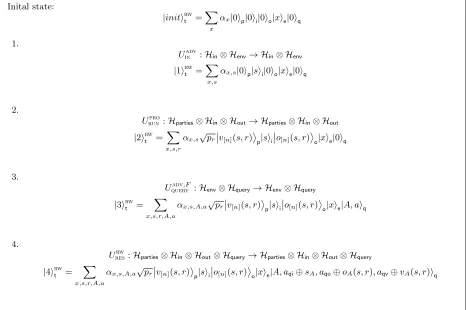
– Hquery is where the query to, and response from, the oracle will be stored. Each of these subspaces are, of course, of appropriate (and finite) dimension.
We will break the superposition run, and attack, of a MPC protocol in the real world down into four unitaries. After each unitary we will consider the change to the description of the state. In the beginning all the registers are blank (i.e., have value 0), except the environment, which might contain some (purified) auxiliary input for the adversary. The initial state is hence,
|initirw
t =
X
x
where |initirw
t ∈ Htotal, |0ip ∈ Hparties, |0ii ∈ Hin, |0io ∈ Hout, |xie ∈ Henv and |0iq ∈ Hquery, as should be expected from the notation. The superscript,rw, specifies that it’s in the real world. The first unitary is applied by the adversary and supplies the inputs to the parties. This is an arbitrary unitary operation. We will denote it,Uadv
in ,
Uadv
in :Hin⊗ Henv→ Hin⊗ Henv .
The result of this is that the input registers are now filled. These are in superposition over all possible inputs. The state after the first unitary is therefore,
|1irw
t =
X
x,s
αx,s|0ip|sii|0io|xie|0iq,
where s=s[n] = (s1, . . . , sn) is the vector of inputs. The classical protocolπ is now run honestly
without intervention from the adversary. This is a classical function π run in superposition of the possible inputs and produces a corresponding superposition of private views and outputs for the parties. We will denote this unitary,Upro
run,π,
Upro
run,π :Hparties⊗ Hin⊗ Hout → Hparties⊗ Hin⊗ Hout .
Recall that we are purifying all actions, hence also the choice of randomness when the protocol is run. The state after the second unitary is therefore,
|2irw
t =
X
x,s,r
αx,s
√
pr
v[n](s, r)
p|sii
o[n](s, r)
o|xie|0iq . (11)
Next the adversary needs to construct his query to the oracle. This includes choosing the superposi-tion of subsets he will corrupt and associated values for the response registers for input, output and view. For simplicity we will sometimes refer to the last three values bya. That is,a= (aqi, aqo, aqv). This is an arbitrary unitary operation. We will denote it, Uqueryadv,F,
Uqueryadv,F :Henv⊗ Hquery→ Henv⊗ Hquery ,
where the F in the notation specifies that all subset with non-zero amplitude in the constructed query are from the adversary structureF. The state is now,
|3irw
t =
X
x,s,r,A,a
αx,s,A,a
√
pr
v[n](s, r)
p|sii
o[n](s, r)
o|xie|A, aiq .
The next unitary is applied by the oracle, that, for each corrupted subset in the query, fills the input, output and view into the response register supplied by the adversary. This is a classical function on each corrupted subset and view in the superposition which fills the input, output and view into the response register. We will denote this unitary, Urw
res,
Uiw
res :Hparties⊗ Hin⊗ Hout⊗ Hquery→ Hparties⊗ Hin⊗ Hout⊗ Hquery .
The state after the fourth unitary is
|4irw
t =
X
x,s,r,A,a
αx,s,A,a
√
pr
v[n](s, r)
p|sii
o[n](s, r)
whereo(s, r) = (o1, . . . , on) whereoiis the output of party numberiin the protocolπ run on inputs
s and randomness r. The adversary receives the response register and must now guess if he’s in the real or ideal world. He can do this using the input register, his auxiliary register and the query register. To see the adversary’s final state we need to trace out the register holding the view of all the parties,
ρrw
adv= trp(|4ih4| rw
t ) =
X
r,r0,s,s0 √
pr
√
pr0ψadvr,s
ψadv r0,s0
trp(
v[n](s, r)
p
v[n](s0, r0)
p)
= X
r,r0,s,s0 √
pr
√
pr0ψadvr,s
ψadv r0,s0
v[n](s, r)
p
v[n](s0, r0)
p)
=X
r,s
pr
ψr,sadv
ψadv r,s
,
where|ψadv r,s i=
X
x,A,a
αx,s,A,a|sii|o[n](s, r)io|xie|A, aqi⊕sA, aqo⊕oA(s, r), aqv⊕vA(s, r)iq.
It is interesting to note that even though the input register was supplied by the adversary he only sees a mixed state. This happens as the parties keep a private copy of their input and therefore collapses the input register from the point of view of the adversary. While it is standard to assume the players keep such a copy (i.e. they remember their own input), you could consider a model where they do not. In this case the input register wouldnot collapse and hence the adversary would have a superposition, instead of a mixed state, over the choice of input. It is an open problem how this would effect security.
We will sum up these steps below in Figure 1.
6.2 MPC model in the ’Ideal world’
Secondly we consider the ideal world, where a simulator is to simulate a real attack for the adversary using only the ideal functionality. The space for this model is,
Htotal=Hideal⊗ Hin⊗ Hout⊗ Hsim⊗ Henv⊗ Hquery .
– Hin,Hout and Henv serve the same purpose as in the real world.
– Hsim denotes the subspace in which the simulator operates.
– Hquery is still the register where the adversary constructs his query, but the simulator will be allowed to change this before using it to query the ideal functionality.
– Finally, we have a space for the ideal functionality,Hideal. This is necessary as we want to purify the random choices made and we need the state of the ideal functionality to be entangled with the input register as the parties would be in the real world.
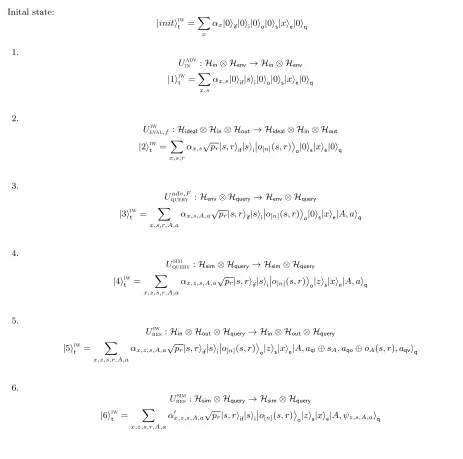
We will describe the unitaries that differ and refer to the earlier description for those that don’t. There will be six unitaries in total. The initial state is,
|initiiw
t =
X
x
αx|0iif|0ii|0io|0is|xie|0iq ,
where |initit ∈ Htotal, |0iif ∈ Hideal, |0ii ∈ Hin, |0io ∈ Hout, |0is ∈ Hsim, |0ie ∈ Henv and |0iq ∈
Hquery, as should be expected from the notation. The superscript,iw, denotes that it’s in the ideal world. The first unitary is exactly as in the real world and hence,
Uadv
Inital state:
|initirw t =
X
x
αx|0ip|0ii|0io|xie|0iq
1.
Uadv
in :Hin⊗ Henv→ Hin⊗ Henv
|1irw t =
X
x,s
αx,s|0ip|sii|0io|xie|0iq
2.
Upro
run :Hparties⊗ Hin⊗ Hout→ Hparties⊗ Hin⊗ Hout
|2irw t =
X
x,s,r
αx,s
√ pr
v[n](s, r)
p|sii
o[n](s, r)
o|xie|0iq
3.
Uadv,F
query :Henv⊗ Hquery→ Henv⊗ Hquery
|3irw t =
X
x,s,r,A,a
αx,s,A,a
√ pr
v[n](s, r)
p|sii
o[n](s, r)
o|xie|A, aiq
4.
Urw
res:Hparties⊗ Hin⊗ Hout⊗ Hquery→ Hparties⊗ Hin⊗ Hout⊗ Hquery
|4irw t =
X
x,s,r,A,a
αx,s,A,a
√ pr
v[n](s, r)
p|sii
o[n](s, r)
o|xie|A, aqi⊕sA, aqo⊕oA(s, r), aqv⊕vA(s, r)iq
|1iiw
t =
X
x,s
αx,s|0iif|sii|0io|0is|xie|0iq .
The ideal functionality now entangles itself with the input register and produces the correct out-puts in the output register. The correct outputs are defined via an n-ary function f. For inputs (s1, . . . , sn) the correct outputs are (o1, . . . , on) = f(s1, . . . , sn). We allow f to be a randomized
function, so that (o1, . . . , on) = f(s1, . . . , sn;r) for some randomizer r. The ideal functionality is
the unitary which evaluates the classical function f in superposition using a purified r. We will denote this unitary, Uiw
eval,f,
Uiw
eval,f :Hideal⊗ Hin⊗ Hout → Hideal⊗ Hin⊗ Hout .
Recall that any random choices are purified ontoHideal. The resulting state is therefore,
|2iiw
t =
X
x,s,r
αx,s
√
pr|s, riif|sii
o[n](s, r)
o|0is|xie|0iq .
Inspect theout-register to note that we use the notationo[n](s, r) for the output vector (o1, . . . , on) =
f(s1, . . . , sn;r). This could potentially lead to confusion as we also use o[n](s, r) to denote the output of the protocol, in the real world. We will, however, restrict our attention to perfectly correct protocols, meaning that running the protocol (o1, . . . , on) = π(x1, . . . , xn;r1, . . . , rn), i.e.,
with uniformly random randomness ri for party Pi, will give a distribution which is identical to
evaluating f(x1, . . . , xn;r) for a uniformly random randomizer r for the randomized function f.
This means that we in the analysis, with loss of generality, can assume that r = (r1, . . . , rn) and
that f(x1, . . . , xn;r) = π(x1, . . . , xn;r1, . . . , rn). Hence o[n](s, r) is exactly the same value in the ideal world and in the real world.
The adversary constructs his query exactly as earlier,
Uadv,F
query :Henv⊗ Hquery→ Henv⊗ Hquery
|3iiw
t =
X
x,s,r,A,a
αx,s,A,a
√
pr|s, riif|sii
o[n](s, r)
o|0is|xie|A, aiq .
Now the simulator gets the query and must construct an appropriate response to the adversary, only using the ideal functionality. First the simulator is allowed to change the adversary’s query using an auxiliary register. Only requirement is that it is corruption preserving 7. This is an arbitrary unitary operation. We will denote it,Usim
query,
Usim
query :Hsim⊗ Hquery→ Hsim⊗ Hquery
|4iiw
t =
X
x,z,s,r,A,a
αx,z,s,A,a
√
pr|s, riif|sii
o[n](s, r)
o|zis|xie|A, aiq
Now the corruption oracle is run on the query from the simulator. This is a classical function that each corrupted subset and each view in the superposition which fills in the input and output into the response register. We will denote this unitary, Uiw
res,
Uiw
res :Hin⊗ Hout⊗ Hquery→ Hin⊗ Hout⊗ Hquery
7