History Based Unsupervised Data Oriented Parsing
Mohsen Mesgar
Department of Computer Engineering,
Sharif University of technology,
Tehran, Iran
[email protected]
Gholamreza Ghasem-Sani
Department of Computer Engineering,
Sharif University of technology,
Tehran, Iran
[email protected]
Abstract
Grammar induction is a basic step in natural language processing. Based on the volume of information that is used by different methods, we can distinguish three types of grammar in-duction method: supervised, unsupervised, and semi-supervised. Supervised and semi-supervised methods require large tree banks, which may not currently exist for many lan-guages. Accordingly, many researchers have focused on unsupervised methods. Unsuper-vised Data Oriented Parsing (UDOP) is cur-rently the state of the art in unsupervised grammar induction. In this paper, we show that the performance of UDOP in free word order languages such as Persian is inferior to that of fixed order languages such as English. We also introduce a novel approach called History-based unsupervised data oriented Parsing, and show that the performance of UDOP can be significantly improved by using some history information, especially in dealing with free word order languages.
1
Introduction
Statistical methods of natural language pro-cessing have shown to be very successful in cor-pus based linguistics. One reason is that electron-ic based texts are now available more than ever (Charniak, 1997; Church, 1998). The success of statistical Part Of Speech (POS) tagger systems has caused the trend of research in lexical analy-sis, language modeling, and machine translation to be changed towards using various statistical methods (Feili and Ghassem-Sani, 2004; Charni-ak, 1996).
Grammar is an essential tool in many applica-tions of natural language processing (Feili and Ghassem-Sani, 2004). Writing a natural language grammar by hand is not only a time-consuming
and difficult task, but also it needs a large amount of skilled efforts. Availability of large parsed corpus such as Penn Treebank (Marcus et al., 1993) has facilitated the development of au-tomatic methods of grammar induction.
Based on the level of supervision information that is used by the different grammar induction methods, they are divided in to three major groups (i.e., supervised, semi-supervised, and unsupervised).
Supervised and semi-supervised methods require large treebanks, which may not exist for many languages. Therefore, many researchers have focused on unsupervised methods. Unsupervised Data Oriented Parsing (UDOP) is currently the state of the art in unsupervised grammar induc-tion. But in the case of free word order languages such as Persian, its performance is inferior to that of fixed order languages like English.
In this paper, we present a novel unsupervised algorithm, named History-Based Unsupervised Data Oriented Parsing (HUDOP), and show, how to improve the performance of UDOP by using history information.
In section 2, we discuss about different methods of grammar induction. In section 3, UDOP is explained. In section 4, the details of HUDOP are introduced. Section 5 presents our experi-mental results on English and Persian. Finally, we conclude the paper in section 6.
2
Grammar induction methods
Supervised methods need fully-parsed and tagged corpora such as Penn Treebank (Marcus et al., 1993; Charniak, 1997; Collins, 1997; Charniak, 2000; Magerman, 1995; BoonkWan and Steedman, 2011). There are also some semi-supervised methods (Pereira and Schabes, 1992; Schabes et al., 1993; Koo et al., 2008), which use less information than their supervised counter-parts. Also, semi-supervised methods need a rich corpus that for some natural language (e.g., Per-sian) does not currently exist. Thus, we have fo-cused our attention on unsupervised methods. Unsupervised methods do not need to pars tree of sentences in training corpus.
Inside-Outside (IO) was introduced by Baker (1979) as an unsupervised algorithm. IO uses Expectation-Maximization (EM) to construct a grammar based on an un-bracketed corpus. The algorithm re-estimates rule probabilities toward some maximization on the training corpus. The algorithm may converge to local optima in dif-ferent runs. This method is regarded as one of the basic algorithms of unsupervised grammar in-duction (Pereira and Schabes, 1992; Amaya et al., 1999; Casacuberta, 1996).
Alignment based Learning (ABL) is a learning method based on a linguistic principle: two con-stituents that belong to one family can be used instead of each other (Van Zaanen, 2000; Van Zaanen, 2002; Van Zaanen and Adriaans, 2001). EMILE, another grammar induction system based on this principle, initially used some levels of supervision, but later was modified to be a completely unsupervised system (Adriaans, 2001).
Another important category of unsupervised in-duction method is based on the distribution of words in sentences. It usually uses some distribu-tional evidence to identify the constituents’ struc-tures (Klein and Manning, 2001). The main idea is that “the same constituents appear in the same contexts” (Clark, 2001; Klein and Manning, 2005). The so-called Context-Constituent Model (CCM) is based on this idea and works on the basis of a weakened version of the classic lin-guistic constituency test (Radford, 1988): con-stituents occur in their contexts.
The independence of the input sentence and its surrounding context are usually assumed in pars-ing. For instance in a Probabilistic Context Free Grammar (PCFG) model, each constituent is
as-sumed to be independent of its surrounding con-stituents (Charniak, 1997). Such assumptions are not in fact valid in many cases. For instance, in English a noun phrase is more likely to be a pro-noun when it is a subject of the sentence than when the noun phrase is in an object position (Allen, 1995). Similar condition exists in Per-sian, too. For instance, in Persian a pronoun sub-ject can be dropped whereas pronouns in obsub-ject positions cannot be dropped (Bijankhan, 2003; Bateni, 1995).
We can reduce the impact of this invalid inde-pendence assumption by using some form of his-tory in parsing. For instance, the information about parent non-terminals can be utilized as a history of parsing. More specifically, P(NPPronoun| Parent=SUBJ) is higher than P(NPPronoun | Parent = VP). Therefore, some of the parsing dependencies between constituents can be modeled by history based parsing. History based models were initially developed at IBM (Black et al., 1992; Jelinek et al., 1992; Jelinek et al., 1994).
Increasing the dependencies on the context is the main feature of history based models. For in-stance, Johnson (1998) used the parent infor-mation of each non-terminal as the history in-formation in the condition part of each rule. He showed that, instead of P(AB|A), which is used in ordinary PCFG based parsing, using P(AB|A, parent(A)), where parent(A) is the nonterminal immediately dominating A, has a major positive impact on the accuracy of the parsing.
Based on the idea proposed by Johnson (1998), the so-called History based IO (HIO), improved the performance of IO especially in Persian (Feili and Ghassem-Sani, 2004). Parent based CCM (PCCM) is another history based method, which improved CCM (Mirroshandel and Ghassem-Sani, 2008). PCCM employs the parent’s infor-mation of each context and constituent to prevent from divergence in the likelihood space.
cal-word-order language, especially in proposition adjunction and complements. It means that an adverb can be used at the beginning, in the mid-dle, or at the end of sentences. This does not of-ten change the meaning of the senof-tences.
In order to test HUDOP in Persian, we manually produced two different training corpora. All sen-tences of these corpuses contain less than 11 words, and have been extracted from a Persian corpus named Peykareh (Bijankhan, 2003; Me-gerdoomian, 2000). Peykareh has more than 32,255 sentences and uses a tag set similar to the tag set used in Amtrup et al. (2003). The first corpus included 3,000 sentences, which were manually changed in such a way that the struc-ture of "S PP O V" was held. In other words, the common property of the sentences in this corpus was that the order of words were artificially fixed (i.e., they were not free in order). Table 2 shows main properties of the first corpus.
Property Value
Number of sentence 3,000
Maximum length 10
Minimum length 2
Average Length 7
Number of words 22,153
Number of POS tags
18 Table 2. Main properties of first corpus.
The second corpus comprised 2,500 sentences with a high degree of free word orderness. Table 3 shows main properties of the second corpus.
Property Value
Number of sentence 2,500
Maximum Length 10
Minimum Length 2
Average Length 7
Number of Words 18,482
Number of POS tags 18
Table 3. Main Properties of second corpus.
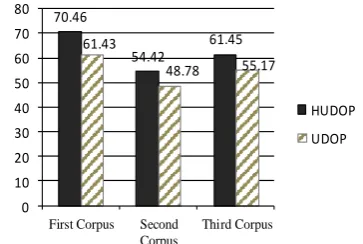
In Persian, we first ran both UDOP and HUDOP on each of the above corpora, separately. We also joined these corpuses to create a third mixed corpus, and repeated the experiments on this cor-pus, too. The results are shown in figure 3.
Figure 3. Comparison of UDOP and HUDOP methods in Persian (Based on the F1 measure).
Figure 3 shows the impact of the free word or-derness property on the performance of both UDOP and HUDOP. The reduction in the per-formance of UDOP on the first corpus, in com-parison to that of the second corpus, has been 13 percent in F1 score. The results of applying both UDOP and HUDOP to the combined corpus demonstrate little improvement. This shows that the free word orderness property of the input language has a negative effect on these methods.
The reason for this weakness is that these meth-ods work based on the repetition of subtrees. Since in free word order languages, some words can freely appear in different places of sentences, the mentioned repetition decreases substantially, and as a result, the performance of the parsing is decreased.
The experiments also show that HUDOP outper-forms UDOP in both languages.
6
Conclusion
Unsupervised Data Oriented Parsing (UDOP) is currently the state of the art in unsupervised grammar induction. UDOP works based on the repetition of possible sub-trees of parse trees of the input sentences. However, in free word order languages such as Persian, words can grammati-cally appear in different places of sentences. Thus, occurrence frequency of such sub-trees substantially decreases. In this paper, we pro-posed a novel approach, called History-based Unsupervised Data Oriented Parsing (HUDOP). We showed how by using parent nodes as a his-tory notion of sub-trees, HUDOP outperforms UDOP. Parent information prevents from proba-bility divergence and parsing will be more in-formative. To evaluate HUDOP, it was applied to both English and Persian (as a free word order
70.46
54.42
61.45 61.43
48.78 55.17
0 10 20 30 40 50 60 70 80
First Corpus Second Corpus
Third Corpus
HUDOP
language). The results of applying the new meth-od to several corpuses with different degree of free word orderness showed that using parent information notably improves the performance of UDOP. One possible future work to improve the performance of HUDOP can be usage of other possible forms of history information. We are working on the idea implementing a semi-supervised HUDOP.
References
Adriaans, P. and Haas, E., (1999). Grammar induction as sub structural inductive logic programming. Proceedings of the 1st Workshop on Learning Lan-guage in Logic. Bled, Slovenia, pp. 117–127.
Allen, J., (1995). Natural Language Understanding. Benjamin/Cummings Pub.
Amaya, F., Benedi, J.M. and Sanchez, J.A., (1999). Learning of stochastic context-free grammars from bracketed corpora by means of re-estimation algo-rithms. The VIII Symposium on Pattern Recogni-tion and Image Analysis, vol. 1, pp. 19–126.
Amtrup, J.W, Rad, H. R., Megerdoomian, K. and Zajac, R., (2000). Persian-English Machine Trans-lation. An Overview of the Shiraz Project, NMSU, CRL.
Baker, J.K., (1979). Trainable grammars for speech recognition. Speech communication papers for the 97th Meeting of the Acoustical Society of Ameri-ca, pp. 547–550.
Bateni, M., (1995). Tosif-e Sakhtari Zaban-e Farsi (Describing the Persian Structure). Amir-Kabir Press, Tehran, Iran (in Persian).
Bijankhan, M., (2003). Emkansanji baraye Tarhe Modelsaziye Zabane Farsi (The feasibility study for Persian language modelling). The Journal of Literature. pp. 162–163.
Bijankhan, M., (2005). The role of corpus in generat-ing grammar: presentgenerat-ing a computational software and corpus. Iranian Linguistic Journal 2 (19), pp. 48–67, (in Persian).
Black, E., Lafferty, J. and Roukos, S., (1992). Devel-opment and evaluation of a broad-coverage proba-bilistic grammar of English-language computer manuals. The Proceedings of the 30th Annual Meeting of the association for computational Lin-guistics, pp. 185–192.
Bod, R., (2006)a., Exemplar-based syntax: How to get productivity from examples? The Linguistic Re-view 23 (3), Special Issues on Exemplar- Based Models in Linguistics.
Bod, R., (2006)b., An All-subtrees Approach to Un-supervised Parsing. Proceedings ACL-COING, Sydney.
Bod, R., (2007)., A Linguistic Investigation into U-DOP. Proceeding ACL workshop on Cognitive Aspects of Computational Language Acquisition, pp.1-8.
BoonkWan, P. and Steedman. M., (2011)., Grammar Induction from Text Using Small Syntactic Proto-types. Proceedings of the 5th International Joint Conference on Natural language Processing, pp. 438-446.
Carroll, G. and Charniak, E., (1992). Two experi-ments on learning probabilistic dependency gram-mars from corpora. Technical Reports Department of Computer Science, Brown University, March.
Casacuberta, F., (1996). Growth transformations for probabilistic functions of stochastic grammars. IJPRAI 10 (3), pp. 183–201.
Charniak, E., (1996). Statistical Language Learning. MIT Press, Cambridge, London, UK.
Charniak, E., (1997). Statistical parsing with a con-text-free grammar and word statistics. Proceedings of the 14th National Conference on Artificial Intel-ligence, pp. 598–603.
Charniak, E., (1997). Statistical techniques for natural language parsing. AI Magazine 18 (4), pp. 33–44.
Charniak, E., (2000). A maximum-entropy-inspired parser. NAACL 1, pp. 132–139.
Church, K., (1988). A stochastic parts program and noun phrase parser for unrestricted text. Proceed-ings of the Second Conference on Applied Natural Language Processing, pp. 136–143.
Clark, A., (2001). Unsupervised induction of stochas-tic context-free grammars using distributional clus-tering. The Proceedings of 15th Conference on Natural Language Learning.
Collins, M., (1996). A new statistical parser based on bigram lexical dependencies. The Proceedings of the 34th Annual Meeting of the ACL, Santa Cruz.
Collins, M., (1997). Three generative, lexicalized models for statistical parsing. ACL 35/EACL 8, pp. 16–23.
Feili, H. and Ghassem-Sani G.,(2004). An Applica-tion of Lexicalized Grammars in English-Persian Translation. Proceedings of the 16th European Conference on Artificial Intelligence, pp. 596-600.
Hemphill, C.T., Godfrey, J. and Doddington, G., (1990). The ATIS spoken language systems pilot corpus. DARPA Speech and Natural language Workshop, Hidden Valey, Pennsylvania, June.
Jelinek, F., Black, E., Lafferty, J., Magerman, D.; Mercer, R. and Roukos, S. (1992). Towards histo-ry-based grammars: using richer models for proba-bilistic parsing. The Proceedings of the 5th DARPA Speech and Natural Languages Work-shop, Harriman, NY.
Jelinek, F., Laferty, J.D., Magerman, D., Mercer, R.; Ratnaparakhi, A. and Roukos, S., (1994). Decision-tree parsing using hidden derivation model. The Proceedings of the Human Language Technology Workshop, pp. 272–277.
Johnson, M., (1998). The effect of alternative tree representations on treebank grammars. New Meth-ods in Language Processing and Computational Natural Language Learning, ACL, pp. 39–48.
Klein, D. and Manning, C.D, (2005). The Unsuper-vised Learning of Natural Language Structure. Ph.D. Thesis, Department of Computer Science, Stanford University.
Klein, D. and Manning, C.D., (2001). Natural lan-guage grammar induction using a constituent-context model. Dietterich, T.G., Becker.
Koo, T., Carrera, X., and Collins, M., (2008). Simple Semi-Supervised Dependency Parsing. Proceeding of ACL 2008.
Magerman, D., (1995). Statistical decision-tree mod-els for parsing. The Proceedings of ACL Confer-ence.
Marcus, M.P., Santorini, B. and Marcinkiewicz, M.A., (1993). Building a large annotated corpus of English: the Penn Treebank. Computational Lin-guistics 19, pp. 313–330.
Megerdoomian, K., (2000). Persian Computational Morphology: A Unification-Based Approach. NMSU, CRL. Memoranda in Computer and Cogni-tive Science.
Mirroshandel, S. A. and Ghassem-Sani, G., (2008). Unsupervised Grammar Induction Using a Parent Based Constituent Context Model. 18th European Conference on Artificial Intelligence.
Pereira, F. and Schabes, Y., (1992). Inside-outside re-estimation from partially bracketed corpora. The Proceeding of 30th Annual Meeting of the ACL, pp. 128–135.
Radford, A., (1988). Transformational Grammar. Cambridge University Press, Cambridge.
Rankin, J., (2007). Data Oriented Parsing, Literature Review, November. pp. 4.
Schabes, Y., Roth, M. and Obsorne, R., (1993). Pars-ing the Wall Street Journal with the inside-outside algorithm. The Proceedings of the 6th Conference of the European Chapter of the ACL, pp. 341–347.
Van Zaanen, M. and Adriaans, P.W., (2001). Compar-ing two unsupervised grammar induction systems: alignment-based learning vs. EMILE. Technical Report: TR2001.05, School of Computing, Univer-sity of Leeds.
Van Zaanen, M., (2000). ABL: alignment-based learning. COLING 2000, pp. 961–967.