TOWARDS DATA AND GOAL ORIENTED ANALYSIS:
TOOL INTER-OPERABILITY AND COMBINATORIAL
COMPARISON
Yoshinobu Kano
1
Ngan Nguyen
1Rune Sætre
1Kazuhiro Yoshida
1Keiichiro Fukamachi
1Yusuke Miyao
1
Yoshimasa Tsuruoka
3Sophia Ananiadou
2,3
Jun’ichi Tsujii
1,2,31
Department of Computer Science, University of Tokyo
Hongo 7-3-1, Bunkyo-ku, Tokyo 113-0033 Tokyo
2
School of Computer Science, University of Manchester
PO Box 88, Sackville St, MANCHESTER M60 1QD, UK
3
NaCTeM (National Centre for Text Mining), Manchester Interdisciplinary Biocentre,
University of Manchester, 131 Princess St, MANCHESTER M1 7DN, UK
{kano,nltngan,satre,kyoshida,keif,yusuke,tsujii}
@is.s.u-tokyo.ac.jp
{yoshimasa.tsuruoka,sophia.ananiadou}@manchester.ac.uk
Abstract
Recently, NLP researches have advanced using F-scores, precisions, and recalls with gold standard data as evaluation measures. However, such evaluations cannot capture the different behaviors of varying NLP tools or the different behaviors of a NLP tool that depends on the data and domain in which it works. Because an increasing number of tools are available nowadays, it has become increasingly important to grasp these behavioral differences, in order to select a suitable set of tools, which forms a complex workflow for a specific purpose. In order to observe such differences, we need to integrate available combinations of tools into a workflow and to compare the combinatorial results. Although generic frameworks like UIMA (Unstructured Information Management Architecture) provide interoperability to solve this problem, the solution they provide is only partial. In order for truly interoperable toolkits to become a reality, we also need
sharable and comparable type systems with an automatic combinatorial comparison generator, which would allow systematic comparisons of available tools. In this paper, we describe such an environment, which we developed based on UIMA, and we show its feasibility through an example of a protein-protein interaction (PPI) extraction system.
1
Introduction
UIMA, Unstructured Information Management Architecture (Lally and Ferrucci, 2004), which was originally developed by IBM and has recently become an open project in OASIS and Apache, provides a promising framework for tool integration. Although it has a set of useful functionalities, UIMA only provides a generic framework, thus it requires a user community to develop their own platforms with a set of actual software modules. A few attempts have already been made to establish platforms, e.g. the CMU UIMA component repository 1 , GATE (Cunningham et al., 2002) with its UIMA interoperability layer, etc.
However, simply wrapping existing modules to be UIMA compliant does not offer a complete solution. Most of TM/NLP tasks are composite in nature, and can only be solved by combining several modules. Users need to test a large number of combinations of tools in order to pick the most suitable combination for their specific task.
Although types and type systems are the only way to represent meanings in the UIMA framework, UIMA does not provide any specific types, except for a few purely primitive types. In this paper, we propose a way to design sharable type systems. A sharable type system designed in this way can provide the interoperability between independently developed tools with fewer losses in information, thus allowing for the combinations of tools and comparisons on these combinations.
We show how our automatic comparison generator works based on a type system designed in that way. Taking the extraction of protein-protein
1
http://uima.lti.cs.cmu.edu/
interaction (PPI) as a typical example of a composite task, we illustrate how our platform helps users to observe the differences between tools and to construct a system for their own needs.
2
Motivation and Background
2.1 Goal and Data Oriented Evaluation,
Module Selection and Inter-operability
There are standard evaluation metrics for NLP modules such as precision, recall and F-value. For basic tasks like sentence splitting, POS tagging, and named-entity recognition, these metrics can be estimated using existing gold-standard test sets.
Conversely, accuracy measurements based on the standard test sets are sometimes deceptive, since its accuracy may change significantly in practice, depending on the types of text and the actual tasks at hand. Because these accuracy metrics do not take into account the importance of the different types of errors to any particular application, the practical utility of two systems with seemingly similar levels of accuracy may in fact differ significantly. To users and developers alike, a detailed examination of how systems perform (on the text they would like to process) is often more important than standard metrics and test sets. Naturally, far greater weight is placed in measuring the end-to-end performance of a composite system than in measuring the performance of the individual components.
In reality, because the selection of modules usually affects the performance of the entire system, it is crucial to carefully select modules that are appropriate for a given task. This is the main reason for having a collection of interoperable TOOL-SPECIFIC TYPES
PennPOS
Penn verb1 … … POS tcas.uima.Annotation
-begin: int -end: int
SyntacticAnnotation SemanticAnnotation
Sentence Phrase
Token NamedEntity Relation
-ent: FSArray<NamedEntity>
POSToken
-pos: POS
RichToken
uima.jcas.cas.TOP
UnknownPOS
-base: String
-posType: String
ToolAToken
Verb Noun …..
ToolBPOSToken
Protein
ToolCProtein
ProteinProteinInteraction
ToolDPPI
modules. We need to show how the ultimate performance will be affected by the selection of different modules and show the best combination of modules in terms of the performance of the whole aggregated system for the task at hand.
Since the number of possible combinations of component modules is typically large, the system has to be able to enumerate and execute them semi-automatically. This requires a higher level of interoperability of individual modules than just wrapping them for UIMA.
2.2 UIMA
2.2.1 CAS and Type System
The UIMA framework uses the “stand-off annotation” style (Ferrucci et al., 2006). The raw text in a document is kept unchanged during the analysis process, and when the processing of the text is performed, the result is added as new stand-off annotations with references to their positions in the raw text. A Common Analysis Structure (CAS) maintains a set of these annotations, which in itself are objects. The annotation objects in a CAS belong to types that are defined separately in a hierarchical type system. The features of an annotation2 object have values that are typed as well.
2.2.2 Component and Capability
Each UIMA Component has the capability property which describes what types of objects the component may take as the input and what types of objects it produces as the output. For example, a named entity recognizer detects named entities in
tools. Types should be defined in a distinct and
2
In the UIMA framework, Annotation is a base type which has begin and end offset values. In this paper we call any objects (any subtype of TOP) as annotations.
the text and outputs annotation objects of the type NamedEntity.
It is possible to deploy any UIMA component as a SOAP web service, so that we can combine a remote component on a web service with the local component freely inside a UIMA-based system.
3
Integration Platform and Comparators
3.1 Sharable and Comparable Type System
Although UIMA provides a set of useful functionalities for an integration platform of TM/NLP tools, users still have to develop the actual platform by using these functionalities effectively. There are several decisions for the designer to make an integration platform.
Determining how to use types in UIMA is a crucial decision. Our decision is to keep different type systems by individual groups as they are, if necessary; we require that individual type systems have to be related through a sharable type system, which our platform defines. Such a shared type system can bridge modules with different type systems, though the bridging module may lose some information during the translation process.
Whether such a sharable type system can be defined or not is dependent on the nature of each problem. For example, a sharable type system for POS tags in English can be defined rather easily, since most of POS-related modules (such as POS taggers, shallow parsers, etc.) more or less follow the well established types defined by the Penn Treebank (Marcus et al., 1993) tag set.
Figure 1 shows a part of our sharable type system. We deliberately define a highly organized type hierarchy as described above.
Secondly we should consider that the type system may be used to compare a similar sort of Comparable Tools
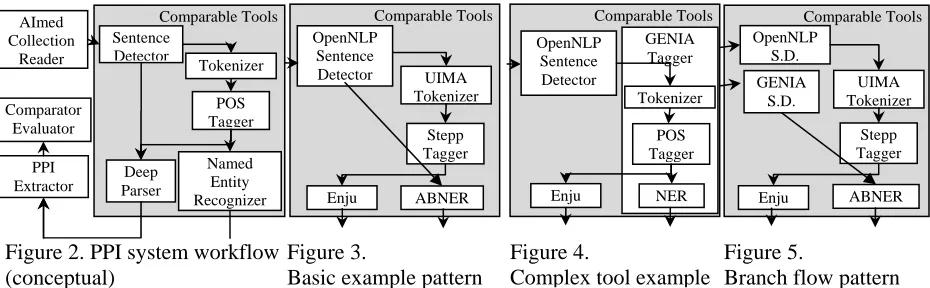
Figure 2. PPI system workflow (conceptual)
Complex tool example Comparable Tools
hierarchical manner. For example, both tokenizers and POS taggers output an object of type Token, but their roles are different when we assume a cascaded pipeline. We defined Token as a supertvpe, POSToken as subtypes of Token. Each tool should have an individual type to make clear which tool generated which instance, because each tool may have a slightly different definition. This is important because the capabilities are represented by these types, and the capabilities are the only attributes which are machine readable.
3.2 General Combinatorial Comparison
stem is defined in the previously
tually shows the workflow of our wh
pattern expansion mechanism which ge
cases, a single tool can play two or m
Generator
Even if the type sy
described way, there are still some issues to consider when comparing tools. We illustrate these issues using the PPI workflow that we utilized in our experiments.
Figure 2 concep
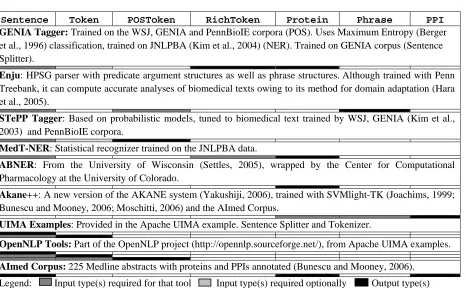
ole PPI system. If we can prepare two or more components for some type of the components in the workflow (e.g. two sentence detectors and three POS taggers), then we can make combinations of these tools to form a multiplied number of workflow patterns (2x3 = 6 patterns). See Table 1 for the details of UIMA components used in our experiments.
We made a
nerates possible workflow patterns automatically from a user-defined comparable workflow. A comparable workflow is a special workflow that explicitly specifies which set of components should be compared. Then, users just need to group comparable components (e.g. ABNER3 and MedT-NER as a comparable MedT-NER group) without making any modifications to the original UIMA components. This aggregation of comparable components is controlled by our custom workflow controller.
In some
ore roles (e.g. the GENIA Tagger performs tokenization, POS tagging, and NER; see Figure 4). It may be possible to decompose the original tool into single roles, but in most cases it is difficult and unnatural to decompose such a
ponent requires two or more input ty
4
Experiments and Results
using our PPI
e have several co
igure 6 show a part of the co
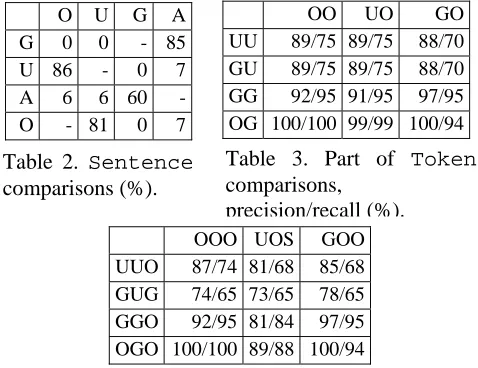
Table 2.
3
In the example figures, ABNER requires Sentence to make the explanation clearer, though ABNER does not require it in actual usage.
complex tool. We designed our comparator to detect possible input combinations automatically by the types of previously generated annotations, and the input capability of each posterior component. As described in the previous section, the component should have appropriate capabilities with proper types in order to permit this detection.
When a com
pes (e.g. our PPI extractor requires outputs of a deep parser and a protein NER system), there could be different components used in the prior flow (e.g. OpenNLP and GENIA sentence detectors in Figure 5). Our comparator also calculates such cases automatically.
OO UO GO
O U G A
UU 8 89 8
We have performed experiments
extraction system as an example (Kano et al., 2008). It is similar to our BioCreative PPI system (Sætre et al., 2006) but differs in that we have deconstructed the original system into seven different components (Figure 2).
As summarized in Table 1, w
mparable components and the AImed corpus as the gold standard data. In this case, possible combination workflow patterns are POSToken for 36, PPI for 589, etc.
Table 2, 3, 4 and F
mparison result screenshots between these patterns on 20 articles from the AImed corpus. In the tables, abbreviations like “OOG” stands for a workflow of O(Sentence) -> O(Token) - UUO 87/74 81/68 85/68 GUG 74/65 73/65 78/65 GGO 92/95 81/84 97/95 OGO 100/100 89/88 100/94
G 0 0 - 85
G(POSToken), where O stands for OpenNLP, G stands for Genia, U stands for UIMA, etc.
When neither of the compared results include th
e comparison on Sentences
sh
%
0
e gold standard data (AImed in this case), the comparison results show a similarity of the tools for this specific task and data, rather than an evaluation. Even if we lack an annotated corpus, it is possible to run the tools and compare the results in order to understand the characteristics of the tools depending on the corpus and the tool combinations.
Although th
ows low scores of similarities, Tokens are almost the same; it means that input sentence boundaries do not affect tokenizations so much.
POSTokensimilarities drop approximately 0-10 100
100 Fi 6 NER (Protein) comp rison di
ences in
5
Conclusion and Future Work
ponents,
design, which the UIMA fra
0
gure . a stribution of
precisions (x-axis, %) and recalls (y-axis, %).
from the similarities in Token; the differ
Token are mainly apostrophes and punctuations;
POSTokens are different because each POS tagger uses a slightly different set of tags: normal Penn tagset for Stepp tagger, BioPenn tagset (includes new tags for hyphenation) for GENIA tagger, and an original apostrophe tag for OpenNLP tagger.
NLP tasks typically consist of many com
and it is necessary to show which set of tools are most suitable for each specific task and data. Although UIMA provides a general framework with much functionality for interoperability, we still need to build an environment that enables the combinations and comparisons of tools for a specific task.
The type system
mework does not provide, is one of the most critical issues on interoperability. We have thus proposed a way to design a sharable and comparable type system. Such a type system allows for the automatic combinations of any UIMA compliant components and for the comparisons of these combinations, when the components have proper capabilities within the type system. We are
Sentence Token POSToken RichToken Protein Phrase PPI
GENIA Tagger: Trained on the WSJ, GENIA and PennBioIE corpora (POS). Uses Maximum Entropy (Berger et al., 1996) classification, trained on JNLPBA (Kim et al., 2004) (NER). Trained on GENIA corpus (Sentence Splitter).
Enju: HPSG parser with predicate argument structures as well as phrase structures. Although trained with Penn Treebank, it can compute accurate analyses of biomedical texts owing to its method for domain adaptation (Hara et al., 2005).
STePP Tagger: Based on probabilistic models, tuned to biomedical text trained by WSJ, GENIA (Kim et al., 2003) and PennBioIE corpora.
MedT-NER: Statistical recognizer trained on the JNLPBA data.
ABNER: From the University of Wisconsin (Settles, 2005), wrapped by the Center for Computational Pharmacology at the University of Colorado.
Akane++: A new version of the AKANE system (Yakushiji, 2006), trained with SVMlight-TK (Joachims, 1999; Bunescu and Mooney, 2006; Moschitti, 2006) and the AImed Corpus.
UIMA Examples: Provided in the Apache UIMA example. Sentence Splitter and Tokenizer.
OpenNLP Tools: Part of the OpenNLP project (http://opennlp.sourceforge.net/), from Apache UIMA examples.
AImed Corpus: 225 Medline abstracts with proteins and PPIs annotated (Bunescu and Mooney, 2006).
preparing to make a portion of the components and services described in this paper publicly available (http://www-tsujii.is.s.u-tokyo.ac.jp/uima/).
The final system shows which combination of co
or this work includes co
cknowledgments
e wish to thank Dr. Lawrence Hunter’s text
References
Vincent J. Della Pietra, and Stephen
IT
Mooney.
on." Edited
tcheva, and V.
ls and
m Lally, Daniel Gruhl, and Edward
RC24122. (2006).
ilistic disambiguation model of an t,
e
." MIT Press, (1999):
169-ls ser: a tool comparator, using protein-protein
i. "Introduction to the Bio-Entity
d
ics
i180-le Application with the Unstructured Information
l 43,
ng a Large Annotated Corpus of
ractical
. (2006).
oko
cally tagging genes, proteins, and other entity rsity
, ust
Part-of-tion
University of Tokyo, (2006). mponents has the best score, and also generates
comparative results. This helps users to grasp the characteristics and differences among tools, which cannot be easily observed by the widely used F-score evaluations only.
Future directions f
mbining the output of several modules of the same kind (such as NERs) to obtain better results, collecting other tools developed by other groups using the sharable type system, making machine learning tools UIMA compliant, and making grid computing available with UIMA workflows to increase the entire performance without modifying the original UIMA components.
A
W
mining group at the Center for Computational Pharmacology for discussing with us and making their tools available for this research. This work was partially supported by NaCTeM (the UK National Centre for Text Mining), Grant-in-Aid for Specially Promoted Research (MEXT, Japan) and Genome Network Project (MEXT, Japan). NaCTeM is jointly funded by JISC/BBSRC/EPSRC.
Berger, Adam L.,
A. Della Pietra. "A maximum entropy approach to natural language processing." Comput. Linguist. (M Press) 22, no. 1 (1996): 39-71.
Bunescu, Razvan, and Raymond
"Subsequence Kernels for Relation Extracti by Weiss Y., Scholkopf B. and Platt J., 171-178. Cambridge, MA: MIT Press, (2006).
Cunningham, H., D. Maynard, K. Bon Tablan. "GATE: A framework and graphical development environment for robust NLP too applications." Proceedings of the 40th Anniversary Meeting of the Association for Computational Linguistics. (2002).
Ferrucci, David, Ada
Epstein. "Towards an Interoperability Standard for Text and Multi-Modal Analytics." IBM Research Report,
Hara, Tadayoshi, Yusuke Miyao, and Jun'ichi Tsujii. "Adapting a probab
HPSG parser to a new domain." Edited by Dale Rober Wong Kam-Fai, Su Jian and Yee Oi. Natural Languag Processing IJCNLP 2005. Jeju Island, Korea: Springer-Verlag, (2005). 199-210.
Joachims, Thorsten. "Making large-scale support vector machine learning practical
184.
Kano, Yoshinobu, et al. "Filling the gaps between too and u
interaction as an example." Proceedings of The Pacific Symposium on Biocomputing (PSB). Hawaii, USA, To appear, (2008).
Kim, Jin-Dong, Tomoko Ohta, Yoshimasa Tsuruoka, and Yuka Tateis
Recognition Task at JNLPBA." Proceedings of the International Workshop on Natural Language Processing. Geneva, Switzerland, (2004). 70-75. Kim, Jin-Dong, Tomoko Ohta, Yuka Teteisi, an Jun'ichi Tsujii. "GENIA corpus - a semantically annotated corpus for bio-textmining." Bioinformat
(Oxford University Press) 19, no. suppl. 1 (2003): i182.
Lally, Adam, and David Ferrucci. "Building an Examp
Management Architecture." IBM Systems Journa
no. 3 (2004): 455-475.
Marcus, Mitchell P., Beatrice Santorini, and Mary Ann Marcinkiewicz. "Buildi
English: The Penn Treebank." Computational Linguistics 19, no. 2 (1993): 313-330.
Moschitti, Alessandro. "Making Tree Kernels P for Natural Language Learning." EACL
Sætre, Rune, Kazuhiro Yoshida, Akane Yakushiji, Yusuke Miyao, Yuichiroh Matsubayashi, and Tom Ohta. "AKANE System: Protein-Protein Interaction Pairs in BioCreAtIvE2 Challenge." Proceedings of the Second BioCreative Challenge Evaluation Workshop.
(2007).
Settles, B. "ABNER: an open source tool for automati
names in text." Bioinformatics (Oxford Unive Press) 21, no. 14 (2005): 3191-3192.
Tsuruoka, Yoshimasa, Yuka Tateishi, Jin-Dong Kim and Tomoko Ohta. "Developing a Rob