Syntax-Driven Machine Translation as a Model of ESL
Revision
Huichao Xue and Rebecca Hwa
Department of Computer Science University of Pittsburgh
{hux10,hwa}@cs.pitt.edu Abstract
In this work, we model the writing re-vision process of English as a Second Language (ESL) students with syntax-driven machine translation methods. We compare two approaches: tree-to-string transformations (Yamada and Knight, 2001) and tree-to-tree trans-formations (Smith and Eisner, 2006). Results suggest that while the tree-to-tree model provides a greater cover-age, the tree-to-string approach offers a more plausible model of ESL learn-ers’ revision writing process.
1 Introduction
When learning a second language, students make mistakes along the way. While some mistakes are idiosyncratic and individual, many are systematic and common to people who share the same primary language. There has been extensive research on grammar error detection. Most previous efforts focus on iden-tifying specific types of problems commonly encountered by English as a Second Language (ESL) learners. Some examples include the proper usage of determiners (Yi et al., 2008; Gamon et al., 2008), prepositions (Chodorow et al., 2007; Gamon et al., 2008; Hermet et al., 2008), and mass versus count nouns (Nagata et al., 2006). However, previous work suggests thatgrammar error correctionis considerably more challenging than detection (Han et al., 2010). Furthermore, an ESL learner’s writing may contain multiple interacting errors that are difficult to detect and correct in isolation. A promising research direction is to tackle automatic grammar error correction as a ma-chine translation (MT) problem. The dis-fluent sentences produced by an ESL learner
can be seen as the input source language, and the corrected revision is the result of the translation. Brockett et al. (2006) showed that phrase-based statistical MT can help to correct mistakes made on mass nouns. To our knowledge, phrase-based MT techniques have not been applied for rewriting entire sen-tences. One major challenge is the lack of ap-propriate training data such as a sizable par-allel corpus. Another concern is that phrase-based MT may not be similar enough to the problem of correcting ESL learner mistakes. While MT rewrites an entire source sentence into the target language, not every word writ-ten by an ESL learner needs to be modified.
Another alternative that may afford a more general model of ESL error corrections is to consider syntax-driven MT approaches. We argue that syntax-based approaches can over-come the expected challenges in applying MT to this domain. First, it can be less data-intensive because the mapping is formed at a structural level rather than the surface word level. While it does require a robust parser, a syntax-driven MT model may not need to train on a very large parallel corpus. Second, syntactic transformations provide an intuitive description of how second language learners revise their writings: they are transforming structures in their primary language to those in the new language.
Grammar (QG) formalism (Smith and Eisner, 2006). We train both models on a parallel cor-pus consisting of multiple drafts of essays by ESL students. The approaches are evaluated on how well they model the revision pairs in an unseen test corpus. Experimental results sug-gest that 1) the QG model has more flexibility and is able to describe more types of transfor-mations; but 2) the YK model is better at cap-turing the incremental improvements in the ESL learners’ revision writing process.
2 Problem Description
This paper explores the research question: can ESL learners’ process of revising their writ-ings be described by a computational model? A successful model of the revision process has several potential applications. In addition to automatic grammar error detection and cor-rection, it may also be useful as an auto-matic metric in an intelligent tutoring system to evaluate how well the students are learning to make their own revisions.
Revising an ESL student’s writing bears some resemblance to translating. The stu-dent’s first draft is likely to contain disfluent expressions that arose from translation diver-gences between English and the student’s pri-mary language. In the revised draft, the diver-gences should be resolved so that the text be-comes fluent English. We investigate to what extent are formalisms used for machine trans-lation applicable to model writing revision. We hypothesize that ESL students typically modify sentences to make them sound more fluent rather than to drastically change the meanings of what they are trying to convey. Thus, our work focuses on syntax-driven MT models.
One challenge of applying MT methods to model grammar error correction is the lack of appropriate training data. The equivalence to the bilingual parallel corpus used for de-veloping MT systems would be a corpus in which each student sentence is paired with a fluent version re-written by an instructor. Un-like bilingual text, however, there is not much data of this type in practice because there
are typically too many students for the teach-ers to provide detailed manual inspection and correction at a large scale. More commonly, students are asked to revise their previously written essays as they learn more about the English language. Here is an example of a student sentence from a first-draft essay:
The problem here is that they come to the US like illegal.
In a later draft, it has been revised into:
The problem here is that they come to the US illegally.
Although the students are not able to cre-ate “gold standard revisions” due to their still imperfect understanding of English, a corpus that pairs the students’ earlier and later drafts still offers us an opportunity to model how ESL speakers make mistakes.
More formally, the corpus C consists of a set of sentence pairs (O, R), where O repre-sents the student’s original draft and R rep-resents the revised draft. Note that while R
is assumed to be an improvement upon O, its quality may fall short of the gold stan-dard revision, G. To train the syntax-driven MT models, we optimize the joint probabil-ity of observing the sentence pair, Pr(O, R), through some form of mapping between their parse trees,τO andτR.
An added wrinkle to our problem is that it might not always be possible to assign a sen-sible syntactic structure to an ungrammati-cal sentence. It is well-known that an English parser trained on the Penn Treebank is bad at handling disfluent sentences (Charniak et al., 2003; Foster et al., 2008). In our domain, sinceO (and perhaps also R) might be disflu-ent, an important question that a translation model must address is: how should the map-ping between the treesτOandτRbe handled?
3 Syntax-Driven Models for Essay Revisions
Lopez (2008)); we focus on two particular for-malisms that reflects different perspectives on the role of syntax. Our goal is to assess which formalism is a better fit with the domain of essay revision modeling, in which the data largely consist of imperfect sentences that may not support a plausible syntactic interpreta-tion.
3.1 Tree-to-String Model
The Yamada & Knight (henceforth, YK) tree-to-string model is an instance of noisy channel translation systems, which assumes that the observed source sentence is the result of trans-formation performed on the parse tree of the intended target sentence due to a noisy com-munication channel. Given a parallel corpus, and a parser for the the target side, the pa-rameters of this model can be estimated using EM(Expectation Maximization). The trained model’s job is to recover the target sentence (and tree) through decoding.
While the noisy channel generation story may sound somewhat counter-intuitive for translation, it gives a plausible account of ESL learner’s writing process. The student really wants to convey a fluent English sentence with a well-formed structure, but due to an im-perfect understanding of the language, writes down an ungrammatical sentence,O, as a first draft. The student serves as the noisy channel. The YK model describes this as a stochastic process that performs three operations onτG, the parse of the intended sentence,G:
1. Each node in τG may have its children
reordered with some probability.
2. Each node in τG may have a child node
inserted to its left or right with some probability.
3. Each leaf node (i.e., surface word) in τG is replaced by some (possibly empty) string according to its lexical translation distribution.
The resulting sentence, O, is the concatena-tion of the leaf nodes of the transformedτG.
Common mistakes made by ESL learners, such as misuses of determiners and preposi-tions, word choice errors, and incorrect con-stituency orderings, can be modeled by a com-bination of theinsert,replace, andreorder
operators. The YK model allows us to per-form transper-formations on a higher syntactic level. Another potential benefit is that the model does not attempt to assign syntactic interpretations over the source sentences (i.e., the less fluent original draft).
3.2 Tree-to-Tree Model
The Quasi-Synchronous Grammar formalism (Smith and Eisner, 2006) is a generative model that aims to produce the most likely target tree for a given source tree. It differs from the more strict synchronous grammar formalisms (Wu, 1995; Melamed et al., 2004) because it does not try to perform simultaneous pars-ing on parallel grammars; instead, the model learns an augmented target-language gram-mar whose rules make “soft alignments” with a given source tree.
QG has been applied to some NLP tasks other than MT, including answer selection for question-answering (Wang et al., 2007), para-phrase identification (Das and Smith, 2009), and parser adaptation and projection (Smith and Eisner, 2009). In this work we use an instantiation of QG that largely follows the model described by Smith and Eisner (2006). The model is trained on a parallel corpus in which both the first-draft and re-vised sentences have been parsed. Using EM to estimate its parameters, it learns an aug-mented target PCFG grammar1 whose pro-duction rules form associations with the given source trees.
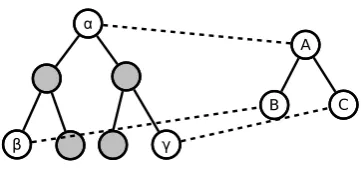
Consider the scenario in Figure 1. Given a source treeτO, the trained model generates a target tree by expanding the production rules in the augmented target PCFG. To apply a
1For expository purposes, we illustrate the model
Figure 1: An example of QG’s soft alignments between a given source tree and a possible tar-get rule expansion.
target-side production rule such as
A→BC,
the model considers which source tree nodes might be associated with each target-side non-terminals:
(α, A)→(β, B)(γ, C)
where α, β, γ are nodes in τO. Thus, as-suming that the target symbol A has already been aligned to source node α from an ear-lier derivation step, the likelihood of expand-ing (α, A) with the above production rule de-pends on three factors:
1. the likelihood of the monolingual tar-get rule, Pr(A→BC)
2. the likelihood of alignments betweenB
and β as well as C and γ.
3. the likelihood that the source nodes form some expected configuration (i.e., be-tween α and β as well as between α and
γ). In this work, we distinguish between two configuration types: parent-child and
other. This restriction doesn’t reduce the explanatory power of the resulting QG model, though it may not be as fine-tuned as some models in (Smith and Eisner, 2006).
Under QG, the ESL students’ first drafts are seen as text in a different language that has its own syntactic constructions. QG ex-plains the grammar rules that govern the re-vised text in terms of how different compo-nents map to structures in the original draft.
It makes explicit the representation of diver-gences between the students’ original mental model and the expected structure.
3.3 Method of Model Comparison
Cross entropy can be used as a metric that measures the distance between the learned probabilistic model and the real data. It can be interpreted as measuring the amount of in-formation that is needed in addition to the model to accurately recover the observed data. In language modeling, cross entropy is widely used in showing a given model’s prediction power.
To determine how well the two syntax-driven MT models capture the ESL student revision generation process, we measure the cross entropy of each trained model on an un-seen test corpus. This quantity measures how surprised a model is about relating an initial sentence, O, to its corresponding revision, R. Specifically, the cross entropy for some model
M on a test corpus C of original and revised sentence pairs (O, R) is:
− 1 |C|
X
(O,R)∈C log Pr
M(O, R)
Because neither model computes the joint probability of the sentence pair, we need to make additional computations so that the models can be compared directly.
The YK model computes the likelihood of the first-draft sentence O given an as-sumed gold parse τR of the revised sentence: PrY K(O |τR). To determine the joint proba-bility, we would need to compute:
Pr
Y K(O, R) =
X
τR∈ΛR Pr
Y K(O, τR)
= X
τR∈ΛR Pr
Y K(O|τR) Pr(τR)
mean stdev percentage ofO =R 54.11% N/A
O’s length 12.95 4.87
R’s length 12.74 4.20 edit distance 1.88 3.58
Table 1: This table summarizes some statis-tics of the dataset.
model is to trust the givenτR. Thus, we made a Viterbi approximation:
Pr
Y K(O, R) =
X
τR∈ΛR Pr
Y K(O |τR) Pr(τR)
≈ Pr
Y K(O |τˆR) Pr( ˆτR)
where Pr( ˆτR) is the probability of the single best parse tree according to a standard En-glish parser.
Similarly, to compute the joint sentence pair probability under the QG model would require summing over both sets of trees because the model computes PrQG(τR | τO). Here, we make the Viterbi approximation on both trees.
Pr
QG(O, R) =
X
τR∈ΛR
X
τO∈ΛO Pr
QG(τO, τR)
= X
τR∈ΛR
X
τO∈ΛO Pr
QG(τR|τO) Pr(τO)
≈ Pr
QG( ˆτR|τˆO) Pr( ˆτO)
where ˆτO and ˆτR are the best parses for sen-tences O and R according to the underlying English dependency parser, respectively.
4 Experiments
4.1 Data
Our experiments are conducted using a collec-tion of ESL students’ writing samples2. These are short essays of approximately 30 sentences on topics such as “a letter to your parents.” The students are asked to revise their essays at least once. From the dataset, we extracted 358 article pairs.
2The dataset is made available by the Pittsburgh
Science of Learning Center English as a Second Lan-guage Course Committee, supported by NSF Award SBE-0354420.
Typically, the changes between the drafts are incremental. Approximately half of the sentences are not changed at all. These sen-tences are considered useful because this phe-nomenon strongly implies that the original version is good enough to the best of the au-thor’s knowledge. In a few rare cases, stu-dents may write an entirely different essay. We applied TF-IDF to automatically align the sentences between essay drafts. Any sentence pair with a cosine similarity score of less than 0.3 is filtered. This resulted in a parallel cor-pus of 7580 sentence pairs.
Because both models are computational in-tensive, we further restricted our experiments to sentence pairs for which the revised sen-tence has no more than 20 words. This re-duces our corpus to 4666 sentence pairs. Some statistics of the sentence pairs are shown in Table 1.
4.2 Experimental Setup
We randomly split the resulting dataset into a training corpus of 4566 sentence pairs and a test corpus of 100 pairs.
The training of both models involve an EM algorithm. We initialize the model parameters with some reasonable values. Then, in each it-eration of training, the model parameters are re-estimated by collecting the expected counts across possible alignments between each sen-tence pair in the training corpus. In out ex-periments, both models had two iterations of training. Below, we highlight our initializa-tion procedure for each model.
In the YK model, the initial reordering
probability distribution is set to prefer no change 50% of the time. The remaining prob-ability mass is distributed evenly over all of the other permutations. For the insertion
dictionary is assigned evenly with N1, where
N is the number of words in the dictionary. Finally, the replace probability distribution is initialized uniformly with the same value (N1+1) across all words in the dictionary, in-cluding the empty string.
For the QG model, the initial parameters are determined as follows: For the monolin-gual target parsing model parameters, we first parse the target side of the corpus (i.e., the revised sentences) with the Stanford parser; we then use the maximum likelihood estimates based on these parse trees to ini-tialize the parameters of the target parser, Dependency Model with Valence (DMV). We uniformly initialized the configuration pa-rameters; the parent-child configuration and
other configuration each has 0.5 probability. For the alignment parameters, we ran the GIZA++ implementation of the IBM word alignment model (Och and Ney, 2003) on the sentence pairs, and used the resulting transla-tion table as our initial estimatransla-tion. There may be better initialization setups, but the differ-ence between those setups will become small after a few rounds of EM.
Once trained, the two models compute the joint probability of every sentence pair in the test corpus as described in Section 3.3.
4.3 Experiment I
To evaluate how well the models describe the ESL revision domain, we want to see which model is less “surprised” by the test data. We expected that the better model should be able to transform more sentence pair in the test corpus; we also expect that the better model should have a lower cross entropy with respect to the test corpus.
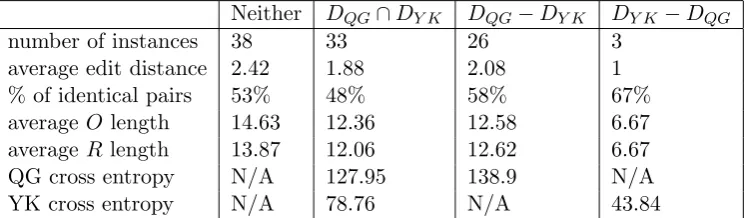
Applying both YK and QG to the test cor-pus, we find that neither model is able to transform all the test sentence pairs. Of the two, QG had the better coverage; it success-fully modeled 59 pairs out of 100 (we denote this subset asDQG). In contrast, YK modeled 36 pairs (this subset is denoted as DY K).
To determine whether there were some characteristics of the data that made one
model better at performing transformations for certain sentence pairs, we compare corpus statistics for different test subsets. Based on the results summarized in Table 2, we make a few observations.
First, the sentence pairs that neither model could transform seem, as a whole, more diffi-cult. Their average lengths are longer, and the average per word Levenshtein edit distance is bigger. The differences between Neither and the other subsets are statistically significant with 90% confidence. For the length differ-ence, we applied standard two-sample t-test. For the edit distance difference, we applied hy-pothesis testing with the null-hyhy-pothesis that “longer sentence pairs are as likely to be cov-ered by our model as shorter ones.”
Second, both models sometimes have trou-ble with sentence pairs that require no change. This may be due to out-of-vocabulary words in the test corpus. A more aggressive smooth-ing strategy could improve the coverage for both models.
Third, comparing the subset of sentence pairs that only QG could transform (DQG−
DY K) against the subset of sentences that both models could transform (DQG ∩DY K), the former has slightly higher average edit dis-tance and length, but the difference is not statistically significant. Although QG could transform more sentence pairs, the cross en-tropy ofDQG−DY K is higher than QG’s es-timate for theDQG∩DY K subset. QG’s soft alignment property allows it to model more complex transformations with greater flexibil-ity.
Neither DQG∩DY K DQG−DY K DY K−DQG
number of instances 38 33 26 3
average edit distance 2.42 1.88 2.08 1
% of identical pairs 53% 48% 58% 67%
average O length 14.63 12.36 12.58 6.67 average R length 13.87 12.06 12.62 6.67
QG cross entropy N/A 127.95 138.9 N/A
[image:7.595.111.484.71.180.2]YK cross entropy N/A 78.76 N/A 43.84
Table 2: A comparison of the two models based on their coverage of the test corpus. Some relevant statistics on the sentence subsets are also summarized in the table.
YK QG
[image:7.595.82.283.233.288.2]overall entropy 78.76 127.95 on identical pairs 52.59 85.40 on non-identical pairs 103.99 168.00
Table 3: A further comparison of the two mod-els on DQG∩DY K, the sentence pairs in the test corpus that both could transform.
4.4 Experiment II
The results of the previous experiment raises the possibility that QG might have a greater coverage because it is too flexible. However, an appropriate model should not only assign large probability mass to positive examples, but it should also have a low chance of choos-ing negative examples. In this next experi-ment, we construct a “negative” test corpus to see how it affects the models.
To construct a negative scenario, we still use the same test corpus as before, but we re-verse the sentence pairs. That is, we use the revised sentences as “originals” and the origi-nal sentences as “revisions.” We would expect a good model to have a raised cross entropy values along with a drop in coverage on the new dataset because the “revisions” should be more disfluent than the “original” sentences.
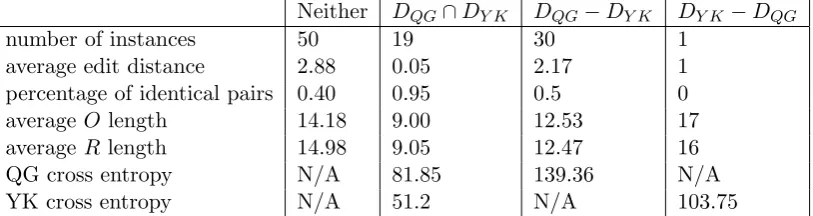
Table 4 summarizes the results. We ob-serve that the number of instances that can be transformed has dropped for both models: from 59 to 49 pairs for QG, and from 36 to 20 pairs for YK; also, the proportion of iden-tical instances in each set has raised. This means that both models are more surprised by the reverse test corpus, suggesting that
both models have, to some extent, succeeded in modeling the ESL revision domain. How-ever, QG still allows for many more transfor-mations. Moreover, 16 out of the 49 instances are non-identical pairs. In contrast, YK mod-eled only 1 non-identical sentence pair. The results from these two experiments suggest that YK is more suited for modeling the ESL revision domain than QG. One possible expla-nation is that QG allows more flexibility and would require more training. Another possi-ble explanation is that because YK assumes well-formed syntax structure for only the tar-get side, the philosophy behind its design is a better fit with the ESL revision problem.
5 Related Work
Neither DQG∩DY K DQG−DY K DY K−DQG
number of instances 50 19 30 1
average edit distance 2.88 0.05 2.17 1
percentage of identical pairs 0.40 0.95 0.5 0
averageO length 14.18 9.00 12.53 17
averageR length 14.98 9.05 12.47 16
QG cross entropy N/A 81.85 139.36 N/A
[image:8.595.95.502.72.180.2]YK cross entropy N/A 51.2 N/A 103.75
Table 4: This table compares the two models on a “trick” test corpus in which the earlier and later drafts are reversed. If a model is trained to prefer more fluent English sentences are the revision, it should be perplexed on this corpus.
information retrieval techniques. Chodorow et al. (2007) instead treat it as a classification problem and employed a maximum entropy classifier. Similar to our approach, Brockett et al. (2006) view error correction as a Ma-chine Translation problem. But their transla-tion system is built on phrase level, with the purpose of correcting local errors such as mass noun errors.
The problem of error correction at a syn-tactic level is less explored. Lee and Seneff (2008) examined the task of correcting verb form misuse by applying tree template match-ing rules. The parse tree transformation rules are learned from synthesized training data.
6 Conclusion
This paper investigates the suitability of syntax-driven MT approaches for modeling the revision writing process of ESL learn-ers. We have considered both the Yamada & Knight tree-to-string model, which only con-siders syntactic information from the typically more fluent revised text, as well as Quasi-Synchronous Grammar, a tree-to-tree model that attempts to learn syntactic transforma-tion patterns between the students’ original and revised texts. Our results suggests that while QG offers a greater degree of freedom, thus allowing for a better coverage of the transformations, YK has a lower entropy on the test corpus. Moreover, when presented with an alternative “trick” corpus in which the “revision” is in fact the earlier draft, YK was more perplexed than QG. These results
sug-gest that the YK model may be a promising approach for automatic grammar error correc-tion.
Acknowledgments
This work has been supported by NSF Grant IIS-0745914. We thank Joel Tetreault and the anonymous reviewers for their helpful com-ments and suggestions.
References
Brockett, Chris, William B. Dolan, and Michael Gamon. 2006. Correcting esl errors using phrasal smt techniques. In Proceedings of COLING-ACL 2006, Sydney, Australia, July.
Burstein, Jill, Martin Chodorow, and Claudia Lea-cock. 2004. Automated essay evaluation: The criterion online writing service. AI Magazine, 25(3).
Charniak, Eugene, Kevin Knight, and Kenji Ya-mada. 2003. Syntax-based language models for machine translation. In Proc. MT Summit IX, New Orleans, Louisiana, USA.
Chodorow, Martin, Joel Tetreault, and Na-Rae Han. 2007. Detection of grammatical errors involving prepositions. In Proceedings of the 4th ACL-SIGSEM Workshop on Prepositions, Prague, Czech Republic.
Das, Dipanjan and Noah A. Smith. 2009. Paraphrase identification as probabilistic quasi-synchronous recognition. In Proceedings of ACL-IJCNLP 2009, Suntec, Singapore, August.
parser to grammatically noisy text. In Proceed-ings of the 46th ACL on Human Language Tech-nologies: Short Papers, Columbus, Ohio.
Gamon, Michael, Jianfeng Gao, Chris Brock-ett, Alexandre Klementiev, William B. Dolan, Dmitriy Belenko, and Lucy Vanderwende. 2008. Using contextual speller techniques and lan-guage modeling for ESL error correction. In
Proceedings of IJCNLP, Hyderabad, India.
Han, Na-Rae, Martin Chodorow, and Claudia Lea-cock. 2006. Detecting errors in English article usage by non-native speakers. Natural Language Engineering, 12(02).
Han, Na-Rae, Joel Tetreault, Soo-Hwa Lee, and Jin-Young Han. 2010. Using an error-annotated learner corpus to develop and ESL/EFL er-ror correction system. InProceedings of LREC 2010, Valletta, Malta.
Hermet, Matthieu, Alain D´esilets, and Stan Sz-pakowicz. 2008. Using the web as a linguis-tic resource to automalinguis-tically correct Lexico-Syntactic errors. In Proceedings of the LREC, volume 8.
Klein, Dan and Christopher Manning. 2004. Corpus-based induction of syntactic structure: Models of dependency and constituency. In Pro-ceedings of ACL 2004, Barcelona, Spain.
Knight, Kevin and Ishwar Chander. 1994. Auto-mated postediting of documents. InProceedings of AAAI-94, Seattle, Washington.
Lee, John and Stephanie Seneff. 2008. Correcting misuse of verb forms. Proceedings of the 46th ACL, Columbus.
Liu, Ting, Ming Zhou, Jianfeng Gao, Endong Xun, and Changning Huang. 2000. PENS: a machine-aided english writing system for chi-nese users. In Proceedings of the 38th ACL, Hong Kong, China.
Lopez, Adam. 2008. Statistical machine transla-tion. ACM Computing Surveys, 40(3), Septem-ber.
Melamed, I. Dan, Giorgio Satta, and Ben Welling-ton. 2004. Generalized multitext grammars. In
Proceedings of the 42nd ACL, Barcelona, Spain.
Nagata, Ryo, Atsuo Kawai, Koichiro Morihiro, and Naoki Isu. 2006. A feedback-augmented method for detecting errors in the writing of learners of english. InProceedings of COLING-ACL 2006, Sydney, Australia, July.
Och, Franz Josef and Hermann Ney. 2003. A sys-tematic comparison of various statistical align-ment models. Computational Linguistics, 29(1).
Smith, David A. and Jason Eisner. 2006. Quasi-synchronous grammars: Alignment by soft pro-jection of syntactic dependencies. In Proceed-ings on the Workshop on Statistical Machine Translation, New York City, June.
Smith, David A. and Jason Eisner. 2009. Parser adaptation and projection with quasi-synchronous grammar features. InProceedings of EMNLP 2009, Singapore, August.
Wang, Mengqiu, Noah A. Smith, and Teruko Mi-tamura. 2007. What is the Jeopardy model? a quasi-synchronous grammar for QA. In
Proceedings of EMNLP-CoNLL 2007, Prague, Czech Republic, June.
Wu, Dekai. 1995. Stochastic inversion transduc-tion grammars, with applicatransduc-tion to segmenta-tion, bracketing, and alignment of parallel cor-pora. InProc. of the 14th Intl. Joint Conf. on Artificial Intelligence, Montreal, Aug.
Yamada, Kenji and Kevin Knight. 2001. A syntax-based statistical translation model. In
Proceedings of the 39th ACL, Toulouse, France.