A Study on Medical Image Compression
Techniques
Swathy S 1, Jumana Nahas2
M. Tech Student, Dept. of Computer Engineering, Govt. Model Engineering College, Thrikkakkara, Kerala, India1 Assistant Professor, Dept. of Computer Engineering, Govt. Model Engineering College, Thrikkakkara, Kerala, India2
ABSTRACT: This paper is a study on various existing techniques for medical image compression. Medical image size is a big issue during transmission as it takes a lot of time due to the high resolution of the image. Therefore, it is necessary to compress the medical image before transmission. It is also necessary that there shouldn’t be any loss of information while compressing the image.
KEYWORDS: Medical image, Image processing, Image transmission, Multi-resolution, Image decomposition, Image Compression
I. INTRODUCTION
Medical images are visual representations of the interior of a body, like organs or bones which are used for medical diagnosis. Healthcare field constantly deals with medical images and there is a need for facilitating image processing feature for remote examination of image over cloud.
Since medical images typically have higher resolution (for example: 3000 × 4000 pixels), the image size comes up to 29MB approximately. It is extremely difficult to store and transmit these images over cloud, because of high bandwidth requirement. As a result, it takes a lot of time to transmit the medical images.
Therefore, it is necessary to compress the medical image before transmission. Compression of medical images is very important matter as any loss of information can critically affect the medical diagnosis. Normal image compression techniques cannot be applied to medical images as there is too much loss of information. There exists different methods for image compression of medical images which are lossless or which has very low loss of information. This paper is a survey on existing methods for medical image compression mainly related to multi-resolution image decomposition technique.
Medical image compression techniques can be classified as lossless and near-lossless compression techniques. Lossy compression techniques like JPEG, GIF etc. cannot be used for medical image compression as there is a high loss of image information.
In Lossless compression schemes, the reconstructed image will be pixel by pixel equal to the original image which was compressed. But the problem with lossless compression is the low compression ratio.
In near-lossless compression schemes, the reconstructed image will not be exactly equal, but it will be identical to original image to the highest extent with minimal loss of image information. The reconstructed image will be visually identical to the original image. We will be able to achieve higher compression ration using near-lossless compression schemes, but not as much as the popular lossy compression schemes.
Compression techniques utilizes different redundancies present in the images to compress the information. The redundancies which we can easily exploit to compress images are: Inter-pixel spatial redundancy, Coding redundancy and Psychovisual redundancy.
Inter-pixel redundancy is the redundancy occurring due to the correlation between the neighbouring image pixels. Compression can be achieved as the pixel value can be predicted from its neighbouring pixels and hence we can represent the image using less information.
Psychovisual redundancy is redundancy while occurs due to the different sensitivities of the human eyes to image signals. My eliminating image signals which are less relevant will result in image compression. [6]
II. RELATED WORKS
A. LOSSLESS IMAGE COMPRESSION
In Lossless image compression, the decompressed image will be same as the original image. There will be no lossless of image information. This is the ideal case of image compression for medical images. But the compression ratio achievable for lossless compression is very low.
The most commonly used lossless compression techniques are: 1. Run Length Coding
2. Huffman Coding 3. Arithmetic Coding 4. LZW Coding
1. Run Length Coding (RLE)
Run-length encoding (RLE) is a simple lossless data compression method where sequences in which same pixel value occurs consecutively, called runs of data are stored as a single pixel value and count, rather than as the original run. Hence, reducing the size needed to store the pixel values. It works best on bi-level images.
But run length coding is not suitable for continuous-tone images as it doesn’t have many runs and it could greatly increase the file size. [3]
2. Huffman Coding
Huffman coding uses the fact that each pixel in an image has a probability of occurrence and this probability does not dependent on the neighbouring pixels. Huffman coding assigns short codes to pixels with high probability of occurrence and longer codes to pixels with low probability.
The Huffman codes are optimum prefix codes and they have the following characteristics.
1. Pixels that occur frequently will have shorter code words than pixels that occur less frequently. 2. Pixels that occur least frequently will have the code words of the same length.
The Huffman procedure is obtained by combining these characteristics. So as a result, the code words for the two lowest probability pixel values will only differ in the last bit.
The problem with Huffman coding is that it doesn’t work well when pixels have equiprobabilities. [3]
3. Arithmetic Coding
Arithmetic coding also uses the probability of occurrence of pixel values to compress data. But, it doesn’t generate individual codes for each pixel value, instead the output will be a tag value and the probability table. The interval zero to one is divided according to the probability of occurrence of pixel values and hence we will finally obtain a fractional number termed as tag value. Arithmetic coding performs well in case where pixels has equal probability where Huffman coding is less efficient. [6]
The limitation of Arithmetic coding in terms of implementation is the need for infinite precision for storing the tag value.
4. LZW Coding
by scanning through the image and matching pixel value runs with dictionary entries and adding it to the dictionary if it’s not in the dictionary. The index for matching pixel values in the dictionary entry is written to the output file.
Decompression is achieved by taking each code from the compressed file, and translating it through the dictionary to decode which pixel value/s it represents. [7]
B. LOSSLESS OR NEAR-LOSSLESS IMAGE COMPRESSION
Near-lossless image compression techniques are lossy compression techniques which has tolerable level of loss of information. The decompressed image will not be exactly equal to the original image, but it will be identical with minimal loss of image information. The decompressed image will be visually similar to the original image. We will be able to achieve higher compression ratio using near-lossless compression schemes, but not as much as the popular lossy compression schemes.
1.
JPEG- LS
JPEG-LS is a lossless/lossless compression which is used for compressing images without loss or with near-loss. It is mainly used in continuous-tone images. JPEG-LS examines several of the previously-seen neighbors of the current pixel, uses them as the context of the pixel, uses the context to predict the pixel and to select a probability distribution out of several such distributions, and uses that distribution to encode the prediction error with a special Golomb code.
JPEG-LS has better performance -than JPEG 2000 and lossless JPEG compression standard. In near-lossless compression, we can control the maximum absolute error when we do image compression. [7]
2.
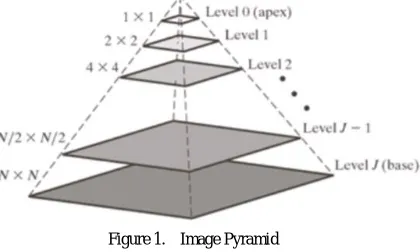
Multi-resolution Image DecompositionImage pyramids are a simple and, yet conceptually simple structure for representing images at more than one resolution. An image pyramid is a collection of decreasing resolution images arranged in the shape of a pyramid. In the pyramid, the base contains a high-resolution representation of the image being processed and the apex contains a low-resolution approximation, as we can see in figure 1. As you move up the pyramid, both size and low-resolution increase.
Figure 1. Image Pyramid
The steps for multi-resolution image decomposition is as follows for an image of size 2J × 2J:
Step 1. Compute a reduced-resolution approximation of the Level j input image. This is done by filtering and down sampling the filtered result by a factor of 2. Place the resulting approximation at level j -1 of the approximation pyramid.
Step 2. Create an estimate of the Level j input image from the reduced-resolution approximation generated in step 1. This is done by up sampling and filtering the generated approximation. The resulting prediction image will have the same dimensions as the Level j input image.
Prediction residual pyramid is also called Laplacian Pyramid. The Laplacian images are high frequency images and are highly compressible. The only problem is the total number of pixels to be compressed is 4/3rd the original image and the compressed ratio will not be as high as expected. The original image can be perfectly reconstructed from the Laplacian pyramid without any loss of image information. If we quantize the Laplacian images, we can achieve high compression ratio. [3]
There are different methods which incorporate multi-resolution image decomposition and entropy encoding together to achieve high compression ratio with less loss of image information.
3.
Hybrid Algorithmic Approach for Medical Image Compression Based on Discrete Wavelet Transform (DWT)and Huffman Techniques for Cloud Computing
In Hybrid Algorithmic Approach [2], medical image compression based on Discrete Wavelet Transform (DWT) and Huffman Techniques for cloud computing is proposed. Multilevel decomposition of the original image is performed by using Haar wavelet transform and then image is quantified and coded based on Huffman technique. The wavelet packet in MATLAB is used for reconstruction of the compressed image.
4.
Multiresolution Compressed Image Management System and MethodIn Multiresolution Compressed Image Management System and Method [1], images are stored in files that contain thumbnail data as well as a full image data structure. Wavelet or wavelet-like transform is applied to the image multiple times to represent the image as wavelet or wavelet-like transform coefficients. Mid-level resolution images can be generated easily by extracting the data for the selected resolution level from the full image data structure. For extraction of mid-level resolution images, the full image data structure is encoded and stored in an efficient manner without having to compute or recompute any image coefficients.
5.
Image data compression using Laplacian pyramidIn Image data compression using Laplacian pyramid [4], the author says that both predictive and transform techniques have advantages. Predictive - relatively simple to implement and readily adapted to local image characteristics. Transform - generally provides greater data compression, but at the expense of greater computation. Technique for removing image correlation which is intermediate between the predictive and transform methods is proposed. Computations are relatively simple in the proposed method. Here, compression is achieved by generation of Laplacian pyramid and then quantizing the Laplacian code.
6.
Laplacian pyramid Laplacian Pyramid Vector Quantization and Laplacian Pyramid Predictive CompressionIn Laplacian Pyramid Image Data Compression [5], two image data compression techniques based on the Laplacian Pyramids are examined: Laplacian Pyramid Vector Quantization (LPVQ) and Vector quantization is performed at each level of Laplacian pyramid, except the top level. After vector quantization, the compressed data for each level along with codebook can be transmitted through a channel. At the receiver, the expanded Laplacian pyramids are used to reconstruct the original image. LP part of the decoder is used to remove the block edge effect of VQ while the image data is reconstructed. That gives us excellent quality of reconstructed image.
III.IMAGEQUALITYMETRICSFORMEDICALIMAGES
The image quality metrics which can be used on medical images are: 1. Pixel by pixel comparison
This is basically comparing each pixel of the original image against the corresponding pixel in the reconstructed image. The count of pixels which differ can be taken as the measure of quality. This is used in case where we have low tolerance for any difference between the original image and reconstructed image.
2. Maximum Pixel difference
It is maximum pixel difference which exists between the original image and reconstructed image pixel values.
Maximum
Pixel
Difference = max
(
( , )
−
( , )
)
(1)
3. Mean pixel difference
The mean pixel difference can be calculated to find the average value by which the pixels differ between decompressed and original images.
MeanPixelDifference = 1
ℎ ℎ × ℎ [ ( , )− ( , )] (2)
III.CONCLUSION
This paper discuss about various existing medical image compression techniques. They can be classified mainly to lossless or near-lossless compression techniques. Lossless compression techniques can achieve only low compression ratio and hence near-lossless techniques are used to compress medical images with tolerable level of loss of information. Multi-resolution image decomposition technique can be incorporated to achieve high compression ratio while maintaining image quality.
REFERENCES
1. Charles K. Chui and Lefan Zhang, “Multiresolution Compressed Image Management System and Method,” U.S Patent 6041143, March 21, 2000
2. D.Ravichandran, Ashwin Dhivakar M R and Vijay Dakha, “Hybrid Algorithmic Approach for Medical Image Compression Based on Discrete Wavelet Transform (DWT) and Huffman Techniques for Cloud Computing”, International Journal of Electrical, Electronics and Computer Systems (IJEECS), Vol. 3, Issue 11, October 2016.
3. R. C. Gonzalez, R. E. Woods, D. J. Czitrom, and S. Armitage, “Digital image processing”, 3rd ed. United States: Prentice Hall, 2007.
4. Edward H. Adelson and Peter J. Burt, “Image Data Compression With The Laplacian Pyramid”, Proceedings of the Pattern Recognition and Information Processing Conference, pp. 218-223, Dallas, TX, 1981.
5. C. H. Chen, “Laplacian Pyramid Image Data Compression”, Southeastern Massachusetts University, N. Dartmouth, MA 02747 USA, 1987 6. S. Jayaraman, S. Esakkirajan and T. Veerakumar, \Digital image processing", New Delhi: Tata McGraw Hill Education, 2009.
BIOGRAPHY
Swathy S is a M. Tech student in the Computer Engineering Department, Govt. Model Engineering College, Thrikkakkara, Kerala, India. She received Bachelor of Technology (B.Tech) degree in 2015 from NIT Calicut, India. Her research interests are Image Processing, Medical Imaging etc.