ISSN:2574 -1241
Application of TOPSIS Method in Decision Making Via
Soft Set
Rana Muhammad Zulqarnain
1, Sohaib Abdal
1*, Adnan Maalik
2, Bagh Ali
3, Zeeshan Zafar
4, Muhammad
Irfan Ahamad
4, Saba Younas
5, Amna Mariam
5and Fazal Dayan
61School of Mathematic, Northwest University, Xian 710127, China
2Department of mathematics, University of Management and technology Sialkot Campus, Punjab, Pakistan
3Department of Applied Mathematics, Northwestern Polytechnical University, Xi’an 710129, China
4Shaanxi Key Laboratory of Earth Surface System and Environmental Carrying Capacity, College of Urban and Environmental Sciences,
Northwest University, Xian 710127, China
5School of Mathematics, National College of Business Administration and Economics Lahore Layyah Campus, Pakistan
6Department of Mathematics, University of Lahore, Punjab, Pakistan
*Corresponding author: Sohaib Abdal, School of Mathematic, Northwest University, Xian 710127, China
DOI: 10.26717/BJSTR.2020.24.004045
Received: December 16, 2019 Published: January 07, 2020
Citation: Rana Muhammad Zulqarnain, Sohaib Abdal, Adnan Maalik, Bagh Ali, et al. Application of TOPSIS Method in Decision Making Via Soft Set. Biomed J Sci & Tech Res 24(3)-2020. BJSTR. MS.ID.004045.
ARTICLE INFO Abstract
Molodtsov introduced a general mathematical theory, to addressing uncertain and
undefined objects which is known as soft set theory. In this work, we study soft set with some definitions and operations, also discuss a soft set technique for order preference by
similarity to ideal solution (TOPSIS) method and use this method for decision making. Keywords: Soft Set; TOPSIS; Decision Matrix; Normalized Decision Matrix; Weighted Normalized Decision Matrix
Introduction
In recent time, classical methods are used to solve different problems which are faced in medical sciences, engineering, social sciences, etc. Many theories like fuzzy set theory, probability theory, rough set theory, etc. are used to solve these uncertainties, but these theories have their own problems which were attensioned by Zadeh. First of all, (Zadeh) in [1] initiated the concept of fuzzy sets by the extension of classical notion on sets. Nowadays fuzzy set theory is rapidly progressing, but cases, we face some limitations
such as how to adjust the membership functions in this theory.
Molodtsov proposed the concept of soft set to solve those problems
which contain uncertainty in 1999 and defines a soft set as a
parameterized family of subsets of universe set where each element is considered as a set of approximate elements of the soft set in the past few years of fundamentals of soft set theory studied by various researchers [2]. Various potential application in soft set in
research Riemann integration theory of measurement and so on are highlighted in Molodtsov.
In these days, mathematician plays a vital role in the soft
set fuzzification. After the fuzzification of soft set, a new theory
introduced which is known as a fuzzy soft set with different types and
properties Maji et al. [3]. The soft set theory was reviewed [4] and
used this theory for decision making, they also introduced different
types of soft set with examples and defined some operations such as
And-operation, Or-operation, union, intersection, complement, etc.
on soft set [5]. In Chen et al. [6] redefine the idea of parameterization
reduction in a soft set and compare it with a rough set, they also
improve the applications of soft set by using a new definition in the
a supplier out of three suppliers in a company of garment operating in Turkey. Jahanshahloo et al. extended the approach of the TOPSIS method for decision making by the help of fuzzy data [9].
They also introduced a new concept of normalized fuzzy
numbers with the help of α-cuts and applied this proposed concept
on numerical problems. The Technique for Order Preference by Similarity to Ideal Solution (TOPSIS) introduced in [10] to solve multi criteria decision making problems with different alternatives. In [11] Chen & Hwang extend the idea of the TOPSIS method and presented a new model for TOPSIS. He also used the newly proposed method for decision making to solve uncertain data in [12]. The authors used this method for the prediction of Diabetes patients in medical diagnosis. In [13-15], the authors presented the applications of fuzzy TOPSIS in different areas and used for decision making. Zulqarnain M and Saeed M [16] used the interval-valued fuzzy soft matrix in decision making. They also introduced a new decision-making method in [17,18] on interval-valued fuzzy soft matrix. In this paper, we discuss about soft set TOPSIS method and
used this method for the selection of best candidates for bank jobs.
Preliminaries
Definition: 2.1 [2]
A pair (F, E) is called a soft set over a given universal set U, if and only if F is mapping of a set of parameters E, into the power set of U. i.e.
F E: → P U
( )
Clearly, an soft set over U is a parameterized family of subsets of a given universe U.
Also, for any p ϵ E, F (p) is considered the set of p –approximate element of the soft set (F, P)
Definition 2.2 [2]
Let (F, A) and (G, B) are two soft sets over the same universe U, then (F, A) is a soft subset of (G, B) if
A B⊆ , and
For all t A∈ , F(t) and G(t) are an identical approximation
It is denoted by (F, A) ⊆ (G, B).
Definition 2.3 [5]
(F, A) and (G, B) are called equal soft sets if
(
F A, ,) (
⊆ G B)
and(
G A, ,) (
⊆ F B)
. It can be written as(F, A) = (G, B)
Definition 2.4 [19]
Let (F, A) and (G, B) are two soft sets over U, then their union is
defined as
Definition 2.5 [19]
Let (F, A) and (G, B) are two soft sets over U, then their
intersection is defined as
( ) ( ) ( )
F A, ∩ G B, , = H C( )
( ) ( )
H t =F t ∩G t for all t ∈ C, where C = ∩A B.
Definition 2.6 [5]
Let (F, A) and (G, B) are two soft sets over the same universe U,
then their restricted difference is defined as
(
F A, , ,)
−R G B(
)
=(
H C)
Where C = ∩A B and for all t C∈ , H t
( )
=F t( ) ( )
∩G tDefinition 2.7 [19,20]
A soft set (F, A) over a universe U is said to be a null soft set denoted by Φ if ∀ ∈e A, F e
( )
= Φ.Definition 2.8 [2]
A soft set (F, A) over a universe U is called absolute soft set denoted by (F, A) if ∀ ∈e E, F e
( )
= U.Definition 2.9 [5]
If (𝐹, 𝐴) and (𝐺, 𝐵) are two soft sets then “(𝐹, 𝐴) 𝐴𝑁𝐷 (𝐺, 𝐵)” denoted by (𝐹, 𝐴) ∧ (𝐺, 𝐵) is defined by(F A, ) (∧ G B, () = H A B, × ),
Where H (α β, ) = F( )α ∩G( ) (β ,∀α β, )∈ ×A B. Example
Let U = {x1, x2, x3, x4, x5} be a set of candidates in interview for
job in the bank. Let A and B are two sets of parameters such that A=
{a1, a2, a3, a4} where ai represents that the candidates are beautiful,
tall, confident and brilliant respectively.
Let B = {b1, b2, b3} be a set that represents the qualification of
candidates SSCE, BS, and MS respectively. Then
Now
a) Means beautiful applicant with SSCE are {x1,x2} b) Means beautiful applicant with BS are {x1,x2} c) Means brilliant applicant with SSCE are {x1,x2,x3,x4}
d) Means brilliant applicant with BS are {x1,x2} e) Means brilliant applicant with MS are {x1,x2} Tabular representation of soft set. (Table 1)
Table 1: Soft Set.
,
H A B
×
a b
1 1,
a b
1,
2a b
1,
3a b
2,
1a b
2,
2a b
2,
3a b
3,
1a b
3,
2a b
3,
3a b
4,
1a b
4,
2a b
4,
31
X 1 1 1 1 1 1 0 0 0 1 1 1
2
X
1 1 1 0 0 0 0 0 0 1 1 13
X 0 0 0 1 0 0 1 0 0 1 0 0
4
X 0 0 0 0 0 0 0 0 0 1 0 0
5
X
0 0 0 1 1 0 1 1 0 0 0 0TOPSIS Method
“To solve multiple criteria decision-making problem Hwang
and Yoon [10] introduced a technique, which is known as the TOPSIS method. He proposed a positive ideal solution and a negative ideal solution to support the shortest Euclidean distance. The basic assumption is that each criterion needs to be minimized or maximized. For ranking alternatives for closeness to the best answer, the TOPSIS is helpful. The process of TOPSIS is based on an optimum ideal solution since the maximum level is obtained by selecting the best alternative available. The ranking of an ideal solution is done in such a way that the best alternative has rank one while the worst alternative a rank approaching zero. For every alternative, there is an intermediate ranking between the best
weighting of relative disease and therefore the optimum disease is alarming which needs attention. Here are presented the steps for the TOPSIS technique.
Step 1: Establishment of DM
First step in TOPSIS is to construct the decision matrix (DM) that is as follows
( )
: F E→ P UWhere l is the alternative index ( l=1, 2,...,q);
n
is the numberof potential sites and is the criteria index .
related to the values of alternatives l with respect to criteria
m
.Step 2: Calculation of the Normalized Decision Matrix
The normalized decision matrix (NDM) denotes the normalized values which represent the relative performance of the alternatives.
2 1 lm lm q lm l c NDM L c = = =
∑
Step 3: Determination of the Weighted Normalized
Decision Matrix
By multiplying every element of each column of normalized decision matrix got a weighted decision matrix.
V V
=
lm
=
W L
m×
lmStep 4: Identification of the Positive Ideal Solution (PIS)
and Negative Ideal Solution (NIS)
The PIS (
I
+) and the NIS (I
−) are defined with respect to theweighted decision matrix as follows.
1 2
NIS
{V ,V , ... ,V }, where:
V {(mini(V ) if m J);(maxi V if m J )}
q
m lm lm
I
− − − − −=
=
′
=
∈
∈
Where
J
′
is associated with the non-beneficial attributes andJ
is associated with beneficial attributes.Step 5: Separation Distance from PIS and NIS, of Each
Alternativ
e
2
1
( ) ; 1,2, ... , p
l m lm
m
S+ V+ V l q
=
=
∑
− =
2 1
( ) ; 1,2, ... ,
p
l m lm
m
S− V− V l q
=
=
∑
− =Where,
l
= Alternative index,m
= Criteria index.Step 6: Relative Closeness to the Ideal Solution.
The relative closeness of the ideal solution is computed as
( ) , 0 C 1
l l l l l S C S S − + − = ≤ ≤ +
Step 7: Ranking of Preference Order
Ranking is done based on the values of Cl the higher value of the relative closeness has a high rank and hence the better performance of the alternative. Rank the preference in descending
order to compare the better performances of alternatives” .
A Decision-Making Method on Soft Set by TOPSIS
Soft set TOPSIS method
a) Step 1: Defining the problem
First, we define the set of decision-makers, set of candidates
and set of parameters which are given as
: : { } } { i n k n
D D i Y Y k
=
= and
P : }= { P jj n
Then a soft set g over P is defined as g: P→ Ῥ(Y)
b) Step 2: Construct the decision matrix for each decision-maker
1 11 12 13 1
2 21 22 23 2
3 31 32 33 3
1 2 3
... ... ... [ ] ... n n n ij
n m m m mn
y d d d d
y d d d d
DM y d d d d d m n
y d d d d
= = ×
DM =U
i j I,∈nd d
ij,
ij=
g
p pi( j)c) Step 3: Construct the weighted normalized decision matrix
11 12 13 1
21 22 23 2
31 32 33 3
1 2 3
( ) 1
...
...
...
[ ]
...
( )
,
,
,
k n n n ijm m m mn
n Pi
i n
kt P t
al
W
m n
g
y f
or
l i k t
I
λ
λ
λ
λ
λ
λ
λ
λ
λ
λ
λ
λ
λ
λ
λ
λ
λ
λ
=µ
=
=
×
=
∑
∈
Andd) Step 4: Construct the decision matrix
( )
1n
i i ji
Y
=λ
ϒ
=
∑
where ϒ (Yi) decide the values of yi, so the decision matrix is ii
R
= ϒ
[ ( )
Y
1ϒ
(
Y
2)
ϒ
(
Y
3)...
ϒ
( ]
Y
n)
e) Step 5: Ranking the preference order
performance of the candidates. Rank the preference in descending order to compare the better performances of candidates.
Application of soft set by TOPSIS method
a) Step 1
A bank manager wants to select two candidates out of from five
which is our universal set Y = {Y1, Y2, Y3, Y4, Y5}
Head office of the bank decide the parameters for the selection
of candidates which are given here
P = {Qualification (Q), Tall (T), Beautiful (Be), Brilliant (Br) and Confidence (C)} and hire a team of five selectors (Decision makers) to choose two candidates out of five.
D = {D1, D2, D3, D4, D5}.
First, the first selector D1 chooses the set of parameters for the selection of candidates such as P1 = {Q, Br, C} and construct the soft set.
ǵP1= {(Q, {Y1, Y3, Y4}), (Br, {Y3, Y5}), (C, {Y1, Y2, Y3, Y4})}
Now, second selector D2 choose the set of parameters for the selection of candidates such as P2 = {Q, T} and construct the soft set.
ǵP2= {(Q, {Y2, Y4, Y5}), (T, {Y1, Y4, Y5})}
Now, third selector D3 choose the set of parameters for the se-lection of candidates such as P3 = {Be, Br, C} and construct the soft set.
ǵP3= {(Be, {Y1}), (Br, {Y3, Y4}), (C, {Y4})}
Fourth selector D4 choose the set of parameters for the selection of candidates such as P4 = {Q} and construct the soft set.
ǵP4= {(Q, {Y1, Y2, Y3, Y4})}
Finally, fifth selector D5 chooses the set of parameters for the selection of candidates such as P5 = {T, C} and construct the soft set.
ǵP5= {(T, {Y1, Y3}), (C, {Y2, Y3, Y4})} b) Step 2
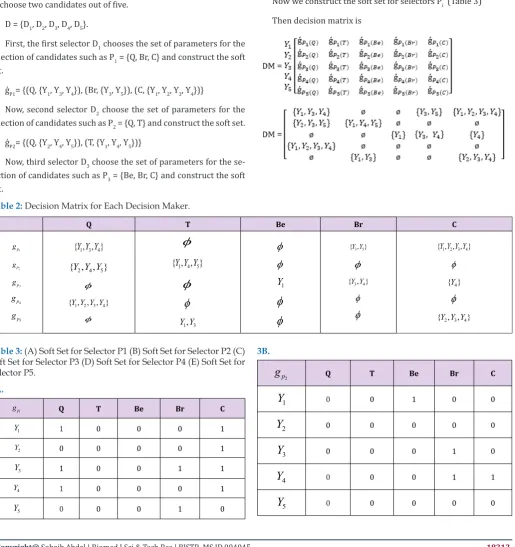
Now, we construct decision matrix for each selector where gpi
represent the soft set. (Table 2)
Now we construct the soft set for selectors Pi (Table 3) Then decision matrix is
Table 2: Decision Matrix for Each Decision Maker.
Q T Be Br C
1
p
g
2 p
g
3
p
g
4
p g
5
p g
1 3 4 { , , }Y Y Y
2 4 5 { , , }Y Y Y
φ
1 2 3 4
{ , , , }Y Y Y Y φ
φ
1 4 5 { , , }Y Y Y
φ
φ
1, 3 Y Y
φ
φ
1
Y
φ
φ
3 5
{ , }Y Y
φ
3 4
{ , }Y Y
φ
φ
1 2 3 4 { , , , }Y Y Y Y
φ
4 { }Y
φ
2 3 4 { , , }Y Y Y
Table 3: (A) Soft Set for Selector P1 (B) Soft Set for Selector P2 (C) Soft Set for Selector P3 (D) Soft Set for Selector P4 (E) Soft Set for Selector P5.
3A.
1
p
g Q T Be Br C
1
Y 1 0 0 0 1
2
Y 0 0 0 0 1
3
Y 1 0 0 1 1
4
Y 1 0 0 0 1
3B.
2
p
g
Q T Be Br C1
Y
0 0 1 0 02
Y
0 0 0 0 03
Y
0 0 0 1 04
Y
0 0 0 1 13C.
3
p
g
Q T Be Br C1
Y
0 1 0 0 02
Y
1 0 0 0 03
Y
0 0 0 0 04
Y
1 1 0 0 05
Y
1 1 0 0 03D.
4
p
g
Q T Be Br C1
Y
1 0 0 0 02
Y
1 0 0 0 03
Y
1 0 0 0 04
Y
1 0 0 0 05
Y
0 0 0 0 03E.
5 p
g Q T Be Br C
1
Y
0 1 0 0 02
Y
0 0 0 0 13
Y
0 1 0 0 14
Y
0 0 0 0 15
Y
0 0 0 0 0c) Step 3:
Construct weighted normalized decision matrix
So, the weight matrix is obtained as
2 2 2 3 1
2 0 1 1 1
1 0 0 0 0
0 0 2 1 1
1 2 2 3 0
W
=
d) Step 4. Constructing the decision matrix (vector), R.
Thus, the DM of each candidate’s values for the decision-makers is obtained as
R= [10 5 1 4 8]
e) Step 5. Ranking the Preference Order.
Ranking among the candidates would be created in the order
in descending order of the values ϒ (Yj) calculated in the fifth step. So, when the fifth step in the calculation of the evaluation of the candidate from small to large ϒ (Y1) ˃ ϒ (Y5) ˃ ϒ (Y2) ˃ ϒ (Y4) ˃ ϒ (Y3)
the order form is realized in the form of ranking Y1 ˃ Y5 ˃ Y2 ˃ Y4 ˃
Y3. In other words, we can say that Y1 and Y5 are the best candidates
for the bank job.
Conclusion
In this paper, we discuss the soft set and TOPSIS method along
with some definitions and examples. Secondly, we discuss the soft
set TOPSIS method. Finally, we apply the soft set TOPSIS method for
the selection of two best candidates for the bank job.
References
1. Zadeh LA (1965) Fuzzy sets. Journal of Information and Control 8(3): 338-353.
2. Molodtsov DA (1999) Soft set theory-first result. Computers and Mathematics with Applications 37(4-5): 19-31.
3. Maji PK, Roy AR, Biswas R (2001) Fuzzy soft sets. Journal of Fuzzy
Mathematics 9(3): 589-602.
4. Maji PK, Roy AR, Biswas R (2002) An application of soft sets in
a decision-making problem. Computers and Mathematics with Applications 44(8-9): 1077-1083.
5. Maji PK, Roy AR (2003) Soft set theory. Computers and Mathematics
with Applications 45(4-5): 555-562.
6. Chen D, Tsang ECC, Yeung DS, Wang X (2005) The parameterization reduction of soft sets and its applications. Computers & Mathematics with Applications 49(5-6): 757-763.
7. Ali MI, Feng F, Liu XY, Min WK (2009) On some new operations
in soft set theory. Computers and Mathematics with Applications 57(9): 1547-1553.
8. Yeşim YA, Aytaç Y, Ahmet O (2012) Fuzzy TOPSIS Method in Supplier Selection and Application in the Garment Industry. Fibres and Textiles in Eastern Europe 20(4).
9. GR Jahanshahloo, F Hosseinzadeh Lotfi, M Izadikhah (2006) Extension
of the TOPSIS method for decision-making problems with fuzzy data. Applied Mathematics and Computation 181(2): 1544-1551.
10. C Hwang, K Yoon (1981) Multiple Attribute Decision Making: Methods
and Applications. In C Hwang, K Yoon (Eds.), (1st Edn), A State-of-the-Art
Survey 1.
11. SJJ Chen, CL Hwang (1992) Chapter 5 Fuzzy Multiple Attribute Decision Making Methods. Springer-Verlag Berlin Heidelberg 375: 289-486. 12. CT Chen (2000) Extensions of the TOPSIS for group decision-making
under fuzzy environment. Fuzzy Sets Syst 114(1): 1-9.
13. A Awasthi, SS Chauhan, SK Goyal (2011) A multi-criteria
decision-making approach for location planning for urban distribution centers under uncertainty. Math Comput Model 53 (1-2): 98-109.
14. T C Chu (2002) Selecting plant location via a fuzzy TOPSIS approach. Int J Adv Manuf Techno 20(11): 859-864.
15. D Yong (2005) Plant location selection based on fuzzy TOPSIS. Int J Adv Manuf Technol 28(7-8): 839-844.
16. M Zulqarnain, M Saeed (2016) An application of Interval valued fuzzy soft matrix (IVFSM) in decision making. Sci Int (Lahore) 28(3): 2261-2264.
17. M Zulqarnain, M Saeed (2016) Comparison between fuzzy soft matrix (FSM) and interval valued fuzzy soft matrix (IVFSM) in decision making. Sci Int (Lahore) 28(5): 4277-4283.
18. M Zulqarnain, M Saeed (2017) A New Decision-Making Method on Interval Valued Fuzzy Soft Matrix (IVFSM). British Journal of Mathematics & Computer Science 20(5): 1-17.
19. Selim Eraslana (2015) A Decision-Making Method via TOPSIS on Soft Sets. journal of new results in science 8: 57-71.
20. M Zulqarnain, F Dayan, M Saeed (2018) TOPSIS Analysis for the Prediction of Diabetes Based on General Characteristics of Humans. International Journal of Pharmaceutical Sciences and Research 9(7): 2932-2939.
Submission Link: https://biomedres.us/submit-manuscript.php
Assets of Publishing with us
• Global archiving of articles
• Immediate, unrestricted online access • Rigorous Peer Review Process • Authors Retain Copyrights • Unique DOI for all articles
https://biomedres.us/
This work is licensed under Creative Commons Attribution 4.0 License
ISSN: 2574-1241
DOI:10.26717/BJSTR.2020.24.004045