Advances in Medical Education and Practice
Dovepress
O R I G I N A L R E S E A R C H
open access to scientific and medical research
Open Access Full Text Article
Impact of an educational program on nursing
students’ caring and self-perception in intensive
clinical training in Jordan
Rawda Khouri
Al Hussein Bin Talal University, Princess Aisha Bint Al Hussein College Of Nursing, Ma’an, Jordan
Correspondence: Rawda Khouri Al Hussein Bin Talal University, Princess Aisha Bint Al Hussein College of Nursing, PO Box 20, Ma’an, Jordan
Tel +96 27 95722133 Fax +96 23 2179050
Email [email protected]
Background: Framing and development of clinical skills in nursing students during their
clinical practice is critical because this can shape their future caring skills. Professional caring empowers patients and contributes to their well-being and health. Education may enhance the capacity of nurses to be effective caring practitioners. Their study program encourages caring behavior in nursing students, consequently affecting their professional self-perception.
Methods: The present study investigated the effect of an educational program on caring behavior
and professional self-perception in nursing students using a controlled pre/post test study design. The study sample consisted of 50 nursing students undertaking their final year in 2010–2011. Subjects were randomly assigned to either an experimental or a control group. The study was conducted in two critical care units affiliated to the Ma’an and Queen Rania hospitals in the south of Jordan. The instruments utilized were the Caring Dimensions Inventory, Nursing Students Attitude Observational Checklist, and Professional Self-Concept of Nurses Instrument.
Results: The study findings favor the effect of the educational program because there was
increased knowledge and understanding of caring theory and related concepts, a more holistic approach to care, enhanced caring practices, and improved self-perception in the study group compared with the control group during different periods of assessment. The study group showed significantly better caring perception in psychological, technical, and professional terms than the control group during different periods of assessment. There was a significant positive trend of overall professional self-perception for the study group compared with the control group.
Conclusion: Nursing curricula should incorporate concepts and principles that guide students
in developing caring, safe, competent, and professional behavior. Nursing students must seek educational opportunities to acquire knowledge for role preparation, to participate in knowledge generation, and for personal and professional development.
Keywords: caring, nursing students, clinical training, educational program, self-perception,
self-identity
Introduction
Nurses are expected to provide high-quality care in health and illness, and to empower
their patients by moving them toward an independent self-regulated healthy life.1,2
Nursing students need to develop their abilities in order to view professional caring from a different perspective and translate new knowledge into action. However, the newly graduated nurse suffers from low levels of self-confidence and professional self-worth
that can make the difference between continuing with nursing or leaving the profession.3
Nurses are torn between the human caring model of nursing that attracted them to the profession and the task-orientated biomedical model and institutional demands that
consume their practice time.4 Moreover, the dynamics of relational, human-to-human
RETRACTED
Advances in Medical Education and Practice downloaded from https://www.dovepress.com/ by 118.70.13.36 on 19-Aug-2020
For personal use only.
Number of times this article has been viewed
This article was published in the following Dove Press journal: Advances in Medical Education and Practice
Dovepress
Khouri
caring practices and comprehensive therapeutic modalities for caring and healing seem to be eclipsed by the daily routines, mechanics, and demands of the economic, manage-ment, physical, and technological aspects of health care. The necessary changes needed for renewal and transformation seem to be dependent on human dimensions and skills that result in transforming patterns and depths of communication,
relationships, and healing modalities.4–6
Caring is viewed as a central but difficult concept in
nursing.5,7 The concept of caring is considered by many to be
central to the practice of nursing and, indeed, some consider
caring and nursing to be almost synonymous.8–10 Caring
has been seen as the essence of nursing and as a process
of interaction and communication.11,12 Arthur and Randle13
view the concept of professional caring as something that empowers the patient and contributes to well-being and health. Lack of professional caring results in reduced well-being and health. Caring is a complex concept and has to be expanded to include professionalism. Caring means being open to and perceptive of others, being genuinely concerned about patients, being morally responsible, being truly present for patients, being dedicated, and having the courage to be
appropriately involved as a professional nurse.14 Caring is
a process that involve feelings together with professional
knowledge, competence, skills, and nursing actions.15
Larson and Ferketich16 stated that, for nursing to achieve
true professional recognition and the esteem it deserves, an understanding of the makeup of its members and their views of themselves as professionals would be valuable.
If self-perception on the part of nurses can be confidently strengthened, then further research that focuses on exploring relationships with job satisfaction, retention, and stress becomes realistic. Resolution of this conflict requires nursing to reconnect with the foundations of professional nursing and its theoretical, knowledgeable, ethical, and philosophical principles. However, to resolve practice dilemmas, abstract conceptualizations of what nursing is must translate into the concrete realm of what nursing does and must guide integra-tive professional clinical judgment for those actions within the context of a system and culture in crisis and conflict. The new emphasis is on a change of consciousness, a focused intentionality towards caring and healing relationships and modalities, a shift towards a spiritualizing of health versus
a limited medicalized view.17–19 Thus, the intensive clinical
training course is a critical period for nurses, is the first contact with the profession, and might alleviate any anxiety resulting from inability of the recent graduate to translate
nursing theory into practice.9,20,21 Graduate framing and
development during their learning is critical because this might shape their future way of caring.
Fahrenwald et al22 defined professional identity in nursing
as the values and beliefs held by the nurse that guides his/her thinking, actions, and interaction with patients. It refers to the nurse’s concept of what it means to be and act as a nurse. It is often addressed in terms of related concepts, ie, professionalism, perception of the role of the nurse, and professional self-perception. Values are inherent in developing and sustaining professional identity and are
expressed in actions in relation to others.23 Professional
identity refers to the commonality of the nursing profession and to the special way the nurse utilizes this commonality within the nursing profession.
The need to strengthen the professional identity of the nurse has attracted attention in recent years. Such endeavors must focus upon the educational and administrative demands of support in an effort to make professional personal devel-opment and growth of nurses possible. This could mainly be realized through the development of personal self-care abilities and increased possibilities for nurses to share their experiences with other nurses in a narrative and reflective way. Professional group supervision may have certain
potential.22,24 An educational supervision program directed
toward professional self-perception is needed to address low recruitment and retention.
Considering the importance of nursing services in any health system, programs need to be designed to strengthen
and empower nurses.6,25,26 Educational programs and
supervi-sion may enhance the nursing student’s capacity to become an effective caring practitioner, which reflects on professional
identity.27 Clinical supervision is a very important concept
in nursing because of the potential benefits it can bring to patient care and nurses themselves, both individually and
as a profession. Simonson27 mentioned that with increasing
emphasis on work-based learning, one of the many strategies designed to support students and professionals is supervision. Professional group supervision is a useful means of
strength-ening the professional identity of nurses. Walsh and Dolan7
stated that reflection is important because it equips nurses to meet various practical problems and deal with them intel-ligently, which are necessary requirements for all nurses.
Lee-Hsieh12 defined supervision as a support mechanism
for practicing professionals within which they can share clinical, organizational, developmental, and emotional experiences with another professional in a secure, confiden-tial environment in order to enhance knowledge and skills. Clinical supervision is both necessary and beneficial. It can
RETRACTED
Advances in Medical Education and Practice downloaded from https://www.dovepress.com/ by 118.70.13.36 on 19-Aug-2020
Dovepress Caring and self-perception in student nurses
be advantageous to individual practitioners and profes-sional groups in enhancing practice and accountability, and
promoting professional development.13,28
Bankert and Kozel15 stressed the value of clinical
supervision in the development of professional expertise and quality of care. The literature is replete with references to clinical group supervision, but its outcomes have not
been sufficiently investigated.29,30 Clinical group
supervi-sion is well described in empirical studies of care in older
people and mental health nursing.31–33 However, only three
published studies on clinical supervision were found to
be related to intensive care.17,34,35 It seems reasonable to
believe that focusing on clinical group supervision will facilitate the understanding of and prerequisites for the provision of care in an intensive care unit.
It has been claimed that clinical supervision, if imple-mented effectively, will bring benefits as diverse as improved
patient care through increased skills and knowledge,36,37
including reduction in stress levels and complaints as well
as an increase in staff morale.20 Increasingly, research is
identifying other benefits, including increased knowledge and awareness of possible solutions to clinical problems, increased confidence, reduced emotional strain and burnout,
increased participation in reflective practice,38,39 and better
self-awareness.33,40 The benefits identified have
implica-tions not only for practitioners but also for patient care and employing organizations.
Arthur et al41 emphasized that professional identity would
be developed by interaction with other nurses and through internalization of knowledge, skills, norms, and the culture of the nursing profession. He also explained that in order for individuals to create their own professional identity, they should initiate relationships at work and participate
in professional activities within an organization. Barker11
added that nurses have a responsibility to educate other nurses to help establish their professional identities. Nurses as educators and role models are essential to the process. By monitoring the process of nursing education and adminis-tration, and conducting further research in this area, we can greatly improve the quality of care, retention of nurses, and the professionalization of nursing.
The interventional educational program investigated in this study aimed to develop the nursing student’s abil-ity to become a caring practitioner. It was also intended to enforce and empower caring behavior which consequently affects professional self-perception. Raising awareness of personal orientation provides an opportunity for change, which is essential for professional development of nursing.
The present study was designed to investigate the effect of this educational program on nursing student’s caring behavior and professional self-perception.
Methods and materials
This research was designed to test the hypotheses that nursing students who participate in an educational program will score higher in their knowledge about caring and professionalism than those who do not participate in such a program, and that nursing students who participate in the program will score higher on aspects of caring and develop more positive professional self-perception than those who do not participate in such a program. A controlled pre/post test study design was utilized to show the impact of educa-tion on caring behavior and professional self-percepeduca-tion. The study program was conducted in two clinical areas in Jordan where nursing students are trained, ie, the critical care units of Ma’an and Queen Rania Hospitals. The study sample comprised 50 nursing students, representing all those undertaking their final year in 2010–2011 at our university. Both groups were selected in a random fashion. Participants was further randomly assigned to either an experimental group or a control group.
Demographic data sheet
A demographic data sheet was developed by the researcher to record the background characteristics of the nursing students, including age, type of education before joining the faculty (secondary school degree or technical institute degree), and any work experience prior to entering nursing training.
Caring dimensions inventory
The Caring Dimensions Inventory (CDI) was developed by
Watson et al.42–44 This instrument was used to gather data
on nursing students’ perception of what represents caring in nursing. It includes 25 items divided into four dimen-sions, ie, technical/professional (nine items), psychosocial (10 items), involvement (three items), and altruism (three items). The content of the CDI spans a range of nursing actions, including instrumental, affective, and professional activity. The scoring system was on a five-point Likert scale from 5 (“strongly agree”) to 1 (“strongly disagree”). The validity and reliability of the CDI has been reported by
Watson and Lea.42 The reliability of the CDI, measured by
internal consistency, was acceptable, with a Cronbach’s alpha of 0.96. The validity of the contrasted groups of nursing students was established.
RETRACTED
Advances in Medical Education and Practice downloaded from https://www.dovepress.com/ by 118.70.13.36 on 19-Aug-2020
Dovepress
Khouri
Professional self concept instrument
The Professional Self Concept Instrument (PSCNI) wasdeveloped by Arthur45,46 to study professional self-perception
in a population of nursing students. The 16 items ask nurses to rate their degree of agreement on three scales examining nurses’ views toward their work. Scale one professional practice has three subscales, ie, leadership, flexibility, and skill, while scales two and three measure satisfaction and communication, respectively.
A high score indicates a positive attitude or belief and a low score indicates a negative attitude or belief. Individual scores and group scores were then obtained for the components of the CaPSTI, ie, professional self-perception ( including professional practice, satisfaction, and communication). A four-point Likert scale was used, with a score of 1 reflecting a low opinion of self as a professional and a score of 4 a more positive professional self-view.
Conceptually, the PSCNI relies on the assumption that attitudes toward self as a professional exist on a continuum from positive to negative, and that these can be measured using an interval scale, such as the Likert. Furthermore, certain attitudes toward oneself as a professional will increase or decrease the likelihood of certain patterns of behavior. This relies on the assumption that cognitive/affective and psycho motor functions are inextricably linked.
The instrument has proven to be reliable and flexible in this context. Factor analytic studies on the PSCNI have supported the construct validity of the subscale structure. Cronbach’s alpha was 0.89 for internal consistency. Acceptable internal consistency measures were reported for the subscales in two separate studies in Australia and
Canada,47 in which the Cronbach’s alpha estimates for the
professional practice subscale were 0.85 and 0.89, and for the satisfaction subscale were 0.82 and 0.82. The communication subscale was weaker at 0.40 and 0.59 in these studies.
Observational checklist
An observational checklist was developed by the researcher to measure the caring and professional behavior of nursing students. It included 30 items divided into two subscales, ie, caring behavior (12 items) and professional behavior (18 items). The scoring system was as follows: 1 (never), 2 (rarely), 3 (usually), and 4 (always). Reliability of the tool was 0.96. The alpha coefficient was 0.83. Content validity was confirmed by a panel of six experts, and any necessary modifications were done by omitting items that could not be measured or performed by female nursing students, and replacement items were added as advised.
Knowledge test questionnaire
A knowledge test questionnaire comprising 40 multiple questions was developed by the researcher and used to measure nursing students’ knowledge regarding both the concepts of caring and professional behavior. Reliability of the tool was 0.88. The alpha coefficient was 0.86. Content validity was confirmed by a panel of ten experts and modi-fications were made by omitting two difficult questions and addition of two questions as advised.
Pilot study
A pilot study was conducted in ten subjects to test the clarity and validity of the content of the study tools. Necessary modifications were done by adding or omitting questions and increasing the time needed to respond to each questionnaire.
Procedure
Prior to implementation of the training course, permission was obtained from the nursing supervisors of the selected units. This was intended to facilitate data collection and to explain the purpose of the study. At the beginning of the course, nursing students were invited to participate in the study. The researcher explained the study purpose and procedures to the randomly selected sample. Student nurses were further informed that participation was voluntary and that study findings would be presented group wise and no individual would be recognized.
A knowledge test was then provided to students in the study and control groups as well as the CDI and professional self-concept scales to assess perceptions about the two concepts. Observations of caring and professional behavior were carried out while the subjects were caring for their patients utilizing the designed observational check lists.
The educational sessions were held twice a week for the study group, while the control group received only the usual course orientation. Six sessions were held, lasting an hour each. As the level of knowledge of the group increased, the content of sessions developed in both depth and range of concepts covered. Contents of the educational sessions were perception of caring and nursing (session 1), caring theories and values (session 2), holistic approach to caring (session 3), concept of professionalism (session 4), ethics and professionalism (session 5), and communication, inter-personal relationship, and assertiveness (session 6).
These sessions were followed by supervision of the nursing students in their clinical areas covering different work shifts in order to provide each student with support, as he/she became involved in new nursing situations and implemented
RETRACTED
Advances in Medical Education and Practice downloaded from https://www.dovepress.com/ by 118.70.13.36 on 19-Aug-2020
Dovepress Caring and self-perception in student nurses
out his/her new knowledge. This was also intended to bridge the gap between theory and practice by providing a role model. The supervision focused on conceptualizing nursing in terms of activities of daily practical work and on interper-sonal skills emphasizing nurses as caring professionals.
Groups of four or five nursing students met twice weekly. These small groups allowed students to learn how other stu-dents practiced. Stustu-dents also had the opportunity to receive input and feedback from each other, particularly when they were feeling overwhelmed by a certain situation or family. The group members helped each other look at the situation in new ways (reframing), suggested trying certain interventions, and provided support to the student who was trying out a new intervention. Sometimes, the group provided the student with a setting in which to seek support with the difficult experiences that they had encountered, such as the death of a patient.
The program thus encouraged reflection and increased self-awareness. This type of clinical teaching is seen as an opportunity to unite theory and practice. It encourages students to be receptive to patients and places value on contextual experiences. An examination of contextual experience shows that care is relational and encourages connections with others. Care is sustained through relationships that give voice to nurs-ing students and patients. This process of givnurs-ing voice makes caring more visible to others. This visibility allows nurses to celebrate caring occasions and validates worth of caring in nursing. Thus, instead of only attending lectures on course content, nursing students shared their personal stories about caring experiences with their colleagues, how they felt, and what the experiences had meant for them. This type of interac-tive experience strategy provided meaningful insights for them and formed the basis for dialog and sharing of meaning and values. Eight supervised sessions were held and the overall program period lasted 2 months, including both the theoretical component and the supervised sessions.
To assess the impact of the program on caring behavior and professional self-perception of nursing students, the previous instruments were utilized immediately after the program and 3 months later.
Statistical analysis
Statistical analyses were done utilizing SPSS version 11.5
(SPSS Inc, Chicago, IL). A P value ,0.05 was considered to
be statistically significant. The analysis proceeded in phases. In the first phase, a descriptive profile of the study and control groups was done. The Chi-square statistic and t-test were used to determine if there were any statistically significant baseline differences between the groups. In the next phase, the effects
of group and time on study outcomes were examined using repeated-measures analysis of variance. The investigators looked at the significant effect of the interaction term, which was group by time. If this interaction term was statistically nonsignificant, the independent effects of time and group were evaluated separately. The independent sample t-test was also carried out to test the difference between group means at each given time point.
Results
Regarding demographic characteristics, as shown in Table 1, 50 students were randomized into the study and control groups
(n = 25 each). The majority of students were aged 21–23 years,
with a mean age of 21 years. Their educational background reflected that of nursing students in general, with the majority (88.3%) being secondary school graduates. The rest com-prised students with technical education. Almost half of the participants had previous working experience (14 in the study group versus 17 in the control group) for less than 2 years, with a mean career duration of 1.2 years. There were no statistically significant differences between the study groups at baseline for any of the socio demographic characteristics. It should be noted that all students undertook a 4-week general orientation program before actual commencement of training.
To show the impact of the program on the study outcomes, repeated-measures analysis of variance was used to assess the effectiveness of the proposed program by examining dif-ferences in changes in study outcomes across time between the groups. Group and time were treated as the independent between-subject and within-subject variables, respectively.
Table 2 shows comparison of the total mean scores for the knowledge test at the three time points (baseline,
Table 1 Socio demographic characteristics of the study
participants (n = 50)
Characteristic Intervention
group
Control group
X2,*
n % n %
Age
#21 years 20 70.0 16 60.0 0.66 (0.59)
22–24 years 5 30.0 9 40.0
Marital status
Not married 23 93.3 24 96.7 0.35 (1.0)
Married 2 6.7 1 3.3
Prior education
Secondary school 22 90.0 21 86.7 0.16 (1.0) Technical education 3 10.0 4 13.3
Previous work experience
Yes 14 46.7 12 56.7 0.60 (0.61)
No 11 53.3 13 43.3
RETRACTED
Advances in Medical Education and Practice downloaded from https://www.dovepress.com/ by 118.70.13.36 on 19-Aug-2020
Dovepress
Khouri
immediately following the program, and 3 months later) between the two groups. The total knowledge score was not significantly different between the groups at baseline. The interaction term for time by group was statistically
signifi-cant (F = 35.33, at P , 0.001), and so was the main effect of
group (F = 28.71, at P , 0.001), indicating that the program
had a consistent effect on improving overall knowledge in the study group, which exceeded that of the control group subjects across the study period. The study group showed significantly better knowledge immediately after the program than at follow-up.
For caring, as shown in Table 3, the product term (for
group by time) was statistically significant (F = 113.19,
P , 0.000), and was the main effect for the intervention
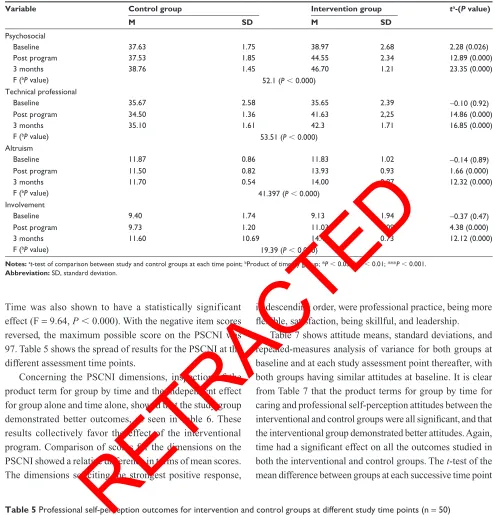
group, which further supports the beneficial effect of the program in improving the caring perception. High scores on the CDI indicate agreement that nursing action is considered to be caring. Differences in scores on the CDI subscales were further investigated using the independent Student’s t-test to see if any scores changed significantly between the two groups at the different assessment points. Mean scores for the CDI subscales changed significantly between study time points, according to t-test results.
The characteristics of the subscale scores strongly endorsed the psychosocial aspects of nursing, as well as professional and technical aspects, as shown in Table 4. Look-ing at the data 3 months after conclusion of the program, it was clear that students in the interventional group perceived caring in more psychosocial, technical, and professional terms than did the students in the control group.
There were significant changes in the scores for a range of subscales as supported by multivariate analysis of vari-ance, suggesting that nursing students had improved ideals about caring and nursing 3 months after the interventional program. Involvement was also endorsed strongly by students in the interventional group compared with those in the control group, whereas altruism was less well endorsed in the interventional group. By inspecting the univariate t-test results, it was found that the groups showed a statistically significant difference at the different study time points. The baseline means and standard deviations for the CDI subscales are reported in Table 4.
Repeated-measures analysis of variance also showed a statistically significant positive trend of endorsing overall professional self-perception for the interventional group
compared with the control group (F = 20.6, P , 0.000).
Table 2 Knowledge outcomes for intervention and control groups at different study time points (n = 50)
Variable Control group Intervention group ta-(P value)
M SD M SD
Knowledge
Baseline 5.93 1.76 6.57 2.22 1.22 (0.23)
Post program 5.93 1.48 12.3 2.39 11.89 (0.000)
3 months 6.13 2.81 10.77 2.82 6.37 (0.000)
F-test for repeated measure (P value)
Time 43.98 (P , 0.000)
Group 110.75 (P , 0.000) G*Tb 42.47 (P , 0.000)
Notes: at-test of comparison between study and control groups at each time point; bF-test for product of time by group; *P , 0.05; **P , 0.01; ***P , 0.001. Abbreviation: SD, standard deviation.
Table 3 Caring outcomes for intervention and control groups at different study time points (n = 50)
Variable Control group Intervention group ta-(P value)
M SD M SD
Caring total score
Baseline 94.65 93.3 95.53 5.93 0.68 (0.499)
Post program 93.27 2.82 111.15 4.57 18.25 (0.000)
6 months 97.07 2.84 117.47 2.35 30.34 (0.000)
F-test for repeated measures (P value)
Time 150.38 (P , 0.000) Group 457.37 (P , 0.000) G*Tb 113.19 (P , 0.000)
Notes: at-test of comparison between study and control groups at each time point; bProduct of time by group; *P, 0.05; **P, 0.01; ***P , 0.001. Abbreviation: SD, standard deviation.
RETRACTED
Advances in Medical Education and Practice downloaded from https://www.dovepress.com/ by 118.70.13.36 on 19-Aug-2020
Dovepress Caring and self-perception in student nurses
Time was also shown to have a statistically significant
effect (F = 9.64, P , 0.000). With the negative item scores
reversed, the maximum possible score on the PSCNI was 97. Table 5 shows the spread of results for the PSCNI at the different assessment time points.
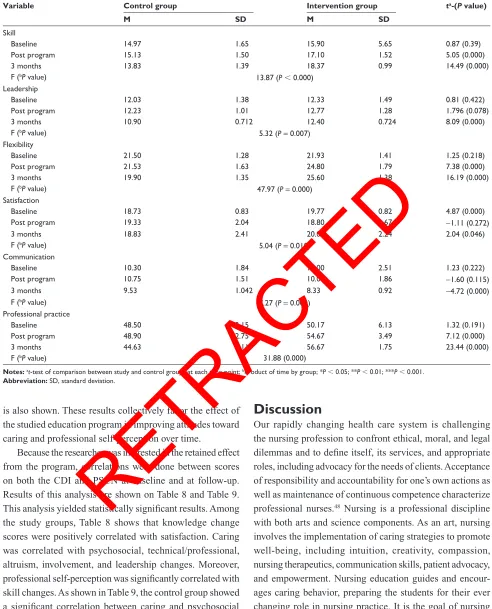
Concerning the PSCNI dimensions, inspection of the product term for group by time and the independent effect for group alone and time alone, showed that the study group demonstrated better outcomes, as seen in Table 6. These results collectively favor the effect of the interventional program. Comparison of scores for the dimensions on the PSCNI showed a relative difference in terms of mean scores. The dimensions soliciting the strongest positive response,
in descending order, were professional practice, being more flexible, satisfaction, being skillful, and leadership.
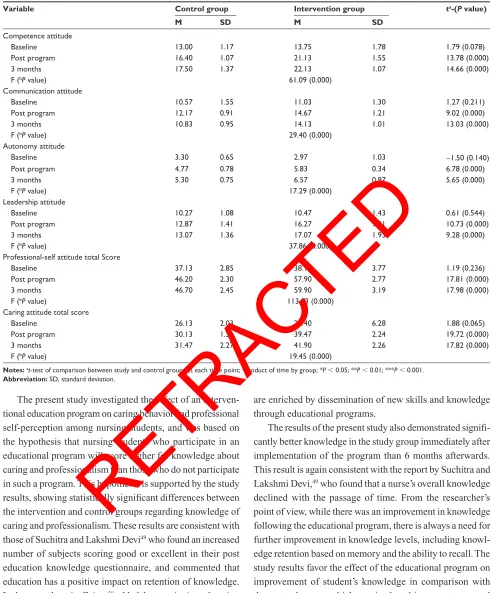
Table 7 shows attitude means, standard deviations, and repeated-measures analysis of variance for both groups at baseline and at each study assessment point thereafter, with both groups having similar attitudes at baseline. It is clear from Table 7 that the product terms for group by time for caring and professional self-perception attitudes between the interventional and control groups were all significant, and that the interventional group demonstrated better attitudes. Again, time had a significant effect on all the outcomes studied in both the interventional and control groups. The t-test of the mean difference between groups at each successive time point
Table 4 Caring subscale outcomes for intervention and control groups at different study time points (n = 50)
Variable Control group Intervention group ta-(P value)
M SD M SD
Psychosocial
Baseline 37.63 1.75 38.97 2.68 2.28 (0.026)
Post program 37.53 1.85 44.55 2.34 12.89 (0.000)
3 months 38.76 1.45 46.70 1.21 23.35 (0.000)
F (bP value) 52.1 (P , 0.000)
Technical professional
Baseline 35.67 2.58 35.65 2.39 -0.10 (0.92)
Post program 34.50 1.36 41.63 2,25 14.86 (0.000)
3 months 35.10 1.61 42.3 1.71 16.85 (0.000)
F (bP value) 53.51 (P , 0.000)
Altruism
Baseline 11.87 0.86 11.83 1.02 -0.14 (0.89)
Post program 11.50 0.82 13.93 0.93 1.66 (0.000)
3 months 11.70 0.54 14.00 0.87 12.32 (0.000)
F (bP value) 41.397 (P
, 0.000) Involvement
Baseline 9.40 1.74 9.13 1.94 -0.37 (0.47)
Post program 9.73 1.20 11.03 1,098 4.38 (0.000)
3 months 11.60 10.69 14.47 0.73 12.12 (0.000)
F (bP value) 19.39 (P , 0.000)
Notes: at-test of comparison between study and control groups at each time point; bProduct of time by group; *P , 0.05; **P , 0.01; ***P , 0.001. Abbreviation: SD, standard deviation.
Table 5 Professional self-perception outcomes for intervention and control groups at different study time points (n = 50)
Variable Control group Intervention group ta-(P value)
M SD M SD
Professional self-perception total
Baseline 77.63 4.79 81.23 6.32 2.49 (0.016)
Post program 78.93 4.10 83.47 4.05 4.31 (0.000)
3 months 74.90 2.25 84.47 1.57 23.10 (0.000)
F-test for repeated measures (P value)
Time 9.64 (0.000)
Group 96.92 (0.000)
G*Tb 20.63 (0.000)
Notes: at-test of comparison between study and control groups at each time point; bProduct of time by group; *P , 0.05; **P , 0.01; ***P , 0.001. Abbreviation: SD, standard deviation.
RETRACTED
Advances in Medical Education and Practice downloaded from https://www.dovepress.com/ by 118.70.13.36 on 19-Aug-2020
Dovepress
Khouri
is also shown. These results collectively favor the effect of the studied education program in improving attitudes toward caring and professional self-perception over time.
Because the researcher was interested in the retained effect from the program, correlations were done between scores on both the CDI and PSCN at baseline and at follow-up. Results of this analysis are shown on Table 8 and Table 9. This analysis yielded statistically significant results. Among the study groups, Table 8 shows that knowledge change scores were positively correlated with satisfaction. Caring was correlated with psychosocial, technical/professional, altruism, involvement, and leadership changes. Moreover, professional self-perception was significantly correlated with skill changes. As shown in Table 9, the control group showed a significant correlation between caring and psychosocial and technical/professional change scores. Professional self-perception changes were correlated with changes in attitude about skill, leadership, flexibility, and autonomy.
Discussion
Our rapidly changing health care system is challenging the nursing profession to confront ethical, moral, and legal dilemmas and to define itself, its services, and appropriate roles, including advocacy for the needs of clients. Acceptance of responsibility and accountability for one’s own actions as well as maintenance of continuous competence characterize
professional nurses.48 Nursing is a professional discipline
with both arts and science components. As an art, nursing involves the implementation of caring strategies to promote well-being, including intuition, creativity, compassion, nursing therapeutics, communication skills, patient advocacy, and empowerment. Nursing education guides and encour-ages caring behavior, preparing the students for their ever changing role in nursing practice. It is the goal of nursing educational programs to provide students with multiple models of professional activities to aid in their development
of professional identity.8
Table 6 Professional self-perception subscale outcomes for intervention and control groups at different study time points (n = 50)
Variable Control group Intervention group ta-(P value)
M SD M SD
Skill
Baseline 14.97 1.65 15.90 5.65 0.87 (0.39)
Post program 15.13 1.50 17.10 1.52 5.05 (0.000)
3 months 13.83 1.39 18.37 0.99 14.49 (0.000)
F (bP value) 13.87 (P, 0.000)
Leadership
Baseline 12.03 1.38 12.33 1.49 0.81 (0.422)
Post program 12.23 1.01 12.77 1.28 1.796 (0.078)
3 months 10.90 0.712 12.40 0.724 8.09 (0.000)
F (bP value) 5.32 (P= 0.007)
Flexibility
Baseline 21.50 1.28 21.93 1.41 1.25 (0.218)
Post program 21.53 1.63 24.80 1.79 7.38 (0.000)
3 months 19.90 1.35 25.60 1.38 16.19 (0.000)
F (bP value) 47.97 (P= 0.000)
Satisfaction
Baseline 18.73 0.83 19.77 0.82 4.87 (0.000)
Post program 19.33 2.04 18.80 1.67 -1.11 (0.272)
3 months 18.83 2.41 20.07 2.24 2.04 (0.046)
F (bP value) 5.04 (P= 0.010)
Communication
Baseline 10.30 1.84 11.00 2.51 1.23 (0.222)
Post program 10.75 1.51 10.00 1.86 -1.60 (0.115)
3 months 9.53 1.042 8.33 0.92 -4.72 (0.000)
F (bP value) 7.27 (P= 0.001)
Professional practice
Baseline 48.50 3.15 50.17 6.13 1.32 (0.191)
Post program 48.90 2.75 54.67 3.49 7.12 (0.000)
3 months 44.63 2.11 56.67 1.75 23.44 (0.000)
F (bP value) 31.88 (0.000)
Notes: at-test of comparison between study and control groups at each time point; bProduct of time by group; *P, 0.05; **P, 0.01; ***P , 0.001. Abbreviation: SD, standard deviation.
RETRACTED
Advances in Medical Education and Practice downloaded from https://www.dovepress.com/ by 118.70.13.36 on 19-Aug-2020
Dovepress Caring and self-perception in student nurses
The present study investigated the effect of an interven-tional education program on caring behavior and professional self-perception among nursing students, and was based on the hypothesis that nursing students who participate in an educational program will score higher for knowledge about caring and professionalism than those who do not participate in such a program. This hypothesis is supported by the study results, showing statistically significant differences between the intervention and control groups regarding knowledge of caring and professionalism. These results are consistent with
those of Suchitra and Lakshmi Devi49 who found an increased
number of subjects scoring good or excellent in their post education knowledge questionnaire, and commented that education has a positive impact on retention of knowledge.
In the same domain, Zeiger50 added that continuing education
programs in nursing beyond basic preparation designed to promote and enrich knowledge, improve skills, and develop attitudes for enhancement of nursing practice, and the profession of nursing, is advanced because its practitioners
are enriched by dissemination of new skills and knowledge through educational programs.
The results of the present study also demonstrated signifi-cantly better knowledge in the study group immediately after implementation of the program than 6 months afterwards. This result is again consistent with the report by Suchitra and
Lakshmi Devi,49 who found that a nurse’s overall knowledge
declined with the passage of time. From the researcher’s point of view, while there was an improvement in knowledge following the educational program, there is always a need for further improvement in knowledge levels, including knowl-edge retention based on memory and the ability to recall. The study results favor the effect of the educational program on improvement of student’s knowledge in comparison with the control group which received nothing except general clinical orientation given at the beginning of the course for all nursing students in different clinical areas.
The study was also based on another hypothesis that nursing students who participate in an interventional
Table 7 Caring and professional self-perception attitudes for intervention and control groups at different study time points (n = 50)
Variable Control group Intervention group ta-(P value)
M SD M SD
Competence attitude
Baseline 13.00 1.17 13.75 1.78 1.79 (0.078)
Post program 16.40 1.07 21.13 1.55 13.78 (0.000)
3 months 17.50 1.37 22.13 1.07 14.66 (0.000)
F (bP value) 61.09 (0.000)
Communication attitude
Baseline 10.57 1.55 11.03 1.30 1.27 (0.211)
Post program 12.17 0.91 14.67 1.21 9.02 (0.000)
3 months 10.83 0.95 14.13 1.01 13.03 (0.000)
F (bP value) 29.40 (0.000)
Autonomy attitude
Baseline 3.30 0.65 2.97 1.03 -1.50 (0.140)
Post program 4.77 0.78 5.83 0.34 6.78 (0.000)
3 months 5.30 0.75 6.57 0.97 5.65 (0.000)
F (bP value) 17.29 (0.000)
Leadership attitude
Baseline 10.27 1.08 10.47 1.43 0.61 (0.544)
Post program 12.87 1.41 16.27 1.01 10.73 (0.000)
3 months 13.07 1.36 17.07 1.93 9.28 (0.000)
F (bP value) 37.86 (0.000)
Professional-self attitude total Score
Baseline 37.13 2.85 38.17 3.77 1.19 (0.236)
Post program 46.20 2.30 57.90 2.77 17.81 (0.000)
3 months 46.70 2.45 59.90 3.19 17.98 (0.000)
F (bP value) 113.03 (0.000)
Caring attitude total score
Baseline 26.13 2.03 28.40 6.28 1.88 (0.065)
Post program 30.13 1.31 39.47 2.24 19.72 (0.000)
3 months 31.47 2.27 41.90 2.26 17.82 (0.000)
F (bP value) 19.45 (0.000)
Notes: at-test of comparison between study and control groups at each time point; bProduct of time by group; *P, 0.05; **P, 0.01; ***P , 0.001. Abbreviation: SD, standard deviation.
RETRACTED
Advances in Medical Education and Practice downloaded from https://www.dovepress.com/ by 118.70.13.36 on 19-Aug-2020
Dovepress
Khouri
Table 8
Partial correlation matrix for outcome measures change scores six months from the program for the study group (n
= 30) 1 2 3 4 5 6 7 8 9 10 11 12 13 14 15 16 17 18 1. Knowledge – 2. Psychosocial 0.17 – 3. Technical/professional -0.01 0.42* – 4. Altruism 0.24 0.04 0.45* – 5. Involvement 0.11 0.20 0.14 -0.06 – 6. Skill -0.01 -0.00 -0.07 -0.13 0.09 – 7. Leadership -0.03 0.20 0.39* 0.24 0.11 -0.15 – 8. Flexibility 0.13 0.15 0.18 -0.03 -0.02 0.09 0.12 – 9. Satisfaction -0.38* -0.26 -0.01 -0.18 -0.41* 0.20 -0.22 0.12 – 10. Communication 0.33 0.18 0.06 0.26 0.52** -0.07 0.09 -0.11 -0.46* –
11. Attitude competence
0.32 -0.09 -0.08 0.06 0.16 -0.06 0.13 -0.06 -0.41* 0.18 –
12. Attitude communication
-0.16 -0.15 0.15 0.01 -0.22 0.06 -0.13 0.11 -0.09 -0.31 -0.03 –
13. Attitude autonomy
-0.13 0.13 0.12 -0.19 0.31 0.11 -0.10 0.04 -0.21 0.06 -0.05 0.02 –
14. Attitude leadership
-0.02 -0.14 0.12 0.10 0.01 0.06 0.14 -0.06 0.05 -0.20 -0.04 -0.01 0.34 –
15. Attitude caring total score
-0.01 -0.23 -0.37* 0.21 -0.22 -0.01 -0.09 -0.04 0.02 0.06 0.41* -0.04 -0.19 0.19 –
16. Attitude professional self total score
0.03 -0.13 0.14 0.03 0.12 0.07 0.06 -0.01 -0.27 -0.13 0.41* 0.37* 0.57* 0.73** 0.22 –
17. Caring total score (CDI)
0.16 0.72** 0.83** 0.45* 0.49** -0.03 0.38* 0.14 -0.35 0.35 -0.01 -0.07 0.18 0.03 -0.31 0.06 –
18. Professional self-perception total score
-0.01 0.06 0.09 -0.02 0.12 0.85** 0.13 0.40* 0.34 0.11 -0.12 -0.10 0.01 0.02 -0.02 -0.07 0.11 – Notes:
**Correlation is significant at the 0.01 level (two-tailed); *Correlation is significant at the 0.05 level (two-tailed).
education program will score higher on aspects of caring and would develop more positive professional self-perception than those who do not participate in such a program. This hypothesis is supported by the study results showing signifi-cant improvement in caring perception and a positive trend of endorsing overall professional self-perception for the interventional group compared with the control group during different periods of assessment after implementation of the
program. In this respect, Zeiger50 asserted that both training
and supervision are essential in developing core skills and a positive professional identity. With supervision students will acquire a solid professional identity that includes commit-ment to professional growth through continued learning. On
the same issue, Davis and North51 emphasized that nursing
education develops students as people and citizens, in addi-tion to being practiaddi-tioners. During the educaaddi-tional sessions, faculty members guided students to use their strengths and inner resources, which are essential to the development of caring, moral, and ethical nurses who demonstrate integrity as people, citizens, and nurses. From the researcher’s point of view, during the supervision sessions, nursing students received guidance and direction, and gained much knowledge and experience from our practical hands-on approach. This favors the effect of our program in the interventional group compared with the control group.
When caring subscales were compared between the interventional group and the control group during different periods of assessment after the program, significant changes were evident for mean scores between the two groups, with the interventional group perceiving caring in more psychological, technical, and professional terms than the control group. This result is consistent with that reported by
Moore et al52 who emphasized the importance of educational
programs in enhancing caring behavior in nurses. They added that programs should stress the importance of learning to value the types of behaviors and interactions that the patients consider to be quality of care and systematically incorporate these interactions in performance and measures
of care. Moreover, Moore et al,52 when assessing the caring
behavior of skilled maternity care providers, demonstrated that there is still a long way to go to ensure that the level of care that all women expect and deserve is routinely available to them as a routine element of care. Moore et al asserted the importance of behavior change strategies to increase car-ing behavior on the part of caregivers. In the same domain,
Suchitra and Lakshmi Devi49 stated that the development of a
caring relationship between caregivers and patient reinforces the holistic approach, and that caring is the basic element in
RETRACTED
Advances in Medical Education and Practice downloaded from https://www.dovepress.com/ by 118.70.13.36 on 19-Aug-2020
Dovepress Caring and self-perception in student nurses
the development of a therapeutic relationship and provides a balance between the “high touch” human response and the “high tech” nature of today’s health care environment.
Moreover, Brunton and Beaman17 in their study of
perception of caring behavior in nursing after introducing an educational program, highlighted the importance of the emotional aspects of caring, that included appreciating the patient as a human being, showing respect for the patient, being sensitive to the patient, being honest, talking to the patient, listening attentively and treating patient information confidentially, and maintaining patient privacy. They also added that placing “caring” practice high on the agenda and integrating sensitization about caring issues into all aspects of care provider’s training is key.
When professional self-perception subscales were investigated in the interventional and study groups, the interventional group demonstrated better outcomes during different periods of assessment after implementation of the program in relation to their professional practice, being more flexible, satisfaction, being skillful, as well as their leader-ship behavior. The results of the present study also show that the interventional group demonstrated better caring and professional attitudes than the control group. In this
respect, Martin and Ashton3 stated that educational programs
enhance the development of professional values and value-based behavior. Understanding the values that patients and other health professionals bring to the therapeutic relation-ship is critically important to providing quality of patient care. During the educational program, nursing students are prepared for numerous dilemmas that will arise in practice and are able to make and assist others in making decisions
within a professional ethical framework. Martin and Ashton3
asserted that by introducing educational programs, nurse’s graduate professionalism is enhanced by demonstration of care values and by applying principles of altruism, excel-lence, caring, ethics, respect, communication, leadership, and accountability.
Although the control students received no relevant intervention during the program, they had a slight increase in mean scores on some subscales of caring and professionalism during different periods of assessment, but these were still lower than those of the study group. This result could be the result of several factors, given that stu-dents in the control group were supervised by their clinical instructors in the faculty of nursing, and underwent periodic evaluation by their clinical instructors for communication, accountability and responsibility, leadership, self-awareness, caring behavior, and professional conduct, and thus their
Table 9
Partial correlation matrix for outcome measures change scores 3 months from the program for the control group (n
= 25) 1 2 3 4 5 6 7 8 9 10 11 12 13 14 15 16 17 18 1. Knowledge – 2. Psychosocial -0.32 – 3. Technical/professional -0.20 0.33 – 4. Altruism 0.19 0.22 0.002 – 5. Involvement 0.04 -0.28 -0.21 -0.13 – 6. Skill 0.04 -0.07 -0.30 0.09 0.09 – 7. Leadership 0.11 -0.27 -0.15 0.05 -0.28 0.33 – 8. Flexibility -0.22 0.03 -0.13 -0.15 -0.01 -0.11 0.17 – 9. Satisfaction -0.41 0.31 0.02 0.21 0.03 -0.14 -0.12 0.03 – 10. Communication -0.14 -0.03 -0.06 0.05 -0.22 0.09 -0.10 0.24 0.31 –
11. Attitude competence
0.34 0.01 -0.44* 0.05 0.33 0.06 -0.43* 0.03 -0.17 -0.12 –
12. Attitude communication
-0.01 0.05 -0.29 0.03 -0.17 0.16 0.25 0.06 0.02 0 -0.01 0.12 –
13. Attitude autonomy
-0.01 0.17 0.26 0.06 -0.17 -0.39* -0.23 -0.38* 0.04 -0.02 -0.04 -0.36 –
14. Attitude leadership
0.18 0.15 0.04 0.27 -0.10 0.11 -0.02 -0.02 -0.17 -0.03 0.12 0.31 0.18 –
15. Attitude caring total score
-0.31 0.32 -0.17 -0.26 -0.11 -0.02 0.04 0.11 0.21 0.11 0.13 0.31 0.07 -0.01 –
16. Attitude professional self total score
0.26 0.15 -0.24 0.20 -0.01 0.05 -0.18 -0.08 -0.15 -0.08 0.60** 0.55** 0.21 0.77** 0.21 –
17. Caring total score
-0.26 0.71** 0.79** 0.29 0.04 -0.19 -0.34 -0.11 0.24 -0.12 -0.17 -0.23 0.22 0.13 -0.05 -0.05 –
18. Professional self-perception total score
-0.04 -0.13 -0.30 0.01 -0.05 0.82** 0.62** 0.60** -0.12 0.13 -0.10 0.21 -0.49** 0.06 0.05 -0.07 -0.15 – Notes:
**Correlation is significant at the 0.01 level (two-tailed); *Correlation is significant at the 0.05 level (two-tailed).
RETRACTED
Advances in Medical Education and Practice downloaded from https://www.dovepress.com/ by 118.70.13.36 on 19-Aug-2020
Dovepress
Khouri
behavior changed and they demonstrated a better outcome. From the researcher’s point of view, frequent interaction between nursing students and their tutors in the interven-tional group offered opportunities for students to learn more professional roles.
Recommendations
In light of the findings of this study, the researcher recommends that the nursing curriculum should incorporate concepts and principles that guide students in developing caring, safe, competent, and professional behaviors. The emphasis of the curriculum should be to ensure that all our nursing graduates are able to maximize their growth, and develop and expand their unique qualities. Faculty members and clinical instructors must act as role models and facilitate learning by providing an environment that promotes holistic care, inquiry, critical thinking, accountability, and more autonomous and professional behavior. Nurses serving as mentors as well as members of the multidisciplinary health care team, so it is essential to foster caring and professional behavior among newly graduated nurses. Nursing students should seek educational opportunities to acquire knowledge for role preparation, to participate in knowledge generation, and for personal and professional development. Finally, additional research should include replication of this study in baccalaureate nursing programs, as well as baccalaureate programs in other regions.
Conclusion
The study findings favor the effect of the interventional program because there were statistically significant differences between the intervention and control groups regarding their mean scores on knowledge about caring and professionalism. The interventional group showed significantly better knowl-edge test scores than the control group during the different periods of assessment. There were also statistically significant differences between the interventional and control groups regarding caring outcomes. The interventional group showed significantly improved caring perception in more psychologi-cal, technipsychologi-cal, and professional terms than the control group during different periods of assessment. In addition, statistically significant differences were found in mean scores regarding professional self-perception between the two groups, with a significant positive trend of overall professional self-perception for the interventional group compared with the control group. Finally, the interventional group demonstrated better caring and professional self-perception attitudes than the control group during the different periods of assessment.
Disclosure
The author reports no conflicts of interest in this work.
References
1. Andersson EP. The perceptions of student nurses and their perceptions of professional nursing during the nurse training programme. J Adv Nurs. 1993;18:808–815.
2. Cowin L. Measuring nurses’ self-concept. West J Nurs Res. 2001;23: 313–325.
3. Martin P, Ashton C. The Essentials of Baccalaureate Education for Professional Nursing Practice. Washington, DC: American Association of Colleges of Nursing; 2008.
4. Watson R, Lea A. Perceptions of caring among nurses: the influence of age and sex. J Clin Nurs. 1998;7:97.
5. Kyle TV. The concept of caring: a review of the literature. J Adv Nurs. 1995;21:506–514.
6. Randle J. Bullying in the nursing profession. J Adv Nurs. 2003;43: 395–401.
7. Walsh M, Dolan B. Emergency nurses and their perceptions of caring.
Emerg Nurse. 1999;7:24–31.
8. Kosowski MM. Clinical learning experiences and professional nursecaring: a critical phenomenological study of female baccalaureate nursing students. J Nurs Educ. 2002;34:235–242.
9. Lea A, Watson R. Perceptions of caring among nurses: the relationship to clinical area. J Clin Nurs. 1995;8:617.
10. Lea A, Watson R, Deary IJ. Caring in nursing: a multivariate analysis.
J Adv Nurs. 1998;28:662–671.
11. Barker P. Reflections on caring as a virtue ethic within an evidence-based culture. Int J Nurs Stud. 200;37:329–336.
12. Lee-Hsieh J, Kuo CL, Tseng HF. Application and evaluation of a caring code in clinical nursing education. J Nurs Educ. 2005;44: 177–184.
13. Arthur D, Randle J. The professional self-concept of nurses: a review of the literature from 1992–2006. Aust J Adv Nurs. 2007;24: 60–64.
14. Sarmiento TP, Laschinger HK, Iwasiw C. Nurse educators’ workplace empowerment, burnout, and job satisfaction: testing Kanter’s theory.
J Adv Nurs. 2004;46:135–143.
15. Bankert EG, Kozel VV. Transforming pedagogy in nursing education: a caring learning environment for adult students. Nurs Educ Perspect. 2005;26:227–229.
16. Larson PJ, Ferketich SL. Patients’ satisfaction with nurses’ caring during hospitalization. West J Nurs Res. 1993;15:690–703.
17. Brunton B, Beaman M. Nurse practitioners’ perceptions of their caring behaviors. J Am Acad Nurse Pract. 2000;12:451–456.
18. Watson J. Assessing and Measuring Caring in Nursing and Health Science. New York, NY: Springer; 2002.
19. Watson R, Deary IJ, Lea A. A longitudinal study of into the perceptions of caring among student nurses using multivariate analysis of the caring dimensions inventory. J Adv Nurs. 1999;30:1080–1089.
20. Ironside P, Diekelmann N, Hirschmann M. Learning the practices of knowing and connecting: the voices of students. J Nurs Educ. 2005;44: 153–155.
21. Leininger MM, editor. Caring: a Central Focus of Nursing and Health Care Services. Detroit, MI: Wayne State University Press; 1988. 22. Fahrenwald NL, Bassett SD, Tschetter L, Carson PP, White L,
Winterboer VJ. Teachingcore nursing values. J Prof Nurs. 2005;21: 46–51.
23. Omdahl BL, O’Donnell C. Emotional contagion, empathic concern and communicative responsiveness as variables affecting nurses’ stress and occupational commitment. J Adv Nurs. 1999;29:1351–1359. 24. Oermann M. Professional Nursing Practice: a Conceptual Approach.
Philadelphia, PA: JB Lippincott Company; 1998.
25. Diekelmann N. Schooling, learning and teaching: toward a narrative pedagogy. 2010. Available at: http://www.son.wisc.edu/diekelmann/ research/slt/index.html. Accessed
RETRACTED
Advances in Medical Education and Practice downloaded from https://www.dovepress.com/ by 118.70.13.36 on 19-Aug-2020
Advances in Medical Education and Practice
Publish your work in this journal
Submit your manuscript here: http://www.dovepress.com/advances-in-medical-education-and-practice-journal
Advances in Medical Education and Practice is an international, peer-reviewed, open access journal that aims to present and publish research on Medical Education covering medical, dental, nursing and allied healthcare professional education. The journal covers undergraduate education, postgraduate training and continuing medical education
including emerging trends and innovative models linking education, research, and healthcare services. The manuscript management system is completely online and includes a very quick and fair peer-review system. Visit http://www.dovepress.com/testimonials.php to read real quotes from published authors.
Dovepress
Dovepress
Caring and self-perception in student nurses
26. Randle J. Changes in self-esteem during a 3-year pre-registrationdip-loma in higher education (nursing) programme. J Clin Nurs. 2003;12: 142–143.
27. Simonson CL. Teaching caring to nursing students. J Nurs Educ. 1996; 35:100–104.
28. Cowin LS, Hengstberger-Sims C. New graduate nurse self-concept and retention: a longitudinal survey. Int J Nurs Stud. 2006;43:59–70. 29. Mezirow J. Learning as Transformation: critical Perspectives on a
Theory in Progress. San Francisco, CA: Jossey-Bass; 2002.
30. Wilkin K, Slevin E. The meaning of caring to nurses: an investigation into the nature of caring work in an intensive care unit. J Clin Nurs. 2004;13:50–59.
31. Bevis E, Watson J. Toward a Caring Curriculum: a New Pedagogy for Nursing. Sudbury, MA: Jones and Bartlett Publishers;2001.
32. Beck CT. Caring within nursing education: a metasynthesis. J Nurs Educ. 2001;40:101–109.
33. Hanson LE, Smith MJ. Nursing students’ perspectives: experiences of caring and not-so-caring interactions with faculty. J Nurs Educ. 1996; 35:105–112.
34. Clouder L, Sellars J. Reflective practice and clinical supervision: an inter professional perspective. J Adv Nurs. 2004;46:262–269. 35. Lindahl B, Norberg A. Clinical group supervision in an intensive care
unit: a space for relief, and for sharing emotions and experiences of care. J Clin Nurs. 2002;11:809–818.
36. Boykin A, Schoenhofer SO. Nursing as Caring: a Model for Transforming Practice. New York, NY: Jones and Bartlett Learning; 2001.
37. Burnard P, Hebden U, Edwards D. Self-esteem and student nurses: an account of a descriptive study. Nurs Health Sci. 2001;3:9–13. 38. Hegedus KS. Providers’ and consumers’ perspective of nurses’ caring
behaviors. J Adv Nurs. 1999;30:1090–1096.
39. Um M-Y, Harrison DF. Role stressors, burnout, mediators, and job satisfaction: a stress-strain-outcome model and an empirical test. Soc Work Res. 1998;22:100–105.
40. Tang FI, Chou SM, Chiang HH. Students’ perceptions of effective and ineffective clinical instructors. J Nurs Educ. 2005;44:187–192.
41. Arthur D, Pang S, Wong T. The effect of technology on the caring attributes of an international sample of nurses. Int J Nurs Stud. 2001; 38:37–43.
42. Watson R, Lea A. The caring dimensions inventory (CDI): content validity, reliability and scaling. J Adv Nurs. 1997;25:87–94.
43. Watson R, Deary IJ, Lea A. A longitudinal study into the perceptions of caring and nursing among student nurses. J Adv Nurs. 1999;29: 1228–1237.
44. Watson R, Deary IJ, Hoogbruin AL. A 35-item version of the caring dimensions inventory (CDI-35): multivariate analysis and application to a longitudinal study involving student nurses. Int J Nurs Stud. 2001; 38:511–521.
45. Arthur D. Measurement of the professional self-concept of nurses: developing a measurement instrument. Nurse Educ Today. 1995;15: 328–335.
46. Arthur D. Measuring the professional self-concept of nurses: a critical review. J Adv Nurs. 1992;17:712–719.
47. Arthur D, Thorne S. Professional self-concept of nurses: a comparative study of four strata of nursing students in a Canadian university. Nurse Educ Today. 1998;18:380–388.
48. Friedman Bowden V, Jones E. Family Nursing: Research, Therapy and Practice. 5th ed. Upper Saddle River, NJ: Pearson Education Inc; 2003. 49. Suchitra J, Lakshmi Devi N. Impact of education on knowledge,
atti-tude and practices among various categories of health care workers on nosocomial infections. Indian J Med Microbiol. 2007;25:181–187. 50. Zeiger R. The Collaborative Interhandbook. Training Year 2008–2009.
The big picture, Understanding the Consortium; 2008.
51. Davis R, North I. Nursing Program, Student Handbook. New York, NY: National League for Nursing Accreditation Commission; 2005. 52. Moore M, Armbruster D, Graeff J, Copeland R. Assessing the: Caring”
Behaviors Of Skilled Maternity Care Providers During Labor and Delivery: experience from Kenya and Bangladesh. Washington, DC; 2002.
RETRACTED
Advances in Medical Education and Practice downloaded from https://www.dovepress.com/ by 118.70.13.36 on 19-Aug-2020