R E S E A R C H
Open Access
Impulsive stabilization of delay difference
equations and its application in Nicholson
’
s
blowflies model
Kaining Wu
*and Xiaohua Ding
* Correspondence: kainingwu@163. com
Department of Mathematics, Harbin Institute of Technology at Weihai, Weihai, 264209, China
Abstract
In this article, we consider the impulsive stabilization of delay difference equations. By employing the Lyapunov function and Razumikhin technique, we establish the criteria of exponential stability for impulsive delay difference equations. As an application, by using the results we obtained, we deal with the exponential stability of discrete impulsive delay Nicholson’s blowflies model. At last, an example is given to illustrate the efficiency of our results.
Mathematics Subject Classification 2000:39A30; 39A60; 39A10; 92B05.
Keywords:impulsive, difference equation, exponential stability, stabilization, Nicholson’s blowflies model
Introduction
Discrete systems exist in the word widely and most of them are described by the dif-ference equations. The properties of difdif-ference equations, especially the stability and stabilization, were studied by many researchers, see [1-6] and the references therein.
As well known, in the practice, many systems are subject to short-term disturbances, these disturbances are often described by impulses in the modeling process, therefore the impulsive systems arise in many scientific fields and there are many works were reported on impulsive systems [7-16]. In those works, the stability study for the impul-sive system is one of the research focuses, see [11-16].
In the study of stability, the Lyapunov function and Razumikhin method were used by many authors, see, for example, [6,17]. In [6], the Razumikhin technique was extended to the discrete systems. Although the stability of impulsive delay difference equations has been studied in some articles, for example, see [18], there are few article concerning on impulsive stabilization of delay difference equations. From the article [19], we know that the continuity is crucial in the proof of the stabilization theorem under the continu-ous situation. However, under the discrete situation, there is no continuity to be utilized. The loss of continuity puts difficulties in the way to get the stabilization theorem. The main aim of this article is to establish the criteria of impulsive stabilization for delay dif-ference equations, using the Lyapunov function and Razumikhin method.
Biological models were studied by many authors, see [20-25] and the references therein. The stability of the positive equilibrium is a hot topic to be studied. In this
article, we also study the stabilization of an impulsive delay difference Nicholson’s blowflies model. We take an unstable difference Nicholson’s blowflies equation without impulses, then the impulsive effects are adopted and the criterion of stability is estab-lished for the impulsive Nicholson’s blowflies model.
The rest of this article is organized as follows. In Section 2, we introduce our nota-tions and defininota-tions. Then in Section 3, we present a theorem of impulsive stabiliza-tion for delay difference equastabiliza-tions. In Secstabiliza-tion 4, by using our result, we deal with the discrete impulsive delay Nicholson’s blowflies equation. In Section 5, an example is given to illustrate the efficiency of our results.
Preliminaries
Let ℝ denote the field of real numbers and ℝndenote the n-dimensional Euclidean space. N andℤrepresent the natural numbers and the integer numbers respectively. For some positive integer m,N-m= {-m, ..., -1, 0}. Given a positive integerm, for any
function : N-m® ℝn, we define ϕm= maxθ∈N−m{|ϕ(θ)|}, where | · | presents the Euclidean norm.
We consider the following impulsive delay difference system:
x(n+ 1) =f(n, x(n−m), x(n−m+ 1), . . ., x(n)),n=ηk−1,
x(ηk) =βkx(ηk−1),
(1)
where x(n)Î ℝn, f :N×R
n× · · · ×Rn
m+1
→Rn
.bkis a constant for anyk ÎN. The
impulsive moments {ηk}∞1 are natural numbers and satisfy 0 =h0 <h1< ··· <hk< ···, hk ® ∞ask®∞.
The following initial values are imposed on system (1):
x(s) =ϕ(s),s∈N−m, (2)
where: [-m, 0]®ℝnsatisfies ||||m<∞.
We assumef(n, 0, 0, ..., 0)≡0, then systems (1) admits the trivial solution. We also assume that for any initial values x(s) =(s),sÎN-m, system (1) has a unique solution,
denoted by x(n,).
Definition 1. [6] The trivial solution of (1) is said to be globally exponentially stable, if for any solution x(n,) with the initial data x(n) =(n), nÎ N-m, there exist
con-stants g> 0 andM> 0 such that
|x(n,ϕ)| ≤Mϕme−γn, ∀n∈N−m∪N. (3)
Impulsive stabilization of delay difference equations
In this section, we present the stabilization theorem of impulsive delay difference equa-tions. By using the Razumikhin technique, we obtain the sufficient conditions to guar-antee the exponential stability of system (1). Moreover, another criterion of exponential stability for system (1) is given, which does not depend on the Lyapunov function but just depends on the system function f, impulsive moments {hk} and the
impulsive gain {bk}. Some techniques we used in the proof of the stabilization theorem
Theorem 2.Assume there exist a positive function V(n,x)and positive constants c1,
c2,p,l,a,a> 1,such that
C1:c1|x|p≤V(n,x)≤c2|x|p, for all nÎ N-m∪Nand xÎ ℝn.
C2:If n≠hk- 1,for any function: N-m∪N®ℝn, the following inequality holds V(n+ 1, f(n, ϕ))≤(1 +λ)V(n, ϕ(n))
whenever qV(n+ 1,(n+ 1))≥V(n+s,(n+s))for all sÎN-m, where q≥e2la. C3:V(hk,bk((hk- 1)))≤dkV(hk- 1,(hk- 1)),where dk> 0.
C4:hk+1- hk≤a, lndk+al<-l(hk+1-hk).
Then,for any initial data x(n) = (n),n Î N-m, there exists a positive constant C, such that
|x(n, ϕ)| ≤Cϕme−λpn,
that is,the trivial solution of system(1)is exponentially stable. Proof. For the sake of simplicity, we writeV(n) =V(n,x(n)). Choose M> 1, such that
(1 +λ)c2ϕpm ≤Mϕpme−λη1e−αλ<Mϕpme−λη1 ≤qc2ϕpm. (4)
We claim that for any nÎ [hk,hk+1),kÎ N,
V(n)≤Mϕpme−ληk+1. (5)
First, we will show, whennÎ[0,h1),
V(n)≤Mϕpme−λη1. (6)
Obviously, whennÎN-m, V(n)≤Mϕpme−λη1.
If (6) is not true, then there must be an n¯∈[0, η1−1) and ann*≥0 such that
V(n¯+ 1)>Mϕpme−λη1, V(n)≤Mϕpme−λη1, n≤ ¯n,
and
V(n∗)≤c2ϕmp , c2ϕpm<V(n)≤Mϕpme−λη1, n∗ <n≤ ¯n. (7)
It should be pointed out there may be a case n∗=n¯, that is, there nonsatisfies the second segment of (7). If it is true, then for any n≤ ¯n, we have
V(n)≤c2ϕpm. (8)
Obviously, for anysÎN-m,
qV(n¯+ 1)>qMϕpme−λη1 >qc2ϕpm ≥V(n¯+s).
FromC2we get
V(n¯+ 1)≤(1 +λ)V(n¯),
that is
V(n¯)≥ 1
1 +λV(n¯+ 1)> 1
1 +λMϕ p me−λη1
= e
αλ
1 +λMϕ p
me−λη1e−αλ
which contradicts with (8), then there must be annsuch that the second segment of (7) holds.
When n∈[n∗+ 1,n¯], from (7),
V(n+s)≤Mϕpme−λη1 <qc2ϕpm<qV(n).
By virtue of conditionC2, when n∈[n∗+ 1,n¯],
V(n)≤(1 +λ)V(n−1). (9)
From the definitions of n¯ andn*, we have V(n¯+ 1)≥V(n¯+s) andV(n* + 1)≥ V (n*+s), then we get
qV(n¯+ 1)≥V(n¯+s), s∈N−m,
and
qV(n∗+ 1)≥V(n∗+s), s∈N−m.
Using condition C2 and inequality (9), we obtain
V(n¯+ 1)≤(1 +λ)V(n¯)≤(1 +λ)n¯−n∗V(n∗+ 1)
≤(1 +λ)αV(n∗)<eαλc2ϕpm.
Since V(n¯+ 1)>Mϕpme−λη1, we get
Mϕpme−λη1 <eαλc2ϕpm,
which is in contradiction with (4), then (6) holds, that is (5) holds fork= 1.
Now we assume (5) holds fork= 1, 2, ..., h -1, i.e. whennÎ [hk-1,hk),k= 1, 2, ..., h,
V(n)≤Mϕpme−ληk. (10)
From conditionC3and condition C4,
V(ηh)≤dhV(ηh−1)≤dhMϕpme−ληh
≤Mϕpme−ληh+1e−αλ≤Mϕpme−ληh+1.
(11)
Now we will show, when nÎ [hh,hh+1),
V(n)≤Mϕpme−ληh+1. (12)
If (12) doesn’t hold, there must be an n¯∈(ηh, ηh+1−1) and an n∗∈[ηh,n¯], such
that
V(n¯+ 1)>Mϕpme−ληh+1, V(n)≤Mϕpme−ληh+1, n∈[ηh,n¯],
and
V(n∗)≤Mϕpme−ληh+1e−αλ, V(n)>Mϕpme−ληh+1e−αλ, n∗<n≤ ¯n. (13)
V(n∗) =V(n¯)≥ 1
1 +λV(n¯+ 1)≥
eλα
1 +λMϕ p
me−ληh+1e−αλ>Mϕpme−ληh+1e−αλ,
which is in conflict with (13). For n∈[n∗+ 1,n¯] and sÎN-m,
V(n+s)≤Mϕpme−ληh =eλ(ηh+1−ηh)Mϕpme−ληh+1 ≤e2λαMϕpme−ληh+1e−αλ≤qV(n).
Using condition C2, we have
V(n)≤(1 +λ)V(n−1), n∈[n∗+ 1,n¯],
and, obviously,
qV(n¯+ 1)≥V(n¯),
then by virtue of condition C2, we obtain
V(n¯+ 1)≤(1 +λ)V(n¯). (14)
Using the definition ofV(n*), we can easily get
qV(n∗+ 1)>V(n∗+s), s∈N−m.
Then, by virtue of condition C2we have
V(n∗+ 1)≤(1 +λ)V(n∗). (15)
Consequently,
V(n¯+ 1)≤(1 +λ)V(n¯)≤(1 +λ)n¯−n∗V(n∗+ 1)
≤(1 +λ)n¯−n∗+1V(n∗)≤(1 +λ)αV(n∗)
<eαλMϕpme−ληh+1e−αλ =Mϕpme−ληh+1 <V(n¯+ 1),
which is a contradiction. Then (5) holds fork=h+ 1.
By induction, we know (5) holds for any nÎ [hk,hk+1),kÎN.
From conditionC1, for anynÎ[hk,hk+1),kÎN
c1x(n, ϕ)
p
≤V(n)≤Mϕpme−ληh+1 ≤Mϕpme−λn,
that is
|x(n, ϕ)| ≤
M c1
1/p
ϕme −λpn
,
which is the assertion.□
Now we are on the position to state a corollary, which is another criterion of expo-nential stability for system (1). This criterion does not dependent on the Lyapunov function but just dependents on the system function, impulsive moments and impul-sive gain.
(1) for any nÎN,there exist positive constants u(n)and aj(n),j= 0, 1, ...,m,such
(2) there exist positive constantl, integera> 1 and constant q,satisfying q≥e2la, such thatμq(μ0+μ)<1and
that is,the trivial solution of(1)is globally exponentially stable.
Proof. Letc1=c2 = 1,p= 2, V(n) = |x(n)|2in Theorem 2. Under this situation, it is
sufficient to verify the conditionC2of Theorem 2. Using condition (1), Hölder
From condition (2) we haveqμ(μ0 +μ)<1, this yields
Application to discrete impulsive delay Nicholson’s blowflies model Consider the discrete Nicholson’s blowflies model with delay (see [24,25]):
x(n+ 1)−x(n) =−cx(n) +ax(n−m)e−bx(n−m), n= 0, 1,. . ., (16)
wherecÎ(0, 1),a,b Î(0; +∞) andmÎN, together with the initial values
x(n) =ϕ(n), n∈N−m,
where(n)>0,nÎN-m.
In view of the application of system (16) in practice, we only take an interest in the positive value of (16). When c < a, there is a unique positive equilibrium
u∗= 1
bln a c.
In [24,25], the authors studied the fold bifurcation and Neimark-Sacker bifurcation. For the convenience, we present the result in [25] as follows:
Lemma 4.Suppose that c<a is satisfied and denotes
a∗=cexp
Definition 5. We call the equilibriumu* of system (17) is exponentially stable, if the trivial solution of system (18) is exponentially stable.
It is easy to get that (-u*, +∞) is an invariant set of system (18). For {y(n)}⊂ (-u*, +∞),
|f(n, y(n), . . ., y(n−m))|
=|(1−c)y(n) +c(y(n−m) +u∗)e−by(n−m)−cu∗| ≤(1−c)|y(n)|+c|(y(n−m) +u∗)e−by(n−m)−cu∗|
= (1−c)|y(n)|+c|e−bξ(1−b(ξ+u))||y(n−m)|
≤(1−c)|y(n)|+cebu∗|y(n−m)| = (1−c)|y(n)|+a|y(n−m)|,
(19)
Where ξÎ(-u*,y(n-m)].
By using Corollary 3, inequality (19) and noting hk+1-hk≤a, we can get the
follow-ing corollary:
Corollary 6.Assume there exist constantsl> 0,integera> 1and q≥e2la,such that the following inequalities hold
(1) aq(1 -c+a)<1and 0< (11−−aqc)2(1+a−(1c+−ac))−1≤λ.
(2) lnβ2
k+λ(ηk+1−ηk)≤ −λα.
Then, the positive equilibrium u* of(17)is exponentially stable.
Corollary 7.Suppose that0 < a(1 -c+a) < 1in system(17).Given a positive con-stant land an integer a> 1satisfying λ <−21αln(a(1−c+a)),hk+1- hk <a, k= 1,
2, ..., and
0< (1−c)
2
+a(1−c)
1−ae2αλ(1−c+a)−1≤λ.
If there exist constants {βk}∞k=1,such that
lnβ2
k <−2λα,
then,the positive equilibrium u* of(17)is exponentially stable.
Proof. Takingq =e2la, notinghk+1 -hk≤aand by virtue of Corollary 6, we get the
assertion directly. □
Remark 8. Corollary 7 tells us, for any positive constant l satisfying
λ <−1
2αln(a(1−c+a)), we can take an impulsive strategy {ηk}
∞
k=1 and {βk}∞k=1, such
that the equilibriumu* is exponentially stable, the exponential rate is less than −λ2.
Numerical experiments
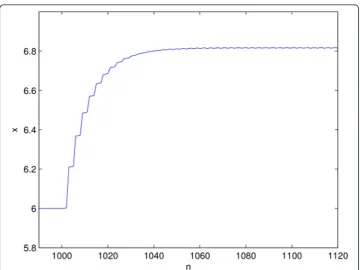
We take a= 0.03,b= 0.5, c= 0.001,m= 1000 in the system of (16), the equilibrium of Equation (16) is u* = 6.8024 and it is unstable [24,25] (see Figure 1), where the initial values are (n)≡6.
We adopt the impulsive control as follows:
Choose hk= 3k, and then choosebk=e-0.3, takel= 0.1 andq= 2.
Figure 1Instability of the equilibriumu*= 6.8024 (no impulses).
Conclusion
In this article, we established some global exponential stability criteria for impulsive delay difference systems by employing the Lyapunov function and Razumikhin techni-que. Using our result, we dealt with the discrete impulsive Nicholson’s blowflies model. We obtained the sufficient conditions of exponential stability for the positive equilibrium of this model. At last, we presented an example to illustrated the e ciency of our results.
Acknowledgements
This work was supported by the National Natural Science Foundation of China under Grant 11026189 and by the Natural Scientific Research Innovation Foundation in Harbin Institute of Technology (HIT.NSRIF.201014).
Authors’contributions
Both authors contributed equally to the manuscript.
Competing interests
The authors declare that they have no competing interests.
Received: 28 March 2012 Accepted: 27 June 2012 Published: 27 June 2012
References
1. Paternoster, B, Shaikhet, L: Stability of equilibrium points of fractional difference equations with stochastic perturbations. Adv Diff Equ2008, 21 (2008). doi:10.1155/2008/718408
2. Shaikhet, L: About an unsolved stability problem for a stochastic difference equation with continuous time. J Diff Equ Appl.17, 441–444 (2011). doi:10.1080/10236190903489973
3. Zheng, B: Explicit conditions for stability of nonlinear scalar delay impulsive difference equation. Adv Diff Equ2012, 17 (2012). doi:10.1155/2010/461014. doi:10.1186/1687-1847-2012-17
4. Xu, SY, Lamb, J, Yang, CW: Quadratic stability and stabilization of uncertain linear discrete-time systems with state delay. Syst Control Lett.43, 77–84 (2001). doi:10.1016/S0167-6911(00)00113-4
5. Ferreira, C, Silva, FC: On the stabilization of linear discrete-time systems. Linear Alg Appl.390, 7–18 (2004) 6. Liu, B, Marquez, HJ: Razumikhin-tpye theorems for discrete delay systems. Automatica.43, 1219–1225 (2007).
doi:10.1016/j.automatica.2006.12.032
7. De la Sen, M, Agarwal, RP, Ibeas, A, Alonso-Quesada, S: On the existence of equilibrium points, boundedness, oscillating behavior and positivity of a SVEIRS epidemic model under constant and SVEIRS epidemic model under constant and impulsive vaccination. Adv Differ Equ2011, 32 (2011). doi:10.1155/2011/748608. doi:10.1186/1687-1847-2011-32 8. De la Sen, M, Agarwal, RP, Ibeas, A, Alonso-Quesada, S: On a generalized time-varying SEIR epidemic model with mixed
point and distributed time-varying delays and combined regular and impulsive vaccination controls. Adv Diff Equ2010, 42 (2010). doi:10.1155/2010/281612
9. Agarwal, RP, Karakoç, F: A survey on oscillation of impulsive delay differential equations. Comp Math Appl.60, 1648–1685 (2010). doi:10.1016/j.camwa.2010.06.047
10. Agarwal, RP, Karakocç, F, Zafer, A: A survey on oscillation of impulsive ordinary differential equations. Adv Diff Equ2010, 52 (2010). doi:10.1155/2010/354841
11. Niu, YJ, Liao, D, Wang, P: Stochastic asymptotical stability for stochastic impulsive differential equations and it is application to chaos synchronization. Commun Nonlinear Sci Numer Simul.17, 505–512 (2012). doi:10.1016/j. cnsns.2011.07.011
12. Anokhin, A, Berezansky, L, Braverman, E: Exponential stability of linear delay impulsive differential-equations. J Math Anal Appl.193, 923–941 (1995). doi:10.1006/jmaa.1995.1275
13. Berezansky, L, Braverman, E: On impulsive Beverton-Holt difference equations and their applications. J Diff Equ Appl.
193, 923–941 (1995)
14. Zhang, SR, Sun, JT, Zhang, Y: Stability of impulsive stochastic differential equations in terms of two measures via perturbing Lyapunov functions. Appl Math Comput.218, 5181–5186 (2012). doi:10.1016/j.amc.2011.10.082 15. Li, CX, Sun, JT, Sun, RY: Stability analysis of a class of stochastic differential delay equations with nonlinear impulsive
effects. J Frankl Inst.347, 1186–1198 (2010). doi:10.1016/j.jfranklin.2010.04.017
16. Xu, LG, Xu, DY: Mean square exponential stability of impulsive control stochastic systems with time-varying delay. Phys Lett A.373, 328–333 (2009). doi:10.1016/j.physleta.2008.11.029
17. Liu, B, Liu, XZ, Teo, K, Wang, Q: Razumikhin-type theorem on exponential stability of impulsive delay systems. IMA J Appl Math.71, 47–61 (2006)
18. Zhu, W, Xu, DY, Yang, ZC: Global exponential stability of impulsive delay difference equations. Appl Math Comput.181, 65–72 (2006). doi:10.1016/j.amc.2006.01.015
19. Wang, Q, Liu, XZ: Impulsive sabilization of delay differential systems via the Lyapunov-Razumikhin method. Appl Math Lett.20, 839–845 (2007). doi:10.1016/j.aml.2006.08.016
20. Bradul, N, Shaikhet, L: Stability of the positive point of equilibrium of Nicholson’s blowflies equation with stochastic perturbations: numerical analysis. Discrete Dyn Natl Soc2007, 25 (2007). doi:10.1155/2007/92959
22. Berezansky, L, Braverman, E, Idels, L: Nicholson’s blowflies differential equations revisited: Main results and open problems. Appl Math Model.34, 1405–1417 (2010). doi:10.1016/j.apm.2009.08.027
23. Berezansky, L, Idels, L, Troib, L: Global dynamics of Nicholson-type delay systems with applications. Nonlinear Anal Real World Appl.12, 436–445 (2011). doi:10.1016/j.nonrwa.2010.06.028
24. Ding, XH, Li, WX: Stability and bifurcation of numerical discretization Nicholson’s blowflies equation with delay. Discret Dyn Natl Soc.2006, 1–12 (2006)
25. Wang, CC, Wei, JJ: Bifurcation analysis on a discrete model of Nicholson’s blowflies. J Diff Equ Appl.14, 737–746 (2008). doi:10.1080/10236190701776035
doi:10.1186/1687-1847-2012-88
Cite this article as:Wu and Ding:Impulsive stabilization of delay difference equations and its application in Nicholson’s blowflies model.Advances in Difference Equations20122012:88.
Submit your manuscript to a
journal and benefi t from:
7Convenient online submission
7Rigorous peer review
7Immediate publication on acceptance
7Open access: articles freely available online
7High visibility within the fi eld
7Retaining the copyright to your article