ISSN(Online): 2319-8753 ISSN (Print): 2347-6710
I
nternational
J
ournal of
I
nnovative
R
esearch in
S
cience,
E
ngineering and
T
echnology
(A High Impact Factor, Monthly, Peer Reviewed Journal)
Visit: www.ijirset.com
Vol. 8, Issue 2, February 2019
A Survey on Efficient Hybrid Algorithm for
High Utility Item Set In Pattern Mining Using
TKU and TKO
Rahul Chavan1, Chirantan Dhumal1, Shivani Sawwalakhe1, Shivani Patki1, Sandeep M. Chitalkar2
B. E Students, Department of Computer Engineering, Sinhgad Institute of Technology and Science, Narhe, Pune, India1
Professor, Department of Computer Engineering, Sinhgad Institute of Technology and Science, Narhe, Pune, India2
ABSTRACT: Data mining is a computerized process of searching for models in huge data sets that has methods at the intersection of the database system. The popular problem of data mining is the extraction of high utility element sets (HUI) or, more generally, the extraction of public services (UI). The problem of HUI (set of elements of high utility) is mainly the introduction to the set of frequent elements. Frequent pattern mining is a widespread problem in data mining, which involves searching for frequent patterns in transaction databases. Solve the problem of the set of high utility elements (HUI) with some particular data and the state of the art of the algorithms. To store the HUI (set of high utility elements) many popular algorithms have been proposed for this problem, such as "Apriori", FP growth, etc., but now the most popular TKO algorithms (extraction of utility element sets) K in one phase) and TKU (extraction of elements sets Top-K Utility) here TKO is Top K in one phase and TKU is Top K in utility. In this paper, address previous issues by proposing a new frame work for k upper HUI where k is the desired number of HUI to extract. Extraction of high utility element sets is an uncommon term. But we are using it while shopping online, etc. It is part of the business analysis. The main area of application is the analysis of the market basket, where when the customer purchases the item he can purchase another to maximize the benefit both the customer and supplier profit.
KEYWORDS: Utility mining, high utility item set, top k Pattern mining, top k high item set mining.
I. INTRODUCTION
ISSN(Online): 2319-8753 ISSN (Print): 2347-6710
I
nternational
J
ournal of
I
nnovative
R
esearch in
S
cience,
E
ngineering and
T
echnology
(A High Impact Factor, Monthly, Peer Reviewed Journal)
Visit: www.ijirset.com
Vol. 8, Issue 2, February 2019
1.1 Background:-
Frequently generate a huge set of HUIs and their mining performance is degraded consequently. Thus in case of bigger transactions in dataset or low thresholds are set, then this condition may become severe. The huge number of HUIs forms a challenging problem to the mining performance since the more HUIs the algorithm generates, the higher processing time it consumes. Thus to bypass this challenges the efficient algorithms have come up. Top k will not work on the parallel mining.
1.2 Motivation:-
1. Set the value of k which is more intuitive than setting the threshold because k represents the number of Item sets that users want to find whereas choosing the threshold depends mainly on database features, which are often not known to users.
2. The main point of min utility variable is not given in advance in top k HUI mining In traditional HUI mining the search space can be efficiently increased to algorithm by using a given the min utility threshold value. In scenario of TKO and TKU algorithm min utility threshold value is provided in advance.
1.3 Aim & Objective:-
1. The execution time of TKO algorithm is less but result is incorrect with a garbage value and it is efficient algorithm. The execution time of TKU algorithm is more but result is correct. It is very challenging issue how hybrid algorithm (TKO WITH TKU) is efficient than TKU algorithm. The time factor is very important in that. 2. Need to achieve significantly better performance.
3. The Hybrid Algorithm get HUI fixed Parameter of Rating and view and Number of Buy’s
II. RELATED WORK
1. “Efficient tree structures for high-utility pattern mining in incremental databases”.[1]High utility pattern (HUP) mining is one of the important research issues in data mining due to its ability to consider the non-binary frequency values of the items in transactions and different profit values for every item. Whereas, incremental and interactive data mining provide the ability to use previous data structures and mining results in order to reduce unnecessary calculations when a database is updated, or when the minimum threshold is changed. In this paper, we will propose three novel tree structures to efficiently perform incremental and interactive HUP mining. The first tree structure, Incremental HUP Lexicographic Tree (IHUPL-Tree), is organized according to an item’s lexicographic order. It can take the incremental data without any restructuring operation. The second tree structure is the IHUP Transaction Frequency Tree (IHUPTF-Tree), which obtains a compact size by organizing items according to their transaction frequency (descending order). To shorten the mining time, the third tree, IHUP-Transaction-Weighted Utilization Tree (IHUPTWU-Tree) is designed based on the TWU value of items in descending order. Extensive performance analysis shows that our tree structures are very efficient and scalable for incremental and interactive HUP mining.
2. “Mining high-utility item sets”[2]Traditional association rule mining algorithms only generate a large number of highly frequent rules, but these rules do not provide useful answers for what the high utility rules are. We are introducing a novel idea of top-K objective-directed data mining, which focuses on mining the top-K high utility closed patterns that directly support a given business objective. To association mining, we add the concept of utility to take highly desirable statistical patterns and show a level-wise item-set mining algorithm. With both positive and negative utilities, the anti-monotone pruning strategy in Apriori algorithm no longer holds. In response, we are developing a new pruning strategy based on utilities that allow pruning of low utility itemsets to be done through a weaker but anti-monotonic condition. Our experiment results shows that our developed algorithm does not require a user given minimum utility threshold and hence it is effective in practice.
ISSN(Online): 2319-8753 ISSN (Print): 2347-6710
I
nternational
J
ournal of
I
nnovative
R
esearch in
S
cience,
E
ngineering and
T
echnology
(A High Impact Factor, Monthly, Peer Reviewed Journal)
Visit: www.ijirset.com
Vol. 8, Issue 2, February 2019
algorithm, known as TFP, is invented for mining all such patterns without minimum support. Two methods, closed-node-count and descendant-sum are introduced to effectively raise support threshold and pruneFP-tree both during and after the construction of FP-tree. During the mining process, a novel top-down and bottom-up algorithm combined with FP-tree mining strategy is developed to speed-up the increasing support and closed frequent pattern discovering. In addition, a fast hash-based closed pattern verification scheme has been employed to verify efficiently if a potential closed-pattern is really closed. Our performance analysis shows that in most cases, TFP performs better than CLOSET and CHARM, the two efficient frequent closed pattern mining algorithms,both are running with the best tuned min-support. Furthermore, the process can be extended to generate association rules and to incorporate user-specified constraints.
4. “Mining frequent patterns without candidate Generation”[4] Mining frequent patterns in transaction databases, times Series databases, and many other kinds of databases have been studied popularly in data mining research. Most of the earlier studies adopt a candidate set like Apriori generationandtest approach. However, candidate set generation is still more costly, especially when there existproli c patterns and/or long patterns. While studying this, we propose a novel frequent pattern tree (FP-tree) structure, which is an extended pre xtree structure used to store compressed, crucial information about frequent patterns, and develop an e client tree based mining method, FP-growth, for mining the complete set of frequent patterns by pattern fragment growth. Exigency of mining is achieved with three techniques: (1) A large database is compressed into a highly condensed, much smaller data structure, which avoids costly, repeated database scans, (2) Our FP-tree-based mining adopts a pattern fragment growth method to neglect the costly generation of a huge number of candidate sets, and (3) a partitioning-based, divide-and-conquer method is used to decompose the mining task into a set of smaller tasks for mining con need patterns in conditional databases, which dramatically reduces the search space. Our performance study shows that the FP-growth method is ancient and scalable for mining both long and short frequent patterns, and is about an order of magnitude faster than the Apriori algorithm and also is faster than some recently introducedfrequent pattern mining methods.
5. “Novel Concise Representations of High Utility Item sets Using Generator Patterns” [5] Mining High Utility Item sets (HUIs) is an important task with many applications. However, the set of HUIs can be very huge, which makes HUI mining algorithms suffer from extended execution time and huge memory usage. To address this issue, compact representations of HUIs have been proposed. However, no compact representation of HUIs has been introduced based on the concept of generator despite that it provides numerous benefits in many applications. In this paper, we consider the concept of generator into HUI mining and devise two new concise representations of HUIs, called as High Utility Generators (HUGs) and The Generator of High Utility Item sets (GHUIs). Two efficient algorithms named as HUG-Miner and GHUI-Miner are proposed to respectively mine these representations. Experiments on both real and synthetic datasets show that proposed algorithms are very efficient and also showsthat these representations are up to 36 times smaller than the set of all HUIs.
6. “Mining Top-K Sequential Rules” [6] Mining sequential rules requires specifying parameters that are often difficult to set (the minimal confidence and minimal support). Depending on the choice of these parameters, current algorithms becomes very slow and generate an extremely huge amount of results or generate too few results, omitting valuable or the needed information. This could be a serious problem because in practice users have limited resources for analyzing the results and thus many times are only interested in discovering a certain amount of results, and fine-tuning the parameters can take lot of time. In this paper, we solve this problem by proposing TopSeqRules, an efficient algorithm for mining the top-k sequential rules from sequence databases, where k is the number of sequential rules to be fetched and is set by the user only. Experimental results on real-life datasets shows that the algorithm has extremely good performance and scalability.
ISSN(Online): 2319-8753 ISSN (Print): 2347-6710
I
nternational
J
ournal of
I
nnovative
R
esearch in
S
cience,
E
ngineering and
T
echnology
(A High Impact Factor, Monthly, Peer Reviewed Journal)
Visit: www.ijirset.com
Vol. 8, Issue 2, February 2019
approach that is working in a single phase without generating candidates sets. The basic approach for us is to enumerate itemsets by prefix extensions, to prune search space by utility upper bounding, and to record and maintain original utility information in the mining process by a novel data structure. Such a data structure helps us to compute a tight bound for powerful pruning and to directly identify high utility itemsets in a very efficient and scalable way. We further improve the efficiency significantly by introducing recursive irrelevant item filtering with sparse data, and a lookahead strategy with dense dataset. Extensive experiments on sparse and dense, synthetic and real datasets suggests that our algorithm is better than the state-of-the-art algorithms over one order of magnitude.
8. “Mining High Utility Itemsets in Big Data” [8]In recent years, extensive studies have been conducted on high utility itemsets (HUI) mining with wide applications. However, many of them assume that data is stored in centralized databases and a single machine is performing the mining tasks. Consequently, the existing algorithms cannot be applied to the big data environments, where all data are often distributed and are too large to be dealt with by a single machine. To resolve this issue, we have proposed a new framework for mining the high utility itemsets in big data. A novel algorithm called as PHUI-Growth (Parallel mining High Utility Itemsets by pattern-Growth) is introduced for parallel mining HUIs on Hadoop platform, which has several nice properties of Hadoop, which includes easy deployment, fault recovery, low communication overheads and high scalability. Moreover, it undertakes the MapReduce architecture to partition the whole mining tasks into smaller independent subtasks and uses Hadoop distributed file system to manage distributed data so that it allows to parallelly discover HUIs from distributed data across multiple commodity computers in a reliable and fault tolerance manner. Experimental results on both synthetic and real datasets represent that PHUI-Growth has high performance on large-scale datasets and is better than state-of-the-art non-parallel type of HUI mining algorithms.
9. “Isolated items discarding strategy for discovering high utility item sets”[9] Traditional methods of association rule mining consider the appearance of an item in a transaction, whether or not it is purchased, as a binary variable. However, customers may buythe same item more than once, and the unit cost may vary among items. Utility mining, a common form of the share mining model, attempts to resolve this problem. Since the Apriori pruning strategy cannot identify high utility item sets, developing an efficient algorithm is crucial for utility mining. This study proposes the Isolated Items Discarding Strategy (IIDS), which can be applied to any currently available level-wise utility mining method to reduce candidates and to improve performance. The most efficient popular models for share mining are ShFSM and DCG, which also work adequately for utility mining as well. By implementing IIDS to ShFSM and DCG, the two methods FUM and DCG+ were implemented, respectively. For both synthetic and real datasets, experimental results reveals that the performance of FUM and DCG+ is more efficient than that of ShFSM and DCG, respectively. Therefore, IIDS is an efficient strategy for utility mining.
10. “ExMiner: An efficient algorithm for mining top-k frequent patterns” [10] Conventional frequent pattern mining
algorithms require users to specify some minimum support threshold. If that specified-value is huge, users may lose some interesting information. In contrast, a small minimum support threshold results in a huge set of frequent patterns that users may not be able to use for useful knowledge. To resolve this problem and make algorithms more user-friendly, an idea of mining the k-most interesting frequent patterns has been introduced. This concept is based upon an algorithm for mining frequent patterns without a minimum support threshold, but with a k number of highest frequency patterns. In this paper, we introduce an explorative mining algorithm, which is called as ExMiner, to mine k-most interesting (i.e. top-k) frequent patterns from big scale datasets effectively and efficiently. The ExMiner is also combined with the idea of “build once mine anytime” to mine top-k frequent patterns sequentially. Experiments are done on both synthetic and real data which show that our proposed methods are more efficient compared to the existing ones.
III. PROPOSED SYSTEM
ISSN(Online): 2319-8753 ISSN (Print): 2347-6710
I
nternational
J
ournal of
I
nnovative
R
esearch in
S
cience,
E
ngineering and
T
echnology
(A High Impact Factor, Monthly, Peer Reviewed Journal)
Visit: www.ijirset.com
Vol. 8, Issue 2, February 2019
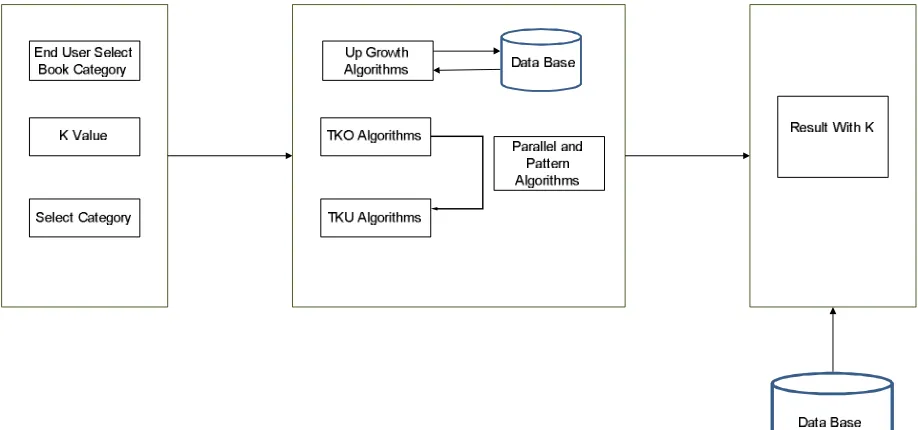
types of production calculations called TKU (extraction of sets of utility elements Top-K) and TKO (sets of themes of extraction Top-K are proposed in one phase) to extract these series of elements without the need to establish a utility minimum. But the TKO algorithm have the main disadvantage of not mainly accumulating the result of TKO given the value of the garbage in the set of high utility items isthe result of the TKU algorithm is increased but the execution time is high, so the alternative solution is to find the efficient algorithm in the proposed combination of the TKO and TKU algorithm system. It can be said that the result of TKO Top K in one phase is given at the entrance of TKU Top K in the utility result of TKO and TKU is increased and the execution time is low. In the proposed system, a new algorithm is generated for combining the name TKO and TKU as TKO WITH TKU or TKMHUI Top k Main set of utility elements.
Module:
Module 1 - Administrator (Admin)
The administrator maintains database of the transactions made by customers. In the daily market basis, each day a new product is required to let go, so that the administrator would add the product or items, and update the new product view the stock details.
Module 2 - User (Customer)
Customer can purchase the number of items. All the history of purchased items is stored in the transaction database.
Module 3 - Construction of Up Tree
In Up Tree Dynamic Table is generated by algorithms. Mainly the Up growth is considerable to get the PHUI item set.
Module 4 TKO and TKU Algorithms
In Combination of TKO and TKU algorithms first the TKO (Top k in one phase) algorithms is called and then output of TKO is given as the input of TKU (Top k in utility phases) then the actual result is TKU Result.
ISSN(Online): 2319-8753 ISSN (Print): 2347-6710
I
nternational
J
ournal of
I
nnovative
R
esearch in
S
cience,
E
ngineering and
T
echnology
(A High Impact Factor, Monthly, Peer Reviewed Journal)
Visit: www.ijirset.com
Vol. 8, Issue 2, February 2019
IV. CONCULSION
In this paper, we looked at the question of the best sets of high-use mining mines, where k is the coveted number of highly useful sets of things to extract. The most competent combination of TKO WITH TKU of the TKO and TKU calculations is proposed to extract such sets of objects without establishing utility limits. Instead TKO is the first single phase algorithm developed for top-k HUI mining called PHUI (high potential set of utility elements) and PHUI is given to TKU in the utility phases. Empirical evaluations on different types of real and synthetic data sets display the proposed algorithms have good scalability in large data sets and the performance of the proposed algorithms are close to the optimal case of the state of the combination of both phases in an algorithm
REFRENCES
1. C. Ahmed, S. Tanbeer, B. Jeong, and Y. Lee, “Efficient tree structures for high-utility pattern mining in incremental databases,” IEEE Trans. Knowl. Data Eng., vol. 21, no. 12, pp. 1708–1721, Dec. 2009.
2. R. Chan, Q. Yang, and Y. Shen, “Mining high-utility itemsets,” in Proc. IEEE Int. Conf. Data Mining, 2003, pp. 19–26.
3. J. Han, J. Wang, Y. Lu, and P. Tzvetkov, “Mining top-k frequent closed patterns without minimum support,” in Proc. IEEE Int. Conf. Data Mining, 2002, pp. 211–218.
4. J. Han, J. Pei, and Y. Yin, “Mining frequent patterns without candidate generation,” in Proc. ACM SIGMOD Int. Conf. Manag. Data, 2000, pp. 1–12.
5. P. Fournier-Viger, C. Wu, and V. S. Tseng, “Novel concise representations of high utility itemsets using generator patterns,” in Proc. Int. Conf. Adv. Data Mining Appl. Lecture Notes Comput. Sci., 2014, vol. 8933, pp. 30–43.
6. P. Fournier-Viger and V. S. Tseng, “Mining top-k sequential rules,” in Proc. Int. Conf. Adv. Data Mining Appl., 2011, pp. 180–194.
7. J. Liu, K. Wang, and B. Fung, “Direct discovery of high utility itemsets without candidate generation,” in Proc. IEEE Int. Conf. Data Mining, 2012, pp. 984–989.
8. Y. Lin, C. Wu, and V. S. Tseng, “Mining high utility itemsets in big data,” in Proc. Int. Conf. Pacific-Asia Conf. Knowl. Discovery Data Mining, 2015, pp. 649–661.
9. Y. Li, J. Yeh, and C. Chang, “Isolated items discarding strategy for discovering high-utility itemsets,” Data Knowl. Eng., vol. 64, no. 1, pp. 198–217, 2008.