Dynamic and Efficient Routing Algorithm for
Multi-Sink Wireless Sensor Networks
Geetavani.B, P Kokila
M.Tech Student, Dept of ISE, The Oxford College of Engineering, Bangalore, India.
Assistant Professor, Department of ISE, The Oxford College of Engineering, Bangalore, India
ABSTRACT: Sensor networks are dense wireless networks where information is gathered by sensor elements spread
out in an interest area. Wireless sensors applications cover large fields such as surveillance and security, target tracking, agriculture, health and military purposes. As wireless sensor network protocols are application specific. The three main categories explored are data-centric, hierarchical and location-based. Each of the routing schemes and algorithms has the common objective of trying to get better throughput and to extend the lifetime of the sensor network. The key objective of the proposed mechanism is to achieve traffic-balancing by detecting the congested areas along the route and distributing the packets along the paths that have idle and under loaded nodes.
KEYWORDS: wireless sensor networks, multiple sinks traffic-aware, end-to-end delay, packet delivery ratio, energy
consumption.
I. INTRODUCTION
Due to recent technological advances and the fact that many comprehensive wireless device usages are proposed in diverse scopes, there is an impulse to increase the speed of the development of wireless communication technology. One of the new growing field of wireless computer networks in recent years is Wireless Sensor Networks (WSNs) [1,2]. A WSN consists of hundreds or thousands of sensor nodes that are usually scattered over a certain area to perform monitoring tasks. The sensor nodes are low-cost, are equipped with limited battery power, and are small sized devices. Besides, they can monitor specific measurement data (e.g. temperature, humidity, and pressure) to detect abnormal events (e.g. a forest fire). Initially the sensor nodes are deployed manually or randomly in the sensing field to form a WSN. The end user may connect to a data concentration centre called the sink node (or base station) via Internet or Satellite to send a request for querying a specific event or phenomenon on this sensing field.
The large numbers of nodes becomes active and transmit data traffic, leading to congestion. Congestion increases the packet delay and the energy consumption due to retransmissions and thus limits the network’s lifetime and efficiency [5]. The centralized traditional approach in which the data traffic from sensor nodes collects toward a single sink [1, 2] which is not efficient in terms of energy consumption or packet delays, Therefore, the use of multiple sinks is proposed as it is more feasible for such dynamic and dense networks [3,4,6]. This approach balances the traffic load and increases the network utilization efficiency. Data traffic from a source to sink node needs an optimal routing protocol that utilizes the limited battery power, memory, and processing resources of nodes effectively.
The proposed algorithm uses two-hop information and detects the congestion owing to its monitoring of the buffer size at a node. The algorithm is the construction of gradient field using three factors:
1.The number of hops
2.The number of packets at one-hop neighbours
3.The minimum number of packets at two-hop neighbours.
The number of hops (distance cost) is built conventionally as in other routing protocols that find the shortest paths for packets. The second and third factor addresses the queue length of neighbouring nodes that may become the next forwarder.
II. LITERATURE SURVEY
ISSN(Online): 2320-9801
ISSN (Print): 2320-9798
I
nternational
J
ournal of
I
nnovative
R
esearch in
C
omputer
and
C
ommunication
E
ngineering
(An ISO 3297: 2007 Certified Organization)
Vol. 3, Issue 4, April 2015
Copyright to IJIRCCE 10.15680/ijircce.2015.0304167 3785
be designed in terms of hop count from sink to node, physical distance, energy consumption, or cumulative delay, depending on the objectives of routing such as energy consumption, packet delay, or packet delivery ratio [8].
Many works have been devoted to solve energy-aware routing problems for wireless sensor networks. GLOBAL algorithm focuses on energy improvement of large-scale multi-sink wireless sensor networks. It allows a source node to select the least-loaded path in order to avoid the overloaded nodes by constructing its gradient field by using the weighted factor of the cumulative path load and traffic load of the overloaded nodes over the path. This approach is based on global information and it cannot guarantee the correctness of the updated information over the long path.
SGF [9] is a gradient-based routing protocol to reach significant energy savings. In SGF gradient fields for nodes are created without using routing tables. Those values are updated on demand by data transmission with little overhead.
GRATA [5] utilizes expected packet delay at one-hop neighbour and the number of hops to make routing decisions. This routing scheme is based on one-hop information and one hop information can be lack of information about traffic condition at some hops away, which may leads the packet to a new congestion area.
SPIN [6] Sensor Protocol For Information via Negotiation disseminates all the information at each node to every node in the network assuming that all nodes in the network are potential base-station. But the SPINs data advertisement mechanism cannot guarantee the delivery of data.
AODV [7] Adhoc on Demand Vector Protocol combines some properties of both Dynamic Source Routing (DSR) and Destination Sequenced Distance Vector (DSDV).It uses route discovery process to cope with routes on demand basis. It uses routing tables for maintaining routing information. Route Request (RREQ) and Route Reply (RREP) messages are used. The disadvantage are AODV does not allow handling unidirectional links and multiple RREP packets in response to a single RREQ packet can lead to heavy control overhead.
III. PROPOSED METHOD
In the gradient based search algorithm, the node builds its own gradient field in response to the neighbour nodes in the direction of a particular sink. Data traffic then flows along the direction with the steepest gradient in order to reach the sink node. The gradient field combines two types of information: 1.geographic distance and 2.the traffic loading. The objective is to prevent packets from going to possible congested areas, leading to reduced end-to-end delays. The proposed algorithm builds a gradient value at each node receiving the updated information about the buffer size from its neighbour nodes. In this process, a node chooses one of its neighbour nodes to become the next forwarder by considering the buffer size at one-hop neighbour and the next one-hop neighbour of with minimum buffer size. This means that a node takes into account both the one-hop neighbour and the two-hop neighbour that can possibly become the next forwarder.
Fig 1: Flow diagram of the proposed method.
Two algorithms are used in this routing protocol. Algorithm 1 is used to update gradient table with each of the sinks. Algorithm 2 is used to calculate gradient indexes and data forwarding. The two algorithms are as follows:
Algorithm1: Updating gradient table with each of sinks
Step 1: Calculates the hop count for each sink. Step 2: Calculates the one hop traffic info. Step 3: Calculates the two hop traffic info. Step 4: Selects the path which has less hop count.
Step 5: Updates new minimum hop count and traffic info for sending ADV packet.
Algorithm 2: Gradient Indexes calculation and data forwarding.
Step 1: Compares traffic info with threshold value
Step 2:If traffic info is greater or equal to threshold then remove that node from the route calculation. Step 3:Calculates the gradient indexes and selects the node having minimum value.
Step 4:If there are many nodes with same values then choose randomly.
IV. SIMULATION
ISSN(Online): 2320-9801
ISSN (Print): 2320-9798
I
nternational
J
ournal of
I
nnovative
R
esearch in
C
omputer
and
C
ommunication
E
ngineering
(An ISO 3297: 2007 Certified Organization)
Vol. 3, Issue 4, April 2015
Copyright to IJIRCCE 10.15680/ijircce.2015.0304167 3787 Table 1: Simulation setup
Parameters Value
Deployment Type Random Topology
Deployment Area 200 m X 200m
Number Of Nodes 250
Number Of Sinks 4
MAC Layer IEEE 802.15.4
Radio Range 15m
Packet Length 30B
Transmission Range 250kbps
Buffer Size 25 packets
Time to Update 0.5-5 s
Simulation time 900 s
V. RESULTS
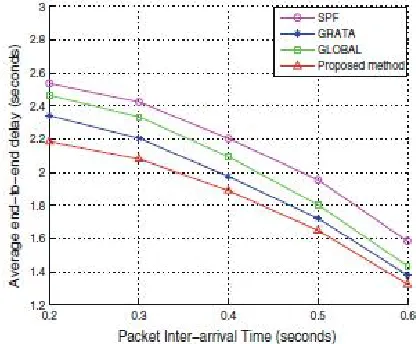
The performance of the proposed algorithm under the two kinds of traffic: constant bit rate and exponential distribution The simulation results are compared with the shortest path first routing algorithm (SPF), GRATA, and GLOBAL to show the improvement in network performance with varied traffic rates.
From the graph fig 2, we can conclude that the proposed routing algorithm performs a smaller packet delay than the other schemes. This is because the two-hop information gradient-based scheme attempts to prevent forwarding packets from next neighbours with high number of packets in the buffer and balances the network traffic.
Fig 3: Packet delivery ratio with various values of Alpha
From the graph fig 3,as the traffic load increases , a larger number of packets are pushed into the network, causing more congestion and dropped packets throughout the network . The proposed scheme improves the packet delivery ratio by spreading traffic over the under loaded paths to reduce congestion and overflow buffers, especially in the cases of high traffic.
Fig 4:Average energy consumption
ISSN(Online): 2320-9801
ISSN (Print): 2320-9798
I
nternational
J
ournal of
I
nnovative
R
esearch in
C
omputer
and
C
ommunication
E
ngineering
(An ISO 3297: 2007 Certified Organization)
Vol. 3, Issue 4, April 2015
Copyright to IJIRCCE 10.15680/ijircce.2015.0304167 3789
VI. CONCLUSION AND FUTURE WORK
In this paper, we have analysed and compared various routing algorithms in wireless sensor networks. From this survey, we conclude that the proposed algorithm reduces overall packet delay in multi-sink WSNs.The proposed algorithm utilizes the number of hops and the current queue length of one hop and two hop neighbour nodes to make routing decision. Simulation results indicate that the proposed algorithm improves the network performances such as end-to-end packet delay, packet delivery ratio, and average energy consumption in comparison to other routing schemes.
In future work we plan to build an analytical model to find the optimal value for these weighted factors, the optimal ratio of these two factors, and the effect of update time on network performance, which is especially important in dense networks.
REFERENCES
1. Akkaya, K., & Younis, M A survey on routing protocols for wireless sensor networks. Ad Hoc Networks, 3, 325–349, 2005.
2. Al-Karaki, J., & Kamal, A Routing techniques in wireless sensor networks: A survey. IEEE Wireless Communications, 11(6), 6–28, 2004. 3. Dijikstra, E. W. A note on two problems in connexion with graphs. Numerische Mathematic, 1 (1), 269–271, 2003.
4. Dinah, N. Q., Hoa, T. D., & Kim, D. S. Distributed traffic aware routing with multiple sinks in wireless sensor networks. In 9th IEEE international conference on industrial informatics (INDIN), pp. 404 –409, 2011.
5. Gao, D. Zheng, T., Zhang, S., & Yang, O. W. W. Improved gradient-based micro sensor routing protocol with node sleep scheduling in wireless sensor networks. In IEEE 72nd vehicular technology conference fall (VTC 2010-Fall), pp. 1–5, 2010.
6. Heinzelman, W., Chandrakasan, A., & Balakrishnan, H. Energy-efficient communication protocol for wireless micro sensor networks. In Proceedings of the 33rd annual Hawaii international conference on system sciences, Vol. 2, p. 10, 2010.
7. Heo, J., Hong, J., & Cho, Y. EARQ: Energy aware routing for real-time and reliable communication in wireless industrial sensor networks. IEEE Transactions on Industrial Informatics, 5 (1), 3–11,2009.
8. Huang, P., Chen, H., Xing, G., & Tan, Y. SGF: A state free gradient-based forwarding protocol for wireless sensor networks. ACM Transactions on Sensor Networks (TOSN), 5, 14:1–14:25, 2009.
9. IETF ROLL WG. RPL: Routing protocol for low power and lossy networks. In IETF internet-draft. IETF ROLL WG, March 8, 2010.
BIOGRAPHY
P Kokila has done her B.E in Electrical & Electronic Engineering from Anna University,
Chennai and M.E in Computer Science and Engineering from Anna University, Chennai. She has worked at Adhiyamaan college of Engineering for Five years. She is currently working as the Assistant Professor in ISE Department of The Oxford College Of Engineering since two years. She has guided many B.E & M.Tech students in Computer Science & Engineering and Computer Network Engineering. She has over all Seven years of teaching experience. Her areas of interest are Wireless Sensor Network and Cloud Computing.
Ms. Geetavani.B a Student of Information Science and Engineering Department at The Oxford
College of Engineering-Bangalore, affiliated to VTU pursuing M.Tech in Computer Networking and Engineering. She received her Bachelor’s of Engineering in Computer science and Information Technology Engineering from S.L.N College Of Engineering Raichur affiliated to VTU. She is currently working as a research assistant under the guidance of
Assistant Prof.Ms P Kokila. Her research interests are Mobile Adhoc Networks and Cloud