University of South Carolina
Scholar Commons
Theses and Dissertations
12-14-2015
Understanding Generosity at Military Colleges and
Universities: Characteristics and Motivations of
Major Donors at the Federal Service Academies
and Senior Military Colleges
John Paul Dowd III
University of South Carolina - Columbia
Follow this and additional works at:https://scholarcommons.sc.edu/etd Part of theEducational Administration and Supervision Commons
This Open Access Dissertation is brought to you by Scholar Commons. It has been accepted for inclusion in Theses and Dissertations by an authorized administrator of Scholar Commons. For more information, please [email protected].
Recommended Citation
UNDERSTANDING GENEROSITY AT MILITARY COLLEGES AND UNIVERSITIES: CHARACTERISTICS AND MOTIVATIONS OF MAJOR
DONORS AT THE FEDERAL SERVICE ACADEMIES AND SENIOR MILITARY COLLEGES
by
John Paul Dowd III
Bachelor of Arts Winthrop University, 1989
Master of Education
The University of South Carolina, 1993
Submitted in Partial Fulfillment of the Requirements
For the Degree of Doctor of Philosophy in
Educational Administration
College of Education
University of South Carolina
2015
Accepted by:
Katherine Chaddock, Major Professor
Chris Plyler, Committee Member
James Rex, Committee Member
Julie Rotholz, Committee Member
DEDICATION
To my wife, Kim: you were my sidekick in the pursuit of this degree and you are so incredibly
bright. It is you who should be wearing a doctoral hood. You have supported me throughout this
process and done so with never wavering encouragement. You maintained the balance in our
family, took care of the kids, and our family never missed a beat. Without you, this degree would
have never even been a dream, much less a reality. I love you dearly.
To Gibson and Brauer: while it is hard for you to imagine, Dad started this degree to honor you
and make your life even better. You are my inspiration and I thought of you the entire way
during this journey. I missed so many of your activities and chances for us to be together, but
you always forgave me and told me how you understood when I was locked away writing. I am
blessed beyond measure to be your father. I love you to the moon and back!
To my mother, Barry Gibson Webster: thank you for always making sure that my priorities were
in order, my compass was pointing north, and that I knew, no matter what, that education was
paramount to achieving success in life. To my stepfather Dr. Ronald Webster – you encouraged
me and offered assistance around every corner.
To my father JP Dowd, Jr. and sister, Elizabeth Dowd Dorrell: thank you for always being
ACKNOWLEDGEMENTS
Dr. Jason Silverman – You always saw an educational spark in me and drove me to try and fuel
the flame. Dr. Raymond Murphy – if not for you, I would have never been given the chance to
pursue a M.Ed. degree, much less work toward a PhD. You saw something in me in the fall of
1991 that I could not see in myself. Thank you. Dr. Mark Tompkins - your guidance and support
for only knowing me a short time was beyond measure. Thank you. Cermette Clardy – If not for
you deciding that I had promise in the field of advancement, I would not be where I am today. I
owe you so much. Thank you. Dr. Jim Rex – You hired me as a graduate intern and introduced
me to the profession into this profession in January 1993. You have been an integral part of my
life personally and professionally. Thank you. Dr. Chris Plyler – Hard to imagine that in 1993, I
was working as an intern with you while you were Chancellor at USC Beaufort. Now for you to
serve on my committee is a compliment that I can never repay. Thank you. Dr. Julie Rotholz –
You have been a guiding light to make sure I became an accomplished researcher and pushed me
to explore my scholarly limits. I am grateful for all of your feedback and support. Thank you.
Dr. Katherine Chaddock – Thank you seems so inadequate when I reflect on everything you have
done to hold my hand through this process. You pressed me to become a scholar and in the
process we became friends. I could not have selected a better chair, thank you from my entire
family. Anna Janosik Cooke – You, my friend, are the unsung hero in this entire effort; I share
this success with you, and can’t imagine not having your help. Thank you. Dr. Elton Hendricks
– You first planted the seed with me that I needed to earn a doctoral degree if I was ever going to
want to have a ticket to the best seat in the theater. Thank you for inspiring me to want that
Lt. General John Rosa– You have been supportive of me and encouraged me to complete
this degree from the first day I joined your staff in February 2013. I am forever indebted. You
are a true principled leader. Thank you. My Board Members, Especially Chairs W Coleman,
Reamer King, and Bud Watts IV – You afforded me the time to complete the degree while at
FMU and The Citadel Foundation. Your support was imperative and unwavering. I have been
fortunate to serve with you all. Thank you. Kathleen Hancock – you supported me on this
journey from day one at The Citadel Foundation, and kept me focused and found time to get me
to the finish line, not an easy task. Thank you. To all my staff and colleagues at Methodist
University, Columbia College, Francis Marion University, The Citadel and The Citadel
Foundation - I share this with you because you all have had some impact on my life and career. I
have been blessed to work with amazing colleagues. Thank you. My PhD Cohorts – Kyle,
Stephanie, and Telesia – Wow! What can I say? You guys rock! I am so grateful that we got the
chance to walk this path together. Thank you! The Staff at Norwich University, The Citadel,
Virginia Military Institute, Virginia Tech, and United States Naval Academy - for distributing the
survey for me and a special thanks to all those persons who responded.
Finally, Dr. Fred Carter – If there were one person who I can look back on and determine
that without his support, I would have never earned this degree, it would be you. Sir, you sat me
down in your office in the fall of 2009 and not only told me I needed to pursue the degree, but
laid the road map for me on how I would get it done. I can’t begin to thank you enough. It is my
goal to use this degree in an effort to honor your legacy of public service and to serve as an
effective leader not only in higher education, but as a leader for the greater public good,
ABSTRACT
The purpose of this study was to determine the characteristics and motivations of
major donors at three federal service academies and the six senior military colleges.
Although much literature has been published on donor motivation, as well as studies
determining what donor characteristics are linked to the decision of alumni to financially
contribute back to their alma maters, research specific to the federal service academies
and the senior military colleges could not be found. Therefore, this study addressed the
void in the literature.
The methods used to gather this data were survey instrument and personal
interviews. The researcher sent letters to colleagues at the study institutions and then
conducted eight personal interviews in a semi-structured environment. The interviews
were selected by participants indicating on the survey their willingness to contribute, as
well as via the researcher’s personal contacts.
The findings were limited to a small sample, due to having 5 out of 9 institutions
participate in distributing the survey; 158 surveys were ultimately returned. This small
sample size is typical of mail surveys in qualitative studies. Nevertheless, the results
highlighted a number of interesting indications about giving; it is anticipated that these
will serve as valuable reference points in future research on this subject of military giving
(especially in regard to alumni giving). These results included, perhaps predictably,
similar unique or “niche” missions. However, there were some interesting differences as
well. Gender played a prominent role, as did age and the perceived value of leaving a
legacy at the institution. Student experiences did not have as much of a role in
motivating donor behavior; however, donors who were on an athletic team showed an
increased propensity to give. The research also supported findings in previous studies,
showing that involvement at the school leads to higher contributions and that donors need
to have faith in administrative leadership in order to permit their gifts to be used in the
best interest of the school. Finally, the research supported the supposition that leaving a
legacy and enhancing the institution’s brand was of high importance to major donors.
The results can assist professional advancement staff at the subject institutions to
develop strategic and specific fundraising approaches with major donors on their
respective campuses. The data points indicated by the study can be beneficial when
working with current or future major donors at the federal service academies and senior
military colleges and universities. The alumni and other major donors who participated
in the survey and interviews have immense loyalty to their alma maters. The study also
provides foundational research in giving at military colleges and universities, which
clearly have strong similarities and differences from other niche mission schools such as
Historically Black Colleges and Universities (HBCU) and women’s colleges (as well as
links to mainstream private and public universities).
TABLE OF CONTENTS
DEDICATION ... iii
ACKNOWLEDGMENTS ... iv
ABSTRACT ... vi
LIST OF TABLES ... xiii
CHAPTER 1: INTRODUCTION ...1
Philanthropy and Military Colleges ...1
Purpose of the Study ...4
Research Questions ...7
Background of Subject Schools ...8
Importance ...15
Definitions ...16
CHAPTER 2: LITERATURE REVIEW ...20
Historical and Descriptive Literature: Philanthropy and Higher Education ...20
Charity vs. Philanthropy: General Definitions and History ...20
Philanthropy in American Higher Education ...21
Alumni Donations ...23
History of Higher Education Fundraising Campaigns ...24
Motivations for Giving ...28
Alumni Giving Studies ...36
Fundraising at the Federal Service Academies and Military Colleges ...40
Summary ...44
CHAPTER 3: METHODOLOGY ...47
Introduction ...47
Conceptual Framework ...48
Participating Institutions ...49
Participants……….51
Access ...52
Interviews ...55
Data Analysis ...56
Researcher Positionality ...57
CHAPTER 4: FINDINGS OF SURVEYS AND INTERVIEWS ...58
Overview of Purpose and Methods ...58
Survey Findings: Introduction ...58
Survey Findings: Institution and Gift Type Profile ...59
Survey Findings: Donor Motivation ...62
Survey Findings: Stewardship of Gifts ...68
Survey Findings: Demographics and Characteristics of the Sample ...70
Interview Findings ...73
Confidence in Current Leadership ...73
Positive Brand and Reputation ...74
Current Alumni and Donor Involvement ...75
Student Experiences ...75
CHAPTER 5: DISCUSSION, RECOMMENDATIONS, AND CONCLUSION ...78
Introduction ...78
Review of the Study’s Purpose ...79
Motivational Factors: Absence of Student Experiences ...79
Motivational Factors: Confidence in Current Leadership ...82
Motivational Factors: Alumni Involvement and Engagement ...84
Demographic Characteristics: Age and Giving ...86
Demographics Characteristics: Proximity to Campus ...87
Demographics Characteristics: Donor Age ...89
Conclusions of Key Findings ...90
Recommendations for Further Research ...92
Limitations ...93
Implications for Practice ...94
Conclusion ...95
REFERENCES ...98
APPENDIX A: INSTITUTIONAL REVIEW BOARD APPROVAL ...103
APPENDIX C: COLLEAGUE LETTER ...112
LIST OF TABLES
TABLE 1.1: Summary of Federal Service Academies and Military Colleges ...5
TABLE 2.1: Donor/Organization Integration Model ...33
TABLE 2.2: Private Gifts Received ...43
TABLE 4.1: Donor Response by Institution ...59
TABLE 4.2: Donor Identity ...60
TABLE 4.3: Types of Gifts ...61
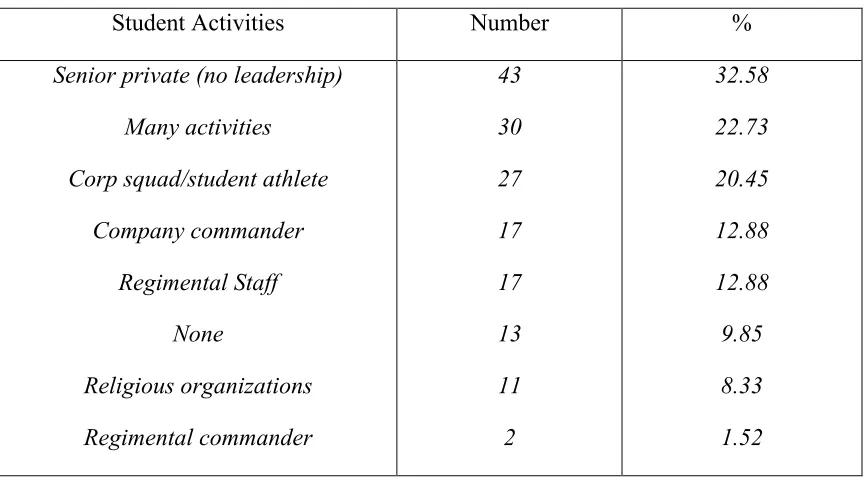
TABLE 4.4: Participation in Student Activities ...63
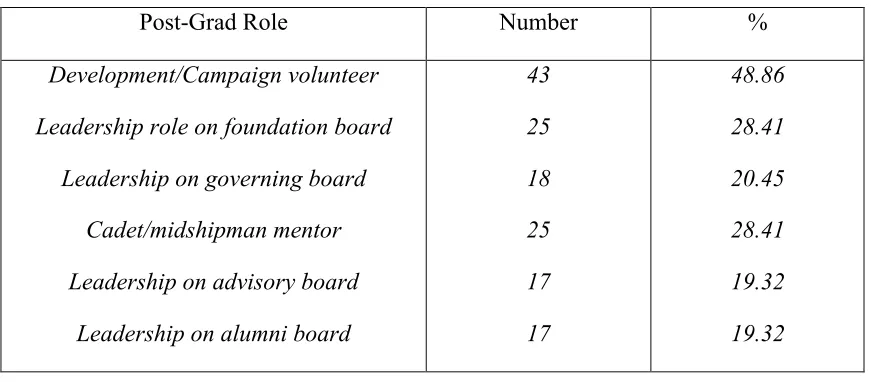
TABLE 4.5: Level of Engagement Post Graduation ...64
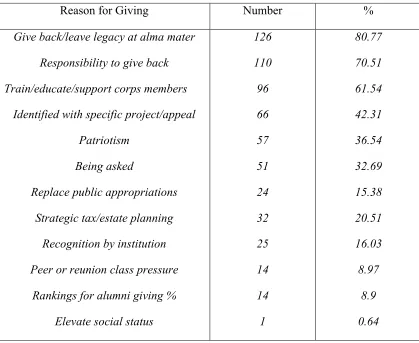
TABLE 4.6: Motivations for Donors ...65
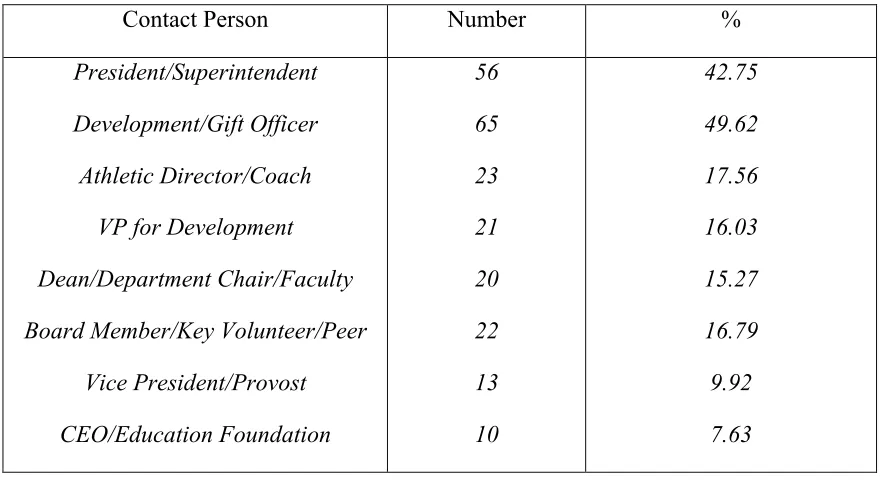
TABLE 4.7: Influential Staff Contact ...66
TABLE 4.8: Satisfaction with Ability to Direct Gifts ...68
TABLE 4.9: Age of Donors ...69
CHAPTER 1: INTRODUCTION
Philanthropy and Military Colleges
The raising of extraordinarily large sums of money, given voluntarily and freely by
millions of our fellow Americans, is a unique American tradition ... Philanthropy, charity,
giving voluntarily and freely ... Call it what you like, but it is truly a jewel of an
American tradition.
-John F. Kennedy [National Philanthropic Trust, n.d.]
American philanthropy in the cause of higher education has changed how
institutions approach their financial modeling and projections. Universities are
increasingly turning to private philanthropy to not only meet budget demands, but also
create and grow additional academic and student support programs on campus (Drezner
2011). The inability to depend on public funds, federal grants, or monies historically
provided by denominations for church-affiliated schools has forced American colleges
and universities to rely more than ever before on the proficiency of their professional
fundraisers and departments. This is, however, only the latest phase of a long tradition of
giving, for as Peter Dobkin Hall explains, “no single force is more responsible for the
giving by individuals and foundations” (Drezner, 2011, p.1). Today, in the area of
philanthropy, development or advancement divisions must depend on the data generated
by outcomes from their internal prospect research, data mining, and data analytics in
order to meet the fiscal demands of the institution.
However, staff in these departments are under increasing pressure to secure
private resources in particular, which drives them to identify what motivates members of
their constituency base to make “major” or “transformational” gifts to their school.
Elliott (2006) states, “While no one can truly know the motivations behind a gift –
sometimes even the donor is not clear or suffers from self-deception – the primary role of
the fundraiser is to understand the donor’s motivations, acquire funds, and work with the
donor to see that the funds are put to the best use for all concerned” (p. 53). He suggests
that staff should be empathetic to the donor’s desires and match those desires to
institutional priorities. The practice of having dedicated divisions and staff to create a
culture of philanthropy on college and university campuses is becoming increasingly
important. This increased need on campuses is directly correlated to the need to find
private resources to replace the dollars once appropriated by federal and state legislative
bodies.
Therefore, the need for an infusion of private dollars into American higher
education is quite possibly at an all-time high, due both to decreases in public funds and
to the lack of sufficient educational and general funds within school’s budgets. This is
evidenced by the quantitative goals and ambitious undertakings occurring at colleges and
universities across the country. Requested gift amounts and fundraising goals are at
(2010) and Drezner (2011) highlight in their research that in June of 2010, 75 campaigns
had stated goals of more than $1 billion. This figure accounts for comprehensive
fundraising campaigns either publically announced or recently completed. Forty-nine of
the 75 considered themselves successful or even exceeded their announced goals. The
remaining 26 are currently in what is referred to as the public phase of the campaign and
expect successful completion of their billion-dollar efforts.
In the wake of severely declining state revenues, pressures to make up budget
shortcomings through alternative means of income have increased over the past decade.
Public institutions have also seen a decline in taxpayer revenues over the past decade, and
since 2008, some public four-year universities have lost nearly 48% of their state
appropriations (SCCHE 2014). For example, in April 2015, Louisiana reported a
potential funding shortfall of 82% at flagship school Louisiana State University (LSU).
The State Council of Higher Education for Virginia, home to both VMI and Virginia
Tech, stated in their 2009 report The Erosion of State Funding for Virginia’s Public
Higher Education Institutions that state appropriations to the public colleges and
universities have been reduced significantly, falling from 14% to 11% between 1992 and
2010. Nor are the federal service academies exempt from this dilemma. According to
recent statements in West Pointcampaign literature, federal appropriations only cover
90% of the cost to educate the next generation of Second Lieutenants in the United States
Army. This creates a serious need for today’s campuses to not only develop relationships
with the constituents who are affiliated with the institutions, but also be able to turn them
into major benefactors for their respective schools (Drezner, 2011; Elliott, 2006; Latta,
Due to declining state and federal appropriations, it is imperative that the federal
service academies and senior military colleges (“subjects”) understand why their donors
are contributing at meaningful levels. Military schools have the ability to build upon
unique campus traditions in order to create emotional connections that lead alumni,
friends and supporters to demonstrate their support by making charitable gifts. The keys
are identifying what those traditions and emotional symbols are for the donors.
Additional research on donors is needed, and specifically, a scholarly exploration of
empirical evidence on motivating factors for major donors at military schools in
particular; student and alumni experiences that may influence donor motivation are of
primary interest.
Purpose of the Study
The purpose of this study was to provide a greater understanding of the
motivating experiences and individual characteristics of major donors at United States
military academies and senior military colleges and to identify how they differ, if at all,
from the findings of studies on donor motivation at non-military colleges and
universities. Are there similarities in what motivates benefactors to contribute to the
different types of institutions? If so, how can the answers be used to assist administrative
leaders to become even more successful in securing large contributions and meeting or
Specifically, this study sought to discover those motivational and demographic
characteristics of alumni and non-alumnimajor gift donors at the federal service
academies and the six senior military colleges: The United States Military Academy
(West Point), The United States Naval Academy (Annapolis), The United States Air
Force Academy (Colorado Springs), Norwich University, Virginia Military Institute, The
University of North Georgia, Texas A&M University, Virginia Tech University, and The
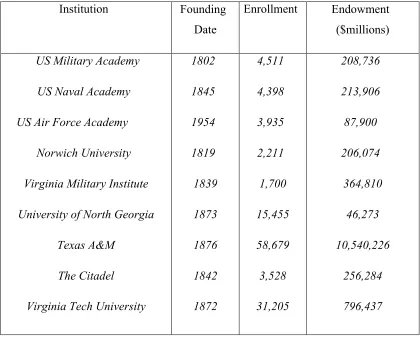
Citadel. Data from the Voluntary Support of Education (VSE) survey (2015), included in
Table 1.1, provides further background information on these schools.
Table 1.1
Summary of Federal Service Academies and Military Colleges
Institution Founding
Date
Enrollment Endowment
($millions)
US Military Academy
US Naval Academy
US Air Force Academy
Norwich University
Virginia Military Institute
University of North Georgia
Texas A&M
The Citadel
Virginia Tech University
The relevant factors studied among donors were those related to student and
alumni experiences. Due to the effort of maintaining and, perhaps more importantly,
sustaining a high level of major gift and campaign activity, the factors that encourage
individuals to support the mission of each institution needed to be identified. Therefore,
this study aimed to provide data regarding these motivational characteristics that could be
used by the professional staff within development and alumni offices to identify future
major gift prospects and to steward current donors.
Although this research was limited to institutions that have a military scope and
mission, results may be applicable to other campuses with similarly specialized missions.
These could include schools such as: women’s colleges, Jesuit colleges, Historically
Black Colleges and Universities, schools that focus on Hispanic students, and even
Research Questions
Question 1
What student experiences/involvement, if any, at service academies and military colleges
influence motivation for later major donor giving to those institutions?
Question 2
What alumni experiences/involvement, if any, at service academies and military colleges
influence motivation for major donor giving to those institutions?
Question 3
What other factors do major donors report as influencing their giving to service
academies and military colleges?
Question 4
Does age or gender correlate with differences in factors that influence giving among
major donors to service academies and military colleges?
Question 5
How do the motivational influences found among major donors at service academies and
military colleges compare to those already uncovered in research concerning college and
Background of Subject Schools
Early in its history, the United States identified a need for higher education
institutions, founded and funded by the federal and state governments, to train and
educate principled military leaders and commission military officers. In colonial times,
there was a popular demand for a strong and well-trained military, made particularly
urgent when General George Washington’s Continental Army faced the overwhelming
odds of fighting a far superior, better trained, and much wealthier British army in its
efforts to secure America’s independence (McCullough, 2005). The creation and
founding of West Point as a fort on a high bluff on the west side of the Hudson River is
associated with Washington and his need to control water travel and access in and out of
New York City from the north. The United States Congress founded the United States
Military Academy at West Point in 1802 (USMA, 2014).
When the United States Congress established the United States Naval Academy in
1845, it chose the strategic position of Annapolis more for an escape than for naval
strategy. According to the US Naval Academy website, “a more suitable location” was
the goal of Secretary of the Navy, George Bancroft, who decided to move the naval
school away from Philadelphia to the more “healthy and secluded location of Annapolis
in order to rescue midshipmen from the temptations and distractions that necessarily
connect with a large and populous city” (2014). The US Naval Academy was essential
for developing a strong naval force for the defense of the United States by land and sea,
and has served ever since as a pipeline of trained servicemen and women to defend the
immediately following World War II, in 1947. At the declaration of the United States
Congress, the Air Force Academy was subsequently founded in 1954.
Military colleges and universities by design are unique in their mission and scope
of delivering educational experiences in regimented and structured environments. Not all
students who want to attend a federal service academy are granted an appointment, and
admission is a rigorous process. Military colleges offer students who are not accepted
into a service academy or are not prepared to commit to a military career the opportunity
to enroll as a member of a cadet corps and obtain a military educational experience. A
majority of the young men and women attending military colleges and universities are
also residential students, which adds another level of emotional commitment to their
experience. Virginia Military Institute and The Citadel, for example, require all cadets to
reside in the barracks on campus. According to the Association of Military Colleges and
Schools of the United States (AMCSUS), military schools employ and emphasize core
values like honor, integrity, duty, service, and self-discipline. The specific statement of
core values varies from school to school.
The six senior military colleges and universities are summarized below and can
trace their roots to the 19th century with dates ranging from Norwich University in 1819
through Virginia Tech in 1872. Notably, only 50% of the senior military colleges still
operate for the purpose of training their students in military command, and the cadets in
those colleges represent the overwhelming majority of undergraduate students at those
institutions. In contrast, the University of North Georgia, Texas A&M, and Virginia
population. As of the fall of 2014, the approximate size of the North Georgia corps of
cadets was 700; Virginia Tech had 1,000 cadets, and Texas A&M had 2,550 cadets.
Each school was founded in response to some specific need for national training
and military mobilization during the 19th and 20th centuries. The rationale for each
school’s location and founding are summarized below(Citadel, 2014; Norwich, 2014;
Virginia Tech, 2014; University of North Georgia, 2014; Texas A&M, 2014; & VMI,
2014):
The Citadel (1842)
With arsenals located across South Carolina, Governor John P. Richardson was the first to conceive the idea of converting the Arsenal in Columbia and the Citadel in Charleston into military academies. With help of the State Legislature, the plan went into effect on December 20, 1842. The Arsenal Academy was made auxiliary to the Citadel Academy and only accepted first year cadets, who would then transfer to The Citadel to complete their education. On March 20, 1843, the first cadets reported to The Citadel, a date which is now known as Corps Day.
Norwich University (1819)
After Captain Alden Partridge’s idea of the “American System of Education” was dismissed by the United States Military Academy, Partridge established his own institution in 1819. This institution was first named the American Literary,
Scientific, and Military Academy at Norwich, Vermont, but was later shortened to Norwich University.
Virginia Tech (1872)
Virginia Tech opened as the Virginia Agricultural and Mechanical College on October 1, 1872. With an enrollment of 132, all students were cadets and organized into a battalion of two companies which were led by the
University of North Georgia (1873)
Originally named the North Georgia Agricultural College, this institution focused particularly on mining and engineering and was established in 1873. That same year, their first class of students asked that military training be part of the
curriculum. In 1986 the Corps of Cadets officially adopted the name of the unit as “Boar’s Head Brigade,” an allusion to part of the family crest of Georgian James Oglethorpe. The Boar’s Head remains a symbol of fighting spirit and hospitality.
Texas A&M (1876)
Founded in 1876, Texas A&M University currently has the largest uniformed body outside the national service academies. Until 1965, when membership in the Corps of Cadets became voluntary, every individual who attended Texas A&M was required to be a cadet. The Corps are referred to as “Keepers of the Spirit” and “Guardians of Tradition.” It has historically produced more officers than any other institution in the nation, other than the academies.
Virginia Military Institute (1839)
Before becoming an institution of higher education in 1839, VMI’s site was one of three locations in Virginia that were occupied by an arsenal. The arsenal guards lacked self-discipline and their leisure-time activities upset the decorum of
Lexington. In 1834, attorney John Thomas Lewis Preston proposed that the arsenal be transformed into a military college, allowing the cadets to pursue educational courses while protecting the stand of arms.
Due to the perpetual need to bolster the nation’s defenses and have well-trained
military officers, the federal government (and subsequently state governments) funded
the academies and military colleges at high levels. Superintendents and presidents of the
institutions were not concerned about sufficient public resources and taxpayer
appropriations until more recently. The federal service academies did not begin to move
in the direction of more defined advancement (development and alumni affairs)
philanthropy and donor motivation in a way that takes into account the unique features of
military schools.
Unique institutional culture influences the perspectives alumni of the federal
service academies and six senior military colleges have about what undergraduate
education should entail. The mission of each of their respective schools – maintaining a
rigorous regimen for cadets and midshipmen alike – is very important to them.
Consequently, the symbolism and traditions, which are important to these alumni, are
very different from those meaningful to students who choose more traditional colleges
and universities. During an interview with a Citadel graduate, he remarked that he was
emotionally bound to his classmates not only by a ring but by the importance of life in
the barracks, which could only be understood by those persons who experienced it.
Another alumnus of The Citadel explained in an interview that the discipline and rigorous
demands of the military environment probably “saved his life” because had he not
attended The Citadel, not only would he have never finished college, but also never
attained his present success in life overall. The fact that many young men and women
choose the college or university experience “less traveled” may warrant future
investigation into their values and motivations, as well as their experience at the
academies. Therefore, the history and founding mission of each of these military schools
substantiates the claim that each one is different by design and should be considered a
subset for review.
This study provided data that may enable the professional staff at the academies
and military colleges to better understand the reasons their largest benefactors are
developing strategies to retain their current contributors, to improve data mining and
analytics, and to construct programs that will encourage others to give at the major gift
level. In each of these areas, the data would thus allow development and alumni offices
to adopt or improve empirical strategies for fundraising, increase solicitation efficiency,
and save institutional resources. The study therefore had a paramount purpose of
presenting these data in a clear and practical format, readily available for future use.
While there is an abundance of research on donor motivation in general, the same
cannot be said for research on donor motivation specific to military schools. Although
research exists that correlates a donor’s actions to some form of psychological or
sociological phenomenon in regard to giving, fundraising in military schools tends to be
driven by alternate values, which mirror the school’s core values: honor, duty, respect,
and country. This has been observed in the personal experiences of advancement
professionals and can also be seen in the institution’s historical fundraising experiences
as well. There is a common conception in the advancement profession that if a donor is
wealthy and has some level of emotional attachment to the school, that may be all that is
necessary for him/her to exhibit charitable behavior. Personal experience indicates that
there is also an overarching assumption that certain commonalities among contributors
exist. This study sought to supplement these personal experiences and anecdotal
knowledge with empirical data.
To achieve this end, it is useful to examine the current literature on the
psychology of charitable giving. The practice of soliciting major gifts has been a part of
the higher education landscape in the United States for years (Nicolson, 2006 & Latta,
However, Latta (2010) asserts, “As the development profession has matured, several
different models have been developed to explain the process of giving. One of the most
well-known models is described as ‘the five I’s’ from Greenfield (1999); the model
includes the steps of identification, interest, information, involvement, and investment”
(p. 30). This model is often modified to meet an institution’s development matrix.
Identification of the potential donor can be brought to the advancement professional’s
attention in several ways: through staff research, wealth screening instruments, or a peer
review assessment where a fellow alumnus or professional colleague shares names of
prospective donors with staff. Once a prospective donor is identified the next step is to
ascertain his/her interest in a possible relationship with the institution. The information
stage consists of conveying data and providing support materials for the particular areas
of interest the donor may have. Involvement could be as simple as meeting with students
or sharing life experiences, or as involved as teaching a class, facilitating a professional
roundtable for faculty, working on job placement, or serving on an advisory board or
board of trustees. According to the model, all of these steps lead to the end goal of
soliciting private resources and securing an investment in the institution. While this
model is sound in theory and practice, in the author’s experience practitioners add a final
point to this model: after closing the gift, there needs to be a high level of engagement in
stewarding the donor and convincing the donor his or her contribution is being used in
Importance
The extent to which public institutions are able to rely on state and federal
funding is dwindling with each budget year. According to an article published in The
Atlantic in March 2013, United States public policies passed by legislative bodies now
generally dictate that fewer appropriations be designated for public institutions. Based on
data from the Center on Budget and Policy Priorities, 48 states decided to cut the
appropriation line for higher education between academic fiscal years 2008-2013,with an
average cut of 28% over that time frame. Only North Dakota and Wyoming experienced
increases during the same period (Weissmann 2013). As a result, there is an even greater
dependency on private donations to adequately maintain scholarships, academic
programs, and capital expenditures.
A bond bill has not been passed by the South Carolina General Assembly since
2000, and the likelihood of passing a bond bill specific to higher education in the near
future is not strong (Harrell, 2014). This means that state public education will not have
capital money available for new buildings or substantial renovations of existing facilities.
Economic and political circumstances dictate the necessity of creating alternative ways to
secure funds for any new construction. This dilemma is just one example of the
challenges faced by the campuses highlighted in this study. Terry and Macy (2007) point
out that state governments have changed their focus from supporting higher education to
public K-12 education, and have limited their support of universities through funding
There are limited studies available that delve into specific segments of
professional philanthropy at institutions with what might be considered niche missions,
(e.g. military colleges, women’s colleges, or religiously fundamental colleges). The
majority of existing studies focus on broader approaches to fundraising and on
characteristics of donors in the areas of race, gender, age, occupation and religion
(Pollard 1958, Worth 2002). Research based on institution type and demographics
(public vs. private, bachelor’s degree vs. master’s degree, etc.) in regard to initiating
major gift solicitation and fundraising campaigns on the nation’s campuses is also
available. Examples of these studies are found within McDearmon & Shirley (2009) and
Monk (2003). There are also numerous studies (Wastyn 2009, Wannuva & Lauze 2001)
which focus on motivation and giving characteristics, embedded in the disciplines of
psychology and sociology, but none thus far have been identified to specifically correlate
to the graduates of military institutions. Therefore, the exploratory nature of this study
provided foundational data that may be used on individual campuses by not only staff,
but by boards of trustees, education foundations, and alumni associations of institutions
with niche missions.
Definitions
Definitions of terminology used in this study include:
Alumnus: someone who has a degree conferred upon him/her by his/her
Association of Military Colleges and Schools of the United States (AMCSUS):
professional association comprised of member schools to include colleges,
universities, and prep schools which provide a quality education in a military
environment
Capital and comprehensive fundraising campaigns: focused efforts within a set
time frame designed to obtain large contributions to address specific institutional
priorities
Council for the Advancement and Support of Education (CASE): professional
association comprised of individuals serving in the advancement profession
(development, alumni, public relations)
Data mining: process of using key identifiers found in existing donor records for
the purpose of prospect research and identifying potential contributors
Federal service academies: higher education institutions founded and funded by
the United States government to train and educate principled military leaders, and
to commission officers equal to the rank of second lieutenants [The United States
Military Academy/West Point (Army), The United States Naval
Academy/Annapolis (Navy and Marines), The United States Air Force
Academy/Colorado Springs (Air Force)]
Major donor/benefactor: an individual who makes a conscientious decision to
make a major contribution at a college or university
Major gift: A contribution of at least $25,000, cash or planned/estate gift
Senior military colleges: colleges and universities which add a military
training and education for principled military leaders [The Citadel, Norwich
University, Virginia Military Institute, Texas A&M University, University of
North Georgia, Virginia Tech University]. (Not all graduates of these institutions
are service contracts with obligations to serve in a branch of the United States
armed forces.)
Limitations
This study was limited to major donors, who were individual donors of a
minimum of $25,000. Using a specific dollar threshold to evaluate financial impact on
the institution necessarily excluded other donors as participants, which meant that the
survey sample did not include smaller gifts from donors who might be equally as loyal to
their alma mater but who did not have the wherewithal to make large gifts. While
important to the donor cycle, smaller donations have minimal impact when creating
specific academic programs or capital projects; thus, only major donors were studied.
The gifts contributed by the donors of this study had a more immediate and noteworthy
impact on the institutions. Secondly, the survey and interview process did not include
those persons who chose not to support the institutions at all, through any causes or
projects. Non-donors, as this population is often referred to in development models, far
outnumber the donor population on the majority of campuses. Again, although studying
non-donors provides important information, this study did not encompass such a large
demographic subset and only sought to provide foundational data for this subject area. It
An additional limitation was the historical demographics of research focused on
donor motivation and core elements of donor motivation, especially for giving large
amounts of one’s wealth. According to Drezner (2011), much of the research theories
that are driving the study of philanthropy to date were created from studying white men.
Historically, this single demographic subset has contributed much of the nation’s
philanthropy.
Access to the donors was granted by the institutions, which was necessary for the
study to proceed. The success of this research depended on the endorsement of each
institution and its role in corresponding with its constituents not only by distributing the
questionnaire, but also by making certain the survey reached the donors in a timely
manner. However, the pool of study participants was not large enough to allow for
CHAPTER 2: LITERATURE REVIEW
Historical and Descriptive Literature: Philanthropy and Higher Education
Numerous authors have devoted considerable time and effort to research the
historical origins of philanthropy and the behavioral causes of acting generously. Thelin
and Trollinger (2014), Curti and Nash (1965), and Bremner (1994) have written
extensively about philanthropy in America and specifically how philanthropy is
applicable to American higher education. Their work chronicles the historical
development of the advancement model as well as the societal needs that led schools to
search for more effective ways to secure resources and offset costs not covered by church
offerings, state funds, federal support, or tuition and fees.
Charity versus Philanthropy: General Definitions and History
Charity, in some form or fashion, has been around for as long as historical records
can be accessed. The Greeks are credited for coming up with the more modern term
“philanthropy” (Bremner 1994). Charity is closely tied to religious beliefs and practice,
cannot adequately do so for themselves. In other words, love thy neighbor. St.
Augustine emphasized in his writings the importance of charity and made the point of
how personal the act of giving actually is to individuals. He encouraged people, when
making the challenging decision of how one shares and distributes precious and
hard-earned resources, to choose wisely by selecting a mission that is closely tied to both
personal beliefs and those most in need (Bremner, 1994).
Philanthropy, on the other hand, is “secular in origin and emphasizing love of
man rather than God, [and] has not been as closely involved with the poor as charity”
(Bremner, p. xii). Robert Gross explains: “Coined as a term in late seventeenth-century
England, it became associated with the Enlightenment, for it sought to apply reason to the
solution of social ills and needs. Either way it aspires not so much to aid individuals as to
reform society” (Friedman (ed.), 2003, p. 31). Bremner also argues that philanthropy in
the 18th and 19th centuries was more about individual actions through reforms associated
with humanitarian efforts (i.e., treatment of persons incarcerated, those considered
mentally challenged, and supporting the rights of laborers and women).
Philanthropy in American Higher Education
Curti and Nash (1965) note that in 1683, gifts and requests for support began the
funding mechanism to establish Harvard and other colonial colleges and schools. When
civilization, religious instruction, and the training of leaders to this new, unsettled world.
Higher education in America during the years 1780-1860 witnessed many donations in
the form of land, gifts in exchange for work, and items of subsistence (such as produce)
to help the colleges survive. Curti and Nash explain: “The meaningful colleges found a
single worthy patron, obtained money abroad, collected a large subscription, or were
taken under the patronage of a state or city. The windfall pulled the struggling institution
out of purgatory into prominence” (p. 45).
The 20th century could be considered a boom period for philanthropy. Bernstein
(2014) writes that the organization of philanthropic institutions is primarily a 20th century
phenomenon, and has been a “decidedly US-based innovation” (p.xv). The creation of
charitable foundations had meaningful influence on higher education in part because of
the rise in the foundations’ assets, which created more wealth to be expended. The
impact of this wealth began to be felt around 1900 with the establishment of notable
foundations such as Carnegie, Rockefeller, Rosenwald, and Russell Sage (Thelin &
Trollinger, 2014). “Foundations represent the institutionalization of philanthropy,”
Thelin & Trollinger explained (p.66). However, Robert Gross disagrees, arguing that
philanthropic organizations really have their own origins in the legal model developed in
the previous two centuries (Friedman, 2003). Gross’s and Thelin & Trollinger’s
arguments may be compatible if one considers that the 20th century’s rise in foundations
occurred at a time when existing factors and new factors together burgeoned into an
explosion of growth. The era beginning in the 1930s and lasting through the 1970s
witnessed foundations like Ford, Sloan, and Pew embark on funding initiatives that often
new, changing sources of economic development in the United States, as the foundation’s
endowments were based on fortunes made in [various fields]” Thelin & Trollinger
explained (p. 68).
Alumni Donations
According to Curti and Nash (1965), the effort to organize and motivate alumni to
contribute back to their respective alma maters did not take shape until the early 20th
century. Cohen (2007) indicates a slightly earlier date: in 1897, The University of
Michigan hired an alumni secretary for the first time, highlighting the need to facilitate
stronger alumni contacts. Curti and Nash (1965) point out that even with structured
alumni support, endowments were not providing sufficient funds to keep colleges above
water financially. Thus a stronger argument was made for making more direct charitable
appeals to alumni. “Alumni traditionally supported their alma maters, usually for
designated purposes,” Curti and Nash explain (p. 186). “After 1918 organized alumni
support gained momentum. The efforts of particular graduating classes and of the overall
alumni organization provided the means by which private institutions could count on a
dependable annual income” (p.186). Pollard (1958) agrees: prior to 1929, he argues,
endowments and income derived from student fees were the most recurring and
dependable forms of revenue for the majority of private colleges and universities – an
even more dependable source of income than foundations. After the beginning of the
gifts. He also says, citing an example from Vassar College’s fundraising efforts in 1922,
that the alumnae appeared to be in a mode of just waiting to be solicited and asked for
support (Pollard, 1958).
The evolution of class reunion campaigns also emerged in the early 20th century,
after Harvard engaged in this practice in 1906 (Curti and Nash, 1965). Class reunion
campaign efforts were based on the understanding that these types of alumni solicitations
and gifts came about when focused fundraising efforts centered around class reunions and
homecoming events; “such anniversary gifts came to be habitual,” they note (p. 201).
Thus, donors’ attitudes toward making gifts in support of their respective alma maters
have changed over time. It is important to understand this change and the evolving
factors that directed that behavior.
History of Higher Education Fundraising Campaigns
Gearhart (2006) credits Michael Worth for describing some of the earliest
fundraising efforts in America. Worth describes how in 1641 William Hibbens, Hugh
Peter, and Thomas Weld set sail from Boston to London on a mission to solicit gifts for
the young Harvard College. Their stated purpose was to raise money enabling the college
to educate the local Native Americans, a cause apparently viewed as worthy by wealthy
British citizens of the time. Hibbens, Peter, and Weld’s efforts were met with “moderate
of pioneering development officers urged the prospective supporters of Harvard that
higher education was important in the attempts to ward off the dangers of ‘degeneracy,
Barbarism, Ignorance, and irreligion doe [sic] by degrees break in upon us’” (p.8). The
adventures of Hibbens, Peter and Weld are considered the first organized fundraising
activity undertaken for an American college (Worth, 1993). The greater outcome of the
trip by Hibbens, Peter and Weld was that it set in motion the tradition of supporting
American colleges and universities with charitable gifts (Curti and Nash, 1965).
Throughout the 18th and 19th centuries, however, fundraising methods were primitive by
today’s standards. These methods mostly consisted of passing the church plate, staging
church suppers or bazaars, and writing letters with a tone more of begging than of
philanthropy (Gearhart, 2006). Pre-Civil War gifts were usually in the form of work,
food, or land (Curti and Nash, 1965). The principle technique was the “begging mission,”
usually carried out by a trustee, the president of the institution, or a paid agent, who was
often given a percentage of the funds raised. Early colleges were often connected with a
sponsoring church and their fundraising reflected a religious zeal, with gifts being
solicited for the purpose of advancing Christianity in a young and uncivilized nation
(Worth, 1993).
Thelin & Trollinger (2014) state that the craft of organized efforts and approaches
to fund-raising for higher education did not exist until the early 1900s, and the
professionalization of philanthropy did not occur until after World War II. Prior to
World War II, efforts to engage alumni for the purpose of raising funds were met with
mixed reactions. Over the past 100 years, fund raising for higher education has shifted its
case statement for support is more donor-centric and specialized. As one source puts it,
“Today, a philanthropic rather than a charitable pitch characterizes the approach to
donors and, in a more comprehensive sense, the model of the relationship between donor
and beneficiary” (Hunter, Jones, and Boger, 1990, p. 529).
Historically, colleges and universities have used campaigns to generate dollars to
support existing programs and new initiatives. The higher education fundraising model
in use today was developed during a three-day meeting held at the Greenbrier Hotel in
White Sulpher Springs, West Virginia, in 1958 (Nicholson, 2006). The purpose of the
event was to provide a platform for universities to discuss the most advantageous ways to
organize fundraising efforts on the respective campuses. A survey conducted at the time
of the conference indicated that 20% of the institutions represented at the Greenbrier
reported only one staff member who was responsible for administering the three critical
areas in institutional advancement: development, alumni, and public relations (Latta,
2010). In 1985, the Council for the Advancement and Support of Education (CASE)
organized a conference to reflect on the issues presented in 1958 at the Greenbrier and
evaluate the profession as it stood to date. The most significant outcome, according to
Latta (2010), was recognizing the need for more scientific research in the advancement
profession, particularly in the areas of theory building, introspective studies, and
administrative studies.
These needs are centered around the importance of understanding what motivates
and inspires individuals and organizations to contribute major donations to institutions.
Frey (1981) states that “universities probably know little about their alumni. They
research into the matter” (quoted by McDearmon, 2013, p. 285). Thelin & Trollinger
(2014) delved deeper into the need to form theories and conduct studies of experiences
for the advancement professional when building a pipeline of future donors. “Since a
student’s satisfaction with her or his college experience is a strong predictor of future
giving to Alma Mater, development officers are wise to consider the growing body of
research literature on the priorities, values, and decisions of young alumni,” they write (p.
176). Thelin & Trollinger mention Travis McDearmon as an example of a scholar who
provides empirical data to determine overall trends in alumni giving – the key is to find a
better understanding as to why mega gifts are being realized at schools every day.
In 2013, several mega gifts were contributed to American higher education.
Three schools recorded gifts in the nine figure range: Columbia University received over
$277.5 million from Dawn M. Greene and Jerome M. Greene; Stanford University
cultivated a relationship with alumnus John Arrillaga resulting in his giving $151 million;
and the University of Southern California booked a gift of $117 million from an
anonymous donor (Giving USA, 2014). These types of gifts came to fruition because of
proper planning and strategy. Equally essential was understanding what motivated each
of these donors, and looking ahead, it is important to understand how data on motivation
could be used to entice others to do the same. Optimism remains high for campus
fundraisers going forward: part of the Giving USA report includes the Council and
Advancement for Support of Education (CASE)’s fundraising index, which reports that
their constituents stated a 5.1% increase in 2013 and cautious optimism for another
increase in 2014. In February 2014, the Council for Aid to Education released survey data
America’s higher education institutions. The survey indicates that $33.8 billion was
contributed during the 2013 fiscal year, a 10% increase from fiscal year 2012, and an
increase from the record of $31.6 billion set in 2008 (Thelin, 2014).
Understanding the historical framework of philanthropy in higher education is
imperative to grasping the methods of best practices in use today. As noted in this
section, philanthropic behavior throughout time has often been motivated by a desire to
help alleviate the most pressing needs within the school or community. While sometimes
not purely altruistic, however, more often than not, individual benevolence has been
linked to a desire to support the mission of a charity or ameliorate the most pressing
societal needs of an individual or group. The broader question of why people give is a
complex and fascinating subject that has received much recent attention. Examining
these larger motivations of giving is important for this study, both from a theoretical
standpoint and also because institutions and staff need to better understand an
individual’s behavior and propensity to give.
Motivations for Giving
Pollard (1958), Cutlip (1965), and Taylor and Martin (1995) report that alumni
giving may very well be the single most influential indicator of how alumni feel about the
institution and “esteem” that accompanies their degree. For example, Taylor and Martin
(1995) point out that for many schools that have been studied, alumni traditions are
do so. An example to support Taylor and Martin’s theory on traditions can be found at
the subject schools. At the military colleges and the federal service academies, the author
has personally observed how the ring presented to each graduate upon degree completion
represents a lifelong connection between school and individual, bound into the emotional
attachment found through such a symbolic icon. In the minds of many alumni, the ring
issues a statement to others they have mastered the challenge of being part of a
disciplined and regimented military school environment. The “band of gold” brands
them one of a select few.
The study of philanthropy as a general field has recently seen an explosion of
scholarly interest. Most of the research has been conducted within the past 30 years.
Holmes (2009) points out that there is substantive research on charitable giving overall,
but fewer sources that focus specifically on higher education. Some scholars would
argue that when focusing on the study of philanthropy as it relates to higher education
that period is even shorter (Drezner, 2011). With the decline in state and federal
revenues over the past five to seven years (as detailed in Chapter 1), it is even more
imperative that research be conducted on the reasons people give and what motivates
them. Andreoni (2006) says that philanthropy first surfaced as an academic field of study
in the 1960s, but more interest and dialogue exploded in the 1980s. Friedman and
McGarvie (2003) also argue this when stating that a political committee recommended in
the 1980s that philanthropy be considered an interdisciplinary field in higher education,
which resulted in philanthropy becoming a more accepted area of historical study.
There are several important considerations for donor motivation and behavior.
immortality, peer pressure, control, a desire for inclusion, transformational change, the
passing of wealth from one generation to the next, and tax considerations (p. 201). First,
many donors are genuinely altruistic, sincerely care about the welfare of the institution,
and also have the desire to help their community and humankind. Secondly, donors who
want to be etched in perpetuity make gifts that allow them to name buildings or endow
faculty chairs or academic programs. Gearhart explains that such benefactors want to be
linked forever with the institution or a particular subculture within the institution. Third,
there is a higher propensity for a donor to respond favorably to a request for support
when it is made by a close confidant or colleague (Gearhart, 2006). A close relationship,
when joined with a meaningful project or cause, can often result in a successful gift
request. Fourth, a donor who desires to influence or guide decision making at an
institution may use a gift for leverage when attempting to impose their will on the
outcome of the decision. This particular characteristic is more often seen in attempts to
gain access to certain athletic events or admission to the institution. Fifth, some donors
use their gifts to “join the club” and be associated with individuals or organizations with
whom they may not otherwise have a connection. Sixth, those donors who have a will to
shape and mold societal issues are motivated to give as a means for transformational
change. Gearhart (2006) credits the baby boomer generation for this philanthropic
paradigm. Seventh, benefactors are interested in leaving a legacy for their children but
do not want wealth to have adverse effects on their children’s lives. Examples of adverse
effects could include the void of motivation in securing a professional position, not
establishing a strong work ethic, or poor financial decisions. The donors thus choose to
and then distribute their remaining assets among the charities or institutions of their
choice. Finally, subsequent research has demonstrated that the charitable tax deduction is
not the primary motivation that many would expect for a majority of donors.
Andreoni (2006) further argued through his “warm-glow” theory of motivation
that some causes are so multifaceted and far-reaching that an individual cannot be
motivated solely by self-interest or the expectation of enjoying direct benefits from their
contribution. The donor instead gets an emotional “warm-glow” from self-gratification.
Thelin & Trollinger (2014) support Andreoni by arguing that social exchange theory is a
key concept when determining causes for giving. “Interdependent relationships such as
those that exist between alumni donors and Alma Mater are readily understood in terms
of social exchange theory,” they state (p. 62). In essence, the individual’s desires must
mirror, or at least closely correlate with, the scope of work that the institution proposed to
the donor in order to secure a supporting contribution. In addition to social exchange
theory, Thelin & Trollinger also summarize two other mainstream theoretical
explanations for donor motivation: a psychological explanation (donor self-expression
and recognition, combined with the desire to contribute) and a teleological one (donor is
motivated because of the end state of where the money is going; the organization’s
mission factors strongly within this theory). The teleological theory is particularly
relevant to this study because the concise and clear missions of the federal service
academies and military colleges factor strongly into donors’ motivations.
Complementing the work of Nicholson (2006), Latta (2010), Matheny (1999) and
Gearhart (2006), there is additional literature related to donor behaviors and the
initiative at Notre Dame University called the Science of Generosity are two notable
research sources for advancement professionals who desire information regarding donor
motivations and best practices in the field. Tanise, Hite and Hite (2007) conducted a
study in which they interacted with the “top ten” donors at 132 institutions of higher
learning within the United States. All of the subject institutions were public university
campuses. The study was undertaken togive readers the opportunity to evaluate
strategies for fulfilling desires of current donors and marketing new fundraising
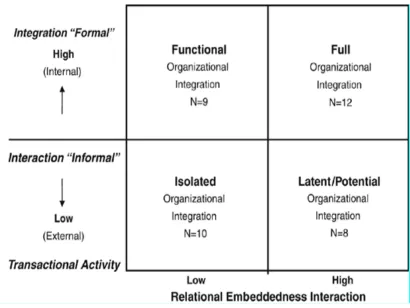
initiatives. The authors reference the Donor/Organization Integration Model (DOIM) as
a way to work with current and future donors. The chart below (Table 2.1) depicts this
model, showing the quadrants and areas of activity that were shown to result in higher
yields of gifts. Each quadrant of the model correlates to, at a minimum, some level of
Table 2.1
Donor/Organization Integration Model
There are other sources on the topic of donor behavior that deal more directly
with wealth transfer and characteristics of the next generation of philanthropists.
Routley, Sargeant, and Scaife (2007) address the large amount of expected wealth
transfer over the next 50 years, the reasons individuals make large bequests, and what
prompts their motivation to give (such as affinity with the mission or the personal estate
planning benefits enjoyed when including a charitable organization as a beneficiary).
Especially pertinent to this study is research that has concluded that satisfaction as
students and later as alumni makes a positive difference in giving. Clotfelter (2001)
important when the definition of satisfaction includes the student approving of the
academic experience that prepared him or her for life post-graduation. Gaier (2005)
specifically correlates student satisfaction regarding their undergraduate experience with
whether or not a pattern of charitable giving begins post-graduation. Survey results
indicate that the relationship between alumni involvement and satisfaction with the
academic curriculum and overall classroom experience as a student is in fact relevant.
However, Weerts and Ronca (2009) find that satisfaction is not significant in their study
unless it correlates with the motivation of major benefactors. In that case, they find
satisfaction to be an important factor. In addition, Gaier (2005) presents his research
results as a reference source for development offices and practitioners to implement.
Increases could be found in both alumni contributions and a propensity to participate
when satisfaction with the experience is very high.
Leslie and Ramey (1988) also report that alumni donors tend to have an emotional
attachment that motivates them to repay the school or institution out of gratitude for some
benefit they enjoyed while enrolled. Gaier’s (2005) data also suggest a positive
correlation between age and giving. The most logical single factor in making major gifts
is the donor’s discretionary income, and this typically increases as alumni mature with
age and professional achievement. Gaier (2005) adds a level of empirical analysis to this
theory in his study, and concludes that as alumni increase in age so does their resource
availability to give. Leslie and Ramey (1988) also support this conclusion with their
research findings.
One question this study asked each participant was the city and state in which
motivation at the academies and military colleges. Based on the author’s personal
experience, the level of alumni involvement with the school is higher when the individual
lives closer to campus, but this does not necessarily equate to major donations. Leslie
and Ramey (1988) find supporting evidence for this in their study; the distance which
alumni lived from the main campus had an impact on their giving and participation in
volunteer activities on campus. Results from Leslie and Ramey’s study indicate that
alumni who live in the same state as the university were more likely to give and to
participate with the university than alumni who live further away. Similar circumstances
may or may not be found for the institutions in this dissertation. Thelin & Trollinger
(2014) refer to a study conducted by Indiana University and Johnson, Gossnickle and
Associates regarding the issue of donor motivation, with the institution’s location taken
into account. The report states that if “students and alumni reported a great campus
experience that fostered loyalty and affiliation; a long-serving president; institutional
maturity; a strong national ranking; a high percentage of tenured professors; a relatively
large endowment; regional location, with metropolitan and Northeastern sites being most
favorable; and, a pattern of thoughtful growth” (p.171) then more multi-million dollar
gifts were commonplace and realized by institutions with these organizational
characteristics.
Giving USA (2014) reports that gifts to the education sector accounted for
approximately 16% of total giving to charity during 2013. In addition to the weighted
sector percentage, contributions to education rose almost 9% from 2012 to 2013. This is
a positive trend and in order to capitalize on its success, studies like the Giving USA