International Journal of Emerging Technology and Advanced Engineering
Website: www.ijetae.com (ISSN 2250-2459,ISO 9001:2008 Certified Journal, Volume 4, Issue 7, July 2014)
318
Qualitative Phytochemical Screening and GC-MS Analysis of
Boerhavia diffusa L.
GR Juna Beegum
1, S Suhara Beevy
2, VS Sugunan
31,2
Department of Botany, University of Kerala, Kariavatom, Thiruvananthapuram 695 581
3Deparment of Zoology, University College, Thiruvananthapuram
Abstract—Boerhavia diffusa L. is a plant which is extensively used in folk medicine and little attention has been given to the characterization of secondary metabolites other than rotenoids and alkaloids. The present study was carried out to identify the phytochemical components of the plant using ethanolic, chloroform, petroleum ether and water extracts and to analyse the volatile composition of ethanolic extract by using GC-MS. The phytochemical screening showed the presence of alkaloids, tannins, steroids, flavonoids, saponins, phlobatannins and phenolics. In GC MS, the mass spectrum of the unknown component was compared and interpreted with the spectrum of the known components stored in the National Institute Standard and Technology (NIST) library. The name, molecular weight and structure of the components of the test materials were ascertained. Out of the seventeen chemical constituents identified, the major chemical constituents are N,N'-Ethylenebis (2-[2-hydroxy phenyl] glycine, Tert-Butyl-4-hydroxy anisole, Propionic acid, pentadecanoic acid, silanamine, 9,12,15-Octadecatrienoic acid, and Benzenedicarboxylic acid having the properties like anti-inflammatory, hypocholesterolemic, cancer preventive, hepatoprotective and antiarthritic activities. The presence of various bioactive compounds justifies the use of the plant for various ailments by traditional practitioners. However, isolation of individual phytochemical constituents and its pharmacological activity will definitely give fruitful results.
Keywords— Boerhavia diffusa, phytochemicals, GC MS, NIST library
I. INTRODUCTION
Boerhavia diffusa or red spiderling a component of several ayurvedic and traditional ethnomedical preparations, belongs to the family Nyctaginaceae which is commonly known as, punarnava meaning that which rejuvenates or renews the body. In India, B.diffusa has a long history of medicinal use in the Ayurveda and Unani forms of medicine. Different plant parts are used for flushing out the renal system, to treat seminal weakness, blood pressure and as appetizer, alexiteric, eye tonic etc.
Its roots are used in treating jaundice, ascites, internal inflammations, asthma, piles and the plain juice can be used as an antidote for rat-poisoning (Khare, 2005).
The medicinal values of the plant lies in the bioactive phytochemical constituents that produce definite physiological actions on the human and animal body. A phytochemical is a natural bioactive compound found in plant foods that works with nutrients and dietary fiber to protect against disease. Okwu(2005) suggests that phytochemicals, working together with nutrients found in fruits, vegetables and nuts, may help to slow the aging process and reduce the risk of many diseases, including cancer and heart diseases. Some of the most important bioactive phytochemical constituents are the glycosides, alkaloids, flavonoids, tannins, steroids, terpenoids, essential oils and phenolic compounds (Harbone, 1984). Thus the present study is designed to evaluate the phytochemical profile of B. diffusa,to revealits medicinal and nutritional significance. GC-MS analysis was also carried out to identify the name, molecular weight and structure of the components of the test materials.
II. MATERIALS AND METHODS
The fresh whole plants of B.diffusa were collected from Karyavattom campus, Trivandrum, Kerala during April, 2012. The materials were washed with distilled water and air dried in shade for two weeks at room temperature. The dried sample was milled into powder using an electric blender. The powder was stored in a sample tube and kept it in a refrigerator for further analysis.
A. Plant Extraction
Dried powdered sample (100gm) was extracted by using 500 ml of solvents viz; ethanol, chloroform and petroleum ether for 12 hrs each. The filtered extract was subjected to physiochemical analyses.
B. Phytochemical Profile (Qualitative and Quantitative Methods)
International Journal of Emerging Technology and Advanced Engineering
Website: www.ijetae.com (ISSN 2250-2459,ISO 9001:2008 Certified Journal, Volume 4, Issue 7, July 2014)
319 C. GC-MS Analysis
GC-MS analysis of ethanol extract of the whole plant,
B.diffusa was carried out by following the method of Hema et al., 2010. GC-MS method is a direct and fast analytical approach for identification of terpenoids and steroids and only few grams of plant material is required for the analysis. The importance of the study is due to the biological activity of these compounds. Analysis was performed by using a GC,Varian CP 3800 and MS, Saturn 2200 (VF 5ms 30 X 0.25 system) equipped with Elite-1, fused silica capillary column composed of 5% phenyl-Arylene-95% Dimethyl poly siloxane. The system comprising a COMBIPAL autosampler set under the following conditions: helium (99.999%) was used as carrier gas at a constant flow of 1ml/min and an injection volume of 1μl EI was employed (split ratio of 1:10) injector temperature 250°C; the oven temperature was programmed from 100-2700C at the rate of 50C; total GC running time was 63 minutes. Interpretation on mass spectrum of GC-MS was done by using the database of National Institute Standard and Technology (NIST) having more than 62,000 patterns. The mass spectrum of the unknown component was compared with the spectrum of the known components stored in the NIST library. The name, molecular weight and structure of the components of the test materials were ascertained.
III. RESULTS AND DISCUSSION
A. Phytochemical Profile
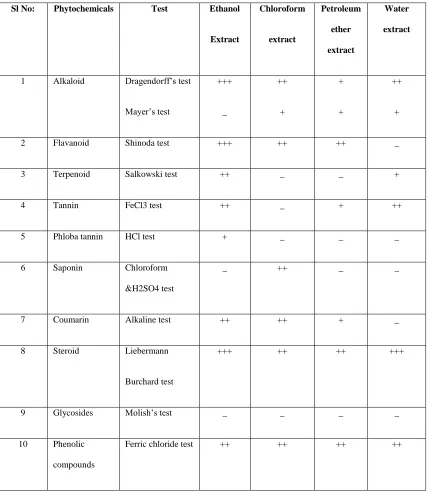
The qualitative analysis (Table I) of the ethanolic, chloroform petroleum ether and water extracts of B.diffusa
revealed the presence of alkaloid, flavanoid, terpenoid, steroid, tannin, phlobatannin and phenolic compounds, whereas cardiac glycosides were absent. Presence of phlobatannin was found only in the ethanolic extract while saponin was present in the chloroform extract. It was observed that almost all the phytochemicals analysed qualitatively were present in the ethanolic extract. Moreover, the highest yield was also observed in ethanol extract and hence this was selected for further studies.
The estimation of phytochemicals revealed that the quantities of flavonoids (5.651g/100g) and phenols (2.471g/100g) were higher than alkaloids (0.232 g/100 g). These results expose that the plant has quite a number of chemical constituents, which may be responsible for many pharmacological actions and have protective or disease preventive properties. Alkaloids are beneficial chemicals to plants with predator and parasite repelling effects (Okaka JC et al.,1992).
As flavonoids having antioxidant property, it protects tissues against oxygen free radicals, thus have a role in prevention of atherosclerosis, cancer, chronic inflammation and may inhibit aging. The polyphenols possess anti parasitic activity, and monoterpenes have been reported to constitute anti-plasmodic, anti-neoplasmic and anti-viral activities (Sharma DK,2006). Presence of flavonoids, phenol and alkaloids in the study revealed that the species may be used as a basic medicinal agent for analgesic, antispasmodic, antibacterial, anti cancer, anti inflammatory and anti oxidant properties. The phytochemical profile of the species gives an insight into its value as a medicinal as well as highly nutritious one, safe for consumption both as a medicine and as a natural source for antioxidant and antioxidant promoting activities
.
B. GC-MS Analysis
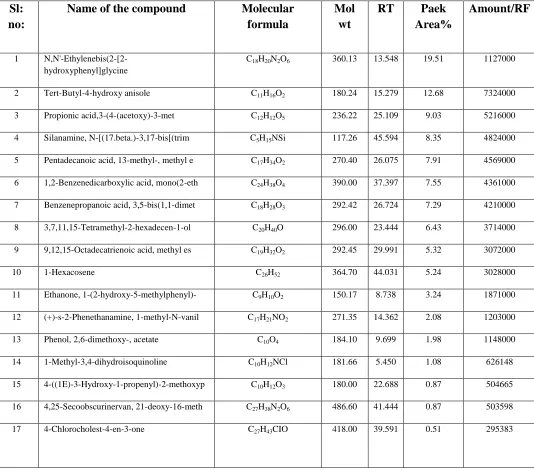
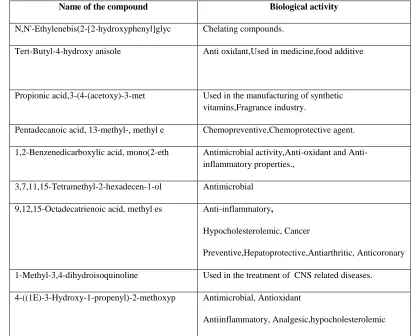
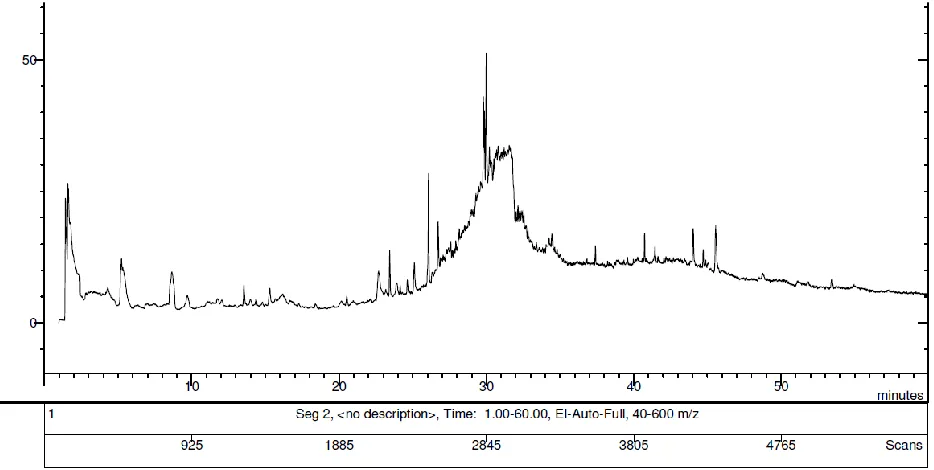
GC-MS chromatogram of the ethanolic extract of B. diffusa (Figure 1) showed 17 peaks indicating the presence of 17 phytochemical constituents. All the constituents were characterized and identified by comparison of the mass spectra of the constituents with the NIST library. The active principles with their retention time (RT), molecular formula, molecular weight (MW) and concentration (%) are presented in Table II. The prevailing compound wasN, N'-Ethylenebis(2-[2-hydroxyphenyl])glycine(19.51%) followed by Tert-Butyl-4-hydroxy anisole(12.68%), Propionic acid (9.03%) and Silanamine(8.35%). Phytochemicals which contributes to the medicinal activity of the plant is listed in Table III. The presence of various bioactive compounds in B diffusa justifies the use of the whole plant for various ailments by traditional practitioners. A detailed study of the various compounds present in B. diffusa and their pharmaceutical importance requires to be carried out such that a drug with multiple effects can be made available in near future.
IV. CONCLUSION
International Journal of Emerging Technology and Advanced Engineering
Website: www.ijetae.com (ISSN 2250-2459,ISO 9001:2008 Certified Journal, Volume 4, Issue 7, July 2014)
320 Acknowledgement
The authors are greatful to Dr. P M Radhamany, Head, Department of Botany, University of Kerala for providing the facilities.
REFERENCES
[1 ] Boham, A.B and Kocipai, A.C. 1994 Flavonoid and condensed tannins from Leaves of Hawaiian vaccininum vaticulum and vicalycinium. Pacific Sci. 48: 458-463.
[2 ] Harbone, J.B. 1984 Phytochemical Methods, 2nd EdnChampion and Hall Publishers, London. 84-196.
[3 ] Hema, R., Kumaravel, S., Gomathi, S and Sivasubramaniam, C .2010 Gas chromatography-Mass spectroscopic analysis of Lasonia inermis leaves. New York Sci. J,3(11): 141-143.
[4 ] Khare, C.P. 2004 Encyclopedia of Indian Medicinal Plant. Rational Western Therapy, Ayurvedic and other Traditional usage Botany, Springer-Verlag Berlin Heidelberg NewYork.104.
[5 ] Obadoni, B.O. and Ochuko, P.O. 2001 Phytochemical studies and Comparative efficacy of the crude extracts of some homeostatic plants in Edo and Delta States of Nigeria, Global Pure App Sci. 8:203-208.
[6 ] Okaka, J.C., Enoch, N.J and Okaka, N.C. 1992 Human nutrition: an integrated approach. Enugu,ESUT Publications. 57-58.
[7 ] Okwu, D.E.2005 Phytochemicals, vitamins and mineral contents of two Nigeria medicinal plants. Int J Mol Med Adv Sci. 1:375-381. [8 ] Sharma, D.K. 2006 Bioprospecting for drug research and functional foods for the prevention of diseases-role of flavonoids in drug development, Journal of Scientific & Industrial Research. 2:391-401. [9 ] Trease, G.E. and Evans, W.C. 1989 Pharmacognosy, 11th edn.
International Journal of Emerging Technology and Advanced Engineering
Website: www.ijetae.com (ISSN 2250-2459,ISO 9001:2008 Certified Journal, Volume 4, Issue 7, July 2014)
[image:4.612.94.522.157.652.2]321 TABLE I
Phytochemical Constituents of B.diffusa detected by preliminary phytochemical screening Sl No: Phytochemicals Test Ethanol
Extract
Chloroform
extract
Petroleum ether
extract
Water extract
1 Alkaloid Dragendorff’s test
Mayer’s test
+++
_
++
+
+
+
++
+
2 Flavanoid Shinoda test +++ ++ ++ _
3 Terpenoid Salkowski test ++ _ _ +
4 Tannin FeCl3 test ++ _ + ++
5 Phloba tannin HCl test + _ _ _
6 Saponin Chloroform
&H2SO4 test
_ ++ _ _
7 Coumarin Alkaline test ++ ++ + _
8 Steroid Liebermann
Burchard test
+++ ++ ++ +++
9 Glycosides Molish’s test _ _ _ _
10 Phenolic
compounds
International Journal of Emerging Technology and Advanced Engineering
Website: www.ijetae.com (ISSN 2250-2459,ISO 9001:2008 Certified Journal, Volume 4, Issue 7, July 2014)
[image:5.612.41.575.159.630.2]322 TABLE II
Phytocomponents identified in the ethanolic extract of B.diffusa using GC MS.
Sl:
no:
Name of the compound
Molecular
formula
Mol
wt
RT
Paek
Area%
Amount/RF
1 N,N'-Ethylenebis(2-[2-hydroxyphenyl]glycine
C18H20N2O6 360.13 13.548 19.51 1127000
2 Tert-Butyl-4-hydroxy anisole C11H16O2 180.24 15.279 12.68 7324000
3 Propionic acid,3-(4-(acetoxy)-3-met C12H12O5 236.22 25.109 9.03 5216000
4 Silanamine, N-[(17.beta.)-3,17-bis[(trim C5H15NSi 117.26 45.594 8.35 4824000
5 Pentadecanoic acid, 13-methyl-, methyl e C17H34O2 270.40 26.075 7.91 4569000
6 1,2-Benzenedicarboxylic acid, mono(2-eth C24H38O4 390.00 37.397 7.55 4361000
7 Benzenepropanoic acid, 3,5-bis(1,1-dimet C18H28O3 292.42 26.724 7.29 4210000
8 3,7,11,15-Tetramethyl-2-hexadecen-1-ol C20H40O 296.00 23.444 6.43 3714000
9 9,12,15-Octadecatrienoic acid, methyl es C19H32O2 292.45 29.991 5.32 3072000
10 1-Hexacosene C26H52 364.70 44.031 5.24 3028000
11 Ethanone, 1-(2-hydroxy-5-methylphenyl)- C9H10O2 150.17 8.738 3.24 1871000
12 (+)-s-2-Phenethanamine, 1-methyl-N-vanil C17H21NO2 271.35 14.362 2.08 1203000
13 Phenol, 2,6-dimethoxy-, acetate C10O4 184.10 9.699 1.98 1148000
14 1-Methyl-3,4-dihydroisoquinoline C10H12NCl 181.66 5.450 1.08 626148
15 4-((1E)-3-Hydroxy-1-propenyl)-2-methoxyp C10H12O3 180.00 22.688 0.87 504665
16 4,25-Secoobscurinervan, 21-deoxy-16-meth C27H38N2O6 486.60 41.444 0.87 503598
International Journal of Emerging Technology and Advanced Engineering
Website: www.ijetae.com (ISSN 2250-2459,ISO 9001:2008 Certified Journal, Volume 4, Issue 7, July 2014)
[image:6.612.96.511.159.495.2]323 TABLE III
Bioactivity of phytocomponents identified in the ethanolic extract of B. diffusa.
Name of the compound Biological activity
N,N'-Ethylenebis(2-[2-hydroxyphenyl]glyc Chelating compounds.
Tert-Butyl-4-hydroxy anisole Anti oxidant,Used in medicine,food additive
Propionic acid,3-(4-(acetoxy)-3-met Used in the manufacturing of synthetic vitamins,Fragrance industry.
Pentadecanoic acid, 13-methyl-, methyl e Chemopreventive,Chemoprotective agent.
1,2-Benzenedicarboxylic acid, mono(2-eth Antimicrobial activity,oxidant and Anti-inflammatory properties.,
3,7,11,15-Tetramethyl-2-hexadecen-1-ol Antimicrobial
9,12,15-Octadecatrienoic acid, methyl es Anti-inflammatory,
Hypocholesterolemic, Cancer
Preventive,Hepatoprotective,Antiarthritic, Anticoronary
1-Methyl-3,4-dihydroisoquinoline Used in the treatment of CNS related diseases.
4-((1E)-3-Hydroxy-1-propenyl)-2-methoxyp Antimicrobial, Antioxidant
International Journal of Emerging Technology and Advanced Engineering
Website: www.ijetae.com (ISSN 2250-2459,ISO 9001:2008 Certified Journal, Volume 4, Issue 7, July 2014)
[image:7.612.75.542.134.369.2]324