
International Journal of Emerging Technology and Advanced Engineering
Website: www.ijetae.com (ISSN 2250-2459,ISO 9001:2008 Certified Journal, Volume 5, Issue 10, October 2015)
369
Efficient Spectrum Utilization in Cognitive Radio Wireless
Sensor Networks (CR-WSNs)
R. C Diovu
1, C. C Okezie
2, G. N Onoh
31,2,3Department of Electronic & Computer Engineering, Nnamdi Azikiwe University, Awka, Anambra State of Nigeria 2,3Department of Electrical and Electronic Engineering, Enugu State University of Science and Technology, Enugu State of
Nigeria
Abstract-- The radio frequency spectrum is a natural resource which ought to be exploited maximally. It has remained a major source of revenue to many countries of the world today. This brings to the fore the issue of spectrum assignment policy and management. Studies have shown that inefficient policies in spectrum assignment and management have brought about the underutilization of the available spectrum. This perceived problem has limited the deployment of new services such as the wireless sensor networks that are needed for various services and applications. Cognitive Radio is an emerging technology that has an assurance of increasing the efficiency in the utilization of the scarce spectrum resource. Therefore, adding cognitive radio abilities to the existing wireless sensor networks creates a new domain of services which might not only interest the next generation mobile user but also will increase the revenue generation for the licensed spectrum users. This paper provides an overview of the architecture of CR-WSNs, spectrum management/assignment policies and other approaches for increasing spectrum utilization in a Cognitive Wireless Sensor Networks.
Keywords-- Cognitive radio wireless sensor networks (CR-WSNs), Dynamic spectrum access, Licensed (Incumbent) user, Nigeria Communications Commission (NCC), Secondary (Cognitive radio) user, Static assignment policy.
I. INTRODUCTION
There is currently a perceived problem of spectrum shortage created by the fast evolution of Wireless
Communications Networks. The International
Telecommunication Union Recommendation Sector (ITU-R) in ITU-R 2005 and recently in ITU-R 2011d had predicted that the demand for more mobile services would keep increasing towards the year 2020. This predicted growth in data rates would inevitably bring about an increase in the demand for spectrum. This problem of spectrum shortage is not only due to real scarcity of the available spectrum, but also due to inefficient policies in spectrum management. In fact, today’s wireless communication networks are characterized by a fixed spectrum assignment policy, which often leads to wastage of large portions of the already limited available spectrum.
Recent studies have shown that sizeable portions of the assigned spectrum are usually underutilized. Cognitive Radio has been proposed as a promising technology to solve the imbalance between spectrum scarcity and spectrum underutilization. On the other hand, the increased deployment of Wireless Sensor Networks in the unlicensed bands for various applications raises more concern for a better spectrum management policy to be put in place. To drastically reduce the perceived problem of spectrum shortage, Wireless sensor networks enabled with cognitive Radio ability could access the unlicensed bands at will when there is less contention for spectrum resources by other wireless networks sharing the unlicensed bands. In the event that the unlicensed bands become crowded, the CR-WSNs can sense this highly contentious situation, dynamically migrates to the white spaces in the licensed bands with the intension of vacating this band the moment its communications begins to interfere unduly with that of the primary user (PU).
II. OVERVIEW OF AWIRELESS SENSOR NETWORKS
International Journal of Emerging Technology and Advanced Engineering
Website: www.ijetae.com (ISSN 2250-2459,ISO 9001:2008 Certified Journal, Volume 5, Issue 10, October 2015)
370
Figure I: A typical Architecture of a Wireless Sensor Networks [1]III. COGNITIVE RADIO WIRELESS SENSOR NETWORKS
(CR-WSNS)
Incorporating Cognitive Radio capability to a Wireless Sensor Networks results in a Wireless Communication paradigm known as Cognitive Radio Wireless Sensor Networks (CR-WSNs) or simply Cognitive Wireless Sensor Networks (CWSNs). CRWSN is a distributed network of Wireless Cognitive Radio nodes, which can sense an event signal and collaboratively communicating their readings dynamically over available spectrum channel in a multi-hop manner, ultimately to satisfy the application-specific requirements [2]. The International Telecommunication Union Recommendation Sector (ITU-R) has defined a Cognitive Radio System as a radio system that has in-built technology that allows the system to obtain knowledge of its operational and geographical environment, established policies and its internal state; to dynamically and autonomously adjust its operational parameters according to the knowledge it obtained in order to achieve some predefined objectives. In order words, a Cognitive Radio System has got some capabilities to obtain useful knowledge from its environment or location in order to make necessary decisions and adjustments so as to learn from the results. Specifically, CR-WSNs can obtain knowledge of the current spectrum availability or occupancy with a view to making very important decisions on which channel to access and when to access such channels.
[image:2.612.334.555.270.553.2]The potential advantages of such systems over traditional Wireless Sensor Networks include: improved spectrum efficiency utilization and increased flexibility in spectrum management that can give room for the deployment of new mobile wireless applications. The architectural model of CR-WSN shown in figure 2, shows a primary user (incumbent user) communicating within a licensed band, and a secondary user also known as a cognitive user operating in the unlicensed band and also waiting to use opportunistically the licensed band during the idle periods of primary users.
Figure II: The Architecture of a cognitive radio wireless sensor network (CR-WSNs) [1].
IV. SPECTRUM ASSIGNMENT POLICIES
International Journal of Emerging Technology and Advanced Engineering
Website: www.ijetae.com (ISSN 2250-2459,ISO 9001:2008 Certified Journal, Volume 5, Issue 10, October 2015)
371
In this static or fixed assignment policy, licenses are usually issued to users or operators for the usage of certain frequency bands. When this license is issued, an operator or a user has the exclusive right over the allocated spectrum on a long-term basis. This method of spectrum assignment policy has resulted in the allocation of the entire spectrum in many countries today. As a result, the deployment of new wireless services like WSNs which are utilized for very crucial, emergency and mission critical services becomes very difficult. In addition, the price involved in acquiring licenses under the fixed static assignment policy is usually very costly. This does not include the cost of acquiring and deploying a robust network infrastructure that could guarantee services to the end users. In addition, monitoring and enforcing laid down rules from the regulatory bodies under fixed static spectrum assignment policy raises some legal issues between the licensed users and regulators.
In a dynamic assignment policy, new services can be accommodated by redefining the spectrum that has been assigned to existing services that utilize the spectrum sparsely [4]. The DSA policy can proactively make open the licensed spectrum frequency bands to unlicensed users on the condition that unlicensed users do not interfere unduly with the communications of licensed users. Under this new spectrum management system, an unlicensed user in addition to having all the rights to access the unlicensed spectrum could be allowed to access opportunistically the licensed spectrum bands as long as it does not constitute a harmful interference to licensed users during its communication periods. Cognitive Radio has emerged as a promising technology to enable the access of the intermittent periods of unoccupied frequency bands called white spaces, thereby increasing spectral efficiency [5, 6]. The different agencies and bodies saddled with the responsibility of managing frequency spectrum in different countries have begun investigations into this purported claim about spectrum scarcity. This has led to several spectrum occupancy measurements that have been conducted mostly in the United States, Europe and recently Asia to ascertain the utilization level of the allocated spectrum. From the study conducted in [4], it was observed that a large portion of the assigned spectrum was used sporadically. The spectrum usage was concentrated over certain portions of the spectrum leaving spectrum holes or white spaces on other portions of the spectrum. To corroborate the claim of [4], the federal communications commission in the United States conducted another study in [7], which reported temporal and geographical variations in the utilization of the assigned spectrum.
V. DYNAMIC SPECTRUM ACCESS MODELS
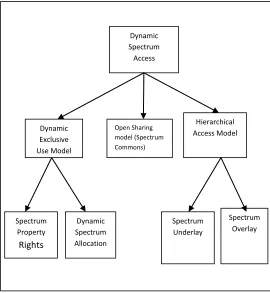
The main idea behind Dynamic Spectrum Access lies in the ability of the CR-WRSNs to identify licensed radio frequency bands which are free or underutilized (spectrum holes or white spaces), using them to communicate and vacating those bands the moment its communications begins to interfere with the communication of incumbent users. In the dynamic spectrum model (Peng et al 2006), it is assumed that the primary users may not always use the spectrum. Hence, the secondary users can opportunistically utilize the spectrum when it is not being occupied by the licensed users. Three main functions in dynamic spectrum access have been captured in [8], and they include: spectrum awareness, cognitive processing and spectrum access. Spectrum awareness creates awareness about the radio frequency environment while spectrum access provides the ways to use the available spectrum opportunistically for efficient reuse. Cognitive processing relies on the intelligence of the radio which helps to make important decisions like learning from the environments, adjusting its operating parameters based on the results learned from its environment. As illustrated in figure 3 below, dynamic spectrum access strategies have been broadly categorized under three models.
A.Dynamic Exclusive Use Model
International Journal of Emerging Technology and Advanced Engineering
Website: www.ijetae.com (ISSN 2250-2459,ISO 9001:2008 Certified Journal, Volume 5, Issue 10, October 2015)
372
B. Open Sharing Model
The open sharing model otherwise known as spectrum commons model encourages open sharing of spectrum resources among peer spectrum users. Every user under this model has equal rights to use the spectrum. The proponents of this model are backed up by the success recorded by wireless services operating in the unlicensed Industrial, Scientific and Medical band (ISM band) (e.g WiFi). Three types of spectrum commons model [12, 13] were highlighted as uncontrolled commons, managed commons and private commons. When the uncontrolled commons is implemented, no entity has exclusive license to the spectrum band. Themanaged commons strives to avoid the tragedy of commons by imposing some restrictions on when and how to use the spectrum resource. The concept of private commons was introduced by the federal Communication Commission (FCC) in its second report on the elimination of barriers to the development of secondary markets for the scarce spectrum. This model encouraged the use of advanced technologies which allowed multiple users to access the spectrum.
C.Hierarchical Access Model
Under the hierarchical access model, unlicensed users make use of the spectrum in such a way that interference to licensed users is limited to the minimum. Three approaches to this model have been proposed [14] and they include: inter-weave, underlay and the overlay. The inter-weave strategy consists in utilizing the white spaces or spectrum holes unused by licensed users to establish communication between unlicensed users. The underlay strategy ensures that secondary user’s communications are always maintained below the maximum allowable interference temperature at the primary user’s receiver [14]. Finally, the overlay approach allows the SUs cooperating with the Pus while transmitting their own signal.
[image:4.612.323.593.232.525.2]In other words, SUs devote part of its transmit power to enhance the primary signal and facilitate its detection at the primary receiver. In exchange for this gesture, they may be allowed to increase the interference temperature above the level permitted in the underlay approach. It is believed that this approach may be widely accepted by licensed users owing to the fact that the SUs contributed in improving the detection of Pus.
Figure IV: Taxonomy of Dynamic Spectrum Access Models
Dynamic Spectrum
Access
Dynamic Exclusive Use Model
Open Sharing model (Spectrum Commons)
Hierarchical Access Model
Spectrum Property Rights
Dynamic Spectrum Allocation
Spectrum Underlay
International Journal of Emerging Technology and Advanced Engineering
Website: www.ijetae.com (ISSN 2250-2459,ISO 9001:2008 Certified Journal, Volume 5, Issue 10, October 2015)
[image:5.612.80.275.171.527.2]373
Figure 3: Approaches of the Hierarchical Access Model [14].VI. SPECTRUM MANAGEMENT POLICY
Unlike most natural resources, the radio spectrum as a result of its unique features is not consumed by usage. This natural resource is therefore infinitely renewable. In Nigeria, for example, radio frequency spectrum is one of the key natural resource which is of great economic value as a result of its direct application in telecommunications, broadcasting, military operations, and scientific research in addition to a range of other socio-economic activities such as social services, law enforcement, education, healthcare and transportation. As such, many industries depend heavily on the efficient utilization of radio frequency spectrum [15].
As a result of the above mentioned factors, comprehensive and clear-cut policies are needed in Nigeria and even beyond to ensure proper and efficient management of the spectrum resource. In [16], spectrum management has been defined as the process of regulating the use of radio frequencies to promote efficient utilization and gain a net social benefit. The government of Nigeria charged the Nigerian Communications Commission (NCC) with the responsibility of developing and adopting polices in accordance with the policy objectives given below which will ensure that this scarce resource is well managed in its area of responsibility.
NCC Frequency Management Policy Objectives [15]: To control and encourage the use of spectrum as an
instrument for developing telecommunication which is an essential infrastructure for stimulating the economic growth and social development of the nation.
To promote competition in the assignment of frequency in order to ensure innovative and efficient use of the radio spectrum (as a scarce resource).
To achieve optimum pricing of spectrum in order to discourage wastage or speculative acquisition of the scarce resource.
To generate moderate revenue for government.
To ensure equitable and fair allocation of spectrum to benefit the maximum number of users.
In order to achieve the above management policy objectives, NCC was empowered to perform the following functions: [15]
Spectrum Planning: Plan the spectrum in order to
make adequate provision for various services based on their relative importance to Nigeria’s socio-economic goals and also make forecast for future requirements.
Frequency Assignment: Evolve fair, equitable and
transparent procedures and conditions for the allocation and assignment of spectrum.
Spectrum Farming: Continually and systematically
phase out ageing technologies in order to free up new spectrum space for allocation to emerging technologies and new services.
Licensing: Develop effective rules, operational
procedures/guidelines for the purpose of regulating the use of spectrum in order to encourage sharing and ensure minimum interference with other users.
Technical Specifications: Define technical utilization
International Journal of Emerging Technology and Advanced Engineering
Website: www.ijetae.com (ISSN 2250-2459,ISO 9001:2008 Certified Journal, Volume 5, Issue 10, October 2015)
374
Enforcement: Impose fines, penalties and sanctions
for any violation of spectrum rules in order to maintain discipline in the use of spectrum.
Monitoring: Monitor the use of spectrum for
interference and occupancy levels in order to take corrective actions when necessary and to provide information feedback for planning, management control and decision-making.
Consultation: Hold regular consultation with experts
in the industry including consultants and members of the academia in order to draw from their wealth of field experience and research findings in the area of spectrum management.
Liaison: Maintain close liaison with all stakeholders
in the industry including operators, other regulating bodies, Manufacturers, ITU, Professional Groups, security agencies and the general public in the spirit of participatory regulation.
Tariff and Pricing: Determine fees payable for
spectrum and evolve effective machinery for its collection.
The authors in [16] captured the general activities involved in spectrum management as: planning, authorization, engineering and monitoring.
Spectrum planning involves the allocation of portions of the frequency spectrum to specified users in accordance with international agreements, technical characteristics and potential use of different parts of the spectrum, and national priorities and policies.
Spectrum authorization involves granting access under certain specified conditions to the spectrum resource by various types of radio communication equipment and the certification of radio operators.
Spectrum engineering involves the development of electromagnetic compatibility standards for equipment that emits or is susceptible to radio frequencies.
Spectrum monitoring and compliance involves the monitoring of the use of the radio spectrum and the implementation of measures to control unauthorized use [17].
The approaches to spectrum management as utilized in many countries today and as highlighted above ensures that licensed users of the spectrum are strongly protected from harmful interference. However, this management approach has led to the inefficient use of the spectrum. Another perceived short coming of this management approach is that the spectrum allocation procedures were lengthy and bureaucratic [16].
In addition, regulatory bodies may be tempted to favour highest bidders at the expense of prospective users that have the technology that can use the spectrum more efficiently. No matter the success rate in managing the spectrum under this approach, it is not usually very clear to which extent the assigned spectrum is utilized. In what looks like an attempt to shift from the former approach, a new spectrum management system has been proposed in Nigeria by NCC. The Commission is putting in place a modern Spectrum Management and Monitoring System (SMMS) [18]. As part of the SMMS implementation, detailed information is required about current and continuing utilization of frequencies assigned to telecommunications operators, equipment operating on those frequencies and sites/locations where they are deployed. The information is required for creating a geo-location database on the utilization of radio spectrum frequencies and associated information that would be constantly updated. The records will provide an invaluable resource for: facilitating resolution of interference, spectrum planning, policy; and the overall spectrum management strategy of the Commission.
VII. GAME THEORY APPROACHES FOR IMPROVING
SPECTRUM UTILIZATION
International Journal of Emerging Technology and Advanced Engineering
Website: www.ijetae.com (ISSN 2250-2459,ISO 9001:2008 Certified Journal, Volume 5, Issue 10, October 2015)
375
On the other hand, Utility Set (U) is a set consisting of utility or payoff functions for all players (where U = U1, U2, U3, …, Un).With regards to cognitive radio networks, two major types of game theory have been proposed in the literature as cooperative game theory and the non-cooperative game theory [20, 22]. The non-cooperative game theory considers that all cognitive radio users are cooperative and aims to maximize total network performance by achieving a Nash bargaining state. Individual user shares vital information like utility with other network users. The non cooperative game theory considers the cognitive radio users as rational users who aim to maximize their own utility in terms of spectrum resources. This type of game converges at Nash equilibrium state with individual user not having access to the strategies and payoff of other users. The Nash equilibrium [23] is defined as a set of strategies for all the users such that no user can improve his/her utility by unilaterally deviating from the equilibrium strategy as long as other users adopt the equilibrium strategies. It does imply that the Nash equilibrium indicates that no individual user would have the incentive to choose a different strategy. In cognitive networks, the competition and cooperation among the cognitive network users can be modeled as a spectrum sharing game [23]. Specifically, the SUs who compete for unlicensed spectrum are the players in the open spectrum sharing model. In the licensed spectrum sharing model, the Pus can lease their unused spectrum bands to the SUs and the players in this type of model include the Pus and SUs. The strategy space for each type of player will therefore depend on the type of spectrum sharing model adopted. For example, the strategy space of SUs in open spectrum sharing may include the transmission parameters they may want to adopt. These parameters include: access rates, transmission powers, time duration etc. On the other hand, the strategy space for the licensed sharing model include the licensed bands that the Pus may want to rent and how much they would be charged for leasing such licensed frequency bands. The utility functions for different users are then defined accordingly in order to characterize various performances criteria. In open spectrum sharing, the utility function for the SUs is usually defined as a non-decreasing function of the quality of service (QoS) which they receive by utilizing the unlicensed band. The utility function for the Pus in the licensed sharing model often represents the monetary gains they derive by leasing the licensed bands. Serious research effort has been made by several researches on using game theory to solve the problem of spectrum allocation in cognitive radio networks.
Gesualdo Scutari et al [24] proposed a non-convex game and used the optimization theory to analyze comprehensively the existence and uniqueness of a standard Nash equilibrium. Their proposed algorithm can be used for both cooperative and non-cooperative cognitive radio network scenarios. The authors in [25] considered using the cooperation game theory to solve the potential problems that might arise when a PU and multiple SUs share the spectrum. At first, the authors designed a static game where all the SUs had to adopt the initial strategies and the mutual information and then afterwards, had to adjust their strategies iteratively according to the last state observations. Wenson Chang et al [26] proposed a novel spectrum leasing game for the underlay cognitive radio network using rate-based pricing strategy for PU. This strategy can decrease significantly the communication signaling overhead. In addition, both the PU and the SU can simultaneously maintain a high transmission rates such that spectrum efficiency can be improved upon. The research done in [27] Proposed a network assisted cooperative game theory which guarantees the PU’s required QoS. The authors in their proposal developed a framework for spectrum allocation where a group of SUs access the spectrum of PUs operating in a Cellular OFDMA based network. According to the proposal, both PUs and SUs send to the PU’s base station their power limitation and channel state information and the base station responds by calculating the optimum sub-channel and power allocation for all the users. In [28], the authors assume the players to be selfish (players who seek to maximize their own profits) and that the PU do not have knowledge of their environment such that they are unaware of the presence of SUs, and the SUs are allowed an opportunistic access to the spectrum. In summary, there is no gainsaying the fact that game theory has been widely used in developing algorithms that can enhance spectrum utilization in cognitive radio networks. However, the major drawback of this approach is that utility functions and the game formulation must be carefully structured in order to achieve the required Nash bargaining state or equilibrium as this may not always be guaranteed. In addition, most propositions on the use of game theory for solving one problem or the other in cognitive radio networks have not been extended to the domain of cognitive radio wireless sensor networks.
VIII. OTHER APPROACHES FOR IMPROVING SPECTRUM
UTILIZATION
International Journal of Emerging Technology and Advanced Engineering
Website: www.ijetae.com (ISSN 2250-2459,ISO 9001:2008 Certified Journal, Volume 5, Issue 10, October 2015)
376
Elias Z. Tragos et al [29] highlighted other approaches which could increase the efficiency of the spectrum utilization in cognitive networks as: Heuristics, Graph theory, and Fuzzy Logic.
A.Heuristics Approach
The heuristics approach is targeted at developing iterative algorithms which aims to find at each iteration, the best solution (for example the best available channel with higher utility) for the SU. The advantage of this approach is its simplicity and ease of implementation and in many cases; they can find high quality solutions. However, there is no known analytical methodology for studying their convergence properties and they get stuck in local optimal solutions which can be far from the global solution. In addition, heuristics approaches appear to be problem-independent in theory, whereas most of the developed heuristic approaches are problem-specific and cannot be used for other problems. Finally, the problem of finding an optimal solution for cognitive spectrum assignment or management has often high complexity and determining good solutions becomes very difficult.
B.Graph Theory Approach
The graph theory approach visualizes every network as a graph where the vertices correspond to the network nodes and the edges correspond to the connections between the nodes. Network graphs have been used extensively in the domain of cognitive spectrum assignments especially for cases where the structure of the network is known a priori [30]. Several techniques according to the available literature have been used in solving the graph-based spectrum assignment problems. The most common technique is to construct the network conflict graph that captures the interference between neighbor SU nodes [31, 32]. A conflict graph can be simple, weighted, multipoint or dynamic [29]. The weights on the edges represent the interference model or the required channel separation between the links in the weighted conflict graph. In cases where it is believed that a single SU is transmitting to multiple receivers, the multi-point conflict graphs are preferred. On the other hand, the dynamic conflict graph approach is used to capture the possible changes in the interference due to previous assignments. Two types of cognitive radio network graph have been identified in [33] as: Node Contention Graph and Link Contention Graph. In node contention graph, cognitive users are represented by nodes while edges indicate that two nodes are in the interfering range of each other. In the link contention node, the vertex represents active flows while the edges represent a contentionbetween different flows.
One major drawback of the proposed algorithms based on graph theory as shown from available literature to the best ofour knowledge have considered networks with SUs only
.
Future works on algorithm proposals or developments based on the graph theory ought to expand the existing scope to accommodate PUs and with particular attention given to CR-WSNs.C.Fuzzy Logic Approach
International Journal of Emerging Technology and Advanced Engineering
Website: www.ijetae.com (ISSN 2250-2459,ISO 9001:2008 Certified Journal, Volume 5, Issue 10, October 2015)
377
D.Markov Decision Process (MDP) Approach
The viability of using Markov decision process to optimize decisions that could impact the utilization of radio frequency spectrum was proposed in [37]. These decisions may include: admission decisions, modulation choice decisions, transmitter power level decisions, and other decisions that could improve the utilization efficiency of the scarce spectrum. The authors formulated three distinct hypotheses, developed the hypotheses and conducted experiments to access each of the hypotheses. The empirical results from the experiments were all in support of the formulated hypotheses. However, the research dealt primarily on admission optimization decision. In other words, the research work can be extended in the future to accommodate decisions like choice of modulation and transmitter power level decisions. In another development, the problem of cognitive access of multiple continuous-time Markovian channel was considered in [38]. According to the authors, the problem was simplified by restricting the spectrum sensing policy to a periodic sensing scheme and this changed the problem from a partially observable Markov decision process with constraint to a constrained finite state Markov decision process. At the end, the authors referred the resulting algorithm as “optimal spectrum access with periodic sensing (PS-OSA). The structure and the fundamental limit of a single continuous-time Markovian channel was investigated in [39]. In their work, the authors considered the optimal transmission policy with arbitrary sensing and transmission periods which is comparably small.
IX. CONCLUSION
This paper has presented an overview of the different approaches for improving the utilization of the scarce radio frequency spectrum. It has highlighted the architecture of CR-WSNs as well as policies employed in spectrum management and assignment. There is therefore no gainsaying the fact that many research papers have proposed different approaches for improving spectrum utilization efficiency in cognitive wireless networks. However, a major revelation from this paper shows that a lot of research work is needed urgently to expand this new domain of research to address peculiar issues relating to resource-constrained and self organizing networks like CR-WSNs.
REFERENCES
[1] Gyanendra Prasad Joshi, SeungYeob Nam and Sung Won Kim, “Cognitive Radio Wireless Sensor Networks: Applications, Challenges and Research Trends” Sensors, vol. 13, 2013 pg 11196-11228 Available at www.mdpi.com/journal/sensors
[2] K.A Yau, P. Komisarczuk, and P.D Teal, “Cognitive Radio-based Wireless Sensor Networks: Conceptual Design and Open Issues” Second IEEE Workshop on Wireless and Internet Services (WISe 2009), 2009.
[3] FCC Spectrum Policy Task Force, “Report of the spectrum efficiency working group” Nov. 2002, Available online at http://www.fcc.gov/spect/reports.html.
[4] S. Ellingson, “Spectral Occupancy at VHF: Implications for Frequency-Agile Cognitive Radios,” in IEEE Vehicular Technology Conference, vol.2 (Dallas), pp. 1379–82, September 2005.
[5] I.F Akyildiz, W.Y. Lee, M.C Vuran and S.Mohanty “Next generation/dynamic spectrum access/ cognitive radio wireless networks: a survey, Computer Networks 50(13) (2006) pg 2127-2159.
[6] I.F Akyildiz, W.Y. Lee, K.R Chowdhury, “CRAHNs: cognitive radio ad hoc networks” Ad Hoc Networks 7 (5) (2009) Pg 810-836
[7] FCC, ET Docket No 03-222 Notice of proposed rule making and order, December 2003.
[8] Goutam Ghosh, Prasun Das and Subhajit Chatterjee, “Cognitive Radio and Dynamic Spectrum Access- A study” International Journal of Next-Generation Networks Vol. 6, No. 1, March 2014 [9] R. Coase, “The federal communications commission,” J. Law and
Economics, pp. 1-40, 1959
[10] D. Hatfield and P.Weiser, “Property rights in spectrum: Taking the next step,” in Proc.1st IEEE Symp. New Frontiers Dynamic Spectrum Access Networks, Nov. 2005, pp. 43-55.
[11] L.Xu, R. Tonjes, T. Paila, W.Hansmann, M. Frank, and M. Albrecht, “DRiVE-ing to the Internet: Dynamic radio for IP services in vehicular environments” in Proc. 25th
Annual IEEE Conf. Local Computer Networks, Nov. 2000, pp. 281 – 289
[12] M.Fitch, M. Nekovee, S. Kawade, K. Briggs, R. MacKenzie, “Wireless service provision in TV white space with cognitive radio technology: A telecom operator’s perspective and experience”, Communications Magazine, IEEE, Vol. 49, No. 3, pp. 64, 73, 2011. [13] Qing Zhao, B.M Sadler, “A survey of dynamic spectrum access”,
Signal Processing Magazine, IEEE, Vol. 24, No.3, pp. 79, 89, 2007. [14] Lorenza Giupponi and Christian Ibars (2009), “Cooperative Cognitive Systems, Cognitive Radio Systems,” Wei Wang (Ed.), ISBN: 978-953-307-021-6, InTech, Available at:
http://www.intechopen.com/books/cognitiveradio-systems/cooperative-cognitive-systems.
[15] http://www.ncc.gov.ng/Archive/SpectrumIssues/ Frequency Management policy 07.pdf
[16] Jide Julius Popoola, Rex Van OIst, “A survey on Dynamic Spectrum Access via Cognitive Radio: Taxonomy, Requirements, and Benefits” Universal Journal of Communications and Network 2(4): 70-85, 2014.
[17] M. Cave, A. Foster, R. W. Jones. “Radio Spectrum Management: Overview and Trends” 1 -22, Online available from http://www.itu.int/osg/stn/spectrum/workshop_Nov, 2008.
[18] http://www.ncc.gov.ng/Archive/Spectrum Issues/SMMS/htm [19] D. Fudenberg and J. Tirole, “Game Theory”, Renmin University of
China Publishing Company, (2002).
International Journal of Emerging Technology and Advanced Engineering
Website: www.ijetae.com (ISSN 2250-2459,ISO 9001:2008 Certified Journal, Volume 5, Issue 10, October 2015)
378
[21] J. Neel, R.Menon, J.H Reed and A.B Mackenzie, “Using GameTheory to analyze Physical Layer Cognitive Radio Algorithms” Department of Electrical Engineering, Bradlley, Virginia Tech. [22] Qiufen Ni, Rongbo Zhu, Zhenguo Wu, Yongli Sun, Lingyun Zhou,
and Bin Zhou, “Spectrum Allocation Based on Game Theory in Cognitive Radio Networks” Journal of Networks, vol. 8, N0. 3, March 2013.
[23] Beibei Wang, Yongle Wu, Zhu Ji, K.J Liu, and T. Charles Clancy, “Game Theoretical Mechanism Design Methods” IEEE signal processing magazine vol. 74, Nov. 2008
[24] Gesualdo Scutari and Jong-Shi Pang, “Joint Power Allocation in Nonconvex Cognitive Radio Games: Nash Equilibrium and Distributed Algorithms” IEEE Transactions on Information Theory, Aug. 8, 2012.
[25] Niyato D and Hossain E, “Competitive Spectrum Sharing in Cognitive Radio Networks: A dynamic Game Approach” IEEE Transactions on Wireless Communications, 2008, 7(7): 2651-2660. [26] Wenson Chang, Yu-Ping Lin and Szu-Lin Su, “Spectrum Leasing
Game for Underlay Cogntive Radio Network with Primary System using Adaptive Rate-Based Pricing Strategy” COCORA 2014: The fourth International Conference on Advances in Cognitive Radio. [27] Attar, A, Nakhai M.R and Aghavami, “Cognitive Radio Game for
secondary spectrum access problem” IEEE Transactions on Wireless Communications 8(4), 2121-2131, 2009.
[28] Jiandong Li and Chungang Yang, “A Markovian Game-Theoritical Power Control Approach in Cognitive Radio Networks: A Multi-Agent Learning Perspective” Wireless Communications and Signal Processing (WCSP), 2010.
[29] Elias Z. Tragos, Sherali Zeadally, Alexandros G. Fragkiadakis and Vasilios A. Siris, “Spectrum Assignment in Cognitive Radio Networks: A Comprehensive Survey” IEEE Communications Surveys and Tutorials, 2013.
[30] E. Z Trags, G.T Karetsos, S.A Kyriazakos, and K. Vlahodimitropoulos, “Dynamic segmentation of cellular networks for improved handover performance” Wireless Communications and Mobile Computing, vol. 8, no. 7, pp. 907 – 919, 2008.
[31] A. Plummer and S. Biswas, “Distributed spectrum assignment for cognitive networks with heterogeneous spectrum opportunities” Wireless Communications and Mobile Computing, vol. 11, no. 9, pp. 1239 – 1253, Sept. 2011.
[32] G. Liu, L. Zhou, K. Xiao, B. Yu, G. Zhou, B. Wang and X. Zhu, “Receiver-Centric Channel Assignment Model and Algorithm in Cognitive Radio Network” 4th International Conference on Wireless Communications, Networking and Mobile Computing , 2008. WiCOM ’08, IEEE 2008, pp. 1 – 4.
[33] Antonio De Domenico, Emilio Calvanese Strinati, and Maria-Gabriella Di Benedetto, “A Survey on MAC Strategies for Cognitive Radio Networks” IEEE Commuications Surveys and Tutorials, 2010 [34] A. Yang, Y. Cai and Y. Xu, “A fuzzy collaborative spectrum sensing scheme in cognitive radio” Proc. International Symposium on Intelligent Signal Processing and Communication Systems (ISPACS), pp. 566-569, Xiamen, China, Nov. 2007
[35] N. Baldo and M. Zorzi, “Cognitive network access using fuzzy decision making”, Proc. IEEE International Conference on Communication (ICC), pp. 6594-6510, Glassgow, Scotland, June 2007.
[36] R. Kaniezhil, Daniel Nesa Kumar, A. Prakash, “Fuzzy Logic System for Opportunistic Spectrum Access using Cognitive Radio” International Journal of Computer Science Issues, vol. 10, Issue 1, No.1, January 2013.
[37] J. Meier, B. Karus, S. Sistla, T. Tidwell, R. D Chamberlain, and C. Gill, “Assessing the Appropriateness of using Markov Decision Processes for RF Spectrum Management” in Proc. Of ACM International Conference on Modeling, Analysis and Simulation of Wireless and Mobile Systems (MSWiM), Nov. 2013, pp. 41-48. [38] Qianchuan Zhao, S. Geirhofer, L. Tong, and B.M Sadler,
“Opportunistic Spectrum Access via periodic Channel Sensing” IEEE transactions on Signal Processing, vol. 36, no. 2, pp. 785 – 796, Feb. 2008
![Figure II: The Architecture of a cognitive radio wireless sensor network (CR-WSNs) [1]](https://thumb-us.123doks.com/thumbv2/123dok_us/8696662.878452/2.612.334.555.270.553/figure-architecture-cognitive-radio-wireless-sensor-network-wsns.webp)
![Figure 3: Approaches of the Hierarchical Access Model [14].](https://thumb-us.123doks.com/thumbv2/123dok_us/8696662.878452/5.612.80.275.171.527/figure-approaches-hierarchical-access-model.webp)
