R E S E A R C H
Open Access
A parallel multisplitting method with
self-adaptive weightings for solving
H
-matrix
linear systems
Ruiping Wen
1*and Hui Duan
2*Correspondence: [email protected] 1Higher Education Key Laboratory
of Engineering and Scientific Computing, Taiyuan Normal University, Taiyuan, Shanxi 030012, P.R. China
Full list of author information is available at the end of the article
Abstract
In this paper, a parallel multisplitting iterative method with the self-adaptive weighting matrices is presented for the linear system of equations when the coefficient matrix is anH-matrix. The zero pattern in weighting matrices is determined in advance, while the non-zero entries of weighting matrices are
determined by finding the optimal solution in a hyperplane of
α
points generated by the parallel multisplitting iterations. Especially, the nonnegative restriction ofweighting matrices is released. The convergence theory is established for the parallel multisplitting method with self-adaptive weightings. Finally, a numerical example shows that the parallel multisplitting iterative method with the self-adaptive weighting matrices is effective.
Keywords: linear systems; self-adaptive weightings; convergence; parallel multisplitting;H-matrix
1 Introduction and preliminaries
To solve the large sparse linear system of equations
Ax=b, A∈Rn×nnonsingular andb∈Rn, (.)
O’Leary and White [] first proposed parallel methods based on multisplittings of matri-ces in , where several basic convergence results may be found. A multisplitting ofA
is a collection of triples ofn×nmatrices (Mi,Ni,Ei)αi= (α≤n, a positive integer) with
Mi,Ni,Ei∈Rn×n, and then the following method for solving system (.) was given:
A=Mi–Ni, i= , , . . . ,α,
Mix(ik)=Nix(k–)+b, i= , , . . . ,α;k= , , . . . ,
x(k)= α
i=
Eix(ik),
whereMi,i= , , . . . ,α, are nonsingular andEi=diag(e(i),e (i) , . . . ,e
(i)
n),i= , , . . . ,α, satisfy
α
i=Ei=I(I∈Rn×nis the identity matrix). By the way,x()is an initial vector ofx∗=A–b.
There has been a lot of study (see [–]) on the parallel iteration methods for solving the large sparse system of linear equations (.). In particular, when the coefficient matrix
Ais anM-matrix or anH-matrix, many parallel multisplitting iterative methods (see, e.g., [–, ]) were presented, and the weighting matricesEi,i= , , . . . ,α, were generalized (see, e.g., [, , –])
α
i=
Ei(k)=I(or =I), Ei(k)≥, diagonal,i= , , . . . ,α;k= , , . . . , (.)
but these weighting matrices were preset as multi-parameter.
As we know, the weighting matrices play an important role in parallel multisplitting iterative methods, but the weighting matrices in all the above-mentioned methods are determined in advance, they are not known to be good or bad, and this influences the efficiency of parallel methods. Recently, Wen and co-authors [] discussed self-adaptive weighting matrices for a symmetric positive definite linear system of equations; Wang and co-authors [] discussed self-adaptive weighting matrices for non-Hermitian positive def-inite linear system of equations. In this paper, we focus on theH-matrix, which originates from Ostrowski []. TheH-matrix is a class of the important matrices that has many ap-plications. For example, numerical methods for solving PDEs are a source of many linear systems of equations whose coefficients formH-matrices (see [–]). Are self-adaptive weighting matrices true for the linear system of equations when the coefficient matrix is anH-matrix? We will discuss this problem in this paper.
Here, we generalize the weighting matricesEi(i= , , . . . ,α) toEi(k) (i= , , . . . ,α;k= , , . . .), which can be divided into two steps: each splitting is first dealt with by a different processor, the weighting matricesE(ik)(i= , , . . . ,α;k= , , . . .) will mask large portion of the matrix, so that each processor deals with a smaller matrix; later, the weighting matrices
E(ik) (i= , , . . . ,α;k= , , . . .) will be approximated to ‘the best’ choices well fork-step iteration in the hyperplane generated by{x(ik),i= , , . . . ,α},k= , , . . . . In this paper, we determine the weighting matricesE(ik)(i= , , . . . ,α;k= , , . . .) for above reasons. Firstly, decreasing execution times is completed by the zero-entry’s set in weighting matrices. Secondly, the self-adaptive weighting matrices are reached by finding the ‘good’ point in the hyperplane generated by{x(ik),i= , , . . . ,α},k= , , . . . . Thus, the scheme of finding the self-adaptive weighting matrices is established for the parallel multisplitting iterative method, it has two advantages as follows:
• The weighting matrices are not necessarily nonnegative; • Only one splitting ofαsplittings is required to be convergent.
In the rest of this study, we first give some notations and preliminaries in Section , and then a parallel multisplitting iterative method with the self-adaptive weighting matrices is put forward in Section . The convergence of the parallel multisplitting iterative method is established in Section . Moreover, we give the computational results of the parallel mul-tisplitting iterative method by a problem in Section . We end the paper with a conclusion in Section .
In what follows, whenAis a strictly diagonally dominant matrix in column,Ais called a strictly diagonally dominant matrix.
Definition .([]) The matrixAis anH-matrix if there exists a positive diagonal matrix
Dsuch that the matrixDAis a strictly diagonally dominant matrix.
Property .([]) The matrixAis anH-matrix if and only ifAis anM-matrix. Definition .([, ]) Suppose thatAis anH-matrix. LetA=M–N, which is called an
H-compatible splitting ifA=M–|N|.
Property .([]) LetAbe anH-matrix, then|A–| ≤ A–.
2 Description of the method
Here, we present a parallel multisplitting iterative method with the self-adaptive weighting matrices.
Let
A=Mi–Ni, i= , , . . . ,α. (.)
Ei(k)=diage(i,k), . . . ,e(i,k)
n
, α
i=
Ei(k)=I, k= , , . . . . (.)
By introducing
Ti=M–i Ni, i= , , . . . ,α. (.)
The iteration matrix ofkth step
Tk= α
i=
Ei(k)M–i Ni= α
i=
E(ik)Ti. (.)
The preset nonzero set
S(i,k) =j|ej(i,k)= , S(k) = α
i=
S(i,k). (.)
Method .
Step . Given a tolerance> and an initial vectorx(). Fori= , , . . . ,α;k= , , . . ., give
also the setS(i,k)and for somei,S(i,k) ={, , . . . ,n}. The sequence ofx(k),k=
, , . . ., until converges.
Step . Solution in parallel. For theith processor,i= , , . . . ,α: computexj(i,k),j∈S(i,k)by
Mix(i,k)=Nix(i,k–)+b, (.)
wherex(i,k)= (x(i,k) , . . . ,x
(i,k)
Step . For theith processor, set
x= α
i=
Ei(k)x(ik)=
⎛ ⎜ ⎜ ⎜ ⎜ ⎝
α i=e
(i,k)
x
(i,k) α
i=e (i,k)
x
(i,k)
.. .
α i=e
(i,k)
n x(ni,k)
⎞ ⎟ ⎟ ⎟ ⎟ ⎠.
Solve the following optimization problem:
min e(ji,k)∈S(k)
Ax–b
s.t. α
i=
E(ik)=I. (.)
Or
Ax–b ≤Ax(ik)–b
s.t. α
i=
E(ik)=I. (.)
Step . Compute
x(k)= α
i=
E(ik)x(ik). (.)
Step . If Ax(k)–b ≤, stop; otherwise,k⇐k+ , go to Step .
Remark . The implementation of this method is that at each iteration there areα inde-pendent problems of the kind (.) withx(ji,k),j∈S(i,k) represents the solution to the local problem. The work for each equation in (.) is assigned to one processor, and commu-nication is required only to produce the update given in (.). In general, some (most) of the diagonal elements inEiare zero and therefore the corresponding components ofx(ji,k),
j∈S(i,k) need not be calculated.
Remark . We may use some optimization methods such as the simplex method (see []) to solve an approximated solution satisfying inequality (.). Usually, we can compute the optimal weighting at every two or three iterations to replace at each iteration step. Hence, the computational complexity of (.) is about nor nflops.
On the other hand, ifS(i,k) =n,S(i,k) = ,i=i, letx= ( –t)x(i,k)+tx¯(k), (.) becomes
Ax–b =Ax(i,k)–b–tAx(i,k)–x¯(k)
= ¯b–at¯ .
Now, we consider the following programming:
min x
n
j=
Assumptions
(a) bj≥,j= , , . . . ,n. (b) b
a≤
b
a ≤ · · · ≤
bn
an.
Lemma . Let programming(.)satisfy Assumptions and xj= bj
aj,j= , , . . . ,n.Then
there exists some jsuch that xjis the solution of programming(.).
Proof As we know, the solutionx∗∈[b
a,
bn
an]. LetP={
b
a,
b
a, . . . ,
bk
ak, . . . ,
bn
an}be a partition
of [b
a,
bn
an], it implies that
b
a<
b
a <· · ·<
bk
ak <· · ·<
bn
an. Thus, we obtain a set of subinterval
induced by the partitionP.
In every subinterval, the function nj=|bj–ajx|is a linear function, then the mini-mization point of the linear function is just a partition point. Hence, the lemma has been
proved.
Corollary . Let programming(.)satisfy Assumptions.Then
min
n
j= bj–aj
bk ak , n j= bj–aj
bk+
ak+ ≤ n j= bj
with bk
ak ≤≤
bk+
ak+.
From Lemma . we obtain an approximated solution, its complexity is about nflops.
3 Convergence analysis
In this section, we discuss the convergence of Method . under the reasonable assump-tions.
Lemma . Let A=M–N be H-compatible splitting of the strictly diagonally dominant matrix A,then
NM–< . (.)
Proof From the definition ofH-compatible splitting, we know thatA=M–|N|. LetN= (NT
,NT, . . . ,NnT)T,Nj= (nj,nj, . . . ,njn). From Property ., it holds that
NM–≤|N|M–=max
≤j≤n
eT|N|M–i.
LeteT|N|M–=xT, wherexT= (x,x, . . . ,xn). We have
eT|N|=xTM.
Letxj=max≤j≤nxj, which implies n
j=
|njj|=mjjxj–
j=j
mjjxj≥
mjj–
j=j
mjj
xj, xj≤ n
j=|njj|
mjj–
j=jmjj
From theH-compatible splittingA=M–|N|and the strict diagonal dominance of
A, it holds that
n j=|njj|
mjj–
j=jmjj
< .
Hence, NM– < .
Lemma . Let A=M–N be H-compatible splitting of the H-matrix A.Then there exists a positive diagonal matrix D such that
DNM–D–< . (.)
Proof There is a positive diagonal matrixDsuch thatDAis a strictly diagonally dominant matrix sinceAis anH-matrix. Thus
DA=DM–|DN|. (.)
Let
DA=A¯, DM=M¯, |DN|=N¯.
Then
¯
A=M¯ –N¯
is a regular splitting of the strictly diagonally dominant matrixA¯. From Lemma ., we know that
N¯M¯–< .
Hence,
DNM–D–
=N¯M¯ –
< .
Theorem . Let A=Mi–Ni,i= , , . . . ,α,beαsplittings of the H-matrix A,and for some
i,let A=Mi–Nibe H-compatible splitting.Assume that E
(k)
i ,i= , , . . . ,α;k= , , . . .
are yielded by(.)or(.)in Method..Then{x(k)}generated by Method.converges
to the unique solution x∗of(.).
Proof Letε(k)=x(k)–x
∗. We have
ε(k+)=Tkε(k), εi(k+)=Tiε(k), i= , , . . . ,α. (.) On the other hand,
min e(ji,k)∈S(k)
Ax–b = min e(ji,k)∈S(k)
LetDbe a positive diagonal matrix such thatDAis a strictly diagonally dominant matrix. Thus, from (.) (or (.)) and Lemma . we know that
DAε(k+) =DATkε(k)≤ min
≤i≤α
DATiε(k)
≤DATiA
–D– DAε
(k)
=DNiM
–
iD
–
·DAε (k)
≤D|Ni|Mi
–D– ·DAε
(k)
≤rDAε (k)
≤ · · · ≤rk+DAε(),
wherer= D|Ni|Mi–D– < .
Thus,limk→∞ DAε(k+) = , which implies that
lim k→∞ε
(k+)= .
We have completed the proof of the theorem.
4 Numerical experiments
In this section, a test problem to assess the feasibility and effectiveness of Method . in terms of both iteration number (denoted by IT) and computing time (in seconds, denoted by CPU) is given. All our tests are started from zero vector and terminated when the cur-rent iterate satisfied r(k) < –, wherer(k)is the residual of the current, saykth iteration
or the number of iterations is up to ,. For the latter the iteration is failing. We solve (.) or (.) in the optimization step by the simplex method (see []).
Problem Consider the generalized convection-diffusion equations in a two-dimensional case. The equation is
–∂
u
∂x –
∂u
∂y +q·exp(x+y)·x·
∂u
∂x+q·exp(x+y)·y· du
dy =f (.)
with the homogeneous Dirichlet boundary condition. We use the standard Ritz-Galerkin finite element method byPconforming triangular element to approximate the following
continuous solutionsu=x·y·( –x)·( –y) in the domain= [, ]×[, ], the step-sizes along bothxandydirections are the same, that is,h=
m,m= , , . Letq= .
After discretization, the matrixAof this equation is given by
A=
⎡ ⎢ ⎢ ⎢ ⎢ ⎢ ⎢ ⎢ ⎣
A B
C A B
. .. . .. . ..
Cp–,p– Ap–,p– Bp–,p
Cp,p– Ap,p
⎤ ⎥ ⎥ ⎥ ⎥ ⎥ ⎥ ⎥ ⎦
∈Rn×n,
Let
A=D–L–U,
whereDis a block diagonal matrix,Lis the strictly block lower triangle matrix,Uis the strictly block upper triangle matrix.
We construct the multisplitting as follows: (a) The block Jacobi splitting (denoted by BJ)
A=M–N, M=D.
(b) The block Gauss-Seidel splitting I (denoted by BGS-I)
A=M–N, M=D–L.
(c) The block Gauss-Seidel splitting II (denoted by BGS-II)
A=M–N, M=D–U.
The three weighting matrices are chosen as follows:
E=diag(ωI,ωI),
E=diag(βI, ),
E=diag(,γI),
whereIis then×n identity matrix.
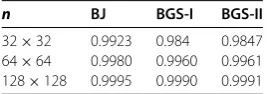
In the first results presented in Table we show the spectral radius of the corresponding iteration matrix for the classical iterative methods (a)-(c). It is well known that an iterative method is convergent when the spectral radius of the corresponding iteration matrix is less than one. We can see that the numbers listed in Table approximate to such that these iterative methods converge to the unique solution of (.) slowly. However, the behavior of the multisplitting method based on three splittings (a)-(c) can be improved by self-adaptive weightings, and the results are shown in Tables and .
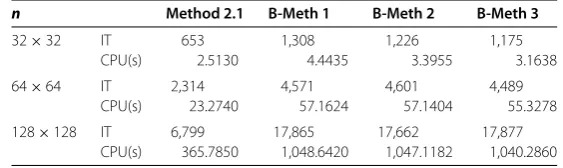
Here, we denote the basic parallel multisplitting iterative method with fixed weighting matrix by B-Meth (see []). In Basic Methods, we propose three groups of weighting ma-trices, which are generated by random selection. Thus, the corresponding parallel multi-splitting iterative methods are denoted by B-Meth , B-Meth , B-Meth , respectively.
The speed-up is defined in the following:
[image:8.595.231.365.684.731.2]speed-up = CPU of the Basic Methods CPU of Method . .
Table 1 Radii of the classical iterative methods
n BJ BGS-I BGS-II
Table 2 The comparison of computational results among the BGS-I, BGS-II, Method 2.1
n BGS-I BGS-II Method 2.1
32×32 IT 866 869 653
CPU(s) 3.465 3.838 2.5130
64×64 IT 3,353 3,358 2,314
CPU(s) 64.493 78.830 23.2740
128×128 IT 13,191 13,202 6,799
CPU(s) 1,203.512 1,367.604 365.7850
Note:kopt= 2can be chosen in Method 2.1.
Table 3 The comparison of computational results between Method 2.1 and Basic Method
n Method 2.1 B-Meth 1 B-Meth 2 B-Meth 3
32×32 IT 653 1,308 1,226 1,175
CPU(s) 2.5130 4.4435 3.3955 3.1638
64×64 IT 2,314 4,571 4,601 4,489
CPU(s) 23.2740 57.1624 57.1404 55.3278
128×128 IT 6,799 17,865 17,662 17,877
CPU(s) 365.7850 1,048.6420 1,047.1182 1,040.2860
From the above numerical experiments, it is obtained that the average speed-up of the new parallel multisplitting iterative method (Method .) is about . (the average value of all computational results by Basic Methods).
5 Conclusion
The parallel multisplitting iterative method with the self-adaptive weighting matrices has been proposed for the linear system of equations (.) when the coefficient matrix is anH -matrix. The convergence theory is established for the parallel multisplitting method with self-adaptive weightings. The numerical results show that the new parallel multisplitting iterative method with the self-adaptive weightings is effective.
Competing interests
The authors declare that they have no competing interests.
Authors’ contributions
RW presented the optimization model of weighting matrices, carried out the convergence studies and drafted the manuscript. HD implemented the algorithm and helped to draft the manuscript. All authors read and approved the final manuscript.
Author details
1Higher Education Key Laboratory of Engineering and Scientific Computing, Taiyuan Normal University, Taiyuan, Shanxi
030012, P.R. China.2Department of Mathematics, Taiyuan Normal University, Taiyuan, Shanxi 030012, P.R. China.
Acknowledgements
The authors are very much indebted to the anonymous referees for their helpful comments and suggestions. And the authors are so thankful for the support from the NSF of Shanxi Province. This work is supported by grants from the NSF of Shanxi Province (201601D011004).
Publisher’s Note
Springer Nature remains neutral with regard to jurisdictional claims in published maps and institutional affiliations.
Received: 17 January 2017 Accepted: 19 April 2017
References
[image:9.595.155.437.230.314.2]2. Bai, ZZ: Parallel matrix multisplitting block relaxation iteration methods. Math. Numer. Sin.17, 238-252 (1995) 3. Bai, ZZ: On the convergence of additive and multiplicative splitting iterations for systems of linear equations.
J. Comput. Appl. Math.154, 195-214 (2003)
4. Bai, ZZ: On the convergence of parallel nonstationary multisplitting iteration methods. J. Comput. Appl. Math.159, 1-11 (2003)
5. Bai, ZZ: A new generalized asynchronous parallel multisplitting iteration method. J. Comput. Math.17, 449-456 (1999)
6. Evans, DJ: Blockwise matrix multi-splitting multi-parameter block relaxation methods. Int. J. Comput. Math.64, 103-118 (1997)
7. Sun, JC, Wang, DR: A unified framework for the construction of various matrix multisplitting iterative methods for large sparse system of linear equations. Comput. Math. Appl.32, 51-76 (1996)
8. Frommer, A, Mayer, G: Convergence of relaxed parallel multisplitting methods. Linear Algebra Appl.119, 141-152 (1989)
9. Neumann, M, Plemmons, RJ: Convergence of parallel multisplitting iterative methods forM-matrices. Linear Algebra Appl.88, 559-573 (1987)
10. Szyld, DB, Jones, MT: Two-stage and multisplitting methods for the parallel solution of linear systems. SIAM J. Matrix Anal. Appl.13, 671-679 (1992)
11. Wang, CL, Meng, GY, Yong, XR: Modified parallel multisplitting iterative methods for non-Hermitian positive definite systems. Adv. Comput. Math.38, 859-872 (2013)
12. Wang, DR: On the convergence of the parallel multisplitting AOR algorithm. Linear Algebra Appl.154-156, 473-486 (1991)
13. Wen, RP, Wang, CL, Yan, XH: Generalizations of nonstationary multisplitting iterative method for symmetric positive definite linear systems. Appl. Math. Comput.216, 1707-1714 (2010)
14. Varga, RS: On recurring theorems on diagonal dominance. Linear Algebra Appl.13, 1-9 (1976)
15. Berman, A, Plemmons, RJ: Nonnegative Matrices in the Mathematical Sciences. Classics in Applied Mathematics. SIAM, Philadelphia (1994)
16. Hirsh, RS, Rudy, DH: The role of diagonal dominance and cell Reynolds number in implicit difference methods for fluid mechanics. J. Comput. Phys.16, 304-310 (1974)
17. Li, BS: Generalizations of diagonal dominance in matrix theory. A thesis submitted to the Faculty of Graduate Studies and Research in Partial Fulfillment of the Requirements for the Degree of Doctor of Philosophy in Mathematics and Statistics, University of Regina (1997)
18. Meijerink, JA, Van De Vorst, HA: Iterative Solution of Linear Systems Arising from Discrete Approximations to Partial Differential Equations. Academisch Computer Centrum, Utrecht (1974)