General rights
Copyright and moral rights for the publications made accessible in the public portal are retained by the authors and/or other copyright owners and it is a condition of accessing publications that users recognise and abide by the legal requirements associated with these rights.
• Users may download and print one copy of any publication from the public portal for the purpose of private study or research.
•
High Dimensional Modulation and MIMO Techniques for Access Networks
Binti Othman, Maisara; Tafur Monroy, Idelfonso ; Jensen, Jesper Bevensee
Publication date:
2012
Document Version
Publisher's PDF, also known as Version of record
Link back to DTU Orbit
Citation (APA):
High Dimensional Modulation and
MIMO Techniques for Access Networks
Maisara Binti Othman
Supervisors:
Professor Idelfonso Tafur Monroy Assistant Professor Jesper Bevensee Jensen
Delivery Date: 1st October 2012
DTU Fotonik
Department of Photonics Engineering Technical University of Denmark
Abstract
Exploration of advanced modulation formats and multiplexing techniques for next generation optical access networks are of interest as promising solutions for delivering multiple services to end-users. This thesis addresses this from two different angles: high dimensionality carrierless amplitude-phase (CAP) and multiple-input multiple-output (MIMO) radio-over-fiber (RoF) systems.
High dimensionality CAP modulation has been investigated in optical fiber systems. In this project we conducted the first experimental demon-stration of 3 and 4 dimensional CAP with bit rates up to 10 Gb/s. These results indicate the potentiality of supporting multiple users with con-verged services. At the same time, orthogonal division multiple access (ODMA) systems for multiple possible dimensions of CAP modulation has been demonstrated for user and service allocation in wavelength division multiplexing (WDM) optical access network.
2×2 MIMO RoF employing orthogonal frequency division multiplex-ing (OFDM) with 5.6 GHz RoF signalmultiplex-ing over all-vertical cavity surface emitting lasers (VCSEL) WDM passive optical networks (PONs). We have employed polarization division multiplexing (PDM) to further increase the capacity per wavelength of the femto-cell network. Bit rate up to 1.59 Gbps with fiber-wireless transmission over 1 m air distance is demonstrated.
The results presented in this thesis demonstrate the feasibility of high dimensionality CAP in increasing the number of dimensions and their po-tentially to be utilized for multiple service allocation to different users. MIMO multiplexing techniques with OFDM provides the scalability in in-creasing spectral efficiency and bit rates for RoF systems.
Resum´
e
Udnyttelse af avancerede modulationformater og multipleksningsteknikker til næste generations optiske access netværker er lovende løsninger, som kan levere multiple funktionaliteter til slutbrugerne. Denne afhandling anskuer dette fra to vinkler: Høj-dimensionel ‘carrierless’ amplitude- og fase-modulation (CAP) samt multipelt input multipelt output (MIMO) radio-over-fiber (RoF) systemer.
CAP med højere dimensionalitet end 2 er blevet undersøgt med hen-blik p˚a brug i fiberoptiske systemer. I dette projekt har vi gennemført den første eksperimentelle demonstration af 3- og 4- dimensional CAP med bit rater op til 10 Gb/s. Disse resultater indikerer et potentiale til at levere konvergerede ydelser til flere brugere ved høje bit rater. ‘Orthog-onal division multiple access’ (ODMA) systemer hvor de mulige multiple CAP-dimensioner er blevet distribueret til slutbrugerne i et bølgelængde multiplekset (WDM) netværk er blevet demonstreret.
Et andet vigtigt resultat fra denne afhandling er den første demonstra-tion af et 2×2 MIMO OFDM fiber/5.6 GHz tr˚adløst passivt optisk netværk (PON), der udelukkende anvender VCSELs som optiske kilder. Baseret p˚a dette koncept har vi anvendt polarisations division multipleksning (PDM) til yderligere at øge kapaciteten per bølgelængde i femtocelle netværk. Bit rater op til 1.59 Gb/s med fibertransmission og tr˚adløs transmission over 1 m er blevet demonstreret eksperimentelt.
Resultaterne, der er præsenteret I denne afhandling, demonstrerer mu-lighederne i høj-dimensional CAP til at allokere forskellige ydelser til forskel-lige brugere. MIMO multipleksning med OFDM tilbyder skalerbarhed samt øget spektral effektivitet og bit rate i RoF systemer.
Acknowledgements
First of all, I would like to attribute my sincere gratitude to my super-visor and co-supersuper-visor, Professor Idelfonso Tafur Monroy and Assistant Professor Jesper Bevensee Jensen for their encouragement, support and enthusiasm. They always spent time with me and guided me through the problems that I have encountered. It is a privilege to work with them. Thanks a lot from my heart.
I am very grateful to the Ministry of Higher Education of Malaysia (MOHE) and University of Tun Hussein Onn Malaysia (UTHM) for pro-viding me with a scholarship. I would not have completed a Ph.D without this financial assistance.
My warmest thanks are extended to my closest friend Lei, Xu, Xiaodan, and Ying. We have spent time together in the lab doing the experiment with a very good team working spirit. My sincere thanks to Kamau and Xianbin for their practical assistance. I would also like to thank all my colleagues at Metro-Access group, Darko, JJ, Neil, Alexey, Thang, Valeria, Roberto, Robert, Silvia, Alexander, Bomin, Miguel, David and also my colleagues in DTU Fotonik. I must also thank Evarist my ex-officemate in building 343 DTU Fotonik for sharing all the good food recipes.
I want to thank to all my Malaysian friends in Denmark for friendship through all these years. Many thanks for supporting each other, and I really hope this friendship will last forever.
Summary of Original Work
This thesis is based on the following original publications:
PAPER 1 M. B. Othman, X. Zhang, L. Deng, M. Wieckowski, J. Bevensee Jensen, and I. Tafur Monroy, “Experimental Investigations Demon-stration of 3D/4D-CAP Modulation with DM-VCSELs,” Photonic Technology Letters, accepted for publication, 2012.
PAPER 2 M. B. Othman, X. Zhang, L. Deng, J. Bevensee Jensen, and I. Tafur Monroy, “Experimental Demonstration of 3D/4D-CAP Mod-ulation Employing CT-CMA Channel Estimation,” submitted to
Journal of Lightwave Technology, 2012.
PAPER 3 M. B. Othman, J. Bevensee Jensen, Xu Zhang, and I. Tafur Monroy, “Performance Evaluation of Spectral Amplitude Codes for OCDMA PON,” in (15th International Conference on Optical Net-work Design and Modeling (ONDM), 2011.
PAPER 4 M. B. Othman, X. Zhang, J. Bevensee Jensen, and I. Tafur Monroy, “Using CAP Dimensionality for Service and User Alloca-tion for Optical Access Networks ,” in Asia Communications and Photonics Conference (ACP), Guangzhou, China, accepted for pub-lication, 2012.
viii Summary of Original Work
and Photonics Conference (ACP), Guangzhou, China, accepted for publication, 2012.
PAPER 6 M. B. Othman, L. Deng, X. Pang, J. Caminos, W. Kozuch, K. Prince, J. Bevensee Jensen, and I. Tafur Monroy, “Directly modu-lated VCSELs for 2×2 MIMO-OFDM radio over fiber in WDM-PON,” in37th European Conference and Exhibition on Optical Com-munication (ECOC), Geneva, Switzerland, paper We.10.P1.119, 2011.
PAPER 7 M. B. Othman, L. Deng, X. Pang, J. Caminos, W. Kozuch, K. Prince, X. Yu, J. Bevensee Jensen, and I. Tafur Monroy, “MIMO-OFDM WDM PON with DM-VCSEL for femtocells application,”
Optics Express , vol. 19, no. 26, pp. B537—B542, 2011.
PAPER 8 X. Pang, L. Deng, Y. Zhao, M. B. Othman, X. Yu, J. Bevensee Jensen, D. Zibar, and I. Tafur Monroy, “Seamless Translation of Op-tical Fiber PolMux-OFDM into a 2×2 MIMO Wireless Transmission Enabled by Digital Training-Based Fiber-Wireless Channel Estima-tion,” in Asia Communications and Photonics Conference and Ex-hibition, Proceedings of SPIE, 2011.
PAPER 9 L. Deng, X. Pang, Y. Zhao, M. B. Othman, J. Bevensee Jensen, Darko Zibar, Xianbin Yu, Deming Liu, and I. Tafur Monroy, “2×2 MIMO-OFDM Gigabit fiber-wireless access system based on polar-ization division multiplexed WDM-PON,” Optics Express. vol. 20, no. 4, pp. 4369-4375, 2012.
PAPER 10 X. Pang, Y. Zhao, L. Deng, M. B. Othman, X. Yu, J. Bevensee Jensen, and I. Tafur Monroy, “A Spectral Efficient PoIMux-QPSK-RoF System with CMA-Based Blind Estimation of a 2×2 MIMO Wireless Channel,” in IEEE Photonics Conference, (IPO), paper TuM2, pp. 296–297, 2011.
ix
International Topical Meeting on & Microwave Photonics Conference (MWP/APMP), pp. 13–16, 2011.
Other scientific reports:
[C1] N. Guerrero Gonzalez, A. Caballero, R. Borkowski, V. Arlunno, T. T. Pham, R. Rodes, X. Zhang, M. B. Othman, K. Prince, X. Yu, J. B. Jensen, D. Zibar, and I. Tafur Monroy, “Reconfigurable digital co-herent receiver for metro-access networks supporting mixed modula-tion formats and bit-rates,” in Proc. Optical Fiber Communication Conference and Exposition, OFC/NFOEC, Los Angeles, CA, paper OMW7, 2011, .
[C2] V. Arlunno, N. Guerrero Gonzalez, A. Caballero, Antonio; R. Borkow-ski, T. T. Pham, R. Rodes, X. Zhang, M. B. Othman, K. Prince, X. Yu, J. B. Jensen, D. Zibar, and I. Tafur Monroy, “Reconfig-urable Digital Coherent Receiver for Hybrid Optical Fiber/Wireless Metro-Access Networks,” inPoster session presented at 2nd Annual Workshop on Photonic Technologies for Access and Biophotonics, Stanford, CA, 2011.
Contents
Abstract i
Resum´e iii
Acknowledgements v
Summary of Original Work vii
1 Introduction 1
1.1 Outline of the Thesis . . . 1
1.2 Optical Transmission for Next Generation Access and In-home Network . . . 2
1.3 Advanced Modulation Formats for Optical Communication System . . . 3
1.3.1 Carrierless Amplitude-Phase Modulation (CAP) . . 5
1.3.2 Multiplexing Scheme for High Dimensionality CAP . 10 1.4 Hybrid Wireless-Optical Links for Next Generation Access Networks . . . 11
1.4.1 MIMO Multiplexing Scheme for RoF Networks . . . 12
1.5 State-of-the-Art Analysis . . . 13
1.5.1 Carrierless Amplitude-Phase Modulation . . . 13
1.5.2 Multiple-Input Multiple-Output Multiplexing Tech-nique . . . 14
1.6 Beyond the State-of-the-Art . . . 16
1.6.1 High Dimensionality CAP . . . 16
1.6.2 2x2 MIMO Multiplexing Techniques . . . 18
xii CONTENTS
2 Description of Papers 21
2.1 High Dimensionality CAP and OCDMA Multiplexing for Next Generation Networks . . . 21 2.2 MIMO Multiplexing Technique Implementation in
Radio-over-Fiber System . . . 24
3 Conclusion 27
3.1 Conclusions . . . 27 3.1.1 CAP Modulation Format . . . 27 3.1.2 MIMO Multiplexing Technique for Hybrid
Wireless-Optical Link . . . 28 3.2 Future Work . . . 30
3.2.1 Carrierless Amplitude-Phase Modulation for Photonic Technologies . . . 30 3.2.2 Towards Next Generation Wireless MIMO in RoF
System . . . 31 Paper 1: Experimental Investigations Demonstration of 3D/4D-CAP
Modulation with DM-VCSELs 33
Paper 2: Experimental Demonstration of 3D/4D-CAP Modulation Employing CT-CMA Channel Estimation 39 Paper 3: Performance Evaluation of Spectral Amplitude Codes for
OCDMA PON 49
Paper 4: Using CAP Dimensionality for Service and User Allocation
for Optical Access Networks 55
Paper 5: Bi-directional Multi Dimension CAP Transmission for Smart
Grid Communication Services 59
Paper 6: Directly modulated VCSELs for 2×2 MIMO-OFDM radio
over fiber in WDM-PON 63
Paper 7: MIMO-OFDM WDM PON with DM-VCSEL for Femtocells
Application 67
CONTENTS xiii
Paper 9: 2×2 MIMO-OFDM Gigabit Fiber-Wireless Access System Based on Polarization Division Multiplexed WDM-PON 83 Paper 10: A Spectral Efficient PoIMux-QPSK-RoF System with
CMA-Based Blind Estimation of a 2×2 MIMO Wireless Channel 91 Paper 11: Experimental Demonstration of 5-Gb/s Polarization-Multiplexed
Fiber-Wireless MIMO Systems 95
Bibliography 101
Chapter 1
Introduction
This chapter provides an introduction to the topics of this thesis. An overview of the covered topics is presented in sections 1.3 and 1.4, and state-of the-art and beyond in sections 1.5 and 1.6. The contributions of this project are described in section 1.7. The introduction is structured into two main categories: multi-level, multi-dimensional carrierless amplitude-phase (CAP) modulation for access and in-home networks applications; and multi-input multi-output (MIMO) multiplexing schemes for radio-over-fiber networks.
1.1
Outline of the Thesis
This thesis is structured as follows: Chapter 1 introduces the context of the main research papers included in this thesis. It provides a short overview on high dimensionality CAP as one of the advanced modulation formats in optical fiber system and MIMO multiplexing techniques as a promising method to increase the data throughput and link range compared to the traditional single-input single-output (SISO) method. The impact of these two main fields is to support the next generation access network in wired and wireless link.
2 Introduction
1.2
Optical Transmission for Next Generation
Access and In-home Network
In the last few years attention has turned to the developments of so-called next generation telecommunication networks [1]. These networks comprise two segments: the next generation core (NGN), or backbone, and the next generation access (NGA) networks. Next generation core refers to the core internet protocol (IP) network and is characterized by the replacement of legacy transmission and switching equipment with IP technology in the core network. Next generation access refers to the access technology (optical fibre, copper or wireless) and its deployment, either to a street cabinet close to the customer premises in conjunction with copper-based infrastructure such as x-digital subscriber line (x-DSL), or with the deployment of fibre or wireless systems directly to the customer premises [2].
The term NGA is often used to describe fibre connections coming closer to the end-user, which may be typically characterized by significantly higher bandwidth than currently available technology, while providing better qual-ity of service and greater uplink/downlink symmetry in data rates. As a result, the copper or cable wire is to an increasing extent replaced with fibre-optic technology. Wireless technologies can also be considered as NGA, indeed, wireless technologies can provide a vital option to extend and improve broadband coverage in particular scenarios.
Next generation access services facilitate network access while the ap-plications provide an interface for information exchange. They differ from traditional access services as they are ‘always on’ and enable the integra-tion of voice, data, images and video applicaintegra-tions. Fig. 1.1 depicts the traditional access with dedicated services and next generation structure that enables the hosting of converged applications in a shared environment taken from [3].
1.3 Advanced Modulation Formats for Optical Communication System 3
Convergence
[image:14.499.91.424.93.281.2]Legacy Environment Next Generation Environment
Figure 1.1: Traditional access environment with dedicated services (on the left) and
next generation service environment (on the right) [3].
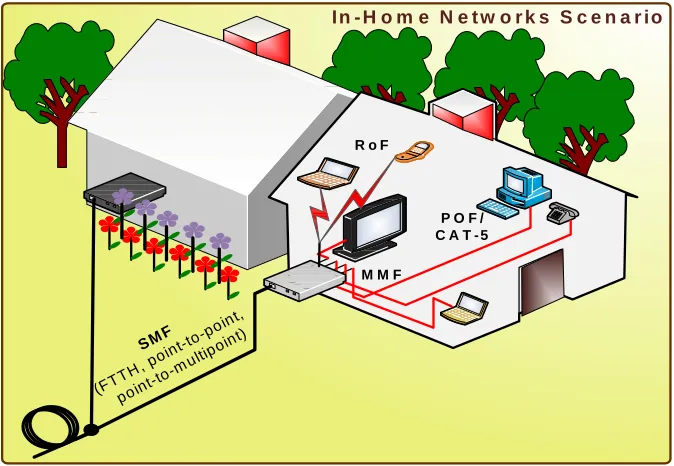
in home access network (HAN) with varieties of multimedia services with wired and wireless network for fiber-to-the-home (FTTH). To increase flex-ibility in the HAN, multiplexing and transparency to different transmission and modulation formats would be beneficial. Optical technologies give solu-tions for such architectures, with multipoint transparent architectures that can eventually use the wavelength domain to achieve multiplexing.
This Ph.D thesis focuses on the applications of high dimensionality CAP modulation in wired transmission for access and in-home networks. In addition, MIMO multiplexing scheme has been used for RoF wireless transmission for HAN with different multiplexing solutions such as wave-length division multiplexing (WDM) and polarization division multiplex-ing (PDM).
1.3
Advanced Modulation Formats for Optical
Communication System
4 Introduction
I n - H o m e N e t w o r k s S c e n a r io
SMF
(FTT H, po
int-to -poin
t,
point -to-m
ultipo int)
M M F
[image:15.499.75.412.90.323.2]P O F / C A T - 5 R o F
Figure 1.2: Fiber-to-the-home home access network with varieties of multimedia
ser-vices supported with wired and wireless network in customer premises.
advanced modulation formats have been suggested to mitigate nonlinear transmission impairments, to improve receiver sensitivity and facilitate a per channel bit rate increase beyond the limits of binary systems [6, 7].
1.3 Advanced Modulation Formats for Optical Communication System 5
R e c e iv e r T r a n s m it te r
M a p p in g P h a s e ∑ s h ifte r
D e c is io n
D e m a p p in g
D e c is io n In p u t
D a ta
O u tp u t D a ta
) 2 (
cos πfct
) 2 (
sin πfct
I Q X ) (t SQAM
P h a s e s h ifte r
) ( t g − ) ( t g − k I ' k Q ' k I k Q ) ( t g ) ( t g ) 2 (
cos πfct
) 2 (
[image:16.499.79.436.89.170.2]sin πfct
Figure 1.3: Block diagram of the QAM transceiver.
R e c e iv e r T r a n s m it t e r
E n c o d e r ∑
D e c is io n D e c o d e r D e c is io n In p u t
D a ta
O u tp u t D a ta
C A P F ilte r 1
C A P F ilt e r 2
C A P In v e r s io n F ilt e r 1
C A P In v e r s io n F ilt e r 2
k I k Q ) 2 ( cos ) ( )
(t g t ft
gi = πc
) 2 ( sin ) ( )
(t g t ft
gq = πc
) ( t
gi −
) ( t
gq − ) (t SCAP I Q X
Figure 1.4: Block diagram of the CAP transceiver.
a single channel and optimizes the data rate over that channel. In contrast, DMT divides the bandwidth into sub-channels and optimizes the data rate for each sub-channel. DMT has been accepted as the standard by the American national standards institute (ANSI) and the European telecom-munications standards institute (ETSI) [13, 14] due to the comtelecom-munications speed, bandwidth efficiency, spectral compatibility, robustness and power consumption.
1.3.1 Carrierless Amplitude-Phase Modulation (CAP)
[image:16.499.84.436.203.292.2]6 Introduction Receiver Transmitter Constellation Mapping CAP Filter 1 CAP Filter 2 Up-sampling + Digital to Analog Analog to Digital CAP Inversion Filter 1 CAP Inversion Filter 2 Data Input Data Output Tx1 Tx2 Down-sampling Constellation Demapping (a) (b) (c) 0 -0.2 0.4 0.2 Amplit ude a. u 0.6
0 64 128 192
Time (ns) 0 -0.2 0.4 0.2 Ampl itu de a .u -0.4
0 64 128 192
Time (ns) 0Frequency (MHz)200 400 600
1
f + f2
-60 -100 M a g n it ude (dB) -140
(a) (b) (c)
[image:17.499.73.416.87.371.2]T ra n sm issi o n M e d iu m
Figure 1.5: CAP transmitter and receiver for 2D CAP system.
CAP has been widely used for ADSL and asynchronous transfer mode (ATM) local area networks (LANs) [15]. In both of these applications, CAP modulation has been adopted primarily because of its high bandwidth effi-ciency and low implementation costs. Additionally, CAP supports modula-tion in more than 2 dimensions, provided that orthogonal pulse shapes can be identified [10]. This possibility of multi-dimensional modulation makes CAP an attractive modulation format to support multiple services for next generation access networks and in-home networks [16].
1.3 Advanced Modulation Formats for Optical Communication System 7
to achieve orthogonality between them and move them from baseband to passband. The resultant waveforms are given by:
f1(t) =hSRRC(t) cos 2πfct (1.1)
f2(t) =hSRRC(t) sin 2πfct (1.2)
wherefcis a frequency suitable for the passband filters. The pair of
modu-lated waveforms f1 andf2 constitute a Hilbert pair. A Hilbert pair is two
signals of the same magnitude response but with phase responses shifted by 90o. Fig.1.5 (a) and (b) presents the impulse response of the CAP
fil-ters in time domain. The two orthogonal signals are added and converted from digital to analog form. The combined frequency spectrum of CAP is shown in Fig. 1.5(c). At the receiver, the signals are converted back to digital form. The time-inversion of the transmission filters, i.e. matched filtering, is implemented to retrieve the original sequence of symbols; the symbols are downsampled and demapped, and the original data can be recovered. For higher dimensionality CAP, the required sample/symbol ratio is linearly proportional to the number of dimensions [10]. The upsam-pling factor therefore must be increased in order to support an increased number of dimensions. This means that the spectral efficiency has not been improved by increasing the number of dimensions. However, the additional dimensions can be used to support multiple access applications.
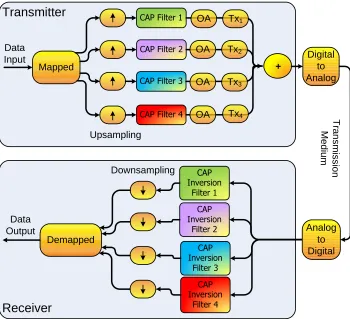
The Hilbert pair which are sine and cosine waveforms used for 2D-CAP can not be used for 3D or 4D, so a new set of filters needs to be designed. The 3D/4D CAP systems are shown in Fig. 1.6. The filters are added according to the dimensions that are required in the system. To avoid inter-dimensional crosstalk; it is vital that the transmitter-receiver filter combinations satisfy the orthogonality or perfect reconstruction (PR) criteria. In the experiment, the optimization algorithm (OA) described in [17] has been applied to extend the conventional 2D-CAP scheme to higher dimensionality and to assure the PR of the filters. The advantage of this formulation is that the frequency magnitude response of the transmitter and receiver filters will be identical. Additionally, it is a straight-forward method to extend the design to higher dimensionality CAP systems. In equation (1.3) the variablesfi and gj represents the CAP transmitter and
receiver finite impulse response (FIR) filters respectively.
P(fi)gj = ˜δ, i, j∈ {1,2,3,4}
8 Introduction
Receiver
Transmitter
Mapped
CAP Filter 1
CAP Filter 2
Upsampling
+
Demapped
CAP Inversion
Filter 1 CAP Inversion
Filter 2
T
ra
n
sm
iss
io
n
M
e
d
iu
m
Data Input
Data Output
CAP Filter 3
CAP Filter 4
CAP Inversion
Filter 3 CAP Inversion
Filter 4
Downsampling
Tx1
Tx2
Tx3
Tx4 OA OA
OA
OA
Digital to Analog
[image:19.499.68.418.90.409.2]Analog to Digital
Figure 1.6: CAP transmitter and receiver for 3D or 4D CAP system.
whereP(fi) is a shift matrix that operates on vector fi, ˜δ is a vector with
one unity element and ˜0 is a vector of all zeros.
The optimization algorithm for high dimensionality CAP is described as follows
min
f1,f2,f3,...fN
max (|F1,HP|,|F2,HP|,|F3,HP|, ...|FN,HP|) (1.4)
subject to the PR condition in (1.3) and
gi= inverse [Fi], i∈ {1,2,3, ..N} (1.5)
where Fi is the discrete Fourier transform (DFT) of vector fi. The Fi,HP
1.3 Advanced Modulation Formats for Optical Communication System 9 -0.2 -0.4 0.2 0.4 0 -0.2 -0.4 0.2 0.4 0 A m p litud e a .u Amp litud e a .u A m p litu de a.u
256 512 768 0
256 512 768 0
256 512 768 0 Time (ns) Time (ns) Time (ns) -25 -45 -65 -25 -45 -65 -25 -45 -65 M a g n itu de (dB) Magn itud e ( d B) Magnitude (dB )
0 200 400600
0 200 400600
0 200 400600 Frequency (MHz) Frequency (MHz) Frequency (MHz) Impulse Response Frequency Response Signa l 1 Signa l 2 Si gn al 3 -0.2 -0.4 0.2 0.4 0 Cross Response Transceiver 1 Cross Response Transceiver 2 Cross Response Transceiver 3 A m plitude a.u 0.25 0.5 0
0 64 128 192 Time (ns) A m plitude a.u 0.25 0.5 0 A m p litu
de a.u 0.25 0.5 0 0.25 0.5 0 A m p litud e a .u 0.25 0.5 0 A m p litud e a .u 0.25 0.5 0 Amplitud e a.u 0.25 0.5 0 Amplitude a .u 0.25 0.5 0 Amplitude a .u 0.25 0.5 0 Amplitude a.u
0 64 128 192 Time (ns)
0 64 128 192 Time (ns)
0 64 128 192 Time (ns)
0 64 128 192 Time (ns)
0 64 128 192 Time (ns)
0 64 128 192 Time (ns)
0 64 128 192 Time (ns)
0 64 128 192 Time (ns)
[image:20.499.118.394.89.250.2](a) (b)
Figure 1.7: 3D-CAP (a) impulse responses and frequency responses; (b) cross responses
of transceiver filters.
Amp litude a .u Ampl it ude a .u A m p lit ud e a. u
480 960 1440 0 Time (ns) Time (ns) Time (ns) -30 -50 -70 Mag n it ude (dB) Ma gn it ude (d B)
0 200 400 600
0 200 400 600 Frequency (MHz) Frequency (MHz) Impulse Response Frequency Response Signal 1 Signal 2 S ign al 3 -0.2 0.2 0 -0.2 0.2 0
480 960 1440 0
480 960 1440 0 -0.2 0.2 0 A m p lit ud e a. u S ign al 4 -0.2 0.2 0 Time (ns) 480 960 1440 0 -30 -50 -70 Mag n it ude ( d B ) -30 -50 -70 Mag n it ude ( d B ) -30 -50 -70
0 200 400 600 Frequency (MHz)
0 200 400600 Frequency (MHz) Cross Response Transceiver 1 Cross Response Transceiver 2 Cross Response Transceiver 3 Amp litude a .u 0.1 0.2 0
0 96 192 288 Time (ns) 0.1 0.2 0 Amp litude a .u
0 96 192 288 Time (ns) 0.1 0.2 0 Ampl it ude a .u
0 96 192 288 Time (ns) 0.1 0.2 0 Ampl it ude a .u
0 96 192 288 Time (ns) 0.1 0.2 0 Ampl it ude a .u
0 96 192 288 Time (ns) Cross Response Transceiver 4 Amp litude a .u 0.1 0.2 0
0 96 192 288 Time (ns) 0.1 0.2 0 A m p lit ud e a. u
0 96 192 288 Time (ns) 0.1 0.2 0 A m p lit ud e a. u
0 96 192 288 Time (ns) 0.1 0.2 0 Amplit ud e a. u
0 96 192 288 Time (ns) 0.1 0.2 0 Amplit ud e a. u
0 96 192 288 Time (ns) 0.1 0.2 0 Amplit ud e a. u
0 96 192 288 Time (ns) 0.1 0.2 0 Amp litude a .u
0 96 192 288 Time (ns) 0.1 0.2 0 Amp litude a .u
0 96 192 288 Time (ns) 0.1 0.2 0 Amp litude a .u
0 96 192 288 Time (ns) Ampl it ude a .u 0.1 0.2 0
0 96 192 288 Time (ns) Amplit ud e a. u 0.1 0.2 0
0 96 192 288 Time (ns)
(a) (b)
Figure 1.8: 4D-CAP (a) impulse responses and frequency responses; (b) cross responses
of transceiver filters.
boundary frequencyfB is to ensure the receivers frequency magnitude
[image:20.499.90.425.298.505.2]10 Introduction
of 21T is needed, where T1 is the baud rate. Similarly, for the 3D-CAP sys-tem, there is a minimum bandwidth (fB,min) value that will achieve the
PR condition. It has been proven in [17], thatfB for the 3D-CAP system
is at least equal to or greater than 23T to preserve the PR condition. In the experiments, the band limiting conditionfB is set to 23(2×fs), wherefsis
the highest frequency component of the 3D/4D-CAP signals.
Fig. 1.7 and 1.8 show the responses of the digital filters at the trans-mitter and receiver for 3D-CAP and 4D-CAP respectively. Fig. 1.7(a) and 1.8(a) show the impulse response and the frequency response for each of the signals. Fig. 1.7(b) and 1.8(b) shows the cross responses of the transmitter-receiver (transceiver) filters. The impulse only exists at the cross responses off1 andg1,f2 andg2,f3andg3,f4 andg4 (extra dimension for 4D-CAP),
with zeros at the other transmitter-receiver pairs, for examplef1 andg2,f1
andg3 and etc. The transmitter-receiver filter combinations are orthogonal
and satisfy the perfect reconstruction criteria.
The generation and experimental demonstration of high dimensionality CAP is reported inPAPER 1for the first time in optical fiber systems. In PAPER 2, the high dimensionality CAP is demonstrated and investigated at higher bit rate up to 10 Gb/s with 1310 nm DM-VCSELs.
1.3.2 Multiplexing Scheme for High Dimensionality CAP
Spread spectrum communication in the form of code division multiple ac-cess (CDMA) offered large advantages to the wireless communication in-dustry in the 1970s [18] in terms of cellular telephony network, global po-sitioning system (GPS), etc. The success of this technique has also mo-tivated interest for applications in optical communication networks under the name of optical code division multiple access (OCDMA). PAPER 3 presents the principle of OCDMA with simulation evaluation of three differ-ent codes that have been developed for spectral amplitude coding - optical code division multiple access (SAC-OCDMA) systems.
1.4 Hybrid Wireless-Optical Links for Next Generation Access Networks11
order to overcome this problem the encoder and decoder can be designed in the electrical domain. The orthogonal division multiple access (ODMA) systems for multiple possible dimensions of CAP modulation [10, 21] has been proposed for multiple services application.
ODMA can be classified under the CDMA concept, with orthogonality imposed on the set of signals. Although the ODMA looks similar to the well-known CDMA, there is a fundamental difference between these two techniques. CDMA is generated using a pseudo-random generator, while the ODMA is generated by employing the optimization algorithm.
In this thesis,PAPER 4presents the first experimental demonstration of a 2x2D-ODMA configuration in a WDM access network. A bi-directional fiber optical link using 3D-CAP and employing DM-VCSELs operating around 1550 nm is demonstrated inPAPER 5.
1.4
Hybrid Wireless-Optical Links for Next
Generation Access Networks
Next generation broadband access networks will provide heterogeneous ser-vices, wired and wireless. The inclusion of wireless, in the form of radio-over-fiber (RoF), into access networks needs to be compatible with ex-isting access architectures and coexist with baseband signals. The most promising architecture for optical access networks is passive optical net-work (PON) because of low cost, simple maintenance and operation, and high-bandwidth provisioning [4, 22]. Several architectures, called hybrid PONs, have been proposed in order to include optical wireless signal dis-tribution in PON. Among the different multiplexing techniques for PON, WDM is the most promising solution for future broadband access networks, as it can accommodate exponential traffic growth, support different broad-band services and allow fast network reconfiguration due to the flexibility in wavelength allocation [22–25].
12 Introduction
Central Office
Internet
Home wireless system
1.. n
λ
Office wireless system
MIMO-OFDM Femtocell
AW
G
Home gateaway
IPTV
Room 1 Room 3
Room 2
Multi-Protocol Mobile Femtocell
RF Tx MIMO Signal Processing RF Tx RF Tx
MIMO Signal Processing
RF RF RF Rx
[image:23.499.82.403.89.318.2]Rx Rx
Figure 1.9: MIMO implementation for in-home and in-office scenarios for WDM-PON
applications.
increased, resulting in a large number of nodes to be distributed and con-trolled by the network. The new architecture shall support high number of BS, with possibly high number of antennas per BS, to support MIMO.
1.4.1 MIMO Multiplexing Scheme for RoF Networks
1.5 State-of-the-Art Analysis 13
implemented to overcome these path-dependent effects.
Orthogonal frequency-division multiplexing (OFDM) has emerged as one of the leading modulation techniques in the wireless domain. The combination of OFDM with MIMO provides an attractive solution because of the simple implementation, and potentially high spectral efficiency.
First experimental demonstration of MIMO for WDM-PON applica-tion is presented in PAPER 6 with 4-QAM-OFDM modulation scheme. These results were extended by using a training sequence algorithm to re-duce computational complexity at the receiver, this work was reported in PAPER 7.
PDM have been implemented in PAPER 8 and PAPER 9 in or-der to increased the spectral efficiency in MIMO systems and WDM-PON networks. The 4-QAM-OFDM and 16-QAM-OFDM have been transmit-ted over 22.8 km of single mode fibre (SMF). Furthermore the constant modulus algorithm (CMA) has been implemented in PAPER 10 and PAPER 11with 4 bit/s/Hz spectral efficiency has been achieved in both papers.
1.5
State-of-the-Art Analysis
In this section the state-of the-art results are divided into two categories; CAP modulation format and MIMO multiplexing techniques.
1.5.1 Carrierless Amplitude-Phase Modulation
14 Introduction
published work on high dimensional CAP up to year 2007 [15], just focused on simulation results rather than realistic practical experiments. Possible limitations of multi-dimensional CAP systems in practice have not been reported so far.
Recently, CAP modulation has received attention in the research of optical communication [32–34] due to the potential high spectral efficiency and the possibility of generating the required orthogonal pulses by means of transversal filters. In [33] 2D-CAP 8-levels per dimension (L/D) over 50 m polymer optical fiber (POF) has been demonstrated with resonance cav-ity light emitting diodes resonant cavcav-ity light emitting diodes (RC-LEDs) with a spectral efficiency of 4.6 bit/s/Hz. Directly modulated vertical cavity surface emitting lasers (DM-VCSELs) for wavelength division multiplexing (WDM) application with 2D-CAP 4-L/D has been experimentally demon-strated in [34, 35], reporting transmission of up to 1.25 Gbps over 26 km standard single mode fiber standard single mode fibre (SSMF). A spec-tral efficiency of 4 bit/s/Hz is reported in both papers. In [36] and [32], 10 Gb/s and 40 Gb/s 2D-CAP 4-L/D has been successfully generated with analogue transversal filters. However, all of these reports are focused only on 2D-CAP at different L/D. A detailed explanation of the relationship between levels per dimension, bits/symbol and total number of levels of CAP can be found inPAPER 1and PAPER 2.
1.5.2 Multiple-Input Multiple-Output Multiplexing
Technique
MIMO technology has attracted attention in wireless communications, be-cause it offers significant increase in data throughput and link range without requiring additional wireless transmission bandwidth or increased transmis-sion power. It achieves this goal by utilizing multiple transceiver antennas to achieve an array gain that improves the spectral efficiency (measured in bits per second per hertz of bandwidth) or to achieve a diversity gain that improves the link reliability (improved transmission robustness to wireless channel fading effects).
MIMO wireless systems implement antenna arrays at both transmit-ter and receiver. First simulation studies that reveal the potentially large capacities of those systems were already done in the 1980s [37], and later papers explored the capacity from an analytical point of view [38,39]. Since that time, interest in MIMO systems has exploded [40].
wire-1.5 State-of-the-Art Analysis 15
less local area networks (WLANs), wireless metropolitan area networks (WMANs), and fourth-generation mobile cellular wireless systems [41–43]. Previous simulation work has been done towards integrating MIMO-OFDM technology with RoF [28], and integrating dense wavelength divi-sion multiplexing (DWDM) with MIMO-OFDM [44]. The bi-directional experimental work of MMF bandwidth investigations are presents for RoF picocellular network architectures with 850 nm and 1300 nm VCSELs [27]. The MIMO-RoF concepts with 16-QAM-OFDM is demonstrated in [45], but that analysis implements separate fibers for each remote antenna unit (RAU). The wireless transmission distance is up to 8 m with optimum of 1 m antenna separation.
Recent proposals have aimed to provide current wireless and/or wired services over WDM passive optical network (WDM-PON) [46–49]. How-ever, in order to increase the throughput of the wireless access, the strict limitation imposed by the radio frequency spectrum leads to the reduc-tion of cell size and the use of higher radio frequency bands, and thus a huge number of base stations (BSs) are needed to cover a wide area. The femto-cell architecture provided by broadband optical access network is a promising approach to realize the next generation wireless access. A novel architecture of broadband ubiquitous femto-cell networks with RoF distributed antenna system (DAS) systems over WDM-PON have been re-ported in [49, 50]. However, these works implemented back-to-back (B2B) signalling using 64-QAM-OFDM modulation without any wireless trans-mission. Further experimental investigation by deploying 20 km and 40 km SMF has been reported in [51] for 2.4 GHz but still without wireless trans-mission. The 2×2 MIMO technique has also been explored at 60 GHz RoF system [52]. A 27.15 Gb/s bit rate is achieved by employing 16-QAM modulation format transmitted over 25 km of standard single-mode fiber and 3 m wireless distance. Frequency domain equalizer (FDE) has been used to estimate the MIMO channel response .
Polarization division multiplexing (PDM) allows doubling of the spec-tral efficiency of a transmission system [53]. A 5 Gb/s PDM wireless MIMO transmission over 60 GHz wireless link has also been reported in [54], however employing OOK modulation. Moreover, high speed PDM-OFDM transmission system have been realized in [55, 56] without wireless trans-mission.
16 Introduction
estimation method based on the butterfly structure because an adaptive filter needs to be assigned for each OFDM subcarrier. Consequently, a training-based channel estimation method has the relatively low computa-tional complexity at the receiver [57]. However, a large signaling overhead is often required to extract the channel response, resulting in the decrease of the net data rate in the system. Furthermore, to obtain preamble or train-ing symbols in the receiver, precise synchronization or timtrain-ing recovery is essential [58, 59] since preamble-based approaches are all decision-directed. In contrast, CMA based equalizer is able to make blind estimation when transmitting constant envelope signals, e.g. QPSK [60]. Meanwhile, CMA could also treat the polarization rotation in the fiber together with the wireless crosstalk when combining the PDM-RoF system with MIMO tech-nique.
1.6
Beyond the State-of-the-Art
The work presented in this thesis has significantly extended the state-of-the-art of the CAP modulation format in optical fiber systems and MIMO mul-tiplexing techniques. Recent work has focused only on 2D-CAP in optical fibers and no experimental work has investigated for high dimensionality CAP. We have successfully demonstrated the 3D-CAP and 4D-CAP at dif-ferent bit rates and transmission distance at difdif-ferent VCSELs wavelengths. For MIMO multiplexing we have successfully demonstrated 2×2 MIMO by employing OFDM with various wireless transmission for WDM-PON. In order to increase spectral efficiency, we have implemented PDM in com-bination with MIMO systems. In this section we divided the achievements into two subsections in conjunction with the previous state-of-the-art.
1.6.1 High Dimensionality CAP
Fig. 1.10 shows the previous work that has been proposed and demon-strated in DSL and optical fiber systems. Details of the extension of this work beyond the state-of-the-art are also highlighted and illustrated in the schematic diagram.
1.6 Beyond the State-of-the-Art 17
Optical Fiber System
3D/4D-CAP 2D-CAP
High Dimensionality
CAP for DSL
2003
1999 2010 2011 2012
A.F. Shalash
et. al., 1999
Xiaosong Tang et. al.,
2003
J.D. Ingham et. al., 10 Gb/s
40 Gb/s
1 Gb/s
J.D. Ingham et. al.,
300 Mb/s M.Wieckowski et. al.,
1 bits/s/Hz 2 bits/s/Hz
3 bits/s/Hz 4 bits/s/Hz
5 bits/s/Hz R. Rodes
et. al.,
Bit rate
Spect ral
Effic iency
Year
Paper 1 Paper 2
Paper 4 Paper 5 Paper
[image:28.499.86.437.74.294.2]contribution
Figure 1.10: Illustration of the of-the-art and further achievement in the
state-of-the-art of CAP modulation format.
encoder and decoder side in real implementations. After a further discus-sion with the supervisor and co-supervisor, we decided to change the scope of the study for investigating higher dimensionality CAP. Previous reports just focused on simulation work [10, 17, 21].
4-18 Introduction
L/D. Coordinate transformed constant modulus algorithm (CT-CMA) chan-nel estimation employed in order to combat the inter symbol interference (ISI) and inter dimensional crosstalk is investigated as an added value of this work.
The usability of CAP modulation dimensions for service and user al-location for WDM optical access has been experimentally demonstrated in a 2x2D-orthogonal division multiple access (ODMA) configurationPAPER 4. The spectral efficiency for 4-L/D is 2.08 bits/s/Hz with bit rate of 833.3 MHz is presented in this work. The flexibility of the 4D-CAP in dividing the di-mensions in the optical fiber systems is successfully demonstrated.
A bi-directional optical transmission using 3D-CAP at 2-L/D and 4-L/D modulation has been successfully demonstrated in PAPER 5. The spectral efficiency achievements of 2.25 bits/s/Hz and 3.6 bits/s/Hz for 3D-CAP 2-L/D and 3D-3D-CAP 4-L/D are achieved at bit rate of 4.5 Gb/s and 7.2 Gb/s respectively. This demonstrative work is a promising solution to enable the Gigabits passive optical networks (PON) transmission.
1.6.2 2x2 MIMO Multiplexing Techniques
Fig. 1.11 shows the previous work that has been proposed and demon-strated for MIMO RoF systems. The extended work to the state of the art is also highlighted and illustrated in the schematic diagram.
1.7 Main Contribution 19
K.Tsukamoto et. al.,
2010
2007 2011 2012
I. Harjula et. al.,
S. Nema,
et. al.,
Kobyakov et. al., 10 Gb/s
20 Gb/s
1 Gb/s
300 Mb/s
1 bits/s/Hz 2 bits/s/Hz
3 bits/s/Hz 4 bits/s/Hz
5 bits/s/Hz
Bit rate
Spect ral
Effic iency
Year 2008
Simulation
MIMO experiment with wireless transmission MIMO experiment without wireless transmission
T.Tashiro et. al., Chun-Ting Lin et. al.,
S.-H. Fan et. al.,
PDM-MIMO
200 Mb/s Paper
6 & 7 Paper 8
Paper 9 Paper 10 & 11
[image:30.499.85.434.83.292.2]Paper contribution
Figure 1.11: Illustration of the of-the-art and further achievement in the
state-of-the-art of MIMO techniques.
PAPER 10presents and experimentally demonstrate a PDM-RoF sys-tem with 1.25 Gbaud/s QPSK sequence on each polarization state and fol-lowed by a 2×2 MIMO wireless link. In the experiment, a 2 m wireless distance and 10 km SMF transmission of 5.4 GHz QPSK with bit rate up to 5 Gbps, and hence 4 bits/s/Hz spectral efficiency was successfully achieved. An extended reach up to 26 km SMF transmission has been demonstrated inPAPER 11. The CMA blind channel estimation has been employed in the 2×2 MIMO wireless channel for characterization and adaptive equal-ization of the demodulated signal.
1.7
Main Contribution
The main contributions of this thesis are the high dimensionality CAP mod-ulation format in optical fiber systems and MIMO multiplexing techniques for next generation access network.
20 Introduction
Chapter 2
Description of Papers
This thesis is based on a set of articles already published or submitted for publication in peer-reviewed journals and conference proceedings. These ar-ticles present the results obtained during the course of my doctoral studies combining theoretical analysis, simulation and experimental results. The papers are grouped in two categories, dealing with the high dimensionality of CAP modulation and MIMO multiplexing techniques in radio-over-fiber (RoF) links. The CAP modulation format is studied and demonstrated ex-perimentally in PAPER 1,PAPER 2,PAPER 4 andPAPER 5. The theoretical analysis and numerical simulation are performed inPAPER 3 for OCDMA PON system. PAPER 6and PAPER 7present the experi-mental results for 2×2 MIMO multiplexing technique for WDM-PON sys-tem. The PDM is proposed and demonstrated inPAPER 8toPAPER 11 for 2×2 MIMO wireless channels.
2.1
High Dimensionality CAP and OCDMA
Multiplexing for Next Generation Networks
22 Description of Papers
achieved after 20 km of SSMF. For 3D/4D-CAP signals at 4-L/D, a bit rate BR)of 937.5 Mb/s and 833.3 Mb/s (including 7% forward error correction (FEC) overhead) is obtained in the system, while spectral efficiencies of 2.68 bits/s/Hz and 2.08 bits/s/Hz are achieved for 3D-CAP and 4D-CAP respectively at 4-L/D.
PAPER 2 presents a further demonstration of 3D-CAP and 4D-CAP at higher bit rates. The signals are successfully transmitted over 10 km SSMF. For both 3D-CAP and 4D-CAP signals, BER below the FEC limit of 2.8×10⁻³ for error free reception was achieved after 10 km SSMF. For
3D/4D-CAP signals at 4-L/D, a bit rate of 10.28 Gb/s and 10.66 Gb/s (including 7% FEC overhead) is obtained in the system. Spectral efficien-cies of 2.44 bits/s/Hz and 1.33 bits/s/Hz are achieved for 3D-CAP and 4D-CAP respectively at 4-L/D. The added value of this demonstration is the coordinate transformed constant modulus algorithm (CT-CMA) chan-nel estimation employed in this experiment. The CT-CMA improves the receiver sensitivity by 1 dB and suppresses inter-dimensional crosstalk of the CAP signals. Despite the fact that the spectral efficiencies are signifi-cantly lower when the dimension is increased, this modulation scheme has the potential of supporting multiple users with integrated services at higher bit rates with directly modulated 1310 nm VCSEL.
PAPER 3presents a theoretical analysis and simulation performance eval-uation of three codes; enhanced double weight (EDW), random diagonal (RD) and zero cross correlation (ZCC) for 10 Gb/s x 4 user, 20 km stan-dard single mode fibre (SSMF) transmission link for OCDMA PON. The purpose of this study is to evaluate these new SAC codes that, to our knowledge, have never been compared before. These SAC codes have ideal in-phase cross-correlation properties to reduce multiple access interference (MAI) effects in OCDMA. The performance has been characterized through received optical power (ROP) sensitivity and dispersion tolerance assess-ments. The numerical results show that when considering ROP the ZCC code has a slightly better performance compared to the other two and sim-ilar behavior against the dispersion tolerance.
2.1 High Dimensionality CAP and OCDMA Multiplexing for Next
Generation Networks 23
(2D-OCDMA). We believe this new concepts can be implemented in WDM networks in an elegant way by utilizing the orthogonal CAP filters designed in the digital domain. The flexibility of the 4D-CAP in dividing the dimen-sions indicates the prospects of combining the ODMA in WDM network for service and user allocation in next generation access network.
24 Description of Papers
2.2
MIMO Multiplexing Technique
Implementation in Radio-over-Fiber System
PAPER 6proposes and demonstrates the first experimental results of 2×2 MIMO-OFDM with wireless transmission for WDM-PON system using all-VCSELs optical sources. We report error free transmission after 20 km non zero dispersion shifted fiber (NZDSF) and 2 meter 2×2 wireless MIMO with 4-QAM-OFDM at 198.5Mb/s with 5.65 GHz RoF signaling trans-mission for WDM-PON system. We also investigate the effects of various wireless transmission path lengths and antenna separation distances to see the robustness of the MIMO-OFDM algorithm. No penalty was observed when varying the antenna separation of the sub-elements of the MIMO-OFDM signal with 1 m separation between remote antenna unit (RAU) and mobile station (MS).PAPER 7 incorporates additional results in investi-gating the number of subcarriers in OFDM signals and 16-QAM OFDM-MIMO. The OFDM-MIMO training sequence algorithm which is applied to compensate the receiver’s complexity is also described in PAPER 7. Additionally, this work is potentially an attractive candidate for future femto-cell networks especially for in-door office environments. PAPER 6 was accepted in the 37th European Conference on Optical Communication
(ECOC’11) andPAPER 7 is an extended work that has been published at the ECOC/Optics Express special issue.
Bibliography
[1] J.-i. Kani, F. Bourgart, A. Cui, A. Rafel, M. Campbell, R. Davey, and S. Rodrigues, “Next-Generation PON—Part I: Technology Roadmap and General Requirements,” IEEE Commun. Mag., vol. 47, no. 11, pp. 43–49, Nov. 2009.
[2] P. Chanclou, Z. Belfqih, B. Charbonnier, T. Duong, F. Frank, N. Genay, M. Huchard, P. Guignard, L. Guillo, B. Landousies, A. Pizzi-nat, H. Ramanitra, F. Saliou, S. Durel, P. Urvoas, M. Ouzzif, J. Le Masson, “Access network evolution: optical fibre to the subscribers and impact on the metropolitan and homenetworks,” Comptes Ren-dus Physique, vol. 9, Issues 9–10, no. 9-10, pp. 935—946, 2008. [3] ACMA Report,Developments in next generation applications and
ser-vices, Australian Communications and Media Authority, Nov 2011. [4] L. Kazovsky, W.-T. Shaw, D. Gutierrez, N. Cheng, and S.-W. Wong,
“Next-generation optical access networks,”J. Lightw. Technol., vol. 25, no. 11, pp. 3428–3442, Nov. 2007.
[5] R. Gaudino, D. Cardenas, M. Bellec, B. Charbonnier, N. Evanno, P. Guignard, S. Meyer, A. Pizzinat, I. Mollers, and D. Jager, “Perspec-tive in next-generation home networks: Toward optical solutions?,”
IEEE Commun. Mag., vol. 48, no. 2, pp. 39 –47, feb. 2010.
[6] T. Tokle,M. Serbay, J.B. Jensen, W. Rosenkranz, and P. Jeppesen, “Advanced Modulation Formats for Transmission Systems,” in Op-tical Fiber Communication/National Fiber Optic Engineers Confer-ence (OFC),OMI1, 2008.
102 BIBLIOGRAPHY
[8] Peter.J. Winzer, and R-J. Essiambre, “Advanced Modulation Formats for High-Capacity Optical Transport Networks,” J. Lightw. Technol., vol. 24, no. 12, pp. 4711–4728, Dec. 2006.
[9] Xiang Zhou and Jianjun Yu , “Multi-Level, Multi-Dimensional Coding for High-Speed and High-Spectral-Efficiency Optical Transmission,”J. Lightw. Technol., vol. 27, no. 16, pp. 3641–3653, Aug. 2009.
[10] A.F. Shalash, and K.K. Parhi, “Multidimensional carrierless AM/PM systems for digital subscriber loops,”IEEE Trans. on Comm., vol. 47, no.11, pp.1655-1667, 1999.
[11] J. J. Werner,“Tutorial on Carrierless AM/PM- Part I: Fundamentals of digital CAP transmitter,” AT&T Contribution to ANSI X3T9.5 TP/PMD, June 1992.
[12] J. J. Werner,“Tutorial on Carrierless AM/PM- Part II: Performance of bandwidth efficient line codes,” AT&T Contribution to ANSI X3T9.5 TP/PMD, Feb. 1993.
[13] B. Whyte,Multimedia Telecommunication, Chapman & Hall, 1997. [14] P.J. Kyees, R.C. McConnell, K. Sistanizadeh,“ADSL: A New
Twisted-Pair Access to the Information Highway,” IEEE Commun. Mag.
vol. 33, no.4, pp.52-60, 1995.
[15] T. Collins, Carrierless Amplitude Phase Modulation, Handbook of Computer Networks: Key Concepts, Data Transmission, and Digital and Optical Networks, John Wiley and Sons, 2008.
[16] Antonio Caballero, Tien Thang Pham, Jesper B. Jensen, and Idel-fonso Tafur Monroy, “Carrierless N-Dimensional Modulation For-mat for Multiple Service Differentiation in Optical In-home Net-works,”International Photonics Conference (IPO), TuM4, 2011. [17] Xiaosong Tang, I.L.-J. Thng, Xinrong Li,“A new digital approach to
design 3D CAP waveforms,”IEEE Trans. on Comm., vol.51, no.1, pp. 12– 16,2003.
BIBLIOGRAPHY 103
[19] Mika¨el Morelle, C. G.-Brugeaud, A.-J. Vergonjanne, J.-P. Cances, “Quality of service differentiation in multimedia 2D optical networks,” in15th European Signal Processing Conference (EUSIPCO), 2007. [20] FP7 Report,Survey of next generation optical access system concepts,
2010.
[21] A.F. Shalash and K.K. Parhi,, “Three-Dimensional carrierless AM/PM Line code for the Unshielded Twisted Pair Cables,” in Proceedings of the IEEE ISCAS’96, 1997.
[22] G.-K. Chang, A. Chowdhury, Z. Jia, H.-C. Chien, M.-F. Huang, J. Yu, and G. Ellinas, “Key technologies of WDM-PON for future converged optical broadband access networks [invited],” IEEE/OSA J. Opt. Commun. and Networking, vol. 1, no. 4, pp. C35 –C50, sept. 2009.
[23] T. Kuri, H. Toda, J. Olmos, and K. Kitayama, “Reconfigurable dense wavelength-division-multiplexing millimeter-waveband radio-over-fiber access system technologies,” J. Lightw. Technol., vol. 28, no. 16, pp. 2247 –2257, aug. 15, 2010.
[24] Y.-Y. Won, H.-S. Kim, Y.-H. Son, and S.-K. Han, “Full colorless WDM-radio over fiber access network supporting simultaneous trans-mission of millimeter-wave band and baseband gigabit signals by side-band routing,” J. Lightw. Technol., vol. 28, no. 16, pp. 2213 –2218, aug. 15, 2010.
[25] C. Lim, A. Nirmalathas, M. Bakaul, P. Gamage, K.-L. Lee, Y. Yang, D. Novak, and R. Waterhouse, “Fiber-wireless networks and subsystem technologies,”J. Lightw. Technol., vol. 28, no. 4, pp. 390–405, 2010. [26] T. Higashino, K. Miyamoto, K. Tsukamoto, S. Komaki, T. Tashiro, K.
Hara, J. Kani, N. Yoshimoto, and K. Iwatsuki,“A New Confguration of Broadband Wireless Access in Heterogeneous Ubiquitous Antenna and Its Experimental Investigation,”PIERS Proceedings, 2011. [27] M. Sauer, A. Kobyakov, J.George, “Radio over fiber for picocellular
network architectures,”J. Lightw. Technol., vol. 25, no. 11, pp. 3301-3320, 2007.
104 BIBLIOGRAPHY
[29] D.D. Falconer, Carrierless AM/PM” in Bell Laboratories Technical Memorandum, 1975.
[30] I. Thng, Xinrong Li, Chi Chung Ko, “A new 3D CAP system,” Pro-ceedings of the IEEE Region 10 Conference (TENCON 99), vol. 1, pp. 309 - 312, 1999.
[31] Xiaosong Tang; I.L.-J. Thng, “An NS frequency-domain approach for continuous-time design of CAP/ICOM waveform,”IEEE Transactions on Communications, vol.52, no.12, pp. 2154–2164, Dec. 2004
[32] J. D. Ingham, R. Penty, I. White, and D. Cunningham, “40 Gb/s Car-rierless Amplitude and Phase Modulation for Low-Cost Optical Dat-acommunication Links,” in Optical Fiber Communication/National Fiber Optic Engineers Conference (OFC),OThZ3, 2011.
[33] M. Wieckowski, J. B. Jensen, I. Tafur Monroy, J. Siuzdak, and J. P. Turkiewicz, “300 Mbps transmission with 4.6 bit/s/Hz spectral effi-ciency over 50 m PMMA POF link using RC-LED and multi-level Carrierless amplitude phase modulation,” in Optical Fiber Commu-nication/National Fiber Optic Engineers Conference (OFC),NTuB8, 2011.
[34] Roberto Rodes, et.al,“Carrierless amplitude phase modulation of VC-SEL with 4bit/s/Hz spectral efficiency for use in WDM-PON,” Optics Express, vol.19, no.27, 2011.
[35] Roberto Rodes, Marcin Wieckowski, Tien-Thang Pham, Jesper Bevensee Jensen, and Idelfonso Tafur Monroy,“VCSEL-based DWDM PON with 4 bit/s/Hz Spectral Efficiency using Carrierless Amplitude Phase Modulation,” inEuropean Conference and Exposition on Optical Communications (ECOC),Mo.2.C.2, 2011.
[36] J. D. Ingham, R. V. Penty, I. H. White and D. G. Cunningham, “Carri-erless Amplitude and Phase Modulation for Low-Cost, High-Spectral-Efficiency Optical Datacommunication Links,” Conference on Lasers and Electro-Optics (CLEO) and Quantum Electronics and Laser Sci-ence ConferSci-ence (QELS), 2010, CThC5, 2010.
BIBLIOGRAPHY 105
[38] G. J. Foschini and M. J. Gans, “On limits of wireless communications in a fading environment when using multiple antennas,”Wireless Per-sonal Communications , vol.6 , pp. 311-335, 1998.
[39] I. E. Telatar, “Capacity of multi-antenna Gaussion channels,” Euro-pean Trans Communications , vol.10 , pp. 585-595, 1999.
[40] A. F. Molisch, “ MIMO systems with antenna selection - an overview,”,
Proceedings Radio and Wireless Conference (RAWCON), T2B.1, pp. 167–170, 2003.
[41] H. Sampath, S. Talwar, J. Tellado, V. Erceg, A.Paulraj, “A fourth-generation MIMO-OFDM broadband wireless system: design, perfor-mance, and field trial results,”IEEE Comm. Magazine, vol. 40 , no.9, pp. 143–149, 2002.
[42] H. Bolcskei, “ MIMO-OFDM wireless systems: basics, perspectives, and challenges,”, IEEE Wireless Communications, vol. 13, no.4, pp. 31–37, 2006.
[43] A.J. Paulraj, D.A. Gore, R.U. Nabar, H.Bolcskei, “An overview of MIMO communications - a key to gigabit wireless,”Proceedings of the IEEE vol. 92, no.2, pp. 198–218, 2004.
[44] S. Nema, et.al, “Integrated DWDM and MIMO-OFDM System for 4G High Capacity Mobile Communication,”Signal Processing an Interna-tional Journal, vol. 3, no.5, 2010.
[45] A. Kobyakov, M. Sauer, A. Ng’oma, J.H. Winters, “Effect of Optical Loss and Antenna Separation in 2x2 MIMO Fiber-Radio Systems,”
IEEE T. Ant & Prop, vol. 58, no. 1, 2010.
[46] K. Prince, J. B. Jensen, A. Caballero, X. Yu, T. B. Gibbon, D. Zibar, N. Guerrero Gonzalez, A. V. Osadchiy, and I. Tafur Monroy, “Con-verged wireline and wireless access over a 78-km deployed fiber long-reach WDM PON,”IEEE Photon. Technol. Lett., vol. 21, no. 17, pp. 1274–1276, 2009.
106 BIBLIOGRAPHY
[48] Z. Jia, J. Yu, et al., “Key enabling technologies for optical-wireless networks: optical millimeter-wave generation, wavelength reuse, and architecture,” IEEE Journal of Lightwave Technology, vol. 25, no.11, pp.3452-3471, (2007).
[49] K. Tsukamoto, T. Nishiumi, T. Yamagami, T. Higashino, R. Kubo, T.Taniguchi, J. Kani, N. Yoshimoto, H. Kimura and K. Iwatsuki, “Convergence of WDM Access and Ubiquitous Antenna Architecture for Broadband Wireless Services,” Proc. 6th PIERS Conf., no. 4, pp. 385-389, Apr. 2010.
[50] T. Tashiro, K. Miyamoto, K. Hara, T. Taniguchi, J. Nakagawa, N.Yoshimoto, K. Iwatsuki, T. Nishiumi, T. Higashino, K. Tsukamoto, and S. Komaki, “Broadband Ubiquitous Network Based on RoF-DAS over WDM-PON,” Optical Fiber Communication Conference, OSA Technical Digest, paper OWT2, 2011.
[51] K. Tsukamoto, T. Iwakuni, K. Miyamoto, T. Higashino, S. Komaki, T. Tashiro, Y. Fukada, J.-I. Kani, N. Yoshimoto, and K. Iwatsuki, “RoF-DAS over WDM-PON Using Bandpass-sampling and Optical TDM Techniques as Universal Entrance Network for Broadband Wireless Access,” Progress In Electromagnetics Research Symposium Proceed-ings, pp. 491-495, 2012.
[52] Chun-Ting Lin, Anthony Ng’oma, Wei-Yuan Lee, Chia-Chien Wei, Chih-Yun Wang, Tsung-Hung Lu, Jyehong Chen, Wen-Jr Jiang, and Chun-Hung Ho, “2×2 MIMO radio-over-fiber system at 60 GHz em-ploying frequency domain equalization,” Optics Express, vol. 20, no. 1, pp. 562–567, 2012.
[53] Sander L. Jansen and Itsuro Morita, “Polarization Division-Multiplexed Coherent Optical OFDM Transmission Enabled by MIMO Processing,” High Spectral Density Optical Communication Technolo-gies Optical and Fiber Communications Reports, Chapter 8, vol.6, Part 2, pp. 167–178, Springer, 2010.
BIBLIOGRAPHY 107
[55] X. Liu and F. Buchali, “Intra-symbol frequency-domain averaging based channel estimation for coherent optical OFDM”, Opt. Express
vol. 16, no. 26, pp. 21944-–21957, 2008.
[56] X. Liu, S. Chandrasekhar, B. Zhu, P. J. Winzer, A. H. Gnauck, and D. W. Peckham, “448-Gb/s reduced-guardinterval CO-OFDM trans-mission over 2000 km of ultra-large-area fiber and five 80-GHz-Grid ROADMs,”J. Lightwave Technol.vol. 29, no. 4, pp. 483–490, 2011. [57] S.L. Jansen, I. Morita, T.C. Schenk, H. Tanaka, “Long-haul
trans-mission of 16×52.5 Gbits/s polarization-division multiplexed OFDM enabled by MIMO processing,” J. Opt. Netw., vol. 7, pp. 173-182, 2008.
[58] W. Shieh, H. Bao, and Y. Tang, “Coherent optical OFDM: theory and design,” Optics Express, vol. 16, pp. 841–859, Jan. 2008.
[59] Y. S. Cho, J. Kim, W. Y. Yang, and C. G. Kang, MIMO-OFDM wireless communications with MATLAB, John Wiley & Sons (Asia), Singapore, 2010.
[60] P. Johannisson, H. Wymeersch, M. Sjo¨din, A.S. Tan, E. Agrell, P. Andrekson, M. Karlsson, “Convergence comparison of CMA and ICA for blind polarization demultiplexing of QPSK and 16-QAM signals,”
36th European Conference and Exhibition on Optical Communication (ECOC), Paper Th.9.A.3., 2010.
[61] Eli Kapon, Alexei Sirbu, “Long-wavelength VCSELs: Power-efficient answer,” Nature Photonics 3, pp. 27 – 29, 2009.
[62] J.L. Wei, J.D. Ingham, D.G. Cunningham, R.V. Penty, and I.H. White, “Comparisons between 28 Gb/s NRZ, PAM, CAP and optical OFDM systems for Datacommunication Application,”IEEE Optical Intercon-nects Conference, pp.3–4, 2012.
[63] J.L. Wei, L.Geng, D.G. Cunningham, R.V. Penty, and I.H. White, “Comparisons between Gigabit NRZ, CAP and Optical OFDM Sys-tems over FEC Enhanced POF Links using LEDs,”ICTON , Tu.P.17, 2012.
108 BIBLIOGRAPHY
[65] Corning Cable System, “Multimode Optical Fiber Selection & Speci-fication,” Applications Engineering Notes, AE Note 75, Revision: 11, pp. 1–10, 2012.
[66] Olaf Ziemann, Hans Poisel, Sebastian Randel, Jeffrey Lee, “Polymer optical Fibers for short, shorter and shortest data links,”Optical Fiber Communication/National Fiber Optic Engineers Conference (OFC)
OWB1, 2008.
[67] Davide Visani et. al., “Beyond 1 Gbit/s Transmission Over 1 mm Diameter Plastic Optical Fiber Employing DMT for In-Home Com-munication Systems,” Journal of Lightwave Tech., vol. 29, no.4, pp. 622–628, 2011.
[68] I. Mollers, D. Jager, R.Gaudino, A. Nocivelli, H. Kragl, O. Ziemann, N. Weber, T. Koonen, C. Lezzi, A. Bluschke, S. Randel, “Plastic optical fiber technology for reliable home networking: overview and results of the EU project pof-all,” IEEE Communications Magazine, vol. 47, no.8, pp. 58–68, 2009.
[69] S.K. Das, T. Ranjan Swain, S.K. Patra,“Impact of in-band crosstalk & crosstalk aware datapath selection in WDM/DWDM networks,” In-ternational Conference on Advances in Engineering, Science and Man-agement (ICAESM), pp. 180–185, 2012.
[70] Y. Benlachtar, R.Bouziane, P. Milder, R. Koutsoyannis, C.R. Berger, J.C. Hoe, M. Pu¨schel, P.M. Watts, M. Glick, R.I. Killey, “Real-time DSP-based optical OFDM transmission,” 23rd Annual Meeting of the IEEE Photonics Society, pp. 665-666, 2010.
[71] S.C.J. Lee, F. Breyer, D. Cardenas, S. Randel, A.M.J. Koonen, “Real-time gigabit DMT transmission over plastic optical fibre,”Electronics Letters , vol. 45, no. 25, pp. 1342–1343, 2009.
[72] Anthony Ng’oma, “Radio-over-Fiber Techniques and Applications for Multi-Gb/s In-Building Wireless Communication,” Access Networks and In-house Communications (ANIC), paper ATuB1, 2011.
BIBLIOGRAPHY 109
[74] Xiaodan Pang, Antonio Caballero, Anton Dogadaev, Valeria Arlunno, Robert Borkowski, Jesper S. Pedersen, Lei Deng, Fotini Karinou, Fa-bien Roubeau, Darko Zibar, Xianbin Yu, and Idelfonso Tafur Monroy, “100 Gbit/s hybrid optical fiber-wireless link in the W-band (75–110 GHz),” Optics Express, vol. 19, no. 25, pp. 24944-24949 , 2011. [75] L. Deng, D. Liu, X. Pang, X. Zhang, V. Arlunno, Y. Zhao, A.
Ca-ballero, A. K. Dogadaev, X. Yu, I. T. Monroy, M. Beltran, and R. Llorente,“42.13 gbit/s 16qam-OFDM photonics-wireless transmission in 75-110 GHz band,”Progress In Electromagnetics Research, vol. 126, pp. 449-461, 2012.
[76] Atsushi Kanno, Toshiaki Kuri, Iwao Hosako, Tetsuya Kawanishi, Yoshihiro Yasumura, Yuki Yoshida, and Ken-ichi Kitayama ,“Optical and Radio Seemless MIMO transmission with 20-Gbaud QPSK,”38th European Conference and Exhibition on Optical Communication (ECOC), Paper We.3.B.2., 2012.
[77] W.Shieh and I. Djordjevic,OFDM for Optical Communication, Chap-ter 1 & 12, Elsevier, 2010.
![Figure 1.1: Traditional access environment with dedicated services (on the left) andnext generation service environment (on the right) [3].](https://thumb-us.123doks.com/thumbv2/123dok_us/8777449.902253/14.499.91.424.93.281/figure-traditional-environment-dedicated-services-andnext-generation-environment.webp)