2017 2nd International Conference on Information Technology and Management Engineering (ITME 2017) ISBN: 978-1-60595-415-8
A Joint NonData-Aided Synchronization Algorithm for MSK Signal
Xian LIU*, Hua FANG, Ke-gang PAN, Xiao-fei PAN, Bin GAO and Nan SHA
College of Communications Engineering, PLA University of Science and Technology,Nanjing 210007, China
*Corresponding author
Keywords: Minimum Shift Keying (MSK), NonData-Aided (NDA), Carrier recovery, Symbol timing.
Abstract. In this paper, a novel method for estimating both symbol timing and carrier frequency offset is presented. Because of its non-data-aided style and low complexity characteristic, such method facilitates the digital implementation at the receiver side. Numerical results show that the proposed algorithm has superior performance at low signal-to-noise ratio, so it is comparatively robust with Gaussian noise.
Introduction
Nonlinear devices such as amplifiers in the analogue frontend of a communication system enforce the designer to use the constant-envelope modulation techniques. Minimum shift keying (MSK) is a simple one whose modulation index is 1/2, and it has the same bit error rate performance with QPSK, which makes it a reasonable choice for power-efficient wireless networks like as the ZigBee [1].
The first task of the receiver is the estimation of the carrier frequency and symbol timing. Frequency and timing synchronization algorithms are typically categorized in decision-directed [2] [3], data-aided[4] [5] and nondata-aided [6] [7] [8] methods. Li Bin presented a phase tracking algorithm and developed a new simple recursive receiver structure [2], however, such algorithm is a decision-directed style, and so is not suitable for the situation without reliable decisions. Qing Zhao presented a code-aided (or soft-decision-directed) style based on the adaptive soft-input soft-output module [9], however, such scheme is complex and suffers hangup (or spurious lock) problem and prolonged acquisitions caused by complex iterations between phase and frequency and/or phase and timing correction algorithms. Ehsan Hosseini proposed the optimum training sequence for joint estimation of carrier phase, frequency offset and symbol timing and offered superior performance which is close to the modified CRB [5]. Although the data-aided schemes could achieve better performance, they yield the lower data rate or power efficiency due to training overhead. NDA methods are preferred when the decisions are not available or not reliable, and the data is not known. Michele Morelli presented a feedforward frequency estimator [6], but such algorithm depends upon the estimation of symbol timing. Mario E. Magana proposed NDA parametric- and nonparametric- based methods for carrier frequency estimation of burst Gaussian minimum-shift keying (GMSK) [7], which have better performance over ad hoc methods such as delay and multiply, but it just paid attention on the frequency recovery, the timing error was not concerned. Denis A. Gudovskiy investigated a novel NDA feed forwad algorithm for joint frequency offset and timing error estimation of MSK-modulated signals in [8], however, the its timing estimator is biased and has poor performance, and the carrier recovery also depends on the timing recovery.
Signal Model
We consider the MSK signal with complex envelope
(
;)
s exp{
(
;)
}
s
E
s t j t
T φ
=
α α
α α
α α
α α (1)
where Es is the symbol energy, and Ts is the symbol period.
The phase of the signal is given by
(
;)
2 i(
s)
i
t h q t iT
φ
α
α
α
α
= π∑
α
− (2)where α =α =α =α =
{ }
αi is the M-ary information sequence. The phase response q(t) is defined as thetime-integral of the frequency pulse f(t), which has duration of L symbol times and an area of 1/2. The modulation index h in (2) can be typically expressed as h = K/P for single index CPM format. For MSK signal, L equals to be 1, and h equals to be 1/2.
The typically received MSK signal can be expressed as follows.
(
; ,)
exp{
(
2π(
)
)
}
2Es exp{
(
,)
}
s t v j v t j t
T
τ θ τ θ φ τ
− = − + − αααα (3)
where v, τ and θ are the frequency offset, timing error and phase error respectively. In order to achieve correct information, such three parameters need to be estimated.
The squared MSK signal is expressed as
(
)
{
(
(
)
)
}
{
(
)
}
2 ; , exp 4π 2 2Es exp 2 ,
s t v j v t j t
T
τ θ τ θ φ τ
− = − + − αααα (4)
For full-response signal, the information bearing phase could be expressed as follows
(
)
(
)
1
1 1
, π π
n
n i
i
t n T
t h h
T τ
φ τ α α
−
=
− − −
− = +
∑
α αα
α (5)
Substituting φ
(
t−τ,αααα)
from (5), expression (4) becomes(
)
(
) (
)
2
; , , , ,
s t−
τ
vθ
= A t v B vθ τ
(6)Whereas A t v
(
,)
is the “Single-tone” component(
,)
2 exp 2π 22
s n
E
A t v j t v
T T
α
= +
(7)
And B v
(
, ,θ τ)
is the “Phase” component(
)
( )
(
)
1
, , exp 4π π 2 π π
n
n n i
i
B v j v n
T τ
θ τ τ α θ α α
=
−
= − + + + − +
∑
(8)Obviously, no matter what value n is, we can get that
(
)
(
)
1
mod 2 0 1
n
n i
i
n
α α α
=
− + ≡ = ±
∑
(
, ,)
exp 4π(
)
π 2n
B v j v
T τ
θ τ = −τ + α − + θ
(9)
According the derivation above, we could see that the “Single-tone” component A t v
(
,)
could beused for frequency capturing. Simultaneously, the “Phase” component B v
(
, ,θ τ)
could be used forfurther synchronization likewise timing recovery, frequency tracking and carrier phase recovery.
Derivation of Estimators
For MSK signal the information αn could be 1 or -1, it means that A t v
(
,)
in expressions (7) includes two single-tones with frequency 2v+1 2T and 2v−1 2T respectively. Either of these could be used for initial frequency capturing through searching for the single-tone during the positive and negative frequency respectively. The initial position of these two single-tones are 1 2T and −1 2T with frequency offset v=0. Assume Poffset is the offset between the actual position (v≠0) with the initial position. The frequency offset could be captured asoffset
0
1 ˆ
2
c
P v
T L
= (10)
Whereas L0 is the symbol observation interval.
The estimation range of such frequency capturing method is very large and adjustable, which is at least to be signal symbol rate. If the sample rate of signal was increased, the estimation range could be further improved, however, the complexity of FFT transformation was also increased. Obviously, such method does not need the aid of timing clock estimation and thus is called non-clock-aided (NCA).
As we know, because of finite duration of signal and discrete time Fourier transformation, the frequency spectrum will no longer be a perfect impulse but will take a sinc shape. So the method of frequency capturing is a biased estimator, and the maximum bias is 1 4
(
TL0)
. The capturingperformance could be further improved with using the interpolated method in [10]. In this paper, after the compensation of capturing frequency vc, the residual frequency offset vr could be further estimated as follows. As a result, the performance of carrier recovery would be further improved in the tracking process.
According to expressions (9), the following two equations could be derived.
(
)
( )
(
)
( )
arg 1 4π π 2
arg 1 4π π 2
n n
B v
T
B v
T τ
α τ θ
τ
α τ θ
−
= = − + +
= − = − + +
(11)
Whereas arg
( )
⋅ means getting the phase operation. Based on (11), the timing estimation could besimply computed as
(
)
(
)
(
)
ˆ arg 1 arg 1
2π n n
T
B B
τ
= α
= − − α
= (12)From the estimator above, it would be easily implemented digitally because it does not depend on the residual frequency offset and carrier phase estimation. Besides, the arg
( )
⋅ operation does not existAfter frequency capturing, the residual frequency offset could not be derived directly from expressions (11). However, if we insert a T/4 duration, the received MSK signal becomes to be
(
4 ; ,)
s t−τ−T vθ . Then the following equations could be got
(
)
(
) (
)
2
4; , , , ,
s t− −
τ
T vθ
= A t v C vθ τ
(13)(
,)
2 exp 2π 22
s n
E
A t v j t v
T T
α
= +
(14)
(
, ,)
exp 4π(
4)
π 4 2n
T
C v j v T
T τ
θ τ = − −τ + α − − + θ
(15)
So the phase of C v
(
, ,θ τ)
is as follows(
)
(
)
1
arg 1 4π π 2
4 4
1
arg 1 4π π 2
4 4
n n
T
C v
T
T
C v
T τ
α τ θ
τ
α τ θ
= = − − + − − +
= − = − − + + +
(16)
Therefore, the residual frequency offset could be derived as follows
(
)
1(
(
)
(
)
)
ˆ 1 arg 1 arg 1 1 4
π
n n n
v B C
T
α = = α = − α = −
(17)
(
)
1(
(
)
(
)
)
ˆ 1 arg 1 arg 1 1 4
π
n n n
v B C
T
α = − = α = − − α = − +
(18)
To reduce the estimation error, the estimator of expression (17) and (18) should be averaged.
(
)
(
)
(
)
(
)
(
)
1
ˆ arg 1 arg 1 arg 1 arg 1
2π n n n n
v B B C C
T α α α α
= = + = − − = − = − (19)
From the derivation above, the frequency estimator is clock-aided because of the T/4 duration operation. However, it is exciting that the estimator is independent with the timing error, which is robust at the receiver side.
Based on the estimation of timing and residual frequency offset, the phase could be derived as follows.
(
)
(
)
(
)
1
ˆ arg 1 arg 1 2πˆ ˆ
4 B n B n v
θ = α = + α = − + τ
(20)
From this, there still exists phase ambiguity of π in the estimation because of the squared
operation. However, it is known that MSK detectors can tolerate such phase ambiguity when used the maximum likelihood algorithm because of the phase rotational invariance of CPM [9].
Simulation Results and Discussion
( )
r t
( ˆ )
exp 2π
c
j v t
−
⊗
ˆr
v
ˆ
τ
( )
2⋅
( )
argBαn=1
( )
argBαn= −1
( )
argCαn=1
ˆ
θ
4
t T−
( )
argCα = −n 1
( )
2⋅ offset
0 1 ˆ
2
c
P v
T L
[image:5.612.203.402.70.253.2]=
Figure 1. Nondata-aided synchronization model.
[image:5.612.104.514.403.573.2]From the diagram, we can see that the complexity of such joint algorithm is very low in whole. Its complexity is mainly due to the FFT computations and squared operation. Comparing with other joint synchronization algorithm, the model presented in this paper has two advantages: one is that it could be implemented easily at the receiver side; the other is that the estimation of frequency offset and timing error is independent with each other.
Figure 2 show the performance of frequency capturing with MSK signal, and the parameter L0 is
the length of observation data. Obviously, the performance of frequency capturing with L0=10000 is
about 5 dB better than the performance with L0=1000. However, the complexity with L0=10000
would be much larger because of the DFT operation.
-9 -8 -7 -6 -5 -4 -3 -2 -1 0 1 10-6
10-5 10-4 10-3 10-2 10-1 100
Eb/No (dB)
p
ro
b
a
b
il
it
y
o
f
w
ro
n
g
c
a
p
tu
ri
n
g
Lo = 1000 Lo = 10000
0 2 4 6 8 10 12 14 16 18 20
10-3 10-2 10-1
Eb/No (dB)
N
o
rm
a
li
z
e
d
t
im
in
g
e
rr
o
r
MCRB
ML-based NDA algorithm in [3] proposed in this paper
Lo = 1000, MSK
Figure 2. Performance of frequency capturing. Figure 3. Performance of timing recovery.
As shown in Figure 2, the probability of wrong capturing is lower than 10e-5 when the bit signal-to-noise ratio is 1 dB with L0=1000. Therefore, such method of frequency capturing is suited
for receiver when working at low signal-to-noise ratio.
Simulation results of timing error are shown in Figure 3. Compared with the maximum-likelihood based NDA algorithm in [3], the performance of the method proposed in this paper is much better especially at high signal-to-noise ratio, which is more close to the modified Cramér-Rao bound.
When the signal-to-noise ratio is lower than 4 dB, the timing error of the proposed estimator is very close to the maximum-likelihood based NDA algorithm. However, such error is little enough even with low signal-to-noise ratio.
performance, especially at low signal-to-noise ratio, which means that the method proposed in this paper is more effective when working at low signal-to-noise ratio.
0 2 4 6 8 10 12 14 16 18 20
10-6 10-5 10-4 10-3 10-2
Eb/No (dB)
N
o
rm
a
li
z
e
d
f
re
q
u
e
n
c
y
e
rr
o
r
MCRB
delay-and-multiply algorithm proposed in [3] method proposed in this paper
Lo = 1000, MSK
0 2 4 6 8 10 12 14 16 18 20
10-1 100 101
Eb/No (dB)
N
o
rm
a
li
z
e
d
p
h
a
s
e
e
rr
o
r
(d
e
g
re
e
)
MCRB
2P-th power method proposed in [3] ML-based NDA algorithm proposed in [3] method proposed in this paper
[image:6.612.91.523.97.277.2]Lo = 1000, MSK
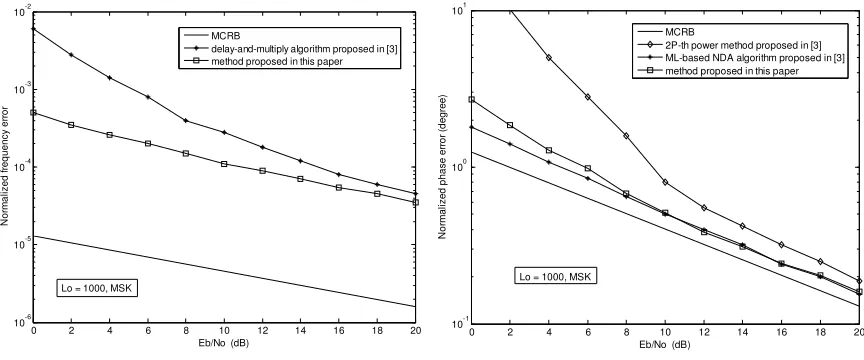
Figure 4. Performance of frequency tracking. Figure 5. Performance of phase recovery.
According to expressions (20), the phase estimation is depending upon both the frequency and the timing estimation. As a result, the phase error would be a little worse with low signal-to-noise ratio, because at such low signal-to-noise ratio the timing and frequency estimation would also be deteriorated.
As shown in Figure 5, the performance of phase recovery is simulated and compared with the 2P-th power method and ML-based NDA method both proposed in [3]. Obviously, the method proposed in this paper could achieve better performance than the 2P-th power method, no matter working at low or high signal-to-noise ratio. However, it is still a litter worse than the ML-based NDA method, especially at low signal-to-noise ratio.
However, the complexity of phase recovery method proposed in this paper is the smallest one compared with the other two methods.
Summary
In this paper, a novel joint synchronization algorithm was investigated based on the squared MSK signal derivation. The frequency offset and timing error could be estimated independent with each other. Simulation results show that such algorithm has superior performance with frequency offset, timing error and carrier phase even working at low signal-to-noise ratio, which makes such algorithm much more challenging with other existing algorithms in power-limited systems. Besides, the complexity of this method is very low in whole, which makes the implementation very easy for the receiver.
However, the disadvantage of such algorithm is that it is just suited for minimum-shift keying signal. Future work should be devoted to the estimation with Gaussian minimum-shift keying or other CPM signals.
Acknowledgement
In this paper, the research was sponsored by the National Nature Science Foundation (Project authorization No. 61301164 and 61501511).
References
[2]L. Bin. A Decision-feedback Phase-tracking Receiver for Continuous Phase Modulation [J]. IEEE Transactions on Communications, 1997 45(4) 396-399.
[3]U. Mengali, A. N. D’Andrea. Synchronizations Techniques for Digital Receivers. New York: Plenum Press, 1997.
[4]G. N. Tavares, L. M. Tavares, A. Petrolino. On The True Cramér-Rao Bound for Data-aided Carrier-phase-independent Frequency Offset and Symbol Timing Estimation [J]. IEEE Transactions on Communications, 2010 58(2) 442-447.
[5]E. Hosseini, E. Perrins. The Cramér-Rao Bound for Training Sequence Design for Burst-mode CPM [J]. IEEE Transactions on Communications, 2013 61(6) 2396-2407.
[6]M. Morelli, U. Mengali. Feedforward Carrier Frequency Estimation with MSK-type Signal [J]. IEEE Communications Letters, 1998 2(8) 235-237.
[7]M. E. Magana, A. Kandukuri. Non-data-aided Parametric- and Nonparametric-based Carrier Frequency Estimators for Burst GMSK Communication Systems [J]. IEEE Transactions on Instrumentation and Measurement, 2010 59(7) 1783-1792.
[8]D. A. Gudovskiy, L. Chu, S. Lee. A Novel Nondata-aided Synchronization Algorithm for MSK-type-modulated Signals [J]. IEEE Communications Letters, 2015 19(9) 1552-1555.
[9]Q. Zhao, H. Kim, G. L. Stuber. Innovations-based MAP Estimation with Application to Phase Synchronization for Serially Concatenated CPM [J]. IEEE Transactions on Communications, 2006 5(5) 1033-1043.