2017 2nd International Conference on Software, Multimedia and Communication Engineering (SMCE 2017) ISBN: 978-1-60595-458-5
Application of Decision Support System
in Load Forecasting Management
Wei-bo ZHAO
*and Dong-xiao NIU
School of Economics and Management, North China Electric Power University, Beijing 102206, China
*Corresponding author
Keywords: Load forecasting, Decision support system, Data warehouse.
Abstract. Power load forecasting is a very important part of the operation of power grid companies. Load forecasting requires a variety of forecasting techniques and methods, as well as a certain amount of historical data. The decision support system can greatly improve the efficiency and accuracy of load forecasting. Data Warehouse (DW) and On Line Analytical Processing (OLAP), which are introduced in this paper, are the organic components of decision support system. The paper analyzed the way to use DW and OLAP to establish power decision support system for power load forecasting work.
Introduction
Power load forecasting plays an important role in real-time control and assuring the economic, safe and reliable operation of power systems. It has become a major component of modern energy management systems in power systems and is of vital importance for power system control, operation and planning. The Power system load forecasting is divided into long-term forecast, medium-term forecast and short-term forecast. Generally speaking, the long-term forecast can be up to 30 years, while the medium-term forecast is usually several years, a few months, and short-term forecast is a few days and even shorter. As the load forecast error will increase the cost of operation and production, accurate and timely load forecast for the power sector and power supply systems are of great significance. Therefore, how to improve the accuracy of short-term forecast has become the problem for the power workers and other scientific and technological personnel to solve [1].
Decision support system can provide users with flexible reporting, random query, On Line Analytical Processing (OLAP) and data mining functions, and ultimately help users find the rule from, the data, forecast trends, and assist them to make the right decisions, in the end to guide the development of organization [2]. The use of decision support system in load forecast management can improve the efficiency and accuracy of forecasting. Besides, the data warehouse can also store the historical data well and facilitate the data collation and analysis. In this paper, the power grid system is used as the research background, and the decision support system is established by using DW and OLAP to provide effective means for the decision of power grid.
Akinde proposed a more efficient online analytical process to combine data warehouses to provide better support for power load forecasting [3]. Teorey believes that there is no general data warehouse structure, so a larger data warehouse structure is proposed [4]. Zheng Binxiang established a power decision support system based on data warehouse. He also introduced the situation of establishing power decision support system by using data warehouse and online analytical processing technology, and provided a favorable means for decision support of electric power economy operation [5].
Requirement Analysis
database and network database, training simulation database. However there is no effective means to use these data for decision support services while the EMS database system has accumulated a lot of data during its long-running. Therefore, how to use these massive data resources to support decision making is an important problem for information system personnel. The solution to the problem not only requires online services, but also involves a large number of data for decision-making, which EMS's traditional database system cannot meet [6].
Related Theories
Data Warehouse
DW is essentially different from traditional database systems. A database is a generic platform, which is built on a rigorous mathematical model to manage enterprise data, perform transactions, and complete related business. In contrast, the DW does not have strict data theory, which is more biased towards engineering. It is the establishment of the enterprise over a long period of time that money cannot buy. Its application object is a different level of managers, while its data source is a variety of data sources. It requires a large amount of historical data and summary data because the data in the library need not be modified to delete, which is mainly for large-scale query and analysis [8]. The DW mainly analyzes the decision analysis data. Because of the particularity of the decision analysis data, the general DW has the following characteristics:
(1) Subject-oriented
DW is subject-oriented, subject means the analysis, decision-making goals and requirements. And such requirements, which are often the key aspects of policymakers' attention, are made by decision makers based on job needs and are intended for policy makers.
The so-called topic-oriented means that the data in DW uses a topic-oriented organization. The subject-oriented data organization is a complete and consistent description of the data objects at a higher level. It can describe the data involved in each analysis object of the enterprises and the relationship between the data. The so-called higher level is relative to the application-oriented data organization, which means that organizing data according to the theme has a higher level of data abstraction.
(2) Integrity
Data analysis and data decision need a certain "data width" in order to obtain a wide range of information for analysis, comparison and identification. So the data in the data warehouse is usually obtained from multiple data sources. To build the data warehouse, it must need to extract, clean and convert data in these different data sources, and then reorganize and synthesize, eliminate inconsistencies in source data, and integrate unified data volumes to ensure that the information in data warehouse is about the whole company's consistent global information.
(3) Nonvolatile
The data in the operational database is usually updated in real time, thus the data changes in time is needed. Data in the data warehouse is mainly used for enterprise in decision analysis, so the data involved in the operation is mainly data query. Once a data is lead into the data warehouse, it will be retained long term generally, that is, data warehouse generally have a lot of query operation, and rare modify and delete operations. This is the basic conditions to ensure the correction of decision-making.
(4) Time Variant
Online Analysis and Processing
The purpose of establishing a data warehouse is to provide processed data for online analytical processing (OLAP) systems. OLAP is based on the characteristics of query and analysis, according to the demand of the information of the decision maker. OLAP helps decision-makers to understand the mystery of the data, to grasp the rules hidden in it, and to provide a useful means for decision support. General online analytical processing has the following main features:
(1) OLAP can provide multi-dimensional concept of data view, so that terminal user can view data from data warehouse in multi-angle, multi-faceted and multi-level. It includes the cross dimension, the calculation and modeling among different levels, so as to deeply understand the information contained in the data and its connotation.
(2) Quick response to user's request. In OLAP, the data in the data warehouse is projected, connected and grouped. It no longer need to deal with the original data in a complex way, just in the real view on the basis of some simple calculations can complete the complex query, which could improve the response speed of the query.
(3) Powerful analysis function. The OLAP system can provide users with powerful statistics, analysis and report processing function and the ability to forecast trend. And users can analysis data from macro to micro and compare data from different inter dimensional. The basic analysis operations for online analytical processing are slices, dice, drill-down, roll-up and rotate [6].
Basic Structure and Characteristics
Power load forecasting is based on the historical data of power load and its influencing factors. Therefore, the prediction accuracy will be affected by a large number of complex factors, such as weather conditions, date types, prediction models, social events, economic activities and other [10]. Load forecasting needs to select the appropriate model according to the forecast plan and retrieve a large number of relevant data. The DW, OLAP and information detection system in the basic structure of load forecasting decision support system can make the load forecasting work more efficient.
Basic Framework
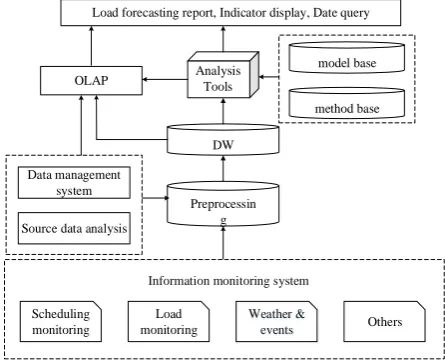
Based on the load forecasting method, this paper establishes a load forecasting model library which is suitable for different situations and accuracy requirements. And it could be combined with data warehouse and information monitoring system to assist load forecasting. In this paper, the basic structure of the load forecasting decision support system is shown in figure 1.
DW
Preprocessin g Analysis
Tools
Load forecasting report, Indicator display, Date query
OLAP
Source data analysis Data management
system
model base
method base
Scheduling monitoring
Load
monitoring Others
[image:3.595.183.406.545.725.2]Weather & events Information monitoring system
(1) Data Warehouse
DW is established by storing data inside. Then store and sort the information obtained from the information monitoring system. Through the analysis of the data management system and the source data, the original data in the DW can be sorted and analyzed, so as to facilitate the load prediction.
The information monitoring system is composed of dispatching monitoring system, load monitoring system, weather monitoring and forecasting system. After the data is processed into the database, through the analysis tools of the model library and the method library, select the appropriate load forecasting technology to analyze and predict, then communicate to the OLAP tools, and finally output the results to users.
(2) Model Base
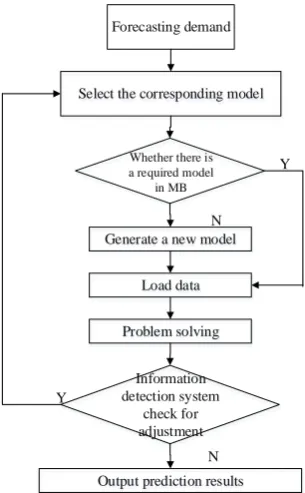
A model library is a collection of related models that are stored for a particular purpose and stored in a particular structure. In a specific application, it is often necessary to establish a number of model libraries, people can classify and maintain according to the nature of the model and the use of different properties of the model [11].
The research of power load forecasting has a long history, and there are a lot of prediction methods, such as self-extrapolation method, correlation analysis method, time series method and so on. With the rise of some new theories, such as fuzzy theory, grey system theory, expert system, neural network and so on, the new prediction method based on the new theory has been developed. The kind of forecasting model should be carefully chosen and considered under different prediction accuracy requirements, because of an unsuitable model could leading a large prediction error. If necessary, we should use different models to calculate, so as to compare and select.
Forecasting demand
Select the corresponding model
Generate a new model
Load data N
Y
Problem solving Whether there is a required model
in MB
Information detection system
check for adjustment
N Y
[image:4.595.211.364.382.629.2]Output prediction results
Figure 2. The operation flow of model base.
In the load forecasting method, for deterministic models with uncertainties and uncertain factors, it is difficult to obtain accurate predictions. The emerging theory can reduce the impact of artificial assumptions on load forecasting, which is more from the power system and the power load itself to proceed with the inherent changes in the development of power load to make a realistic analysis and prediction to make up for the shortcomings of traditional prediction methods to determine the model to replace the development of the load itself.
the relative similarity of the day to complete the current collected information and 1D forecast information and deviation, we could determine if the current load and the load of original plan have big deviation based on related theory. When the degree of similarity and deviation is large, the short-term load forecasting system is restarted to predict whether or not to revise the plan.
System Features
The system involves a variety of advanced technologies, such as data warehouse, OLAP, combined with the original load forecasting model to integrate the existing historical data and the key database. Then we could realize the monitoring and management of load data and establish the comprehensive decision support model of load forecasting. Based on that, the multi-dimensional analysis of load forecasting data and the analysis report function of expert system are carried out.
Extract-Transform-Load (ETL) is used to describe the process of extracting, transforming and loading data from the source to the destination [9]. Then the DW model and OLAP analysis model are constructed by ETL, which is used to deal with the data of dispatching system and load control system. The processed data is organized according to the relevant data model, and the data interface layer is used to interact with the outside world. Above the unified data interface layer is the application layer related to the business. The integrated information resources platform can achieve the integration of applications, providing a variety of analysis reports, statements, inquiries, etc. The basic characteristics of the decision support system include:
Focus on the integration of existing data, establish a data management platform to provide a unified interface for monitoring and verification of data integration, establish a new application for providing a convenient, standardized and stable data base, which can greatly reduce the difficulty, and the construction period of the new system; aiming at the key indicators of the enterprise, the system provides a series of analysis functions, which can effectively improve the accuracy and precision of the key indicators, and provide support for decision-making; in the process of system construction, implementation and use, the decision support system has established a complete set of management methods, which effectively promoted the information management of users.
Conclusion
Power load forecasting is of great significance for the optimization of power generation plan and power allocation plan, and has high economic and social benefits. As a result, the need for the accuracy of the load forecasting is higher and higher, but the work of load forecasting is very complex and difficult. This paper adds the decision support system into the load forecasting management, by using methods of data warehouse and OLAP, which is helpful to improve the efficiency and accuracy of load forecasting.
References
[1] Niu Dongxiao. Power load forecasting technology and its application (Second Edition) [M]. China Power Press, 2009.
[2] Chen Wenwei. Tutorial of decision support system [M]. Tsinghua University press, 2010.
[3] Akinde M O, Bohlen M H, Johnson T, et al. OLAP Processing in Data Warehouses [J]. Information Systems, 2015, 28 (1-2): 111-135.
[4] Teorey T J. Review - Methodological Framework for Data Warehouse Design. [J]. 2015, 2.
[6] Cui Qiming, Pan Hongjian, et al. Application and practice of auxiliary decision support system for power supply enterprises under the background of smart grid [J]. Energy Technology and Economics, 2011, 23 (11): 26-31.
[7] Luo Jing. Design and analysis of power load forecasting model [D]. Fudan University, 2008.
[8] Wu Xuehui. Research and development of price risk analysis and decision support system for regional power supply market [D]. North China Electric Power University (Beijing), North China Electric Power University, 2007.
[9] Zhang Zhimin. ETL parallel scheduling of data warehouse [D]. Jilin University, 2015.
[10] Wu Chunyan. Construction and application of load forecasting management system [J]. China Information Technology, 2012 (24).