January 26, 1994
SRC
Research
Report
120Dynamic Typing
in Polymorphic Languages
Martn Abadi, Luca Cardelli,
Benjamin Pierce, and Didier Remy
d i g i t a l
Systems Research Center
130 Lytton Avenue
Systems Research Center
The charter of SRC is to advance both the state of knowledge and the state of the art in computer systems. From our establishment in 1984, we have performed basic and applied research to support Digital's business objectives. Our current work includes exploring distributed personal computing on multiple platforms, networking, programming technology, system modelling and management tech-niques, and selected applications.
Our strategy is to test the technical and practical value of our ideas by building hardware and software prototypes and using them as daily tools. Interesting systems are too complex to be evaluated solely in the abstract; extended use allows us to investigate their properties in depth. This experience is useful in the short term in rening our designs, and invaluable in the long term in advancing our knowledge. Most of the major advances in information systems have come through this strategy, including personal computing, distributed systems, and the Internet.
We also perform complementary work of a more mathematical avor. Some of it is in established elds of theoretical computer science, such as the analysis of algorithms, computational geometry, and logics of programming. Other work explores new ground motivated by problems that arise in our systems research. We have a strong commitment to communicating our results; exposing and test-ing our ideas in the research and development communities leads to improved understanding. Our research report series supplements publication in profes-sional journals and conferences. We seek users for our prototype systems among those with whom we have common interests, and we encourage collaboration with university researchers.
Dynamic Typing
in Polymorphic Languages
Benjamin Pierce is at the Department of Computer Science of the University of Edinburgh. Part of his work was done at INRIA Rocquencourt and part at the School of Computer Science, Carnegie Mellon University. Didier Remy is at INRIA Rocquencourt.
A preliminary version of this material appeared as [2].
c
Digital Equipment Corporation 1994
Authors' Abstract
There are situations in programmingwhere some dynamic typing is needed, even in the presence of advanced static type systems. We investigate the interplay of dynamic types with other advanced type constructions, discussing their inte-gration into languages with explicit polymorphism (in the style of system F),
Contents
1 Introduction
1
2 Review
2
3 Explicit Polymorphism
4
3.1 Higher-order pattern variables: : : : : : : : : : : : : : : : : : : : 4
3.2 Syntax : : : : : : : : : : : : : : : : : : : : : : : : : : : : : : : : : 6
3.3 Tag closure : : : : : : : : : : : : : : : : : : : : : : : : : : : : : : 7
3.4 Deniteness and matching : : : : : : : : : : : : : : : : : : : : : : 8
4 Implicit Polymorphism
10
4.1 Implicit tagging: : : : : : : : : : : : : : : : : : : : : : : : : : : : 10
4.2 Tag instantiation and tuple variables : : : : : : : : : : : : : : : : 11
4.3 A language : : : : : : : : : : : : : : : : : : : : : : : : : : : : : : 12
4.4 Related work : : : : : : : : : : : : : : : : : : : : : : : : : : : : : 13
5 Abstract Data Types
14
6 Subtyping
16
7 Conclusion
19
Acknowledgements
19
1 Introduction
Dynamic types are sometimes used to palliate deciencies in languages with static type systems. They can be used instead of polymorphic types, for ex-ample, to build heterogeneous lists; they are also exploited to simulate object-oriented techniques safely in languages that lack them, as when emulating meth-ods with procedures. But dynamic types are of independent value, even when polymorphic types and objects are available. They provide a solution to a kind of computational incompleteness inherent to statically-typed languages, oering, for example, storage of persistent data, inter-process communication, type-dependent functions such asprint, and theevalfunction.
Hence, there are situations in programming where one would like to use dynamic types even in the presence of advanced static type systems. In this paper we investigate the integration of dynamic types into languages with ex-plicit polymorphism (in the style of systemF [10]), implicit polymorphism (in
the style of ML [16]), abstract data types, and subtyping. Our study extends earlier work [1], but keeps the same general approach and the same basic lan-guage constructs: dynamic, for tagging a value with its type, andtypecase, for
comparing a type tag with a pattern and branching according to whether they match.
The interaction of polymorphism and dynamic types gives rise to problems in binding type variables. We nd that these problems can be more clearly addressed in languages with explicit polymorphism. Even then, we encounter some perplexing diculties (as indicated in [1]). In particular, there is no unique way to match the type tag of a dynamic value with atypecase pattern. Our
solution consists in constraining the syntax oftypecasepatterns, thus providing
static guarantees of unique solutions. The examples we have examined so far suggest that our restriction is not an impediment in practice.
Drawing from the experience with explicit polymorphism, we consider lan-guages with implicit polymorphism in the ML style. The same ideas can be used, with some interesting twists. In particular, we are led to introduce tuple variables, which stand for tuples of type variables.
The treatment of abstract data types does not present any new typing or matching diculties. Instead, it raises an interesting question: whether the type tag of a dynamically typed value should be matched abstractly or concretely (that is, using knowledge of the value's actual run-time type). We explore the consequences of both choices.
Subtyping is exploited in combination with dynamic types in languages with restrictedtypecasepatterns, such as Simula-67 [3] and Modula-3 [8]. There, a
tag matches a pattern if it is a subtype of the pattern. This sort of matching does not work out well with more generaltypecasepatterns. We nd it preferable to
match type tags against patterns exactly, and then perform explicitly prescribed subtype tests.
types [12, 14, 21]. The work most relevant to ours is that of Leroy and Mauny, who dene and investigate two extensions of ML with dynamic types. We compare their designs to ours in section 4.
Section 2 is a brief review of dynamic typing in simplytyped languages, based on [1]. Section 3 considers the addition of dynamic typing to a language with explicit polymorphism [10]. Section 4 then deals with a language with implicit polymorphism. Sections 5 and 6 discuss abstract data types and subtyping, respectively. We conclude in section 7.
2 Review
The integration of static and dynamic typing is fairly straightforward for mono-morphic languages. The simplest approach introduces a new base typeDynamic
along with adynamicexpression for constructing values of typeDynamic
(infor-mally called \dynamics") and a typecaseexpression for inspecting them. The
typechecking rules for these expressions are:
` a2T
` dynamic(a:T)2Dynamic
(Dyn-I)
` d2Dynamic ;x:P ` b2T ` c2T ` typecase d of (x:P)b else c2T
(Dyn-E)
The phrases (x:P) and else are branch guards; P is a pattern|here, just a
monomorphic type;bandcarebranch bodies. For notational simplicity, we have
considered onlytypecaseexpressions with exactly one guarded branch and an else clause; a typecase involving several patterns can be seen as syntactic
sugar for several nested instances of the single-patterntypecase.
In the most direct implementation, the semantics of a dynamic is a pair consisting of a value and its type. The semantics of typecase d of (x:A) b else e is then: break dinto a value c and a type C, and ifCmatches Athen
bind xtoc and execute b, otherwise execute e. In the simplest version of this
semantics, CmatchesA if they are identical; in languages with subtyping, it is
common to allowCto be a subtype ofAinstead.
Constructs analogous todynamicandtypecasehave appeared in a number
of languages, including Simula-67 [3], CLU [15], Cedar/Mesa [13], Amber [4], Modula-2+ [20], Oberon [23], and Modula-3 [8]. These constructs have sur-prising expressive power; for example, xpoint operators can already be dened at every type in a simply typed lambda-calculus extended with Dynamic [1].
Important applications of dynamics include persistence and inter-address-space communication. For example, the following primitives might provide input and output of a dynamic value from and to a stream:
extern 2 WriterDynamic!Unit
Moreover, dynamics can be used to give a type for anevalprimitive [11, 18]: eval 2 Exp!Dynamic
We obtain a much more expressive system by allowing typecase guards
to contain pattern variables. For example, the following function takes two dynamics and attempts to apply the contents of the rst (after checking that it is of functional type) to the contents of the second:
dynApply =
(df:Dynamic) (da:Dynamic)
typecase df of
fU,Vg (f:U!V)
typecase da of
fg (a:U)
dynamic(f(a):V) else ...
else ...
HereUandVare pattern variables introduced by the rst guard. In this example,
if the arguments are:
df = dynamic(((x:Int)x+2):Int!Int)
da = dynamic(5:Int)
then thetypecaseguards match as follows:
Tag: Int!Int
Pattern: U!V
Result: fU=Int;V=Intg
Tag: Int
Pattern: Int
Result: fg
and the result ofdynApplyisdynamic(7:Int).
A similar example is the dynamic-composition function, which accepts two dynamics as arguments and attempts to construct a dynamic containing their functional composition:
dynCompose =
(df:Dynamic) (dg:Dynamic)
typecase df of
fU,Vg (f:U!V)
typecase dg of
fWg (g:W!U)
dynamic(f g:W!V)
3 Explicit Polymorphism
This formulation of dynamic types may be carried over almost unchanged to languages based on explicit polymorphism [10, 19]. For example, the following function checks that its argumentdfcontains a polymorphic functionftaking
lists to lists. It then creates a new polymorphic function that accepts a type and a listxof values of that type, instantiatesfappropriately, and appliesfto
the reverse ofx:
(df:Dynamic)
typecase df of
fg (f:8(Z) List(Z)!List(Z))
(Y) (x:List(Y)) f[Y](reverse[Y](x))
else (Y) (x:List(Y)) x
Here Listandreversehave the obvious meanings; they are not primitives of
the language treated below, but can be encoded. The type abstraction operator is written . Type application is written with square brackets. The types of
polymorphic functions begin with8. For example, 8(X)X!Xis the type of the
polymorphic identity function, (X)(x:X)x.
3.1 Higher-order pattern variables
First-order pattern variables, by themselves, do not appear to give us sucient expressive power in matching against polymorphictypes. For example, we might like to generalize the dynamic-application example from section 2 so that it can accept a polymorphic function and instantiate it appropriately before applying it:
dynApply2try =
(df:Dynamic) (da:Dynamic)
typecase df of
fg (f:8(Z):::!:::)
typecase da of
fWg (a:W)
dynamic(f[W](a): ...) else ...
else dynApply(df)(da)
But there is no single expression we can ll in for the domain of f that will
makedynApply2tryapply to both
df = dynamic ((Z) (x:ZZ) <snd(x),fst(x)>: ...)
da = dynamic(<3,4>: ...)
df = dynamic(((Z) (x:Z!Z) x): ...)
da = dynamic(((x:Int) x): ...)
In the former case, the expected type forfis8(X)(XX)!(XX); in the latter
case, it is8(X)(X!X)!(X!X). These two types are incompatible.
Thus we are led to introducing order pattern variables. A higher-order pattern variable ranges over pattern contexts|patterns abstracted with respect to some collection of type variables. With higher-order pattern variables, we can express polymorphic dynamic application:
dynApply2 =
(df:Dynamic) (da:Dynamic)
typecase df of
fF,Gg (f:8(Z)F(Z)!G(Z))
typecase da of
fWg (a:F(W))
dynamic(f[W](a):G(W)) else ...
else dynApply(df)(da)
For example, if
df = dynamic(id:8(X)X!X)
da = dynamic(3:Int)
then thetypecaseexpressions match as follows:
Tag: 8(X)X!X
Pattern: 8(Z)F(Z)!G(Z)
Result: fF= (X)X;G= (X)Xg
Tag: Int
Pattern: F(W) (which reduces toW)
Result: fW=Intg
and the result of the application
dynApply2(df)(da)
is
dynamic(id[Int](3) :Int)
Followingstandard notational conventions, we write (X)Xfor the identity
It is now easy to deal with the two inputs given above. If
df = dynamic ((Z) (x:ZZ) <snd(x),fst(x)>: 8(X)(XX)!(XX)))
da = dynamic(<3,4>:IntInt)
then the match is:
Tag: 8(X)(XX)!(XX)
Pattern: 8(Z)F(Z)!G(Z)
Result: fF= (X)XX;G= (X)XXg
Tag: Int
Pattern: F(W) (which reduces toWW)
Result: fW=IntIntg
If
df = dynamic(((Z) (x:Z!Z) x): 8(X)(X!X)!(X!X))
da = dynamic(((x:Int) x): Int!Int)
then the match is:
Tag: 8(X)(X!X)!(X!X)
Pattern: 8(Z)F(Z)!G(Z)
Result: fF= (X)X!X;G= (X)X!Xg
Tag: Int
Pattern: F(W) (which reduces toW!W)
Result: fW=Int!Intg
3.2 Syntax
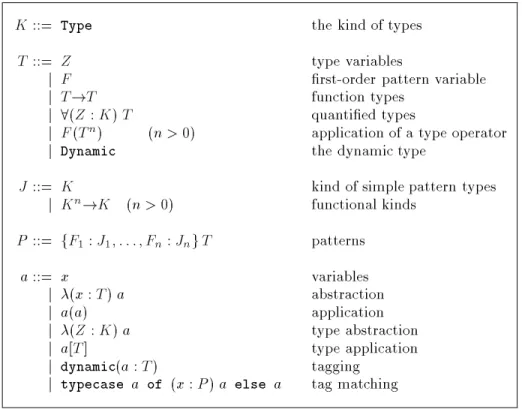
We now present dynamic types in the context of a second-order polymorphic
-calculus, system F. The syntax of F with type Dynamic (including some
third-order constructs used in patterns) is given in Figure 1. In examples we also use base types, cartesian products, and lists in types and patterns, but we omit these in the formal treatment.
We regard as identical any pair of formulas that dier only in the names of bound variables. For brevity, we sometimes omit kinding declarations and empty pattern-variable bindings. Also, it is technically convenient to write the pattern variables bound by a typecase expression as a syntactic part of the
pattern, rather than putting them in front of the guard as we have done in the examples. Thus, typecase e1 of fVg(x:T)e2 else e3 should be read
K::= Type the kind of types
T ::= Z type variables
j F rst-order pattern variable
j T!T function types
j 8(Z :K)T quantied types j F(T
n) (
n>0) application of a type operator j Dynamic the dynamic type
J ::= K kind of simple pattern types
j K n
!K (n>0) functional kinds P ::= fF
1: J
1 ;:::;F
n: J
n
gT patterns
a::= x variables
j (x:T)a abstraction
j a(a) application
j (Z:K)a type abstraction
j a[T] type application
j dynamic(a:T) tagging j typecase a of (x:P)a else a tag matching
Figure 1: Syntax for systemF withDynamic
3.3 Tag closure
One critical design decision for a programming language with type Dynamic
is the question of whether type tags must be closed (except for occurrences of pattern variables), or whether they may mention universally bound type variables from the surrounding context.
In the simplest scenario,dynamic(a:A)is legal only whenAis a closed type.
(The typeAmay be polymorphic, of course, so long as all the type variables it
mentions are also bound withinA; for example,8(Z)Zis a legal tag.) Similarly,
we would require that the guard in atypecaseexpression be a closed type.
If the closure restriction is not instituted, then types must actually be passed as arguments to polymorphic functions at run time, so that code can be compiled for expressions like:
(X) (x:X) dynamic(<x,x>:XX)
where the type XX must be generated at run time. For languages where
becomes essential (see section 4). For now, we consider the unrestricted case, where tags may contain free type variables.
3.4 Deniteness and matching
When pattern variables may range over functions on types, there is in general no guarantee of unique matches of patterns against tags. For example, when the pattern F(Int) is matched against the tagBool, the pattern variableF is
forced to be (X)Bool. But when the same pattern is matched against the tag Int, we nd that F can be either (X)X or (X)Int. There is no reasonable
way to choose. Worse yet, considerF(W) orF(W!Int) for a pattern variableW.
Two sorts of solutions come to mind:
At run time, we may look for matches and fail if none or more than one
exist. Unfortunately, failures could be somewhat unpredictable.
At compile time, we may allow only patterns that match each tag in
at most one way. This condition on patterns is called deniteness in a preliminary version of this work [2]. As deniteness seems hard to decide at compile time, an approximation to deniteness may be used instead. As in [2], we choose a compile-timesolution. We propose a condition on patterns sucient to guarantee deniteness ((1) and (2), below), in combination with an appropriate denition of matching ((3), below). This condition is more restrictive than that of [2], and in some cases it mayentail some code duplication. On the other hand, it is easier to describe, it suces for our examples, and in general it does not seem to aect expressiveness.
Our condition on patterns is:
1. each pattern variable introduced in a pattern is used in the same pattern; 2. in each of these uses, the arguments of the pattern variable are distinct
type variables bound in the same pattern (not pattern variables). Note that as far as innertypecaseexpressions are concerned, pattern variables
of outer typecaseexpressions are just constants, and they may appear in any
positions where constants may appear. For example, we allow:
fF:Type!Typeg8(Z)F(Z) fF:Type!Typeg8(Z)H(F(Z))
fG:TypeType!Typeg8(Z)8(W)G(W;Z)
(whereHis a pattern variable of arity 1 introduced by an enclosingtypecase).
But we do not allow:
fF:Type!TypegF(Int)
because, according to requirement (2), F must be applied to a type variable
rather than to Int or to H(Z), and G must be applied to two distinct type
variables rather than toZtwice.
At run time, we must solve the problem of matching a tag against a pattern. The cases where the pattern's outermost construct is a type variable,!, or8are
all evident. Hence, the problem of matching a tag against a pattern is reduced to matching subproblems of the formF(X1;:::;Xk) = A, where F is a pattern
variable introduced in the pattern,X1;:::;Xkare distinct type variables, andA
is a subexpression of the tag. We require:
3. the free type variables of a tag subexpression matching a pattern variable are exactly the arguments to the pattern variable
or, in this instance,X1;:::;Xk are the free type variables ofA. If this holds, we
takeF= (X1) :::(Xk)Aas the solution for the subproblem. This solution is
evidently unique, and thus deniteness is guaranteed. Moreover, requirement (3) implies that the function (X1) :::(Xk)Ahas the desirable properties of being
closed and of using all of its arguments. For example, we obtain a success with
Tag: 8(Z)8(W)Z!(Z!Z)
Pattern: fF:Type!Typeg8(Z)8(W)F(Z)
Result: fF= (X)X!(X!X)g
but failures with
Tag: 8(Z)8(W)Z!(W!W)
Pattern: fF:Type!Typeg8(Z)8(W)F(Z)
Result: failure
and
Tag: 8(Z)8(W)Int!(Int!Int)
Pattern: fF:Type!Typeg8(Z)8(W)F(Z)
Result: failure
In the second example,Wis a free variable of the tag subexpression Z!(W!W)
but not an argument inF(Z). Requirement (3) prevents the escape ofWfrom the
scope of its binder. In the third example,Zis an argument inF(Z) but does not
occur in the tag subexpression Int!(Int!Int). Requirement (3) guarantees
that later, successful matches instantiate all new pattern variables: if F were
allowed not to use its argumentZ, a later pattern
fV:TypegF(V)
might succeed withVundetermined.
4 Implicit Polymorphism
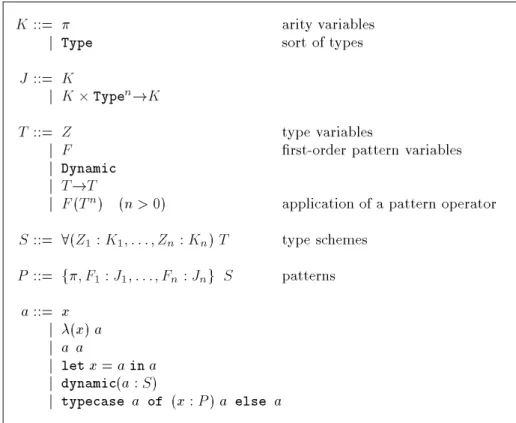
In this section we investigate dynamics in an implicitly typed language, the core language of ML.
The general treatment of dynamics for explicitly typed languages can be applied directly to ML, thus providing the language with explicitly tagged dy-namics. In this extension of ML, types can still be inferred for all constructs except dynamics; the user needs to provide type information only when creating or inspecting dynamics. For instance, consider the following program:
twice = dynamic((f) (x) f(f x):8(Z)(Z!Z)!(Z!Z))
To verify its correctness, we rst infer the type scheme 8(Z)(Z!Z)!(Z!Z)
for (f) (x) f(f x) as if it were to be let-bound. Then we check that this
type scheme has no free variables and that it is more general than the required tag 8(Z)(Z!Z)!(Z!Z). Similarly, when a typecasesucceeds, the extracted
value is given the type scheme of its tag as if it had been let-bound. That is, an instance of the value can be used with dierent instances of the tag as in:
foo = (df)
typecase df of
(f:8(Z)(Z!Z)!(Z!Z)) <f succ, f not>
else ...
wheresuccis the successor function on integers, andnotis the negation function
on booleans.
This solution is adequate. However, it seems to go against the spirit of ML in several respects, as we discuss next.
4.1 Implicit tagging
The solution just sketched requires explicit tags indynamic expressions. Since
the ML typechecker can infer most general types for expressions, one would expect it to tag dynamics with their principal types. For instance, the user should be able to write:
twice = dynamic((f) (x) f(f x))
and expect that the dynamic will be tagged with 8(Z)(Z!Z)!(Z!Z).
If types are not to be passed as arguments to polymorphic functions at run time, the tags of dynamics must be closed (see section 3.3). This restriction creates diculties for the implicit-tagging approach: a program like
(x) dynamic(x)
will fail to have a principal type. It will therefore simplify matters to assume that explicit tags are given indynamicexpressions. An alternative is discussed
4.2 Tag instantiation and tuple variables
The tag ofapply:
apply = dynamic((f) (x) f x:8(X,Y)(X!Y)!(X!Y))
is equivalent to8(Y,X)(X!Y)!(X!Y), and an ML programmer would
proba-bly view the order of quantiers as unimportant. In addition, the tag is more general than the pattern in the functionfoo; hence an ML programmer would
probably expect the tag and the pattern to match whenapplyis passed tofoo.
In general, it seems reasonable to ignore the order of quantiers in a tag, and to let a tag match a pattern if any instance of the tag does. This principle is calledtag instantiation.
Tag instantiation and second-order pattern variables do not t smoothly together. The diculty comes from the combination of two features:
Second-order pattern variables may depend on universal variables, as in
the pattern fFg (f:8(Z)F(Z)!Z).
Tag instantiation requires that if a typecase succeeds, then it also
suc-ceeds for a dynamic with an argument that has a more general tag. The tag 8(Z)(ZZ)!Z matches the previous pattern; so should the tag 8(X,Y)(XY)!X. ButFis not supposed to depend on two variables.
Because of tag instantiation, polymorphic pattern variables may always depend on more variables than the ones explicitly mentioned. We deal with this possi-bility by introducing tuple variables, which stand for tuples of variables. The tuple variable in a pattern will be dynamically instantiated to the tuple of all variables of the tag not matched by other variables of the pattern. For example, using a tuple variableU, the pattern fFg (f:8(Z)F(Z)!Z) should be written fFg (f:8(U;Z)F(U;Z)!Z).
Tuple variables bound in dierent patterns may be instantiated to tuples with dierent numbers of variables. Because of such size considerations, it is not always possible to use a tuple variable as argument to an operator, since this operator may expect an argument of dierent size. We introduce a simple system of arities in order to guarantee that type expressions are well formed. Formally, our example pattern should now be written:
f:Tuple;F:!Type!Typeg (f:8(U: ;Z:Type)F(U;Z)!Z)
The arity variableis to be bound at run time to the size of the tuple assigned
to the tuple variableU. However, it is not necessary to write all the arities in
programs since a typechecker can easily infer them.
In the following examples, we write Ui for the i-th component of tuple
variableU.
Tag: 8(Z) (ZZ)!Z
Pattern: f ;Fg (f:8(U: ;Z)F(U;Z)!Z)
K::= arity variables
j Type sort of types
J ::= K
j KType n
!K
T ::= Z type variables
j F rst-order pattern variables
j Dynamic j T!T j F(T
n) (
n>0) application of a pattern operator S::= 8(Z
1: K
1 ;:::;Z
n: K
n)
T type schemes P ::= f ;F
1: J
1 ;:::;F
n: J
n
g S patterns a::= x
j (x)a j a a
j letx=aina j dynamic(a:S)
j typecase a of (x:P)a else a
Figure 2: Syntax for ML withDynamic
Here the tuple arity is zero, thusFdoes not depend onU.
Tag: 8(X;Y) (XY)!X
Pattern: f ;Fg (f:8(U: ;Z)F(U;Z)!Z)
Result: f=1; F= (U;Z)ZU1g
Tag: 8(X;Y) (XY)!X
Pattern: f ;F;Gg (f:8(U: ;Z)F(U)!G(U))
Result: f=2; F= (U)U1U2; G= (U)U1g
4.3 A language
language, the well-formedness of type expressions and the correct scoping of type symbols must also be checked.
The matching algorithm is slightly complicated by tag instantiation and the use of tuple variables. As in the explicit case, we stipulate that fresh pattern variables can be applied only to distinct universally quantied variables. We also require that there be at most one universal tuple variable per pattern, and that its arity be given by the unique fresh arity variable introduced in the pattern. With these restrictions, matching becomes a simple extension of rst-order unication with restricted type operators; we omit the details.
4.4 Related work
The work on dynamic typing most closely related to ours is that of Leroy and Mauny [14]. Their dynamics without pattern variables have been implemented in the CAML language [22]. Our work can be seen as an extension of their system with \mixed quantication."
Rather than introduce a typecasestatement, Leroy and Mauny merge
dy-namic elimination with the usual case statement of ML. Ignoring this dierence, their dynamic patterns have the formQZ whereZ is a type andQa list of
ex-istentially or universally quantied variables. For instance,
8(X)9(F)8(Y)9(G) (v:T(X,F,Y,G))
is a pattern of their system. The existentially quantied variables play the role of our pattern variables. The order of quantiers determines the dependencies among quantied variables. Thus, the pattern above can be rephrased:
9(F)9(G)8(X)8(Y) (v:T(X,F(X),Y,G(X,Y)))
The equivalent pattern for us is:
f ;F;Gg (v:8(U: ;X;Y)T(X;F(U;X);Y;G(U;X;Y)))
With the same approach, in fact, we can translate all their patterns. On the other hand, some of our patterns do not seem expressible in their language, for example:
f ;F;Gg (v:8(U: ;X;Y)T(X;F(U;X);Y;G(U;Y)))
because the quantiers in the prex of their patterns are in linear order, and cannot express the \parallel" dependencies ofFonXandGonY.
let applyTwice =
(df) (dxy)
typecase df of
f,F,F'g (f:8(U:)F(U)!F'(U))
typecase dxy of
f 0
,G,Hg (x,y:8(U': 0
)F(G(U'))(F(H(U'))))
f x, f y else ... else ...
which applies its rst argument to each of the two components of its second argument and returns the pair of the results. Such examples cannot be expressed in systems with only type quantiers.
5 Abstract Data Types
The interaction between the use ofDynamic and abstract data types gives rise
to a puzzling design issue: should the type tag of a dynamic containing an element of an abstract type be matched abstractly or concretely? There are good arguments for both choices:
Abstract matching protects the identity of \hidden" representation types
and prevents accidental matches in cases where several abstract types happen to have the same representation.
On the other hand, transparent matching allows a more permissive style
of programming, where a dynamically typed value of some abstract type is considered to be a value of a dierent version of \the same" abstract type. This exibility is critical in many situations. For example, a program may create disk les containing dynamic values, which should remain usable even after the program is recompiled, or two programs on dierent ma-chines may want to exchange abstract data in the form of dynamically typed values.
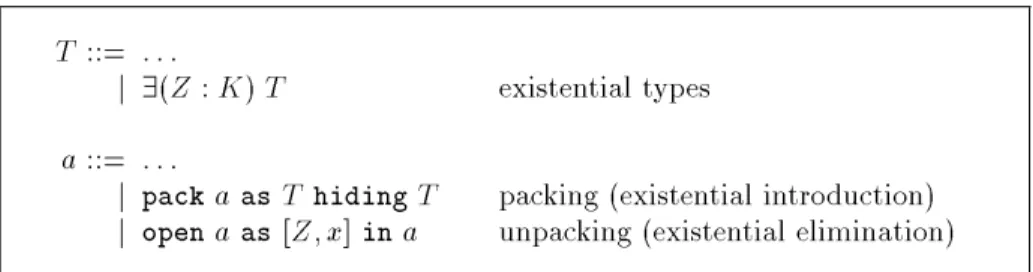
By viewing abstract types formally as existential types [17], we can see ex-actly where the dierence between these two solutions lies, and suggest a gener-alization of existential types that supports both. (Existential types can in turn be coded using universal types; with this coding, our design for dynamic types in the previous sections yields the second solution.)
To add existential types to the variant ofF dened in the previous section,
T ::= :::
j 9(Z :K)T existential types a::= :::
j packaasT hidingT packing (existential introduction) j openaas[Z;x]ina unpacking (existential elimination)
Figure 3: Extended syntax with existential types The typechecking rules forpackandopenare:
S=9(Z:K)T ` a2[R=Z]T ` (packaasS hidingR)2S
(Pack)
` a29(Z:K)S Z 62FV(T) ;Z :K;x:S ` b2T ` (openaas[Z;x]inb)2T
(Open)
A typical example where an element of an abstract type is packed into a
Dynamicis:
let stackpack = pack
push = (s:IntList) (i:Int) cons(i)(s),
pop = (s:IntList) cdr(s),
top = (s:IntList) car(s),
new = nil as 9(X)
push:X->Int->X,
pop:X->X, top:X->Int, new:X hiding IntList
in
open stackpack as [Stack,stackops] in let dstack =
dynamic
(stackops.push(stackops.new)(5):Stack) in
typecase dstack of
(s:Stack) stackops.top(s) else 0
Note that this sort of example depends critically on the use of open type tags. As discussed in section 3.3, open tags must be implemented using run-time types. The evaluation of pack must construct a value that carries the
We have a choice in the evaluation rule for theopenexpression:
We can evaluate the expression open a as [Z ;x] in b by replacing the
representation type variableZ by the actual representation type obtained
by evaluatinga.
Alternatively, we can replaceZ by a fresh type constant.
Without Dynamic, the dierence between these rules cannot be detected. But
withDynamicwe get dierent behaviors. Since both behaviors are desirable, we
may choose to introduce an extended openform that provides separate names
for the abstract version and for the transparent version of the representation type:
` a29(Z:K)S Z 62FV(T) ;Z :K;x:S ` [Z =R]b2T ` (openaas[R;Z;x]inb)2T
(Open)
In the body ofb, we can build dynamic values with tagsRorZ; atypecaseon
the former could investigate the representation type, while a typecaseon the
latter could not violate the type abstraction.
Further experience would be useful for understanding the interaction of
Dynamicand abstract types.
6 Subtyping
In simple languages with subtyping (e.g., [4, 8]) it is natural to extendtypecase
to perform a subtype test instead of an exact match. Consider for example the expression:
let dx = dynamic(3:Nat) in
typecase dx of (x:Int) ... else ...
The rst typecase branch is taken: although the tag ofdx, Nat, is dierent
fromInt, we haveNatInt.
Unfortunately, this idea runs into diculties when applied to more complex languages. In general, there does not exist a most general instantiation for pattern variables when a subtype match is performed. For example, consider the pattern V!Vand the problem of subtype-matching (Int!Nat)(V!V). Both
Int!IntandNat!Natare instances of V!Vand supertypes ofInt!Nat, but
they are incomparable. Even when the pattern is covariant there may be no most general match. Given a patternVV, there may be a typeABsuch that
K::= Type the kind of types
j Power(K)(T) the kind of subtypes ofT J ::= K
j K n
!K (n>0) j Power(K
n
!K)(F)
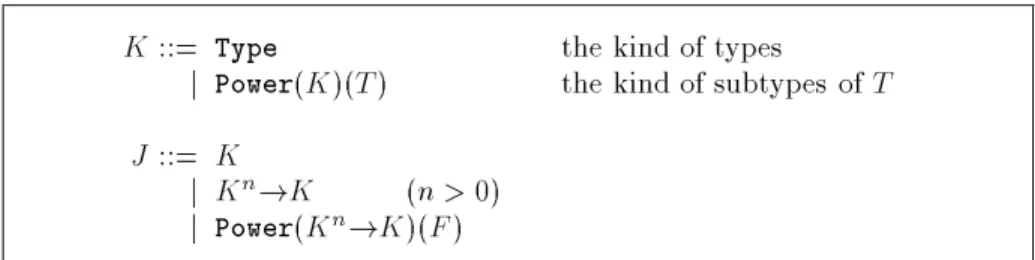
Figure 4: Extended syntax with subtyping
forV. This can happen, for example, in a system with bounded quantiers [7, 9],
and in systems where the collection of base types does not form an upper semi-lattice. Linear patterns (where each pattern variable occurs at most once) avoid these problems, but we nd linearity too restrictive.
Therefore, we take an approach dierent from that found in simple languages with subtyping. Our approach works in general and ts well with the language described in section 3.2. We intend to extend systemF with subtyping along
the lines of [6]. In order to incorporate also the higher-order pattern variables, we resort to power-kinds [5].
The kind structure of section 3.2 is extended in Figure 4, where it is assumed thatT :KandF :K
n
!K. Informally, the kindPower(Type)(T) is the
collec-tion of all the subtypes ofT, and similarly the kindPower(K 1
:::K n
!K)(F)
is the collection of all the operators of kindK 1
:::K n
!K that are pointwise
in the subtype relation withF. Subtyping () is not a primitive notion in the
syntax, but it is dened by interpreting:
TT 0:
K as T :Power(K)(T 0)
; whereT;T 0:
K FG: (K
1
:::K n
!K) asF(Q 1
;:::;Q n)
G(Q 1
;:::;Q n) :
K ;
for allQ 1:
K 1,
:::,Q n:
K
n, where
F ;G: (K 1
:::K n
!K)
The axiomatization ofPower(K)(T) [5] is designed to induce the expected
sub-typing rules. For example,T :Power(T) says thatTT.
Because of power-kinds, we can now write patterns such as:
typecase dx of
fV,W(VV)g (x:WV) ...
(that is: fV:Type, W:Power(Type)(VV)g (x:WV))
else ...
Each branch guard is used in typechecking the corresponding branch body. The shape of branch guards is fF
1 : K
1 ;:::;F
n : K
n
g(x : P) where each F i
may occur in the K j with
j >i and in P. This shape ts within the normal
Next we consider the dynamic semantics of typecase in the presence of
subtyping. The idea is to preserve the previous notion thattypecaseperforms
exact type matches at run time. Subtyping is introduced as a sequence of additional constraints to be checked at run time only after matching. These constraints are easily checked because, by the time they are evaluated, all the pattern variables have been fully instantiated. In the example above, suppose that the tag of dxis (NatInt)Int; then we have the instantiations W=
NatIntandV=Int. When the matching is completed, we successfully check
that W(VV).
Some examples should illustrate the additional exibility obtained with sub-typing. First we show how to emulate simple monomorphic languages with subtyping but without pattern variables, where typecase performs a subtype
test. The rst example of this section can be reformulated as:
typecase dx of
fVIntg (x:V) ...
else ...
In this example, the tag ofdxcan be any subtype ofInt.
The next example is similar to dynApply in section 2, but the type of the
argument can be any subtype of the domain of the function:
typecase df of
fV,Wg (f:V!W)
typecase da of
fV'Vg (a:V')
dynamic(f(a):W) else ...
else ...
With polymorphic tag types, or with polymorphic pattern types with only rst-order pattern variables, nothing new happens except that the matching and subtype tests must be the adequate ones for polymorphism.
The next degree of complexity is introduced by higher-order pattern vari-ables. Just as we had V0
V, a subtype constraint between two rst-order
pat-tern variables, we may haveFG:(K!K')for two higher-order pattern variables
F,G:(K!K'). As mentioned above, the inclusion is intended pointwise: FGi
F(X)G(X):K'under the assumptionX:K.
Another form of dynamic application provides an example of higher-order matches with subtyping:
typecase df of
fF,G:Type!Type,Vg (f:8(ZV)F(Z)!G(Z))
typecase da of
fWVg (a:F(W)) dynamic(f[W](a):G(W))
Finally, dynamic composition calls for a constraint of the formG0 G:
typecase df of
fG,H:Type!Typeg (f:8(X)G(X)!H(X))
typecase dg of
fF:Type!Type,G'G:Type!Typeg
(g:8(Y)F(Y)!G'(Y))
dynamic(((Z) f[Z] g[Z]):8(Z)F(Z)!H(Z))
else ... else ...
This example generalizes to functions of bounded polymorphic types, such as
8(XA)G(X)!H(X).
7 Conclusion
The extension of statically-typed languages with dynamic types is rather com-plicated. Perhaps we have been overly ambitious. We have tried to allow as much exibility as possible, at the cost of facing dicult matching problems. And perhaps we have not been ambitious enough. In particular, we have not provided mechanisms for dealing with multiple matches at run time, in order not to complicate the language designs or their implementations. We have also ignored the possibility of adding dynamic types toF
3, or to F
![10]. Only more
experience will reveal the most useful variants of our approach.
We have deliberately avoided semantic considerations in this paper. It seems relatively straightforward to provide precise operational semantics and then prove subject-reduction theorems for our languages. These theorems would be extensions of those established for monomorphic languages in [1], and would guarantee the soundness of evaluation for the languages. It is an entirely dif-ferent matter to dene denotational semantics. In particular, open tags clearly allow the expression of a rich class of non-parametric functions (which manipu-late types at run time), and these do not exist in many of the usual models for polymorphic languages.
Acknowledgements
References
[1] Martn Abadi, Luca Cardelli, Benjamin Pierce, and Gordon Plotkin. Dy-namic typing in a statically-typed language. ACM Transactions on Pro-gramming Languages and Systems, 13(2):237{268, April 1991.
[2] Martn Abadi, Luca Cardelli, Benjamin Pierce, and Didier Remy. Dy-namic typing in polymorphic languages. In Peter Lee, editor,ACM Sigplan Workshop on ML and its Applications, pages 92{103. Technical Report CMU-CS-93-105, School of Computer Science, Carnegie Mellon University, 1992.
[3] Graham M. Birtwistle, Ole-Johan Dahl, Bjorn Myhrhaug, and Kristen Ny-gaard. Simula Begin. Studentlitteratur (Lund, Sweden), Bratt Institute Fuer Neues Lerned (Goch, FRG), Chartwell-Bratt Ltd. (Kent, England), 1979.
[4] Luca Cardelli. Amber. In Guy Cousineau, Pierre-Louis Curien, and Bernard Robinet, editors,Combinators and Functional Programming Lan-guages, pages 21{47. Springer-Verlag, New York, 1986. Number 242 in Lecture Notes in Computer Science.
[5] Luca Cardelli. Structural subtyping and the notion of power type. In
Proceedings of the 15th ACM Symposium on Principles of Programming Languages, pages 70{79, 1988.
[6] Luca Cardelli, Simone Martini, John C. Mitchell, and Andre Scedrov. An extension of system F with subtyping. In T. Ito and A. R. Meyer, editors,
Theoretical Aspects of Computer Software, number 526 in Lecture Notes in Computer Science, pages 750{770, New York, 1991. Springer-Verlag. [7] Luca Cardelli and Peter Wegner. On understanding types, data abstraction,
and polymorphism. Computing Surveys, 17(4), December 1985.
[8] Greg Nelson (editor). Systems Programming in Modula-3. Prentice Hall, 1991.
[9] Giorgio Ghelli.Proof Theoretic Studies about a Minimal Type System Inte-grating Inclusion and Parametric Polymorphism. PhD thesis, Universita di Pisa, March 1990. Technical report TD{6/90, Dipartimento di Informatica, Universita di Pisa.
[12] Fritz Henglein. Dynamic typing: Syntax and proof theory. Science of Computer Programming, 1993. Special Issue on European Symposium on Programming 1992 (to appear).
[13] Butler Lampson. A description of the Cedar language. Technical Report CSL-83-15, Xerox Palo Alto Research Center, 1983.
[14] Xavier Leroy and Michel Mauny. Dynamics in ML. In John Hughes, edi-tor, Functional Programming Languages and Computer Architecture 1991, volume 523 ofLecture Notes in Computer Science, pages 406{426. Springer-Verlag, 1991.
[15] B. Liskov, R. Atkinson, T. Bloom, E. Moss, J.C. Schaert, R. Scheier, and A. Snyder. CLU Reference Manual. Springer-Verlag, New York, 1981. [16] Robin Milner, Mads Tofte, and Robert W. Harper. The Denition of
Stan-dard ML. MIT Press, Cambridge, Massachusetts, 1990.
[17] John Mitchell and Gordon Plotkin. Abstract types have existential type.
ACM Transactions on Programming Languages and Systems, 10(3):470{ 502, July 1988.
[18] Alan Mycroft. Dynamic types in ML. Draft article, 1983.
[19] John Reynolds. Towards a theory of type structure. In Proc. Colloque sur la Programmation, number 19 in Lecture Notes in Computer Science, pages 408{425, New York, 1974. Springer-Verlag.
[20] Paul Rovner. On extending Modula-2 to build large, integrated systems.
IEEE Software, 3(6):46{57, November 1986.
[21] Satish R. Thatte. Quasi-static typing (preliminary report). In Proceed-ings of the Seventeenth ACM Symposium on Principles of Programming Languages, pages 367{381, 1990.
[22] Pierre Weis, Mara-Virginia Aponte, Alain Laville, Michel Mauny, and As-cander Suarez. The CAML reference manual. Research report 121, INRIA, Rocquencourt, September 1990.