604
SWARM INTELLIGENCE BASED DYNAMIC SOURCE
ROUTING FOR IMPROVED QUALITY OF SERVICE
1N.UMAPATHI, 2N.RAMARAJ
1Research Scholar, Department of Electronics and Communication,
GKM College of Engg and Tech,Chennai-63,, India
2 Professor., Department of Computer Science Engineering,
GKM College of Engg and Tech, Chennai-63, India.
E-mail: [email protected], [email protected]
ABSTRACT
Ad hoc networks are wireless mobile hosts collections forming a temporary network without any infrastructure/centralized administration. So a mobile host is required to enlist the help of other hosts to forward packets to destination because of each mobile host’s limited range of wireless transmission. The paper presents a protocol for routing in ad hoc networks using Dynamic Source Routing (DSR) and Swarm Intelligence based on Ant Colony Optimization (ACO) to optimize the node pause time. The simulation results shows that the improved performance of routing in the network.
Keywords:MANET, Routing Protocols, Dynamic Source Routing (DSR), Ant Colony Optimization (ACO), Swarm Intelligence (SI)
1. INTRODUCTION
Mobile ad hoc network (MANET) [1] comprise of wireless mobile hosts forming a temporary network without infrastructure. Hosts move randomly organizing themselves arbitrarily leading to rapid/unpredictable topology changes. They also subject wireless links to unpredictable environmental changes thereby providing only limited bandwidth. Due to network topology’s dynamic nature and limited resources, MANET routing is challenging. Provision of quality of service (QoS) in MANETs guarantees more challenges than in wired networks due to node mobility, multihop communications, channel access contention and lack of central coordination.
MANET routing using shortest-path metric, is insufficient to construct high-quality paths, as hop count routing selects routes with less capacity than best network paths which exist [2]. Existing MANET protocols optimize hop count, to build route selection. Examples of MANET protocols are Destination Sequenced Distance Vector (DSDV), Ad hoc On Demand Distance Vector (AODV), and Dynamic Source Routing (DSR). But hop count based route selection may be of poor quality as routing protocols fail to ignore weak quality links used in connecting remote nodes. These have poor
signal-to-noise ratio (SNR) leading to higher frame error rates and lower throughput.
The Dynamic Source Routing protocol (DSR) is simple and efficient and designed for use in mobile nodes multi-hop wireless ad hoc networks. The network is completely configuring and self-organizing and requires no existing network infrastructure/administration when it uses DSR. Network nodes (computers) forward packets to each other to ensure communication over multiple “hops” between nodes not within direct wireless transmission range of each other. As the number/sequence of intermediate hops to reach a destination can change at will, resulting network topology is rich and constantly changing [3].
DSR protocol allows nodes discover a source route
across multiple network hops to a destination in an ad hoc network. A data packet carries in its header, a complete nodes list through which packets pass, allowing its routing to be loop-free and avoiding updating routing information in intermediate nodes through which packets are forwarded. By including source route in data packet header, other nodes forwarding/overhearing these packets may cache routing information for future use.
To find a route to destination, a route request
605 transmission range. Along with addresses of source and destination nodes, a route request packet contains a route record, an accumulated record of nodes visited by route request packet. When a node receives a route request, the following action results [4],
• If the request’s destination address matches own
address, then it is the destination. The packet route record contains route by which request reached the node from source. This route is reverted to the source through a route reply packet following the route in reverse.
• It is otherwise an intermediate node. If the node
does not see the request earlier and has a destination route in its cache table, a route reply packet is created with its cache route and returns it to the source. These are called Intermediate-Node replies; when it lacks a route it appends own address to route record, and increases hop count by one, and rebroadcasts request.
An Artificial Intelligence technique, Swarm Intelligence (SI) [5] is based on study of collective behaviour, in decentralized, self-organized systems. Swarm intelligence is “the emergent collective intelligence of groups of simple agents”. It leads to complex and intelligent behaviour through simple, unsupervised interactions between many autonomous swarm members. There is usually no centralized control dictating how individual agents must behave, but local interactions between agents lead to a global behaviour emerging.
Swarm Intelligence (SI) refers to complex behaviour from simple individual behaviours and interactions, observed in nature, especially among insects like ants, bees and fish. Though each individual has little intelligence, they just obey basic rules with locally obtained information from the environment. Ant routing resembles mechanisms from distributed Swarm Intelligence (SI) in biological systems and is an interesting solution where routing problems exist. Ant based routing is increasing in popularity due to its adaptive and dynamic nature.
Ant colony optimization (ACO) [6] is a recent technique for approximate optimization, inspired by real ant colonies. Specifically, ACO is inspired by ants’ foraging behaviour at whose core is the indirect communication between ants through chemical pheromone trails, enabling them to find short paths between nest and food sources. This real ant colonies characteristic is exploited in ACO algorithms to solve, discrete optimization problems.
Depending on view point, ACO algorithms may belong to various approximate algorithm classes. Seen from an artificial intelligence (AI) perspective, ACO algorithms are the most successful of swarm intelligence. Swarm intelligence’s goal is inspired by the collective behaviour of social insects like bees, termites, wasps, ants, and other animal societies like flocks of birds or fish schools to design an intelligent multi-agent system. In this paper, the proposed work is the extension of DSR, and ACO is used to optimize node pause time and mobility of the nodes. The remaining sections included are Related works and Methods used for this work. Finally, the conclusion is included.
2. RELATED WORK
Ghosekar et al [7] tried to ensure a comprehensive overview of this field by first explaining important roles that MANETs play in future wireless technology evolution. Then, the latest research in areas of MANET’s characteristics, capabilities and applications are reviewed. MANETs are self-organizing/self-configuring multi-hop wireless networks with dynamically changing topologies due to node mobility. Current Proactive routing protocols ensure routing information in the network for nodes always. This is achieved by a table driven routing information distribution, and updated routing information’s regular distribution which suit small-scale nodes with high mobility. The issue is high routing overhead for MANETs. Chandrika and Papanna [8] suggested reactive routing protocols to offset these problems. Reactive routing protocols suit large-scale networks with moderate/low mobility. The authors provide a synopsis of reactive protocols (E.g.: DSR, LAR, AODV, TORA).
606 Protocol (ZRP) regarding delay, jitter and throughput using Qualnet simulation software. Comparisons were presented by Uchhula and Bhatt [10] of different Ant based algorithms including Ant Based Control Routing, Ant Colony based Algorithm Routing, Probabilistic Emergent Routing Algorithm, AntHocNet and AntNet.
Recently, mobile computing/wireless networks saw a huge rise in popularity/technological advancement. MANET’s routing deals with procedures to transport packets across networks from the source node to the destination node. Due to MANET’s dynamic nature, it is hard to design effective routing algorithms. A novel meta-heuristic on-demand routing protocol Ant-E, using the Blocking Expanding Ring Search (Blocking-ERS) to control overhead/local retransmission and improve packet delivery ratio (PDR) reliability was introduced by Sethi and Udgata [11]. The method enhanced MANET routing protocol efficiency. Ant-E inspired by ant-colony optimization (ACO) solved complex optimization problems, using a collection of mobile agents to perform as “ants” in optimal routing. Exhaustive simulations revealed that Ant-E performed better than other two on demand routing protocols, AODV and DSR.
3. MATERIALS AND METHODS
Dynamic Source Routing (DSR) Protocol Dynamic Source Routing (DSR) Protocol [12] is a source-routed on-demand routing protocol. A node has route caches with source routes it knows. The node updates entries in route cache as and when it comes to know about new routes. The 2 major phases of the protocol are: Route Maintenance and Route Discovery. When a source node forwards a packet to a destination, it looks into its route cache to see if it already has destination route. When it locates an unexpired route to the destinations, it uses it to forward the packet. If the node lacks such a route, then route discovery is initiated by broadcasting a route request.
DSR uses 2 packet types for route maintenance: Acknowledgements and Route Error packet. Acknowledgments packets verify correct route link operation including passive acknowledgments where nodes near the next hop forward packets along the route. A Route Error packet is got when a node meets a fatal transmission problem at data link layer. When a node gets a route error packet, the hop in error is removed from its route cache. All routes with hop in error are truncated at that point.
Ant colony optimization (ACO)
Ant colony optimization is based on Swarm Intelligence, which is a part of Artificial Intelligence. ACO is characterized as a policy search strategy aimed to learn distributed parameters (called pheromone variables according to a biological metaphor) of stochastic decision policy used by so-called ant agents to generate solutions. ACO developed from ant-behaviour when foraging for food, specifically the method through which ants choose a shortest path to a specific source when many trails are evident. Using pheromones trails, ants indicate food presence to others in the colony [13].
A combinatorial optimization problem is defined over a set C = c1,...,cn of basic components. A subset S of components represents a solution of problem; F O 2C is the subset of feasible solutions, thus a solution S becomes feasible if and only if S OF. A cost functionz is defined over solution domain, z : 2C R, the objective being to find a minimum cost feasible solution S*, i.e., to find S*: S* OF and z(S*) ≤ z(S),∀SOF.
An ACO algorithm includes two mechanisms: trail evaporation and, optionally, daemon actions. Trail evaporation lowers trail values over time to avoid unlimited trails accumulation over some component. Daemon actions implement centralized actions which is impossible for single ants, like invocation of a local optimization procedure, or global information update to decide whether to bias the exploration process from a non-local perspective [14].
607 Mobility models describe mobile user’s movement patterns, their location, velocity and acceleration playing a role in determining protocol performance which is differentiated regarding their spatial and temporal dependencies.
i) Spatial dependency is how two nodes are dependent in their motion. When two nodes move in the same direction, they then have high spatial dependency.
ii) Temporal dependency is how current velocity
(magnitude and direction) are related to previous velocity. Two nodes with the same velocity and direction mean they have high temporal dependency.
The commonly used mobility model in MANET is RWM.
4. RESULTS AND DISCUSSION
The most usually used mobility model is the RWM model. Here each node chooses randomly a destination, moving towards it at a uniform distribution (0, Vmax) at the moment of time. The maximum velocity of each node is Vmax. At the destination, every node stops for a duration given by the pause time parameter. Choosing a random destination, after the pause time, the whole process until the end of simulation is repeated. The time taken by a node to choose the destination for packet delivery is called pause time [16].
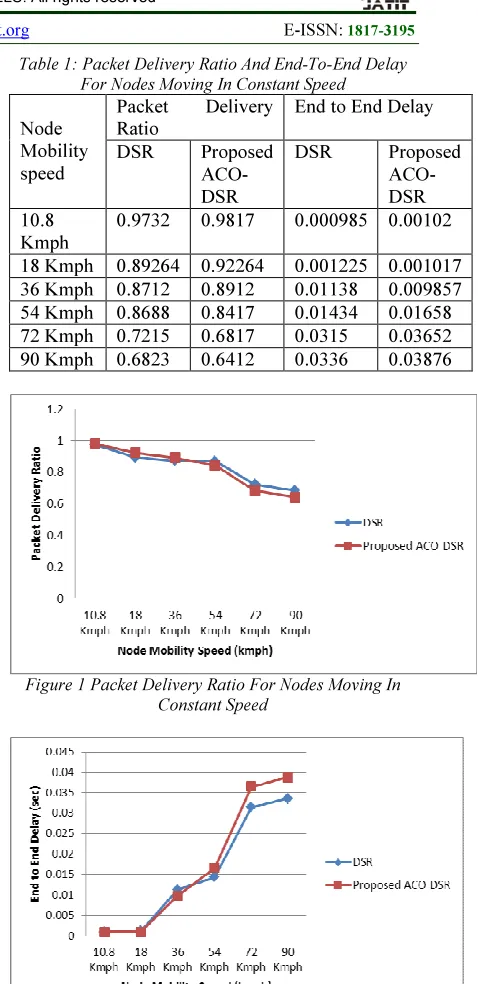
[image:4.595.300.539.100.592.2]The OPNET simulation tool is used to evaluate the performance. 25 Nodes are moving in constant speed in an area of 4000 x 4000 sqm. The data is transmitted at a data rate of 2 Mbps. Simulations are run using DSR, and Proposed ACO-DSR. The proposed approach is evaluated for packet delivery ratio and end to end delay. The experiments were conducted based on the above simulation parameters. Each data point in the graph represents an average of ten simulation runs. Figure 1 shows the packet delivery ratio for Nodes moving in constant speed varying from 10.8 to 90 kmph. Figure 2 show the end-to-end delay in MANET. Table 1 tabulates the same.
Table 1: Packet Delivery Ratio And End-To-End Delay For Nodes Moving In Constant Speed
Node Mobility speed
Packet Delivery Ratio
End to End Delay
DSR Proposed ACO-DSR
DSR Proposed ACO-DSR 10.8
Kmph
0.9732 0.9817 0.000985 0.00102
18 Kmph 0.89264 0.92264 0.001225 0.001017 36 Kmph 0.8712 0.8912 0.01138 0.009857 54 Kmph 0.8688 0.8417 0.01434 0.01658 72 Kmph 0.7215 0.6817 0.0315 0.03652 90 Kmph 0.6823 0.6412 0.0336 0.03876
Figure 1 Packet Delivery Ratio For Nodes Moving In Constant Speed
Figure 2 End-To-End Delay Nodes Moving In Constant Speed
From Figures 1 and 2, it is seen that when the nodes move in constant speed, the proposed ACO-DSR performance is improved.
5. CONCLUSIONS
608 collective behaviour in decentralized, self-organized systems. Ant Colony Optimization is popular among Swarm Intelligent Techniques. Ant-based routing algorithms attracted attention of researchers as they are highly robust, reliable, and scalable than conventional routing algorithms. As they do not use extra message exchanges for path maintenance during network topology change, they suit MANETs where nodes move dynamically and topology changes regularly. The paper presented a protocol for routing in ad hoc networks using dynamic source routing and Swarm Intelligence based ant colony optimization to optimize the node pause time and mobility. The simulation results show that the algorithm builds routes based on node pause time achieving better packet delivery ratio and end-to-end delay.
REFRENCES:
1. R, Yang., B, Yan., & B, Sun. (2009). An Entropy Constrained Stability QoS Multicast Routing Algorithm in MANET. Proceedings of the 2009 International Symposium on Information Processing (ISIP’09), pp 054-057. 2. Mamoun, M. H. (2011). A Proposed Route
Selection Technique in DSR Routing Protocol for MANET. computing, 9, 10.
3. Johnson, D. B., Maltz, D. A., &Broch, J. (2001). DSR: The dynamic source routing protocol for multi-hop wireless ad hoc networks. Ad hoc networking, 5, 139-172. 4. Boppana, R. V., &Mathur, A. (2005,
December). Analysis of the dynamic source routing protocol for ad hoc networks.
In Workshop on Next Generation Wireless
Networks (p. 1).
5. Raghavendran, C. H. V., Satish, G. N., &Varma, P. S. (2012). Intelligent Routing Techniques for Mobile Ad hoc Networks using Swarm Intelligence. International Journal of
Intelligent Systems and Applications,
IJISA, 5(1).
6. Blum, C. (2005). Ant colony optimization: Introduction and recent trends. Physics of Life reviews, 2(4), 353-373.
7. Ghosekar, P., Katkar, G., & Ghorpade, D. P. (2010). Mobile ad hoc networking: imperatives and challenges. IJCA Special Issue on “Mobile
Adhoc Networks” MANETs.
8. Chandrika, M., &Papanna, N. (2013). A Survey on Reactive Protocols in Mobile Ad Hoc Networks. International Journal, 3(1).
9. Lavanya, G., &Jeyakumar, A. E. An Enhanced Secured Dynamic Source Routing Protocol for MANETS. International Journal of Soft Computing and Engineering (IJSCE), ISSN: 2231, 2307.
10. Uchhula, V., & Bhatt, B. (2010). Comparison of different ant colony based routing algorithms. International Journal.
11. Sethi, S., &Udgata, S. K. (2010). The efficient ant routing protocol for MANET.International
Journal on Computer Science and
Engineering, 2(07), 2414-2420.
12. D. B. J. Rao, K. Sreenu, P. Kalpana. (2012). A Study on Dynamic Source Routing Protocol for Wireless Ad Hoc Networks. International Journal of Advanced Research in Computer and Communication Engineering, 1(8), 2319-5940.
13. U.Jaiswal, S.Aggarwal. (2011). Ant Colony Optimization. International Journal of
Scientific & Engineering Research, 2(7), 2229-5518.
14. V. Maniezzo, L. M. Gambardella, F. de Luigi. (2001). Ant Colony Optimization. BISON. 15. Praveen B., and Sowmya K.S. (2012). Routing
In Manets Using AcoWith Mobility Assistance. IJCSC, 3(1), pp 97-101.