ISSN: 1992-8645 www.jatit.org E-ISSN: 1817-3195
VIDEO REPLICA PLACEMENT STRATEGY FOR STORAGE
CLOUD-BASED CDN
1 SHIJIA. YAO,2WENLE ZHOU ,3HAOMIN CUI AND, 4MING. ZHU
1,2,3,4Department of Automatic of University of Science and Technology of China, Hefei, China
Email: 1,2,3{ yaosj ,chhmm,wlzhou}@mail.ustc.edu.cn, [email protected]
ABSTRACT
The online video service need the support of CDN(Content Delivery Networks). Compared with traditional CDNs, it can save a lot of cost by using cloud-based storage nodes to deliver the video content. To guarantee end users’ QoS, CDN should pre-deploy the content files of online video service to the edge nodes which are close to the users. Existed researches have shown that the cost of building CDN by cloud storage nodes is much less than that of using traditional CDNs. The existed off-line replica placement algorithm named GS(Greedy Site) can meet the QoS requirement with relatively small cost when the information of users’ requests is provided. However GS will result in bad load balance and it need the information of users’ requests. In this paper, two classes of offline algorithms are proposed. One named GUCP(Greedy User Core Preallocation) effectively solved the load imbalanced problem caused by GS ,and the other one named PBP(Popularity Based Placement) which is based on the popularity of content effectively placed replicas while there is no users’ requests information. Numerical experiments have demonstrated the effectiveness of the algorithms above.
Keywords: Cloud storage, CDN, Replica Placement, Load balance,QoS.
1. INTRODUCTION
With the rapid development of online video service, there has been a large number of small companies of online video service. The video online service needs the support of CDN(Content Delivery Networks). Traditional CDNs such as Akamai and Mirror Image have deployed tens of thousands of data centers and edge servers to deliver content across the globe. Unfortunately, the price of traditional CDNs(such as Akamai) is so much higher than small organizations such as medium-sized enterprises, government agencies,
universities, and charities[1].The price of building
CDNs or hiring existing CDNs is much higher than the ability of finance of medium-sized video service provider. As a result, the idea of utilizing storage clouds as a poor man’s CDN is very enticing. The cloud storage providers promise the ability of rapid, cheap reading and writing and are easy to be expanded to meet flash crowds of web sites. Economies of scale, in terms of cost effectiveness and performance for both providers and end users, can be achieved by leveraging existing “storage cloud” infrastructure, instead of investing large amounts of money in their own
content delivery platform or utilizing one of the
incumbent operators like Akama[2].
The recent emergence of storage cloud providers such as Amazon S3, Nirvanix and Rackspace has opened up new opportunities to provide cost-effective CDNs. Storage cloud providers operate data centers that can offer Internet-based content storage and delivery capabilities with the assurance of service uptime and end user perceived service quality. Service quality is typically in the form of bandwidth and
response time guarantees [3].
Utilizing storage cloud building CDNs can effectively reduce the cost of content storage and delivery. In rest of this paper, the based-cloud storage CDN is called cloud CDN for short. .
It’s difficult to use multiple cloud storage to provide service of CDN, because each cloud storage providers offers different Web services or programmer APIs and each service is best utilized via unique Web services or programmer APIs and has their own unique quirks. Many Web sites have utilized individual storage clouds to deliver some
or all of their content [4], most notably the New
York Times [5]and SmugMug [6], however, there is
ISSN: 1992-8645 www.jatit.org E-ISSN: 1817-3195
their services as a content delivery network. Most “storage cloud” providers just provide basic file storage and delivery services. But do not offer the capabilities of a typically CDN such as automatic replication, fail-over, geographical load redirection, and load balance. Furthermore, a customer may need coverage in more locations than offering by a single provider. The MetaCDN is a system that utilizes numerous cloud storage providers in order to create an overlay network that can be used as a
high-performance, reliable, and redundant
geographically distributed CDN to solve these
problem[7].Storage cloud providers charge their
customers by their storage and bandwidth usage
following the utility computing model [8]. Storage
cost is measured per GB per unit time and bandwidth cost is measured per GB transferred. Bandwidth cost consists of upload cost for incoming data and download cost for outgoing data.
The costumers of storage cloud, cloud CDN are accustomed to utilize different cloud storage providers in order to reduce the cost. Because cloud storage can be scaled on-demand, cloud CDN can be easily adjusted according to demand. Cloud CDN can offer multiple resources to multiple customers as traditional CDN. In other words, cloud CDN can provide service such as traditional CDN, but without maintaining or owning any infrastructure.
The file of online video service is very large, the response time should be as short as possible as possible. The replicas should be placed on the edge nodes, which are nearest to the users.
In this paper, two kinds of off-line replica placement algorithms for cloud CDN which provides service for online video service were proposed. One algorithm named GUCP could be used to place replicas when cloud CDN has users and requests from them. This algorithm could solve the load imbalance problem which is caused by GS. The other algorithm named PBP could used to place replicas while there is no information of users’ requests in cloud CDN.
2. RELATED WORKS
The replica placement problem in traditional CDNs refers to finding the best set of servers to place content replicas. Replica placement belongs
to the NP-complete class of problems [9]. The CDN
performance can be affected by decisions such as:
1. The number of surrogates required.
2. Their location.
3. The cost model adopted including storage
cost, content retrieval cost, and content updating cost.
4. QoS considerations.
A considerable amount of research has been done for replica placement in CDNs. The cost model has evolved to include one or more of the three types of costs: retrieval (or download), storage and update (or upload) cost.
In terms of minimizing content retrieval cost only, Li et al. [10] and Krishnan et al. [11] showed that replica placement in general network topologies is NP-complete and provided optimal solutions for tree topologies. Qiu et al. [12] evaluated a number of heuristics and found a greedy algorithm offering the best performance.
In addition to retrieval cost, Xu et al. [13] and Jia et al.[14] further added update cost, whereas Cidon et al. [15] added storage cost into consideration. Furthermore, Kalpakis et al. [16] comprehensively considered all three costs (retrieval, update and storage) and offered solutions for a tree topology only. However, none of the work studied the case in which provisioning cost between.
MetaCDN [7] system is a commercially available cloud based CDN that provides an interface for standard cloud providers to be used for content delivery. The system, via an appropriate web portal, grants end users with a number of different options related to cost and QoS. Specifically, it enables a set of replica deployment options that consequently define the request
redirection policies [17].
However, the details of the replica placement strategies are not provided. Chen et al. [18] are the first ones to investigate the problem of placing server replicas in storage cloud CDNs along with building content distribution paths among them. Their goal is to minimize the cost incurred on CDN providers while satisfying QoS requirements for end users.
In the proposed work, we go one step further by considering the optimized replica placement problem and distribution path construction for networked cloud environment. Two kinds of off-line replica placement algorithms for cloud CDN either have or not the information of users’ request.
3. CLOUD CDN AND ITS ERFORMANCE
3.1 Cloud CDN
ISSN: 1992-8645 www.jatit.org E-ISSN: 1817-3195
replica placement cannot be used on cloud CDN setting for the flowing reasons:
Much research on traditional CDNs assumes that the network topology is given, for example, the tree structure which root is the origin server. However, in the cloud environment, the CDN builders have the freedom to build any topology. Thus, the problem of replica placement in cloud CDN is a joint problem of building distribution paths and replication.
The cost of replicas copy from site u to v is
( ; )
d u v . For traditional CDN, the edges are usually
undirected, i.e. d u v( ; )=d v u( ; ). However, the
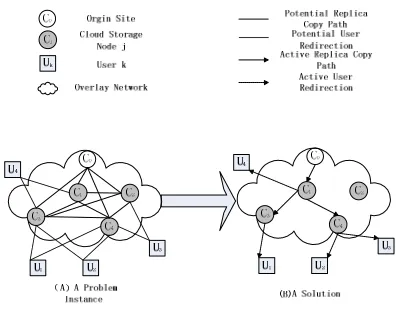
[image:3.612.94.292.313.476.2]prices for uploading and download in storage cloud are different, which demonstrates that the edge is directed. This implies that only choosing a set of replica nodes is not enough; replication directions should be presented.
Figure 1. The Problem of Replica Placement
in Cloud CDN
Replica placement problem in cloud CDN is given in figure 1.The potential replicas nodes are
1
C --C4. Some potential paths of distribution from
0
C are demonstrated by bold line. It is assumed
that each nodes have the path to every
usersUk.However, only a subset of these paths can
satisfy the requirements of QoS for users request which are drawn as dashed line in figure 1(A). A kind of solution of replica placement is shown in
Figure 1(B), whereC3 is chosen to provide service
for to the request from U1 and C4 is chosen to
provide service for the request from U2 andU3.C1
is chosen to provide service from U4 as well as
forward the replica from C0 to C3and C4
[18]
.
In Ref. [18], a off-line replica placement
algorithm is proposed. Via trace-based study, it is shown that cloud CDN significantly reduces the
cost of providing CDN service to small Web sites to as low as 2.62 US Dollar compared to the 99 US Dollar minimum charge by a traditional CDN. However the GS algorithm does not consider the load balance problem, which is assumed that the cloud CDN managers have both the information
and the requests from the users. In this paper, two
classes of off-line replica placement algorithms
for cloud CDN were proposed, which provide
service for online video service .One of the
algorithms named GUCP could be used to place replicas when cloud CDN. It could solve the load imbalance problem caused by GS. The other named PBP could be used to place replicas while there is no information of users’ requests in cloud CDN.
3.2 The Cost of Cloud CDN
Multiple storage cloud nodes copy replicas from
the origin serverC0, and then respond to all the
edge users’ requests. The cloud CDN uses multiple storage nodes or data centers, however, each storage node belongs to a certain provider. The cloud nodes from different providers may be co-local, but they may offer different service prices as well. It is assumed that there are m edge
users U ={U U1, 2,L,Um} index by
k , (k=1, 2,Lm) ,and n cloud storage nodes
1 2
{ , , , n}
C= C C L C index by i or j,( ,i j=1, 2,Ln).
In this paper, it is assumed that the size of replica is T .The cloud storage nodes will change with the data storage, input and output traffic. Node
j
C will charge unit storage cost of Sjper GB for
storing the replica, Pj per GB for replica uploading
traffic and Dj per GB for replica downloading
traffic.
Let Vuv denote the cost of replica copied from
node u to node v .Vuv has two different meanings
which are depended on the nature of node v . Case I: node v is the node of storage cloud
node. Vuv is the cost of opening node, that is to say,
the cost of node v=Cj downloading replica from
any node which has it. The origin service will update the replica in real time. In this paper, it is
assumed that F T⋅ is the content needs to be
updated per unit time, where F represents the
frequency of content
update,Vuv=Vij=(Sj+P Fj +D F Ti ) . The node C0
which has the original replica is assumed to be the origin server. The path of replica distribution will
be a tree structure, the root node of which is C0, as
ISSN: 1992-8645 www.jatit.org E-ISSN: 1817-3195
Case II: v in Vuv indicates a user, v=Uk,Vuv is
the access cost of user who is assigned to node
j
u=C .The size of content which edge user Uk
request is Tk and Vuv=Vik=T Dk j . Tk may be
smaller than T or larger than or equal T , because of users did not request is not the whole replica or using web cache, or repeated request the without caching.
In summary, the cost of cloud CDN is the sum of the cost of replicas placed on the storage cloud node(i.e. open node) and the cost of service for the
requests from users, Cost=OpenCost+UserCostIn
this paper, the cost of uploading, downloading and storage of each node is defined randomly. The cost is measured by abstract monetary values (not a specific currency such as the U.S. dollar). The value of cost is used to compare the performance of different algorithms, but is not the real money in this paper.
3.3 The Definition of QoS in Cloud CDN
There is significant correlation between network delay and route distance. Because the actual hop count information between users and cloud sites is difficult to achieve, the geographic distance is considered as an indicator of delay. In this paper, the route distance is defined as the geographic distance between user and storage cloud node. Moreover, the Euclid distance is chosen as the route distance in our simulation experiments. In fact, the choice of distance metric does not impact the performance of our algorithms; any distance metric that is capable of describing the QoS requirement is applicable.
Let Rjk denotes the route distance between
user Uk and node Cj . Rjk represents the
communication quality between two nodes. The
smaller Rjk (the distance from node to user) is, the
better the quality of communication will be obtained. In this paper, the storage cloud nodes are utilized as replica servers. The abilities of bandwidth, reliability and concurrency of replica server nodes are consistent. The QoS distance could be represented by route distance. To satisfy the requirements of QoS from the users, it should be ensured that the route distance is less than QoS
threshold Q ,i.e. Rjk≤Q . The GS algorithm
assigns the users to the nearest node.
The number of users is very large, and the total route distance will be increasing with the users.
Hence, the average route distance is used to measure the QoS performance. The average route
distance R is obtained by (1).
(
) (
2)
21 1
n m
j k j k
node user node user
j k
R X X Y Y m
= =
=
∑ ∑
− + − (1)Where j
node
X and j
node
Y respectively denote
horizontal and vertical coordinates of the node,
which is assigned to users k,mis the total number
of users.
3.4 The Load Balance of Cloud CDN
The load balance is an important performance in distributed system. To achieve the minimum of the running time, the distributed systems assign jobs according to the servers’ performance.
In the process of online video service, the time of the connection between users and service nodes is very long. In order to serve more users with limited nodes, the improvement of the load balance performance of multiple video server nodes is a very important problem.
In this paper, it is assumed that the resource of load is the number of users served by cloud storage nodes, while the other resources (storage,
bandwidth or CPU and so on) is not taken into
account. The number of users which node provides service to is used to scale the performance of load.
In this paper, we used the load weight [19] to
describe the performance of load in cloud CDN. It is assumed that there are n cloud storage nodes in cloud CDN. The ability of load of cloud
storage node Ci ,i=1,L,n is ωi ,i=1,L,n .
Based on the principle that the node load should match with its load ability, We assume that the ability of cloud storage nodes is the same, i.e.
1 2 n
ω ω= = =L ω ω= (2)
It is assumed that the load of Ci is Li , load
weight is defined as the ratio of current load and ability of load.
i i i
L i
L L
W
ω ω
= = (3)
When the load balance is achieved,
i j
L L
W =W ,i≠j i j; , =1, 2,L,n (4) The average load weight is defined as formula (5).
1 1
1 n 1 n
i
L L i
i i
W W L
n = nω =
=
∑
=∑
(5)Load weight could be represented by formula (6) when the cluster is balancing.
1 2
1 1
1 n 1 n
i
L L L L i
i i
W W W W L
n = nω =
= =L= =
∑
=∑
(6)ISSN: 1992-8645 www.jatit.org E-ISSN: 1817-3195
could be represented approximately as formula (7) while the cluster is balancing.
1 2 n L'
L =L =L=L =W (7)
The load of a node is associated with its uses in
formula (7). The load coefficient is defined to
evaluate the load performance. In this paper, the mean square deviation of load is used to describe the load coefficient of cloud CDN. The load
coefficient η is defined as formula (8).The smaller
ηis, the load is better.
2 1
( ')
n
i L
i
L W
n
η =
−
=
∑
(8)3.5 The Other Performance of Cloud CDN
Performances mentioned above can be used to measure cloud CDN with information of users’ requests. Unfortunately, it fails when there is no information of users’ request to use.
After replicas are placed on the nodes randomly, requests from users will be redirected to the nearest nodes. If the redirected node has no replica which is needed, the node will download it from the other nodes. The process of copying replicas from the other nodes will result in additional cost and time delay.
Let Push Cost_ denote the additional cost, and it can be represented as:
1, 1, 1
_ ( )
n L
l j j i
i j i j l
Push Cost T S P D
= = ≠ =
=
∑ ∑
+ + (9)In (9), j denotes the node which downloads
and stores the replica from the other nodes, and i
denotes the replica provider.Tlis the size of the
replica.
Let DELAYij denote the time delay and
_ _
Avg Push Delay denote the average time delay. It is considered that we should download replicas
from node j to i when DELAYij is nonzero, and
M is the time of downloading. It is assumed that
the value of DELAYijis the route distance between
node i and .j Avg_Push Delay_ can be obtained
by (10).
1, 1,
_ _ /
n
ij i j i j
Avg Push Delay DELAY M
= = ≠
=
∑
(10)4. THE VIDEO REPLICA PLACEMENT
ALGORITHM WITH REQUESTS
INFORMATION
In this paper, cloud CDN investigated is for online video. The content of the online video has large file size and low updating frequency. The users must be responded to as soon as possible,
hence, the video replica should be placed on the edge nodes.
The cloud CDN may either have or not the information of users’ requests. On the one hand, if the cloud CDN has the information of users’ requests, it could be used to push the content to the edge nodes; On the other hand, if cloud CDN has no requests information, PBP (popular based placement) algorithm could is used to place the replica based on the content popular.
4.1 GS Algorithm
The GS(Greedy Site) algorithm is proposed in [18],GS is adopted from an approximation
algorithm for the Set Covering Problem[20]. GS
iteratively decides to open a closed site which has the maximum utility and assign all its potential users to it. A potential user of a node has minimum route distance and it has not been assigned to any node. The Cloud CDN opens a storage cloud node, and then finds the next one to open, until all of the
users are assigned to a certain node. Let Oj denote
the cost to openCj.
{ | }
0 min
i
j j
i i C isopen ij
ifC isOPEN O
V otherwise
∈
=
(11)
The algorithm 1 is the pseudo-code of GS.
Algorithm AlgorithmAlgorithm
Algorithm 1 : Greedy Site1 : Greedy Site1 : Greedy Site1 : Greedy Site[18]
Eis the set of user who have not been assigned
j
E is the current set of users who can be assigned to Cj
while E≠ ∅ do
j k, K j
k
W ←
∑
w U ∈E*
{ }
arg max j
j
j C isCLOSED j j j
W j
W D O
∈ ←
+ Assing all users in Ej*to Cj*
Open Cj*
* j
E← −E E
end while
4.2 The Description of Load Imbalance
Problem
The assignment of users in GS is operated according to the route distance , which may lead to load imbalance.
ISSN: 1992-8645 www.jatit.org E-ISSN: 1817-3195
coefficient of cluster is η=1411.71, the maximum
and minimum load of node are LMax=155 and
54 Min
L = respectively.
The load threshold defined in Ref. [21] is
(1 ) / 2
Th= +L , where L is the average load of all
the nodes. Unfortunately, the definition is not suited for the cloud CDN, which is proved by experiments. We define the new dynamic load
threshold of cloud CDN as (10), whereα is the
imbalance factor taking values in (0,1]. The value
of α will be given in section VI by experiments.
' * L
Th=W α (12)
The users of nodes should be adjusted to
ensure the load balance, when Lp>Lq and
p q
L −L ≥Th and p≠q p q; , =1, 2,L,n. To solve the load imbalance caused by GS, A new algorithm named GUDP(Greedy User Core Preallocation) is proposed.
4.3 GUCP Algorithm
The GUCP(Greedy User Core Preallocation)
will adjust the assignment when load imbalance appears, after assigning users to the nearest nodes.
Some users of node p should be assigned to q,
while Lp−Lq≥Th , p≠q; p q, =1, 2,L,n . It is
assumed that the coordinate of node is uniformly distributed.
K-means algorithm is a normal cluster algorithm. It is a clustering method based on statistics. K-means clustering is a method of vector quantization originally from signal processing, that is popular for cluster analysis in data mining. K-means clustering (MacQueen, 1967) is a method commonly used to automatically partition a data set
into k groups. It precedes by selecting k initial
cluster centers and then iteratively refining them as follows [22]:
1. Each instance Ui is assigned to its closest
cluster center.
2. Each cluster center COREj is updated to be
the mean of its constituent instances.
Firstly, K-means algorithm is adopted to accomplish the clustering of the users. Then, about
(Lp−Lq) / 2 users should be picked from node p
and added toq. K-means algorithm could be used
to cluster the users of node p, and move users
belonging to p and nearest to q in batches.
But it is difficult to get a suitable value of k for different data sets. In this paper, we want to
move about (Lp−Lq) / 2 users because the users are
uniform distribution at the location need to place replicas. The number of cores in k-means can be given by (13):
2 ( )
k i p q
N = L L −L (13)
A core COREk is selected from Nk cores
which are clustered by k-means ,and it is nearest
to q. Then, we move the users that correspond to
k
CORE to q. Then we check whether the system is
load imbalance again. If load imbalance, we will repeat the operation of users assigning adjustment until load balance. The core idea of GUCP is using k-means to cluster the users which are assigned to the over load node, and then adjusting the users by the cores to load balance of cloud CDN. The system achieves balance quickly because of the frequency of adjustment is reduced by this algorithm. The algorithm 2 is the pseudo-code of GUCP:
Algorithm Algorithm Algorithm
Algorithm 2 : 2 : 2 : 2 : Greedy User Core Preallocation
Eis the set of user who have not been assigned
j
E is the current set of users who can be assigned to Cj
while Lp−Lq≥Th(p≠q p q; , =1, 2,L,n) do
k
N cores←Kmeans (Up)
Find min distance Core num_ between Cqand cores Assigned users Ucore num_ to Cq
end while while E≠ ∅
j k, K j
k
W ←
∑
w U ∈E *{ }
arg max j
j
j C isCLOSED j j j
W j
W D O
∈ ←
+ Assing all users in Ej*to Cj*
Open Cj*
* j
E← −E E
end while
5. THE VIDEO REPLICA PLACEMENT
ALGORITHM WITHOUT REQUEST INFORMATION
5.1 The Popularity of Video content
In the last section, a video replica placement algorithm for cloud CDN is proposed for cloud CDN with information of users’ requests. However, if cloud CDN has no requests information, the presented algorithm in the last
section fails. Hence, in this section,a new
algorithm based on popularity of video replica is proposed for cloud CDN without requests information. Popularity of video contents
The quality of service of CDN is affected by
ISSN: 1992-8645 www.jatit.org E-ISSN: 1817-3195
one hand, If the replicas are placed more than they are needed, the storage space is wasted. On the other hand, when the copies are placed too few, then it will result in low service quality. Although the CDN can adjust the number of copies itself, it will cost a lot of time and much operation of I/O.
The popularity of replica is an important basis for placement. Methods of decision tree and neural network model to predict the popularity of movies were proposed in Ref. [24] and Ref. [25]. These methods can be used in cloud CDN when it has no requests information.
The distribution of popularity of replica is
assumed as Zipf distribution in Ref. [26] and
Mandelbrot-Zipf distribution in Ref. [27] , but
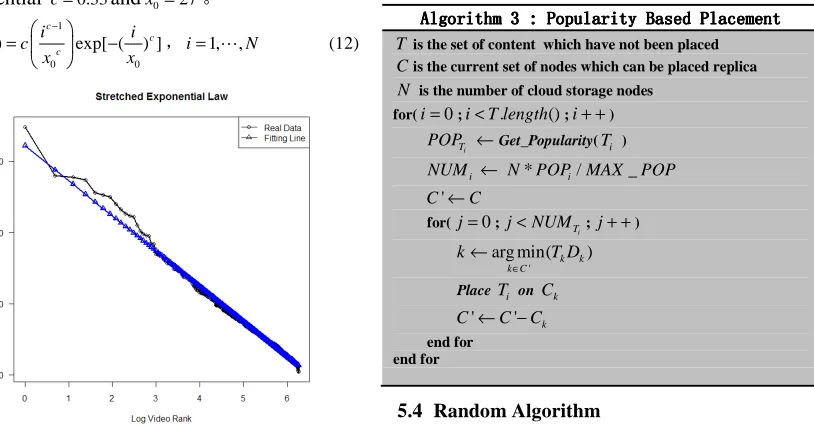
the distribution of video popularity obeys neither of them. s. The extensive law model is suitable for the
distribution of popularity of movie [28]. The 17220
pieces of movies’ request information are got from
http://movie.youku.com in 2013. It is shown that
the use of stretched exponential model on income popularity data fitting and found more in line with the stretched exponential model in figure 2. It proves that the distribution of video popularity is a stretched exponential distribution. The probability density function (PDF) of stretched exponential is shown in (12). The parameters of the video popularity distribution
function can be got , which is stretched
exponential c=0.33andx0=27。
1
0 0
( ) exp[ ( ) ]
c
c c
i i
p i c
x x
− = −
[image:7.612.118.525.464.678.2],i=1,L,N (12)
Figure 2. Fitting Of Data And Stretched
Exponential Model
5.2 The Relationship between Number and
Popularity of Replicas
It is assumed that cloud CDN has N nodes,
which have been opened. Let NUMi denote the
number of replicas of content i andPOPi denote
the popularity of video contenti. It is known to us
that the more popular the video content is, the more replicas ars needed. Hence it is assumed that the most popular content’s replicas are placed on all of the storage cloud nodes, and then, the number the
most popular content the replicas is N . It is
assumed that the ratio of POPi and MAX_POP is
equal to the ratio of NUMiandN.
i
NUM =N POP MAX* i/ _POP (13)
5.3 PBP Algorithm
To place the replicas suitably with requests information, a new algorithm named PBP (Popularity Based Placement) is proposed.
Let T denote the content set and Ti denote
the content of k .PBP utilizes popularity of video content to place the replicas. For every content in
T , The popularity of Ti is given first, then
calculate the number of replicas of Ti NUMi by
(13) lastly , select the nodes are selected with minimum cost from the opened nodes to place the replicas. Algorithm 3 is the pseudo-code of PBP:
Algorithm Algorithm Algorithm
Algorithm 3333 : : : : PopularityPopularityPopularityPopularity Based PlacementBased PlacementBased PlacementBased Placement
Tis the set of content which have not been placed
Cis the current set of nodes which can be placed replica
N is the number of cloud storage nodes for(i=0;i<T length. ();i+ +)
i T
POP ←Get_Popularity(Ti ) NUMi ← N*POP MAXi/ _POP
C'←C
for(j=0;
i T
j<NUM ;j+ +)
'
arg min( k k) k C
k T D
∈ ←
Place Ti on Ck
C'← −C' Ck end for
end for
5.4 Random Algorithm
ISSN: 1992-8645 www.jatit.org E-ISSN: 1817-3195
with the PBP. NUMi is given in random algorithm
as (14).
i
NUM =rand()%(N+1) (14)
6. EXPERIENCE AND DISCUSSION
In this section, we present the parameters for numerical experiments in section A, and then
6.1 Parameters of Simulation
In this section, numerical experiments are performed to evaluate the performance of the proposed algorithms in Matlab. It is assumed that there are 20 nodes whose cost of uploading, downloading and storage are random numbers taking values in (0,10] . The cost values are assumed to be different from each other and the users is less than 1000. The bandwidth of each node is 10 Mbps; the users are randomly distributed in a ring, of which the inside diameter is 10 and the outside
diameter is 20. When every user watches video,
an average of 100Kb is occupied.20 nodes can serve 2000 users at most. Hence, the simulation experiment via 1000 users will not cause overload. The number 20 reflects the current status of the number of cloud storage providers is not much. The number 20 reflects the fact that there are not so many cloud storage providers. However, even if more than 20 nodes are chosen, it has little influence on the final results.
The value of imbalance threshold has influence not only on the value of load
coefficient η , but also on the frequency of
adjustment when load imbalance occurs.
Reasonable threshold value can ensure less
frequency of adjustment while the load
coefficient η is smaller. To get the value of
dynamic imbalance factor α ,we assume that there
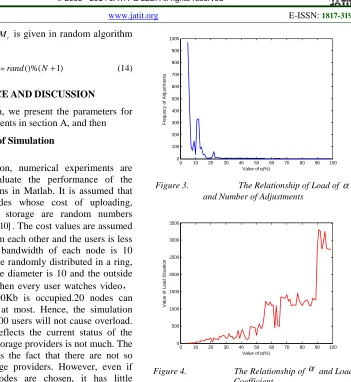
are 600 users using the cloud CDN. The evolution of the load coefficient and the adjustment frequency are shown in figure 3 and 3 respectively,
as α varies from 5%to 99%.
0 10 20 30 40 50 60 70 80 90 100 0
100 200 300 400 500 600 700 800 900 1000
Value of (%)α
F
re
q
u
n
c
y
o
f
A
d
ju
s
tm
e
n
ts
Figure 3. The Relationship of Load of α
and Number of Adjustments
0 10 20 30 40 50 60 70 80 90 100 0
500 1000 1500 2000 2500 3000 3500
Value of (%)α
V
a
lu
e
o
f
L
o
a
d
S
it
u
a
ti
o
n
Figure 4. The Relationship of α and Load
Coefficient
From the figures 3 and 4, we can see that at
the point 25% , the adjustment frequency has
decreased to some acceptable extent, besides, the
load coefficient is not very large. Hence, α is
chosen as 25%,consequently, the load threshold
' * 0.25 L
Th=W .
According to the distribution of nodes and users, It is assumed that the average distance between users and nodes is 10, the threshold of QoS can be chosen as 10, the upper limit of route distance is 10. The parameters of numerical experiments are listed in table I.
Table1. Parameters of Numerical Simulation
Experiment Parameter Type
Nodes User
s
Contents number
Content
s size Q α
Value 20 100 ~10 00
100 0~10 1
[image:8.612.165.516.66.448.2]ISSN: 1992-8645 www.jatit.org E-ISSN: 1817-3195
6.2 Result of Numerical Experiment for
Algorithm with Requests Information
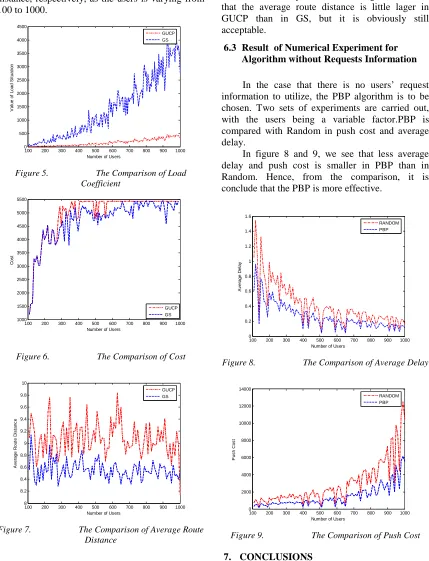
Three sets of experiments are carried out, with the users being a variable factor. GUCP is compared with GS in load, cost and average route distance, respectively, as the users is varying from 100 to 1000.
100 200 300 400 500 600 700 800 900 1000 0
500 1000 1500 2000 2500 3000 3500 4000 4500
Number of Users
V
a
lu
e
o
f
L
o
a
d
S
it
u
a
ti
o
n
[image:9.612.93.522.173.734.2]GUCP GS
Figure 5. The Comparison of Load
Coefficient
100 200 300 400 500 600 700 800 900 1000 1000
1500 2000 2500 3000 3500 4000 4500 5000 5500
Number of Users
C
o
s
t
[image:9.612.325.502.388.519.2]GUCP GS
Figure 6. The Comparison of Cost
100 200 300 400 500 600 700 800 900 1000 8
8.2 8.4 8.6 8.8 9 9.2 9.4 9.6 9.8 10
Number of Users
A
v
e
ra
g
e
R
o
u
te
D
is
ta
n
c
e
GUCP GS
Figure 7. The Comparison of Average Route
Distance
The comparison of load coefficient between GS and GUCP is shown in figure 5, which implies that the latter one has much advantage over the former in load balancing abilities.
In figure 6, we see that more cost should be pain in the algorithm GUCP compared with GS, which is also acceptable for us. In figure 7, we see that the average route distance is little lager in GUCP than in GS, but it is obviously still acceptable.
6.3 Result of Numerical Experiment for
Algorithm without Requests Information
In the case that there is no users’ request information to utilize, the PBP algorithm is to be chosen. Two sets of experiments are carried out, with the users being a variable factor.PBP is compared with Random in push cost and average delay.
In figure 8 and 9, we see that less average delay and push cost is smaller in PBP than in Random. Hence, from the comparison, it is conclude that the PBP is more effective.
100 200 300 400 500 600 700 800 900 1000 0
0.2 0.4 0.6 0.8 1 1.2 1.4 1.6
Number of Users
A
v
e
ra
g
e
D
e
la
y
RANDOM PBP
Figure 8. The Comparison of Average Delay
100 200 300 400 500 600 700 800 900 1000 0
2000 4000 6000 8000 10000 12000 14000
Number of Users
P
u
s
h
C
o
s
t
RANDOM PBP
Figure 9. The Comparison of Push Cost
ISSN: 1992-8645 www.jatit.org E-ISSN: 1817-3195
In this paper, two offline replica placement algorithms are proposed for cloud-based storage CDNs. The GUCP effectively solved the load imbalance problems in replica placement compared with the existed GS algorithm. When there is no information of users’ requests, a new algorithm called PBP is proposed based on the popularity of video content. It is shown that the PBP has much advantage in average delay and push cost compare
with the Random algorithm. Numerical
experiments have demonstrated the effectiveness of the method above.
ACKNOWLEDGMENT
The authors are grateful to the anonymous referees for their valuable comments and suggestions to improve the presentation of this paper. This work was supported in part by National Key Technologies R&D Program of China (Grant No. 2012BAH73F02) and the ”Strategic Priority Research Program” of the Chinese Academy of Sciences(Grant No. XDA06030900).
REFERENCES
[1] Rayburn D. CDN pricing: Costs for outsourced
video delivery[J]. Streaming Media West, 2008.
[2] Broberg J. Building Content Delivery
Networks Using Clouds[J]. Cloud Computing: Principles and Paradigms, 511-531.
[3] M. Armbrust, A. Fox, R. Griffith, A. Joseph,
R. Katz, A. Konwinski,G. Lee, D. Patterson, A. Rabkin, I. Stoica et al., “Above the clouds:A berkeley view of cloud computing,” EECS Department, University of California, Berkeley, Tech. Rep. UCB/EECS-2009-28, 2009.
[4] Elson J, Howell J. Handling flash crowds from
your garage[C]//USENIX ATC. 2008, 4.
[5] D.Gottfrid.Self-service,prorated superc
omputing fun! OPEN: All the code tha is ft
to
printf().http://open.mytime.com/2007/11/01/se lf-service-prorated-super-com-putting-fun/,1/11/2007
[6] MacAskill D. Scalability: Set Amazon’s
servers on fire, not yours[C]//ETech 2007: O’Reilly Emerging Technology Conference. 2007.
[7] J. Broberg, R. Buyya, and Z. Tari, “MetaCDN:
Harnessing Storage Clouds’ for high
performance content delivery,” Journal of
Network and Computer Applications, vol. 32, no. 5, pp. 1012–1022, 2009.
[8] J. Broberg, S. Venugopal, and R. Buyya,
“Market-oriented grids and utility computing: The state-of-the-art and future directions,” Journal of Grid Computing, vol. 6, no. 3, pp. 255–276, 2008.
[9] Neves T A, Drummond L, Ochi L S, et al.
Solving replica placement and request
distribution in content distribution networks[J]. Electronic Notes in Discrete Mathematics, 2010, 36: 89-96.
[10]Li B, Golin M J, Italiano G F, et al. On the
optimal placement of web proxies in the internet[C]//INFOCOM'99. Eighteenth Annual Joint Conference of the IEEE Computer and
Communications Societies. Proceedings.
IEEE. IEEE, 1999, 3: 1282-1290.
[11]Krishnan P, Raz D, Shavitt Y. The cache
location problem[J]. IEEE/ACM Transactions on Networking (TON), 2000, 8(5): 568-582.
[12]Qiu L, Padmanabhan V N, Voelker G M. On
the placement of web server
replicas[C]//INFOCOM 2001. Twentieth
Annual Joint Conference of the IEEE Computer and Communications Societies. Proceedings. IEEE. IEEE, 2001, 3: 1587-1596.
[13]Jia X, Li D, Hu X, et al. Placement of
web-server proxies with consideration of read and update operations on the internet[J]. The Computer Journal, 2003, 46(4): 378-390.
[14]Xu J, Li B, Lee D L. Placement problems for
transparent data replication proxy services[J]. Selected Areas in Communications, IEEE Journal on, 2002, 20(7): 1383-1398.
[15]Cidon I, Kutten S, Soffer R. Optimal allocation
of electronic content[J]. Computer Networks, 2002, 40(2): 205-218.
[16]Kalpakis K, Dasgupta K, Wolfson O. Optimal
placement of replicas in trees with read, write, and storage costs[J]. Parallel and Distributed Systems, IEEE Transactions on, 2001, 12(6): 628-637.
[17]Papagianni C, Leivadeas A, Papavassiliou S. A
Cloud-oriented Content Delivery Network Paradigm: Modeling and Assessment[J]. 2013.
[18]Chen F, Guo K, Lin J, et al. Intra-cloud
lightning: Building CDNs in the
cloud[C]//INFOCOM, 2012 Proceedings
IEEE. IEEE, 2012: 433-441.
[19]Guo Cheng-cheng Yan Pu-liu.A Dynamic
Load-bal anci ng Al gorit hmf or
ISSN: 1992-8645 www.jatit.org E-ISSN: 1817-3195
[20]Chvatal V. A greedy heuristic for the
set-covering problem[J]. Mathematics of
operations research, 1979, 4(3): 233-235.
[21]Godfrey B, Lakshminarayanan K, Surana S, et
al. Load balancing in dynamic structured P2P systems[C]//INFOCOM 2004. Twenty-third
AnnualJoint Conference of the IEEE
Computer and Communications Societies. IEEE, 2004, 4: 2253-2262.
[22]Wagstaff K, Cardie C, Rogers S, et al.
Constrained k-means clustering with
background knowledge[C]//ICML. 2001, 1: 577-584.
[23]V.S.RAMASUBRAMANIAN,”Cost-Aware
Resource Management for Decentralized tralized Internet Services,” PhD thesis, Cornell University, January 2007.
[24]Shijia Y, Liuzhang Z, Ming Z. The popularity
of movies predict system based on data mining technology for CDN[C]//Computer Science and Information Technology (ICCSIT), 2010 3rd IEEE International Conference on. IEEE, 2010, 7: 604-607.
[25]Li J, Hong S, Xia S, et al. Neural Network
Based Popularity Prediction For IPTV
System[J]. Journal of Networks, 2012, 7(12): 2051-2056.
[26]Zhou X, Xu C Z. Optimal video replication
and placement on a cluster of video-on-demand servers[C]//Parallel Processing, 2002. Proceedings. International Conference on. IEEE, 2002: 547-555.
[27]Hefeeda M, Noorizadeh B. On the benefits of
cooperative proxy caching for peer-to-peer traffic[J]. Parallel and Distributed Systems, IEEE Transactions on, 2010, 21(7): 998-1010.
[28]Zhuo You,“VOD system access behavior
research: measurement, analysis and
modeling,” PhD thesis, University of Science and Technology of China, January 2007.
[29]Borst S, Gupta V, Walid A. Distributed