expression of three major human ApoE
isoforms in ApoE-deficient mice.
K Tsukamoto, … , J M Glick, D J Rader
J Clin Invest.
1997;
100(1)
:107-114.
https://doi.org/10.1172/JCI119501
.
Apolipoprotein E (apoE) plays a key role in lipoprotein metabolism and may have other
important biological functions. In humans, there are three common, naturally occurring
isoforms of apoE that are associated with differences in lipid levels and atherosclerosis.
However, the direct in vivo effects of the apoE isoforms on lipoprotein metabolism and
atherosclerosis are not yet fully understood. To investigate the effect of the apoE isoforms in
vivo, we constructed second-generation recombinant adenoviruses encoding each of the
apoE isoforms. These recombinant adenoviruses were injected intravenously into
apoE-deficient mice fed a Western diet (mean baseline cholesterol level 1401 mg/dl) in order to
study their effects in the absence of endogenous mouse apoE. Hepatic expression of apoE3
and apoE4 completely normalized the lipoprotein profile; 3 d after injection, mean plasma
cholesterol levels were 194 and 217 mg/ dl, respectively, and this effect was maintained for
at least 6 wk. Expression of apoE2 had much less effect on lipoprotein levels (mean
cholesterol level 752 mg/dl 3 d after injection), despite much higher plasma levels of apoE2
compared with apoE3 and apoE4; by 6 wk after injection the cholesterol levels had returned
to baseline levels in the apoE2-expressing mice. Expression of all three isoforms
significantly increased HDL cholesterol levels by approximately threefold and was
independent of the cholesterol-lowering effect. ApoE transgene expression was
substantially […]
Research Article
Find the latest version:
J. Clin. Invest.
© The American Society for Clinical Investigation, Inc. 0021-9738/97/07/0107/08 $2.00
Volume 100, Number 1, July 1997, 107–114
Liver-directed Gene Transfer and Prolonged Expression of Three Major Human
ApoE Isoforms in ApoE-deficient Mice
Kazuhisa Tsukamoto, Pearle Smith, Jane M. Glick, and Daniel J. Rader
Department of Medicine and Department of Molecular and Cellular Engineering, University of Pennsylvania School of Medicine, Philadelphia, Pennsylvania 19104
Abstract
Apolipoprotein E (apoE) plays a key role in lipoprotein me-tabolism and may have other important biological func-tions. In humans, there are three common, naturally occur-ring isoforms of apoE that are associated with differences in lipid levels and atherosclerosis. However, the direct in vivo effects of the apoE isoforms on lipoprotein metabolism and atherosclerosis are not yet fully understood. To investigate the effect of the apoE isoforms in vivo, we constructed sec-ond-generation recombinant adenoviruses encoding each of the apoE isoforms. These recombinant adenoviruses were injected intravenously into apoE-deficient mice fed a West-ern diet (mean baseline cholesterol level 1401 mg/dl) in or-der to study their effects in the absence of endogenous mouse apoE. Hepatic expression of apoE3 and apoE4 com-pletely normalized the lipoprotein profile; 3 d after injec-tion, mean plasma cholesterol levels were 194 and 217 mg/ dl, respectively, and this effect was maintained for at least 6 wk. Expression of apoE2 had much less effect on lipopro-tein levels (mean cholesterol level 752 mg/dl 3 d after injec-tion), despite much higher plasma levels of apoE2 com-pared with apoE3 and apoE4; by 6 wk after injection the cholesterol levels had returned to baseline levels in the apoE2-expressing mice. Expression of all three isoforms sig-nificantly increased HDL cholesterol levels by approximately threefold and was independent of the cholesterol-lowering effect. ApoE transgene expression was substantially prolonged compared with that achieved using a first generation ade-novirus and apoE was readily detected in plasma 3 mo after virus injection. These studies demonstrate: (a) prolonged in
vivo expression of human apoE isoforms in apoE deficient mice after second-generation recombinant adenovirus-medi-ated somatic gene transfer; and (b) significantly impaired
ability of apoE2 in vivo to mediate clearance of remnant li-poproteins in apoE-deficient mice fed a Western diet com-pared with apoE3 and apoE4. (J. Clin. Invest. 1997. 100:107–
114.) Key words: apoE isoform• gene transfer • adenoviral vector • lipoprotein metabolism • hyperlipoproteinemia
Introduction
Apolipoprotein E (apoE) is a 34-kD glycoprotein that plays a key role in lipoprotein metabolism (1). It mediates the uptake and degradation of chylomicron and VLDL remnants by act-ing as a ligand for the LDL receptor and the LDL receptor-related protein (LRP) (1, 2). ApoE has also been proposed to have a variety of biological functions in addition to that in lipo-protein metabolism (1, 3, 4). Genetic deficiency of apoE in hu-mans (5–8) and in mice (9, 10) results in a substantial increase in plasma levels of remnant lipoproteins. Certain rare muta-tions of apoE within the receptor binding region severely im-pair apoE binding and result in a dominant form of familial dysbetalipoproteinemia (Type III hyperlipoproteinemia) (11). ApoE occurs in three major common isoforms in humans. ApoE3 (112 Cys, 158 Arg) is the most common isoform and is considered the wild type. ApoE4 (112 Arg, 158 Arg) and apoE2 (112 Cys, 158 Cys) differ from apoE3 by single amino acid substitutions. The North American allele frequency of apoE4 is z 14% and of apoE2 is z 7% (12). Both of these
al-ternative apoE isoforms are clinically important. The presence of even one apoE4 allele is associated with slightly higher LDL cholesterol levels (12) and is also associated independently with an increased risk of coronary heart disease (12, 13). Ho-mozygosity for apoE2 is associated with a recessive form of fa-milial dysbetalipoproteinemia, although only a minority of apoE2/2 homozygotes actually develops hyperlipidemia (14). This phenomenon is not well understood but has been as-cribed to the need for a second factor in addition to homozy-gosity for apoE2 for full expression of this lipid disorder (14).
The biological behavior of apoE2 and apoE4 relative to apoE3 has been studied using in vivo tracer studies in humans and in vitro binding studies in cell culture. Kinetic tracer stud-ies in human subjects have established that the turnover of apoE2 is slower and apoE4 faster than that of apoE3 (15, 16). Although important in understanding the relative turnover of the apoE isoforms, these tracer studies do not directly address their impact on lipoprotein metabolism. Cell culture studies have demonstrated that apoE2 has little binding activity to the LDL receptor compared to apoE3 ( , 2%) (1, 17). This severe defect in binding in vitro is in contrast to the fact that most apoE2/2 homozygotes have normal lipid profiles. This discrep-ancy has never been fully resolved. Binding of apoE4 in cul-ture is comparable to the binding of apoE3; the relative impact of apoE4 on lipoprotein metabolism compared to apoE3 has not been determined. Therefore there remain important ques-tions regarding the relative effects of the three major apoE iso-forms on lipoprotein metabolism in vivo.
To investigate the function of the apoE isoforms on lipo-protein metabolism without the confounding presence of en-dogenous apoE, we used somatic gene transfer of apoE iso-forms in apoE-deficient mice. Recombinant adenoviruses have been used for somatic liver-directed gene transfer in several
Address correspondence to Daniel J. Rader, M.D., University of Pennsylvania Medical Center, 409 Stellar Chance Labs, 422 Curie Blvd., Philadelphia, PA 19104. Phone: 215-898-4011; FAX: 215-573-8606; E-mail: [email protected]
animal species (18). For example, two groups reported the use of a first-generation adenoviral vector for the transient expres-sion of human apoE3 in apoE-deficient mice (19, 20). How-ever, first-generation adenoviruses typically permit only short-term expression of the transgene due to hepatic inflammation caused by the vector. Adenoviral protein expression in the liver from first-generation vectors results in a substantial im-mune response targeted toward the hepatocyte, leading to the loss of expression (21, 22). In contrast, a second-generation, temperatusensitive, recombinant adenovirus has been re-ported to result in less immune response and substantially longer transgene expression in liver (23, 24). Therefore, we constructed recombinant second-generation adenoviruses en-coding the human apoE2, apoE3, and apoE4 cDNAs. When injected into apoE-deficient mice fed a Western diet, these vi-ruses resulted in high level, long-term expression of the appro-priate apoE isoforms, allowing direct investigation of their in vivo effects on lipoprotein metabolism in the absence of en-dogenous apoE.
Methods
General methods.DNA and RNA manipulations were performed by standard techniques (25), and immunoblotting was also done by com-monly used methods (26) unless otherwise indicated. The plasma to-tal cholesterol and triglyceride levels were measured enzymatically on a Cobas Fara (Roche Diagnostic Systems Inc., Nutley, NJ) using Sigma reagents (Sigma Chemical Co., St. Louis, MO). The densito-metric analysis was performed by using an imaging densitometer (Bio-Rad Laboratories, Hercules, CA) and Molecular Analyst soft-ware (Bio-Rad Laboratories).
Construction of recombinant adenoviruses. The plasmids used to create the replication-defective second-generation recombinant ade-noviruses were constructed as follows. The human apoE3 cDNA was kindly provided by Dr. J. Smith and Dr. J. Breslow from The Rock-efeller University (New York, NY). The plasmid was digested with XbaI to isolate human apoE3 cDNA. This fragment was subcloned into XbaI site of the pALTER-1 (Promega Corp., Madison, WI) and designated as pALTER-E3. By utilizing the altered sites II in vitro mutagenesis system kit (Promega Corp.), and using the oligonucleo-tides E2mut (59-CTGCAGAAGTGCCTGGCAG-39) and E4mut (59-GAGGACGTGCGCGGCCGCC-39), mutagenesis of pALTER-E3 was performed. After amplification of the relevant region of the apoE gene (from 398 to 664 bp of apoE cDNA) by PCR and diges-tion of the amplified PCR products with the restricdiges-tion enzyme HhaI, which recognizes polymorphic sites of the apoE isoform cDNAs (27), we screened the mutagenized plasmids to confirm the appropriate mutagenesis. After the confirmation by PCR-RFLP, we performed sequencing of the clones by the dideoxy-chain termination method to confirm that there were no other mutations in the cDNA sequences. The mutated plasmids were designated as E2 and pALTER-E4, respectively.
These three plasmids, E2, E3, and pALTER-E4, were digested with XbaI, treated with Klenow enzyme, and hu-man apoE2, apoE3, and apoE4 cDNAs were purified. These cDNAs were subcloned into the SnaBI site of the shuttle plasmid vector pAd-CMV-link (24), which contains adenoviral 0–1 mU, the cytomegalo-virus immediate early gene enhancer and promoter, and adenoviral 9–16 mU. After screening for the appropriate orientation by restric-tion analysis, the resulting plasmids were designated as pAdCMVE2, pAdCMVE3, and pAdCMVE4 respectively.
Recombinant adenoviruses were generated using established methods (28). The adenoviral DNA used for subsequent cotransfec-tion was purified from H5.110CMVlacZ (lacZ virus) (24), which con-tains a temperature-sensitive mutation (ts125) in the E2A region of adenoviral DNA. This ts125 mutation renders the recombinant
vi-ruses incapable of replication at 398C (23). The three plasmids, pAdCMVE2, pAdCMVE3, and pAdCMVE4, were linearized with NheI and cotransfected into 293 cells along with adenoviral DNA di-gested with ClaI, and cells were overlaid with agar and incubated at 328C for 15 d. Plaques were picked and screened by PCR. Those pos-itive for the apoE cDNA were further subjected to a second round of plaque purification after dilution. After confirmation of the presence of apoE cDNA and the absence of wild type adenovirus, the new re-combinant adenoviruses were expanded in 293 cells. Cell lysates were used to infect HeLa cells for confirmation of the expression of human apoE by Western blotting of media. The recombinant adenoviruses, designated as H5.110CMVE2 (apoE2 virus), H5.110CMVE3 (apoE3 virus), and H5.110CMVE4 (apoE4 virus), were further expanded in 293 cells and purified by cesium chloride ultracentrifugation. Viral DNA was subjected to PCR-RFLP, and the genotypes were con-firmed. The lacZ virus that carries b-galactosidase cDNA was also subjected to plaque purification and purified as mentioned above. All the recombinant viruses were confirmed to be incapable to grow at 398C. The purified viruses were stored in 10% glycerol/PBS at 2808C.
Animal studies. Male apoE-deficient mice, 4–6 wk old, were ob-tained from Jackson Laboratory (Bar Harbor, ME). They were placed on a Western diet (normal chow supplemented with 0.15% cholesterol and 20% butter fat). 4 wk after initiation of the diet, they were injected intravenously with 1.5 3 1011 particles (4.5–6 3 109 pfu)
of apoE2, apoE3, apoE4, or lacZ viruses. Each group contained 7–8 mice. Blood was obtained from the retroorbital plexus after a 4-h fast before injection, 3 d after injection, and weekly over the course of the next 6 wk. Blood was collected into a tube containing EDTA, NaN3,
gentamicin, PMSF, and benzamidine (the final concentrations are 2 mM, 0.2%, 0.77%, 1 mM, and 1 mM, respectively). Aliquots of plasma were stored at 48 and 2208C. One animal from each group was killed on day 7 to analyze the mRNA expression in the liver (described below). A few mice from each group were maintained beyond the 6-wk experi-mental period to determine the duration of apoE expression.
Determination of apoE isoforms by isoelectric focusing (IEF).5 ml of plasma was delipidated using ethanol-ether as previously described (29). After delipidation, total protein was suspended in 100 ml of IEF1
sample buffer (100 mM Tris, 6 M urea, 1% wt/vol sodium dodecyl sul-fate, 5% vol/vol mercaptoethanol, 1% glycerol), and 20 ml was loaded on an IEF gel (pH 4–6.5). After electrophoresis, proteins were trans-ferred to a nitrocellulose membrane (Schleicher & Schuell, Keene, NH), and human apoE isoforms were determined using a monoclonal antibody to human apoE (a kind gift from Dr. David Usher, Univer-sity of Delaware) and peroxidase-labeled goat mouse IgG anti-body as a second antianti-body.
Detection and quantification of human apoE in mouse plasma.2 ml of mouse plasma were subjected to 10% SDS-PAGE. Proteins were transferred to nitrocellulose membrane, and human apoE was de-tected by a monoclonal antibody to human apoE and peroxidase-labeled goat anti-mouse IgG antibody. After the color development, the membranes were subjected to densitometric analysis. Plasma apoE levels were also measured using an immunoturbidometric assay (Wako Chemicals USA, Inc., Richmond, VA) on the Cobas Fara au-toanalyzer.
Lipoprotein analysis. Pooled plasma samples (120 ml) from 3 to 4 mice were subjected to fast protein liquid chromatography (FPLC) gel filtration (Pharmacia LKB Biotechnology, Uppsala, Sweden) on two Superose 6 columns as described (30). Each fraction was col-lected in 500 ml, and cholesterol concentrations were determined us-ing an enzymatic assay kit (Wako Pure Chemical Industries, Ltd., Osaka, Japan). For estimation of the component of the plasma cholesterol present in each lipoprotein fraction, the percentages of cholesterol re-covered from the column in the fractions forming the first peak, the
second peak, and the third peak were considered to be VLDL, inter-mediate density lipoprotein (IDL)/LDL, and HDL, respectively.
Distribution of human apoE in lipoprotein classes. After separat-ing the pooled plasma samples on FPLC, 50-ml samples from two ad-jacent fractions were pooled and subjected to 10% SDS-PAGE. Hu-man apoE was detected by Western blotting as described above. After color development, the membranes were subjected to densito-metric analysis.
Northern blotting analysis of human apoE mRNA in liver. One mouse from each group was killed 7 d after the injection of virus, and a liver sample was quickly frozen in liquid nitrogen and stored at
2808C. The sample was homogenized in TRIzol Reagent (GIBCO-BRL, Grand Island, NY), and total RNA was purified and dissolved in FORMAzol (Molecular Research Center, Inc., Cincinnati, OH). 25
mg of total RNA was loaded on a formaldehyde-agarose gel, blotted to Hybond-N1 (Amersham Life Science, Amersham, UK), and hy-bridized with apoE3 cDNA labeled with digoxigenin utilizing the Ge-nius DNA labeling kit (Boehringer Mannheim Corp., Indianapolis, IN). After the incubation with anti-digoxigenin antibody conjugated with alkaline phosphatase, color was developed using nitroblue tetra-zolium and 5-bromo-4-chloro-3-indolyl phosphate, followed by densi-tometric analysis. The apoE probe was then stripped, and the membrane was reprobed with mouse glyceraldehyde-3-phosphate dehydroge-nase (GAPDH) cDNA labeled with digoxigenin.
Results
The DNA of apoE isoform recombinant adenoviruses was subjected to PCR-RFLP and the apoE genotypes were con-firmed (Fig. 1). To confirm the expression of the appropriate apoE isoform in vivo, the mouse plasma samples obtained 7 d after injection were subjected to IEF followed by Western blotting. Fig. 2 demonstrates in vivo expression of the expected apoE isoforms.
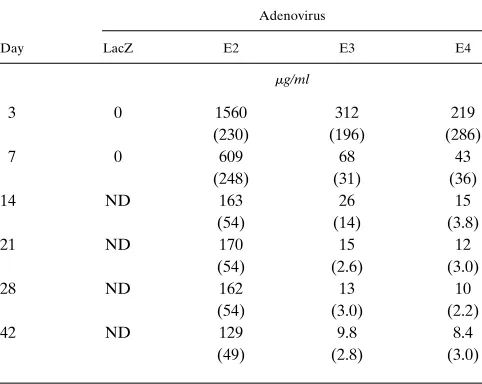
Plasma concentrations of human apoE were determined using an immunoturbidometric assay (Table I). There were substantial differences in the plasma concentrations of apoE among the three isoforms. On day 3 postinjection, the concen-tration of apoE2 was 5-fold higher than that of apoE3, which in turn was 1.5-fold higher than that of apoE4. On day 7, the level of apoE2 was 9-fold greater than that of apoE3, which was 1.6-fold greater than that of apoE4. Fig. 3 D shows repre-sentative Western blots of plasma human apoE on days 3 and 7 in mice injected with the three apoE adenoviruses.
To determine the duration of expression of apoE proteins, Western blotting of human apoE after separation by
SDS-PAGE was performed on plasma obtained at multiple time points after injection of viruses (Fig. 3). Fig. 3, A, B, and C
show the time courses of apoE in the plasma of mice injected with the apoE2, apoE3, and apoE4 viruses, respectively. The plasma concentration of apoE declined fairly rapidly from day 7 to day 14, followed by gradual decline. In all groups, apoE protein was still expressed 3 mo after injection of the adenovi-ruses. The plasma apoE levels on day 84 were approximately one fourth of normal human levels for apoE3 and apoE4 and were higher than normal human levels for apoE2.
[image:4.612.316.554.61.181.2]To determine whether the observed differences in plasma apoE concentrations were a reflection of differential apoE gene expression, hepatic apoE mRNA levels were evaluated
Figure 1. Genotyping of the three apoE iso-form adenoviruses. Af-ter amplification of the relevant region of the apoE gene by PCR, the PCR products were di-gested with the restric-tion enzyme HhaI and subjected to 20% poly-acrylamide gel electro-phoresis. The template DNA used for amplifi-cation are as follows: lane 1, plasmid pAdCMVE2; lane 2, apoE2 virus; lane 3, plasmid pAdCMVE3; lane 4, apoE3 virus; lane 5, plasmid pAdCMVE4; lane
[image:4.612.315.556.521.713.2]6, apoE4 virus.
Figure 2. Phenotyping of the three apoE isoforms expressed in vivo after gene transfer. After delipidation of 10 ml of plasma, samples were dissolved in IEF buffer, and 1/5 vol of each sample was loaded on an IEF gel (pH 4.5–6). After electrophoresis, the proteins were transferred to a nitrocellulose membrane, and apoE protein was de-tected with monoclonal antibody raised against human apoE. (Lane
1) Human apoE2/E2 plasma sample; (lane 2) plasma sample from a mouse injected with apoE2 virus; (lane 3) plasma sample
[image:4.612.58.297.572.706.2]from a mouse injected with apoE3 virus; (lane 4) plasma sample from a mouse injected with apoE4 virus; (lane 5) human apoE4/E4 plasma sample; (lane 6) human apoE3/E3 plasma sample.
Table I. Plasma ApoE Levels in the Animals Injected with ApoE Isoform Viruses
Day
Adenovirus
LacZ E2 E3 E4
mg/ml
3 0 1560 312 219 (230) (196) (286)
7 0 609 68 43
(248) (31) (36) 14 ND 163 26 15
(54) (14) (3.8) 21 ND 170 15 12
(54) (2.6) (3.0) 28 ND 162 13 10
(54) (3.0) (2.2) 42 ND 129 9.8 8.4
(49) (2.8) (3.0)
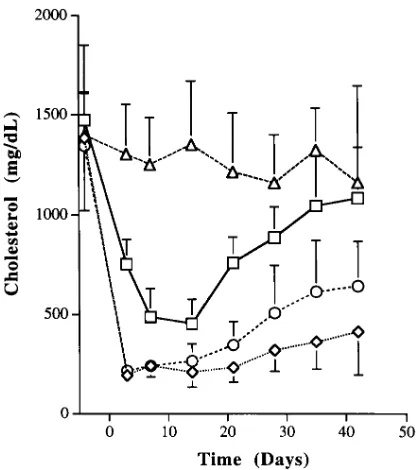
by Northern blotting utilizing mouse GAPDH mRNA as an internal control (Fig. 4). Because more than 90% of recombi-nant adenovirus infused intravenously is known to be deliv-ered to the liver (31), liver samples were subjected to analysis. The relative ratios of apoE mRNA to GAPDH mRNA were 1.34, 1.10, and 1.00 for apoE2, apoE3, and apoE4, respectively. Thus, the differences in plasma concentrations of apoE among the isoforms were not due to differences in mRNA abundance. We observed significantly different effects of the three apoE isoforms on plasma cholesterol and lipoproteins in these mice fed a Western diet. As shown in Fig. 5, plasma total cho-lesterol levels in mice injected with the apoE3 virus decreased dramatically after injection. The mean cholesterol level was 1,384 mg/dl before injection, falling to 194 mg/dl 3 d after injec-tion. This marked decrease in cholesterol levels was sustained throughout the 42 d of the study, although cholesterol levels began to gradually increase after day 28. Mice injected with the apoE4 virus revealed virtually the same pattern as that of mice injected with apoE3 virus (mean cholesterol 1,345 mg/dl before injection and 217 mg/dl 3 d after injection). The choles-terol level in this group began increasing gradually after day 21, but still remained much lower than the baseline level by day 42. The mice injected with the apoE2 virus showed a very different response compared with mice injected with the
apoE3 or apoE4 viruses. The effect on total cholesterol was slower and much less substantial; the maximum decrease in plasma total cholesterol level occurred 14 d after injection, with the mean level falling to 452 mg/dl from a preinjection mean level of 1,474 mg/dl. Cholesterol levels in the apoE2-injected mice returned to baseline levels by day 42.
To determine the effects of the various apoE isoforms on individual lipoprotein classes, FPLC gel filtration of pooled plasma samples was performed (Fig. 6). There was no
[image:5.612.57.297.58.241.2]differ-Figure 3.Western blotting analysis of the plasma samples of the mice injected with recombinant apoE adenoviruses. After separating 2 ml of plasma sample by SDS-PAGE, proteins were transferred to a ni-trocellulose membrane, and apoE was detected with a monoclonal antibody against human apoE. (A, B, and C) The time course changes in plasma concentration of the apoE proteins in representative mice. (A) samples from a mouse injected with apoE2 virus, (B) samples from a mouse injected with apoE3 virus, and (C) samples from a mouse injected with apoE4 virus. (Lane 1) Control human plasma; (lane 2) mouse plasma drawn before injection of the virus; (lane 3) day 7; (lane 4) day 14; (lane 5) day 28; (lane 6) day 42; (lane 7) day 63; (lane 8) day 84. (D) Mouse plasma samples on day 3 and 7 and ana-lyzed by Western blotting. (Lane M) Molecular weight markers; (lanes 1 and 2) plasma samples from mouse injected with control (lacZ) adenovirus on day 3 and 7, respectively; (lanes 3–5) plasma samples on day 3 from mice injected with apoE2, and apoE3, and apoE4 viruses, respectively; (Lanes 6–8) plasma samples on day 7 from mice injected with apoE2, and apoE3, and apoE4, respectively; (Lane 9) control human plasma sample.
Figure 4. Northern blotting analysis of mRNA from liver. 25
mg of total RNA puri-fied from the livers of mice killed 7 d after in-jection of viruses was separated on a gel and probed with (A) human apoE cDNA or (B) mouse GAPDH cDNA. (Lane 1) RNA molecular weight mark-ers, the band represents 1.3 kb; (lane 2) mouse injected with lacZ vi-rus; (lane 3) mouse in-jected with apoE2 virus; (lane 4) mouse injected with apoE3 virus; and (lane 5) mouse injected with apoE4 virus.
[image:5.612.317.553.85.283.2] [image:5.612.314.524.435.670.2]ence between groups in the FPLC cholesterol profile before injection of the viruses. 7 d after injection, the VLDL and IDL/ LDL cholesterol levels normalized in mice injected with apoE3 or apoE4 viruses, and HDL cholesterol increased. Analysis of plasma from mice injected with the apoE2 virus re-vealed a much smaller decrease in VLDL and IDL/LDL cho-lesterol levels and an appearance of lipoproteins between the
normal LDL and HDL size ranges. The HDL cholesterol level in this group increased to almost the same level as in apoE3 and apoE4 virus-injected mice.
[image:6.612.58.531.57.336.2]The VLDL cholesterol (VLDL-C), IDL and LDL choles-terol (IDL/LDL-C), and HDL cholescholes-terol (HDL-C) levels were determined from the FPLC fractions over the 6-wk course of the experiment and are shown in Fig 7. The VLDL-C levels
Figure 6.FPLC cholesterol profile. Pooled plasma samples were subjected to gel filtration using Superose 6 columns, and the cholesterol level in each fraction was measured by using an enzymatic assay kit. (A) Data from samples collected before injection of viruses, and (B) data from sam-ples collected 7 d after injection of viruses. (squares) Mice injected with apoE2 virus; (diamonds) mice injected with apoE3 virus; (circles) mice injected with apoE4 virus; and (triangles) mice injected with control lacZ virus.
[image:6.612.56.519.500.680.2]and IDL/LDL-C levels decreased dramatically in mice injected with apoE3 and apoE4 viruses, whereas the mice injected with apoE2 virus had a more moderate decrease. In addition, after day 28, the IDL/LDL-C level in mice injected with apoE2 virus rose to the same level as the mice injected with control virus. The changes in HDL-C level (Fig. 7 C) were similar among the mice injected with apoE2, apoE3, and apoE4 viruses, showing increases in HDL-C level of approximately threefold, which were sustained through day 42.
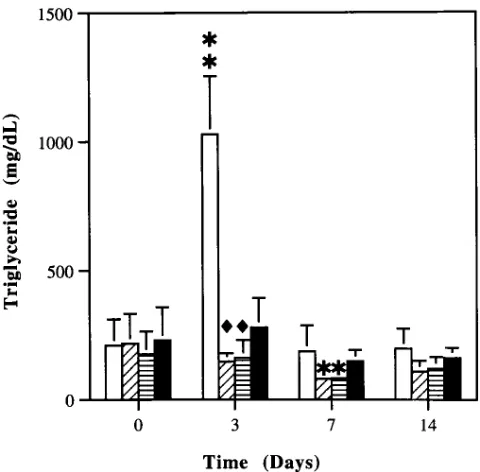
The changes in plasma triglyceride (TG) level are shown in Fig. 8. There was no change in the TG level of the mice in-jected with control virus. Mice inin-jected with the apoE2 virus had a significant increase in TG level 3 d after injection of the virus. However, by 7 d after injection, TG in these mice had re-turned to the baseline level. In contrast, mice injected with the apoE3 and apoE4 viruses had small but significant decreases in plasma TG levels.
To examine whether there was a difference in the pattern of distribution of these three apoE isoforms among lipoprotein classes, aliquots of the fractionated samples from FPLC gel fil-tration were subjected to SDS-PAGE and analyzed by West-ern blotting. Fig. 9 shows the results from the samples drawn on day 7. All apoE isoforms distributed on all lipoprotein classes, however, there was a difference in their patterns of dis-tribution. To approximate the amount of apoE per lipoprotein particle, the apoE protein concentration in each lipoprotein fraction was divided by the cholesterol concentration in each fraction. As shown in Table II, the ratio of apoE2/cholesterol
was much higher in all lipoprotein classes than that of apoE3 or apoE4, indicating a much greater amount of apoE2 per par-ticle. These ratios also indicate that apoE4 distributed prefer-entially to VLDL and apoE2 to HDL as compared with apoE3.
Discussion
Few data exist comparing the direct effects of the three major apoE isoforms on lipoprotein metabolism in vivo. The purpose of this study was to investigate the influence of the three hu-man apoE isoforms on lipoprotein metabolism in the absence of endogenous apoE by utilizing liver-directed somatic gene transfer in apoE-deficient mice. Replication-defective recom-binant adenoviruses have been utilized for the study of effects of gene expression in vivo, and have been especially useful in the investigation of effects on lipoprotein metabolism (32). However, one drawback has been the short duration of gene expression and high degree of inflammation using first-genera-tion adenoviruses (28). We previously used a first-generafirst-genera-tion recombinant adenovirus encoding the human apoE3 cDNA in mice, but the expression of apoE was extremely low by day 28 (data not shown), consistent with other reports (19, 20). Sec-ond-generation temperature-sensitive recombinant adenovi-ruses were reported to result in less inflammation and longer expression of b-galactosidase (23) and ornithine transcarbam-ylase (24) in mouse liver compared to first-generation adenovi-ruses. This study is the first report of the use of a second-gener-ation adenovirus for gene transfer and expression of a secreted protein. The advantage of a secreted protein is that it can be repetitively measured in the same animals over time, allowing a more quantitative assessment of the duration of transgene expression and the biological effects of expression over time. These studies revealed that not only was the level of apoE ex-pression high, but it was maintained for a much longer period of time than with first-generation adenoviral vectors. ApoE was present at levels comparable to or greater than normal hu-man levels for at least 3 mo after injection of adenovirus.
[image:7.612.57.297.57.293.2]The injection of the same doses of recombinant adenovi-ruses encoding each of the three apoE isoforms resulted in ap-proximately the same level of expression of the transgene based on the level of mRNA abundance in the liver as mea-sured 7 d after injection. However, the plasma concentrations of apoE2 were markedly greater than that of apoE3 or apoE4, and levels of apoE3 were greater than those of apoE4. ApoE2 levels remained substantially higher than apoE3 and apoE4 throughout the study even up to 3 mo after injection. These data are consistent with previous tracer turnover studies sug-gesting that in humans the turnover of apoE2 is slowest and apoE4 is fastest among these three isoforms (15, 16).
Figure 8. Changes in plasma triglycerides. Plasma triglyceride levels were measured enzymatically as described. Open bars represent mice injected with apoE2 virus (n5 7), bars with slanted lines mice in-jected with apoE3 virus (n5 6), bars with horizontal lines mice in-jected with apoE4 virus (n5 7), and closed bars mice injected with control lacZ virus (n5 6). Data are mean6SD. (**) P, 0.0001 com-pared with all other groups on the same day; (*) P, 0.01 compared with control, and (closed diamond) P, 0.04 compared with control at the same time point.
Adenovirus VLDL IDL/LDL HDL
mg apoE/mg cholesterol
apoE2 95 144 125
apoE3 17 63 17
[image:7.612.315.556.83.176.2]Hepatic gene transfer of apoE3 and apoE4 in apoE-defi-cient mice fed a Western diet completely normalized plasma cholesterol levels by reducing VLDL and IDL/LDL. In con-trast, gene transfer of apoE2 was not nearly as effective in re-ducing cholesterol and lipoprotein levels. Furthermore, the na-dir did not occur until 14 d after injection of the apoE2 virus. Therefore, although apoE2 did have some effect on lipopro-tein metabolism in this model, the effect was markedly attenu-ated compared with that of apoE3 and apoE4.
The acute effect of apoE gene transfer on triglyceride lev-els did not always directly correlate with changes in cholesterol levels. Mice injected with the apoE2 virus had an acute in-crease in triglyceride levels on day 3 despite a modest dein-crease in cholesterol levels. In contrast, mice injected with the apoE3 and apoE4 viruses had a modest decrease in triglyceride levels. Several in vitro studies demonstrated that apoE inhibited li-polysis at high concentration (33, 34). At high levels, apoE may also have an acute inhibitory effect on lipolysis of TG-rich lipoproteins in vivo. Testing of this hypothesis will require fur-ther investigation.
Despite differences in the effect of apoE isoforms on apoB-containing lipoproteins, gene transfer of all three apoE iso-forms produced a sustained increase in HDL cholesterol levels of approximately threefold compared to the baseline level, which was maintained throughout the course of the experi-ment. This increase in HDL levels may be in part associated with the decrease in VLDL and IDL/LDL. However, in mice injected with the apoE2 virus, whose VLDL and IDL/LDL levels on day 42 had returned back to control levels, a similar sustained increase in HDL was observed. Therefore, apoE it-self may have contributed to increased HDL cholesterol by en-hancing the formation of apoE-rich HDL particles. The obser-vation that all apoE isoforms were found in abundance in the HDL fraction is consistent with this interpretation.
The distribution of apoE isoforms in vivo was similar to that predicted by tracer studies. A greater fraction of apoE2 associated with HDL and a higher fraction of apoE4 associ-ated with VLDL relative to apoE3. It is of interest that the hu-man apoE isoforms are consistent in their predilection for spe-cific lipoprotein particles even in mice.
We observed increases in plasma cholesterol levels and remnant lipoproteins over time that were different for the three isoforms. In mice injected with the apoE2 virus, choles-terol levels rebounded rapidly to the baseline level; in mice in-jected with the apoE4 virus, cholesterol levels started increas-ing at day 21; and in mice injected with the apoE3 virus cholesterol levels began to increase gradually at day 28. It is likely that there is a threshold plasma concentration of human apoE3 and apoE4 required to normalize the plasma choles-terol level in apoE-deficient mice on a Western diet. Plasma levels of apoE4 on days 14 and 21 were 15.0 mg/ml and 11.6 mg/ ml, respectively, and those of apoE3 on days 21 and 28 were 15.4 mg/ml and 13.3 mg/ml, respectively. Therefore, approxi-mately one third of the normal human apoE plasma concen-tration is necessary for apoE3 and apoE4 to normalize choles-terol levels in these mice when fed a Western diet. In contrast, a previous report (35) demonstrated that one tenth of the mal apoE plasma concentration in apoE-deficient mice fed nor-mal chow was sufficient to nornor-malize the lipoprotein profile.
Another possible explanation for the increase in choles-terol levels is the generation of antibodies to human apoE. Previous studies (36–38) utilizing recombinant adenoviruses as a vehicle for gene transfer report production of antibodies to the transgene 3 wk after the injection. Human apoE is a neo-antigen to apoE-deficient mice, making it likely that antibody against apoE would be produced. Over the time course of this experiment, we detected only a very small titer of antibody to human apoE that was first detectable on day 28. There was no apparent difference among the three isoforms. Therefore, an immune response to the apoE is unlikely to be a major factor in influencing these results.
[image:8.612.58.484.60.202.2]In summary, second-generation recombinant adenoviruses were used to achieve high level, long-term hepatic gene ex-pression of all three major human apoE isoforms in apoE-defi-cient mice fed a Western diet. On this background of absent endogenous apoE, their differential effects on lipoprotein me-tabolism were determined. The use of second generation ade-noviruses for somatic gene transfer of apoE should permit fur-ther investigation of apoE isoform effects on longer term endpoints such as atherosclerosis.
Wilson for providing the second generation lacZ adenovirus, and to Dr. David Usher for antibodies to human apoE.
This research was supported in part by grants to D.J. Rader from the W.W. Smith Charitable Trust, the National Institutes of Health (HL55323), the American Heart Association and the American Health Assistance Foundation.
References
1. Mahley, R.W. 1988. Apolipoprotein E: cholesterol transport protein with expanding role in cell biology. Science (Wash. DC). 240:622–630.
2. Beisiegel, U. 1995. Receptors for triglyceride-rich lipoproteins and their role in lipoprotein metabolism. (Review.) Curr. Opin. Lipidol. 6:117–122.
3. Nathan, B.P., S. Bellosta, D.A. Sanan, K.H. Weisgraber, R.W. Mahley, and R.E. Pitas. 1994. Differential effects of apolipoproteins E3 and E4 on neu-ronal growth in vitro. Science (Wash. DC). 264:850–852.
4. Strittmatter, W.J., and A.D. Roses. 1995. Apolipoprotein E and Alz-heimer disease (Review.) Proc. Natl. Acad. Sci. USA. 92:4725–4727.
5. Ghiselli, G., E.J. Schaefer, P. Gascon, and H.B. Breser, Jr. 1981. Type III hyperlipoproteinemia associated with apolipoprotein E deficiency. Science (Wash. DC). 214:1239–1241.
6. Mabuchi, H., H. Itoh, M. Takeda, K. Kajinami, T. Wakasugi, J. Koizumi, R. Takeda, and C. Asagami. 1989. A young type III hyperlipoproteinemic pa-tient associated with apolipoproteinemic papa-tient associated with apolipoprotein E deficiency. Metab. Clin. Exp. 38:115–119.
7. Kurosaka, D., T. Teramoto, T. Matsushima, T. Yokoyama, A. Yamanda, T. Aikawa, Y. Miyamoto, and K. Kurokawa. 1991. Apolipoprotein E deficiency with a depressed mRNA of normal size. Atherosclerosis. 88:15–20.
8. Feussner, G., J. Dobmeyer, H.J. Grone, S. Lohmer, and S. Wohlfeil. 1996. A 10-bp deletion in the apolipoprotein epsilon gene causing apolipopro-tein E deficiency and severe type III hyperlipoproapolipopro-teinemia. Am. J. Hum. Genet. 58:281–291.
9. Plump, A.S., J.D. Smith, T. Hayek, K. Aalto-Setälä, A. Walsh, J.G. Ver-stuyft, E.M. Rubin, and J.L. Breslow. 1992. Severe hypercholesterolemia and atherosclerosis in apolipoprotein E-deficient mice created by homologous re-combination in ES cells. Cell. 71:343–353.
10. Zhang, S., R. Reddick, J. Piedrahita, and N. Maeda. 1992. Spontaneous hypercholesterolemia and arterial lesions in mice lacking apolipoprotein E. Sci-ence (Wash. DC). 258:468–471.
11. Rall, S.C., Jr., and R.W. Mahley. 1992. The role of apolipopreotein E genetic variants in lipoprotein disorders. (Review.) J. Intern. Med. 231:653–659. 12. Davignon, J., R.E. Gregg, and C.F. Sing. 1988. Apolipoprotein E poly-morphism and atherosclerosis. Arteriosclerosis. 8:1–21.
13. Wilson, P.W.F., R.H. Myers, M.G. Larson, J.M. Ordovas, P.A. Wolf, and E.J. Schaefer. 1994. Apolipoprotein E Alleles, Dyslipidemia, and coronary heart disease. JAMA. 272:1666–1671.
14. Brewer, H.B., Jr., L.A. Zech, R.E. Gregg, D. Schwartz, and E.J. Schaefer. 1983. Type III hyperlipoproteinemia: diagnosis, molecular defects, pathology, and treatment. Ann. Intern. Med. 98:623–640.
15. Gregg, R.E., L.A. Zech, E.J. Schaefer, and H.B. Brewer, Jr. 1981. Type III hyperlipoproteinemia: defective metabolism of an abnormal apolipoprotein E. Science (Wash. DC). 211:584–586.
16. Gregg, R.E., L.A. Zech, E.J. Schaefer, D. Stark, D. Wilson, and H.B. Brewer, Jr. 1986. Abnormal in vivo metabolism of apolipoprotein E4 in hu-mans. J. Clin. Invest. 78:815–821.
17. Weisgraber, K.H., T.L. Innerarity, and R.W. Mahley. 1982. Abnormal
land. 1995. Phenotypic correction of hypercholesterolemia in apoE-deficient mice by adenovirus-mediated in vivo gene transfer. Arteriosclerosis Thromb. Vasc. Biol. 15:479–484.
20. Kashyap, V.S., S. Santamarina-Fojo, D.R. Brown, C.L. Parrott, D. Ap-plebaum-Bowden, S. Meyn, G. Talley, B. Paigen, N. Maeda, and H.B. Brewer, Jr. 1995. Apolipoprotein E deficiency in mice: gene replacement and preven-tion of atherosclerosis using adenovirus vectors. J. Clin. Invest. 96:1612–1620.
21. Yang, Y., F.A. Nunes, K. Berencsi, E.E. Furth, E. Gonczol, and J.M. Wilson. 1994. Cellular immunity to viral antigens limits E1-deleted adenovi-ruses for gene therapy. Proc. Natl. Acad. Sci. USA. 91:4407–4411.
22. Yang, Y., H.C.J. Ert, and J.M. Wilson. 1994. MHC class I-restricted cy-totoxic T lymphocytes to viral antigens destroy hepatocytes in mice infected with E1-deleted recombinant adenoviruses. Immunity. 1:433–442.
23. Engelhardt, J.F., X. Ye, B. Doranz, and J.M. Wilson. 1994. Ablation of E2A in recombinant adenoviruses improves transgene persistence and de-creases inflammatory response in mouse liver. Proc. Natl. Acad. Sci. USA. 91: 6196–6200.
24. Ye, X., M. Robinson, M. Batshaw, E. Furth, I. Smith, and J.M. Wilson. 1996. Prolonged metabolic correction in adult ornithine transcarbamylase-defi-cient mice with adenoviral vectors. J. Biol. Chem. 271:3639–3646.
25. Sambrook, J., E.F. Fritsch, and T. Maniatus. 1989. Molecular Cloning, A Laboratory Manual. Cold Spring Harbor Laboratory Press, Cold Spring Har-bor, New York.
26. Harlow, E., and D. Lane. 1988. Antibodies, A Laboratory Manual. Cold Spring Harbor Laboratory Press, New York.
27. Tsukamoto, K., T. Watanabe, T. Matsushima, M. Kinoshita, H. Kato, Y. Hashimoto, K. Kurokawa, and T. Teramoto. 1993. Determination by PCR-RFLP of apo E genotype in a Japanese population. J. Lab. Clin. Med. 121:598–602. 28. Kozarsky, K.F., and J.M. Wilson. 1993. Gene therapy: adenovirus vec-tors. Curr. Opin. Gene. Dev. 3:499–503.
29. Menzel, H.-J., and G. Utermann. 1986. Apolipoprotein E phenotyping from serum by Western blotting. Electrophoresis. 7:492–495.
30. Gerdes, L.U., C. Gerdes, I.C. Klausen, and O. Faergeman. 1992. Gener-ation of analytic plasma lipoprotein profiles using two prepacked superose 6B columns. Clin. Chim. Acta. 205:1–9.
31. Herz, J., and R.D. Gerard. 1993. Adenovirus-mediated transfer of low density lipoprotein receptor gene acutely accelerates cholesterol clearance in normal mice. Proc. Natl. Acad. Sci. USA. 90:2812–2816.
32. Leiden, J.M. 1996. Adenovirus-mediated gene transfer as an in vivo probe of lipoprotein metabolism. Circulation. 94:2046–2051.
33. Havel, R.J. 1984. The formation of LDL: mechanism and regulation. J. Lipid Res. 25:1570–1576.
34. Ehnholm, C., R.W. Mahley, D.A. Chappell, K.H. Weisgraber, E. Lud-wig, and J.L. Witztum. 1984. Role of apolipoprotein E in the lipolytic conver-sion of b-very low density lipoproteins to low density lipoproteins in type III hyperlipoproteinemia. Proc. Natl. Acad. Sci. USA. 81:5566–5570.
35. Linton, M.F., J.B. Atkinson, and S. Fazio. 1995. Prevention of athero-sclerosis in apolipoprotein E-deficient mice by bone marrow transplantation. Science (Wash. DC). 267:1034–1037.
36. Vilquin, J.T., B. Guerette, I. Kinoshita, B. Roy, M. Goulet, C. Gravel, R. Roy, and J.P. Tremblay. 1995. FK506 imunosuppression to control the im-mune reactions triggered by first-generation adenovirus-mediated gene trans-fer. Hum. Gene Ther. 6:1391–1401.
37. Imler, J.L. 1995. Adenovirus vectors as recombinant viral vaccines. (Re-view.) Vaccine. 13:1143–1151.