www.ijraset.com Volume 4 Issue III, March 2016 IC Value: 13.98 ISSN: 2321-9653
International Journal for Research in Applied Science & Engineering
Technology (IJRASET)
Survey on Personalized Web Search Engine
A.Smilien Rophie #1, Dr.A.Anitha*2 #
Department of Information Technology, Francis Xavier Engineering College, Tirunelveli, Tamilnadu, India
Abstract- Search engines like bing, yahoo, google are very essential component in web existence. Internet engines are built for all kind of people and now not for any particular people. General web engines can't pick out the special needs of various clients, if person enter unsuitable keyword, ambiguous keywords to specific what they want are some demands trashed by generic engines. To overcome this problem, the personalization is needed. Personalized web search (PWS) is potential to perceive one-of-a-kind wishes of different individuals who trouble the similar query for searching and to perform information renewal for any user of their own interests. Depending upon the user query and reranking results , the personalization takes place. Several PWS techniques using web contents, web link structure, browsing history ,user profiles and user queries. The PWS techniques mainly depends on the contents of web mining, browsing information, links, individual user profile and also queries. The proposed paper is to study on different strategies of personalization.
Keywords— Privacy, User profile, Personalization, Reranking, Search quality
I. INTRODUCTION
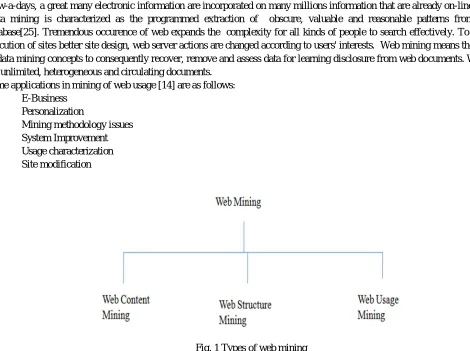
Now-a-days, a great many electronic information are incorporated on many millions information that are already on-line today[24]. Data mining is characterized as the programmed extraction of obscure, valuable and reasonable patterns from extensive database[25]. Tremendous occurence of web expands the complexity for all kinds of people to search effectively. To expand the execution of sites better site design, web server actions are changed according to users' interests. Web mining means the utilization of data mining concepts to consequently recover, remove and assess data for learning disclosure from web documents. Web mining are unlimited, heterogeneous and circulating documents.
Some applications in mining of web usage [14] are as follows: E-Business
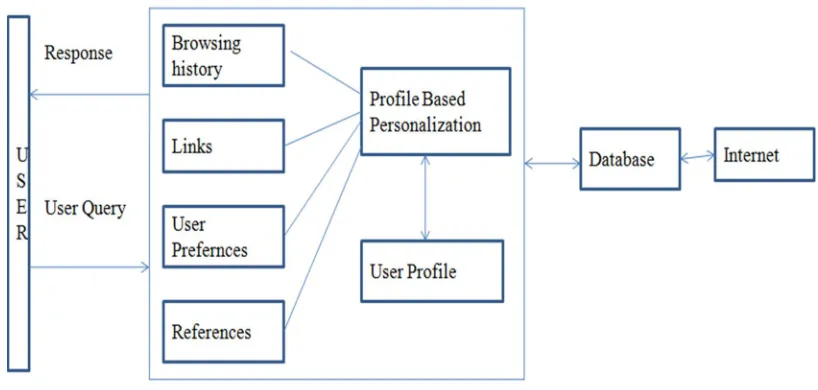
Personalization
[image:2.612.55.525.321.672.2]Mining methodology issues System Improvement Usage characterization Site modification
Fig. 1 Types of web mining
Technology (IJRASET)
Fig. 2 Diagram for personalization
II. LITERATURE SURVEY
The paper [21] uses personalised search has been underneath way for many years and plenty of personalization algorithms have been investigated, it's far nevertheless uncertain whether personalization is constantly effective on unique queries for unique users and under unique search contexts. In this paper, they give a large-scale evaluation framework for customized search primarily based on query logs. An advance of this concept is that documents are mixed may be clearly reviewed by the members. For fewer queries, it increases search accuracy. But it harms many amount of queries.
The author [8] proposed PWS is an useful manner of enhancing the best result especially done on user profile. However individuals who need to look in web would prefer not to uncover his profile to the outside worldwide. It follows hierarchical structure. If the users increases, then the server will take extra time to search.
In this paper [9] they propose a reasonable layout for PWS engine. It follows the meta search method which responds on any of the search engines like Yahoo, Google to execute the search. When the unique query submitted by any user, the search engine retrieve the same information. In this paper, they proposed the personalized search, i.e., obtaining only correct information. It uses profile based personalization, where OSPs build huge profile for the person and customise the content based totally in this profile. Whilst OSPs genuinely tune rich user histories, they can infer a super deal greater by way of mining this uncommon records. Internet search outcomes ought to adapt to users with distinct statistics desires. The author expect such statistics, there are various methods relate information mining techniques to extract usage styles from web logs. However, the invention of patterns from usage records by using itself is not suffice for performing the personalization responsibilities.
In this paper [2] they proposed a unique UUP protocol particularly used to defend the users privacy. This device displays a disorted individual profile to the search engine. The privacy necessities of the users, satisfies the following rules. Users should not link a particular query with the user who has created it. The central node should not link a query with the user who has created it. The web search engine should be unable to assemble a dependable profile of a user.
The author [20] uses to receive PWS, the user has to present own information and interests, further to the query itself, to the web service. By using any other private data, then anyone can easily known the other interests also. So it needs privacy. In this paper, they uses online anonymity for hiding private data. The on-line anonymity is interrelation between the unknown and dynamic web users, who can use either online or offline at any time.
www.ijraset.com Volume 4 Issue III, March 2016 IC Value: 13.98 ISSN: 2321-9653
International Journal for Research in Applied Science & Engineering
Technology (IJRASET)
MSN rankings.
Pseudo identification [12] is the most reduced degree of privateness protection. As a result of the evacuation of client character, which might somehow or another be utilized to specifically recognize a user, a few individuals who couldn't care less much about security might acknowledge this level of protection insurance. A typical approach to execute the group identity security is to place up an intermediary for a gathering of users and every one of the user would speak with the web crawler through the intermediary. At present, there are numerous public intermediary servers accessible on the Internet. The more privacy is no identity.
The author [18] proposed a novel protection saving procedure that defeat the security issues. The center of this arrangements is the idea of customized anonymity, i.e., a man can determine the level of security protection for her/his exposure qualities. Personalization is a natural idea of security conservation whose goal is to ensure the hobbies of people at the primary place. To start with, they formalize the ideas that highlight another structure of processing protection cognizant data considering individual interests. As a second step, they examine the customized anonymity behind this approach, and determine formulae for evaluating security breach probability. The author propose the idea of customized anonymity, and build up another speculation structure that considers protection necessities. This strategy effectively avoids protection interruption even in situations where the current methodologies fall flat, and results in summed up tables that allow exact total examination.
Adapting to questionable inquiries [7] has for some time been an imperative part in the exploration of Information Retrieval, yet stays to be a testing task. Moreover, a user ordinarily has a little number of points that she is fundamentally interested on and her choices to a page is frequently influenced by her general interest for the theme of the page. In this paper [7], they demonstrate that how a web search tool can take in a user’s preferences consequently in view of her past history and how it can utilize the client interests to customize results. This investigations demonstrate that user’s preferences can be gained precisely even from little history information and customized search taking into account user preference yields huge enhancements over the best existing ranking technique.
The author [26] displayed a methodology for obviously optimizing the utility-privateness tradeoff in PWS along with internet search. The author confirmed that application functions like click on entropy reduction fulfill submodularity. In evaluation, privateness concerns perform supermodularly; the greater private records are combined, the most sensitivity and hazard of identifiability. They proved near- optimal tradeoff.
A. Summary of Literature Survey
The main drawback is tradeoff between personalization and privacy. The search engine returns the same information for all user queries. It is called as offline generalization. The solution of this offline generalization is online generalization. If any query takes place in the search engine , then personalization takes place. Only reranking methods are not effective. The solution to the above problem is to rerank the result and also by using greedy algorithm it reduces the response time of the query.
III.PROBLEM DEFINITION
Some personalization techniques does not increase the search quality. It also reduces the search effectively.
IV.PROPOSED WORK
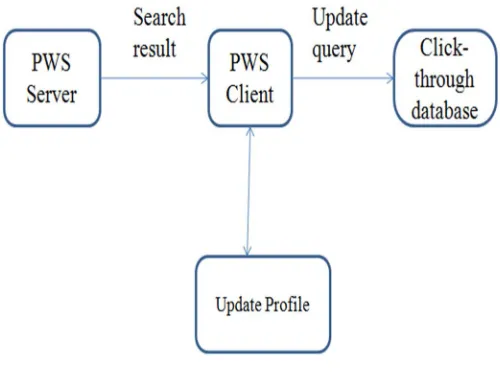
In our proposed work, the user contains separate profile. The hierarchical structure can be followed in user profile. The profile can be updated in the PWS client. Reranking can be done at the client side. In PWS, there are some personalization stategies. They are
A. Person- level reranking.
B. Group level reranking.
Technology (IJRASET)
Fig. 3 Proposed work of PWS
V. CONCLUSION
In spite of the fact that the World Wide Web is the biggest form of electronic data, it needs with compelling strategies for recovering, removing noises, and displaying the data that is precisely required by every user. The information present in the Internet is very large and grow very fastly. But the user needs only exact correct detail. By achieving the above data, personalization is needed. The PWS increases the search quality also. This paper contains surveys the different activities completed to enhance the execution of personalization procedure.
REFERENCES
[1] Aruna V., Palanivel K., “A Privacy-Preserving Personalized Web Search (PWS) Framework UPS,” Global Journal of Advanced Engineering Technologies,
Vol. 3, 2014.
[2] Castella Roca J., Viejo A. and Herrera Joancomarti J., “Preserving User’s Privacy in Web Search Engines,” Computer Comm., Vol. 32, No. 13-14, pp. 1541-1551, 2009.
[3] Chirita P.A., Nejdl W., Paiu R. and Kohlschutter C., “Using ODP Metadata to Personalize Search,” Proc. 28th Ann. Int’l ACM SIGIR Conf. Research and
Development Information Retrieval (SIGIR), 2005.
[4] Dou Z., Song R. and Wen J.R., “‘A Large-Scale Evaluation and Analysis of Personalized Search Strategies,” Proc. Int’l Conf. World Wide Web (WWW),
pp. 581-590, 2007.
[5] Madhu G. and Govardhan A. and Rajinikanth T.V., “Intelligent Semantic Web Search Engines: A Brief Survey,” International journal of Web & Semantic
Technology (IJWesT) Vol.2, No.1, 2011.
[6] Priyanka Z. and Todmal S.R., “Privacy Protection Using CPS Framework in Personalized Web Search,” International Journal for Research in Applied
Science & Engineering Technology (IJRASET), Vol. 2, pp. 181-184, 2014.
[7] Qiu F. and Cho J., “Automatic Identification of User Interest for Personalized Search,” Proc. 15th Int’l Conf. World Wide Web (WWW), pp.
727-736, 2006.
[8] Radhika M. and Vijaya Chamundeeswari V., “Privacy Protection In Personalized Web Search Using Generalized Profile,” ARPN Journal of Engineering
and Applied Sciences, Vol. 10, No. 7, pp. 4-17, 2015.
[9] Ramya V. and Gowthami S., “Enhance Privacy Search In Web Search Engine Using Greedy Algorithm,” International Journal of Scientific Research
Engineering & Technology (IJSRET), 2014.
[10] Sai Kumar V., Pavan Kumar P.N.V.S., “A UPS Framework for Providing Privacy Protection in Personalized Web Search” International Journal of
Innovative Research in Science, Engineering and Technology Vol. 4, 2015.
[11] Shen X., Tan B. and Zhai C., “Implicit User Modeling for Personalized Search,” Proc. 14th ACM Int’l Conf. Information and Knowledge Management
(CIKM), 2005.
[12] Shen X., Tan B. and Zhai C., “Privacy Protection in Personalized Search,” SIGIR Forum, Vol. 41, No. 1, pp. 4-17, 2007.
[13] Shou L., Bai H., Chen K., and Chen G., “Supporting Privacy Protection in Personalized Web Search,” IEEE Transactions On Knowledge And Data
Engineering, Vol. 26, No. 2, 2014.
[14] Srivastava J., Cooley R., Deshpande M. and Tan P.N., “Web Usage Mining: Discovery and Applications of Usage Patterns from Web Data,” SIGKDD
Explorations, Vol. 1, pp. 12-17, 2006.
www.ijraset.com Volume 4 Issue III, March 2016 IC Value: 13.98 ISSN: 2321-9653
International Journal for Research in Applied Science & Engineering
Technology (IJRASET)
Research and Development in Information Retrieval (SIGIR), pp. 449-456, 2005.
[16] Teevan V., Dumais S.T. and Liebling D.J., “To Personalize or Not to Personalize: Modeling Queries with Variation in User Intent,” Proc. 31st Ann. Int’l
ACM SIGIR Conf. Research and Development in Information Retrieval (SIGIR), pp. 163-170, 2008.
[17] Viejo A. and Castella-Roca J., “Using Social Networks to Distort Users’ Profiles Generated by Web Search Engines,” Computer Networks, Vol. 54, No. 9,
pp. 1343-1357, 2010.
[18] Xiao X. and Tao Y., “Personalized Privacy Preservation,” Proc. ACM SIGMOD Int’l Conf. Management of Data (SIGMOD), 2006.
[19] Xu Y., Wang K., Zhang B. and Chen Z., “Privacy-Enhancing Personalized Web Search,” Proc. 16th Int’l Conf. World Wide Web (WWW), pp. 591-600,
2007.
[20] Xu Y., Wang K., Yang G. and Fu A.W.C., “Online Anonymity for Personalized Web Services,” Proc. 18th ACM Conf. Information and Knowledge
Management (CIKM), pp. 1497-1500, 2009.
[21] Yuan X., Song R., Wen J.R. and Dou Z., “Evaluating the Effectiveness of Personalized Web Search,” IEEE Transactions On Knowledge And Data
Engineering, Vol. 21, No. 8, pp. 1178-1190, 2009.
[22] Zhu Y., Xiong L. and Verdery C., “Anonymizing User Profiles for Personalized Web Search,” Proc. 19th Int’l Conf. World Wide Web (WWW), pp.
1225-1226, 2010.
[23] Jaideep S., Cooley R., Deshpande M. and Tan P.N., “Web Usage Mining: Discovery and Applications of Usage Patterns from Web Data,” SIGKDD
Explorations, Vol. 1, pp.12-17, 2006.
[24] J Vellingiri, S.Chenthur Pandian, “A Survey on Web Usage Mining,” Global Journal of Computer Science and Technology, Vol. 11, Issue 4 , March 2011.
[25] Priyanka C. Ghegade, Prof. Vinod Wadane, “A Survey of Personalized Web Search in Current Techniques,” International Journal of Computer Science and
Information Technologies, Vol. 5 (6) , 2014.