5
VIII
August 2017
Study of Various Challenges In IS-OWC – A
Review
Abhishek Sharma1 , Rudrakshi Kapoor2
1.2Department of ECE, Sri Sai University Palampur, India
Abstract Inter-satellite optical-wireless communication systems (IsOWC), one of the important applications of FSO/WSO technology, will be deployed in space in the near future. The IsOWC systems provide a high bandwidth, small size, light weight, low power and low cost alternative to present microwave satellite systems. In this paper we have reported the challenges of Is-OWC
Key words: Is-OWC (inter-satellite optical wireless communication), LOS (line of sight),
I. INTRODUCTION
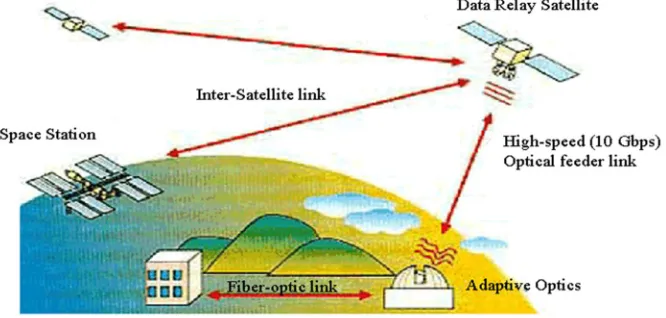
[image:2.612.160.493.422.581.2]Inter-satellite optical wireless communication has attained recognition in small time due to its infinite advantages as compared to its RF counterpart. This study includes system description of Is-OWC system with study of different parameters which effects system performance along with applications and advantages of utilizing this technology. Now we are in the twenty first century, the era of ‘Information technology’. There is no doubt that information technology has had an exponential growth through the modern telecommunication systems. A communication system transmits information from one place to another, whether separated by a few kilometers or by transoceanic distances. Information is often carried by an electromagnetic carrier wave whose frequency can vary from a few megahertz to several hundred terahertzes. Optical communication systems use high carrier frequencies (100 THz) in the visible or near-infrared region of the electromagnetic spectrum. Fiber-optic communication systems are light wave systems that employ optical fibers for information transmission. One key problem for developing practical optical communications systems was the lack of good transmission medium. [1] Fig. 1 shows inter-satellite communication and optical communication.
Figure 1 Inter-satellite communication and optical communication
Optical fibers provide enormous and unsurpassed transmission bandwidth with negligible latency, and are now the transmission medium of choice for long distance and high data rate transmission in telecommunication networks. [2]
Satellite optical wireless communication system (Is-OWC) communication usually involves directed line-of-sight LOS and point-to-point laser links from transmitter to receiver through the atmosphere. LOS links require an unobstructed path for reliable communication, whereas diffuse links rely on multiple optical paths from surface reflections.
II. ADVANTAGES OF OFDM
A. Makes efficient use of the spectrum by allowing overlap.
B. By dividing the channel into narrowband flat fading sub channels, OFDM is more resistant to frequency selective fading than
single carrier systems are. i.e. robustness to frequency selective fading channels C. Eliminates ISI through use of a cyclic prefix.
D. Using adequate channel coding and interleaving one can recover symbols lost due to the frequency selectivity of the channel. E. Channel equalization becomes simpler than by using adaptive equalization techniques with single carrier systems.
F. It is possible to use maximum likelihood decoding with reasonable complexity.
G. OFDM is computationally efficient by using FFT techniques to implement the modulation and demodulation functions.
H. Is less sensitive to sample timing offsets than single carrier systems are.
I. Provides good protection against co channel interference and impulsive parasitic noise.
III. DISADVANTAGES OF OFDM
A. It is more sensitive to ICI (inter carrier interference) which is due to frequency offset. B. Peak to average power ratio (PAPR) is high.
C. Bandwidth and power loss can be significant due to guard interval. D. High power transmitter amplifiers need linearization.
E. Low noise receiver amplifiers need large dynamic range.
IV. BACKGROUND STUDY
The application of laser technology to communications, particularly space communications, was envisioned in the very early days of laser development around 1962, described a method for secure communications between a satellite and a submarine. In the 40 years since, government agencies, companies, universities, and individuals in many countries have made tremendous technical progress in optical space communication i.e. inter-satellite optical wireless communication. A comprehensive review of the work in the field of inter-satellite optical wireless communication system reported by various researchers is briefly described.
The author studied the error performance of a heterodyne differential phase-shift keying (DPSK) optical wireless (OW) communication system operating under various intensity fluctuation conditions. [8] Specifically, it was assumed that the propagating signal suffers from the combined effects of atmospheric turbulence-induced fading, misalignment fading (i.e., pointing errors) and path-loss. Novel closed-form expressions for the statistics of the random attenuation of the propagation channel were derived and the bit-error rate (BER) performance was investigated for all the above fading effects. Numerical results were provided to evaluate the error performance of OW systems with the presence of atmospheric turbulence and/or misalignment. Moreover, nonlinear optimization was also considered to find the optimum beam width that achieves the minimum BER for a given signal-to-noise ratio value.The author studied the integrated Satellite-High altitude Platform system and presented their work. [9] Their work focused on routing algorithm reliability for evaluation of QOS parameters.
The author presented outline on HAP perception growth. IN detail Contrast was also made between HAP, satellite and terrestrial system. [10] Positioning possibilities of using HAP in communication scenarios were explained by collaborating with terrestrial or satellite systems.
The author studied the use of laser satellite communication to send Information to one another and also to relay the information to another satellite and then to the ground stations [11]. As the number of satellites orbiting Earth increase year by year, a network between the satellites provides a method for them to communicate with each other. And the laser communication not only eliminates the requirement for the lengthy fibers, but also connects the satellite with the data rates up to several Gbps. The optical wireless communication link performance focusing on data transfer between Low Earth Orbit (LEO) satellites. The system performance, including bit rates, input power, wavelength and distance on an inter-satellite link were analyzed.
EGC schee gives better performance than the SC scheme, and the long wavelength gives better performance than shorter wavelength.
The authorpresented their work on improvement of BER. [13] Vibration Induced pointing jitter in Is-OWC systems severely affects
communication quality as an effect of intensity fluctuations. The optical intensity fluctuations were investigated with deliberation of satellite variation for Is-OWC.
The author examined his work on the error performance for convolution coded on-off keying free space optical communication to
communicate over strong turbulence and misaligned fading channels. [14] BY using error control coding they have obtained low BER target with small SNR values.
The author proposed an ultra-high bit-rate inter-satellite optical wireless communication (Is-OWC) system. [15] The system was designed and simulated up to the bit rate of 400 Gbps. The proposed system was a non-diffused link or line-of-sight setup, which used coherent optical quadrature phase-shift keying (QPSK) modulation technique. The performance of the system was analyzed in terms of Q-factor, bit-error rate, eye opening and so on. The coverage distance observed with an input power level of 30 dBm for a bit-rate of 400, 160 and 100 Gbps are 4767, 7542 and 9532 km, respectively. Finally, the maximum bit-rate that can be communicated, for inter-satellite link at different orbits such as low-Earth orbit, medium-Earth orbit and geostationary Earth orbit were presented.
The authorhad investigated the implementation of an inter-satellite link (ISL) between two satellites estranged by a distance of 1000 Km at a data rate of 2.5 Gbps with and without square root module (SM). [16] It was concluded that the improved SNR ratio in conjunction with acceptable BER can be achieved by using the SM module. Also less transmitted power was required to transmit the externally modulated data of 2.5 Gbps over an ISL link of 1000 Km at an operating wavelength of 1550nm.
The author had analyzed an optical wireless communication system using subcarrier intensity modulation for gamma-gamma turbulence channels along with the pointing errors. [17] They employed the M-ary phase shift keying, differential phase shift keying and non-coherent frequency-shift keying to study the error rate performance of such systems. Highly accurate error rate approximations and outage probability expressions were derived using a series expansion approach for such a system. The asymptotic analysis reveals some unique transmission characteristics of such a system and suggests that pointing error compensation was necessary as pointing errors can severely degrade the error rate and outage probability performance of an uncompensated system.
The author had designed an inter-satellite OWC system to establish an inter-satellite link (ISL) of 1000 Km length between two satellites at data rate of 2.5 Gbps. [18] The system performance is compared at two different operating wavelengths i.e. at 1550 and 850nm. After simulating the proposed OWC system it was concluded that the ISL length of 1000 Km with BER of 10−6 can be
achieved with less transmitted power by 4dBm by transmitting the externally modulated data at 2.5 Gbps at operating wavelength of 850 nm rather than at 1550 nm.
The author proposed a new approach to reduce the four wave mixing (FWM) crosstalk based on polarization interleaving technique. [19] The FWM behavior and the performance of WDM systems were analyzed using the proposed technique. The simulation was performed using different power values with 100 GHz channel spacing, and at a data rate of 60Gbs. It was found that the FWM power was drastically reduced to -64 dBm when the polarization technique was used. In addition, the WDM system performance showed that at the sixth channel (192 THz), the suggested approach incurred a BER of 4.86×10⁻²¹, in comparison with the absence of the approach where the BER was 4.3×10- 10 at the same received power. The results prove that the proposed system is superior in mitigating FWM crosstalk.
The authorproposed a downlink transmission model from Leo to earth using HAP assistance. [20] Advantage of using this system
was faster speed and lower energy consumption.
systems. [21] With the use of M-array PPM, the turbulence and fading effects were mitigated hence improved transmission range in FSO systems obtained.
The author had analyzed an inter-aircraft optical-wireless communication system with different parameters and reported the improed performance by usage of a square root module (SQRT). [22] An inter-aircraft optical-wireless communication system with different parameters reported the improved investigation through implementation of a square root module by a distance of 80 km at data rate of 1.25 Gbps. Hence through square root module an efficient improvement in inter-aircraft optical-wireless communication system is achieved, which further helped in increasing the transmission length of the system.
knowledge rate, data rate and its adequate performance in frequency selective attenuation channels. The pilots were inserted among subcarriers in transmitter with distances emerged of sampling theory then Least sq. (LS) technique & minimum mean-square error (MMSE) was chosen for initial channel estimation in pilots at receiver, mistreatment applicable projected receiver, that has straight forward and usable structure, then channel state info was calculable by linear interpolator in information subcarriers, that uses 2 adjacent channel estimation in pilots to calculate channel in another subcarriers and associate degree LMS repetitive algorithmic rule, as well as a feedback of output is another to system. This algorithmic rule uses the channel estimation of last iteration in current estimation. Adding a LMS repetitive algorithmic rule to system, improves the channel estimation performance. Simulation results established the acceptable BER performance of repetitive channel estimation algorithm that is closed to the best channel. The low complexity projected receiver as well as LMS algorithmic rule, has a higher potency than typical methods (without channel estimation & LMMSE) and it will add lower quantity of SNRs.
V. CHALLENGES OF IS-OWC
The figure 1 below shows the broad categorization of optical communication systems. There are two foremost categories: fiber communication and optical wireless communication. Fiber communication uses fiber as medium or channel for communication whereas optical wireless communication transmits information without using fiber. Optical wireless communication is further divided into two categories: Is-OWC and free space optics (FSO). Is-OWC is used for communication between satellites and FSO for ground or terrestrial communication.
Fig.2 Classification of Optical Communication
Previous studies on Is-OWC have reported certain challenges such as beam divergence, and receiving and transmitting pointing errors which further limit transmission distance and capacity [24].When the transmitter and the receiver are not aligned, it leads to power reduction at the receiver side. These further results in pointing losses as shown by the equation below [25-36]:
=4.3229(ф ) (1)
In the above equation, фe refers to the boundary angle of diffraction which is the limited beam of the transmitter. Beam divergence
refers to spreading of beam during its propagation from transmitter to receiver. These challenges must be considered by researchers during the design of inter-satellite communication system.
A. Advantages of Inter-satellite Communication
1) Wide service coverage
2) Reduced shadowing from terrain
3) Environmental advantages
4) Rapid deployment
5) Easy servicing
6) No space
7) Low cost.
8) Less atmospheric influence
VI. APPLICATIONS
The various applications of artificial satellites include
A. Weather forecasting
B. Navigation
C. Astronomy
D. Satellite phone E. Satellite television F. Military satellite G. Satellite interne H. Satellite radio.
REFERENCES
[1] C. K. Kao and G. A. Hock ham, “Dielectric-fiber surface waveguides for optical frequencies,” Proc. IEE, vol. 133, pp. 1151–1158, 1966.
[2] Francis Idachaba, Dike U. Ike, and Orovwode Hope Future Trends in Fiber Optics Communication Proceedings of the World Congress on Engineering 2014
Vol I, WCE 2014, July 2-4, 2014, London, U.K.)
[3] Attar, H. Tang, A. Vasilakos, F. Yu and V. Leung, "A Survey of Security Challenges in Cognitive Radio Networks: Solutions and Future Research
Directions", Proceedings of the IEEE, vol. 100, no. 12, pp. 3172-3186, 2012.
[4] H. Yang, Y. Zhang, Y. Zhou, X. Fu, H. Liu and A. Vasilakos, "Provably secure three-party authenticated key agreement protocol using smart
cards", Computer Networks, vol. 58, pp. 29-38, 2014.
[5] J. Zhang, T. Duong, A. Marshall and R. Woods, "Key Generation from Wireless Channels: A Review", IEEE Access, vol. 4, pp. 614-626, 2016.
[6] J. Zhang, A. Marshall, R.Woods and T. Duong, “Secure Key Generation from OFDM Subcarriers’ Channel Response”, IEEE Global Communications
Conference, 2017.
[7] Krainak, M. A. 1992. “Inter-satellite communications optoelectronics research at the Goddard Space Flight Center”, IEEE Aerospace Electronic Systems
Magazine, 7, pp. 44-47.
[8] Sandalidis, H. G., Tsiftsis, T. A., & Karagiannidis, G. K., “Optical wireless communications with heterodyne detection over turbulence channels with pointing
errors”, Journal of light wave technology, 27(20), 4440-4445, 2009.
[9] Pasquale Pace and Gianluca Aloi, “Routing and scalability issues for multi-layered Satellite-HAPs networks” Second International Conference on Advances
in Satellite and Space Communications, 978-0-7695-4067-2/10/IEEE, 2010.
[10] Z. Yang and A. Mohammed, “Wireless Communications from High Altitude Platforms: Applications, Deployment and Development” IEEE, 978-1-4244-6871-
3/10/1476-1479/IEEE.
[11] Hashim, A. H., Mahad, F. D., Idrus, S. M., & Supa'at, A. S. M. 2010, July. “Modeling and performance study of inter-satellite optical wireless communication system”, International Conference on Photonics (ICP), pp. 1-4. IEEE, 2010.
[12] Liu, X. 2011, June. “Outage Behavior of a MISO Wireless Optical Link with Pointing and Tracking Errors”, IEEE International Conference on
Communications (ICC), pp. 1-5. IEEE, 2011.
[13] Xin Li, ling Ma, Siyuan Yu, and Liying Tan, “Investigation of Optical Intensity Fluctuation in the Presence of Satellite Vibration for Inter-satellite Optical
Communications” International Conference on Computer Science and Network Technology, 978-1-4577-1587-71/IEEE, 2011
[14] Harilaos G. Sandalidis, “Coded Free-Space Optical Links over Strong Turbulence and Misalignment Fading Channels” IEEE transactions on
communications, Vol. 59, No. 3, 2011.
[15] Patnaik, B., & Sahu, P. K., “Inter-satellite optical wireless communication system design and simulation” IET Communications, 6(16), 2561-2567, 2012.
[16] Sharma, V., & Kumar, N., “Modeling of 2.5 Gbps inter-satellite link (ISL) in inter-satellite optical wireless communication (Is-OWC) system”, Optic-International Journal for Light and Electron Optics, 124(23), pp. 6182-6185, 2013.
[17] Song, X., Yang, F., & Cheng, J., “Subcarrier intensity modulated optical wireless communications in atmospheric turbulence with pointing errors”, Journal
of Optical Communications and Networking, IEEE/OSA, 5(4), pp. 349-358, 2013.
[18] Sharma, V., & Kumar, N. , “Modeling of 2.5 Gbps inter-satellite link (ISL) in inter-satellite optical wireless communication (Is-OWC) system”, Optic-International Journal for Light and Electron Optics, 124(23), pp. 6182-6185,2013.
[19] Abd, H., Din, N. M., Al-Mansoori, M. H., Abdullah, F., & Fadhil, H. A., “Mitigation of FWM crosstalk in WDM system using polarization interleaving
technique”, 4th International Conference on Photonics (ICP), IEEE pp. 117-119. IEEE, 2013.
[20] Zhi Chen, Teng Joon Lim and Mehul Motani, “HAP-Assisted LEO Satellite Downlink Transmission: An Energy Harvesting Perspective” 15th International
Workshop on Signal Processing Advances in Wireless Communications (SPAWC) 978-1-4799-4903-8/14/IEEE, 2014.
[21] Hien T.T. Pham, Ngoc T. Dang and Anh T. Pham, “Routing and scalability issues for multi-layered Satellite-HAPs networks” IET Communication, Vol. 8,
Iss. 10, pp. 1762– 1768, 2014.
[22] Kumar, N., “2.50 Gbit/s optical wireless communication system using PPM modulation schemes in HAP-to-satellite links”, Optik-International Journal for
Light and Electron Optics, 125(14), pp. 3401-3404, 2014.
[23] Akash Kumar Shrivas, “A comparative analysis of LS and MMSE Channel Estimation Technique for MIMO-OFDM system”, International Journal for
Innovative Research in Science & Technology, vol. 1, no. 8, pp. 44-48, 2015.
[24] Chaudhary, Sushank, and Angela Amphawan. "The role and challenges of free-space optical systems." Journal of Optical Communications 35.4 (2014):
[25] H. G. Sandalidis, T. A. Tsiftsis, and G. K. Karagiannidis, "Optical wireless communications with heterodyne detection over turbulence channels with pointing errors," Journal of light wave technology, vol. 27, pp. 4440-4445, 2009.
[26] Sushank Chaudhary, Priyanka Chauhan, Abhishek Sharma, “High Speed 4× 2.5 Gbps-5 GHz AMI-WDM-RoF Transmission System for WLANs”, Journal of
Optical Communications, Published Online: 2017-07-18 | DOI: https://doi.org/10.1515/joc-2017-0082
[27] Sushank Chaudhary, Deepika Thakur, Abhishek Sharma, “10 Gbps-60 GHz RoF Transmission System for 5 G Applications”, Journal of Optical
Communications, Published Online: 2017-07-22 | DOI: https://doi.org/10.1515/joc-2017-0079
[28] Rudrakshi Kapoor, Abhishek Sharma, Sushank Chaudhary, “Empirical Evaluation of 4 QAM and 4 PSK in OFDM-based Inter-Satellite Communication
System”, Journal of Optical Communications, Published Online: 2017-06-29 | DOI: https://doi.org/10.1515/joc-2017-0059
[29] Abhishek Sharma, Neha Chaudhary, Sushank Chaudhary, “6 × 20 Gbps Hybrid WDM–PI Inter-satellite System under the Influence of Transmitting Pointing
Errors”, Journal of Optical Communications, Published Online: 2016-05-27 | DOI: https://doi.org/10.1515/joc-2015-0099
[30] Abhishek Sharma, Neetu, “ANALYSIS AND MITIGATION OF RECEIVER POINTING ERROR ANGLE ON INTER-SATELLITE COMMUNICATION”
International Journal of Innovative Technology and Research, Volume 3, Issue 6, Pages 2540-2544, Nov 2015
[31] Sushank Chaudhary, Abhishek Sharma, Neetu, “6 x 20Gbps Long Reach WDM-PI based High Altitude Platform Inter-Satellite Communication System”
International Journal of Computer Applications, Volume 122, Issue 22, Pages 41-45, July 2015
[32] Savita Rana Abhishek Sharma, “Comprehensive study of Radio over Fiber with different Modulation Techniques – A Review”, International Journal of
Computer Applications, Volume 170, Issue 4, Pages 22-25, Aug 2017
[33] Abhishek Sharma, Deepika Thakur, “A Review on WLANs with Radio-Over-Fiber Technology”, International Journal of Electronics and Communication
Engineering (IJECE), Volume 6, Issue 5, Pages 1-6, Aug 2017.
[34] Kanika Thakur Abhishek Sharma, “Comparison of MDRZ, CSRZ and DRZ schemes using different Communiation Channels”, International Journal of
Computer Applications, Aug 2017
[35] Kanika Thakur Abhishek Sharma, “Study of Radio over Fiber with Different coding Channel – A Review”, International Journal of Computer Applications,
Aug 2017
[36] Abhishek Sharma, Priyanka Chauhan, “A Study of Radio over Fiber Technology in WLAN Applications” International Journal for Research in Applied