
Examination of Energy Efficiency for MAC Protocol in
Wireless Body Area Networks
Sidra Hassan
Department of Computer Science The University of Lahore, Sargodha Campus
M. Mateen Yaqoob
Department of Computer Science The University of Lahore, Sargodha CampusABSTRACT
Wireless body area networks are widely used for applications such as health care system, where wireless sensors (nodes) monitor the parameter(s) of interest. Sensors play a critical role in many sensor network applications. Mac layer operates on non-beacon and beacon enabled mode. The IEEE 802.15.4 standard provide two modes of connections: beacon enabled mode and offer transmission determinism. The non-beacon enabled mode does not suggest any assurance on traf-fic determinism. In this network an unslotted CSMA/CA channel access method is used beacon mode. In beacon-enabled networks, the extraordinary network nodes called ZigBee Routers transmit episodic beacons to verify their exis-tence to other network nodes i.e. it can.
Opposing to the non-beacon enabled mode, the beacon ana-lyze delay, packet loss ratio, network life time, throughput of the wireless body area network. There will be three states nodes, sleep, awake, idle, which will be used to do transmis-sion of data packets.AR-MAC protocol is based upon TDMA technique to reduce energy utilization. AR-MAC assigns Guaranteed Times Slot (GTS) to every sensor node for com-munication based upon the necessities of sensor node. Analy-sis of this parameter is performed on TDMA and CSMA/CA techniques that will be used to do the comparison on MAC layer. The performance will be judged on beacon and non-beacon enabled mode. Enabled mode does not permit us to shape mesh topology in order to interrelate numerous beacon networks.
Keywords
WBAN, AR-MAC, CSMA/TDMA, Frame format, MAC protocols.
1.
INTRODUCTION
Sensor network offer a power full combination of distributed sensing, calculating and communication. Throughout past few years research in areas of Wireless Sensor Networks (WSNs) are escalated.
Many other latent applications like medical sensing control, wearable computing and location identification are based on Wireless Body Area Networks (WBANs).Media access con-trol in sensor networks must be energy efficient and permit fair bandwidth allocation to all the nodes [1]. Each sensor node is prepared with a sensing device, a low computational capacity processor, a short range wireless transmitter-receiver and a restricted battery supplied energy. Sensor nodes monitor some surrounding environmental fact, to process the data obtained and forward these data towards the base station also known as sink node. These characteristics of a WSN encour-age a MAC that is different from traditional wireless MACs, since energy saving and self-configuration become the prima-ry constraint. Medium Access Control (MAC) protocols play an essential role in overall performance of a network. In wide,
they are clear in two categories contention-based and sche-dule-based MAC protocols.
In contention-based protocols like Carrier Sense Multiple Access with Collision Avoidance (CSMA/CA) each node content to entrance the medium. If node finds medium busy, it reschedules broadcast until medium is free. In schedule-based protocols like Time Division Multiple Access (TDMA), each node transmits data in its pre-allocated time slot [2]. They provide themselves to numerous applications and at the same time, suggest several challenges due to their peculiarities [3].
A unique purpose of Wireless Sensor Network (WSN) that enables remote monitoring is termed as WBAN.A WBAN consists of in-body and on-body nodes that constantly monitor patient’s essential information for diagnosis and preparation. On large scale, WBAN is classified into invasive and nonin-vasive networks [4]. As MAC layer controls the radio activity, therefore, it is compulsory to aim at an energy efficient MAC protocol. The essential characteristic of a good MAC protocol for Wireless body area network is energy efficiency. In sever-al applications, device should sustain a battery life of years or months without intrusion, whereas others application may need a battery life of only tens of hours due to nature of appli-cations.
Conventional MAC protocols focus on improving fairness, latency, bandwidth consumption throughput and lack energy conserving mechanism. Studies expose that energy wastage in existing MAC protocols occurs from four main sources: Colli-sions, overhearing, control packet overhead, and idle listening [5].
The main aim of building such kind of protocol having Low-power consumption protocol. The coordination and synchro-nization between nodes should be reduced in the protocol. The MAC protocol must be able to maintain a large number of nodes. It must have a high degree of scalability. Beacon enabled mode is used with slotted CSMA/CA for network settings. The performance analysis of IEEE 802.15.4 low power and low data rates wireless standard in WBAN is done.
2.
LITERATURE REVIEW
The IEEE 802.11 and its more enhancements like IEEE 802.11 b/g/n are designed for medium range high speed wire-less networks, like Wirewire-less Local Area Networks (WLANs). It supports high data rate. Beacon enabled mode of IEEE 802.15.4 medium access control does not work well in long term monitoring applications due to beacon broadcast which consequences in overhead. The non-beacon mode of IEEE 802.15.4 standard MAC uses simple CSMA/CA which in-creases energy necessities for Clear Channel Assessment (CCA).
Omeni et al. in [7] present MAC protocol for single hop WBANs which has essential characteristics of wakeup and sleep mechanism along with wakeup fall back time. Core procedure of this protocol in master slave relation. When slave node attempts to communicate with master node and it fails, slave node goes to sleep mode. Furthermore, central control mechanism prevents overhearing and continuous time slots keep away from collision.
Regarding to MAC protocol the IEEE 802.15.4 standard al-lows two kinds of channel access method: beacon enabled and non-beacon mode. The latter case uses un-slotted carrier sense multiple access with collision avoidance (CSMA/CA).
Each time a device wants to access the radio channel, it waits for a random back off period, at the end of which, it sense the channel. If the channel is found to be idle, then the device transmits the data, or else, it waits for another random period before trying to access the channel again. Beacon enabled networks use a slotted CSMA/CA managed by PAN coordina-tor is implemented. The super frame is bounded by two suc-cessive beacon messages sent by PAN coordinator at regular interval channel [8].
IEEE 802.15.4 standard is used for low power, low data rate with high reliability. In this paper the author used non-beacon enabled mode in 10 node networks with unslotted version by using CSMA/CA techniques, and show maximum throughput and lowest delay is achieved at high data rate on three distinct frequency bands [9].
Main aim is to design MAC layer protocol for WBAN share high reliability and less energy burning up. In beacon enabled mode of IEEE 802.15.4 standard beacon packets are required for broadcast, which result in overhead. The non-beacon mode of IEEE 802.15.4 needs extra energy for CCA operation. In protocol like S-MAC, Med MAC, and Mc MAC sleep sche-dules are periodically exchanged resulting in high synchroni-zation overhead. A comprehensive study on MAC protocol for WBANs is presented which concentrate on energy mini-mization approaches like low power listening, schedule con-tention, and TDMA. However the new side of the picture is that, the number of transmission remains like a dark shade. Let Ecycle be the energy consumed by transceiver during one
cycle.
𝐸cycle =𝐸sleep +𝐸active --- (1)
Where Esleep is the energy consumed during sleep mode and
Eactive is the energy consumed throughout active mode.
Tran-sceiver absorbs less energy in sleep mode as compared to active mode. Therefore, we stress on an adaptive approach to minimizing Eactive. The major problem is to prolong the
net-work lifetime. To maximize netnet-work life time, energy con-sumption of all the nodes needs to be fair. Node prepared with less remaining energy should reduce their energy consump-tion [10].
The theory of S-MAC protocol is based on a number of frame relays entering in a communication. Every frame is distributed into two equal periods: wake-up and sleep periods. Synchro-nization of nodes takes place in a neighborhood node and exchange their calendars. A wake up period enables for two neighbor nodes in a wake up state to stay active during all the time of communication. In the sleep period, when a commu-nication split ends, communicating nodes go into a sleep mode of switching off their transceiver. This mechanism makes it possible to prolong network life time. Numerous energy efficient protocols in the literature are based on wake up and sleep mechanism. T-MAC, Z-MAC, X-MAC and B-MAC, T-MAC and B-MAC are considered be like a SMAC protocol with adaptive wake up and sleep periods. In these protocols, as early as a node detects that a medium is occu-pied, enter immediately in sleep mode so as to preserve more energy and reduce a collision ricks in his neighborhood [11].
DEEC protocol provides different methods of energy con-sumption. Under several different scenarios containing high level heterogeneity to low level heterogeneity. Nodes may be presented far away from BS so direct communication is not feasible due to limited battery as direct communication re-quires high energy. Clustering is the key technique for de-creasing battery consumption on which members of the clus-ter select a clusclus-ter head. Energy consumption for aggregation of data is much less as compared to energy used in data transmission. Clustering can be done in two types of networks i.e. homogeneous and heterogeneous networks. SEP designed for two level heterogeneous network. SEP only consider nor-mal and advances node. DEEC, DDEEC, EDEEC and TDEEC are designed for multilevel heterogeneous networks and can also perform efficiently in two level heterogeneous scenarios. Three level heterogeneous networks contain nor-mal, advances, and super nodes whereas super node have highest energy level as compare to normal and advanced nodes. They are discriminating each protocol on the basis of prolonging network life time of nodes during rounds for three level heterogeneous networks [12].
MOD LEACH, a new variant of LEACH in WSNs. The two approaches utilized in MOD LEACH can further be utilized in other clustering routing protocol for better efficiency. MOD-LEACH is used to reduce network energy consumption by:
The capable cluster head substitute after very initial round
Double transmitting power levels for intra cluster and cluster head to base station communication.
However, soft and hard thresholds are implemented on MODLEACH to give a comparison on performance of these protocols considering throughput and energy utilization.
The modified protocol called “k medoids LEACH protocol (K-LEACH) for clustered WSN” is aimed at increasing the lifetime of the sensor networks by balancing the energy con-sumption of the nodes. Routing in WSNs can be divided into flat based routing (data-centric routing), hierarchical based routing, and location based routing depend on the network formation.
depen-dent on the grouping or clustering of transmitting and receiv-ing nodes. K-LEACH considers least distant from the center of a cluster as a criterion for a node to be chosen as a cluster head during cluster head section procedure. The K-LEACH protocol improves the clustering and cluster head selection procedure [13].
3.
COMPARISON BETWEEN CSMA
AND TDMA TECHNIQUES
CSMA/CA is mainly essential for wireless networks, where collision recognition of the Another CSMA/CA is unpredicta-ble due to buried node prounpredicta-blem [14].
MAC in sensor network must be energy proficient and permit fair bandwidth allocation to every part of the nodes. CSMA strategies contain listening to the channel before transmission, using explicit positive or negative acknowledgement to signal collision, relaying on time synchronized slotting channels of performing collision.
The author outline a CSMA based MAC and transmission control method to get fairness while being energy proficient. They categorize media access control mechanism into listen-ing, back off, contention control and rate control scheme. Listening joint with back off mechanism: Neighboring nodes will intellect the similar event and attempt to broad coast at the same time.
According to purposed design, whenever nodes need to transmit, they establish random delay followed by a constant listening period. If the channel is free, then they transmit. Otherwise, they enter in a back off period, during which the radio is turned off. This back off is also applied as a phase shift to the periodicity of the application, aiming to desyn-chronize nodes.
As compare to contention based MAC, schedule based ap-proaches TDMA have their natural advantage, such as colli-sion free, low overhearing and low duty cycle operation. Since nodes can only transmit data for the period of their as-signed time slots in every predetermined period, collision can be completely avoided.
The energy consumption of AR-MAC increases with a small variation due to its adaptive time allocation and adaptive guard band mechanism. AR-MAC assignees guaranteed time slots to sensor nodes for communication to overcome the packet collision and overhearing.
[image:3.595.49.286.670.749.2]Nodes only require on the radio during their assigned time slot, so that low overhearing and low duty cycle operation can be achieved. Furthermore, TDMA protocols can effectively condense the transmission latency and increase transmission determinism by guaranteeing dedicated time slots for every node periodically. These natural pros of TDMA technique make it more energy efficient, as compared with contention based scheme, and attractive for wireless sensor networks, especially BSNs. [15].
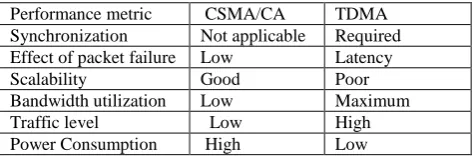
Table 1: CSMAand TDMA Protocols
Performance metric CSMA/CA TDMA Synchronization Not applicable Required Effect of packet failure Low Latency
Scalability Good Poor
Bandwidth utilization Low Maximum
Traffic level Low High
Power Consumption High Low
3.1
Need of AR-MAC Protocol
MAC protocol specifies
Which node in the network needs to talk? How do the nodes formed to talk?
When and how long they are going to be alive?
If there is no MAC protocol then all the nodes try to talk at same time, consequences collision will produced.
3.2
Attributes of a Good MAC Protocol
To design a good MAC protocol for the WSN following attributes are needs to be consideredi.e. Energy efficiency, Latency, Throughput, and Fairness.
3.2.1
Energy Efficiency
The first strategy is energy efficiency. The sensors nodes are battery powered and its s very difficult to change or recharge batteries. Sometimes it’s better to replace them instead of recharge it again and again.
3.2.2
Latency
The second strategy is latency. Latency requirement based on the applications. In the sensor network applications, the detec-tive events must be reported to sink node in real time so that appropriate action could be taken immediately.
3.2.3 Throughput
The third strategy is throughput. Throughput varies with dif-ferent applications. Some network applications need to sample the information with fine temporal resolution. In such network applications it is better than center node receives more data.
3.2.4 Fairness
In many sensor network when bandwidth is limited. It is es-sential to ensure that sink node receive information from all sensor node fairly. Although all over the above aspect energy efficiency and throughput are the major aspects. Energy effi-ciency can be increased by minimizing the energy wastage.
4. MAJOR SOURCES OF ENERGY
WASTES
Major sources of energy sources are of two types in wireless sensor network, idle listening, overhearing, collision, Packet overhead.
4.1 Collision
The first source is collision, when a transmitted packet is cor-rupted due to interference. It has to be discarded and follow on retransmissions increase energy consumptions. Collision increases latency also.
4.2
Overhearing
The second source is overhearing meaning that the node picks up packet that is intended to other node.
4.3 Packet Overhead
The third source is packet overhead sending and receiving control packets use energy too and less useful data can be transmitted.
4.4 Idle listening
reduce the energy waste due to idle listening; overhearing and collision.
5. MAC PROTOCOL DESIGN
CHAL-LENGES
The MAC protocols for the wireless sensors network have to attain two objectives. The first objective is the creation of sensor network transportation. A huge number of sensor nodes are deployed and MAC scheme must establish the communication link among the sensor node. The second ob-jective is to share the communication medium fairly and suc-cessfully.
[image:4.595.58.275.237.414.2]6. CHANNEL SELECTION IN AR-MAC
PROTOCOL
Figure 1. Channel Selection [5]
At the beginning, CN starts scanning for free Radio frequency channel. If Radio frequency channel is busy, CN switches off the current Radio channel and switches on another RF chan-nel. The processes continuous to find until free RF chanchan-nel. Than it spread the channel packet to all the nodes. The CP (Channel Packet) contains information about related to ad-dress of CN and channel information. Equaling to this process nodes scan for free RF channel, if it is busy they wait for Con-tention period of Time (Tcp) to listen for CP. If CP is not re-ceived node switch off the current RF channel and switch on the next RF channel. When nodes accept all CP fruitfully, it sends an ACKNOWLEDGMENT packet to Central Node (CN) as you can see in figure 1.
6.1 Frame Format in AR-MAC Protocol
Proposed AR MAC uses two types of packets data packets and control packets. In data packets sensor nodes send its periodic data in allocated time slot [5]. For emergency data, node uses CAP control packets are.
1. Channel packet (CP): after channel selection cen-tral node advertises channel information and its unique address in channel packet.
2. Time slot request RSR packet: sensor node sends information to central node for guaranteed time slot assignment in time slot request packet.
3. Time slot request reply TSRR packet: central node sends GUARANTED TIME slots information with CAP information to node in time slot request reply packet.
4. Synchronization – acknowledgment (SYNC- ACK) packet: for synchronization, central node
sends the required drift value to end node with ACK of previously received data packet in synchroniza-tion packet.
5. Data request DR packet: for on demand traffic in-formation central node sends data request packet to end node.
6. Acknowledgment (ACK) packet: each data packet is acknowledged using acknowledgment packet.
6.2 Pseudo Code for Synchronization
CN needs synchronization for communicate efficiently with assigned time slots to every node. After N number of cycles synchronization helps to consume energy consumption. With-in expected timeslot, CN listen for data packet.
CN compare
1. 1) CAT of packet 2) EAT with delay
2. DV = CAT – EAT (related to ACK to adjust time for future)
3. If Difference> D
4. CN send DV with SYC-ACK for future synchronization.
5. Else
6. CN sends simple ACK for received data packet
7. For communication of data in future.
8. Sensor node adjusts Wake up time schedule.
9. According to DV
10. A node goes to sleep mode (without losing synchroniza-tion).
7.
CONCLUSION
We use MATLAB simulator to compare and measure energy efficiency of the AR-MAC protocol. In energy consumption comparisons energy consumption of RF transceiver is consi-dered. Assign time slots to every sensor node to overcome packet drop ratio.GTS for communication, Synchronization mechanism are used to reduce collision and overhearing. Drift value is calculated for future Synchronize ACKNOWLEDG-MENT. Increase in energy consumption is due to extra energy requirement of CSMA/CA technique in IEEE standard 802.15.4.To minimize energy consumption wakeup and sleep mechanism play an important role.To maximize network life time of all node energy consumption needs to be balanced. Nodes prepared with less residual should decrease their ener-gy consumption. By doing simulation we will purpose a new protocol that will have all these features and functions, more energy efficient. So, that network life time will improve.
8.
RESULTS
By doing the comparison of IEEE 802.15.4 standard, AR-MAC protocol, assign time slots to sensor nodes for commu-nication to overcome the packet drop ratio. Within that stabili-ty of prolonging life time of a network will be improved as well as delay, throughput, and packet loss ratio.
9.
FUTURE TRENDS
10.
ACKNOWLEDGMENTS
A special thank goes to Mr. Mateen Yaqoob, who is most responsible for helping me to complete the writing of this dissertation as well as challenging research that lies behind it.
11.
REFRENCES
[1] Ahmad, A; Latif, K.; Javaid, N.; Khan, A.; Qasim. U: “Density controlled divide-and-rule scheme for energy efficient routing in Wireless Sensor Networks”, in proc. of 26th Annual IEEE Canadian Conference, pp. 1-4, 5-8 May 2013
[2] Puccinelli, D.Haenggi, M,”Wireless sensor networks: applications and challenges of ubiquitous sensing”, IEEE Magazine Circuits and Systems, Vol. 5 Issue No 3, pp.19–31, 2005.
[3] M. M. Alam, O. Berder, D. Menard, and O. Sentieys, “Latency energy optimized mac protocol for body sensor networks”, in proc. of the 9th International Conference on Wearable and Implantable Body Sensor Networks (BSN ’12), pp. 67–72, 2012.
[4] W. Ye, J. Heidemann, and D. Estrin, “An energy-efficient mac protocol for wireless sensor networks,” in Proc. of IEEE Infocom, pp. 1567–1576, 2002.
[5] N. Javaid,A. Ahmad,A. Rahim, Z. A. Khan, M. Ishfaq, and U. Qasim “Adaptive Medium Access Control Proto-col for Wireless Body Area Networks”, International Journal of Distributed Sensor Networks, Volume 2014.
[6] Chiara Buratti, ”Performance Analysis of IEEE 802.15.4Beacon-Enabled Mode”, IEEE Transactions on Vehicular Technology, Vol. 59, No. 4, pp. 2031-2045, May 2010.
[7] O. Omeni, A. C. W. Wong, A. J. Burdett, and C. Touma-zou,“ Energy efficient medium access protocol for wire-less medical body area sensor networks,” IEEE Transac-tions on Biomedical Circuits and Systems, Vol. 2 No.4, pp.251–259,2008
[8] Buratti. C; Verdone. R:”Performance Analysis of IEEE 802.15.4Non Beacon-Enabled Mode,” IEEE Transac-tions on Vehicular Technology, Vol. 58 No. 7, pp. 3480-3493, 2009.
[9] F. Timmons and Scanlon, W.G., “Analysis of the Per-formance of IEEE 802.15.4 for Medical Sensor Body Area Networking”, In Proc. of First Annual IEEE Com-munications Society Conference on Sensor and Ad Hoc Communications and Networks, pp. 16-24, 2004.
[10] Z. Abbas, N. Javaid, M. A. Khan, S. Ahmed, U. Qa-sim, Z. A. Khan: “Simulation Analysis of IEEE 802.15.4.Non-beacon Mode at Varying Data Rates”, In Proc. of Seventh International Conference on Broadband, Wireless Computing, Communication and Applications (BWCCA), pp. 46-52, August 2012.
[11] ChungsuSuh, Young-Bae, and Dong- Minson, ”Energy Efficient Cross-Layer MAC Protocol for Wireless Sensor Networks”, Advanced Web and Network Technologies, and Applications, Vol. 3842,pp. 410-419, 2006.
[12] T. N. Qureshi, N. Javaid, M. Malik, U. Qasim, Z. A. Khan: “On Performance Evaluation of Variants of DEEC in WSNs”, In Proc. of Seventh International Conference on Broadband, Wireless Computing, Communication and Applications (BWCCA), 2012.
[13] Parul Bakaraniya, Sheetal Mehta,”K-LEACH: An im-proved LEACH protocol for lifetime improvement in WSN”, International Journal of Engineering Trends and Technology (IJETT), Vol. 4 No 5, May 2013.
[14] H. Li and J. Tan, “An ultra-low-power medium access control protocol for body sensor network,” in Proc. of 27th Annual International Conference on Eng. Med. Bi-ol. Soc, pp. 2451–2454, 2005.
![Figure 1. Channel Selection [5]](https://thumb-us.123doks.com/thumbv2/123dok_us/8027334.767743/4.595.58.275.237.414/figure-channel-selection.webp)
