ISSN 2250-3153
Comparison Dissecting Techniques in Thoracoscopic
Surgeries
KB Galketiya1, MVG Pinto2, BAM Premadasa2, AHMAH Abayasinghe2, GWGDD Galahawela2, RAA Shaminda3, NR Kumarasinghe3, H Sunanda3, AS Samarasinghe3, LAK Samarasekara3
1
Department of Surgery, Faculty of Medicine, University of Peradeniya
2
Department of Aneasthesiology, Faculty of Medicine, University of Peradeniya
3
Teaching Hospital Peradeniya
Abstract- The morbidity of thoracotomy or median sternotomy can be minimized by thoracoscopy whilst providing a clear vision for a precise dissection. One of the challenges of the new learning curve set is tissue dissection and haemostasis specially in complex procedures. .
The methods available are blunt, scissor, diathermy and ultra-sonic dissections. Blunt cannot be used in complex procedures. Out of the energy sources ultrasonic dissector is more effective as it provides haemostasis and dissection but is more costly. Selective usage of ultra-sonic dissector will allow re-using the ultra-sonic dissector probes, done in developing countries to reduce cost. We have evaluated the use of energy sources in a combined and selective manner to increase the efficacy and to reduce cost in seventy seven patients undergoing a wide range of procedures. The duration of surgery, blood loss and successful completion without conversions were assessed. In minor ablative procedures (sympathectomy and splanchnicectomy) monopolar diathermy was the preferred technique of dissection.
In complex dissections (oesophagectomy, retrosternal goiter, thymectomy and lymph node dissection) ultra-sonic dissector with bipolar assist was preferred as it allowed quicker dissection. Using bipolar as a haemostatic adjunct allows better haemostasis and more cost effective as it increases the usage time of the ultra-sonic dissector.
In lung biopsy ultrasonic dissector provided adequate tissue sealing to prevent gas leaks.
Index Terms Cost, Dissecting techniques,Thoracoscopy,Ultara- sonic dissector
I. INTRODUCTION
Diagnostic and therapeutic procedures of the thorax are done via thoracotomy or median sternotomy. The trauma of access causes a
significant morbidity. In thoracotomy there is division of muscles and in some cases excision of part of rib. Sternotomy involves
splitting the sternum. Subsequently strong retraction is necessary. Opening and closing takes time. The post-operative pain is
significant and will affect breathing. This will lead to prolonged ventilatory support, hence an extended intensive or high dependency
care. Due to poor respiratory effort and coughing chances of respiratory infections is higher.1There is a risk of wound infections.
Wound dehiscence specially in sternotomy may have disastrous outcome. 2,3,4,6 The hospital stay will be prolonged with delay to report
for work.5The morbidity of open access will be taken away by minimal access surgery;thoracoscopy. 7,8,9,10,11 An added advantage
will be a clear display of anatomy. The image is magnified and it is possible to get a closer view of the anatomy by zooming in.
However it involves a new learning curve. Lack of tactile sensation and difficulties of hand eye coordination will be challenges.
Obtaining space for dissection and methods of dissection haemostasis should be worked out. 9,10,11,20 Specimen retrieval should be
planned. Initial cost of equipment poses problems to the institute.
One of the challenges which is tissue dissection and haemostasis was evaluated in this study.
combined with a haemostatic adjunct, best being bipolar diathermy16,21. Monopolar diathermy provides a precise dissection but is less
haemostatic17,21. Compared to these methods ultrasonic dissector is more effective as it provides haemostasis and dissection but is
more costly13,14,15,18,19,21. Bipolar diathermy can be used for additional haemostasis along with the ultra-sonic dissector14,21. Using
bipolar diathermy along with ultra-sonic dissector may allow better haemostasis and longer usage of ultrasonic dissector probes21..
Reusing the ultra-sonic dissector probes, done in developing countries is cost-effective as the probes are expensive21.
Table 1 - Comparison of the techniques of dissection and the cost21.
The cost shown for monopolar diathermy and ultrasonic dissector are those for the working instrument only, which has a wear and
tear, specially for more costly ultrasonic probes. The diathermy machine and the ultrasonic dissector machines cost about 3 million
LKR but are long durable.
An evaluation was done of the efficacy of ultra-sonic dissector for tissue dissection in comparison with scissor and monopolar
diathermy. This evaluation is important as selective use of ultra-sonic dissector is more cost effective.
II.PATIENTS AND METHODS
An analysis was done on the usage of ultra-sonic dissector comparing that of scissor and monopolar diathermy in a wide range of
procedures. The time of dissection and blood loss were evaluated. The procedures performed were oesophagectomy, thoracic lymph
node biopsy, thymectomy, resection of retrosternal goiter, thoracic sympathectomy, splanchnicectomy and lung biopsy. Technique Quality of dissection Haemostasis Cost of instrument
Blunt Limited Nil Low
Scissor Precise and quick Nil 120,000 LKR
Monopolar
diathermy
Precise and quick Minimal 50,000 LKR
Ultrasonic
dissector
Precise and
intermediate
Provides ; depend on
vessel size
ISSN 2250-3153
III.RESULTS
[image:3.612.174.438.169.368.2]A total number of seventy seven patients underwent thoracoscopic procedures (Table 2)
Table 2-Procedure and number of patients
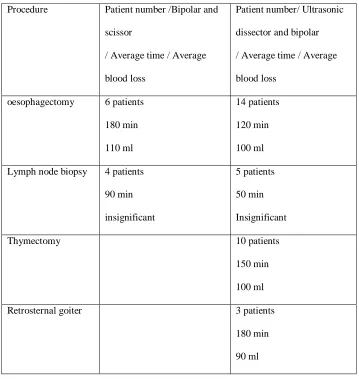
Table 3- Dissecting techniques, duration, blood loss in oesophagectomy, Lymph node biopsy, Thymectomy and retrosternal goiter.
Procedure Number of patients
oesophagectomy 20
Lymph node biopsy 09
Thymectomy 10
Retrosternal goitre 03
Thoracic symphathectomy 10
splachnicectomy 14
Table 4 - Dissecting techniques, duration, blood loss in sympathectomy, splanchnicectomy and lung biopsy
Procedure Patient number /Bipolar and
scissor
/ Average time / Average
blood loss
Patient number/ Ultrasonic
dissector and bipolar
/ Average time / Average
blood loss
oesophagectomy 6 patients
180 min
110 ml
14 patients
120 min
100 ml
Lymph node biopsy 4 patients
90 min
insignificant
5 patients
50 min
Insignificant
Thymectomy 10 patients
150 min
100 ml
Retrosternal goiter 3 patients
180 min
90 ml
Procedure Number of patients equipment
/ Dissecting / Average time /
Number of patients /
ISSN 2250-3153
IV.DISCUSSION
Prior to availability of ultra-sonic dissector, bipolar diathermy and scissor were used to dissect in oesophagectomy and lymph node
biopsy, which were the initial thoracoscopic procedure done in our unit. Once ultrasonic dissector was available the dissections were
performed using this and bipolar diathermy. The time of dissection was less for ultra-sonic dissector and bipolar compared to bipolar
and scissor with comparable blood loss. Using ultra-sonic dissector with bipolar diathermy to assist haemostasis allows better
haemostasis and reduces the usage time of ultra-sonic dissector which is cost-effective.
With this observation thymectomy and retro-sternal goiter were performed using ultra-sonic dissector with bipolar assistance. For
larger veins; azygous and thymic clips were used.
Sympathectomy and splanchnicectomy involves opening of mediastinal pleura and ablation of nerve trunks. The initial ablative Average blood loss Average time /
Average blood loss
Thoracic sympathectomy 2 patients
Ultrasonic dissector and
monopolar diathermy
50 min
Blood loss- not measurable
8 patients
Monopolar diathermy
45 min
Blood loss- not measurable
Splanchnicectomy (bilateral) 14 patients
Monopolar diathermy
25 min/ per side
Blood loss- not measurable
Lung biopsy 11 patients
Ultrasonic dissector and
scissor
10 min
procedure doesn’t involve dissecting any vascular tissues after the first two patients all sympathectomies and splanchnicectomies were
done with monopolar diathermy which can also be done quicker than ultra-sonic dissector.
In lung biopsy a small sample of lung tissue is obtained from the surface of lung. This was done using ultrasonic dissector to seal off
lung parenchyma and then divide with scissor. The sealing with ultra-sonic dissector was adequate to prevent gas leaks.
V. CONCLUSION
In minor ablative procedures (sympathectomy and splanchnicectomy) monopolar diathermy was the preferred technique of dissection.
In complex dissections(oesophagectomy, retrosternal goiter, thymectomy and lymph node dissection) ultra-sonic dissector with
bipolar assist was preferred as it allowed quicker dissection. Using bipolar as a haemostatic adjunct allows better haemostasis and
more cost effective as it increases the usage time of th ultra-sonic dissector
In lung biopsy ultrasonic dissector provided adequate tissue sealing to prevent gas leaks.
REFERENCES
1. Findik G, Gezer S, Sirmali M, Turut H, Aydogdu K, Tastepe I, Karaoglanoglu N, Kaya S. Thoracotomies in children.Pediatr Surg Int. 2008 Jun;24(6):721-5.
2. Cohen M, Yaniv Y, Weiss J, Greif J, Gur E, Wertheym E, Shafir R.s Median sternotomy wound complication: the effect of reconst ruction on lung function. Ann Plast Surg. 1997 Jul;39(1):36-43.
3. Grmoljez PF, Barner HH, Willman VL, Kaiser GC. Major complications of median sternotomy. Am J Surg. 1975 Dec;130(6):679-81.
4. Yuen JC, Zhou AT, Serafin D, Georgiade GS. Long-term sequelae following median sternotomy wound infection and flap reconstruction. Ann Plast Surg. 1995 Dec;35(6):585-9.
5. McKenna RJ Jr, Benditt JO, DeCamp M, Deschamps C, Kaiser L, Lee SM, Mohsenifar Z,Piantadosi S, Ramsey S, Reilly J, Utz J J Safety and efficacy of median sternotomy versus video-assisted thoracic surgery for lung volume reduction surgery. Thorac Cardiovasc Surg. 2004 May;127(5):1350-60. 6. Zacharias A, Habib RH. Factors predisposing to median sternotomy complications. Deep vs superficial infection. Chest. 1996 Nov;110(5):1173-8. 7. Mark T jones, Hooper TL Video assisted thoracic surgery in introduction to Minimal Access Surgery BMJ publishing group 1995;62-64 8. Cusheri Alfred, Steele RJC Surgical craft and technology in Essential surgical practice 4th ed Arnold 1995;45
9. Dapri G, Himpens J, Cadière GB. Robot-assisted thoracoscopic esophagectomy with the patient in the prone position. J Laparoendosc Adv Surg Tech A. 2006 Jun;16(3):278-85.
10. Shibasaki H, Kinoshita T, Ogata A, Miyazaki M. Thoracoscopic esophagectomy in the prone position.DestroHepatogastroenterology. 2012 Sep;59(118):1840-3
11. Rückert JC, Gellert K, Einhäupl K, Müller JM Thoracoscopic thymectomy for treatment of myasthenia gravis Zentralbl Chir. 1998 ;123(5):506-11. 12. Fujioka S, Yoshida K, Okamoto T, Yanaga K. Stapleless laparoscopic splenectomy using harmonic scalpel by 2- step sealing. Int Surg 2013; 98(4):385-7 13. A. Cuschieri. A, Shimi. S, Banting S and Vander Velpen. G, Endoscopic ultrasonic dissection for thoracoscopic and laparoscopic surgery, Operative
Techniques in Otolaryngology-Head and Neck Surgery, 1993; 19(1):59-66.
14. David S. Leonard and Conrad Timon, Evaluation of the ultracision ultrasonic dissector in head and neck surgery, Journal of society of lapendoscopic surgeons, 1998;2(3): 221–225.
15. P. A. Sutton, S. Awad, A. C. Perkins and D. N. Lobo, Comparison of lateral thermal spread using monopolar and bipolar diather my, the Harmonic ScalpelTM and the LigasureTM, British Journal of Surgery, 2010;97: 428–433
16. Hye-Yon Cho, Kong-JuChoi,Young-LanLee,KylieHae-Jin Chang, Hong-Bae Kim, and Sung-Ho Park, , Comparison of Two Bipolar Systems in Laparoscopic Hysterectomy,Journal of society of lapendoscopic surgeons, 2012;16(3): 456–460.
17. Ibrahim Alkatout, ThoralfSchollmeyer, Nusrat A. Hawaldar, Nidhi Sharma, and Liselotte Mettler, Principles and Safety Measures of Electrosurgery in Laparoscopy,Journal of society of lapendoscopic surgeons, 2012;16(1): 130–139.
18. Theodore Diamantis , Michael Kontos , AntoniosArvelakis , SpiridonSyroukis , DimitrisKoronarchis , ApostolosPapalois , Emmanu el Agapitos , Elias Bastounis , and Andreas C. Lazaris, Comparison of Monopolar Electrocoagulation, Bipolar Electrocoagulation, Ultracision, and Ligasure, Surgery Today, 2006;36:908–913
19. Mario Morino, Roberto Rimonda, Marco EttoreAllaix, Giuseppe Giraudo, and CorradoGarrone, Ultrasonic Versus Standard Electric Dissection in Laparoscopic Colorectal Surgery, Annals of Surgery, 2005;242(6): 897–901
20. ,K.B.Galketiya, V.Pinto and S.M.Bandara, Thoracoscopy: beyond the key hole,The Sri Lanka Journal of Surgery 2014; 32(1): 29-34
21. Galketiya KB, Pinto MVG, Kumarasinghe N, Shaminda RAA, Abayasinghe AHMAH, Premadasa BAM, Galahawela GWGDD. Comparison of Ultra-Sonic Dissector with Scissor and Monopolar Diathermy in Complex Laparoscopic surgeris for Tissue Dissection and hemostasis.IAIM,201 5;2(10):22-27.
AUTHORS
First Author – KB Galketiya, Department of Surgery, Faculty of Medicine, University of Peradeniya, Sri Lanaka
ISSN 2250-3153
Third Author – BAM Premadasa, Department of Anaesthesiology, Faculty of Medicine, University of Peradeniya, Sri Lanaka
Fourth Author - AHMAH Abayasinghe, Department of Anaesthesiology, Faculty of Medicine, University of Peradeniya,Sri Lanaka [email protected]
Fifth Author - GWGDD Galahawela,Department of Anaesthesiology, Faculty of Medicine, University of Peradeniya,Sri Lanaka [email protected]
Sixth Author - RAA Shaminda, Teaching Hospital Peradeniya, Sri Lanaka [email protected]
Seventh Author- NR Kumarasinghe, Teaching Hospital Peradeniya,Sri Lanka [email protected]
Eighth Author – H Sunanda, Teaching Hospital Peradeniya,Sri Lanka [email protected]
Ninth Author - AS Samarasinghe, Teaching Hospital Peradeniya,Sri Lanka [email protected]
Tenth Author - LAK Samarasekara, Teaching Hospital Peradeniya,Sri Lanka [email protected]
Correspondence Author –