© 2017, IRJET | Impact Factor value: 5.181 | ISO 9001:2008 Certified Journal
| Page 131
MULTI-OBJECTIVE ECONOMIC EMISSION DISPATCH USING BAT
ALGORITHM WITH MULTIPLE LOADS
G. Ravi Kumar
1,B. Sasikala
21
Professor,
Bapatla Engineering College, Bapatla
2
PG Scholar,
Bapatla Engineering College, Bapatla
---***---
Abstract—
The main aim of power utilities is to providehigh quality power supply to the consumer at lowest possible cost and minimum emission while operating to meet the limits and constraints imposed on the generating units. The combustion of fossil fuel gives rise to particular material and gaseous pollutants apart from the discharge of heat to water courses as by-products. Several contaminants, such as Sulphur oxides, nitrogen oxides and carbon dioxide show destructive effects on human life. In the Multi-objective problem formulation, there is minimum emission dispatch for in operating strategy, which can ensure minimum pollution level at minimum operating cost. The economic and emission dispatch problem with multiple loads has been addressed in this paper using Bat algorithm with weighting method. In the experimental study, Bat algorithm is analysed and demonstrated on standard IEEE 30 bus system consisting of six generating units.
Keywords - Economic Emission Dispatch, Emission
Dispatch, Multi-Objective Optimization, Bat algorithm, Weighting Method.
1. INTRODUCTION
Economic emission dispatch (EED) has become an essential function in operation and control of modern power system and it is a sub problem of an optimal power flow. The main aim of the economic emission dispatch problem is to find an optimal combination of the output power of all the online generating units that minimize the total fuel cost and reduction of pollution level up to a safe limit of the generation and supplies the power demand while satisfying unit constraints, equality and inequality constraints [1]. The major part of the power is generated due to the fossil fired plants and hence their emission contribution cannot be ignored. Fossil fired electric power plants use coal, oil, gas as primary energy resources and produce atmospheric emission whose nature and quantity depend upon fuel type and its quality. The particulate matter such as ash and gaseous pollutant i.e. CO2, NOX (oxides of nitrogen) etc. are produced due to coal. Hence it is a needed to reduce the emission from there fossil fired plants either by design or by operational strategies [2]. In classical Economic Load Dispatch (ELD) problem, mathematical model of fuel cost function has been approximated as a single quadratic cost function [3]. A
number of conventional optimization techniques have been applied to solve the EED problem such as linear Programming (LP) [4], nonlinear programming (NLP) [5], quadratic programming (QP) [6], and interior point methods [7]. Although these conventional techniques offer good results but when the search space is non-linear and has discontinuities they become very complicated with a slow convergence ratio and sometimes unable to find the optimal solution. To overcome these difficulties new numerical methods are needed which have high speed search to the global optima and does not suffer from the problem of local minima [8]. In the recent years the soft computing techniques such as Genetic algorithm (GA) [9], Evolutionary programming (EP), Simulated annealing (SA), Tabu search (TS) technique, Particle Swarm Optimization (PSO) [10-11-12] etc. may prove to be very effective in solving nonlinear EED problems.
In this paper a bio inspired optimization, i.e., BAT algorithm is proposed to solve economic dispatch problems is presented and the effectiveness of proposed algorithm is tested using six generating unit test systems with different loads. As a novel feature, bat algorithm (BA) was based on the echolocation features of micro bats (Yang, 2010), and BA uses a frequency-tuning technique to increase the diversity of the solutions in the population, while at the same, it uses the automatic zooming to try to balance exploration and exploitation during the search process by mimicking the variations of pulse emission rates and loudness of bats when searching for prey. As a result, it proves to be very efficient with a typical quick start. Obviously, there is room for improvement. This bat algorithm method is extended to the economic emission dispatch problems. A big advantage BA has over other algorithms is that it has a number of tuneable parameters giving a greater control over the optimization process. BA and its variants have also been used to solve the ELD problem [13–15]. It has proven efficient in for lower dimensional optimization problem but ineffective for high dimensional problems because of fast initial convergence.
2. MULTI-OBJECTIVE OPTIMIZATION PROBLEM
FORMULATION
In the multi objective problem formulation, four important non commensurable objectives in an electrical thermal
© 2017, IRJET | Impact Factor value: 5.181 | ISO 9001:2008 Certified Journal
| Page 132
emission and emission are considered. The
Multiobjective optimization problem is defined as
Minimize ∑ Rs/h (1)
Minimize ∑ kg/h (2)
Minimize ∑ kg/h (3)
Minimize ∑ ) kg/h (4)
Subjected to ∑ (5)
Where
, and are cost coefficients of theith generating unit
, and are emission coefficients
and are emission coefficients
and are emission coefficients
is the power demand to be met
is the transmission losses, Which are approximated in terms of B-coefficients as
∑ ∑ (6)
is the lower operating generation limit
is the upper operating generation limit
N is the number of generators in the power system (P), (P), (P) and (P) are the objective functions to be minimized over the set of admissible decision vector P. To generate the non-inferior solution to the multi-objective problem, the weighing method is applied. In this method, the problem converted into a scalar optimization as given below:
Minimize ∑ (7)
Subjected to ∑ (8)
∑ (9)
Where M is the number of objectives
are levels of normalized weights.
This approach yields meaningful result to the decision maker when solved many times for different values
Weighing factors are determined
based on the relative importance of various objectives, which may vary from place to place and utility to utility.
© 2017, IRJET | Impact Factor value: 5.181 | ISO 9001:2008 Certified Journal
| Page 133
4. DESCRIPTION OF THE TEST SYSTEM
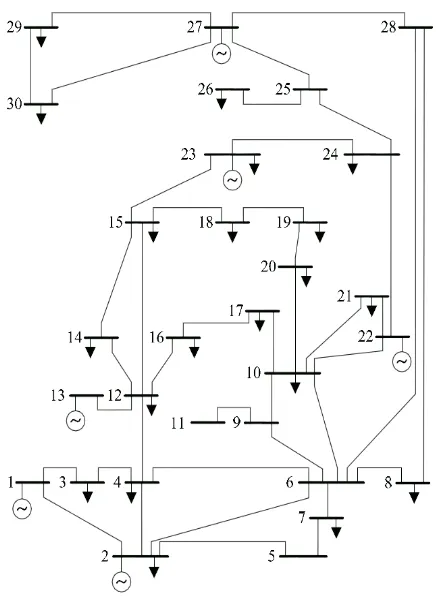
[image:3.595.55.273.173.471.2]In the study of experiment, Bat algorithm is tested over standard IEEE 30-bus power system with six generating units as shown in figure 1.
Fig 1: Single Line Diagram of IEEE 30-Bus Test System
The algorithm is tested for load demand 1800MW, 2000MW and 2200MW. The coefficients of Economic Emission Dispatch problem and transmission loss coefficients matrix are taken from Power System Optimization(D.P. Kothari and J.S. Dhillon) Text Book.
The transmission loss coefficients matrix is given by equation
the fuel cost, emission, emission and emission coefficients are given in Table1.
Table1: coefficients of fuel cost, emission
5. RESULT AND DISCUSSION
Here the Multi-objective Economic Emission Dispatch problem with different loads is solved by using Bat algorithm for the standard IEEE 30-bus power system. A
Systematic variation of the will generate non-inferior
solution. Combination of weights is given in Table2 and
Generation scheduling with all load demands
corresponding to the weights are given in Table 3 to
5.power loss with all loads are given in Table6. Fuel cost ,
emission , emission and emission with
all loads are given in Table 7 to 9.
Table2: Combination of weights
S No 1 2 3 4 5 6 7 8 9 10 1.0 0.0 0.0 0.0 0.2 0.4 0.6 0.1 0.1 0.2 0.0 1.0 0.0 0.0 0.2 0.4 0.2 0.1 0.6 0.0 0.0 0.0 1.0 0.0 0.2 0.1 0.1 0.6 0 0.2 0.0 0.0 0.0 1.0 0.4 0.1 0.1 0.2 0.3 0.6
0.0020 8.432 85.6348 0.0038 6.410 303.778 0.0021 7.428 847.148 0.0013 8.301 274.224 0.0021 7.428 847.148 0.0059 6.915 202.025
0.0063 -0.381 80.901 0.0064 -0.790 28.824 0.0031 -1.360 324.177 0.0063 -2.399 610.253 0.0031 -1.360 324.177 0.0061 -0.390 50.380
0.0012 5.059 51.377 0.0023 3.846 182.26 0.0012 4.456 508.52 0.0008 4.976 165.34 0.0012 4.456 508.52 0.0035 4.149 121.21
© 2017, IRJET | Impact Factor value: 5.181 | ISO 9001:2008 Certified Journal
| Page 134
Table3:Generation scheduling with 1800(MW) Load demand
Table4: Generation scheduling with 2000(MW) Load demand
Table5: Generation scheduling with 2200(MW) Load demand
Table6: Power Loss with all Load demands
Table7: Economic and emission cost with 1800(MW) Load demand
Table8: Economic and emission cost with 2000(MW) Load demand.
Table9: Economic and emission cost with 2200(MW) Load demand
5. CONCLUSION
© 2017, IRJET | Impact Factor value: 5.181 | ISO 9001:2008 Certified Journal
| Page 135
formulated as multi objective economic dispatch problem with consisting fuel cost and environmental impact objectives. The results show that the method is efficient for solving multi objective economic and emission dispatch problem with different loads.
REFERENCES
[1] A.J. Wood, B.F. Wollenberg, Power Generation, Operation and Control, Wiley Interscience, Newyork, 1996.
[2] Baskar S, Subbaraj P, Rao MVC (2002). Hybrid genetic algorithm solution to emission and economic dispatch problems, J. Inst. Eng.,(India), 82: 243-249.
[3] A.J. Wood and B.F. Wollenberg, “Power generation operation and control” John Wiley and Sons, New York 1984.
[4] B. Sttot and J. L. Marinho, “Linear programming for power system network security applications” IEEE Trans. Power Apparat. Syst. vol. PAS-98, pp. 837-848, May/June 1979.
[5] M. Huneault, and F. D. Galiana, “A survey of the optimal power flow literature” IEEE Trans. Power Systems, vol. 6, no. 2, pp. 762-770, May 1991.
[6] J. Wood and B. F. Wollenberg, Power Generation, Operation, and Control, 2nd ed. New York: Wiley, 1984.
[7] J. A. Momoh and J. Z. Zhu, “Improved interior point method for OPF problems” IEEE Trans. Power Syst., vol. 14, pp. 1114-1120, Aug.1999.
[8] G.B. Sheble and K. Brittig, "Refined genetic algorithm-economic dispatch example,” IEEE Paper 94 WM 199-0 PWRS, presented at the IEEE/PES 1994 Winter Meeting.
[9] Balamurugan R, Subramanian S (2008). A Simplified Recursive Approach to Combined Economic Emission Dispatch, Electric Power Components and Systems, 36(1): 17-27.
[10] D.C. Walters and G.B. Sheble, "Genetic algorithm solution of economic dispatch with valve point .
[11] M.A. Abido, Multiobjective evolutionary algorithms for electric power dispatch problem, IEEE Trans. Evol. Comput. 10 (3) (2006) 315–329.
[12] R.Balamurugan and S.Subramanian, “Self Adaptive Differential Evolution Based Power Economic Dispatch of Generators with Valve Point Effects and Multiple Fuel Options”, International Journal Of Computer Science And Engineering ,Vol. 1, No. 1, 2007, ISSN 1307-3699, pp. 10-17.
[13]. Sidi-Bel-Abbes, A. Economic dispatch problem using bat algorithm. Leonardo J. Sci. 2014, 24, 75–84.
[14]. Niknam, T.; Azizipanah-Abarghooee, R.; Zare, M.; Bahmani-Firouzi, B. Reserve constrained dynamic environmental/economic dispatch: A new multiobjective self-adaptive learning bat algorithm. Syst. J. IEEE 2012, 7, 763–776.
[15]. Ramesh, B.; Chandra Jagan Mohan, V.; Veera Reddy, V.C. Application of bat algorithm for combined economic load and emission dispatch. Int. J. Electr. Eng. Telecommun. 2013, 2, 1–9.
BIOGRAPHIES
Goli Ravikumar graduated from Andhra
University College of Engineering,
Visakhapatnam, India in 1993 and received M.Tech and PhD from Jawaharlal Nehru Technology Jawaharlal Nehru Technology university college of Engineering, Kakinada, India in 2007 and 2014.Presently working as Professor In electrical and electronics Engineering at Bapatla Engineering college.
B.Sasikala pursuing under post graduation in Electrical and Electronics Engineering from
Bapatla Engineering College, Bapatla