126
Copyright © 2018. IJEMR. All Rights Reserved.
Volume-8, Issue-4, August 2018
International Journal of Engineering and Management Research
Page Number: 126-130
DOI: doi.org/10.31033/ijemr.8.4.15
The Impact of Signal Strength over Routing Protocols in Wireless
Networks
Dr. Reem Jafar Ismail
Assistant Professor, Department of Computer Science, Cihan University-Erbil, ERBIL-IRAQ
Corresponding Author: [email protected]
ABSTRACT
In ad hoc routing protocols the source node may need an intermediate nodes to transmit the packets into the destination if the destination is not within transmission range of the source. This paper studies the impact of signal strength of nodes over ad hoc routing protocols and explains an important effect of signal strength on ad hoc routing protocols in four different directions including the routes and the nodes. As a result the study give an important improvement in ad hoc routing protocols when using signal strength compared to other ad hoc routing protocols without considering signal strength.
Keywords-- Signal strength, Ad hoc routing protocol, Link reliability, Route optimization, Routing metric
I.
INTRODUCTION
Ad hoc network has many mobile nodes that are moved without specific topology this makes failure when sending packets in ad hoc routing protocols. One of the important parameters that has been considered in ad hoc routing protocols is signal strength of the nodes in ad hoc network. Many applications of ad hoc networks are based on signal strength like: real time communication, security and wireless sensor networks.
The following sections of the paper is organized as follows. Section 2 describes related work, section 3 provides a detailed explanation of four important effect of signal strength on ad hoc routing protocols and finally, section 4 gives the conclusions of the study.
II.
ELATED WORKS
Signal strength in ad hoc networks has been used as metric in ad hoc routing protocols. In [1], Min-Gu and Sunggu lee proposed a route selection based on
differentiated signal strength (DSS). DSS indicates whether the nodes are getting closer or getting farther apart. If the signal strength is getting stronger, the link is considered to be stable and if the signal strength is getting weaker in case of node moving away it is considered to be unstable link.
According to [2] the route discovery for the intermediate nodes use one parameters in order to replay for the node that send the packet which is the signal strength of the node that send the packet where it must be more than threshold value.
In [3] the route discovery for the intermediate nodes use two parameters in order to replay for the node that send the packet:
The first is the signal strength of the node that send the packet where it must be more than threshold value.
The second is the energy level of the node that send the packet where it must be more than threshold value.
III.
SIGNAL STRENGTH IN WIRELESS
AD HOC ROUTING PROTOCOL
In wireless ad hoc routing protocols the signal strength is important to be considered in routing since it effect on the rout discovery of nodes in the network. According to the importance of signal strength we recognize two main used of it related to the link between node or the nodes itself. The following sections will describe signal strength implementation in ad hoc routing protocol.
3.1 Route Optimization
127
Copyright © 2018. IJEMR. All Rights Reserved.
important mechanisms in DSR are Route Discovery and Route Maintenance. Nodes discover and maintain routes through the network using these mechanisms [4].
In route discovery phase, flooding of control packets produces significant traffic load, wastage of bandwidth and increase the number of collisions. In case of high mobility and intensive topology changes flooding can provoke broadcasting storm.
the proposed cross-layer ad hoc routing protocol the search space in route discovery phase is optimized by selecting partial neighbor nodes of the transmitting node instead of selecting all neighbor nodes for broadcasting ROUTE REQUEST messages according to the signal strength of nodes [5]..
Then the procedure of Route Discovery Phase will be:
Read the signal strength from the ROUTE REQUEST message packet format that is send by the sender node.
If Signal strength="low" or Signal strength="very low" or Signal strength="excellent"
Then Drop ROUTE REQUEST Message Else Forward ROUTE REQUEST Message End If
Where the proposed protocol discards the following neighbor nodes order to obtain reliable link:
The neighbor nodes that have excellent signal strength are too close to the transmitting node.
The neighbor nodes that have low and very low signal strength are too far to the transmitting node.
The routing protocol need to have a new ROUTE REQUEST message option format is constructed by adding the "Signal Strength of the current Node" field in it, as shown in figure (1).
Figure 1. The New ROUTE REQUEST Message Option Format
As a result, the optimized flooding percentage is reduced to 22% -34% when compared to DSR routing protocol. This percentage depends on the total number of nodes in ad hoc network and the current topology of the nodes which have different arrangement across the network with different signal strength compared to the transmitting node [5].
3.2 Routing Metric
Signal strength parameter has been used as link quality metrics in many routing protocols for wireless networks.
Punnoose et al. [6] convert the signal strength into a link quality factor, which is then used to assign weights to the links. For a route consisting of M hops, the link quality factor of the route is estimated as L:
∏ ( (( ) )) …(1)
where Q(x) is the standard Q-function, is
the theoretically predicted power received by the ith node from the (i - 1)th node, is the receiving threshold and σ
is the variance of signal variations, which are assumed to be normally distributed.
The link quality factor is the product of probabilities computed for each hop that at a certain time in the future the signal level will be above the receiving threshold. The theoretically predicted power is calculated as follows: using linear position extrapolation based on the input data from GPS positioning and velocity information, estimates for the positions of all nodes one second in the future are calculated. These positions, along with some propagation model are used to obtain, while the default values for the variance of signal is σ = 6 dB and for the receiving threshold = 60 dBm [6].
3.3 Indicator of Link Reliability and Stability
Since the nodes in ad hoc network (MANET) is mobile that makes topology constantly changing so the
nodes that are selected as route nodes are not stable and have a high mobility, data transmission route is broken quickly. Therefore, the method can be considered in the routing that from the nodes are between source and destination, nodes that are more stable, are selected as intermediate nodes. In [7] propose a novel routing metric for MANETs that is called Signal Strength Based Reliability (SSBR), by measuring signal strength changes of neighbor nodes, to identify nodes that have a lot of mobility and can cause link failure. Thus, we don't select them as route nodes. Advantage of this scheme is by selecting reliable nodes we can create a stable route that it has long lifetime.
Ad hoc On-demand Distance Vector Routing (AODV) [8, 9, 10]. The Ad-hoc On-Demand Distance Vector protocol is a very simple, efficient and effective routing protocol for mobile Ad-hoc networks which do not have fixed topology. All the node in the network will be a router and the routes are obtained, which makes the Option Type Opt. Data Len ID Target Address Signal Strength of the
Node
128
Copyright © 2018. IJEMR. All Rights Reserved.
network specified its structure. In this protocol the routing will be on demand and does not require to obtain it periodically by using the available bandwidth that will be less compared to other protocols.
This protocol uses sequence number counter that is maintained and increased by each node. The route discovery process needs a route-request message (RREQ) and this RREQ will be broadcasted to all other nodes in the network. When the node has discovered a valid route to the destination, it replies with a route-reply (RREP) message. The destination node uses the reverse route entry in its routing table starting from the last node, which contains the number of hops to source node, address of the source node, and the address of the node from which it receives
the message i.e. the next hop’s address. Coping up with dynamic topology and broken links: When the nodes in the network move from their places and the topology is changed or the links in the active path are broken, the intermediate node that discovers this link breakage propagates an RERR packet and the source node starts the path discovery again if it still desires the route. This ensures quick response to broken links that happen in routing.
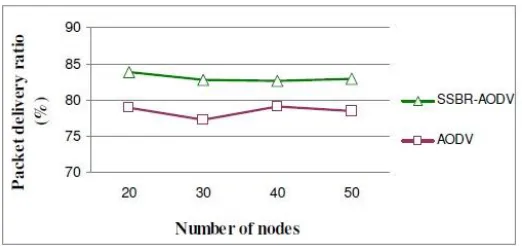
SSBR schema is used in AODV, leading to SSBR-AODV as a result routing control overhead is decreased and packet delivery ratio is increased compared to number of nodes in the networks as shown in figure 2 and figure 3, respectively [7].
Figure 2. Routing control overhead vs. number of nodes
Figure 3. Packet delivery ratio vs. number of nodes
3.4 Localize the Unknown Node
Signal strength in ad hoc networks can be used as a parameter to measure distance between nodes in ad hoc networks. In ad hoc routing protocol the connectivity of the network will depend on available received signal strength (RSS) measurements and a predefined RSS threshold to find the location of the node.
129
Copyright © 2018. IJEMR. All Rights Reserved.
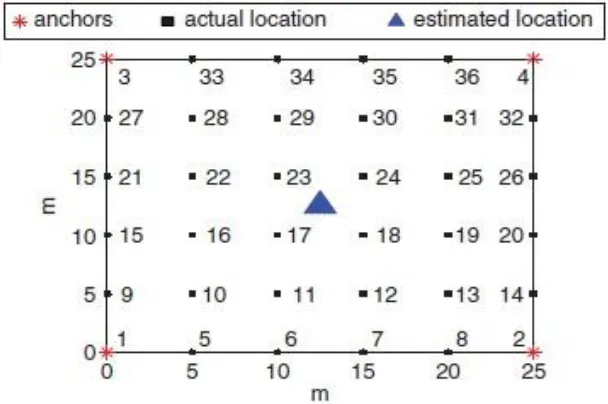
Figure 4. Performance of DV-HOP in practical environment
In order to localize unknown node in DV-HOP must the network must be fully connected in which all nodes can reach each other via a direct link and all unknown nodes are 1-hop away from all anchors.
In [13] proposed a formula to determined the signal strength threshold RSSth to ensure that all the nodes
in the network are connected means that every node in the network is within the radio range of every other node, where:
if RSS < RSSth (not connected)
if RSS ≥ RSSth (connected)
The formula is derived as a function of the total number of nodes and the network size.
IV.
CONCLUSION
The signal strength for the nodes in wireless networks is important as indicator in route as optimization and metric, and in nodes as stability and connectivity. The performance of standard wireless routing protocols like, DSR are increased when signal strength is consider as a parameter in routing.
As a result the routing in wireless network had prevented link breakages and routing failure so the packet delivery increased.
REFERENCES
[1] Lee, M.-G. & Lee, S. (2006). A link stability model
and stable routing for mobile ad-hoc networks. In
Embedded and Ubiquitous Computing: International
Conference, EUC, Seoul, Korea, 904–913.
[2] Nitin Manjhi & Nilesh Patel. (2012). Signal strength
based route selection in MANETs. International Journal
of Computer Science and Telecommunications, 3(7), 27-30.
[3] P. Srinivasan & K. Kamalakkannan (2012). Signal strength and energy aware reliable route discovery in
MANET. International Journal of Communication
Network Security, 1(4), 55-59.
[4] C. Li, X. Wang, L. Yang, & W.-P. Zhu. (2011). Joint sourceand-relay power allocation in multiple-input multiple-output amplify-and-forward relay systems: A nonconvex problem and its solution. IET Signal Processing, 5(6), 612–622,
[5] Reem Jafar Ismail & Dr. Hilal Al-Qurashi. (2010). Development of cross-layer ad hoc routing protocol.
Department of computer science, University of
Technology, Iraq, Ph. D dissertation.
[6] Georgios et al. (2006). Routing metrics for Wireless
Mesh Networks. chapter, Computer Engineering and
Networks Laboratory. Available at:
https://pdfs.semanticscholar.org/2f01/32fd549cbe4fdb0556 50e2b0516caeadcdbf.pdf.
[7] Yaser Taj & Karim Faez. (2010). Signal strength based
reliability: A novel routing metric in MANETs. Second
International Conference on Networks Security, Wireless Communications and Trusted Computing, 37-40. DOI: 10.1109/NSWCTC.2010.17.
[8] Nikhil Kumar, Vishant Kumar, & Nitin Kumar. (2014). Comparative study of reactive routing protocols AODV and DSR for mobile ad hoc networks. International
Journal of Computer Science and Information
Technologies, 5(5), 6888-6891.
130
Copyright © 2018. IJEMR. All Rights Reserved.
[10] Neetendra Singh Dhakad & Anjana Goen. (2016). Review on routing protocols of mobile ad-hoc network MANET. International Journal of Advanced Research in Electrical, Electronics and Instrumentation Engineering, 5(4), 2785-2790. DOI:10.15662/IJAREEIE.2016.0504116.
[11] Ming Jiang et al. (2015). An advanced DV-HOP localization algorithm in wireless sensor network. International Journal of Control and Automation, 8(3), 405-422.
[12] Huamin Yang, Qi Wang & Zhuang Liu. (2013). A wireless sensor network DV-Hop localization algorithm. International Conference on Information Science and Computer Applications (ISCA 2013), 281-286.
[13] N.A.M. Maung & M. Kawai. (2014). Experimental evaluations of RSS threshold based optimised DV-HOP
localisation for wireless ad-hoc networks. Electronics