S. Swathi et al, International Journal of Computer Science and Mobile Applications,
Vol.2 Issue. 11, November- 2014, pg. 115-124
ISSN: 2321-8363
©2014, IJCSMA All Rights Reserved, www.ijcsma.com 115
Analysis and Comparison of Different Image
Denoising Techniques- Review
S. Swathi *
1,
V.Magudeeswaran *
2*1PG Scholar, Department of Electronics and Communication Engineering,
PSNA college of Engineering and Technology, Dindigul -624619, India.
*2Assistant Professor, Department of Electronics and Communication Engineering, PSNA college of Engineering and Technology,
Dindigul -624619, India. [email protected]
Abstract
Image denoising is the process of recovering the underlying clean image from an observation that has been corrupted by various noises. Due to the fact that image quality is critical for later high-level applications (e.g., object detection), denoising is a very popular topic in the image processing field. This paper presents the comprehensive study that serves as a good reference and stimulates new research ideas in image denoising
Keywords: Linear and non linear filter, spatial wiener filter, median filter, Bilateral filter, Trilateral filter
Introduction
Denoising is the process of reconstructing the original image by removing unwanted noise from a corrupted image. It is designed to suppress the noise, while preserving as many image structures and details as possible. The term noise in digital image processing is referred to any quantity that deflects an observed pixel from its raw value. Observed images can be easily corrupted by various noises in the process of acquisition or transmission. On the other hand, universal noise removal has always been a difficult problem. This is because the noises corrupting an image could be of various forms, such as additive Gaussian noise, impulse noise or multiplicative noise, with different characteristics [1-5].
S. Swathi et al, International Journal of Computer Science and Mobile Applications,
Vol.2 Issue. 11, November- 2014, pg. 115-124
ISSN: 2321-8363
©2014, IJCSMA All Rights Reserved, www.ijcsma.com 116
The spatial Wiener filter [21] is one of the classical linear filtering, and is known to be the optimal estimator for the true underlying image. However, as a linear and shift invariant filter scheme, Wiener filter is often assumed to be unsuitable for images containing edges and details. In order to deal with edges and details in images, the Perona– Malik anisotropic diffusion (PMAD) image denoising method was proposed by Perona and Malik in 1990 [9].Bilateral filter (BF) [19] proposed by Tomasi and Manducci is another significant nonlinear filtering algorithm. BF uses local information of an image to identify detailed components and then smooth them less than the other components of the image. Moreover, this approach is simple, non iterative and local [19] and [15]. One of the most limitations of BF is that the range filter coefficients rely heavily on pixel intensity values. Furthermore, BF does not consider edge information, and thus cannot balance the effects of noise removal and edge preservation. Several algorithms of BF have been proposed to address visual details and smooth the rest regions as much as possible [5], [2], [6], [8] and [11]. On the other hand, BF is a class of Gaussian noise removal methods with parameters which are usually determined by trial and error in practice. Fixed parameters may not be well suited for noise removal and edge preservation for all regions within an image. In [11], Zhang et al. proposed that a good range for the standard deviation of the domain filter is rough [1.5–2.1], and the optimal standard deviation of the range filter changes importantly as the noise standard deviation changes. Yang et al. utilizes particle swarm optimization (PSO) algorithm to adjust the parameter of BF [7]. However, it does not explain the details about how to choose the fitness function and the parameter values of PSO. Above all, there are seldom theoretical insights into the problem of how to obtain the optimal values for the parameters of BF.
Another type of noise often corrupting an image is impulse noise, which replaces the values of a portion of pixel with random values. Such noise will exist in an image due to transmission errors [20]. Median filter can remove impulse
noise to a certain extent, with some of its improved alternatives better preserving edge and
details [16], [12], [13], [3] and [9].
Trilateral filter (TF) [14] and switching bilateral filter (SBF) [10] are also two notable filters on the basis of BF for removing mixed noise in gray images. TF computes the rank-order absolute difference (ROAD) statistics for impulse noise detection. SBF proposed the sorted quadrant median vector (SQMV) scheme for detecting impulse noise, and the range filter inside the BF switches between Gaussian and impulse noise relying on the noise classification results.
Methods and Materials
Filtering in an image processing is a process that cleans up appearances and allows for selective highlighting of specific information. The choice of filter is determined by the nature of the task performed by filter and behaviour and type of the data. Filters are used to remove noise from digital image while keeping the details of image preserved is an necessary part of image processing.
Linear and non linear filter
Linear filter
S. Swathi et al, International Journal of Computer Science and Mobile Applications,
Vol.2 Issue. 11, November- 2014, pg. 115-124
ISSN: 2321-8363
©2014, IJCSMA All Rights Reserved, www.ijcsma.com 117
image. A serious problem with image convolution is the enormous number of calculations that need to be performed,
often resulting in unacceptably long execution times
.
Non-linear filter
Nonlinear filter is a filter whose output is not a linear function of its input. That is, if the filter outputs signals R and S for two input signals r and s separately, but does not always output αR + βS when the input is a linear combination αr + βs.
Nonlinear filters have quite different behavior compared to linear filters. For nonlinear filters, the filter output or response of the filter does not obey the principles outlined earlier, particularly scaling and shift invariance. Moreover, a nonlinear filter can produce results that vary in a non-intuitive manner.
The simplest nonlinear filter to consider is the median or rank-order filter. In the median filter, filter output depends on the ordering of input values, usually ranked from smallest to largest or vice versa. A filter support range with an odd number of values is used, making it easy to select the output.
For example, suppose a filter was based on five values. In the region of interest, x0..x4, the values are ordered from smallest to largest. The value at position 2 is selected as the output. Consider the case at low frequency; all the values are the same or close to it. In this case, the value selected will be the original value ± some small error. In the case of high frequency, such as an edge, the values on one side of the edge will be low and the values on the other side will be high. When the ordering is done, the low values will still be in the low position and the high values will still be in the high position. A selection of the middle value will either be on the low side or the high side, but not in the middle, as would be the case using a linear low-pass filter. The median filter is sometimes called an edge-preserving filter due to this property. It is useful in removing outliers such as impulse noise.
However, nonlinear filters are considerably harder to use and design than linear ones, because the most powerful mathematical tools of signal analysis (such as the impulse response and the frequency response) cannot be used on them. Thus, for example, linear filters are often used to remove noise and distortion that was created by nonlinear processes, simply because the proper non-linear filter would be too hard to design and construct
.
Spatial wiener filter
The Wiener filter is the MSE-optimal stationary linear filter for images degraded by additive noise and blurring. Calculation of the Wiener filter requires the assumption that the signal and noise process are second order stationary.For this description, only noise processes with zero mean will be considered (this is without loss of generality).Wiener filters are usually applied in the frequency domain. Given a degraded image x(n,m), one takes the Discrete Fourier Transform (DFT) to obtain X(u,v). The original image spectrum is estimated by taking the product of X(u,v) with the Wiener filter G(u,v):
S. Swathi et al, International Journal of Computer Science and Mobile Applications,
Vol.2 Issue. 11, November- 2014, pg. 115-124
ISSN: 2321-8363
©2014, IJCSMA All Rights Reserved, www.ijcsma.com 118
The Fourier domain of the Wiener filter is
Where H(u,v) fourier transform of the point-spread function, Ps (u,v) power spectrum of the signal process, obtained by taking the fourier transform of the signal auto correlation and Pn(u,v) power spectrum of the noise process, obtained by taking the fourier transform of the noise auto correlation.
Figure.1 Example of Wiener filtering
Figure 1 shows a simulation result of wiener filter. The small test image has very strong high-frequency components, so the Wiener filter leaves lots of residual noise. If the test image, which is 64x64, is centered in a 256x256 empty image, the relative power of those high-frequency components is diminished by the large amounts of empty space. The Wiener filter then elects to attenuate high-frequency components to reduce noise in the empty regions. This results in blurring over the small 64x64 sub image.
Wiener filters are comparatively slow to apply, since they require working in the frequency domain. To speed up filtering, one can take the inverse FFT of the Wiener filter G(u,v) to obtain an impulse response g(n,m). This impulse response can be truncated spatially to produce a convolution mask. The spatially truncated Wiener filter is inferior to the frequency domain version, but may be much faster.
Median Filter
The median filter is a nonlinear digital filtering technique, often used to remove noise. Such noise reduction is a typical pre-processing step to improve the results of later processing (for example, edge detection on an image). Median filtering is very widely used in digital image processing because, under certain conditions, it preserves edges while removing noise
.
S. Swathi et al, International Journal of Computer Science and Mobile Applications,
Vol.2 Issue. 11, November- 2014, pg. 115-124
ISSN: 2321-8363
©2014, IJCSMA All Rights Reserved, www.ijcsma.com 119
Algorithm of Median Filter
:
Step 1. Select a two dimensional window W of size 3*3. Assume hat the pixel being processed is Cx,y. Step 2. Compute Wmed the median of the pixel values in window W.
Step 3. Replace Cx,y by Wmed.
Step 4. Repeat steps 1 to 3 until all the pixels in the entire image are process
General Definition of median filter is
This can be computed as follows: Let I be a monochrome (1-band) image.
1. Let Z define a neighborhood of arbitrary shape. 2. At each pixel location, p = (r,c), in I
3. select the n pixels in the Z-neighborhood of p,
4. sort the n pixels in the neighborhood of p, by, value into a list L(j) for j=1,n 5. The output value at p is L(m), where
By calculating the median value of a neighborhood rather than the mean filter, the median filter has two main advantages over the mean filter:
The median is a more robust average than the mean and so a single very unrepresentative pixel in a neighborhood will not affect the median value significantly.
Since the median value must actually be the value of one of the pixels in the neighborhood, the median filter does not create new unrealistic pixel values when the filter straddles an edge. For this reason the median filter is much better at preserving sharp edges than the mean filter.
Bilateral Filter
A bilateral filter is a non-linear, edge-preserving and noise-reducing smoothing filter for images. The intensity value at each pixel in an image is replaced by a weighted average of intensity values from nearby pixels. This weight can be based on a Gaussian distribution. Crucially, the weights depend not only on Euclidean distance of pixels, but also on the radiometric differences (e.g. range differences, such as color intensity, depth distance, etc.). This preserves sharp edges by systematically looping through each pixel and adjusting weights to the adjacent pixels accordingly.
The bilateral filter is defined as
where the normalization term
ensures that the filter preserves image energy and
is the filtered image
S. Swathi et al, International Journal of Computer Science and Mobile Applications,
Vol.2 Issue. 11, November- 2014, pg. 115-124
ISSN: 2321-8363
©2014, IJCSMA All Rights Reserved, www.ijcsma.com 120
are the coordinates of the current pixel to be filtered is the window centered in
is the range kernel for smoothing differences in intensities. This function can be a Gaussian function is the spatial kernel for smoothing differences in coordinates. This function can be a Gaussian function
Bilateral filtering has gained great popularity in image processing due to its capability of reducing noise while preserving the structural information of an image. The bilateral filter consists of two components. The detail-preserving property of the filter is mainly caused by the nonlinear filter component also called photometric filter. It selects the pixe ls of similar intensity which are averaged by the linear component afterward. Very often, the linear component is formulated as a low-pass filter. The amount of noise reduction via selective averaging and the amount of the blurring via low-pass filtering are both adjusted by two parameters.
The understanding of these parameters is very intuitive, which leverages the bilateral filter to an almost all-purpose solution in image processing. In the noise filtering, despite the prevailing view, not always implies resolution reduction but can even be used to sharpen the edges or to enhance the flow like structures. The motion-adaptive bilateral filter is used for quality improvement in low bit rate video coding. The bilateral filter is applied for noise reduction in a method for local tone mapping which maps high dynamic range image to low dynamic range image. Recently, bilateral filtering has gained a high awareness level in medical image processing and nondestructive testing.
The impact of noise reduction by the bilateral filter applied to the reconstructed images. They concluded that the images processed with this filter show a significant improvement in image quality compared to their unfiltered counter parts. The results of noise reduction by the bilateral filter in projection space. This means that the noise filtering takes place prior to computing the reconstructed volume. It has been concluded that noise reduction of this kind can be translated into a dose reduction in X-ray computed tomography. Considering industrial applications, the dose reduction permits the reduction of the scanning time and thus allows a higher throughput of test items. As the reduction of the exposure time due to filtering is feasible, we are interested in a real-time filtering of projections.
Trilateral filter
The trilateral filter was introduced as a means to reduce impulse noise in images. The principles of the filter were based on the bilateral filter, which is an edge-preserving Gaussian filter. The trilateral filter was extended to be a gradient-preserving filter, including the local image gradient (signal plane) in the filtering process. Figure demonstrates this process using a geometric sketch. This filter has the added benefit that it requires only one user-set parameter (the starting bilateral filter size), and the rest are self tuning to the image
.
S. Swathi et al, International Journal of Computer Science and Mobile Applications,
Vol.2 Issue. 11, November- 2014, pg. 115-124
ISSN: 2321-8363
©2014, IJCSMA All Rights Reserved, www.ijcsma.com 121
The trilateral filter is a gradient-preserving" filter. It aims at applying a bilateral filter on the current plane of the image signal. The trilateral case only requires the specification of one parameter . At first, a bilateral filter is applied on the derivatives of f (i.e., the gradients):
…….(2)
To approximate , forward differences are used. For the subsequent second bilateral filter, suggested the
use of the smoothed gradient [instead of ] for estimating an approximating plane.
………..(3)
Let
Furthermore, a neighbourhood function
………(4)
is used for the second weighting. Parameter c specifies the adaptive region and is discussed further below. Finally,
da………..(5)
.
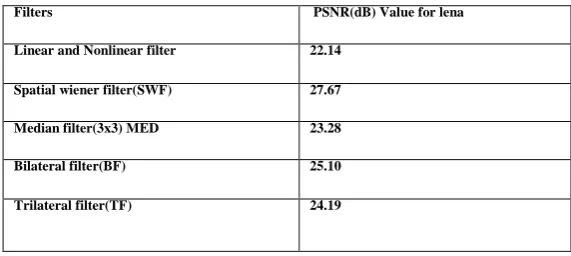
Table - Comparison of Quantitative results in PSNR(dB)
Filters PSNR(dB) Value for lena
Linear and Nonlinear filter 22.14
Spatial wiener filter(SWF) 27.67
Median filter(3x3) MED 23.28
Bilateral filter(BF) 25.10
S. Swathi et al, International Journal of Computer Science and Mobile Applications,
Vol.2 Issue. 11, November- 2014, pg. 115-124
ISSN: 2321-8363
©2014, IJCSMA All Rights Reserved, www.ijcsma.com 122
Results
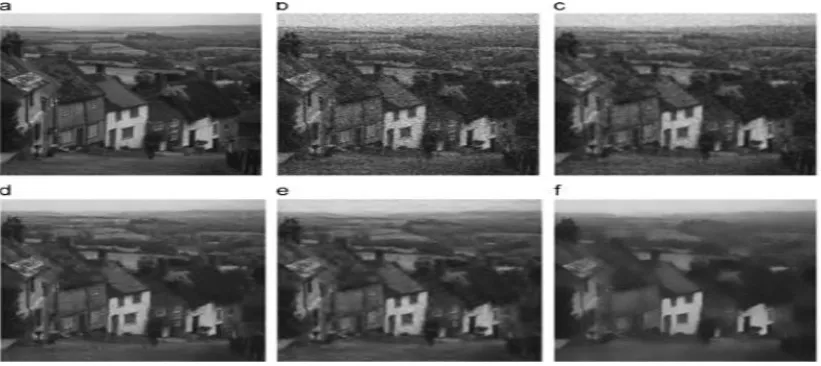
Figure 3 shows the simulation results of various denoising techniques namely Linear and Non linear filter, Spatial wiener filter, Median filter, Bilateral filter and Trilateral filter. Figure 3a) shows the original image without noise. Figure 3b) shows the image with noise added to the original image. This image is corrupted by uniform impulse noise, salt-and-pepper noise, Gaussian noise, and mixed noise with different noise levels separately. Figure 3c) shows the denoising by linear filter in which the value of an output pixel is a linear combination of the input pixel’s neighbourhood but requires long execution time.Figure 3d) shows the denoising by non-linear filter. Filter output depends on the ordering of input values, usually ranked from smallest to largest or vice versa.Nonlinear filter would be too hard to design and construct. Figure 3e)shows the denoising by bilateral filter.The intensity value at each pixel in an image is replaced by a weighted average of intensity values from nearby pixels. Figure 3 f) shows the denoising by trilateral filter. It is a gradient preserving filter.
Figure. 3 shows the simulation results of gold hill image (a) original image,(b)Noisy image,(c)Denoising by linear filter,(d) Denoising by nonlinear filter,(e)Bilateral filter,(f)Trilateral filter
Conclusion
In this paper, we reviewed and compared representative denoising methods both qualitatively and quantitatively. Each method has own advantage and disadvantage. For filtering any image, there are three aspects in image denoising are important that merit our attention. First, the accuracy of the noise detection is a very important factor. Second, the computational efficiency is also an important factor to the denoising filters because in the real-time work, the filters with lower computational efficiency may not obtain the satisfactory results. Finally, large uncertainties exist in the noise. filters provide better performance as compared to other filters based on the criteria of Mean Absolute Error and Mean Square Error. Although all the above filters are either eliminating impulse noise or Gaussian noise, work with either highly corrupted images or low corrupted images
S. Swathi et al, International Journal of Computer Science and Mobile Applications,
Vol.2 Issue. 11, November- 2014, pg. 115-124
ISSN: 2321-8363
©2014, IJCSMA All Rights Reserved, www.ijcsma.com 123
Acknowledgements
We take this opportunity to express our profound gratitude and deep regards to the Management and Principal of PSNA College of Engineering and Technology for encouraging us throughout the project.
References
[1]
L. Shao, R. Yan, X. Li, Y. Liu(2013) “ From heuristic optimization to dictionary learning: a review and comprehensive comparison of image denoising algorithm”, IEEE Trans, Cybern.,http://dx.doi.org/10.1109/ TCYB.2013.2278548.
[2] N. Rajpoot, I.Butt (2012) “A multi resolution framework for local similarity based image denoising”, Pattern Recognit., 45 (8), page(s) :2938–2951.
[3] C. Lu, T.Chou (2012) “Denoising of salt-and-pepper noise corrupted image using modified directional-weighted median filter”, Pattern Recognit. Lett, 33(10), page(s):1287–1295.
[4] R. Yan, L. Shao, S.D. Cvetkovic, J. Klijn (2012)” Improved nonlocal means based on pre-classification an invariant block matching”, IEEE/OSA J. Disp. Technol, 8 ,page(s): 212–218.
[5] H. Yang, X.Wang, T.Qu, Z.Fu (2011) “Image denoising using bilateral filter and Gaussian scale mixtures in shiftable complex directional pyramid domain”, Comput. Electr.Eng, 37(5) , page(s):656–668.
[6] H. Yu, L.Zhao, H.Wang (2011) “An efficient edge-based bilateral filter for restoring real noisy image”, IEEETrans. Consume. Electron, 57(2), page(s):682–686.
[7] W.Yang, C.Kung, C.Kung (2011) “Image enhancement using the multi-scale filter: application of the bilateral filtering scheme and PSO algorithm,in”:Theoretical and Mathematical Foundations of Computer Science, ICTMF 2011, Singapore, Communications in Computer and Information Science (CCIS) 164, page(s): 508-514.
[8] A.DeDecker, J.A.Lee, M.Verleysen (2010) “A principled approach to image denoising with similarity kernels involving patches”, Neurocomputing73(7–9),page(s):1199–1209.
[9] R. Krupiski (2010) “Recursive polynomial weighted median filtering”, Signal Process, 90 (11),page(s):3004–3013.
[10] C. Lin, J.Tsai, C.Chiu (2010) “Switching bilateral filter with a texture/noise detector for universal noise removal”, IEEETrans. ImageProcess, 19(9), page(s):2307–2320.
[11] M. Zhang, B.K. Gunturk (2008), “Multiresolution bilateral filtering for image denoising”, IEEE Trans.ImageProcess, 17(12),page(s):2324–2333.
[12] Y.Dong, S.Xu (2007) “ A new directional weighted median filter for removal of random- valued impulse noise”, IEEE Signal Process.Lett,14(3),page(s):193–196.
S. Swathi et al, International Journal of Computer Science and Mobile Applications,
Vol.2 Issue. 11, November- 2014, pg. 115-124
ISSN: 2321-8363
©2014, IJCSMA All Rights Reserved, www.ijcsma.com 124
[14] R. Garnett, T.Huegerich, C.Chui, W.He (2005) “A universal noise removal algorithm with an impulse detector”, IEEETrans.ImageProcess, 14(11), page(s):1747–1754.
[15] M. Elad (2002) “On the origin of the bilateral filter and ways to improve it”, IEEETrans. Image Process, 11(10), (2002), page(s):1141–1151.
[16] T.Chen, H.R.Wu (2001) “Adaptive impulse detection using center-weighted median filters”, IEEESignalProcess. Lett, 8(1), page(s):1–3.
[17] C. Tomasi , R.Manduchi (1998) “Bilateral filtering for gray and color images”, IEEE International Conference on Computer Vision, Bombay, page(s) :839–846.
[18] S.J. Ko, Y.H. Lee (1991) “Center weighted median filters and their applications to image enhancement”, IEEE Trans. Circuits Syst, 38, page(s):984–993.
[19] P. Perona, J. Malik (1990) “Scale space and edge detection using anisotropic diffusion”, IEEE Trans. Pattern Anal. Mach. Intell, 12 , page(s):629–639.
[20] I. Pitas, A.N.Venetsanopoulos (1990) “Nonlinear digital filters: principles and applications”, Kluwer, Norwell.