Comparison of Content Based Image Retrieval Systems
Based on Various Techniques
Dr. M. Narayana, B. Manikanta, B. Sneha, G. Veeresh
Abstract – Nowadays people are interested in using digital images. So the size of the image database is increasing rapidly. Lot of interest is paid to find images in the database. There is a great need for developing an efficient technique for retrieving the images. In order to find an image, image has to be represented with certain features. Color and texture are two important visual features of an image. This paper proposes that the color feature can be extracted using HSV color space and the texture features can be extracted using grey level cooccurance matrix (GLCM) and Discrete wavelet transformation. In this paper, we have compared different content based image retrieval techniques to achieve good efficiency in the image retrieval.
This comparison has done in between content based image retrieval using HSV color space and GLCM, GLCM and wavelet and the combination of HSV, GLCM and Wavelet. After obtaining all the experimental results, a comparative study was done. From the result, we have found that the CBIR system that uses the combination of all the three techniques gave a better performance as compared to other two methods with an accuracy of 83.95%.
Keywords – CBIR, HSV, Wavelet Transformation, GLCM.
I.
I
NTRODUCTIONThe content based image retrieval system is also known as query by image content. The term contents refer to color, texture, shape or any other information that can be derived from the image itself. Content Based Image Retrieval (CBIR) was proposed to retrieve images based on visual features (contents) of images in substitute for the traditional text based image retrieval, since the linguistic description of image by small number of key words is very limited in comparison to the image contents [2, 9]. The visual contents called as features, are numeric descriptors capturing specific visual characteristics. Text based image retrieval consumes more time when the database is very large[16]. To get around these problems, content based image retrieval system is proposed.
In an image, two features are present, local features and global features. From the literature we came to know that the local features play an important role in finding the similarity of images than global features[15]. So, in this paper, we present a technique for image retrieval based on local features like color and texture. Because these Low level visual features of the images such as color and texture are especially useful to represent and to compare images automatically. Color is a low level feature that gives the visual similarity. This color feature is extracted using HSV Color space [1]. Texture is also an important visual feature that refers to describe repeated patters, surface properties of an object and their relationship to the surrounding environment. Many objects in an image can be distinguished solely by their textures without any other
information [3]. In our techniques, texture features are extracted using gray-level cooccurrence matrix (GLCM) and discrete wavelet transformation.
II.
F
EATURESE
XTRACTIONA. Color extraction
The color feature is extracted from an image by using color space. The most common color space used to extract color from an image is HSV. The HSV color space has three components: hue, saturation and value. It is used to select various different colors needed for a particular picture. It gives the color according to human perception [1, 5, 13]. In HSV, hue represents color. In this model, hue is an angle from 0 degrees to 360 degrees.
Table-2.1: Hue color ranges
Angle Color
0-60 Red
60-120 Yellow 120-180 Green
180-240 Cyan
240-300 Blue
300-360 Magenta
Saturation indicates the range of grey in the color space. Its value ranges from 0 to 1. When the saturation is ’0,’ the color is grey and when the saturation is ’1,’ the color is a primary color. A faded color is due to a lower saturation level, which means the color contains more grey. Value is the brightness of the color and varies with color saturation. Its value is calculated from 0 to 1. When the value is ’0′ the color space will be totally black. With the increase in the value, the color space brightness up and shows various colors.
2.A (1) Non-interval quantization
Because of a large range of each component, if characteristics are directly calculated for retrieval, then computation will be very difficult to ensure rapid retrieval. It is essential to quantify HSV space component to reduce computations and improve its efficiency. At the same time, because the human eye can distinguish only limited colors, there is no need to calculate all segments. H,S,V components are quantized with unequal intervals according to the human color perception.
Copyright © 2015 IJECCE, All right reserved for different values of with different weight to form
one-dimensional feature vector named[6].
G = QSQV H +QV S +V (1) Where QS is quantified series of S, QV is quantified series of V.
Here we set QS =QV =3, then
G = 9H +3S +V (2)
In this way, three-component vector of HSV form one-dimensional vector, which quantize the whole color space for the 72 kinds of main colors [3, 7].So we can handle 72 bins of one-dimensional histogram. This quantification can be effective in reducing the images by the effects of light intensity, but also reducing the computational time and complexity.
B. Extraction of texture feature using GLCM
GLCM is created in four directions with the distance between pixels as one. Texture features are extracted from the statistics of this matrix.[3, 5, 13] The main advantage of GLCM is its Rotation invariance characteristic. Four GLCM texture features are commonly used which are given below: GLCM is composed of the probability value, it is defined by P(i, j |d, θ) which expresses the probability of the couple pixels at θ direction and d interval. When θ
and d is determined, P ( i, j| d, θ ) is showed by Pi, j . Distinctly GLCM is a symmetry matrix; its level is determined by the image gray-level. Elements in the matrix are computed by the equation showed as follow:
P ( i, j| d, θ ) = 𝑝(𝑖,𝑗 |𝑑,θ)
∑∑𝑝(𝑖,𝑗 |𝑑,θ) (3) GLCM expresses the texture feature according the correlation of the couple pixels gray-level at different positions. It quantificationally describes the texture feature.[2, 15] In this paper, texture feature include four properties energy, contrast, entropy, homogeneity.
I. Energy
E=ΣΣ p(x, y)^2 (4) It is a gray-scale image texture measure of homogeneity changing, reflecting the distribution of image grayscale uniformity of weight and texture.
II. Contrast
I=ΣΣ(x-y)^2p(x, y) (5) Contrast is the main diagonal near the moment of inertia, which measure the value of the matrix is distributed and images of local changes in number,
reflecting the image clarity and texture of shadow depth. Contrast is large means texture is deeper.
III. Entropy
S = – ΣΣ p(x, y)log p(x, y) (6) Entropy measures image texture randomness, when the space co-occurrence matrix for all values is equal, it achieved the minimum value; on the other hand, if the value of co-occurrence matrix is very uneven, its value is greater.
Therefore, the maximum entropy implied by the image gray distribution is random.
IV. Homogeneity
H = ∑∑1 𝑝(𝑥,𝑦)
1+(𝑥−𝑦)2 (7) It measures local changes in image texture number. Its value in large is illustrated that image texture between the different regions of the lack of change and partial very evenly. Here p(x, y) is the gray-level value at the coordinate (x, y).
B. Extraction of texture features using wavelet
transformation
Texture is a difficult concept to represent. It can be represented as a statistical measure or as wavelets. Here texture was represented using wavelet coefficients. This was a certain alteration of the method proposed in for texture feature [4, 10]. Mathematically, wavelet transform is a convolution operation, which can equivalent to passing the pixel values of an image through a low pass filter and a high pass filter.
Fig.2.1. wavelet transform
III.
A
RCHITECTURE FOR THEC
ONTENTB
ASEDI
MAGER
ETRIEVALFig.3.1. Architecture for the Content Based Image Retrieval
IV.
S
IMILARITYM
EASUREContent based image retrieval determines visual similarities between query image and images in database. In the three different techniques in this paper, Euclidean distance is used to measure the similarity between the query images and the images in the database[8]. The images with the minimum distance are displayed
Euclidian Distance= ∑ (𝐴𝑖 − 𝐵𝑖)2 (8) Where A is the query image feature and B is the feature of the database image
V.
P
ROPOSEDM
ETHODSIn this paper, three combinations of techniques were proposed. Out of which first combination uses both HSV Color Space and GLCM, second combination uses GLCM and Wavelet transformation and the third combination uses all the three techniques
5.1. Image retrieval using HSV and GLCM
The proposed method is based on HSV and GLCM. In this method color of the query image is extracted using HSV and the texture features are extracted using Grey Level Cooccurance Matrix.
This technique is efficient in color dominating images when compared to the other images.
Implementation of image retrieval using HSV and
GLCM
Step1: Choose a query image from the data base.
Step2: Convert the query image from RGB to HSV color space and extract the HSV(Hue, Saturation, Value) features.
Step3: Quantize the HSV values and a feature vector is constructed.
Step4: From the query image obtain four statistic features (Energy, Contrast, Entropy and inverse difference) from GLCM.
Step5: Construct a combined feature vector for color and texture.
Step6: Extract the same features vectors of the images in the database as the query image.
Step7: Find the distances between feature vector of query image and the feature vectors of target images using normalized Euclidean distance.
Step8: sort the Euclidean distances.
Step9: retrieve first 15 most similar images with minimum distance
5.2 Image Retrieval Using GLCM and Wavelet
Transform
This method is based on GLCM and Wavelet Transformation. GLCM is used to extract the texture features of the image. The four GLCM features are
extracted using GLCM technique. Wavelet
Transformation is mainly used to extract the texture features of the image.[11] Along with the texture features, wavelet transformation gives analyses the image frequency and edges.
Implementation of image retrieval using GLCM and
Wavelet Transformation
Step1: Choose a query image from the data base.
Step2: Convert the query image from RGB to grey and extract the GLCM features (energy, contrast, entropy, homogeneity).
Step3: Extract the wavelet features from the image by using wavelet transformation.
Step4: Extract the same features of the images in the database as the query image.
Step5: Find the distances between features of the query image and the features of target images using normalized Euclidean distance.
Step6: Sort the Euclidean distances.
Step7: Retrieve first 15 most similar images with the minimum distance.
5.3 Image Retrieval using HSV, GLCM and Wavelet
This method uses HSV Color Space, GLCM and Wavelet transformation.HSV color space is used to extract the color features of the image , GLCM is used to extract the four features (Energy contrast, entropy, homogeneity) and wavelet transformation is used to extract the texture features and to detect the edges. All these features are extracted to the images in the database, similarity is measured and the images with the required images are retrieved
Implementation of image retrieval using HSV and
GLCM and Wavelet Transformation
Step1: Choose a query image from the data base.
Copyright © 2015 IJECCE, All right reserved Step3: Quantize the HSV values and a feature vector is
constructed
Step4: From the query image obtain four statistic features (Energy, Contrast, Entropy and inverse difference) from GLCM.
Step5: Construct a combined feature vector for color and texture.
Step6: Convert the RGB image to grey image and extract the wavelet features.
Step7: Extract the same features vectors of the images in the database as the query image.
Step8: Find the distances between feature vector of query image and the feature vectors of target images using normalized Euclidean distance.
Step9: Sort the Euclidean distances.
Step10: Retrieve first 15 most similar images with minimum distance.
VI.
R
ESULT ANDD
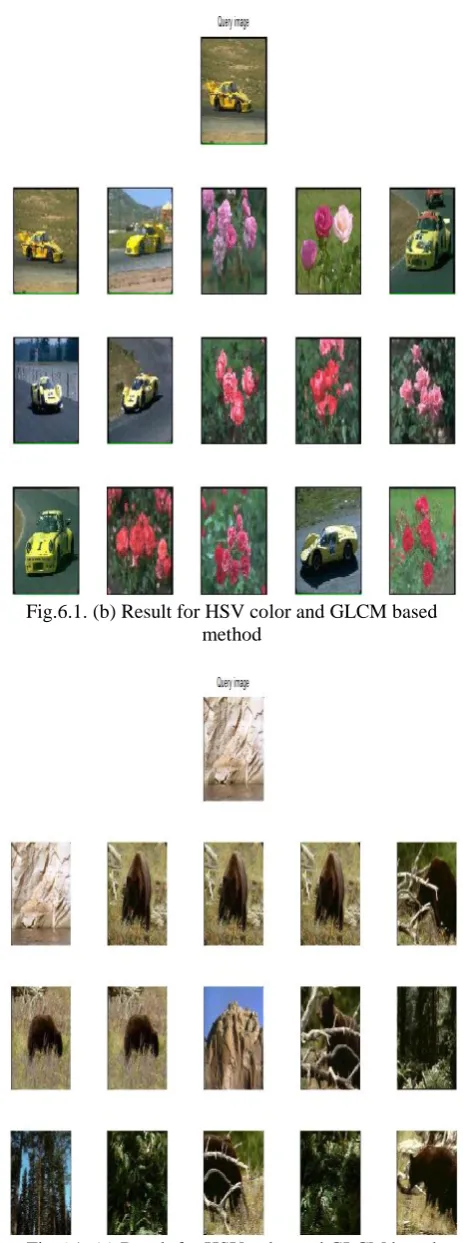
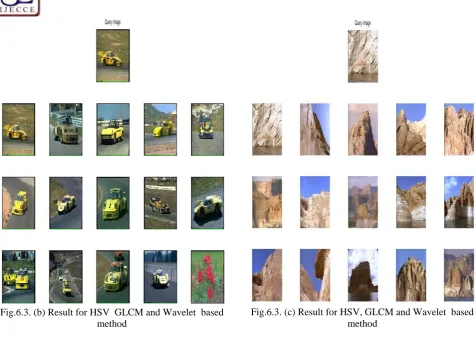
ISCUSSIONFor the proposed methods, a database with eight hundred images is used. The images in the database are classified into different categories namely cars, mountains, flowers, horse and flags etc., each category consists of twenty similar images. The query image is selected from the database and the images are retrieved using the three techniques. The results from the three techniques are analyzed. Out of these images, the results of flowers, cars and mountains are shown below; the top middle of the window shows the query image.
Fig. 6.1. (a) Result for HSV color and GLCM based method.
Fig.6.1. (b) Result for HSV color and GLCM based method
Fig.6.2. (a) Result for GLCM and Wavelet based method
Fig.6.2. (b) Result for GLCM and Wavelet based method
Fig6.2.(c).Result for GLCM and Wavelet based method
Copyright © 2015 IJECCE, All right reserved Fig.6.3. (b) Result for HSV GLCM and Wavelet based
method
Fig.6.3. (c) Result for HSV, GLCM and Wavelet based method
Table 6.1-Precision and Recall of various methods
Images HSV-GLCM GLCM-Wavelet HSV-GLCM-Wavelet
Images Retrieved
Precision Recall Images Retrieved
Precision Recall Images Retrieved
Precision Recall
Dinosaur 15 1 0.75 15 1 0.75 15 1 0.75
Flowers 13 0.86 0.65 14 0.93 0.7 15 1 0.75
Bushes 13 0.86 0.65 10 0.66 0.5 15 1 0.75
Cars 7 0.46 0.35 14 0.93 0.7 14 0.93 0.7
Horse 15 1 0.75 11 0.73 0.55 15 1 0.75
Bear 11 0.73 0.55 14 0.93 0.7 14 0.93 0.7
Ship 15 1 0.75 10 0.66 0.5 15 1 0.75
Flag 15 1 0.75 15 1 0.75 15 1 0.75
Mountain 2 0.133 0.1 7 0.46 0.35 15 1 0.75
Trees 9 0.6 0.45 11 0.73 0.55 11 0.73 0.55
6.1. Performance evaluation
The performance of an image retrieval system is evaluated in terms of its accuracy. Accuracy is the average of precision and the recall values. Precision and Recall values are calculated by using the below formulae. The efficiency of an image retrieval system is maximum when its accuracy is high.
Precision = 𝑛𝑢𝑚𝑏𝑒𝑟 𝑜𝑓 𝑠𝑖𝑚𝑖𝑙𝑎𝑟 𝑖𝑚𝑎𝑔𝑒𝑠 𝑟𝑒𝑡𝑟𝑖𝑒𝑣𝑒𝑑
𝑡𝑜𝑡𝑎𝑙 𝑛𝑢𝑚𝑏𝑒𝑟 𝑜𝑓 𝑖𝑚𝑎𝑔𝑒𝑠 𝑟𝑒𝑡𝑟𝑖𝑒𝑣𝑒𝑑 (9)
Recall= 𝑁𝑢𝑚𝑏𝑒𝑟 𝑜𝑓 𝑠𝑖𝑚𝑖𝑙𝑎𝑟 𝑖𝑚𝑎𝑔𝑒𝑠 𝑅𝑒𝑡𝑟𝑖𝑒𝑣𝑒𝑑
𝑡𝑜𝑡𝑎𝑙 𝑁𝑢𝑚𝑏𝑒𝑟 𝑜𝑓𝑠𝑖𝑚𝑖𝑙𝑎𝑟 𝑖𝑚𝑎𝑔𝑒𝑠 𝑖𝑛 𝑡𝑒 𝑑𝑎𝑡𝑎𝑏𝑎𝑠𝑒 (10)
Accuracy = 𝑃𝑟𝑒𝑐𝑖𝑠𝑖𝑜𝑛 +𝑅𝑒𝑐𝑎𝑙𝑙
2 ×100 (11)
From the result, we can say that the efficiency of the system with the combination of HSV color space, GLCM, and the Wavelet transformation gives the maximum efficiency with an accuracy of 83.95%., where the combination of GLCM gives 70.4% of accuracy and the combination of HSV Color Space and GLCM gives an accuracy of 66.97%.
Table 6.2: Accuracy of various methods
Images Accuracy
HSV-GLCM
GLCM-Wavelet
HSV-GLCM-Wavelet
Dinosaur 87.5 87.5 87.5
Flowers 75.5 81.5 87.5
Bushes 75.5 58.0 87.5
Cars 40.5 81.5 81.5
Bear 64.0 87.5 81.5
Ship 87.5 58.0 87.5
Flag 87.5 87.5 87.5
Mountain 11.65 40.5 87.5
Trees 52.5 64.0 81.5
VII.
C
ONCLUSION ANDF
UTURES
COPEThe main objective of this research is to investigate and evaluate an effective and robust approach for texture representation and to use it in image retrieval. For this purpose, we have investigated the texture analysis using several approaches. Throughout the contrast, the characteristics of the main methods, i.e., discrete wavelet, and GLCM were discussed. The combination of HSV, GLCM and Wavelet has absorbed the advantages of the color feature and wavelet while overcomes the disadvantages of both these methods. From experimental results, the combination of all the features is found to be promising. Finally, we compared the CBIR based on combination of color, GLCM and wavelet performance with that of the existing color and texture based methods and wavelet based methods. This research has found that combination of the three techniques outperformed the individual techniques in both accuracy and efficiency. From all the experimental results, HSV color space and GLCM based search gives an average retrieval accuracy of 66.97%, GLCM and Wavelet based search gives an average retrieval accuracy of 70.4% , Finally the combination of HSV Color Space, GLCM and Wavelet search gives an average retrieval accuracy of 83.95%. Performance of combination based search is better than the GLCM, wavelet and color based search because the combination extracts all the features information more accurately than individual techniques. Therefore, we find the combination of HSV Color Space, GLCM and Wavelet texture descriptor as a powerful means to perform CBIR The content based image retrieval can be further developed to obtain 100% efficiency by using various techniques and by extracting high level features like edges, shapes, curves etc.,[10].
R
EFERENCES[1] Sharma,N., Rawat, P., and Singh,J., Efficient CBIR Using Color Histogram Processing, Signal & Image Processing: An International Journal(SIPIJ) Vol.2, No.1,( March 2011). [2] Dr. M. Narayana, K. Harshini, Content Based Image Retrieval
using singular value decomposition, International Journal of Engineering Innovation & Research Volume 1, Issue 5. [3] Khan,W., Kumar,S., Gupta,N., Khan,N., A Proposed Method for
Image Retrieval using Histogram values and Texture Descriptor Analysis, IJSCE, ISSN: 231-2307, Volume-I Issue-II,( May 2011).
[4] Vadivel, A., Majumdar,A.K., and Sural,S., Image Retrieval using Wavelet Based Texture Features, International Conference on Communications, Devices and Intelligent Systems,( 2004). [5] Ch. Kavitha, and Dr. B. Prabhakara rao, Image Retrieval Based
on Color and Texture Features of the Sub-Blocks, International Journal of Computer Applications , Volume 15– No.7, February 2011
[6] Vadivel, A., .Majumdar, A.K., and Sural,S., Characteristics of Weighted Feature Vector in Content Based Image Retrieval
[7] Suhasini, P.S., Krishna, K.S.R, Krishna, V.M., CBIR Using Color Histogram Processing, Journal Theoretical and Applied Information technology, (NWTIT), page 110-115.
[8] Nachtegaela, M., Wekenb, D. V., Wittea, V. D., Schultea, S., M´elangea, T., Kerrea, E.E., Color Image Retrieval Using Fuzzy Similarity Measures And Fuzzy Partitions, ICIP, IEEE(2007). [9] Ritendra Datta, Dhiraj Joshi, Jia Li, James Z. Wang, Image
retrieval: ideas, influences, and trends of the new age, ACM Computing Surveys 40 (2) (2008) 1–60.
[10] P.V.N. Reddy and K. Satya Prasad, Color and Texture Features For Content Based Image Retrieval, P V N Reddy et al, Int. J. Comp. Tech. Appl., Vol 2 (4), 1016-1020
[11] Khan, W., Kumar,S., Gupta,N., Khan,N., Signature Based Approach For Image Retrieval Using Color Histogram And Wavelet Transform, International Journal of Soft Computing and Engineering (IJSCE), (March 2011).
[12] Ali,A., Murtaza,S., Malik,A.S., Content Based Image Retrieval Using Daubechies Wavelet Transform, Proceedings of the 2nd National Workshop on Trends in Information Technology, (2003).
[13] Rahul Mehta, Color-Texture Based Image RetrievalSystem, International Journal of Computer Applications, volume 24, June 2011
[14] Russ, J.C., The image processing handbook, CRC Press, (1999). [15] Sridhar, Gouri, Color and Texture Based Image Retrieval, ARPN Journal for Systems and Software, volume 2, no.1, January 2012. [16] Dr. M. Narayana, Color Sketch Based Image Retrieval, International Journal of Advanced Research in Electrical, Electronics and Instrumentation Engineering
A
UTHOR'
SP
ROFILEDr. M. Narayana
is a professor and HOD in ECE department at Jaya Prakash Narayan College of Engineering, Mahabubnagar, AP. He received B.Tech. from G.Pullareddy College of Engg, Kurnool, SKU, Anantapur, M.Tech. from JNTUH, Hyderabad, AP, India and received PhD from JNTUA, Anantapur, AP. He has published more than 20 papers in reputed international and national journals. He has sixteen years of experience in teaching undergraduate and post graduate students, his research interests are in the areas of signal and image processing, segmentation, pattern recognition, content based image retrieval, Biometrics and Biomedical Engineering.
Email: [email protected].
Mr. Banuru Manikanta
is pursuing his B.Tech. at Jaya Prakash Narayan College of Engineering, Mahabubnagar, Telangana, India. His research interests include programming languages, electronics and Digital Image Processing.
Email: [email protected]
Ms. B. Sneha
is pursuing her B.Tech. at Jaya Prakash Narayan College Of Engineering, Mahabubnagar, Telangana, India. Her research interests include, electronics, Digital Image Processing.
Email: [email protected]
Mr. G. Veeresh
is pursuing his B.Tech at Jaya Prakash Narayan College Of Engineering, Mahabubnagar, Telangana, India. His research interests include electronics, Digital Image Processing.