An Anonymous and Lightweight Authentication Scheme for Mobile Devices
Kuo-Hui Yeh
The Department of Information Management, National Dong Hwa University, Hualien 974, Taiwan,
e-mail: [email protected]
http://dx.doi.org/10.5755/j01.itc.44.2.8335
Abstract. In this paper, we present a lightweight authentication scheme designed to enable mobile devices to achieve robust client-anonymity and computation efficiency. Instead of the heavy encryption and decryption modules of Elliptic Curve Cryptography (ECC), we adopt the key agreement operation of ECC as the core technique in the proposed anonymous authentication scheme. This eliminates significant computation cost and thus does not exceed the inherent resource-limitations on mobile devices. Security analyses are conducted to guarantee the robustness of the proposed authentication scheme. Moreover, when we implement our proposed scheme, the demo-system we have named AuthDroid, into the Android system, the implementation results demonstrate a practical execution time, e.g. 149.7 microseconds, on an Android-based smartphone, i.e. HTC ONE X, to complete the whole authentication procedure of AuthDroid.
Keywords: Android; Anonymity; Authentication; ECC; Mobile devices; Security.
1. Introduction
With the universalness of intelligent mobile devices (e.g. android phones, i-phones and tablets), myriad value-added services have been developed to benefit consumers and businesses. As mobile users use their mobile devices, the value-added applications often require a public wireless connection to provide full functionality. To support the smooth and effective running of applications it is necessary to design suitable operating systems for intelligent mobile devices such as smartphones and tablets. Among current operating system technologies, iOS [10] and Android [1] are two of the most popular system architectures and lead the way in terms of the successful development of numerous value-added applications for intelligent mobile devices. These two system architectures have stimulated the generation of numerous online application markets all over the world. Recently, a critical challenge for mobile devices revolves around how to resolve the tension between the convenience provided by mobile applications and the data transmission threat to mobile clients. Mobile application services, in general, need to possess specific secure transmission designs. Famous mobile software platforms such as WhatsApp [25], Line [12], Skype [17] and Facebook [7], have embedded lightweight authentication schemes to support secure transmission over the Internet. Without appropriate defense mechanisms, the utilization and
transmission of user information may be insecure against malicious adversaries on the Internet.
In this paper, we describe a secure communication protocol for use among mobile devices (or applications) through a trusted third-party. We assume that the data transmission environment is public and insecure, and each legal communication entity intends to negotiate a session key agreement for secure transmissions among numerous mobile devices with robust client privacy and low computation overhead. The primary goal of this scheme is to prevent sensitive personal information from being disclosed during transmission and to facilitate communication between applications by phone users (or external mobile services). Taking into account the need to find a balance between the resource constraint impinging on mobile devices and the desired level of security, we adopt the key agreement property of ECC in the proposed authentication scheme instead of relying on heavy encryption/decryption modules. In addition, we implement a demo-system, called AuthDroid, on the Android system to demonstrate the feasibility and practicability of our proposed authentication scheme.
2. Related works
As facilities and computers are linked together, primarily via Internet, resources can be easily shared and exploited. Since the authentication protocol was introduced by Lamport [15], a range of authentication protocols have been developed to ensure legitimate access to resources and secure data exchange. In the following section we discuss research which is the most relevant to our study.
Single-sign on (SSO) is a concept of authentication technology that enables each remote user to access multiple services via a single credential in a distributed computer network. In 2010, Chang and Lee [3] presented a SSO based authentication mechanism for a distributed network environment. Based on their proposed security arguments, the robustness of the mechanism seems to be appropriate, however, two attacks, i.e. a user impersonation attack and a credential recovering attack, can be invoked successfully on Chang and Lee’s protocol [23]. Next, Juang et al. [14] proposed a smart card based authenticated key agreement scheme. The authors provided a method to protect user identity during each authentication session. The security of Juang et al.’s mechanism is based on ECC and symmetric cryptosystem. Nevertheless, Sun et al. [18] showed that the security of Juang et al.’s protocol is doubtful and proposed a remedy to eliminate all identified weaknesses. Later, Li et al. [16] demonstrated that Juang et al.’s scheme cannot provide initiator untraceability, and proposed a solution to strengthen the security and efficiency of Juang et al.’s scheme. Unfortunately, Tsai et al. [19] found that Li et al.’s scheme is vulnerable to de-synchronization attack. In addition, the secret update mechanism of Li et al.’s scheme is not well-designed and the scalability of the registration table in thus not efficient. For these
reasons, Tsai et al. demonstrated an anonymous authentication scheme. The distinguishing feature of Tsai et al.’s scheme is that the server does not need to maintain a registration table, which makes the scheme suitable for a large scale of service level. Nevertheless, as Tsai et al.’s protocol is a single server based scheme, the scalability may be limited in multi-server environments.
In 2012, Wang [24] analyzed the trust between a smart card and card reader. The possibility of user compromise attacks was examined in the situation where an adversary possesses a stolen smart card in conjunction with a compromised user password. The authors then presented important findings under multiple kinds of password based schemes and different attacker types. Namely, the security of both the symmetric key based scheme and the public key HMQV-based scheme is limited, , while the public key ID-based scheme (PSCAb) and the public key based scheme with password validation data at server (PSCAV) are both secure. Chen et al. [6] subsequently proposed a password-based authentication scheme without smart cards; unfortunately, the researches [8] and [13] have proved that Chen et al.’s scheme is not secure. Next, several advancements were made by Tsai et al. in recent years, with two group key agreement protocols [20, 22] being developed for mobile architecture and one password-based authentication scheme [21] being proposed for a multi-server environment. Chang et al. [5] next proposed an authentication scheme to resist against user traceability attack. The authors claimed that their scheme could withstand various attacks such as user impersonation attacks, server counterfeit attacks, replay attacks, and password guessing attacks. However, Chang et al.’s scheme is insecure against server counterfeit attacks, user impersonation attacks, and man-in-the-middle attacks. In addition, their scheme cannot provide user-untraceability. In 2013, Huan et al. [9] identified two specific scenarios for password authentication in distributed systems, i.e. (1) adversaries with pre-computed data stored in a smart card, and (2) adversaries with different data (with respect to different time slots) stored in a smart card. Two attacks were shown to be practicable via implementing attacks on the two authentication schemes, and corresponding countermeasures were proposed.
3. The proposed authentication scheme
In this section, we demonstrate our proposed authentication scheme, in which a trusted registration center, RC, is required. The server and RC do not require the maintenance of any registration table for the authentication of each communication entity, including the user or the server. In addition, both the user and the server need to store only one set of public parameters, i.e. {p, Ep, P, PRC, n, h(.), h1(.)} and {p,
RC. Note that RC chooses an elliptic curve Ep over a finite field Zp with a large prime p, and three one-way hash functions h(.), h1(.) and h2(.). Then, RC chooses a generator point P with order n, and computes its private key xRC and its public key PRC= xRC×P. Finally,
RC publishes and shares {p, Ep, P, PRC, n, h(.), h1(.)} and {p, Ep, P, PRC, n, h(.), h2(.)} with the user and the server, individually.
Registration Phase of the service provider Sj: In the
registration phase, the server Sj will receive the parameters {p, Ep, P, PRC, n, h(.), h2(.)} publicized by
RC. In addition, the identity, i.e. SIDj, of Sj is public.
Step1. Sj sends his/her identity SIDj to RC via a secure channel.
Step2. Once obtaining SIDj, RC computes
h(h(SIDj)||yRC), and sends h(h(SIDj)||yRC) to
SIDj via a secure channel, where yRC is the secret generated by RC.
Step3. Now Sj possesses {p, Ep, P, PRC, n, h(.), h2(.)} and h(h(SIDj)||yRC).
Registration Phase of the user Ui: In the registration
phase, the user’s mobile device, such as a tablet or a smart phone, has been configured with public parameters {p, Ep, P, PRC, n, h(.), h1(.)}. When the user Ui wants to register on RC, the following steps are performed.
Step1. Ui inputs his/her password PWi to compute
h(PWi||b), where b is a random number generated by the user’s mobile device. Next,
Ui sends his/her identity IDi and h(PWi||b) to
RC via a secure channel.
Step2. Upon receiving {IDi, h(PWi||b)}, RC
calculates V=h(h(IDi)||zRC)♁h(PWi||b) and sends V to Ui via a secure channel, where zRC
is the secret generated by RC.
Step3. When Ui gets V, Ui stores {V, b} into the user’s mobile device.
Pre-computation Phase: We launch this phase once the session key at the current session is agreed upon successfully. That is, once the session key is established between Ui and Sj, the user’s mobile device will generate a new random number N1 and compute eUi=N1×P and cUi=N1×PRC. After that, {eUi,
cUi, N1} will be stored in the user’s mobile device. Furthermore, the server chooses a random number N3 to compute eSj=N3×P and cSj=N3×PRC, and maintains {eSj, cSj, N3} for the next authentication.
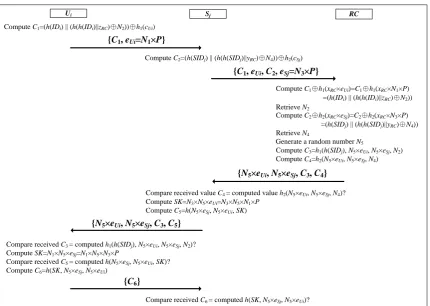
Login Phase (Fig. 1): When Ui wants to access Sj, Ui
searches the public identity SIDj of service provider Sj, and inputs his/her identity IDi and password PWi.
Step1. Ui derives h(h(IDi)||zRC) from V♁h(PWi||b),
and calculates C1=( h(IDi) ||
(h(h(IDi)||zRC)♁N2) ) ♁ h1(cUi), where N2 is a random number. Next, Ui sends {C1, eUi} to Sj
according to the public identity SIDj and the corresponding network address.
Step2. After getting {C1, eUi}, Sj computes C2=(
h(SIDj) || (h(h(SIDj)||yRC)♁N4) ) ♁ h2(cSj) and sends {C1, eUi, C2, eSj} to RC. Note that N4 is a random number.
Step3. Once RC receives {C1, eUi, C2, eSj}, RC performs the following equations.
(1) Derive ( h(IDi) || (h(h(IDi)||zRC)♁N2) ) from
C1♁h1(xRC×eUi)=C1♁h1(xRC×N1×P), where xRC is stored by RC.
(2) Calculate h(h(IDi)||zRC) with h(IDi) derived in (1) and the secret zRC maintained by RC.
(3) Retrieve N2 with h(h(IDi)||zRC) calculated in (2) and (h(h(IDi)||zRC)♁N2) derived in (1).
(4) Derive ( h(SIDj) || (h(h(SIDj)||yRC)♁N4) ) from
C2♁h2(xRC×eSj)=C2♁h2(xRC×N3×P).
(5) Compute h(h(SIDj)||yRC) with h(SIDj) derived in (4) and the secret yRC stored at RC.
(6) Retrieve N4 with h(h(SIDj)||yRC) calculated in (5) and (h(h(SIDj)||yRC)♁N4) derived in (4).
(7) Generate a random number N5.
(8) Calculate N5×eUi=N5×N1×P, N5×eSj=N5×N3×P,
C3=h1(h(SIDj), N5×eUi, N5×eSj, N2), and C4=h2(N5×eUi,
N5×eSj, N4).
(9) Send {N5×eUi, N5×eSj, C3, C4} to Sj.
Step4. Upon obtaining {N5×eUi, N5×eSj, C3, C4}, Sj computesh2(N5×eUi, N5×eSj, N4) and compares the result with the received value C4. If it holds, Sj forwards {N5×eUi, N5×eSj, C3, C5} to
Ui, where SK=N3×N5×eUi=N3×N5×N1×P and
C5=h(N5×eSj, N5×eUi, SK). After that, Ui calculates h1(h(SIDj), N5×eUi, N5×eSj, N2) and compares the result with the received value
C3. If both of these values are equal, Ui computes SK=N1×N5×eSj=N1×N5×N3×P, and verifies C5. If this verification is successful,
Ui performs C6=h(SK, N5×eSj, N5×eUi) and sends it to Sj. Finally, Sj examines the validity of C6. If it holds, the session key SK is successfully agreed upon by Ui and Sj.
4. Security analyses
Ui Sj RC
Compute C1=(h(IDi) || (h(h(IDi)||zRC)♁N2))♁h1(cUi)
{C1, eUi=N1×P}
Compute C2=(h(SIDj) || (h(h(SIDj)||yRC)♁N4))♁h2(cSj)
{C1, eUi, C2, eSj=N3×P}
Compute C1♁h1(xRC×eUi)=C1♁h1(xRC×N1×P)
=(h(IDi) || (h(h(IDi)||zRC)♁N2))
Retrieve N2
Compute C2♁h2(xRC×eSj)=C2♁h2(xRC×N3×P)
=(h(SIDj) || (h(h(SIDj)||yRC)♁N4))
Retrieve N4
Generate a random number N5
Compute C3=h1(h(SIDj), N5×eUi, N5×eSj, N2)
Compute C4=h2(N5×eUi, N5×eSj, N4)
{N5×eUi, N5×eSj, C3, C4}
Compare received value C4 = computed value h2(N5×eUi, N5×eSj, N4)?
{N5×eUi, N5×eSj, C3, C5}
Compute SK=N3×N5×eUi=N3×N5×N1×P
Compute C5=h(N5×eSj, N5×eUi, SK)
Compare received C3 = computed h1(h(SIDj), N5×eUi, N5×eSj, N2)?
Compute SK=N1×N5×eSj=N1×N5×N3×P
Compare received C5 = computed h(N5×eSj, N5×eUi, SK)? Compute C6=h(SK, N5×eSj, N5×eUi)
Compare received C6 = computed h(SK, N5×eSj, N5×eUi)?
{C6}
Figure 1. The proposed authentication scheme
be a legitimate user, service provider or system administrator who is legitimate and verified in our system, and possesses the authorization of some system functionalities. On the other hand, there exists another probabilistic polynomial-time attacker A, who is restricted to delivering messages generated from one of the communicating parties to the other one. In the real world, this kind of attacker can be an outsider who does not have the capability to inject or modify the transmitted messages. Note that an insider without entity verification or function authorization can also be an example of this kind of attacker.
In traditional security verification of
authentication, the random oracle model is widely used to guarantee protocol robustness by showing that an attacker would require impossible behavior from the oracle or would have to solve some mathematical problem believed to be hard. On the other hand, the famous BAN logic technique is always adopted to ensure the mutual authentication property. In this section, we will first show that our proposed scheme is insecure against malicious attackers under the hardness of elliptic curve discrete logarithm. Then, we
present the mutual authentication of our proposed scheme via the BAN logic technique.
Definition. Let E be an elliptic curve over a finite field Fp with a prime order q. Suppose that G is a base point over E(Fp), and a (t, ε)-ECDL attacker in E(Fp) is a probabilistic Turing machine Δ running in a time period t such that Succ𝐺𝐸𝐶𝐷𝐿𝑃(∆) = Pr[∆(𝑎𝐺, 𝑏𝐺) = 𝑎𝑏𝐺] ≥ 𝜀, where the probability is taken over the random values a and b. The Elliptic Curve Discrete Logarithm Problem (ECDLP) is (t, ε)-intractable if there exists no (t, ε)-attacker in E(Fp). The Elliptic Curve Discrete Logarithm Assumption is the case for all polynomial t and any non-negligible ε.
Theorem 1. Let A be an adversary against the Authenticated Key Agreement (AKA) security of our proposed authentication scheme within a time bound t, with less than qs interactions with the communication entities, and asking qh times ℎ(. ), 𝑞ℎ1 times ℎ1(. ) and 𝑞ℎ2 times ℎ2(. ) hash-queries. Then,
Adv𝑃𝐴𝐾𝐴(𝐴) = (
𝑞ℎ2×𝑞ℎ1×2 𝑞ℎ22
(2𝑙+1)(2𝑙1+1)(2𝑙2+1)) + ( 𝑞𝑠2
2𝑘+1) + max [(
𝑞ℎ12 2𝑙1+1) , (
𝑞ℎ22 2𝑙2+1)] + (
3×𝑞ℎ2
2𝑙+1) + 𝑞𝑠× Succ𝐺𝐸𝐶𝐷𝐿𝑃(𝑡′),
where 𝑡′≤ 𝑡 + 𝑞
𝑠× 𝜏𝐺 , and 𝜏𝐺 denotes the
computational time for a multiplication in G with order q.
the games are analyzed, we then derive the possibility (or probability) of compromising our authentication scheme.
Game G0. This is the real attack game in the random oracle models. For any game Gn, we define some events as follows. First, event Enoccurs if b=b′, where
b is the binary bit involved in the Test-query, and b′is the output of the adversary. By this definition, we have
Adv𝑃𝐴𝐾𝐴(𝐴) = 2Pr[𝐸0] − 1. If the adversary has not
stopped playing the game after qsSend-queries lasting for more than time t, the game is terminated and a random bit b′ will be chosen as the output, where qs
and t are predefined upper bounds.
Game G1. In this game, we first simulate three hash oracles:
ℎ(. ): {0, 1}∗→ {0, 1}𝑙, with a hash list Λ ℎ. ℎ1(. ): {0, 1}∗→ {0, 1}l1, with a hash list Λh1.
ℎ2(. ): {0, 1}∗→ {0, 1}𝑙2, with a hash list Λℎ2.
All instances such as Ui and Sj can be simulated to conform to real player behavior, for Send, Execute, Reveal, Corrupt and Test-queries [4, 19]. From this simulation, we can easily see that this game is indistinguishable from a real attack unless the permutation properties of h(. ), h1(. ) andh2(. ) do not
hold. According to the birthday paradox, for example, the probability of collisions happening under h(. )is at most 𝑞ℎ2/2𝑙+1. For the same reason, we have
|Pr[𝐸1] − Pr[𝐸0]| ≤ ( 𝑞ℎ2 2𝑙+1) × (
𝑞ℎ1
2
2𝑙1+1) × ( 𝑞ℎ2
2
2𝑙2+1)
Game G2: In this game, we modify the game so that the adversary may guess the correct authentic values {C1, C2}, {C3, C4}, {C5} or {C6} without hash queries. Thus, games G1 and G2 are indistinguishable under the following probability, where the maximum bit-length among {C1, C2}, {C3, C4}, {C5} and {C6} is k.
|Pr[𝐸2] − Pr[𝐸1]| ≤ ( 𝑞𝑠2 2𝑘+1)
Game G3: In this game, we avoid collisions amongst the hash queries asked by the adversary to RC’s ephemeral secrets, i.e. xRC, yRC and zRC, maintained by
RC. Assume that no collision has been found by the adversary for RC’s ephemeral secrets. Choose two random elementsr ∈ {0, 1}𝑙andr
1∈ {0, 1}𝑙1. If this
query is directly asked by the adversary and {(∗, r), (∗ , r1)} ∈ Λ𝐴, where Λ𝐴denotes the queried list of the
adversary, then we abort the game. Note that xRC is involved with h1(. ) andh2(. ), and yRC and zRC are
involved with only h(. ). The two games G3and G2are indistinguishable once the adversary causes the game to abort. Hence, we obtain
|Pr[𝐸3] − Pr[𝐸2]|
≤ max [( 𝑞ℎ1
2
2𝑙1+1) , ( 𝑞ℎ22 2𝑙2+1)]
+ (2 × 𝑞ℎ 2
2𝑙+1 )
Game G4: This game considers the collisions amongst the hash queries asked by the adversary to the current
session key SK. Choose a random set of
elementsr𝑠𝑘 ∈ {0, 1}𝑙. If (∗, r𝑠𝑘)} ∈ Λ𝐴, the game is
terminated. Note that SK is involved with h(. ). In that case, games G4and G3are indistinguishable unless the adversary terminates the game. Therefore, we can derive
|Pr[𝐸4] − Pr[𝐸3]| ≤ ( 𝑞ℎ2 2𝑙+1)
Game G5: In this game, we simulate the executions under the random self-reducibility of ECDLP. Given a pair ECDLP instance (X, Y), where X=αA and Y=βB, we wish to derive Z=ECDLP(X, Y). With the list Λ𝐴,
we can obtain the elliptic curve discrete logarithm secret values with the probability1/𝑞𝑠. We thus can
find the values α and β such that ECDLP(X, Y) =
ECDLP(αA, βB) = ECDLP(A, B)αβ. Finally, we have |Pr[E5]-Pr[E4]| ≤ qs× SuccGECDLP(t') where 𝑡′≤ 𝑡 + 𝑞𝑠× 𝜏𝐺.
And this completes the proof.
Theorem 2. The proposed authentication scheme guarantees mutual authentication. Proof. The mutual authentication of the proposed authentication scheme is proved via BAN logic [2]. Basic constructs and logic postulates are defined as follows. Note that in this section the symbols P and Q
range over principals, X and Y range over statements, and K ranges over encryption keys (or long-term secrets).
Constructs:
P believes X: The principal P believes that X is true.
P sees X: Someone has sent a message containing
X to P, who can read and repeat X (possibly after doing some decryption).
P said X: P has actually sent a message including statement X at the current session of the protocol or before.
P controls X: P has jurisdiction over X, i.e. the principal P is an authority on X and this matter should be trusted.
fresh(X): X has not been sent in a message before the current session of the protocol.
P
X Q: The formula X is a secret known only to P and Q. Only P and Q may use X to prove their identities to each other. {X}K: This symbol represents the formula X
encrypted or protected under the key K.
Logical postulates:
Rule 1 (the message-meaning rules): If P believes
P
K Q and P sees {X}K, then we postulate Pbelieves Q said X.
Rule 2 (the nonce-verification rule): If P believes fresh(X) and P believes Q said X, then we postulate P believes Q believes X.
Rule 3 (the jurisdiction rule): If P believes Q
controls X and P believes Q believes X, then we postulate P believes X.
Rule 4:
a. If P sees (X, Y) then P sees X.
b. If P believes P
X Q and P sees {X}K,then P sees X.
Rule 5: If one part of a formula is fresh, then the entire formula must also be fresh. If P believes fresh(X), then P believes fresh (X, Y).
Assumption:
Before analyzing the authentication scheme, the assumptions are given as follows. Note that all symbols are the same as those in the proposed authentication scheme presented in Section III.
Assumption 1: Ui, RC believe 𝑈𝑖
𝑧𝑅𝐶,𝑥𝑅𝐶,𝑆𝐼𝐷𝑗 ↔ 𝑅𝐶
Assumption 2: Sj, RC believe 𝑆𝑗
𝑦𝑅𝐶,𝑥𝑅𝐶,𝑆𝐼𝐷𝑗
↔ 𝑅𝐶
Assumption 3: Ui, Sj, RC believe fresh(N1), fresh(N2), fresh(N3), fresh(N4), fresh(N5)
Assumption 4: Ui, SjbelieveRC controls N5
The concrete realization of the proposed authentication scheme:
Step 1: UiSjRC: {C1, eUi, C2, eSj} Step 2: RCSj: {N5×eUi, N5×eSj, C3, C4} Step 3: SjUi:{N5×eUi, N5×eSj, C3, C5} Step 4: UiSj: {C6}
The formal analysis of mutual authentication:
1. Sjsees{N5×eUi, N5×eSj, C3, C4}. 2. Sj believes 𝑆𝑗
𝑦𝑅𝐶,𝑥𝑅𝐶,𝑆𝐼𝐷𝑗
↔ 𝑅𝐶 (From
assumption 2).
3. Sj believes RC said {N5×eUi, N5×eSj, C3, C4} ((1) & (2), Inferred by Rule 1).
4. Sj believes fresh(N1), fresh(N3), fresh(N5) (From assumption 3).
5. Sj believes RC believes {N5×eUi, N5×eSj, C3,
C4} ((3) & (4), Inferred by Rule 2).
6. Sj believes RC controls {N5} (From assumption 4).
7. Sj believes {N5×eUi, N5×eSj, C3, C4} ((5) & (6), Inferred by Rule 3).
8. Uisees {N5×eUi, N5×eSj, C3}. 9. Ui believes 𝑈𝑖
𝑧𝑅𝐶,𝑥𝑅𝐶,𝑆𝐼𝐷𝑗
↔ 𝑅𝐶 (From
assumption 1).
10. Uibelieves RC said {N5×eUi, N5×eSj, C3} ((8) & (9), Inferred by Rule 1).
11. Ui believes fresh(N1), fresh(N3), fresh(N5) (From assumption 3).
12. Uibelieves RC believes {N5×eUi, N5×eSj, C3} ((10) & (11), Inferred by Rule 2).
13. Ui believes RC controls {N5} (From Assumption 4).
14. Uibelieves {N5×eUi, N5×eSj, C3} ((12) & (13), Inferred by Rule 3).
The final results are as follows.
Sj believes RC believes {N5×eUi, N5×eSj, C3, C4} (From (5))
Sj believes {N5×eUi, N5×eSj, C3, C4} (From (7))
Ui believes RC believes {N5×eUi, N5×eSj, C3} (From (12))
Ui believes {N5×eUi, N5×eSj, C3} (From (14)) With the four results (5), (7), (12) and (14), and the assumption of the trustworthiness of RC, both the remote user Ui and the service provider Sj can be authenticated by each other via RC. In addition, the session key SK can be perfectly constructed by Ui and
Sj as only they can verify C3, C4, C5, and C6 successfully.
□
Claim 1: The proposed authentication scheme guarantees data security and session key security.
In the proposed authentication scheme, all transmitted messages {C1, eUi}, {C1, eUi, C2,
eSj},{N5×eUi, N5×eSj, C3, C4},{N5×eUi, N5×eSj, C3, C5} and {C6} are well-protected via high-entropy secrets
xRC, yRC and zRC chosen by RC. Without knowing these three secrets, attackers cannot obtain any useful information from transmitted ciphertexts. In addition, as some transmitted ciphertexts such as C3, C4, C5 and
Claim 2: The proposed authentication scheme guarantees user anonymity.
In each session of the proposed authentication scheme, five random numbers N1, N2, N3, N4 and N5 are generated and utilized to randomize the messages transmitted among the user, the service provider and the registration center. Without revealing the real identity in public, all the communication entities only need to know whether the involved partners are legitimate or not. In a more detailed way, in the proposed authentication scheme all the identities are transmitted in cipher format instead of plaintext and these identities will be randomized at each new session. As a result, the proposed authentication scheme can guarantee the property of user anonymity.
Claim 3: The proposed authentication scheme guarantees known-key security and forward security.
In the proposed authentication scheme, the session key SK=N3×N5×N1×P is involved with three one-time valid random numbers, i.e. N1, N3 and N5, at each session. Even if an attacker can acquire one or more previous session keys, the attacker cannot derive any useful information regarding the currently involved session key from previous session keys. That is, since the current session key is constructed with N1, N3 and
N5, it is hard to derive the current session key without knowing these one-time valid numbers N1, N3 and N5. Hence, the proposed authentication scheme can provide known-key security. In addition, once the attacker obtains the long-term secrets xRC, yRC and zRC, the attacker may derive the numbers N2 and N4. Nevertheless, the one-time valid numbers N1, N3 and
N5 still cannot be retrieved as they are well-protected in the values eUi and eSj. In other words, under the difficulty of solving the ECDLP problem, we know that these three random numbers N1, N3 and N5 cannot be derived. Therefore, the proposed authentication scheme can ensure forward security.
Claim 4: The proposed authentication scheme guarantees the non-repudiation property and the resistance to man-in-the-middle based attacks such as server counterfeit attack, user impersonation attack and man-in-the-middle attack.
An attacker may issue counterfeit messages to deceive the legal communication users or the service providers. However, without the knowledge of three high-entropy secrets xRC, yRC and zRC, and five one-time valid numbers N1, N2, N3, N4 and N5, it is difficult for the attacker to compute legitimate request or response messages such as {C1, eUi}, {C1, eUi, C2, eSj}, {N5×eUi, N5×eSj, C3, C4}, {N5×eUi, N5×eSj, C3, C5} and {C6}. Even if the attacker sends a previously eavesdropped message to a victim party, the verification of these old messages will fail. This is because all of these random numbers N1, N2, N3, N4 and N5 have been used at a previous session. In addition, the verification procedures at the registration center side will help the communicating parties to prevent against man-in-the-middle based attacks. In a more detailed way, N2 and N4 can temporarily be represented as the legitimate pseudonyms of the user and the service provider, respectively, instead of revealing the real identities in public. Moreover, the values h(IDi) and h(SIDj) retrieved by the registration center can serve as evidence for each service request. This design will result in man-in-the-middle based attacks always failing at the registration center side. Furthermore, in the case that some service conflicts happen, the maintained evidence will play a useful role in dealing with these troubles. Obviously, the proposed authentication scheme delivers the property of non-repudiation.
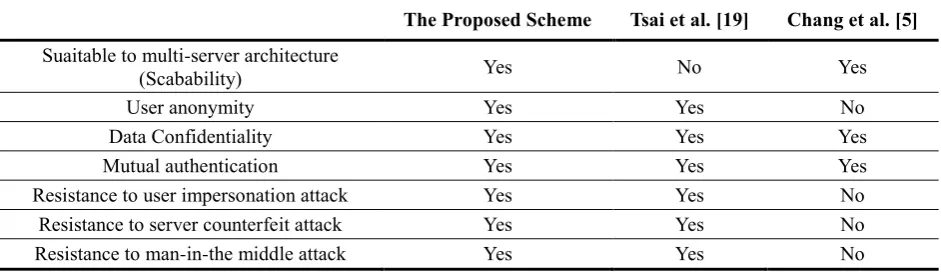
Based the above analyses, we present a comparison (i.e. Table 1) of our proposed protocol and other relevant schemes. In the next section, we will introduce the implementation on current mobile device to demonstrate the feasibility and practicability of our proposed scheme.
Table 1. Comparison of our proposed protocol and other schemes
The Proposed Scheme Tsai et al. [19] Chang et al. [5]
Suaitable to multi-server architecture
(Scabability) Yes No Yes
User anonymity Yes Yes No
Data Confidentiality Yes Yes Yes
Mutual authentication Yes Yes Yes
Resistance to user impersonation attack Yes Yes No
Resistance to server counterfeit attack Yes Yes No
Resistance to man-in-the middle attack Yes Yes No
5. Implementation
In this section, we introduce the environment setup followed by the implementation results of the proposed authentication scheme. The overview of the
[11]. The client program runs on a HTC ONE X with Android version 4.1.1, and the server program runs on a cloud-based machine, called MyCloud Pro, AMD 7450 Dual-Core 2.4 G, DDR2 1.5 G, Fedora Linux 12. We next report the implementation results.
Table 2. Environment Description
User’s Smartphone HTC ONE X: 1.5 GHz, quad-core, RAM 1 GB, Android 4.1.1
Server MyCloud Pro: AMD 7450 Dual-Core 2.4G, DDR2 1.5G, Fedora Linux 12 Development
Environment Eclipse Java EE IDE
Below are the instantiations of the cryptographic primitives involved in the implementation of
AuthDroid:
Hash Functions: SHA-2 (256 bits, 384 bits, 512 bits)
ECC: Java Elliptic Curve Cryptography project (JECC)
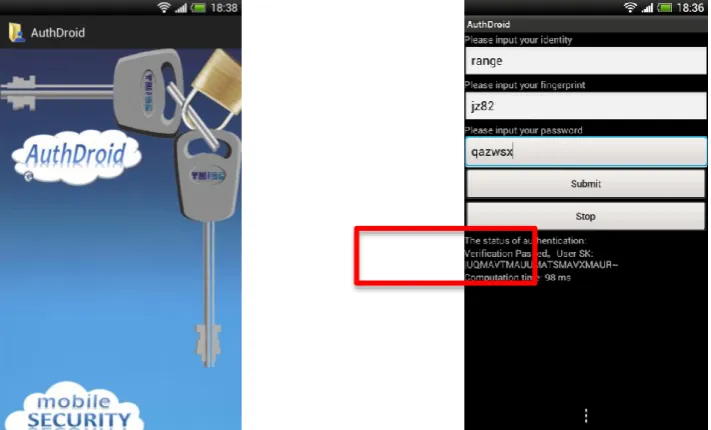
Fig. 2 shows the client program. To initiate a login, the user needs to input his identity, password and fingerprint. Then, the user clicks the “Submit” button, and the client program starts AuthDroid with the server program, as shown in Fig. 3. Our implementation results show that AuthDroid takes about 149.7 microseconds for the client program to complete the whole authentication procedures of
AuthDroid with the server program. We obtained this average time from 200 runs of AuthDroid. As the HTC ONE X is a common smartphone, our implementation reflects the practicability and feasibility of the proposed authentication scheme.
Figure. 2. Client Program on Android (HTC ONE X: 1.5 GHz, quad-core, RAM 1 GB, Android 4.1.1)
6. Conclusion
This paper presents a lightweight authentication scheme for mobile devices. The proposed authen-tication scheme enjoys the advantages of the convenience of password based authentication and preserves client-privacy protection as well. Formal analyses are demonstrated to promise the security robustness. We further implemented a prototype
AuthDroid on a common Android-based smartphone, i.e. HTC ONE X, to show the practicability and feasibility of the proposed authentication scheme. The implementation results present that AuthDroid delivers a good performance on Android 4.1.1, where a short execution time period of 149.7 microseconds is required to mutually agree on a robust session key.
Conflict of interests
The author declares that there is no conflict of interest regarding the publication of this article.
Acknowledgments
This work was partly supported by the Taiwan Information Security Center (TWISC) and the Ministry of Science and Technology, Taiwan, under the Grants Numbered MOST 103-2221-E-259-016-MY2 and MOST 103-2221-E-011-090-103-2221-E-259-016-MY2.
References
[1] Android, https://www.google.com/mobile/android/. [2] M. Burrows, M. Abadi, R. Needham. A logic of
authentication. ACM Transactions on Computer
Systems, 1990, Vol. 8, No. 1, 18-36.
[3] C. C. Chang, C. Y. Lee. A Secure Single Sign-On Mechanism for Distributed Computer Networks. IEEE
Trans. on Industrial Electronics, 2012, Vol. 59, No. 1,
629-637.
[4] C. C. Chang, H. C. Tsai. An Anonymous and Self-Verified Mobile Authentication with Authenticated Key Agreement for Large-Scale Wireless Networks.
IEEE Trans. on Wireless Communications, 2010,
Vol. 9, No.11, 3346-3353.
[5] Y.-F. Chang, W.-L. Tai, H.-C. Chang. Untraceable dynamic-identity-based remote user authentication scheme with verifiable password update. International
Journal of Communication Systems, 2014, Vol. 27,
No. 11, 3430-3440.
[6] B.-L. Chen, W.-C. Kuo, L.-C. Wuu. Secure Password-based Remote User Authentication Scheme without Smart Cards. Information Technology and
Control, 2012, Vol. 41, No.1, 53-59.
[7] FACEBOOK, https://www.facebook.com/.
[8] D. He, D. Wang, S. Wu. Cryptanalysis and Improvement of a Password-based Remote User
Authentication Scheme without Smart Cards.
Information Technology and Control, 2013, Vol. 42,
No. 2, 170-177.
[9] X. Huan, X. Chen, J. Li, Y. Xiang, L. Xu. Further Observations on Smart-Card-Based Password-Authenticated Key Agreement in Distributed Systems.
IEEE Transactions on Parallel and Distributed
Systems, 2014, Vol. 25, No. 7, 1767-1775.
[10] iOS, https://www.apple.com/tw/.
[11] Java Elliptic Curve Cryptography project, http://jecc.sourceforge.net/.
[12] LINE, http://line.me/zh-hant/.
[13] Q. Jiang, J. F. Ma, G. Li, Z. Ma. An Improved Password-based Remote User Authentication Scheme without Smart Cards. Information Technology and
Control, 2013, Vol. 42, No.2, 150-158.
[14] W. S. Juang, S. T. Chen, H. T. Liaw. Robust and Efficient Password-Authenticated Key Agreement Using Smart Cards. IEEE Trans. Industrial
Electronics, 2008, Vol. 55, No. 6, 2551-2556.
[15] L. Lamport. Password Authentication with Insecure Communication. ACM Communications, 1981, Vol. 24, No. 11, 770-772.
[16] X. Li, W. Qiu, D. Zheng, K. Chen, J. Li. Anonymity Enhancement on Robust and Efficient Password-Authenticated Key Agreement Using Smart Cards.
IEEE Trans. on Industrial Electronics, 2010, Vol. 57,
No. 2, 793-800.
[17] Skype, http://www.skype.com/zh_TW/.
[18] D. Z. Sun, J. P. Huai, J. Z. Sun, J. W. Zhang, Z. Y. Feng. Improvements of Juang et al.’s Password-Authenticated Key Agreement Scheme Using Smart Cards. IEEE Trans. on Industrial Electronics, 2009, Vol. 56, No. 6, 2284-2291.
[19] J.-L. Tsai, N.-W. Lo, T.-C. Wu. Novel Anonymous Authentication Scheme Using Smart Cards. IEEE
Trans. on Industrial Informatics, 2013, Vol. 9, No. 4,
2004-2013.
[20] J.-L. Tsai, N.-W. Lo, T.-C. Wu. ID-Based Authenticated Group Key Agreement Protocol from Bilinear Pairings for Wireless Mobile Devices. Ad Hoc
& Sensor Wireless Networks, 2013, Vol. 17, Issue 3-4,
221–231.
[21] J.-L. Tsai, N.-W. Lo, T.-C. Wu. A New Password-Based Multi-server Authentication Scheme Robust to Password Guessing Attacks. Wireless Personal
Communications, 2013, Vol. 71, No. 3, 1977–1988.
[22] J.-L. Tsai. A novel authenticated group key agreement protocol for mobile environment. Annales des
Télécommunications, 2011, Vol. 66, Issue 11-12,
663–669.
[23] G. Wang, J. Yu, Q. Xie. Security Analysis of a Single Sign-on Mechanism for Distributed Computer Networks. IEEE Trans. on Industrial Informatics, 2013, Vol. 9, No. 1, 294-302.
[24] Y. Wang. Password Protected Smart Card and Memory Stick Authentication against Off-Line Dictionary Attacks. In: Proceedings of SEC 2012, IFIP
AICT 376, 2012, pp. 489–500.
[25] WhatsApp, http://www.whatsapp.com/?l=zh_tw.