CASE REPORT
A child with (central) auditory processing disorder: a case
report
Amir Arami1, Farzaneh Zamiri Abdollahi2*, Mamak Joulaie3
1- Mehr Aria Speech Therapy Clinic, Karaj, Iran 2
- Department of Audiology, School of Rehabilitation, Tehran University of Medical Sciences, Tehran, Iran
3- Speech and Language Pathology Clinic, AVA Rehabilitation Center, Karaj, Iran
Received: 3 Jul 2018, Revised: 4 Aug 2018, Accepted: 28 Aug 2018, Published: 15 Jan 2019
Abstract
Background: Subjects with (central) auditory processing disorder (C)APD may manifest a range of complaints including difficulty in spee-ch perception in noise, following directions, and discrimination of similar speech sounds. Other disorders may also have the same behavioral manifestations.
The Case: Here we present an 8-year-old boy who was misdiagnosed and mismanaged as a child with learning disability. His speech, language and cognition problems at initial eva-luation included semantic problem, a short len-gth of speech, phonological sound disorder, and attention disorder. He showed abnormality in the dichotic digits test with free recall approach and monaural selective auditory attention test. Based on his performance and test results, he was suffering from (C)APD especially in dicho-tic listening and speech perception in com-petition. It was suggested that binaural hearing training with differential interaural intensity, informal localization training including loca-lization clock, and auditory training in noise be added to his classic auditory training program.
Conclusion: Studying this subject was impor-tant because (C)APD diagnosis needs a team approach. Evidently, the parents, teacher and speech-language pathologist (SLP) did not seek a central auditory processing evaluations early enough but some of his behaviors could poten-tially be a red flag for (C)APD and could guide SLPs to refer him for central auditory testing. As we may not be able to evaluate central auditory processing in the early childhood, iden-tifying the possible (C)APD signs by a SLP may help them to plan a more suitable program even before reaching a definite diagnosis.
Keywords: Central auditory processing; learning disability; auditory system
Citation: Arami A, Zamiri Abdollahi F, Joulaie M. A child with (central) auditory processing disorder: a case report. Aud Vestib Res. 2019;28(1):57-61.
Introduction
The American Speech-Language-Hearing Asso-ciation (ASHA; ASHA, 2005a) defines central auditory processing (CAP) as how efficient and effective the central nervous system (CNS) makes use of auditory information [1,2]. CAP includes the mechanisms responsible for the following skills/behaviors: sound localiza-tion and lateralizalocaliza-tion; auditory discriminalocaliza-tion;
*
auditory pattern recognition; temporal proce-ssing including temporal resolution, temporal masking, temporal integration, and temporal ordering; auditory performance with competing acoustic signals including dichotic listening; and auditory performance with degraded acoustic signals [3,4]. The involvement of one or more of these behaviors is considered as (central) auditory processing disorder (C)APD [5].
Children with (C)APD may manifest a range of complaints like difficulty in speech perception in noise, following directions, and discrimi-nation of similar speech sounds [6]. In school, they may have difficulty with spelling, reading, and understanding auditory information [7]. A multidisciplinary team approach is critical to adequately assess and understand the multiple problems exhibited by children with (C)APD and reach a differential diagnosis [1,8]. Thus, a teacher will notice academic difficulties; a psy-chologist may evaluate cognitive functioning; a speech-language pathologist (SLP) may probe written and oral language, speech, and related capabilities. None of the SLP’s testsare diagno-stic testas for (C)APD, and the actual diagnosis is one of audiologist’s responsibilities. A child must be at least seven or eight years old for most audiologic (C)APD tests because in youn-ger children test interpretation may not be possi-ble due to highly variapossi-ble brain function [7,8]. Once a diagnosis of (C)APD is made, the nature of the disorder is determined. There are many types of CAP deficits and because each child is different, (C)APD may have various manifes-tations. Therefore, the type of auditory deficit for the child should be determined, then custo-mized management and treatment training sho-uld be applied to address his or her specific areas of difficulty [8]. Here we present a case with (C)APD. The patient suffered from several speech and language disorders in addition to (C)APD but the focus of the paper is on audi-tory processing disorder and its manifestations.
Case presentation
An 8-year-old hyperactive boy with speech sound disorder was referred to an SLP. He had phonological and orthographic difficulties. He
took one Ritalin tablet per day only in school days and based on the psychiatric diagnosis he suffered from attention deficit hyperactivity disorder (ADHD).
Wechsler Intelligence Scale for Children-Revised (WISC-R) IQ test had been performed on him at age of 6, and the raw verbal score, executive score and the total score were 45, 37, 87 respectively. He was categorized in the lower range of the normative data. He gained an unusual low score in short-term auditory mem-ory. Accordingly, he started to receive sound disorder treatment and he was considered as a child with learning disability (LD) for 9 mon-ths. After showing no progress, he was referred for more evaluations. His sound disorder was highly resistant to treatment.
In speech evaluation, he had an inability in using long phrases, storytelling, and narration skills as well as auditory phonemic discrimi-nation, working memory (two units), and imme-diate auditory memory (three units) deficits. About syntax, there was no significant difficulty except for using prepositions and morphologic features in verbs. His phonological awareness was poor especially in syllabic segmentation and blending, phonological segmentation and blending, and onset and rhyming skills. His aud-itory assessment showed normal hearing thre-shold and speech understanding in quiet.
In conclusion, his speech-language and cogni-tive problems at the first evaluation were as follows: semantic problem (narrative and conti-nuous speech), the short length of speech, pho-nological sound disorder, and attention deficit. A treatment program was started with particular attention to the following areas: improving sen-tence production and storytelling (language ski-lls), auditory training, improving auditory dis-crimination and identification, improving pho-nological awareness, improving cognitive skills, immediate auditory memory, working memory, and auditory attention.
sustained attention and attention-switching (Table 1). In IVA test, he had difficulty in auditory discrimination as well. The Conners test showed that he had moderately decreased attention and subtle impulsivity.
After 30 training sessions, parents claimed that a child’s progress was outstanding, but from the therapist’s point of view, he only had a good progress in the language area and storytelling. He showed some improvement in cognitive ski-lls and phonological awareness, too. The child did not show any significant improvement in auditory skills and sound disorder.
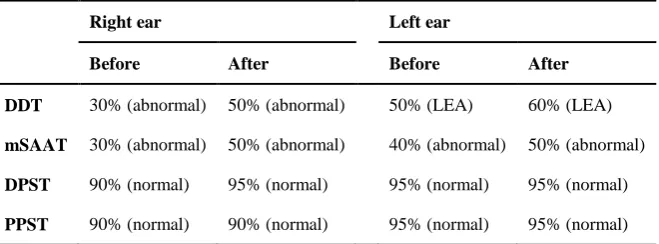
He was referred to an audiologist for central auditory processing assessment. Audiologist selected four central tests mainly based on the multiple auditory processing assessment (MAPA), which included the dichotic digits test (DDT) with free recall approach, the monaural
selective auditory attention test (mSAAT), the duration pattern sequence test (DPST), and the pitch pattern sequence test (PPST). His central auditory test results are summarized in Table 2. Based on his performance and test results, it was concluded that he was suffering from (C)APD especially in dichotic listening and speech per-ception in competition (monaural attention). It was suggested that binaural hearing training (differential interaural intensity difference; Per-sian DIID [9]), informal localization training (localization clock) and auditory training in noise be added to his classic auditory training program. The new treatment plan consisted of the following training:
- Working on phonemic discrimination, - Storytelling and narration training, - Onset and rhyming exercises,
- Phonological segmentation and blending ski-lls,
- Phonemes identification in words, - Improving working memory, - Sound disorder therapy,
- Training for vigilance in a noisy situation, - Auditory attention in the presence of backgr-ound babble noise,
- Sound localization in quiet and in the presence of babble noise,
- Writing (orthography) in quiet and in noise from various distances and different spatial loc-ations (especially 90 and 60 degrees right/left and from front and back),
- Dichotic listening training, and
- Auditory selective and divided attention in the presence of two speakers.
The reason to perform other training (in addition to auditory processing training) was the results of the primary language evaluations. The speech-language pathologist showed that not only there was a phonemic disorder but also there was a significant semantic disorder in using continuous speech. The speech-language pathologist performed a full speech and langu-age evaluations and planned treatments based on their results. As the speech-language patho-logist was a psychopatho-logist too, cognitive inter-ventions were included as well. The WISC-R IQ test was performed again 6 months after the Table 1. Results of the integrated visual and
auditory test at the age of 6 and 7 months after starting the new training
Auditory Visual
Scales Before After Before After
Quickness 114 103 97 83
Readiness 98 97 110 124
Prudent 96 106 76 99
Reliability 87 102 80 99
Acuity 82 72 88 110
Dependability 100 91 98 97
Consistency 71 100 82 99
Stamina 93 91 71 88
Stability 81 Mildly
impaired
82 87
Speed 115 105 99 85
Swiftness 116 101 106 97
Comprehension 46 93 81 86
Steadiness 43 86 89 83
initiation of the new training program. The child showed a total score of 71 which was interpre-ted as a borderline score. His verbal test was scored the highest (83), and his working mem-ory was scored as the lowest (68). In all cate-gories of IVA test, the child showed significant improvement except for auditory selective atten-tion. The scores are listed in Table 1.
The results of the (C)APD tests are presented in Table 2. There is a slight but significant impro-vement in DDT and mSAAT results after chan-ging the training plan and focusing on central auditory processing training.
Discussion
Children exhibiting auditory problems in a school setting are usually referred to speech-language pathologists and audiologists for deter-mining their need for special services. ADHD and (C)APD co morbidity is 41% for children with a confirmed diagnosis of ADHD, and 43% for the children suspected of ADHD. It is hypo-thesized that children with ADHD show audi-tory processing deficits, such as audiaudi-tory atten-tion, poor discrimination in noise, and reduced temporal processing [10]. In the present case, the child had ADHD and (C)APD simultane-ously.
The child was diagnosed with LD and went under LD training for 9 months without any significant improvements. The prevalence of (C)APD in children diagnosed with LD is esti-mated to be as high as 30% to 50% [11]. Due to
high comorbidity between (C)APD and LD, it is recommended that therapists pay particular atte-ntion to children’s auditory symptoms and care-fully monitor their progress and check central auditory processing.
Central auditory tests can evaluate each auditory processing separately and can determine special processing involved in each one, and therapist can decide which trainings must be chosen based on the results. This specialization leads to an effective and efficient training program [5]. The MAPA test battery was used to evaluate the temporal processing, dichotic listening and monaural low redundancy performance of the central auditory system which they can evaluate the most important parts of auditory processing. There are different test batteries for auditory processing disorder. The MAPA test battery has 90% sensitivity and 100% specificity in diagno-sing (C)APD [12]. As a result, this test battery was selected in this study.
Conclusion
Studying this subject was important because of the diagnosis issue in (C)APD which needs a team approach. Evidently, the child’s parents, teacher and SLP did not seek an audiology exa-mination for ruling out the (C)APD. However, some of his behaviors which was mentioned in the article could guide the SLP to refer him for central auditory testing. As we may not be able to evaluate central auditory processing of very young children, identifying the (C)APD signs Table 2. Central auditory processing test results before and after new
training
Right ear Left ear
Before After Before After
DDT 30% (abnormal) 50% (abnormal) 50% (LEA) 60% (LEA)
mSAAT 30% (abnormal) 50% (abnormal) 40% (abnormal) 50% (abnormal)
DPST 90% (normal) 95% (normal) 95% (normal) 95% (normal)
PPST 90% (normal) 90% (normal) 95% (normal) 95% (normal)
by a SLP may help them to plan a more suitable training program even before reaching a definite diagnosis.
Conflict of interest
The authors declare that they have no conflict of interest.
References
1. American Speech-Language-Hearing Association. (cen-tral) auditory processing disorders [Technical Report]. 2005. Available from www.asha.org/policy. doi:
10.1044/policy.TR2005-00043
2. Pavlick ML, Zalewski TR, González JE, Duncan MKW. A (C)APD screening instrument for the buffalo model diagnostic test battery. J Educ Audiol. 2010;16:4-13. 3. Bellis TJ. Assessment and management of central
audi-tory processing disorders in the educational setting: from science to practice. 2nd ed. San Diego: Plural Publishing; 2011.
4. Delecrode CR, Cardoso ACV, Frizzo ACF, Guida HL. Pitch pattern sequence and duration pattern tests in Brazil: literature review. Rev CEFAC. 2014;16(1):283-92. doi: 10.1590/1982-021620143912
5. Geffner D. Central auditory processing disorders: defi-nition, description, and behaviors. In: Geffner D, Ross-Swain D, editors. Auditory processing disorders: asse-ssment, management, and treatment. 2nd ed. San Diego: Plural Publishing Inc.; 2013. p. 59-90.
6. Bellis TJ, Beck BR. Central auditory processing in clinical practice. 2000; Available at: https://www.audiologyonline.com/articles/central-auditory-processing-in-clinical-1281. August 7, 2000. 7. Genovese E, Vallarino M, Guarnaccia MC, Monzani D.
Diagnosis of auditory processing disorders. In: Mercuri E, Fedrizzi E, Cioni G, editors. New Diagnostic and therapeutic tools in child neurology. 1st ed. ed. Paris: John Libbey Eurotext; 2011. p. 83-90.
8. Bellis TJ. Understanding auditory processing disorders in children. American Speech-Language-Hearing Asso-ciation. 2004. Available from http//www asha org/public/hearing/disorders/understand-apd-hild htm. 9. Anjidani Z, Moosavi A, Lotfi Y. Evaluation of effects of
dichotic interaural intensity difference (DIID) training on dichotic integration scores in learning disordered children aged 7-12. [Dissertation]. Tehran: University of Social Welfare and Rehabilitation Sciences; 2015. 10. DeBonis DA, Moncrieff D. Auditory processing
disor-ders: an update for speech-language pathologists. Am J Speech Lang Pathol. 2008;17(1):4-18. doi:
10.1044/1058-0360(2008/002)
11. Iliadou V, Bamiou DE, Kaprinis S, Kandylis D, Kaprinis G. Auditory processing disorders in children suspected of learning disabilities--a need for screening? Int J Pediatr Otorhinolaryngol. 2009;73(7):1029-34. doi:
10.1016/j.ijporl.2009.04.004