Vol.7 (2017) No. 1
ISSN: 2088-5334
An Interactive Application for Halal Products Identification
based on Augmented Reality
Haslina Arshad
#1, Saidatul A’isyah bt Ahmad Shukri
#2, Waqas Khalid Obeidy
#3, Rimaniza Zainal Abidin
#4 #Faculty of Information Science and Technology, University Kebangsaan Malaysia, Selangor, Malaysia E-mail: [email protected], [email protected],[email protected],[email protected]
Abstract— Identification of halal products is a challenging issue especially for the Muslim community. Previously, a few researches
were conducted to identify halal products using AR technology which enables the end users to scan product to ensure the quality. Further study needs to be conducted in order to investigate augmented reality experience in identifying halal products and beverages for the Muslim community. This paper presents an application to identify halal products based on Malaysian Islamic Development Department (JAKIM) database for Muslim consumers in Malaysia. The core aim of this research is to provide experience to the user regarding the usage of the proposed mobile application based on AR technology. Evaluation of the proposed application by conducted a survey to 22 users, reveals that user can detect a halal status of the products and give knowledge of awareness to have confident in order to choose the halal product.
Keywords— augmented reality; food; beverages; user experiences
I. INTRODUCTION
Advancement in the communication technology enables the Muslim community to prevent false information about products in the market [1] , [2]. However, identification halal food is still unsolved issue especially for technological perspective for the Muslim community in accordance with the guideline of the specific religious department. However, lack of knowledge about the legal halal logo issued by JAKIM makes task for the Muslim more complicated. This research presents the usage of AR technology by proposing a new mobile application to identify halal status of the products. Results of the proposed application was evaluated by conducted a survey with 22 users about using AR technology for halal checking on products.Augmented reality technology is new research area which can be defined as a technology that is used to display virtual objects in the real world. The main aim of this research is to focus on AR technology on mobile devices where user needs to induce an image or marker to identify the quality of the product in order to decide halal product. For determination about halal product, guidelines inherited from JAKIM is employed which facilitates the community to decide about the products. Thus, the vision this study is to facilitate the individual Muslim to get information about food and beverage products using the proposed application based on AR technology in smart phone.The objective of the project presented in this paper has been to develop the mobile augmented reality
application in android platform and to gather information usability of this application either Muslim community in Malaysia can accept AR technology to know status halal of some products as their know now days there are many fake information that easy can be spreads through social media.To achieve this objective, this paper purpose a mobile application based on AR technology that can be used by the consumer in Malaysia that had a higher level of awareness status product especially Muslim consumer and conduct a survey to gained information about awareness status of halal for food and beverage, and to know how many people had used or experienced of AR among Malaysian community. Next, development of system was based on the survey which the brand of the product was the marker of AR for this application,survey was shown that intention of consumer usually will notice brand of product rather other features. So it’s influenced the consumer to buy the halal products.[3]
II. MATERIAL AND METHOD
A. Augmented Reality in Mobile Application for Halal Products
environments. Therefore, AR supplements reality, rather than completely replacing it. AR systems are composed with the following three characteristics [5]:
1)Combines real and virtual 2)Interactive in real time 3)Registered in 3-D 4)
Fig.1. Continuum Mixed Reality
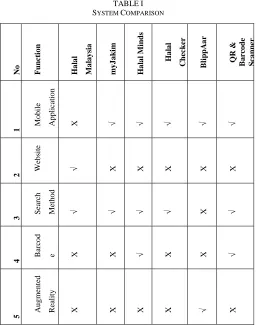
This research used AR technology to check for halal status of the product through a mobile application. However, currently consumer judge halal status of the product based on the brand written on the product [6], [7]. Besides, outlook of the package for the products also plays an important role to impress the consumers to decide about halal status.Table 1 shows the comparison among systems that have been developed and available for checking Halal status product in Malaysia. Basic function such as searching tool (Halal Malaysia. myJakim, HalalMinds, HalalChecker), scan and QR code (QR & Barcode Scanner) was used to develop the application and none of this application applies AR technology which is more interactive in real time environment [1].Most of the application that found was used mobile platform(myJakim, HalalMinds, HalalChecker and QR &Barcode Scanner) and only one web-based system(Halal Malaysia). Blippar is using AR technology which track brand of product as marker and overlay AR layout and only this application used AR technology compared with other applications as mentioned earlier. Based on the functionalities stated in the Table 1, one prototype of mobile application on checking on halal products using AR was developed with combination of function search tools and augmented reality using platform android to make this system different with the existence system.
B. Definition Of Halal
The word “Halal” is derived from the Arabic word Halal namely Halla, Yahillu, Hill, wahalalan which means allowed or permitted by Islamic law. While from the point of Dr. Yusuf al-Qaradawi defined halal as an obligation, which tends to break restrictions, and banned by Islam. Halal can also be defined as something that should be allowed by Islamic law.
Halal definition under the Trade Descriptions 1975 is as • Any parts or products from animals that Muslims are
forbidden by Islamic law to eat.
• Contains any substance considered to be imputed according to Islamic Law
• During preparation, processing or storage adjacent to any food that does not meet the requirements.
TABLEI SYSTEM COMPARISON
N o F u n ct io n H a la l M a la y si a m y J a k im H a la l M in d s H a la l C h ec k er B li p p A a r Q R & B a rc o d e S ca n n er 1 M o b il e A p p li ca ti o n
X √ √ √ √ √
2 W
eb
si
te
√ X X X X X
3 S ea rc h M et h o d
√ √ √ √ X √
4 B
ar
co
d
e X X √ X X √
5 A u g m en te d R ea li ty
X X X X √ X
C. AR in Mobile Platform
Each AR-based applications have a similar workflow. This can be seen in Figure 2, which shows a workflow-based application that is reviewed by Domhan AR. After application AR acquire an image from a camera, these markers should be separated from the other images. After that, the contours of these markers will be extracted. Of four angles (or contour), the translation matrix for the virtual object can be calculated and used to display objects on the marker. Basically, there are three things that are needed in AR applications. The first thing is the camera, it is necessary to capture the real environment. The second thing is the display, it is necessary to show the final result. The final thing is that the device, it must have the power central processing unit (CPU) to further generate 3D objects. There are many devices available to meet this need.
Development of the proposed application is involved with four phases i.e. planning phase, implementation phase, testing phase and validation phase.
D. The Planning Phase
In the planning phase, few plans are preliminary settled which involves
1) Objectives of the application,
2) Collect information about product packaging which currently consumer judge halal status of the brand written on the product [8],
3) Collect selected data in JAKIM database(website), 4) Develop mobile AR application,
5) Finally, testing criteria to validate the application (survey).
E. The Implementation Phase
In the implementation phase, android SDK is used to develop the application. Next, a package of android SDK and Plug-in Android Development Tools (ADT) is installed on Eclipse. Algorithm is written in the form of convertible machine language understood by the Android platform. Vuforia API was used for AR database to keep marker such as brand of products.
F. The Testing Phase
In the testing stage, Android Virtual Device (AVD) is used to validate the application and to ensure that application is able to meet the needs of users. In addition, smart phones Android platform used for the testing process.
G. The Valuation Phase
In the validation phase, an application is validated to check objective needs to be achieved. However, in the validation phase whether the proposed application can check the status of the product or not is also checked to ensure the reliability. 22 users had answer a survey after demonstration of application had done.
H. Implementation of SHALAL Mobile Application
Architecture for the proposed application is shown in fig 3. The concept of tiered client-server was chosen to develop the application. This framework architecture is original from Service Oriented Mobile AR Architecture(SOMARA) which is fulfill the requirement and focused on mobile AR [7] and for this research only two tier is included from the origin architecture [9] , [10]. Based on framework, Database JAKIM from website will provide information needed after tracked the marker which is the images brand’s logo of product using API Vuforia via Service Request. Then it will show overlays of AR layout for AR Environment personalization in mobile interface. Digital content request will show the Halal Logo and validation of status halal after checked name of the brand in database.
MOBILE AR CLIENT
HALAL INFO DATABASE
Fig. 3. Architecture of Mobile Application of SHALAL
I. User Interface of Augmented Reality and SHALAL
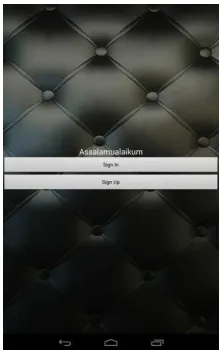
System interface is developed which intention before developing the interface was to make the interface user friendly and easy to use by the users. A log in interface is developed shown in fig 4 where users and administrators need to provide user name and password to start using the application.
Fig. 4. Log In interface
An interface to show the status and brand notification of the products is developed shown in fig 5. Fig 6 shows interface after the user is able to track the product and after the application is able to track the product log and user chooses to press the drink button.
AR APPLICATION
Mobile AR SDK(Vuforia)
Service Request
Digital Content Request
AR Environment
Fig.5. Interface to show the status and brand notification
Fig.6. Interface after the user is able to track the product
J. Specifications Functional Application Halal Products
The functional requirements of a very important role in the development of a reference to the application. Functional right shows the success of these applications is in line with the objectives of the application. It can be expressed as functions required by the system to perform a task that has been set.
1) Main Menu
This function is intended to attract the attention of users that the application is currently in the process of being opened. The user is instructed to press the "Sign in" at the beginning of the application after it opened. Users are given a few seconds before the next screen is displayed. It also provides time for the application to process the data necessary to the next page. This function has the elements for the user does not feel a long wait for the application to process the necessary data.
2) Choose Menu
The main menu has a function to give preference to applications to the next page where the next page has a key to the application of info Scanning food and Halal Logo.
3) Info Logo Menu
This page will display information related to the halal logo, which is defined by JAKIM.
4) AR Function Menu
This page will scan the logo of brand put in front of camera mobile phones. Then it will go to the next page where it will display information about the food.
III.RESULTS AND DISCUSSION
Validation of the proposed application is demonstrated through 22 users (university students) who have less knowledge about awareness to check the status halal of product. This section describes the evaluation in detail.
A. Usability Study
Initial questionnaires were prepared in order to conduct the usability study for the proposed application [11]. Furthermore, users were observed during demonstration of application and interviewed in an informal way in order to find out of the easiness and satisfaction. Every user was given 20 minutes to experience to use this application. After using the application, all the users are given questionnaires.
B. Results
Initial After using the application, users were excited to know and use the application. All the users like to have such an application to check statuses of product, 18 users selected strongly agree and 4 users chose agree. Most of the users stated that they found the application as new way to check halal product and experience when using augmented reality to check the halal status. Among the users, 16 of them selected strongly agree, 5 users agree and 1 neutral. Users found the application easy when using augmented reality content to detect status halal of product. Among the users, 15 users chose strongly agree and 7 users chose agree. They also found the application is enjoyable, 17 selected strongly agree and 6 of the users selected agree. About users felt confidence to use this application, 10 users chose strongly agree and 12 chose agree. In addition, for comments, most of users wanted to have more choice of brands and list of products that have all around the world so that when they travel they can use the proposed. Over questionnaire responses are shown in Table 2. The overall results are highly encouraging and positive that shows the potential requirement of such halal check application. From the results shows user have confident and comfortable to use AR technology for halal check application based on the brand of the products.
C. System Testing
End users will have the satisfaction in case of each function in the application can run smoothly. Function for admin run smoothly when admin add and edit information of users that registered with the system. Furthermore, admin also can add and edit information of products that always need be to updated in the system and it’s run smoothly with error in database . Interface that need to data was synchronize and up to date when user ask for it when they click on button Halal Information. After tracking process was been took place,user can see list of information about the data that had been save in database by the admin.
TABLEII QUESTIONNAIRE RESPONSE
Questions
Strong ly Agree
Agr ee
Neutr al
Disagr ee
Strongl y Disagre
e I like to have such an
application to find halal product.
18 4 0 0 0
I had a new experience on using Augmented Reality to detect halal product.
16 5 1 0 0
I found it easy when using Augmented Reality content to detect halal product.
15 7 0 0 0
I enjoy use this
application. 17 6 0 0 0
I felt confident to use this
application. 10
1
2 0 0 0
I would imagine that most people would learn to use this application very quickly.
12 8 2 0 0
I found the application
unnecessarily complex. 10 8 2 2 0 I think that I would like
to use this system frequently
13 7 2 0 0
I thought the application
easy to use. 18 4 0 0 0
I found the various functions in this system were well integrated
14 8 0 0 0
D. Integration Testing
This type of test is a test that involves the integration or link contained in the application system. Things also have to be aware of every page is linked with the button works properly. This test also ensures that the information is fit for any module and no errors in data entry. Button for AR function and camera interface will be appear next process of tracking was been started.Next, user and admin need to log in into the system. Log in interface need to be integrate in the system so that if user success to log in it can be in the system and can use system with smoothly without any error. Next, halal’s logo information run perfectly with shown of list of related product that had in database of the system which take from JAKIM’s website and manually insert into database of this system for this prototype.
E. Discussion
Users answer to questionnaire, comments and observation shows that they found the system easy to use, and alternative to know status of the product. Users explained the interaction method through handheld device screen easy. They found that the interaction technique of pointing handheld device towards the brand’s logo and getting real time information about products.The application provided the user to search information of halal status for a product and it that helped them to save time. Users wanted to have more brands and can be use whenever user travel all around the world in a real time. Detail questionnaire will be made and interfaces will be more enriched and enhanced based on the users comments.Most of the users are not familiar with terms of augmented reality was asked their experienced using AR mobile application for the first time and acceptance using this technology in their daily life’s activity. Users are interested to know more about this technology and excited while used this application. They gave comments to improve the interface and better performance for tracking when they are in brighter environment, Overall, user like to use because easy to gain information with confident.
F. Compare with Previous Studies
The user still had the same feeling when experienced when using mobile AR. The behavior toward the products still the same which it will provide information about the products. in form interfaces that overlays on the top of the product called as AR technology.
IV.CONCLUSIONS
Proposed application has been developed to check products for halal status. The main objective is to facilitate the process using android application that displays information. Proposed methodology is described and designed in order to make the task easy for Muslim community to check halal status and to measure of AR content show whether it’s useful or not [12]. The data was refer by using information from database JAKIM website. The prototype of this application just show a few of product brand that popular among the citizen for the marker that save in Vuforia database as image target. Even it’s not cover all the brands that have in Malaysia atleast user can understand and adapt with changes of technologies such as AR.Based on experiment’s result, most of the respondent found it easy to use mobile augmented reality (MAR) and application enables various things to be done better and gaining new experiences and perspective to gain information [13]. The advantages of this application compare with other application that have been developed in Malaysia was the presentation of information becomes more interesting with this application. Use Reality Augmentation is the key to the charm of this application. This method of delivery with an impact on the users of these applications. And search using this application is easier than with the application of available because it has chosen in accordance with the category in which it is easier for users to search quickly and accurately. Users do not need to fill the information to make the search.However, there are some shortcomings and scope for improvement in this application exists for future such as adding more choices of brands and list of products that have all around the world so that users can use this application during travel.For the future work, it’s good to have more brands to test and also brand from other countries that also had market in Malaysia. So the consumer have confident to buy the international products too. This system was different with exists products in Malaysia compare with normal mobile application with no advance technologies such as Augmented reality. This can enhanced user experience of using AR in daily life activities.
A. Limitation Research Scope
In this system the main limitation is to gather information of products.Prototype was developed by manually insert into database and only refer from JAKIM’s website to gather the information. To avoid fraud information, research need to done before admin manually take take the data and put in database of the system. Next, tracking marker of brand’s logo in brighter environment which took longer time need to improve. This can be avoid by improve the system because only company can change the type of packging and not the developers. One of the solution, focus of the camera while tracking need to be improve so can reduce time of tracking.
B. Improvement and Future Works
As mentioned earlier, it’s good to have more brands to test and also brand from other countries that also had market in Malaysia. More researcher on the data of the brand need to do so that the data is real and not fraud. Different countries will have different data which admin need to enter in database. To avoid gain the fraud information, there are need for halal products research itself in academic research so there are guide when develop this application. Others, interface of system need to be improve so that user will understand more the features in the system and interested to use the system. Furthermore, hope in the future, data from JAKIM’S website can be link directly to the system so that it’s up to date every second.Next, improvement in tracking while in the brighter environment and face problem when the quality of paper for marker such as plastic need to be improve in the research so for future there are not lag time while tracking halal status of the products. To have a good system must be evaluated positively include friendly, good design, supportive, secure, organized, understandable, clear, and valuable[14].
ACKNOWLEDGMENT
I would like to thank Assoc. Prof Dr Haslina Arshad for all the support and advice during the execution of the project and for encouraging me to research about this innovative field. And Mr Waqas Khalid Obeidy for help in development phase.
REFERENCES
[1] A. Masnono, "Factors Influencing The Muslim Consumer’s Level Of Confidence On Halal Logo Issued By Jakim: An Empirical Study," USM, 2005.
[2] J. A. N. Shaari and N. Mohd Arifin, "Dimension of halal purchase intention: A preliminary study," International Review of Business Research Papers, vol. 6, pp. 444-456, 2010.
[3] T Weber,K Baier and C Willers,"Sustainable (Green) Food and Purchase Intention – An Analysis of Influence Factors," International Journal on Advanced Science, Engineering and Information Technology, vol. 5, no. 4, pp. 311-313, 2015.
[4] R. T. Azuma, "A Survey of Augmented Reality Presence: Teleoperators and Virtual Environment," ed, 2013.
[5] R. Azuma, Y. Baillot, R. Behringer, S. Feiner, S. Julier, and B. MacIntyre, "Recent advances in augmented reality," IEEE Computer Graphics and Applications, vol. 21, pp. 34-47, 2001
[6] R. Zaimah, A. H. Awang, M. Sarmila, S. Ishak, A. Azima, S. Saad, and M. Y. Hussain, "Malaysia sebagai pusat halal global: Satu penemuan awal mengenai persepsi halal dalam kalangan pengguna di Malaysia," Geografia: Malaysian Journal of Society and Space, vol. 10, pp. 48-56, 2014.
[7] T. Domhan, K. TIT07INA, and G. der Dualen Hochschule, "Augmented reality on android smartphones," Studiengangs Informationstechni. Dualen Hochschule Baden-Württemberg Stuttgart, 2010.
[8] S. Rattanarungrot and M. White, "A service-oriented mobile augmented reality architecture for personalized museum environments," in Virtual Systems & Multimedia (VSMM), 2014 International Conference on, 2014, pp. 277-284.
[9] D. Wagner and D. Schmalstieg, "Making Augmented Reality Practical on Mobile Phones, Part 1," IEEE Computer Graphics and Applications, vol. 29, pp. 12-15, 2009.
[10] Wagner and D. Schmalstieg, "Making Augmented Reality Practical on Mobile Phones, Part 2," IEEE Computer Graphics and Applications, vol. 29, pp. 6-9, 2009.
[12] M. E. C. Santos, A. Chen, T. Taketomi, G. Yamamoto, J. Miyazaki, and H. Kato, "Augmented Reality Learning Experiences: Survey of Prototype Design and Evaluation," IEEE Transactions on Learning Technologies, vol. 7, pp. 38-56, 2014.
[13] T. Olsson and M. Salo, "Online user survey on current mobile augmented reality applications," in Mixed and Augmented Reality
(ISMAR), 2011 10th IEEE International Symposium on, 2011, pp. 75-84.