HIV in NSW in 2010: sustaining success
in an evolving epidemic
GUEST EDITORS
Darryl O’Donnell
A,F, Andrew Grulich
B, Roger Garsia
C, Nicolas Parkhill
Dand Kim Browne
EA
AIDS/Infectious Diseases Branch, NSW Department of Health
BNational Centre in HIV Epidemiology and Clinical Research, The University of New South Wales
C
Royal Prince Alfred Hospital, Sydney South West Area Health Service
D
ACON (AIDS Council of New South Wales)
E
Population Health, Planning and Performance, Hunter New England Area Health Service
F
Corresponding author. Email: Darryl.O’[email protected]
Abstract: NSW has been recognised internation-ally for achieving a sustained, stable rate of HIV infection since 2000. An early mobilisation by communities initially at risk of HIV – gay men, sex workers and injecting drug users – resulted in rapid behaviour change and provided the basis for a continuing cooperative partnership with gov-ernment, health service providers and researchers.
This special issue of theNSW Public Health Bulletin
describes the current response to HIV in NSW. Experts from diverse disciplinary and professional fields offer perspectives on the epidemiology, mor-bidity and impacts of HIV, current prevention challenges including with Aboriginal communities and people from culturally and linguistically diverse backgrounds, models for the diagnosis, care and treatment of HIV, and the legislative protection of public health and those who are living with HIV. The NSW experience demonstrates that the sustained cooperation of those affected, together with the efforts of government, health service pro-viders and researchers, can achieve HIV control.
In October 1986, Ross Duffin, a community activist who would later become Australia’s foremost human immuno-deficiency virus (HIV) educator, declared acquired immune deficiency syndrome (AIDS) the medical news story of the 1980s.1 From 1982, media reporting of what would ubiqui-tously become known as the AIDS crisis had both reflected and engendered hysteria and panic across the Australian commu-nity. Duffin’s declaration was prescient, coming six months before the 1987 Grim Reaper AIDS Campaign. Within its first decade AIDS had emerged as a public health emergency.2
While AIDS burst into the public consciousness, the easing of anxiety has taken a slower, steadier path. In what ways has the response to HIV remained constant, and in what ways has it been transformed? What might people with newly-acquired infection expect today of their illness? Does HIV remain a personal crisis? Where is HIV treatment and prevention headed?
Enduring principles
There remain some notable points of continuity between the AIDS crisis of the 1980s and today’s response to HIV.
Working in partnership
The principle of partnership has underpinned both the rhetoric and practice of Australia’s response to HIV.
Vol. 21(3–4) March–April 2010
ISSN 1034 7674
NSW PUBLIC HEALTH
BULLETIN
HIV in NSW in 2010
CONTENTS – See back page w w w . p u b l i s h . c s i r o . a u / j o u r n a l s / p h b
Commonwealth-state cooperation to secure the blood sup-ply lead then Commonwealth Minister for Health, Dr Neal Blewett, to comment in 1986 on the ‘goodwill and excellent cooperation of state and territory governments’.3 ‘Partner-ship’ would later become an aspirational principle of each successive National HIV/AIDS Strategy, denoting the desirability for ‘an effective, cooperative effort between all levels of government, community organisations, the medical, health care and scientific communities and people living with or affected by HIV/AIDS’.4The application of this principle is formalised in New South Wales (NSW) through the composition of the NSW Ministerial Advisory Committee on HIV and Sexually Transmissible Infections. It is also evident in the composition of the guest editorial group for this special issue of theBulletin, in the supporting commentary to this editorial offered by Rob Lake of Positive Life NSW, and in the paper by James Ward and colleagues on HIV and Aboriginal communities.
While now a familiar concept in many health domains, the principle of partnership in relation to HIV reflects the nature of the disease, stemming from an early recognition by government that it had limited understanding of or access to the marginalised communities most affected by HIV, and that changes in intimate and private risk beha-viours would best occur through the voluntary decisions and cooperation of those at risk. In effect, the HIV partner-ship acknowledges a mutual interdependence between gov-ernments and those at risk if the goal of minimising HIV transmission is to be realised. With this recognition, princi-ples of personal action, shared responsibility, community centrality and cooperation were also enshrined within national HIV/AIDS policy alongside that of partnership. Coercive approaches were considered likely to result in those at risk placing themselves ‘beyond the reach of policies designed to assist them and to stem the spread of infection’.5 NSW has also benefitted from an early and continuing political non-partisanship, wherein successive governments and oppositions, have supported the sensitive, pragmatic measures necessary to maintain effective control of HIV.
Evolution of an epidemic
In the almost 30 years since it was first described, the morbidity and expected epidemic spread of HIV in Aus-tralia have been radically altered by advances in scientific enquiry, clinical research and practice (both preventive and treatment), and through the sustained behaviour change of affected communities.
Initial expectations of a generalised epidemic that extended from early-affected populations to heterosexuals have not been realised in Australia, although it has cer-tainly occurred in many other locations with poorer HIV control. McPherson and Ward report in this issue on the epidemiology of HIV in NSW in 2010. Three features make the current epidemiology of HIV in NSW unique
in industrialised settings and have attracted national and international public health attention: the effective contain-ment of HIV among gay men, sustained low HIV incidence among gay men, and low HIV incidence and prevalence in all other populations including injecting drug users and sex workers.
Hales presents in this issue the findings of an epidemiolo-gical and economic analysis of public health measures for HIV in NSW.6He reports that, in the period to 2005, 45 000 cases of HIV had been avoided through NSW public health efforts, representing an estimated 80% reduction in new cases that would otherwise have occurred. The Needle and Syringe Program, providing injecting drug users access to the means to directly prevent HIV infection, represents 75% of total cases avoided. HIV prevalence rates in countries such as Spain and the United States of America that are more than five-fold higher than in Australia also point to cases avoided.7 The economic effectiveness of such immediately effective public health intervention is notable: for every $1 invested in HIV prevention, the NSW Government alone saved $13 in clinical care costs.6This benefit excludes indirect costs and costs accruing to the Australian Government through the Pharmaceutical Benefits Scheme and Medicare.
Despite these achievements HIV is endemic among Sydney gay men with prevalence estimated at 9%.8With greatly improved prognosis, even low sustained rates of incident infection will increase the number of people with HIV in this population. The Darlinghurst 2010 postcode remains Australia’s HIV epicentre, although there is a steady drift of new diagnoses to Sydney’s inner western suburbs, reflect-ing the changreflect-ing demographic of Sydney’s gay community and the increasing age of those receiving a diagnosis of HIV (37 years in men in Australia in 2008).7 Inner Sydney’s concentrated HIV prevalence should not however be allowed to obscure the needs of those living with HIV in greater Sydney and regional and rural NSW and the challenges presented by dispersal and distance.
given risk event. Grulich, O’Donnell and de Wit describe in this issue the work of a partnership-based committee that functions as a reflexive broker of HIV research, policy and practice in directing gay men’s and other HIV health promotion efforts in NSW.
Wodak and Maher report on transformation in the Needle and Syringe Program; there is now overwhelming evi-dence of the effectiveness of the program in preventing HIV infection among injecting drug users. The authors also note that gains can be fragile to sustain, and even see-mingly small changes in the availability of injecting equipment can lead to rapid and dramatic rises in acquisi-tion of HIV infecacquisi-tion and consequent onward sexual transmission within heterosexual populations.
Ward, Akre and Kaldor in this issue note that injecting drug use and heterosexual transmission contribute disproportio-nately to HIV infection within NSW Aboriginal commu-nities. Currently, HIV rates in NSW Aboriginal communities are stable at levels similar to that reported among non-Aboriginal people – a significant outcome achieved in difficult circumstances. Disadvantage, poorer access to primary health care, higher rates of sexually transmissible infections, and increased injecting drug use indicate a need for strengthened action by health services, Aboriginal com-munities and their partners to prevent HIV.
Donovan and colleagues report low rates of HIV and sexually transmissible infections among brothel-based sex workers but note the diversity of the sex industry in NSW and the high annual turnover within this workforce. McMahon, Moreton and Luisi observe the variability of HIV prevalence within the communities that constitute NSW’s culturally diverse society, and the inevitability of steady increases in HIV infection associated with high international population mobility.
Together, these articles capture the distinctive ways in which HIV has affected populations prioritised for preven-tion activities. While the principles of health promopreven-tion remain the same across these populations, the implementa-tion of HIV prevenimplementa-tion programs offered by area health services and community organisations is closely targeted to each community. Targeting recognises the different patterns and effects of HIV infection within each community, as well as their different strengths. It also reflects the pragmatic imperative for sensitive programs that necessarily address sexual and drug-using behaviours to reach the intended audience.
The death of AIDS – HIV morbidity in 2010
In the evolution of the HIV epidemic, it is arguably in the treatment and care of those living with HIV that rapid and transformative change is most evident. Dwyer in this issue
reports that, while reliable laboratory assays to detect HIV have been available since 1985, new generation combina-tion assays now allow deteccombina-tion of HIV approximately two weeks after infection. For people with HIV and their clinicians, nucleic acid testing for quantifying HIV viral load and detecting antiretroviral drug resistance, together with CD4þ T lymphocyte cell counts, provide essential prognostic and antiretroviral management guidance.
Cowdery and Cooper report on the early availability in NSW of combination antiretroviral therapy (cART) which from the mid-1990s has made the control of viral replication and disease progression the goal of HIV management. Since that time, simpler, more effective and better tolerated cART regimens have become available. For most people with HIV in industrialised countries, cART has rendered HIV a chronic, manageable condition with many people achieving sustained viral suppression and, in those with immune suppression, partial reconstitution of immune function.
Improvements in mortality and morbidity for people with HIV have been profound. A large multinational cohort study showed that a 20-year-old person starting successful HIV treatment could now expect to live to 63 years on average.12 Those with a CD4þcell count above 200 cells/mm3could expect to live to 70 years on average, pointing to the importance of early detection of HIV infection while also highlighting that life expectancy remains shortened even in optimal circumstances.13
Gains have also been achieved for those living long-term with HIV through the use of drug-resistance testing, addres-sing co-morbidities, managing side-effects of cART, and persistence where necessary with multiple changes of cART regimens.
Improvements in treatment have not come without cost. Clinical trials have shown conclusively that treatment interruptions are significantly detrimental to people with HIV. In 2010, people with HIV face lifelong treatment and close clinical monitoring to ensure sustained treatment efficacy and to manage complications related to long-term HIV infection and treatment. The optimism that followed the introduction of cART is today softened by concern for the effects of long-term cART use, with accelerated ageing, metabolic disorders, neurological complications, malignancies, cardiovascular disease and kidney dysfunc-tion all presenting as novel sources of morbidity.14Patients with co-morbidities such as hepatitis B and C, drug and alcohol misuse, mental illness or social disadvantage that interferes with the effective and routine management of their HIV infection, also experience poorer outcomes.15
Garsia in this issue charts the changing clinical profile of HIV infection in the service arrangements of primary, allied and tertiary health services. Clinical care arrangements have
HIV in NSW in 2010
proved responsive to the changing needs of people with HIV with substantial service re-development evident since the mid-1990s. Declining inpatient activity and concomitantly increasing demand for outpatient services has been seen at all major tertiary sites. A workforce of primary-care providers authorised to prescribe highly specialised HIV treatment continues to allow many people with HIV to receive their routine treatment and care in community settings. Demand has increased significantly for flexible care arrangements and case support that allow people with complex clinical and behaviour needs to remain in the community.
Where service change has been insufficient, the NSW Department of Health has triggered reviews and funding reforms to align HIV resources with need. Recent reforms to HIV supported accommodation arrangements, pathology charging and statewide services have contemporised ser-vice delivery and unlocked resources required to meet the demands of increased HIV prevalence and life expectancy. The reform of HIV program funding has also enabled expansion of the dedicated investment in hepatitis C prevention, treatment and care.
Something old, something new
In NSW in 2010, the early fears of AIDS have eased. The aetiology of HIV is known. New HIV infections continue, but at a low rate. Members of the gay community are generally well informed of their personal risk. Importantly, they understand that infection is preventable. Improved diagnostic tests are available. The prognosis for those diagnosed early is excellent.
Yet HIV continues to be a serious, preventable and potentially fatal infection with the capacity for rapid spread within already-affected populations and more broadly. The promise of near normal life expectancy can only be realised with early detection, daily treatment and good clinical management. Stigma associated with the infection remains high, and people with HIV report too frequent experiences of discrimination including within health-care settings.16An HIV diagnosis remains in 2010 an experience of personal crisis, with those diagnosed being required to reconcile deeply ingrained perceptions of HIV with a more contemporary reality.
For public health professionals, relative success in contain-ing HIV infection at low rates within the gay community can obscure a more unsettling, underlying picture. In 2007 an expert think tank concluded that the stability of HIV notifications in NSW when examined against growth in the numbers elsewhere could be attributed to very small differences across a range of HIV transmission variables.17 Since that time, NSW behaviour surveillance points to a rapid increase in the most significant of these contributing transmission variables – unprotected anal intercourse by
gay men with casual partners. The imperative to maintain control of HIV in NSW is all the greater because, unlike infections such as chlamydia, proven models for population-level HIV control exist. HIV is a disease shown to be amenable to programmatic intervention and, as described in this issue, the economic effectiveness of prevention is well established.
In 2010, concern about HIV in the public consciousness remains exceptional. This is evident in circumstances which give rise to the spectre of uncontrolled HIV trans-mission such as media reporting of community needle-stick injury (a situation that presents negligible HIV risk) or the investigation of infection control incidents. HIV transmission offences – with implied recklessness or intent in the behaviour of people with HIV and a suspicion of public health failure – stimulate similar fears. Clayton, in this issue, points to the legislative context for HIV trans-mission in NSW, with public health and crimes provisions variously regulating HIV disclosure, behaviour, exposure and infection. HIV continues to be subject to legislative sanction in excess of comparable communicable diseases, and the increased use of criminal laws in Australia and elsewhere make it unlikely that HIV will be legislatively normalised in the near future.
Conclusion
HIV control in Australia is a hard-won success story. While increases in HIV notifications in some Australian jurisdictions in recent years have re-ignited commentary about the sufficiency and adequacy of existing arrange-ments, the appropriateness of community-driven preven-tion programs, and whether more coercive approaches may be required, the extreme early fears associated with HIV are now tempered. Hopes for the early identification of a vaccine have faded confirming the need for control mea-sures based on the Needle and Syringe Program, education about safe sex, and partnership and cooperation with affected communities. As described in this issue of the
Bulletin, these measures have been demonstrated to be both effective and cost-effective however they require sustained effort.
References
1. French R, Duffin R. Mossies could spread AIDS: Australian media references on AIDS, 1981–1985. Sydney: Gay History Project; 1986.
2. Sendziuk P. Learning to trust: Australian responses to AIDS. Sydney: University of NSW Press; 2003.
3. Duckett M. Australia’s response to AIDS. Canberra: Australian Government Publishing Service; 1986.
5. Commonwealth of Australia. AIDS: a time to care, a time to act: towards a strategy for Australians. Canberra: Australian Government Publishing Service; 1988.
6. Health Outcomes International, National Centre in HIV Epide-miology and Clinical Research. The impact of HIV/AIDS in NSW: morbidity, mortality and economic impact. Sydney: NSW Department of Health; 2007.
7. National Centre in HIV Epidemiology and Clinical Research. HIV/AIDS, viral hepatitis and sexually transmissible infections in Australia Annual Surveillance Report 2009. Sydney: National Centre in HIV Epidemiology and Clinical Research, The Uni-versity of NSW; 2009. Available at: http://www.nchecr.unsw. edu.au/NCHECRweb.nsf/page/AnnualþSurveillanceþReports (Accessed 08 March 2010.)
8. Prestage G, Jin F, Zablotska I, Imrie J, Kaldor JM, Grulich AE. Trends in HIV prevalence among homosexual and bisexual men in Eastern Australian states.Sex Health2008; 5: 103–7. 9. NSW Department of Health. NSW HIV/AIDS Strategy
2006–2010. Sydney: NSW Department of Health; 2006. 10. Zablotska IB, Imrie J, Bourne C, Grulich AE, Frankland A,
Prestage G. Improvements in sexual health testing among gay men in Sydney, Australia, 2003-2007.Int J STD AIDS2008; 19: 758–60. 11. Prestage G, Jin F, Zablotska IB, Imrie J, Grulich AE, Pitts M.
Trends in HIV testing among homosexual and bisexual
men in eastern Australian states. Sex Health2008; 5(2): 119–23.
12. The Antiretroviral Cohort Collaboration. Life expectancy of individuals on combination therapy in high-income countries: a collaborative analysis of 14 cohort studies.Lancet2008; 372: 293–9.
13. Cooper DA. Life and death in the cART era. [comment]Lancet 2008; 372: 266–7.
14. Neuhaus J, Angus B, Kowalska JD, La Rosa A, Sampson J. Wentworth D for the INSIGHT SMART and ESPRIT study groups. Risk of all-cause mortality associated with nonfatal AIDS and serious non-AIDS events among adults
infected with HIV.AIDS2010; 24: 697–706.
15. Tuma P, Jarrin I, del Amo J, Vispo E, Medrano J, Martin-Carbonero L et al. Survival of HIV-infected patients with compensated liver cirrhosis.AIDS2010; 24: 745–53.
16. Grierson J, Power J, Pitts M, Croy S, Clement T, Thorpe R et al. HIV Futures 6: Making positive lives count, Monograph series number 74. Melbourne: Australian Research Centre in Sex, Health and Society, Latrobe University; 2009.
17. Griew R, Grulich AE, Prestage G, Law M, McDonald A, Kaldor JM et al. A think tank: why are HIV notifications flat in NSW 1998–2006? Consensus Statement. Sydney: NSW Department of Health; 2007.
NSW PUBLIC HEALTH
BULLETIN
TheNSW Public Health Bulletinis a peer-reviewed
journal produced by the NSW Department of Health and indexed in Medline. It has a NSW focus, however, it aims to support the practice of public health more broadly.
Editor
Dr Lynne Madden
BSc(Med)Hons1, MBBS, MPH, MSc, FFPH, FAFPHM Editorial Manager
Mary Sinclair
Editorial correspondence
Please address all correspondence and submissions to:
The Editor,NSW Public Health Bulletin Locked Mail Bag 961
North Sydney NSW 2059 Australia Email: [email protected] Telephone: +61 2 9424 5876
Fax: +61 2 9391 9232
Submission of articles
TheBulletinaccepts proffered and
commissioned articles along with short reports, on all aspects of public health. Articles should be 1500–2000 words, not including tables and figures, and should include an abstract of up to 100 words. Articles should follow the journal style and layout as closely as possible, as described in the Instructions to Authors. Articles should be emailed in a Word for Windows format to: [email protected], and should be accompanied by a covering letter signed by all authors and a License to Publish. The Instructions to Authors, License to Publish and other useful information can be downloaded from the
Bulletinwebsite.
Distribution
TheBulletinis freely available from the
Bulletinwebsite. Copies of the current issue
and back issues can be downloaded in both PDF and HTML formats. If you would like to be notified when new issues of theBulletin are available online, subscribe to the early alert email system at theBulletinwebsite. The early alert email contains the contents of each new issue along with electronic links to the articles. To receive a printed copy of theBulletin, subscribe online at the Bulletin website, or contact your local public health unit or the editorial office.
eISSN 1834-8610
Website:www.publish.csiro.au/journals/phb Copyright&2010 NSW Department of Health
HIV in NSW in 2010
Rhythm of life: choices, challenges and change
Rob Lake
Positive Life NSW
Email: [email protected]
Life with human immunodeficiency virus (HIV) in 2010 is life with a future, a different situation to that in 1989 or even 1999. Conclusive evidence of the success of combination antiretroviral therapy was first presented at the 1996 World AIDS Conference. Subsequent treatments and combinations of treatments have, for most people with HIV, achieved better results. These improved treatment outcomes translate as the achieve-ment and long-term maintenance of undetectable HIV viral load, greatly increased CD4 cell counts and fewer side-effects from therapy.
For people with HIV like me, treatment consists of twice-daily tablets and regular monitoring, a bit too much time in hospital pharmacies and more optimism about my future health than in 1995 when I was first diagnosed. Life with HIV for me is about work, family, friends, good health and wellbeing. I am lucky that I can be open about my HIV status at home, at work and to family: many people are not so fortunate as demonstrated by 57% of respondents to Futures 6 reporting that they had not disclosed their HIV status to their employers.1
My experience differs from that of other men and women, particularly older people, who have lived long-term with HIV. Their experience is tempered by: unpredictable, uncertain interactions between the impacts of HIV on the body; the premature experience of ageing-related health; physiological and sometimes cognitive impairments; and the psychosocial impact of long-term debilitating illness.
Poverty and social exclusion are recognised as impor-tant social determinants of health. Discrimination and stigma arise from judgmental attitudes about HIV and how it is acquired, homophobia, and fear of transmis-sion. Women and men with HIV experience this dis-crimination: in the workplace; among family and other relationships; and from health-care providers. It has been identified through research including the Futures studies and Men and Women Living Heterosexually with HIV.1,2
To be optimistic about future health and wellbeing for people with HIV we need: ongoing improvements to treatments; the uptake and availability of these treat-ments; and a better understanding of the impact and management of co-infections and the implications of mental illness and heart, kidney and similar diseases. People with HIV, including those who migrate to Australia, need to be included, valued citizens. Those with the highest need must be assisted with clinical and other support services to ensure early interventions and comprehensive, coordinated care, some of which will be HIV specific. They also need services such as aged care, oncology and treatment for other conditions. The con-temporary experience of HIV diagnosis now incorporates improved treatment outcomes and reduced side-effects from treatment. Timely access to relevant support and information continues to be a key factor in determining how well someone integrates HIV into their life.
HIV prevention has two aspects for us: • preventing transmission
• and better health for people with HIV through the good management of HIV-related and preventable conditions.
Individually and as part of HIV organisations, we have a role to play. We share a responsibility to prevent HIV transmission, to care for ourselves, our partners and our communities in the same way we expect them to care for us. That care includes identifying and addressing stigma and discrimination.
This is a time for reflection, a time to prepare for the future with the goal of achieving the best possible health and quality of life for women and men with HIV. It’s a future some didn’t think they’d see and it’s worth fighting for.
References
1. Grierson J, Power J, Pitts M, Croy S, Clement T, Thorpe R et al. HIV Futures 6: Making positive lives count, Monograph series number 74. Melbourne: Australian Research Centre in Sex, Health and Society, Latrobe University; 2009. 2. Persson A, Richards W, Barton D, Reakes K. Men and women
How does the HIV epidemic in NSW
compare to other Australian jurisdictions
and internationally?
Michelle E. McPherson
Aand Kate A. Ward
A,B ACommunicable Diseases Branch, NSW Department of Health
B
Corresponding author. Email: [email protected]
Abstract: Aim: To review the epidemiology of HIV in NSW and compare HIV rates in NSW with those of other comparable jurisdictions.
Method: The rate of newly diagnosed cases of HIV reported in NSW was compared with those published from other Australian and comparable international jurisdictions. Results: Until recent years, NSW has consistently reported the highest rate of newly diagnosed HIV infections in Australia with a peak of 29.1 per 100 000 population in 1987. Since then the notification rate has decreased significantly and has been stable since 2000 at an average annual rate of 5.6 per 100 000. Rates in NSW and in other Australian states and territories are lower than most comparable international jurisdictions, although stability in rates has been observed elsewhere. Between 1984 and 2008, 82% of infections that reported a risk exposure occurred among men who have sex with men.Conclusion:
Rates of HIV infection in NSW have been stable over the last decade, remaining among the highest in Australia but lower than those in other compar-able industrialised jurisdictions. In NSW, the majority of cases continue to occur among men who have sex with men.
Human immunodeficiency virus (HIV) has been a notifi-able disease in New South Wales (NSW) since 1985, shortly after laboratory testing for HIV became available. The purpose of HIV surveillance in NSW is to monitor the epidemiology of HIV infections in NSW to inform the development of better prevention strategies. By 2008, there had been 28 330 diagnoses of HIV in Australia, with 54% occurring in NSW, with the most common risk
behaviour being men who have sex with men.1Previous studies have shown that, since the late 1990s, NSW, which has stable rates of newly diagnosed HIV in men who have sex with men, is unique compared with other industrialised countries.2,3In this paper we describe the HIV epidemic in NSW and compare NSW rates to those of other Australian jurisdictions and those of comparable international indus-trialised jurisdictions.
Methods
HIV epidemiology in NSW
Six HIV reference laboratories confirm newly diagnosed HIV infections in NSW. Under thePublic Health Act 1991, these laboratories are required to report all confirmed HIV infections to the NSW Department of Health, using a nationally standardised case definition.4Laboratories must send a standard notification form with the HIV-positive result to the treating medical practitioner seeking detailed demographical, clinical and HIV risk behaviour information about the patient. The completed form is then forwarded to the NSW Department of Health and the information entered in a secure database.
NSW residents diagnosed with their first positive HIV test in NSW were the subject of this analysis and defined as cases. As a person remains HIV positive for life and can have more than one confirmatory test performed, all new HIV diagnoses were matched against those already on the database. People were excluded from the analysis if they were already on the database, were not NSW residents or reported a previous positive-HIV test outside NSW. A case of newly acquired HIV infection was defined as a person with either a negative or indeterminate HIV antibody test or a seroconversion illness in the 12 months prior to HIV diagnosis. A case of late-diagnosed HIV was defined as having an acquired immune deficiency syndrome (AIDS)-defining illness within three months of HIV diagnosis and/ or a CD4 count less than 200 cells/mm3in the absence of a seroconversion illness. Information to determine the stage of diagnosis has only been collected in NSW since 2000 and is thus reported from 2000 onwards.
Risk exposure information was provided by the treating medical practitioner using the notification form. Where more than one risk exposure was reported, a hierarchy of risk was used to designate the case’s primary risk exposure –
that most strongly associated with transmission of HIV. Homosexually acquired infection was always considered the primary risk exposure if it was reported. High prevalence countries or regions are those where the prevalence of HIV in the population is more than 1% and included Sub Saharan Africa, Thailand, Burma, Cambodia, the Caribbean and Papua New Guinea. Since 1996 the category of heterosexual risk exposure has included cases who have been exposed to these high prevalence countries and other heterosexual exposures, most of which were not further defined.
National and international comparisons
The numbers of newly diagnosed HIV cases in other Australian jurisdictions were obtained from the National Centre for HIV Epidemiology and Clinical Research (NCHECR) 2009 Australian HIV Public Access Dataset5 (which includes those individuals who have previously been diagnosed overseas) and rates were calculated using estimated resident populations from the Australian Bureau of Statistics.6 HIV notifications by number, rate and proportion acquired by men who have sex with men were also sought from comparable international jurisdic-tions that had data publicly available from 2000, including Canada,7the United Kingdom (UK),8New Zealand,9the European Union countries,10the United States of America including San Francisco11and New York.12Rates for the USA only included those from states with confidential name-based HIV infection reporting for 2004 to 2007.13–16 Where rates were not provided in these reports, they were calculated using reported population estimates.17,18 The case definitions used in these jurisdictions all include laboratory confirmation of HIV infection.
Results
Since 1984, 15 106 NSW residents have been newly diagnosed in NSW. The rate of newly diagnosed HIV infections peaked in NSW in 1987 at 29.1 per 100 000 population (Figure 1). Since then the notification rate has decreased significantly and has been stable since 2000 with an average annual rate of 5.6 per 100 000 population.
Risk exposures in NSW
The most common risk behaviour for newly diagnosed HIV since the beginning of the epidemic in NSW was men who have sex with men who included 64% of all cases between 1984 and 2008, or 82% of those with a risk exposure reported. This rate has been consistent over the epidemic and stable since 2000.
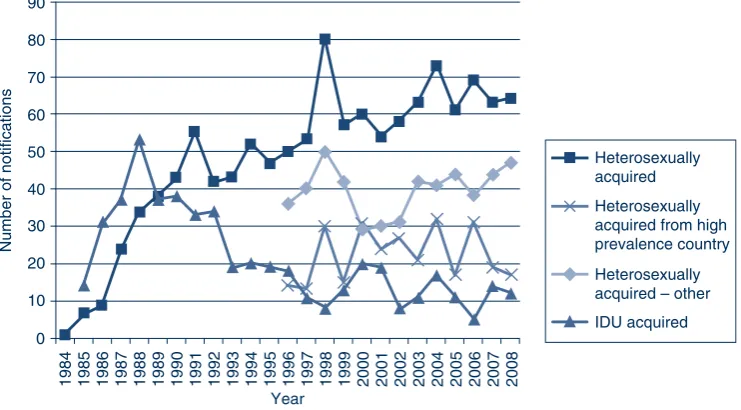
Heterosexual transmission is the second most commonly reported risk factor in NSW. Since 1996, HIV acquisition in people from high prevalence countries increased from a low of 13 in 1997 to a high of 32 in 2004, with an average of 22 cases per year. Notifications in other heterosexually acquired HIV infections have fluctuated between a low of 29 cases in 2000 and a high of 50 cases in 1998 with an average of 40 cases per year. The number of cases reporting injecting drug use as their risk exposure decreased over the epidemic from a high of 53 in 1988 to a low of 5 in 2006, with an average of 21 cases per year since the beginning of the epidemic and 13 per year since 2000 (Figure 2).
Risk exposures through receipt of blood or tissue, and haemophilia and coagulation disorders were highest in 1985 at 28 and 50 cases respectively. Since the mid 1990s
0.0 5.0 10.0 15.0 20.0 25.0 30.0 35.0
1984 1985 1986 1987 1988 1989 1990 1991 1992 1993 1994 1995 1996 1997 1998 1999 2000 2001 2002 2003 2004 2005 2006 2007 2008
Year
Rate per 100 000
NSW
QLD
SA/NT
VIC/TAS
WA
Australia
Figure 1. Rate of newly diagnosed HIV notifications in Australia by jurisdiction, 1984 to 2008.
there have been no reported cases of HIV transmission through the receipt of a blood or tissue product, except for one case where the exposure occurred in the early 1980s. Vertical transmission (from mother to child) was reported as the risk exposure for an average of two cases per year since the beginning of the epidemic, with the highest number reported in 1991 at five cases. Where country of birth was reported (n¼29), most cases acquired through vertical transmission (76%) were born in Australia. The percentage of cases with unreported risk exposures ranged from 44% in 1986 to 1% in 2008 with an average of 17% per year.
Stage of infection at HIV diagnosis
Between 2000 and 2008, 25% to 39% of newly diagnosed cases each year were classified as newly acquired, and 11% to 21% as late-diagnosed infections per year. In 2008, when only 4% of cases had an unknown stage of diagnosis, almost half (45%) of homosexually acquired cases had evidence of newly acquired infection and 10% (24 cases) had evidence of late diagnosis. Of the heterosexually acquired cases associated with high prevalence countries, 24% presented early and 24% presented late in the infec-tion. Of the remaining people with heterosexually acquired HIV infections, 19% were diagnosed early and 23% late.
National comparisons
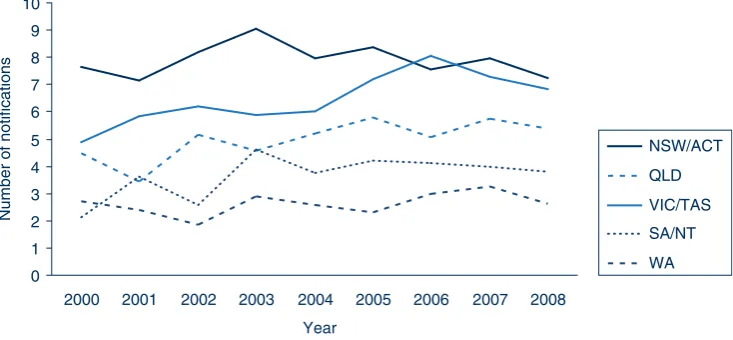
NSW has consistently reported the highest notification rates although in 2008 the notification rate for NSW was similar to those of Victoria and Tasmania (combined), and Queensland (Figure 1). NSW has reported stable rates of newly diagnosed HIV infections in men reporting homo-sexual contact since 2000 at an average of 7.9 per 100 000
men. Stable rates, albeit at lower levels, have also been reported in other Australian jurisdictions except for Victoria where the notification rate increased between 2004 and 2006 with a subsequent decline (Figure 3).
International comparisons
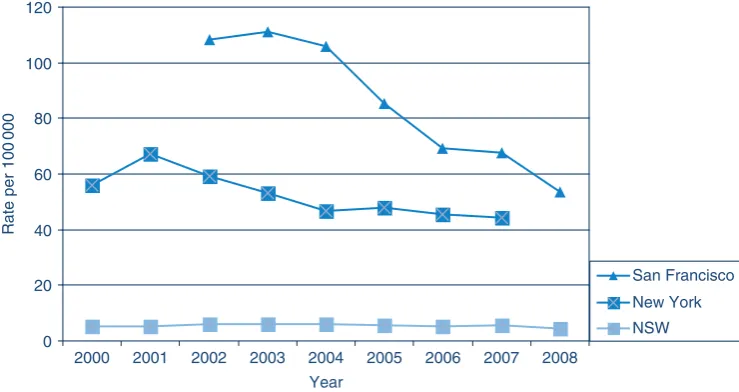
The rate of people newly diagnosed with HIV since 2000 in NSW and the rest of Australia was lower than in other similarly developed jurisdictions reviewed, except for New Zealand. Like NSW, the rates of newly diagnosed HIV in most of these other jurisdictions have remained stable over the last few years (Figure 4), except in New York City and San Francisco, where the rates, although much higher than NSW, have decreased (Figure 5).
Discussion
NSW has consistently had the highest rates of newly diagnosed HIV in Australia since the beginning of the HIV epidemic in the early 1980s. The rate of newly diagnosed HIV has stabilised in the last decade in NSW, which was not observed in other Australian jurisdictions until more recent years. Notification rates nationally have converged.19The apparent decline in NSW in 2008 was likely due in part to improved identification of people who had previously tested positive for HIV infection. The NSW epidemic has occurred predominately in men who have sex with men, although there has been a modest increase in the number of cases reporting heterosexual acquisition since the mid 1990s. Acquisition through injecting drug use has been minimal in the latter half of the epidemic with the other risk exposures, such as blood products, rarely occurring since early in the epidemic.
0 10 20 30 40 50 60 70 80 90
1984 1985 1986 1987 1988 1989 1990 1991 1992 1993 1994 1995 1996 Year
1997 1998 1999 2000 2001 2002 2003 2004 2005 2006 2007 2008
Number of notifications
Heterosexually acquired from high prevalence country Heterosexually acquired
Heterosexually acquired – other
IDU acquired
Figure 2. Number of cases of newly diagnosed HIV acquired heterosexually compared with the number acquired through injecting drug use (IDU) in NSW, 1984–2008.
Source: NSW Department of Health. Notifiable Diseases Database. NSW HIV/AIDS database.
Comparison of HIV epidemic in NSW to other Australian jurisdictions and internationally
NSW has lower rates of newly diagnosed HIV than other comparable international jurisdictions except New Zealand, and is not alone in reporting stable rates in the last decade, particularly for men who have sex with men.2,3 Canada reported that a fifth of its cases were exposed through injecting drug use; the peak number of HIV notifications for men who have sex with men, 581, in 2004 has decreased each year to 515 for 2007.7 San Francisco reported similar proportions of men who have sex with men as NSW of between 62% and 70% each year between 2002 and 2008; the decline in the total rate of HIV over the last decade corresponds to a decrease in the rate of HIV in men who have sex with men.11New York, for the three years of data available, had similar annual numbers of
cases of HIV diagnosed in men who have sex with men.12 In contrast, in the UK, half the HIV cases are reported as being heterosexually acquired, mostly in migrants from Sub-Saharan Africa. There are also reports of increasing numbers of cases occurring among men who have sex with men.20New Zealand and the European Union coun-tries also reported higher proportions of heterosexual acqui-sition compared with NSW, and also a doubling of the number of men who have sex with men since 2000.10,17
The use of notification data for reporting the HIV epidemic has its limitations as these data neither represent the total number of people with HIV infection (prevalence) or the number of people with newly acquired infection each year
0 1 2 3 4 5 6 7 8 9 10
2000 2001 2002 2003 2004 2005 2006 2007 2008
Year
Number of notifications
NSW/ACT
QLD
VIC/TAS
SA/NT
WA
Figure 3. Rate of newly diagnosed HIV infections for men reporting homosexual contact, by Australian jurisdiction, 2000–2008. Source: National Centre for HIV Epidemiology and Clinical Research. 2009 Australian Public Access Datasets on newly diagnosed HIV infection and AIDS.
R
a
te per 100 000
United Kingdom
Canada
European Union
NSW
New Zealand
United States
0 2 4 6
8
10 12 14 16
18
20 22
2000 2001 2002 2003 2004 2005 2006 2007 2008
Year
(incidence). Notification data reflect only those who have been tested and diagnosed with HIV. Given that HIV is a chronic infection with a long latent period and that routine laboratory testing does not distinguish newly acquired cases of HIV from other cases it is impossible to accurately determine the timing of disease acquisition for many newly diagnosed infections. Newly diagnosed people who test more frequently are more likely to be identified as newly acquired thus comparisons between risk behaviours and countries with different testing practices should be made with caution.
References
1. National Centre in HIV Epidemiology and Clinical Research. HIV/AIDS, Viral hepatitis and sexually transmissible infections in Australia. Annual surveillance report 2009. Sydney: National Centre in HIV Epidemiology and Clinical Research, The University of New South Wales; 2009. Available at: http:// www.nchecr.unsw.edu.au/NCHECRweb.nsf/page/Annualþ SurveillanceþReports (Cited 16 March 2010.)
2. Grulich AE, Kaldor JM. Trends in HIV incidence in homosexual men in developed countries.Sex Health2008; 5: 113–8. doi:10.1071/SH07075
3. Sullivan P, Hamouda O, Delpech V, Kaldor J, Folch C, Op de Coul E et al. Reemergence of the HIV epidemic among men who have sex with men in North America, Western Europe and Australia, 1996–2005.Ann Epidemiol2009; 19: 423–31. doi:10.1016/j.annepidem.2009.03.004
4. Communicable Diseases Network of Australia. Surveillance Case Definitions for the Australian National Notifiable Diseases Surveillance System. Australian Government Department of Health and Ageing 2003. Available at: http://www.health.gov.au/ internet/main/publishing.nsf/Content/cdna-casedefinitions.htm (Cited 13 August 2009.)
5. National Centre for HIV Epidemiology and Clinical Research. 2009 Australian Public Access Datasets on newly diagnosed HIV infection and AIDS. Sydney: National Centre in HIV Epi-demiology and Clinical Research, The University of New South
Wales; 2009. Available at: http://www.nchecr.unsw.edu.au/ nchecrweb.nsf/page/HIV-AIDS-Datasets (Cited 5 January 2009.) 6. Australian Bureau of Statistics. Estimated Resident Population,
States and Territories. Australian Demographic Statistics. In. 3101.0 ed; 2009. Available at: http://www.abs.gov.au/ ausstats/[email protected]/mf/3101.0/ (Cited 16 March 2010.) 7. Public Health Agency of Canada. HIV and AIDS in Canada.
Surveillance Report to December 31, 2007. Ottawa; 2008 Contract No.: ISBN 978-0-662-05687-4.
8. Health Protection Agency Centre for Infections and Health Protection. United Kingdom HIV New Diagnoses to end of June 2009. Scotland; 2009. Available at: http://194.74.226.162/web/ HPAwebFile/HPAweb_C/1237970242135 (Cited
5 January 2009.)
9. AIDS Epidemiology Group UoOMS. HIV and AIDS in New Zealand – 2000 to 2008. Dunedin; 2009. Available at: http://www. moh.govt.nz/moh.nsf/pagesmh/2871 (Cited 5 January 2009.) 10. European Centre for Disease Prevention and Control/WHO
Regional Office for Europe. HIV/AIDS surveillance in Europe 2008. Stockholm; 2009 Contract No.: ISBN 978-92-9193-197-2. 11. San Francisco Department of Public Health AIDS Office. HIV/
AIDS Epidemiology Annual Report 2008. San Francisco; 2009. Available at: http://www.sfdph.org/dph/files/reports/ RptsHIVAIDS/AnnlReport2008-20090630.pdf
(Cited 5 January 2009.)
12. New York State Department of Health. New York State HIV/ AIDS Surveillance Annual Report For Cases Diagnosed Through December 2007. New York City; 2009. Available at: http://www. health.state.ny.us/diseases/aids/statistics/annual/2007/
2007-12_annual_surveillance_report.pdf (Cited 5 January 2009.) 13. Centers for Disease Control and Prevention. HIV/AIDS
Surveillance Report, 2004. Atlanta: U.S.; 2006. Available at: http://www.cdc.gov/hiv/topics/surveillance/resources/reports/ 2006report/default.htm (Cited 5 January 2009.)
14. Centers for Disease Control and Prevention. HIV/AIDS Surveillance Report, 2005. Atlanta: U.S.; 2007. Available at: http://www.cdc.gov/hiv/topics/surveillance/resources/reports/ 2006report/default.htm (Cited 5 January 2009.)
0 20 40 60 80 100 120
2000 2001 2002 2003 2004 2005 2006 2007 2008
Year
Rate per 100
000
San Francisco
New York
NSW
Figure 5. Comparison of HIV notification rates in NSW, New York and San Francisco, 2000–2008.
Source: NSW Department of Health. Notifiable Diseases Database. NSW HIV/AIDS database and specific city data.11,12
Comparison of HIV epidemic in NSW to other Australian jurisdictions and internationally
15. Centers for Disease Control and Prevention. HIV/AIDS Surveillance Report, 2006. Atlanta: U.S.; 2008.
Available at: http://www.cdc.gov/hiv/topics/surveillance/ resources/reports/2006report/default.htm (Cited
5 January 2009.)
16. Centers for Disease Control and Prevention. HIV/AIDS Sur-veillance Report, 2007. Atlanta: U.S.; 2009. Available at: http:// www.cdc.gov/hiv/topics/surveillance/resources/reports/ (Cited 5 January 2009.)
17. Statistics New Zealand. National Population Estimates at 30 June. Auckland; 2009. Available at: http://search.stats.govt. nz/search?w¼population (Cited 5 January 2009.)
18. US Census Bureau. 2008 Population Estimates. Available at: http://factfinder.census.gov/servlet/DownloadDatasetServlet?_ lang¼en (Cited 5 January 2009.)
19. Guy R, McDonald A, Bartlett M, Murray J, Giele C, Davey T et al. HIV diagnoses in Australia: diverging epidemics within a low-prevalence country.Med J Aust2007; 187(8): 437–40. 20. Lattimore S, Yin Z, Logan L, Rice B, Thornton A, Molinar D
et al. Situation of HIV infections and STIs in the United Kingdom in 2007.Euro Surveill2008; 13(49): 1–2.
...
...
...
...
...
...
...
...
...
...
...
...
The economics of HIV prevention strategies
in NSW
James R. Hales
Hales Health Consulting Email: [email protected]
Abstract:HIV in Australia was first diagnosed in NSW in the early 1980s, and has had a significant effect on public health. The NSW Government commenced its investment in HIV/AIDS in 1984 and the investment now encompasses research, primary and secondary prevention, and care, treat-ment and support for people living with HIV/AIDS. A recent study examined the historical impact of the HIV/AIDS epidemic and projected its future impact in NSW. The analysis indicates that the NSW HIV/ AIDS investment program has been highly effec-tive in reducing HIV transmission, and has also been cost effective in: avoiding future health-care costs; life years saved; and quality of life benefits. The analysis also indicates that any scaling back of prevention initiatives would result in an increase in the number of people living with HIV.
Human immunodeficiency virus (HIV) in Australia was first diagnosed in New South Wales (NSW) in the early 1980s. Since then, it has had a significant effect on public health; by the end of 2008, there had been 28 330 diagnoses of HIV infection, 10 348 diagnoses of acquired immuno-deficiency syndrome (AIDS) and 6765 deaths following AIDS in Australia.1Within Australia, approximately 56% of total HIV diagnoses have been reported in NSW.1
The NSW Government commenced its investment in HIV/ AIDS in 19842and it now encompasses research, primary and secondary prevention, and care, treatment and support for people living with HIV and AIDS. The investment program identifies priorities for reducing future infections among those populations considered at highest risk: gay men, people from culturally and linguistically diverse (CALD) backgrounds, Aboriginal people, people who inject drugs and sex workers. It also identifies priorities for improving the health of people living with HIV/AIDS,
through population-level programs, individual clinical services, research and service development.
A recent study, funded by the NSW Department of Health, examined the historical impact of the HIV/AIDS epidemic and projected its future impact in NSW.3This encompassed an analysis of the NSW investment in the public health response to HIV/AIDS, the morbidity and mortality arising from HIV/AIDS, and the economic impact of the epidemic in regard to clinical care costs, life years saved and quality of life outcomes. The National Centre in HIV Epidemiology and Clinical Research (NCHECR) undertook the epidemio-logical analysis, and Health Outcomes International (HOI) undertook the economic analysis. The methodology was based on that used in a previous cost-effectiveness study of needle and syringe programs in Australia.4 This article introduces some of the findings of the study. Copies of the full study are available on the NSW Department of Health website at: http://www.health.nsw.gov.au/resources/public health/sexualhealth/ImpactStatement_pdf.asp.
Epidemiological model
The study examined four identified population groups: homosexual men, injecting drug users, the general hetero-sexual population, and sex workers. For each group, historical trends in HIV transmission and the risk factors that affect transmission were studied. Models were then developed that compared a baseline scenario that reflected HIV transmission rates to date with preventive strategies in place with modelled alternative scenarios that assumed that no intervention strategies were in place other than antiretroviral therapy. Projections were then made that estimated the number of people living with HIV/AIDS under each scenario from 2005 to 2090, by which time those having HIV were estimated to have died. In scenarios where intervention measures for sexual transmission of HIV were absent, it was assumed that the absence of intervention measures accounted for 50% of the estimated change in levels of risk. For injecting drug users, the model assumed only the presence or absence of needle and syringe programs for its estimation of effect. Results of this analysis are presented in Table 1.
The total number of cases of HIV avoided between 1980 and 2005 was estimated at approximately 44 500 cases. This number represents an estimated 80% reduction in the number of new cases of HIV that would otherwise have occurred during this period. Injecting drug users comprised
75% of the total cases avoided, with homosexual men comprising 22%.
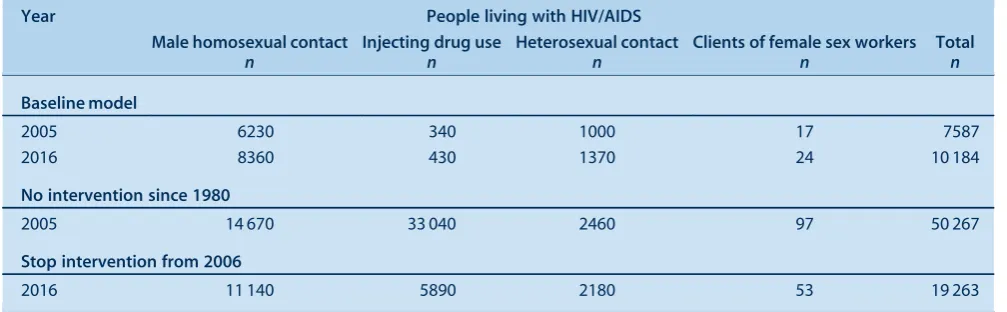
Separate projections were prepared for the period between 2006 and 2016 to assess the likely impact of terminating prevention initiatives from 2005 (Table 2). In these projec-tions, it was assumed that 50% of the estimated benefits in terms of changes in levels of sexual risk behaviour still occur without the intervention.
Under the assumptions regarding the impact of cessation of these initiatives on risk behaviours among the various population groups, HIV incidence increased among all groups, particularly injecting drug users. In these projec-tions, an additional 9100 cases of HIV were estimated to occur from 2006 to 2016 if the current prevention initia-tives were to cease at the end of 2005. This would result in an additional 9000 people living with HIV in 2016, with an associated increase in clinical care costs for the remainder of their lifetimes.
Economic model
The economic analysis examined the investment made in HIV/AIDS by the NSW Department of Health since 1981, including funds allocated to preventive and clinical care services, together with the direct clinical care costs
avoided as a result of the reduced incidence of HIV associated with the preventive activities.
The NSW Department of Health provided data on funds allocated under the program from 1981/82 to 2005/06. Total program funding was then apportioned between clinical care and prevention (where the category was the primary function of the funding) (Table 3).
In total, an estimated $1259 million was allocated under the program from 1981/82 to 2005/06 ($1606 million in 2005/06 prices), with 70% allocated to clinical care and 30% to prevention activities. Prevention funds were then apportioned to the various target populations, based on analyses undertaken by the NSW Department of Health, with $355 million (2005/06 prices) allocated across the four study population groups.
Table 1. Total number of HIV cases avoided, HIV/AIDS program, NSW 1980–2005
Group Baseline
n
No intervention
n
Cases avoided
n
Reduction %
Male homosexual contact 9843 19 479 9636 49.5
Injecting drug use 439 33 633 33 193 98.7
Heterosexual contact 1186 2806 1620 57.7
Clients of female sex workers 24 120 95 79.2
Total 11 492 56 038 44 545 79.5
Table 2. Projected number of people living with HIV/AIDS, by exposure category, NSW 2005 and 2016
Year People living with HIV/AIDS
Male homosexual contact
n
Injecting drug use
n
Heterosexual contact
n
Clients of female sex workers
n
Total
n
Baseline model
2005 6230 340 1000 17 7587
2016 8360 430 1370 24 10 184
No intervention since 1980
2005 14 670 33 040 2460 97 50 267
Stop intervention from 2006
2016 11 140 5890 2180 53 19 263
Note: Total is sum of the four exposure groups only, and excludes other subpopulations and those for whom exposure is unknown/undetermined.
Table 3. Funds allocated under the NSW HIV/AIDS program, 1981/82 to 2005/06
Allocation Original value $
2005/06 dollars $
%
Clinical care 885 338 616 1 122 299 444 69.9 Prevention 373 376 125 483 698 791 30.1
The analysis of the return on the investment in preventive activities considered two aspects:
• The financial value of the direct lifetime costs of clinical care of HIV avoided by the NSW Department of Health. The model applied standard unit clinical care costs to the 44 545 cases estimated as having been avoided to the end of 2005, until that cohort died. Direct clinical care costs were based on the previous study by Health Outcomes International and NCHECR, adjusted to 2005/06 prices.4The analysis included a Net Present Value analysis which compared the funds invested with the returns from that investment, and applied a common discount rate to the various cashflows that relate to the activities associated with the investment. Under this approach, a project is potentially worthwhile (or viable) if the Net Present Value is greater than zero; i.e. the total
discounted value of benefits is greater than the total discounted costs.
• The life years and quality adjusted life years saved as a result of the preventive activities. The values used in this study were based on those used in the previous study of needle and syringe programs by Health Outcomes International and NCHECR, which were drawn from the extant literature.4–6
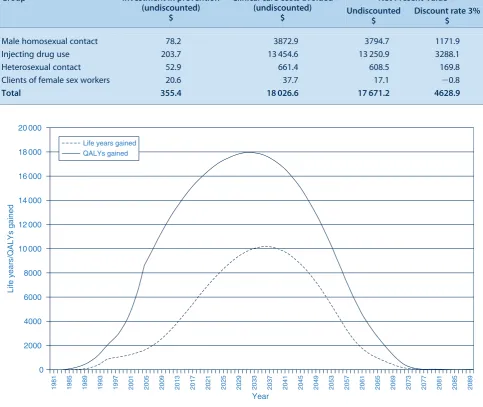
For an investment of $355 million between 1981 and 2005, a total of $18 027 million in clinical care costs would be avoided over the lifetime of those people who did not acquire HIV because of the preventive programs. The Net Present Value of these savings at a discount rate of 3% is $4629 million for the program as a whole. The Net Present Value is positive for three of the four components
Table 4. Net Present Value of the investment in NSW HIV/AIDS program to 2005 ($ million)
Group Investment in prevention
(undiscounted) $
Clinical care costs avoided (undiscounted)
$
Net Present Value Undiscounted
$
Discount rate 3% $
Male homosexual contact 78.2 3872.9 3794.7 1171.9 Injecting drug use 203.7 13 454.6 13 250.9 3288.1 Heterosexual contact 52.9 661.4 608.5 169.8 Clients of female sex workers 20.6 37.7 17.1 20.8
Total 355.4 18 026.6 17 671.2 4628.9
0
1
98
1
1
98
5
1
989 1993 199
7
2001 2005 200
9
201
3
2017 2021 2025 202
9
20
33
20
3
7
2041 2045 204
9
205
3
2057 2061 2065 206
9
207
3
2077 20
8
1
20
8
5
20
89
Year
Life ye
a
r
s
/QALY
s
g
a
ined
2000 4000 6000
8000
10 000 12 000 14 000 16 000 18000 20 000
Life years gained QALYs gained
Figure 1. Life years and quality-adjusted life years (QALY) gained by persons avoiding HIV in NSW, 1980–2090.
Source: Health Outcomes International in association with National Centre in HIV Epidemiology and Clinical Research. The impact of HIV/AIDS in NSW: mortality, morbidity and economic impact. Sydney: NSW Department of Health; 2007.
The economics of HIV prevention strategies in NSW
(homosexual contact, injecting drug use and heterosexual contact), but is negative ($0.8 million) for sex worker contact. The negative result for sex worker contact is due to the relatively small number of cases avoided (Table 4). These results also hold true for alternative discount rates of 5% and 7%.
The second component of the economic model examined the life years and quality-adjusted life years saved as a result of the investment in preventive initiatives. A total of approximately 394 000 life years were expected to be gained over the lifetime of people avoiding HIV. Of the total life years saved, 55% relate to injecting drug users, with 38% attributed to homosexual men. Life year gains among heterosexual people account for a further 6%.
In regard to the impact on quality of life, an estimated 863 000 quality-adjusted life years (QALYs) are expected to be gained over the lifetime of people who would otherwise have acquired HIV. The distribution of these two outcomes over the lifetime of people avoiding HIV is illustrated in Figure 1.
A rudimentary comparison of these results with those for several other public health preventive initiatives aimed at reducing tobacco consumption and reducing coronary heart disease indicates that the HIV/AIDS investment program compares very favourably in regard to direct health care costs saved and total benefits derived relative to the funds invested.7For example, the ratio of clinical care costs saved to funds invested in the HIV/AIDS program is estimated at 13:1 compared to 2:1 for tobacco reduction strategies, while the ratio of total benefits to funds invested for HIV/AIDS is 189:1 compared to 49:1
for tobacco reduction strategies. These results are also consistent with the recent study on the cost effectiveness of needle and syringe programs in Australia.8
Conclusion
The NSW Government investment program in HIV/AIDS has been a major public health initiative, and has been in place since the early 1980s. It has sought to achieve a balance in funding allocations between clinical care and treatment services and preventive activities. The analysis of the effectiveness of the program indicates that it has been highly successful (see Box 1). The analysis also indicates that continued investment in the preventive initiatives of the program can be expected to continue to provide benefits in each of these areas into the future.
References
1. National Centre in HIV Epidemiology and Clinical Research. HIV/AIDS, viral hepatitis and sexually transmissible infections in Australia Annual Surveillance Report 2009. National Centre in HIV Epidemiology and Clinical Research, The University of New South Wales, Sydney, NSW, 2009. Available at: http:// www.nchecr.unsw.edu.au/NCHECRweb.nsf/page/Annualþ SurveillanceþReports (Accessed 2 March 2010.)
2. Stewart K, Penny R. Containing HIV in NSW: a world class success.NSW Public Health Bull2003; 14(3): 57–9. doi:10.1071/NB03018
3. Health Outcomes International Pty Ltd in association with National Centre in HIV Epidemiology and Clinical Research. The impact of HIV-AIDS in NSW: mortality, morbidity and economic impact. Sydney: NSW Health; 2007. Available at: http://www.health.nsw.gov.au/resources/publichealth/sexual health/ImpactStatement_pdf.asp (Accessed 8 March 2010.) 4. Health Outcomes International Pty Ltd in association with
National Centre in HIV Epidemiology and Clinical Research and Centre of Health Economics. York University. Return on investment in needle and syringe programs in Australia. Commonwealth Department of Health and Ageing, 2002. 5. Tengs TO, Wallace A. One thousand health-related
quality-of-life estimates.Med Care2000; 38(6): 583–637. doi:10.1097/ 00005650-200006000-00004
6. Holtgrave DR, Pinkerton SD. Updates of cost of illness and quality of life estimates for use in economic evaluations of HIV prevention programs.J Acquir Immune Defic Syndr Hum
Retrovirol1997; 16: 54–62.
7. Commonwealth Department of Health and Ageing. Returns on Investment in Public Health: An epidemiological and economic analysis. Canberra: Department of Health and Ageing; 2003. 8. National Centre in HIV Epidemiology and Clinical Research.
Return on investment 2: evaluating the cost-effectiveness of needle and syringe programs in Australia 2009. Canberra: Australian Government Department of Health and Ageing; 2009. Box 1. Key findings fromThe impact of HIV-AIDS in NSW:
mortality, morbidity and economic impact3
A reduction in the number of cases of HIV avoided (45 000 cases avoided)
A reduction in the number of deaths from HIV (2750 deaths avoided by 2010)
Avoidance of significant clinical care costs of HIV and AIDS over the lifetime of the cases avoided (estimated at $18 000 million, undiscounted)
A positive Net Present Value in respect of the investment in preventive initiatives and the clinical care costs avoided
An increase in life-years survived by persons who would otherwise have contracted HIV (394 000 life years saved)
Gay men: current challenges and emerging
approaches in HIV prevention
John B. F. de Wit
A,E, Garrett P. Prestage
B,Cand Ian R. Duffin
DA
National Centre in HIV Social Research, The University of New South Wales
B
National Centre in HIV Epidemiology and Clinical Research, The University of New South Wales
C
Australian Research Centre in Sex, Health and Society, La Trobe University
D
Positive Life NSW
E
Corresponding author. Email: [email protected]
Abstract:While the HIV epidemic is resurging in gay communities worldwide, HIV notification rates remain stable in NSW. This outcome demon-strates the success of a well-funded partnership approach to preventing HIV infection in gay men in NSW. However, population rates of new diagnoses of HIV are similar to those seen in comparable countries and sexual risk-taking may be increasing. As the HIV epidemic has evolved, prevention in gay men has become more complex and must effectively engage with an increasing diversity of risk reduction strategies. These strategies reflect the continual adaptation of the gay community to evolving understandings of the HIV epidemic and the diverse ways in which gay men balance plea-sure and prevention.
The early responses of gay communities to HIV are widely seen as outstanding examples of effective disease preven-tion. However, the current situation is one of resurgent epidemics of human immunodeficiency virus (HIV) and other sexually transmissible infections in gay communities in post-industrial countries worldwide,1–4including Aus-tralia.5 This re-emergence has led some commentators to suggest that HIV prevention in gay men is faltering.6 Rather than suggesting an HIV prevention failure, this review of the state of the HIV epidemic and prevention in gay men in New South Wales (NSW) recognises the complexities of HIV prevention in gay men. In the absence of a tradition of condom use informed by the prevention of pregnancy or sexually transmissible infections, the uptake
of condom use by gay men in the first decade of the HIV epidemic remains a major community prevention success. However, as HIV treatments improved dramatically, some gay men saw less reason to maintain consistent condom use. There are now gay men who are making informed (and not so informed) decisions to engage in sexual practices which they know may put them at increased risk of HIV. HIV educators and health promoters need to collaborate with these men to find effective ways to minimise risk, without estranging the gay men who continue to use condoms for many if not all acts of anal sex. This article describes current trends in HIV infection in Australia and the challenges to supporting effective HIV prevention strategies in NSW.
Evolving HIV epidemic in gay men in Australia and NSW
Since 2000 the annual number of new diagnoses of HIV in Australia has increased by 38%.7Gay men continue to be the most affected, accounting for 64% of people who were newly diagnosed as having HIV infection in 2004–2008, and 82% of the infections that were determined to have been acquired no more than a year before they were diagnosed. Recent trends in new HIV diagnoses differ across Australian jurisdictions. While the population rate of HIV diagnosis doubled in Victoria between 1999 and 2006, increased markedly in South Australia and Western Australia in that period and steadily increased in Queens-land since 1999, in NSW over the past decade the rate has remained relatively stable.7,8Historically, NSW has had the highest infection rate per capita of Australian jurisdic-tions,7 but in recent years infection rates in Victoria have caught up (Figure 1). HIV infection rates in NSW are also in the range of those seen in comparable countries where the HIV epidemic mainly affects gay men, in particular Canada and The Netherlands,1while in the USA infection rates are markedly higher.1,9
Differing epidemiological trends have initiated reflection on the factors that promote success in responding to the HIV epidemic in gay men in Australia.10This process has identified partnerships between community organisations, policy makers and researchers, grounded in an adequate funding base and political support, as factors in the success-ful NSW response to HIV.11,12 Nevertheless, while HIV notifications in NSW have been stable over the past decade, an increase in rates of newly-acquired HIV infections was observed between 1998 and 2003, which may however
have been at least partly due to changes in the methods of notification.13Importantly, while national and state HIV strategies aim to contribute to a reduction in infections, this has not been achieved since the mid 1990s.5,7,8
In the past decade, rates of sexual risk behaviour in gay community-attached men, as reflected in particular by rates of unprotected anal intercourse with casual partners in Sydney, have also been relatively stable or even declin-ing, but nonetheless appear to remain higher than was the case in the early to mid 1990s.14,15Of concern is the possibility of increasing rates of unprotected anal inter-course with casual partners in HIV-negative men, as suggested by the 2009 Sydney Gay Community Periodic Survey (Table 1). Recent years have also brought steeply increased rates of sexually transmissible infections, in particular syphilis, in HIV-positive men.16,17
The potential for HIV transmission among gay men in NSW continues to be high and increases in HIV notification rates seen in other jurisdictions and overseas caution that sustained stable rates of HIV notifications in gay men
require continued vigilance and effective responses. The apparent stability of the current HIV epidemic in gay men in NSW may reflect testing patterns, HIV status knowledge and disclosure and the well-reasoned use of risk-reduction strategies that this enables. This stability in the epidemic could be undermined by the loss of prevention programs that balance support for effective risk-reduction practices and continued use of condoms.
Evolving prevention responses and approaches
From the days of the outbreak of acquired immune defi-ciency syndrome (AIDS) in the early-mid 1980s, gay men have continually found ways to adapt their prevention responses to the evolving HIV epidemic. Since the early 1990s, the gay community in NSW in particular has led the way in developing an increasingly sophisticated and com-plex array of risk-reduction strategies other than condom
use.18,19The massive uptake of HIV testing, and the
result-ing widespread knowledge of one’s HIV status, have enabled many gay men to develop sexual practices that simultaneously reduce the likelihood of HIV transmission while also ensuring that sex remains about more than preventing HIV transmission.20,21 Notably, seroadaptive behaviours,22 such as negotiated safety (i.e. unprotected anal intercourse in a stable relationship of two men who have tested negative for HIV and established agreements regarding sex and protection outside their relationship); serosorting (i.e. unprotected anal intercourse with a (casual) sex partner of similar HIV status); strategic positioning (i.e. an positive man taking the receptive role or an HIV-negative man taking the insertive role in unprotected anal intercourse); planned withdrawal and unprotected sex with HIV-positive partners with undetectable viral load, have allowed some men to lead more satisfying sex lives.
Social research in NSW and Australia has been instru-mental in documenting these community risk-reduction responses and has been pivotal in showing that not all unprotected anal sex is risky.18,19,23 These insights also provide a counterpoint to discourses that see HIV preven-tion in gay men as failing because of complacency within the community.24The practice of risk-reduction strategies
Table 1. Proportion of men participating in the Sydney Gay Community Periodic Survey who had engaged in unprotected anal intercourse with casual partners in the six months prior to the survey, by HIV status of respondent
2008 February 2008 August 2009 February 2009 August
n(%) n(%) n(%) n(%)
HIV-positive 117 (54.4) 42 (45.2) 120 (59.1) 74 (48.7) HIV-negative 287 (24.9) 106 (23.1) 345 (29.5)* 185 (30.6)* HIV status unknown 18 (20.2) 14 (25.0) 46 (33.1)* 37 (34.6)
Total 422 183 511 349
*Significant change compared with same time previous year (Feb-Feb or Aug-Aug).Source: Sydney Gay Community Periodic Survey August 2009. National Centre in HIV Social research, The University of New South Wales.
Figure 1. Newly diagnosed HIV infection, 1999–2008, by year and state and territory, Australia.
reflects the continued importance gay men attach to HIV prevention and illustrates a culture of care that values HIV prevention. Risk-reduction strategies reflect gay men’s extensive knowledge and understanding of HIV-treatment efficacy and can be understood as rational and sophisticated ways to balance risk and pleasure in times when the threat of HIV is reduced. The communities of gay men engaging with these evolving risk-reduction strategies may no longer have the goal of fully eliminating new HIV infections and accept that their behaviours carry some risk of HIV transmission and infection. Bridging the gap with the public health goal of eliminating new HIV infections will benefit from the increased use of technologies such as rapid HIV (antigen) testing and early treatment for prevention.
The National Gay Men’s Syphilis Action Plan
A testing-and-treatment approach is the cornerstone of the National Gay Men’s Syphilis Action Plan, which responds to the increased notifications of syphilis that is seen world-wide, in particular in HIV-positive gay men. This action plan underscores the importance of promoting regular testing for syphilis, and treatment if needed, in ways that reflect men’s level of sexual activity and potential exposure. When successfully implemented, this approach may not only be effective in curbing the syphilis epidemic,25but it is also acceptable to large parts of the gay community, including sexually adventurous men who engage in sex with substan-tial numbers of partners and who have moved away from consistent condom use. While the current evidence base for a direct impact of the control of syphilis and other sexually transmissible infections on HIV prevention is limited and discouraging,26when embedded in an appropriate, compre-hensive approach to HIV prevention, regular testing for sexually transmissible infection offers additional opportu-nities to address and support HIV prevention, including for gay men living with HIV (positive prevention).
Contemporary HIV prevention
HIV prevention today is perhaps more complex than it has ever been before and involves implementing respon-sive services and messages that support gay men with increasingly diverse prevention needs, preferences and practices. The daunting task of contemporary HIV pre-vention in gay men benefits from a sound understanding of the factors that shape men’s sexual and risk-reduction practices in different situations. This understanding remains limited and patchy. While it has been important to show that risk-reduction strategies are rational and informed responses, current theorising and research acknowledge that risk-reduction practices are not always enacted in reasoned ways, are influenced by a range of motivations and desires that play out in a specific situation and can be supported by advance planning.27These con-ceptual developments in health promotion theory hold substantial promise for a new generation of HIV-prevention
programs for gay men, as do evolving health promotion and communication technologies.
The normalisation of ‘gay’, the decentring of gay identity in favour of the adoption of multiple identities, the change from