Visual Secret Sharing Schemes for QR Code
________________________________________________________________________________________
Ms. M. Sukumari ME
1, A. Nisha ME
21 Assistant professor, 2 Student
1 2 Department of Computer Science and Engineering, Rajas International Institute of Technology for women
Abstract— In this project, a novel visual secret sharing (VSS) scheme for QR code (VSSQR) was proposed with (n, n) threshold
based on high capacity, admirable visual effects and popularity of color QR code. By splitting and encoding a secret image into QR
codes and then fusing QR codes to generate QR code shares, the scheme can share the secret among a certain number of
participants. However, less than n participants cannot reveal any information about the secret. The embedding amount and
position of the secret image bits generated by VSS are in the range of the error correction ability of the QR code. On one hand, the
secret image can be reconstructed by first decomposing three QR codes from each QR code share.Then stacking the corresponding
QR codes based on only human visual system without computational devices. On the other hand, by decomposing three QR codes
from each QR code share and then XORing the three QR codes respectively, we can reconstruct the secret image lossless.
Index Terms—Visual secret sharing, general access structures, multiple secrets, information-theoretic security.
INTRODUCTION
1.1 COMPUTER FORENSICS
Computer forensics (also known as computer forensic science)
is a branch of digital forensic science pertaining to evidence
found in computers and digital storage media. The goal of
computer forensics is to examine digital media in a
forensically sound manner with the aim of identifying,
preserving, recovering, analyzing and presenting facts and
opinions about the digital information. Although it is most
often associated with the investigation of a wide variety of
computer crime, computer forensics may also be used in civil
proceedings. The discipline involves similar techniques and
principles to data recovery, but with additional guidelines and
practices designed to create a legal audit trail.
1.2 SECRET SHARING
Secret sharing (also called secret splitting) refers to methods
for distributing a secret amongst a group of participants, each
of whom is allocated a share of the secret. The secret can be
reconstructed only when a sufficient number, of possibly
different types, of shares are combined together; individual
shares are of no use on their own.
In one type of secret sharing scheme there is one dealer and n
players. The dealer gives a share of the secret to the players,
but only when specific conditions are fulfilled will the players
be able to reconstruct the secret from their shares. The dealer
accomplishes this by giving each player a share in such a way
that any group of t (for threshold) or more players can together
reconstruct the secret but no group of fewer than t players can.
Such a system is called a (t, n)-threshold scheme (sometimes it
is written as an (n, t)-threshold scheme).
APPLICATIONS OF SECRET SHARING
A secret sharing scheme can secure a secret over multiple
servers and remain recoverable despite multiple server
failures. The dealer may act as several distinct participants,
distributing the shares among the participants. Each share may
be stored on a different server, but the dealer can recover the
secret even if several servers break
down as long as they can recover at least t shares; however,
crackers that break into one server would still not know the
secret as long as fewer than t shares are stored on each server.
This is one of the major concepts behind the Vanish computer
project at the University of Washington, where a random key
across several nodes in a P2P network. In order to decrypt the
message, at least t nodes on the network must be accessible;
the principle for this particular project being that the number
of secret-sharing nodes on the network will decrease naturally
over time, therefore causing the secret to eventually vanish.
However, the network is vulnerable to a Sybil attack, thus
making Vanish insecure.
Consequently, although tools and techniques such as Vanish
can make data irrecoverable within their own system after a
time, it is not possible to force the deletion of data once a
malicious user has seen it. This is one of the leading
conundrums of Digital Rights Management.
1.3 VISUAL CRYPTOGRAPHY
Visual cryptography is a cryptographic technique which
allows visual information (pictures, text, etc.) to be encrypted
in such a way that decryption becomes the job of the person to
decrypt via sight reading. One of the best-known techniques
has been credited to Moni Naor and Adi Shamir, who
developed it in 1994. They demonstrated a visual secret
sharing scheme, where an image was broken up into n shares
so that only someone with all n shares could decrypt the
image, while any n − 1 shares revealed no information about
the original image. Each share was printed on a separate
transparency, and decryption was performed by overlaying the
shares. When all n shares were overlaid, the original image
would appear. There are several generalizations of the basic
scheme including k-out-of-n visual cryptography. Using a
similar idea, transparencies can be used to implement a
one-time pad encryption, where one transparency is a shared
random pad, and another transparency acts as the ciphertext.
Normally, there is an expansion of space requirement in visual
cryptography. But if one of the two shares is structured
recursively, the efficiency of visual cryptography can be
increased to 100%.Some antecedents of visual cryptography
are in patents from the 1960s. Other antecedents are in the
work on perception and secure communication. Visual
cryptography can be used to protect biometric templates in
which decryption does not require any complex computations.
(2, N) VISUAL CRYPTOGRAPHY SHARING CASE
Sharing a secret with an arbitrary number of people N such
that at least 2 of them are required to decode the secret is one
form of the visual secret sharing scheme presented by Moni
Naor and Adi Shamir in 1994. In this scheme secret image
which is encoded into N shares printed on transparencies. The
shares appear random and contain no decipherable information
about the underlying secret image, however if any 2 of the
shares are stacked on top of one another the secret image
becomes decipherable by the human eye.
Every pixel from the secret image is encoded into multiple
subpixels in each share image using a matrix to determine the
color of the pixels. In the (2,N) case a white pixel in the secret
image is encoded using a matrix from the following set, where
each row gives the subpixel pattern for one of the components.
For instance in the (2,2) sharing case (the secret is split into 2
shares and both shares are required to decode the secret
complementary matrices to share a black pixel and identical
matrices to share a white pixel was used. Stacking the shares
the user has all the subpixels associated with the black pixel
now black while 50% of the subpixels associated with the
white pixel remain white.
1.4 OVERVIEW OF THE PROJECT
The secret sharing (SS) scheme is a cryptosystem which
encrypts a secret into multiple shares so that any qualified
combination of shares can reconstruct the secret, while any
forbidden combination of shares reveals no information about
the secret.
2 SYSTEM ANALYSIS
2.1 EXISTING SYSTEM
An extended visual cryptography scheme (EVCS), for an
access structure (ᴦQual; ᴦForb) on a set of n participants, is a
technique to encode n images in such a way that when stack
together the transparencies associated to participants in any set
X єᴦQual get the secret message with no trace of the original images, but any X єᴦForb has no information on the shared
image. Moreover, after the original images are encoded they
are still meaningful, that is, any user will recognize the image
on his transparency. The main contributions of the proposed
system are the following: A trade-off between the contrast of
the reconstructed image and the contrast of the image one ach
transparency for (k; k)-threshold EVCS (in a (k; k)-threshold
EVCS the image is visible if and only if k transparencies are
condition for the existence of (k; k)-threshold EVCS for the
values of such contrasts. In case a scheme exists explicitly
construct it. A general technique to implement EVCS, which
uses hypergraph colourings. This technique yields (k;
k)-threshold EVCS which are optimal with respect to the pixel
expansion. Finally, some applications are discussed for this
technique to various interesting classes of access structures by
using relevant results from the theory of hypergraph
colourings.
2.1.1 DISADVANTAGES
Less security
High complexity
Slow transmission
Time consumption is more
2.2 PROPOSED SYSTEM
The aim of the proposed system is to maximize the range of
the access control of VSS schemes encrypting multiple
images. As a first step, the preliminary version maximally
generalized the formulations of access structures and VSS
schemes for multiple secrets, and then provided a construction
of VSS schemes of the most general form. This project
provides further developments of this generalization. First, this
project justifies the above construction in a more general
framework. More precisely, this project introduces a more
general construction which includes the previous one as a
special case. In particular, this inclusion is strict in the sense
that the former (Construction 11) can generate VSS schemes
with strictly better contrast and pixel expansion than the latter.
Then, this project proves that for any given access structure of
the most general form, the former indeed generates a VSS
scheme realizing the access structure and also the latter is a
special case of the former this completes the justification of
the latter construction. Here, to describe the former
construction, the proposed system has introduced two notions
which together with the proofs to characterize and justify the
construction reveal a sufficient condition to be satisfied by the
encryption of VSS schemes for multiple secrets. Moreover, it
is demonstrated that for threshold access structures, the latter
construction generates VSS schemes with the same pixel
expansion as (k, n, s)-MVCS and (k, n, s, R)-MVCS. Finally,
the optimality of the former (more general) construction is
examined, giving that there exist access structures for which it
generates no optimal VSS schemes.
2.2.2 ADVANTAGES
Avoid leakage of information
Better access structure
High security
Fast transmission of visual secrets in images
Here, the sets of the qualified combinations and the forbidden
combinations are called a qualified set and a forbidden set,
respectively, and the pair of the qualified and forbidden sets is
called an access structure. A typical example of SS schemes is
the (k, n)-threshold SS scheme, in which a secret is encrypted
into n shares so that any k or more shares can reconstruct the
secret, while any k – 1 or less shares leak no information about
the secret. In contrast to the ordinary cryptosystems, there
exist SS schemes whose decryption can be performed by
humans without any numerical computations.
The visual secret sharing (VSS) scheme is an example of such
SS schemes. This scheme encrypts a visual secret into visual
shares so that humans can visually reconstruct the secret with
their eyes by superposing a qualified combination of visual
shares each printed on a transparency. One of the applications
in which VSS schemes are essential is for the authentication
by a human recipient without any trusted communication
channels. More precisely, the problem here is to authenticate a
message from an informant to a human recipient through an
insecure channel which is under full control of an adversary.
This arises, for example, in the interactions between a human
and an electronic device without screen such as a smartcard. It
is hard to provide a solution to this problem without assuming
a secure channel and the authentication based on VSS
schemes, called the visual authentication has been the only
secure solution.
3.SYSTEM DESIGN
Systems design is the process of defining the
architecture, modules, interfaces, and data for a system to
satisfy specified requirements. Systems design could be seen
as the application of systems theory to product development. It
involves the identification of classes their relationship as well
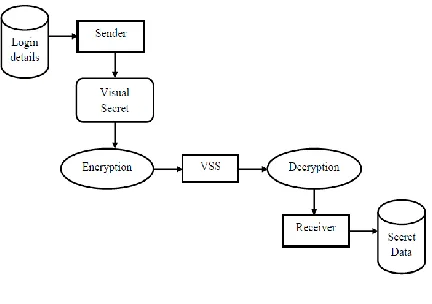
Fig 3.1.1 System Architecture
In this figure 3.1.1, it shows that the access structure
was generated to obtain the secret image then the accurate
condition was provided to perform the encryption and the
threshold access structure was applied to generate the no
optimal solution.
4.SYSTEM IMPLEMENTATION
4.1.1 FORMULATION OF ACCESS STRUCTURE
The formulation of visual sharing scheme was
provided by encrypting multiple images. That is the secret
image is splited and it is encrypted in the form of multiple
images it was formed by having two matrix for describing the
security and construction of VSS. Let S = {s1, s2, · · · ,sn} be
an ordered set of size n, and a be an ordered subset of S of size
n_. For an n_ ×m matrix M = (mi j), let [M]a denote the n × m
matrix defined by ([M]a)i j =_mod a (si ) j if si∈ a, 1
otherwise.
The matrix [M]a is called the super matrix of M with
respect to a. For an n×m matrix M = (mi j), let [M]a denote the
n_×m submatrix of M defined by ([M]a)orda(si ) j = mi j for
si∈ a. The matrix [M]a is called the submatrix of M with
respect to a. The submatrix with respect to the empty set ∅ is
defined to be the empty string ε; i.e. [M]∅ = ε for all M.
Access Structure for Multiple Secrets was given as Let S be a
finite set, and q ∈ N. For i∈ [q], let AiQ and AiF be subsets of
2S such that AiQ∩ AiF= ∅. The pairs ᴦq of the subsets AiQ
and AiF = ᴦ (AiQ ,AiF)i=1, is called an access structure on S
for q secrets if AiQ and AiF satisfy the monotonicity .Then the
theequivalenmce between the two structures are generated.
4.1.2 VSS SCHEME
In the VSS schemes, the secrets and shares are both
visual, and their decryption can visually be performed by
human eyes. Each black-white pixel in a secret image is
encrypted into a set of black-white subpixels in shares. Hence,
the encryption of each pixel can be represented as a pair of
matrices Cb= (Cbij )with b ∈ {0, 1}, where b = 0 for a white
pixel in a secret image and b = 1 otherwise, and Cbi j = 0 for a
white j -th subpixel in the i-th share and Cbi j = 1 otherwise. A
secret image is encrypted into two shares. Each share is
indistinguishable from noise images, and so leaks no
information about the secret. On the other hand, the secret
image can be reconstructed when both of the shares are
superposed. This can be constructed as follows.
A pixel e in the secret image is encrypted into two
subpixels in each of the two shares. If e is white (resp. black).
The superposition of the two shares has one black subpixel
and one white subpixel (resp. two black subpixels) if e is
white (resp. black). This construction can be represented by
the sets C0 and C1 of matrices more precisely, the above
encryption and decryption can be represented by the functions
Enc : {0, 1} → {0, 1}2×2 and Dec : {0, 1}2×2 → {0, 1}2
given by Enc(b) = CbUand Dec(M) = (m11 ∨m21,m12 ∨m22)
for b ∈ {0, 1} and M = (mi j ) ∈ {0, 1}2×2, respectively,
where ∨ denotes the OR operation.
4.1.3 PIXEL EXPANSION
The relative difference in gray level between
superposed shares that come from a white pixel and a black
pixel in the secret image is called the contrast. In the above
example, the reconstructed pixel has a gray level of 2/2 = 1 if
e is black, and a gray level of 1/2 if e is white; therefore,
Contrast = 2/2−1/2= ½. The higher contrast makes it easier to
recognize reconstructed images. The number of subpixels in
shares encrypted from a pixel in a secret is called the pixel
expansion.
In the above example, a pixel in a secret is encrypted
into two subpixels in shares; therefore, Pixel expansion = 2.
The lower pixel expansion allows the more practical
resolution of share images. A VSS scheme and its encryption
4.1.4 DECRYPTION
In general, it is difficult to examine the optimality of SS
schemes realizing a general access structure in fact, the
optimality has been shown so far only for very limited classes
of SS schemes such as threshold SS schemes threshold VSS
schemes and (non-perfect) uniform SS schemes. Hence,
instead of directly examining the optimality, examine the
possibility that the optimality of Construction may be reduced
to that of each encryption Enci. For this purpose, consider first
a simple access structure = (AiQ, AiF)ϵi=1 on S = {s1, s2} for
2 secrets,. This access structure can be realized by a VSS
scheme with the (deterministic) encryption given by Enc(b) =
b1b2 for b ∈ {0, 1}, while any VSS scheme generated by
Construction has the pixel expansion no less than 2. Note that
the above matrix is the concatenation of the basis matrices
Cb11,1 and Cb21,1 with respect to the row (not column). Then
construct an optimal VSS scheme realizing by defining its
encryption to be the concatenation of {Enc_i}iwith respect to
the row . Hence the optimal pixel expansion for _ is maxi mi
and it generates the no optimal VSS scheme. The recipient
retrieves the secret information from the encrypted multiple
images by decryption. Decryption is done by superimposing
the n shares.
CONCLUSION
This project provides an application of our VSS schemes. In
the authentication based on VSS schemes encrypting a single
secret image, one way to detect tampering by an adversary is
to divide the secret image into two disjoint areas: one for a
message and the other for the detection. On the other hand,
VSS schemes encrypting multiple images allow the
authentication in which Shares 1 and 3 are distributed to a
human recipient, Share is generated by an informant, and the
two secrets v1 and v2 are taken to be an all-black image for the
detection and an image for a message, respectively. This
authentication, equipped with the idea behind the third method
―black and gray‖ in ensures that an adversary cannot tamper
with the latter image without tampering with the former,
which makes its security analysis simpler and more practical.
FUTURE ENHANCEMENT
This project can be further modified in future to investigate
this authentication more in detail. In the Proposed work the
visual secret data’s are send directly to the receiver, this can be modified by sending the secret visual data’s to the cloud
and then to the recipient.
REFERENCES
[1]. C. Blundo, P. D’Arco, A. D. Santis, and D. R. Stinson (2003), ―Contrast optimal threshold visual cryptography schemes,‖ SIAM J. Discrete Math., vol. 16, no. 2, pp. 224–261
[2]. Y.-C. Chen (2017), ―Fully incrementing visual
cryptography from a succinct non-monotonic structure,‖ IEEE
Trans. Inf. Forensics Security, vol. 12, no. 5, pp. 1082–1091.
[3]. S. Cimato, R. de Prisco, and A. de Santis (2005),
―Optimal colored threshold visual cryptography schemes,‖
Des., Codes Cryptogr., vol. 35, no. 3, pp. 311–335.
[4]. Y. Desmedt, S. Hou, and J.-J. Quisquater (1998), ―Audio
and optical cryptography,‖ in Advances in Cryptology—
ASIACRYPT (Lecture Notes in Computer Science), vol.
1514. Berlin, Germany: Springer-Verlag, pp. 392–404.
[5]. M. Naor and B. Pinkas, ―Visual authentication and identification,‖ in Advances in Cryptology—CRYPTO
(Lecture Notes in Computer Science), vol. 1294. Berlin,
Germany: Springer-Verlag, 1997, pp. 322–336.
[6]. M. Sasaki and Y. Watanabe (2014), ―Formulation of visual secret sharing schemes encrypting multiple images,‖ in
Proc. 39th IEEE Int. Conf. Acoust., Speech Signal Process.
(ICASSP), pp. 7391–7395.
[7]. S. J. Shyu (2014), ―Threshold visual cryptographic scheme with meaningful shares,‖ IEEE Signal Process. Lett.,
vol. 21, no. 12, pp. 1521–1525.
[8]. S. J. Shyu, S.-Y. Huang, Y.-K. Lee, R.-Z. Wang, and K.
Chen(2007), ―Sharing multiple secrets in visual cryptography,‖ Pattern Recognit., vol. 40, no. 12, pp. 3633–
3651.
[9]. R. Z. Wang (2009), ―Region incrementing visual cryptography,‖ IEEE Signal Process. Lett., vol. 16, no. 8, pp.
659–662.
[10]. C.-N. Yang and T.-H. Chung (2010), ―A general
multi-secret visual cryptography scheme,‖ Opt. Commun., vol. 283,