1
B. Deekshita
2
V. Srikumari
3
K. Madhavi
CORRESPONDING AUTHOR
1B. Deekshita
MPT (Neurology)
College of Physiotherapy,
Sri Venkateswara Institute of Medical Sciences, (SVIMS)
Int J Physiother. Vol 1(5), 242-247, December (2014) ISSN: 2348 - 8336
ABSTRACT
Background: Stroke is an acute onset of neurological dysfunction resulting in the most common disability. Balance among these stroke subjects is impaired. To determine the effect of task oriented exercises on standing balance in subjects with stroke using performance oriented tinetti assessment score and single leg stance time is the need if the study.
Methods: Participants were taken from outpatient department of physiotherapy and neurology department in the institute. Randomized controlled trial with Prospective experimental design with simple random sampling including 30 subjects. An inclusion criterion includes stroke subjects with age 40- 75, both genders who were confirmed as stroke subjects by MRI n CT scan investigations. Right or left hemiplegia who are conscious and coherent were included. Subjects with spinal injuries, cognitive, perceptual disorders, shoulder subluxations, cardiac problems were excluded. Participants received daily 45 minutes of task oriented exercises protocol for 6days a week for 6weeks for study group and conventional physiotherapy for control group.
Results: Performance oriented tinetti assessment score and Single leg stance time which is valid and reliable measure for balance in stroke subjects was used. There is a significant improvement in performance oriented tinetti assessment score and single leg stance time from baseline to the end of
intervention with significance (P<0.01) existing between the baseline and 6th week in both variables.
Conclusion: Task oriented exercises appeared effective in improving standing balance in subjects with stroke. Single leg stance duration improved on task oriented exercise approach.
Keywords: Stroke, standing balance, task oriented exercises, single leg stance.
2Assistant Professor,
Sri Venkateswara Institute of Medical Sciences, (SVIMS), Tirupati.
3Principal,
Received 21th July 2014, revised 01st October 2014, accepted 06th October 2014
www.ijphy.org
INTRODUCTION
Stroke is an acute onset of neurological dysfunction due to an abnormality in cerebral circulation with resultant signs and symptoms that corresponds to
involvements of focal areas of brain.1The WHO
rates this as the third biggest health problem with India the second highest incidence rate in the world. The incidence of the disease in India to be around 130 per 100,000 population every year and says about 20% of heart patients are susceptible to
it.2
The disease has turned out to result in most common disability and dependence with more than 70% of stroke survivors remaining vocationally impaired and more than 30%
requiring assistance with activities for daily living.3
The resulting paralysis after stroke reduces motor skills and related functional abilities. After stroke, the recovery of balance is considered to be of crucial importance to achieve autonomy in
activities of daily living4. Both static and dynamic
balance can be improved by various physiotherapy treatment approaches. Several techniques have been developed to improve daily living activities like sitting, standing and walking without
assistance devices.5
Balance impairment after stroke results in loss of static and dynamic balance with decreased proprioception, somatosensory and vestibular function. Balance re-education is very important
in post stroke rehabilitation.6 Through specific
physical exercises, balance re-reduction enables patients to regain or improve balance and better control over activities of daily living. Therapists are using different exercise modalities such as balance board, sit-fits, Swiss ball therapy, and individually designed exercises to help patients to
improve balance and physical wellbeing as well.7, 8
Task oriented exercises are very helpful in improving balance and activity levels of the patients especially after stroke. These exercises have been used for quite a long time by physiotherapists as an effective means of
improving balance.9 Several researchers have
experimented various surfaces in training balance to add to the effectiveness of task oriented
exercises.10 This approach includes a wide range of
interventions such as treadmill training, walking training on the ground, bicycling programmes, endurance training and circuit training, sit-to-stand exercises, and reaching tasks for improving balance. In addition, use is made of arm training
using functional tasks such as grasping objects, and
mental imagery.11,12
Present study uses task oriented exercises to improve standing balance in subjects with post stroke. The decreased ability to maintain static and dynamic balance after stroke could be related to the inability to select reliable sensory information
(visual, vestibular, somatosensory systems)
Exercise interventions, in the form of task-oriented exercise programmes, are now recognized as a new strategy to improve the functional status of stroke
individuals.13
MATERIALS AND METHODOLOGY
Task oriented exercises is a new strategy to improve static and dynamic balance after stroke and improve process of somatosensory integration.
It is used to stimulate awareness and
proprioception, balance, coordination.14,15 Aim of
the study is to evaluate the effectiveness of task oriented exercises on standing balance in subjects with stroke. Subjects were recruited from the department of physiotherapy OP, general ward and neurology OPD of the institute. A randomized controlled trail, prospective experimental design with pretest- post test design. Total 30 subjects with 15 in each group fulfilling inclusive criteria which includes stroke subjects with age between 40-75 years, both male and female with both right and left hemiplegic hemorrhagic type between 1 week to 3 months from onset of stroke who are conscious coherent with no other comorbidity Stroke subjects able to stand with tinetti balance score<10.Stroke subjects with cardiopulmonary dysfunctions, shoulder subluxation, poor GCS orthopaedic surgeries (TKR/THR) were excluded.
Procedure:
Participants are provided with full explanation and information sheet, written consent was taken from them after going through the information sheet. Information to the relevant medical team was given and suggestions were accepted for each individual participant .Data was collected over 6 weeks the lead researcher recorded all outcomes and provided all therapy except during the period of absence, when an alternate researcher covered this.
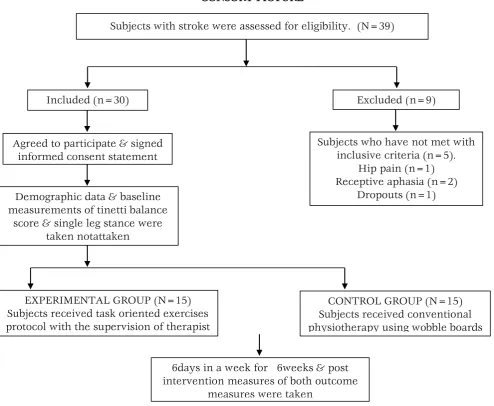
CONSORT PICTURE
Table – 1 Demographic data of the subjects in both experimental and control groups
variables
Experimental group (mean+/-SD)
Control group (mean+/-SD)
p-value (2 tailed)
Age 49.57+/-9.39 51.73+/-6.37 0.281
Sex M:F 9:6 11:4 X2 =3.595, p=0.084
Height (cm) 157.93+/-2.537 157.53+/-3.218 0.48
Intervention phase began immediately after baseline and lasted for 6weeks, lead researcher was provided with task oriented protocol. Treatment protocols were designed by the lead researcher
after discussing with the senior
neurophysicaltherapist, and they were unique and changes every week according the participants standing recovery, acceptance level. Intervention was given to experimental group with informed consent. It includes stepping forward, backward and sideways. Stepping over blocks of various heights. Standing up from a chair, walking 4 steps
chair, walking 4 steps forward, turning to right, stepping over the exercise step. Turning to right again and walking forwards to chair. (repeat circuit in opposite direction) Performing double leg stance for 10 sec. Performing tandem stance for 10 sec. Rising from chair without using arms. Walking forward and backward with tandem walking. Performing single leg stance for 10 sec. 45 min. per day, 6days per week, 6wks. For experimental group and conventional physiotherapy for control group.
RESULTS
Subjects with stroke were assessed for eligibility. (N=39)
Included (n=30) Excluded (n=9)
Agreed to participate & signed informed consent statement
Demographic data & baseline measurements of tinetti balance
score & single leg stance were taken notattaken
Subjects who have not met with inclusive criteria (n=5).
Hip pain (n=1) Receptive aphasia (n=2)
Dropouts (n=1)
EXPERIMENTAL GROUP (N=15) Subjects received task oriented exercises protocol with the supervision of therapist
CONTROL GROUP (N=15) Subjects received conventional physiotherapy using wobble boards
6days in a week for 6weeks & post intervention measures of both outcome
balance score with total score ranges from 0–24. Tinetti Assessment Tool mainly assesses body structure (impairments), but Tinetti Balance Test evaluates activities (limitations to activity-disability): mobility = changing & maintaining body position. Single leg stance time is one of the most challenging gauges of stability while standing on a narrow area of support” and averred it to be the most frequently used measure of balance I n physical training studies involving older adults. It has reliability and is a valid standing assessment tool. Primarily data was analyzed by trend (direction in which the series of score is progressing). Change scores were calculated as the difference between baseline scores and the maximal scores attained in the intervention Conformation of visual interpretation of data is enhanced by conforming through statistical
analysis. To observe the statistical significance as
well as the trend between baseline and 6th week
paired samples t test has been performed for the variables tinetti balance score and single leg stance time separately. To verify whether there is a trend in both variables curve fitting technique is applied. All 30 participants with 15 in each experimental and 15 in control group completed all phases based on the respective group protocols with no adverse effects. This was considered to be a positive result. Tinetti balance scores and total change scores for each participant. Improvement occurred in all the
30 participants from 1st week to 6th week in both
experimental and control groups. Improvements in scores differed in both groups. In experimental group change of scores ranged from 7 to 13.6 ( mean). In control group change of scores ranged from 6.4 to 9.06(mean)
Table-2 Analysis of tinetti balance score in pre and post intervention in experimental group
Table-3 Analysis of tinetti balance in control group
Group Parameter N mean deviation Standard t-value p-value
control Tinetti balance pre 15 6.4 1.404 12.64 <0.05
post 15 9.06 1.162
The total Single leg stance timescores across the baseline and intervention showed a positive change in trend in all participants.all showed a period of latency before change in total scores was
evident,these periods of latency ranged from 1st
week to 3rd week.Improvements were seen in all
subsections for 30 participants.
Table-4 Analysis of single leg stance in pre and post intervention in experimental group
Group parameter N mean Standard
deviation t-value p-value
experimental Single leg
stance
pre 15 6.53 2.263
22.52 <0.05
post 15 14.6 2.995
Table-5 Analysis of single leg stance in control group
Group parameter N mean Standard
deviation t-value p-value
experimental
Performance oriented tinetti
balance
pre 15 7 1.851
18.33 <0.05
post 15 13.4 2.693
Group parameter N mean deviation Standard t-value p-value
control Single leg
stance
pre 15 6 1.690 6.32
<0.05
Table-6 Between the groups post intervention scores
groups N Mean Std. Deviation
TINETTI BALANCE
ASSESMENT Experimental 15 6.4 1.35225
control 15 2.6667 0.8165
SINGLE LEG STANCE Experimental 15 8.0667 1.38701
control 15 2.6667 1.63299
Graph-1
Graph-2
DISCUSSION
This study has explored the effects of task oriented exercises on standing balance in the sub-acute phase of rehabilitation after stroke. We found
improvement in standing balance and
performance of activity in 30 participants, with clear difference in total single leg stance time and performance oriented tinetti balance scores
between baseline and 6th week of intervention.
Even though risk for mortality is more in ICH stroke clients, there is an evidence of good
associated with any intra ventricular bleed, poor GCS and midline shift.
The significant results of the current study are may be due to absence of factors responsible for poor prognosis. Other factors responsible for significant results are early recruitment of participants into intervention after ictus i,e., ranged from 2-10 weeks after ictus. Due to early recruitment after ictus task oriented exercises has enhanced standing balance by minimizing the unbalanced forces and adapting better stability to perform activity.
Even though the baseline scores of performance oriented tinetti balance showed least scores in few participants, showed better results along with other participants after intervention. Single leg stance time improved along with balance and stability. Feber MJ et al in their studies, stated that
Performance Oriented Mobility Assessment
(POMA) measures both static and dynamic balance using tasks testing balance and gait
The current study supports the early hypothesis which states significant proprioception and
somatosensory54 information to brain, facilitating
direct brain activation to maintain standing balance. As a result it is evident that task oriented exercises activate the standing balance and the ability to perform activity with good stability.
Katz-Leurer et al. in his two studies performed
with patients in the chronic phase has shown. In one study that the effects on stroke survivors of a task-oriented exercise programme were compared with altered sensory input.
Pollock et al in his study, three small studies of good quality focusing on task-oriented exercises and using functional outcome measures were identified and reviewed.
In the present study scores of performance oriented tinetti balance showed latency in improving scores. Latency in scores was proportional to the severity in balance impairment.
6.4
2.6667
0 1 2 3 4 5 6 7
Experimental control
TINETTI BALANCE ASSESMENT
TINETTI BALANCE ASSESMENT
8.0667
2.6667
0 1 2 3 4 5 6 7 8 9
Experimental control
SINGLE LEG STANCE
exercises in improvising the standing balance and performance.
Statistical results signify the differences in the
performance oriented scores at 6th week showed
better results in the intervention group than the control group. Ability to perform activity was better in the intervention group
CONCLUSION
The study for 6 weeks using task oriented exercises appeared to be effective in improving standing balance and performance of activity in subjects with stroke. The latency for change in the improvement changes with the severity in balance impairment. Recovery was noted better in single leg stance time with the participants in the intervention group compared to control group. Task oriented exercises is a focused intervention in improving the ability to perform a task.
Quality of life was better in the intervention group
after 6th week than the control group. Tinetti
balance scores showed better results from baseline
to 6th week. Task oriented exercises appeared
effective in improving standing balance in subjects with stroke. Single leg stance duration improved on task oriented exercise approach. Intervention is beneficial in improving standing balance in stroke subjects.
REFERENCES
1. Kathlen strong,colin mathers, ruth bonita.
Preventing stroke: saving lives around the world. Lancet Neurol. 2007;6(2):182-7
2. Banerjee T, dass. Epidemiology of stroke in
India.Neurology Asia 2006; 11: 1 – 4.
3. FionaC Taylor, suresh kumarK. stroke India
fact sheet ( updated 2012).
4. FeiginV, LawesC,BennetCelloS, ParagV.
Worldwide stroke incidence and early case
fatality in 56 population based studies; a systemic review. Lancet neurol. 2009; 8(4): 355-369.
5. Susan B.O’ Sullivan, Thomas J. Schmity.
Physical rehabilitation. 5th edition; 2007.
6. A m bronstein, t brandt. Clinical disorder of
balance disorders, gait and posture. J Neurol
Neurosurg Psychiatry. 1997; 63:415.
7. David Good. Handbook of Neurorehabilitation.
1st Edi; 1994.
8. Dean CM, Shepherd RB. Task- related training
improves performance of seated reaching tasks after stroke, A randomized controlled trial. Stroke.1997; 28(4); 722-8.
9. Raymond D Adams, Maurice Victor, Allan H.
Ropper. Principles of Neurology, 6th Edi; 1997.
10.Ottawa Panel, Khadilkar A, Phillips K, et al,
Ottawa Panel. Evidence-based clinical practice guidelines for post-stroke rehabilitation; Top Stroke Rehabil. 2006 Spring; 13 (2); 1-269.
11.Chen IC, Cheng PT, Chen CL, et al. Effects of
balance training on hemiplegic stroke patients. Chang Gung Med J.2002; 25(9): 583-90.
12.Duncan P, Studenski S, Richards L, et al.
Randomized clinical trial of therapeutic exercise in sub acute stroke. Stroke. 2003; 34(9):2173-80.
13.Bayouk, Jean-Francois A, Boucher, et al.
Balance training following stroke: effects of task oriented exercises with and without altered sensory input. International Journal of Rehabilitation Research. 2006; 29(1):51-59.
14.Jang SH, Kim YH, Cho SH, et al. Cortical
reorganization induced by task- oriented training in chronic hemiplegic stroke patient. Neuroreport. 2003;14(1):137-41.
15.Lehman GJ, Hoda W, Oliver S. Trunk muscle
activity during bridging exercises on and off a
Swiss ball. Chiropractic & Osteopathy. 2005;
13:14.
Citation
B. Deekshita, V. Srikumari & K. Madhavi. (2014). EFFECT OF TASKORIENTED EXERCISES ON
STANDING BALANCE IN SUBJECTS WITH STROKE. International Journal of Physiotherapy,1(5),