A proximal approach for constrained cosparse modelling
Giovanni Chierchia, Nelly Pustelnik, Jean-Christophe Pesquet, B´
eatrice
Pesquet-Popescu
To cite this version:
Giovanni Chierchia, Nelly Pustelnik, Jean-Christophe Pesquet, B´
eatrice Pesquet-Popescu. A
proximal approach for constrained cosparse modelling. Acoustics, Speech and Signal Processing
(ICASSP), 2012 IEEE International Conference on, Mar 2012, Kyoto, Japan. pp.3433 - 3436,
2012,
<
10.1109/ICASSP.2012.6288654
>
.
<
hal-00826002
>
HAL Id: hal-00826002
https://hal.archives-ouvertes.fr/hal-00826002
Submitted on 28 May 2013
HAL
is a multi-disciplinary open access
archive for the deposit and dissemination of
sci-entific research documents, whether they are
pub-lished or not.
The documents may come from
teaching and research institutions in France or
abroad, or from public or private research centers.
L’archive ouverte pluridisciplinaire
HAL
, est
destin´
ee au d´
epˆ
ot et `
a la diffusion de documents
scientifiques de niveau recherche, publi´
es ou non,
´
emanant des ´
etablissements d’enseignement et de
recherche fran¸
cais ou ´
etrangers, des laboratoires
publics ou priv´
es.
A PROXIMAL APPROACH FOR CONSTRAINED COSPARSE MODELLING
G. Chierchia,
1N. Pustelnik,
2J.-C. Pesquet,
3and B. Pesquet-Popescu,
1 1T´el´ecom ParisTech/Institut T´el´ecom, LTCI, UMR CNRS 5141, 75014 Paris, France 2Laboratoire de Physique de l’ENS Lyon, UMR CNRS 5672, F69007 Lyon, France
3Universit´e Paris-Est, Lab. d’Informatique Gaspard Monge, UMR CNRS 8049, 77454 Marne la Vall´ee, France
ABSTRACT
The concept of cosparsity has been recently introduced in the arena of compressed sensing. In cosparse modelling, theℓ0(orℓ1) cost of an analysis-based representation of the target signal is minimized un-der a data fidelity constraint. By taking benefit from recent advances in proximal algorithms, we show that it is possible to efficiently address a more general framework where a convex block sparsity measure is minimized under various convex constraints. The main contribution of this work is the introduction of a new epigraphical projection technique, which allows us to consider more flexible data fidelity constraints than the standard linear or quadratic ones. The validity of our approach is illustrated through an application to an image reconstruction problem in the presence of Poisson noise.
Index Terms— Signal restoration, compressed sensing,
itera-tive methods, optimization methods, wavelet transforms.
1. INTRODUCTION
The tremendous research activity in the field of sparse modelling and compressed sensing [1, 2] has been at the root of novel signal/image processing concepts. Among the most appealing ideas, the concept of cosparsity has been introduced [3] to extend the standard approach where theℓ0cost (or itsℓ1convex relaxation) of the target signal is minimized under a linear constraint accounting for the observation model. In cosparse modelling, a sparsity measure of a linear trans-formationF xof the sought signalxis minimized subject to a linear constraint. In the presence of noise this constraint is usually replaced by a quadratic one of the form
kT x−zk2≤η (1)
wherezis the vector of observations,T is the linear operator mod-elling the observation process andηis a positive bound related to the variance of the noise. Instead of considering a standardℓ0orℓ1cost function, it may be fruitful to consider more general block or group sparsity measures [4, 5, 6, 7] for which appropriate algorithmic tools can also be developed.
For a long time in signal and image processing, it has been rec-ognized that incorporating as many available information as possible on the sought solution to an inverse problem is beneficial to the es-timation performance. POCS algorithm [8] and its extensions have been developed to iteratively compute the solution to a convex ad-missibility problem, where the target signal is known to belong to the intersection of a finite number of convex constraint sets. Recent offsprings of these methods and their applications in learning are discussed in [9].
This work was supported by the Agence Nationale de la Recherche under grant ANR-09-EMER-004-03.
A natural extension of the notion of projection is provided by the proximity operator [10]. This tool constitutes the cornerstone of many convex optimization algorithms offering the ability to tackle nonsmooth functions (e.g. convex sparsity measures) and to split the optimized criterion in a sum of simpler terms onto which parallel processing can be performed.
Our objective in this paper is to provide efficient solutions to a convex formulation of cosparse modelling problems by taking ben-efit from recent advances in proximal algorithms. One of the main advantages of our proposed approach is that it allows us to address more flexible data fidelity constraints than (1) as well as additional convex constraints modelling prior information. It is worth empha-sizing that the proposed method does not require to formulate the problem through its Lagrange dual, which would necessitate to de-termine the associated Lagrange multipliers. The flexibility of our approach is obtained by introducing a new epigraphical projection technique which is the main contribution of this work.
The paper is organized as follows. In Section 2, we formulate the considered problem. We motivate the choice of proximal tools in Section 3. In order to efficiently deal with a general data fidelity constraint, a splitting approach involving an epigraphical projection is proposed. This projection is described in Section 4 and its appli-cation is the topic of Section 5. Experiments in the context of an image reconstruction problem where the data are corrupted with a Poisson noise are presented in Section 6. Finally, some conclusions are drawn in Section 7.
2. PROBLEM STATEMENT
LetHbe a real Hilbert signal space. We will denote byΓ0(H)the class of lower-semicontinuous functions fromHto]−∞,+∞]. For simplicity, the norm of a Hilbert space is denoted byk · kwithout specifying the underlying space. LetFbe a bounded linear operator fromHtoℓ2(K)withK⊂N,1which corresponds to some analysis transform, e.g. the decomposition onto some analysis frame. LetT
be a linear operator fromHtoRKmodelling an observation process
and letzbe the associated observed vector inRK. We will further
assume that the observation model yields an inequality of the form
g(T x, z)≤η (2) wherex∈ His the signal to be determined,g(·, z)∈Γ0(RK)and
η ∈R. For example, when the observation is generated through a
linear additive noise model with log-concave noise probability den-sity function∝exp −Ψ(·), we can chooseg(·, z) = Ψ(· −z)
and the upper boundηcan be fixed based on some given confidence level. We will also consider a nonempty closed convex setC ⊂ H 1ℓ2(K)denotes the space of square summable sequences indexed onK.
modelling some prior knowledge (e.g. range value constraints) one may have on the sought signalx.
The objective of this paper is to find an estimate ofxby solving the following optimization problem
minimize
x kF xk2,1 subject to
(
x∈C
g(T x, z)≤η. (3)
Hereabove,k · k2,1corresponds to a block (or group) sparsity mea-sure taking the form
∀y∈ℓ2(K) kyk2,1=X
b∈L
kBbyk (4)
whereL ⊂ Kand, for everyb ∈ L, Bbis some block selection
transform. A linear transformB fromℓ2(K)toRLwill be said to
be a block selection transform if it allows us to select a block ofL
data from its input vector. This means that there exist distinct in-dicesk1, . . . , kLinKsuch that, for everyy= (y(k))k∈K∈ℓ2(K),
By= (y(k1), . . . , y(kL)). Note that the operators(B
b)b∈Lmay
cor-respond to overlapping blocks having different sizes. However, for computational reasons, it will be assumed that these blocks can be regrouped intoSsets of non-overlapping blocks. (This assumption is always satisfied whenLis finite.) In other words, we assume that
there exists a partition ofLinSsubsets(Ls)1≤s≤Ssuch that
∀y∈ℓ2(K) kyk2,1=
S
X
s=1
fs(y) (5)
where, for everys∈ {1, . . . , S}, the functionfsis defined as
∀y∈ℓ2(K) fs(y) = X
b∈Ls
kBbyk (6)
and(Bb)b∈Lsselect disjoint blocks. In the particular case whenS= 1,L=L1 =Kand, for everyb∈ L,Bb: (y(k))k∈K7→y(b), the
classicalℓ1-norm is obtained.
It is then useful to note that the considered minimization prob-lem (3) can be reformulated more concisely as follows:
minimize x∈H S X s=1 fs(F x) +ιC(x) +ιD(T x) (7)
whereιC is the indicator function ofC, which is equal to 0 onC
and+∞onH \C.ιDis the indicator function of the closed convex
setDcorresponding to the lower level set ofg(·, z)at heightη:
D=u∈RKg(u, z)≤η = lev≤ηg(·, z). (8)
3. PROXIMAL TOOLS
Problem (7) corresponds to the minimization of a sum ofS+2 lower-semicontinuous convex functions composed with linear operators. It can thus be efficiently solved by proximal methods [10] (see also [11] for related augmented Lagrangian techniques). If we do not impose specific assumptions on the operatorsFandT, primal-dual proximal approaches [12, 13, 14, 15] appear as appealing methods to solve the problem. These methods have become popular recently due to the fact that they do not require operator inversions whose computational cost may be high. In order to apply these methods, we need however to compute the proximity operators of the involved functions in Problem (7).
Recall that the proximity operator of a functionϕinΓ0(H)is defined as proxϕ:H → H:x7→argmin p∈H 1 2kp−xk 2+ϕ(p). (9) The computation of the proximity operators of block sparsity mea-sures has been investigated in [6]. Based on basic properties of prox-imity operators, it can be shown that, for everys∈ {1, . . . , S}and for everyy ∈ ℓ2(K), p = prox
γfsywithγ > 0is given by the
following block thresholding rule:
(∀b∈Ls) Bbp= 1− γ kBbyk Bby ifkBbyk> γ (0, . . . ,0) otherwise. (10)
The proximity of the indicator function ofCreduces to the projec-tionPC onto this closed convex set. In the following, it will be
assumed that the projection ontoChas a closed form expression. In turn, we will be interested in the case whengdoes not nec-essarily takes a simple form (e.g. a quadratic one), so that the pro-jection ontoDcannot be calculated in an explicit manner. In the next section, we describe a method allowing us to circumvent this difficulty.
4. EPIGRAPHICAL PROJECTION
Let us now see how to handle a convex constraintDeof the form e
D=v∈RKMh(v)≤η (11)
whenhis a function inΓ0(RKM)having the following separable form: (∀v∈RKM) h(v) = K X r=1 hr(v(r)). (12)
Hereabove, the generic vectorvhas been decomposed intoKblocks of coordinates as follows v⊤= [(v(1))⊤ | {z } sizeM , . . . ,(v(K))⊤ | {z } sizeM ] (13)
and, for everyr ∈ {1, . . . , K},v(r) ∈RM andhr is a function in
Γ0(RM).
By defining an auxiliary vectorζ ∈ RK, the components of
which are denoted by ζ(r)1≤r≤K. The inequality in (11) can be equivalently rewritten as K X r=1 ζ(r)≤η (14) (∀r∈ {1, . . . , K}) hr(v(r))≤ζ(r). (15)
The latter inequality means that, for every r ∈ {1, . . . , K},
(v(r), ζ(r)) belongs to the so-called epigraph epihr of hr. Let
us now introduce the closed half-space ofRKdefined as
V =ζ∈RK1⊤Kζ≤η , with1K= (1, . . . ,1)⊤∈RK,
(16) and the closed convex set
E={(v, ζ)∈RKM×RK |
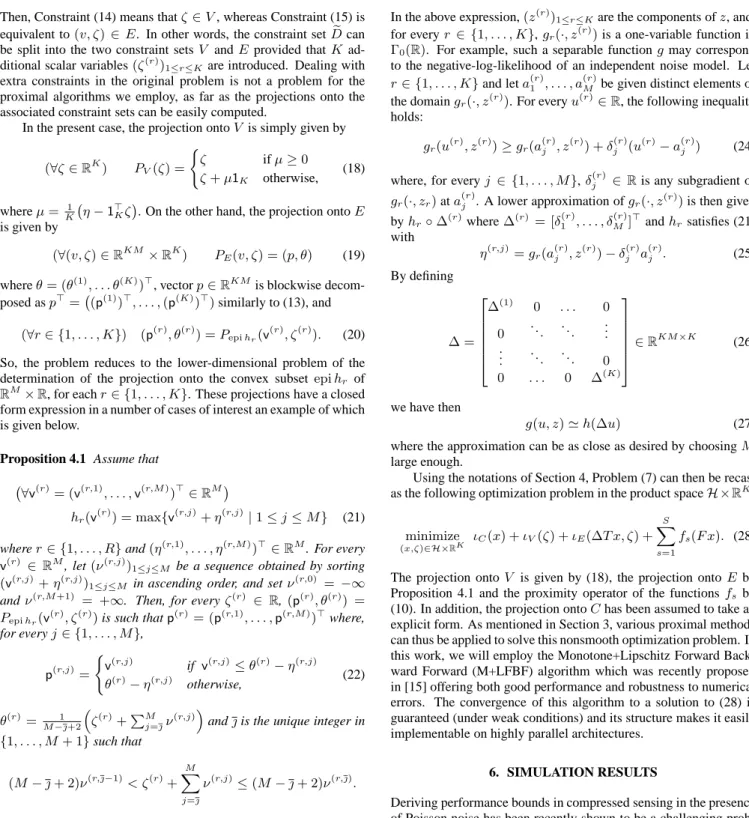
Then, Constraint (14) means thatζ∈V, whereas Constraint (15) is equivalent to(v, ζ)∈ E. In other words, the constraint setDe can be split into the two constraint setsV andE provided thatK ad-ditional scalar variables(ζ(r))1≤r≤K are introduced. Dealing with
extra constraints in the original problem is not a problem for the proximal algorithms we employ, as far as the projections onto the associated constraint sets can be easily computed.
In the present case, the projection ontoV is simply given by
(∀ζ∈RK) PV(ζ) = ( ζ ifµ≥0 ζ+µ1K otherwise, (18) whereµ= K1 η−1⊤Kζ
. On the other hand, the projection ontoE
is given by
(∀(v, ζ)∈RKM×RK) PE(v, ζ) = (p, θ) (19)
whereθ= (θ(1), . . . θ(K))⊤, vectorp∈RKMis blockwise
decom-posed asp⊤= ( p(1))⊤, . . . ,( p(K))⊤) similarly to (13), and (∀r∈ {1, . . . , K}) (p(r), θ(r)) =Pepihr(v (r) , ζ(r)). (20) So, the problem reduces to the lower-dimensional problem of the determination of the projection onto the convex subsetepihr of
RM×R, for eachr∈ {1, . . . , K}. These projections have a closed
form expression in a number of cases of interest an example of which is given below.
Proposition 4.1 Assume that
∀v(r)= (v(r,1), . . . ,v(r,M))⊤∈RM
hr(v(r)) = max{v(r,j)+η(r,j)|1≤j≤M} (21) wherer∈ {1, . . . , R}and(η(r,1), . . . , η(r,M))⊤∈RM
. For every
v(r) ∈ RM, let(ν(r,j))
1≤j≤M be a sequence obtained by sorting
(v(r,j)+η(r,j))1≤j≤M in ascending order, and setν(r,0) = −∞ andν(r,M+1) = +∞. Then, for everyζ(r) ∈ R,(p(r), θ(r)) =
Pepihr(v (r), ζ(r))is such that p(r)= (p(r,1), . . . ,p(r,M))⊤where, for everyj∈ {1, . . . , M}, p(r,j)= ( v(r,j) if v(r,j)≤θ(r)−η(r,j) θ(r)−η(r,j) otherwise, (22) θ(r) = 1 M−+2 ζ(r)+PM j=ν (r,j)
andis the unique integer in
{1, . . . , M+ 1}such that (M−+ 2)ν(r,−1)< ζ(r)+ M X j= ν(r,j)≤(M−+ 2)ν(r,).
As will be shown in the next section, this result will play a central role in the solution of Problem (7) for non-trivial forms of functiong.
5. ALGORITHMIC SOLUTION
Let us come back to the original problem formulated in Section 2 in the case when, for everyu= (u(1), . . . , u(K))⊤∈RK
, g(u, z) = K X r=1 gr(u(r), z(r)). (23)
In the above expression,(z(r))1≤r≤Kare the components ofz, and,
for everyr ∈ {1, . . . , K},gr(·, z(r))is a one-variable function in
Γ0(R). For example, such a separable functiongmay correspond to the negative-log-likelihood of an independent noise model. Let
r∈ {1, . . . , K}and leta(1r), . . . , a (r)
M be given distinct elements of
the domaingr(·, z(r)). For everyu(r)∈R, the following inequality
holds: gr(u(r), z(r))≥gr(a( r) j , z (r)) + δj(r)(u (r)− a(jr)) (24)
where, for everyj ∈ {1, . . . , M},δ(jr) ∈ Ris any subgradient of
gr(·, zr)ata( r)
j . A lower approximation ofgr(·, z(r))is then given
byhr◦∆(r)where∆(r) = [δ1(r), . . . , δ (r) M ] ⊤ andhrsatisfies (21) with η(r,j)=gr(a(jr), z (r))−δ(r) j a (r) j . (25) By defining ∆ = ∆(1) 0 . . . 0 0 . .. . .. ... . .. . .. . .. 0 0 . . . 0 ∆(K) ∈RKM×K (26) we have then g(u, z)≃h(∆u) (27) where the approximation can be as close as desired by choosingM
large enough.
Using the notations of Section 4, Problem (7) can then be recast as the following optimization problem in the product spaceH ×RK:
minimize (x,ζ)∈H×RK ιC(x) +ιV(ζ) +ιE(∆T x, ζ) + S X s=1 fs(F x). (28)
The projection ontoV is given by (18), the projection ontoE by Proposition 4.1 and the proximity operator of the functionsfs by
(10). In addition, the projection ontoChas been assumed to take an explicit form. As mentioned in Section 3, various proximal methods can thus be applied to solve this nonsmooth optimization problem. In this work, we will employ the Monotone+Lipschitz Forward Back-ward ForBack-ward (M+LFBF) algorithm which was recently proposed in [15] offering both good performance and robustness to numerical errors. The convergence of this algorithm to a solution to (28) is guaranteed (under weak conditions) and its structure makes it easily implementable on highly parallel architectures.
6. SIMULATION RESULTS
Deriving performance bounds in compressed sensing in the presence of Poisson noise has been recently shown to be a challenging prob-lem [16]. We subsequently provide some experiments in the Poisson context.
Figure 1 shows the reconstruction results for an electron mi-croscopy image of sizeN = 128×128(H = RN) degraded by
a randomly decimated blur (uniform blur of size3×3and approxi-mately 40% of missing data, that leads toK= 9829) and by Poisson noise with scaling parameter0.5. We aim at evaluating the recon-struction results obtained whenC= [0,255]N, and the data fidelity
constraint related to the Poisson likelihoodgis approximated as de-scribed in Section 5 withM = 9.
Original Degraded Restored 1 SNR = 3.87 dB SNR = 18.0 dB
Restored 2 Restored 3 Restored 4 SNR = 19.3 dB SNR = 19.4 dB SNR = 19.6 dB
Fig. 1. Reconstruction results.
The Restored 1 image displays the results we obtain whenFis a wavelet transform using symmlet filters of length 6 applied over 2 resolution levels and the classicalℓ1criterion is employed. The images in the second row present the obtained results whenF is a dual-tree transform (DTT) [17] using symmlet filters of length 6 ap-plied over 2 resolution levels. Not only the use of a redundant frame allows us to reach higher SNR values, but the visual quality is sig-nificantly improved. Restored 2 corresponds to the classicalℓ1cost function. Restored 3 results from the minimization of a block spar-sity measure for blocks gathering primal and dual DTT coefficients.
Restored 4 shows the good performance of the proposed approach
when spatially overlapping blocks of size2×2are employed for each tree (primal or dual) separately
7. CONCLUSION
In this paper, we have proposed a convex optimization approach for solving cosparse modelling problems under flexible convex con-straints. Our method is grounded on the use of recent proximal al-gorithms and a novel epigraphical projection technique. In the psented simulation results, this approach has been applied to a re-construction problem involving data corrupted with Poisson noise. Other applications can be considered where the ability to take into account an arbitrary convex data fidelity constraint may be fruitful.
8. REFERENCES
[1] D. L. Donoho, “Compressed sensing,” IEEE Trans. on Inform. Theory, vol. 52, no. 4, pp. 1289–1306, Apr. 2006.
[2] E. J. Cand`es and T. Tao, “Near-optimal signal recovery from random projection : universal encoding strategies,” IEEE Trans. on Inform.
Theory, vol. 52, pp. 5406–5425, Dec. 2006.
[3] S. Nam, M. Davies, M. Elad, and R. Gribonval, “Cosparse analysis modeling - uniqueness and algorithms,” in Int. Conf. on Acoust., Speech
and Sig. Proc., Prague, Czech Republic, May 22 - 27, 2011, pp. 5804–
5807.
[4] Y. C. Eldar and M. Mishali, “Robust recovery of signals from a struc-tured union of subspaces,” IEEE Trans. on Inform. Theory, vol. 55, no. 11, pp. 5302–5316, Nov. 2009.
[5] J.-J. Fuchs, “Extension of the global matched filter to structured groups of atoms: Application to harmonic signals.,” in Int. Conf. on Acoust.,
Speech and Sig. Proc., Prague, Czech Republic, May 22 - 27, 2011, pp.
3996–3999.
[6] G. Peyr´e and J. Fadili, “Group sparsity with overlapping partition func-tions,” in Proc. Eur. Sig. and Image Proc. Conference, Barcelona, Spain, Aug. 29 – Sept. 2, 2011, pp. x+5.
[7] F. Bach, R. Jenatton, J. Mairal, and G. Obozinski, “Structured sparsity through convex optimization,” Technical report, 2011, Preprint Hal-00621245.
[8] P. L. Combettes, “Inconsistent signal feasibility problems : least-squares solutions in a product space,” IEEE Trans. on Signal Proc., vol. 42, no. 11, pp. 2955–2966, Nov. 1994.
[9] S. Theodoridis, K. Slavakis, and I. Yamada, “Adaptive learning in a world of projections,” IEEE Signal Processing Magazine, vol. 28, no. 1, pp. 97–123, Jan. 2011.
[10] P. L. Combettes and J.-C. Pesquet, “Proximal splitting methods in sig-nal processing,” in Fixed-Point Algorithms for Inverse Problems in
Sci-ence and Engineering, H. H. Bauschke, R. Burachik, P. L. Combettes,
V. Elser, D. R. Luke, and H. Wolkowicz, Eds. Springer-Verlag, New York, 2010.
[11] M. V. Afonso, J. M. Bioucas-Dias, and M. A. T. Figueiredo, “An aug-mented Lagrangian approach to the constrained optimization formula-tion of imaging inverse problems,” IEEE Trans. on Image Proc., vol. 20, no. 3, pp. 681–695, Mar. 2011.
[12] G. Chen and M. Teboulle, “A proximal-based decomposition method for convex minimization problems,” Math. Programm., vol. 64, pp. 81–101, 1994.
[13] A. Chambolle and T. Pock, “A first-order primal-dual algorithm for convex problems with applications to imaging,” J. Math. Imaging. Vis., vol. 40, no. 1, pp. 120–145, 2011.
[14] L. M. Brice˜no-Arias and P. L. Combettes, “A monotone+skew splitting model for composite monotone inclusions in duality,” SIAM J. Optim., 2011, To appear, http://arxiv.org/abs/1011.5517.
[15] P. L. Combettes and J.-C. Pesquet, “Primal-dual splitting algorithm for solving inclusions with mixtures of composite, Lipschitzian, and parallel-sum type monotone operators,” Set-Valued and Variational Analysis, 2011, To appear, http://arxiv.org/abs/1107.0081.
[16] M. Raginsky, S. Jafarpour, Z. Harmany, R. Marcia, R. Willett, and R. Calderbank, “Performance bounds for expander-based compressed sensing in Poisson noise,” IEEE Trans. on Signal Proc., 2011, To appear, http://arxiv.org/abs/1007.2377.
[17] C. Chaux, L. Duval, and J.-C. Pesquet, “Image analysis using a dual-treeM-band wavelet transform,” IEEE Trans. on Image Proc., vol. 15, no. 8, pp. 2397–2412, Aug. 2006.