Abstract
This paper uses the Management and Employee Questionnaires from the 1998 Workplace Employee Relations Survey (WERS98) to consider whether the performance of workplaces which offer a range of family-friendly policies are superior to that of workplaces without such practices. It is found that in almost all cases where there is a significant relationship between the use of a family-friendly practice and workplace performance, this relationship is positive. In addition, it appears that workplaces which offer an extensive range of family -friendly policies are much more likely to have above-average performance than those with no such practices. The paper moves on to consider whether employers offering policies which enable employees with families to maintain a full-time presence in the workplace e.g. a workplace nursery, have better performance than those which offer policies which result in reduced-visibility e.g. working from home, part-time work. The evidence from WERS98 suggests that this is indeed the case.
JEL classifications: J13, J24, J71, L10, M12,
Keywords: Family -friendly, part-time, equality, business case.
Acknowledgements
I would like to thank Gill Dix, who acted as discussant for this paper at the June 2001 seminar on the Future of Trade Unions, as well as other seminar participants for their comments on an earlier draft of this paper. Thanks are also due to colleagues on the Future of Trade Unions programme at the Centre for Economic Performance, and delegates at the Gender, Work and Organization Conference, June 2001. I would particularly like to thank Alex Beauregard for her helpful comments and advice.
The research was carried out under the Leverhulme -funded project on the Future of Trade Unions in Modern Britain, based at the Centre for Economic Performance. The author also acknowledges the Department of Trade and Industry, the Economic and Social Research Council, the Advisory, Conciliation and Arbitration Service and the Policy Studies Institute as the originators of the 1998 Workplace Employee Relations Survey data, and the Data Archive at the University of Essex as the distributors of the data. None of these organizations bear any responsibility for the author’s analysis and interpretation of the data.
Comments on this paper should be sent to the author at: Centre for Economic Performance London School of Economics and Political Science Houghton Street
London. WC2A 2AE.
Telephone: 020 7955 6976 E-mail: [email protected]
This paper was produced under the ‘Future of Trade Unions in Modern Britain’ Programme supported by the Leverhulme Trust. The Centre for Economic Performance acknowledges with thanks, the generosity of the Trust. For more information concerning this Programme please email [email protected]
Published by
Centre for Economic Performance
London School of Economics and Political Science Houghton Street
London WC2A 2AE
Helen Gray, submitted December 2001 ISBN 0 7530 1550 1
Family-Friendly Working: What a Performance!
An Analysis of the Relationship Between
the Availability of Family-Friendly Policies
and Establishment Performance
Helen Gray
May 2002
1. Introduction 1
2. Theory 4
3. Data 11
3.1 The dependent variables 12
3.2 The independent variables 13
3.3 The control variables 14
3.4 Other data considerations 16
4. Results and Discussion 17
4.1 Marginal effects for the Management Questionnaire 17
4.2 Marginal effects for the Survey of Employees Questionnaire 19
4.3 Benchmarking 21
5. Conclusions 24
Tables 26
Appendix 36
References 39
1. Introduction
Girls outperformed boys at both GCSE and A- level for the first time in 2000, and this pattern was repeated in 2001 (Smithers, 2000: 9; Joint Council for General Qualifications, 2000; 2001). Although a slightly larger proportion of male undergraduates gained first class degrees in the most recent year for which data is available (2000), more first class degrees were awarded to women. Combining the proportion of undergraduates gaining first, or upper second degrees, 54 per cent of women attained a degree in the top two categories, against 47 per cent of men. At the other end of the spectrum, 18 per cent of male undergraduates received third class, or pass degrees as opposed to 13 per cent of women (Higher Education Statistics Agency, 2001).
The ability of women to outperform men in gaining academic qualifications suggests the possibility that they may also outperform men in the workplace. However, it might be expected that if women bear the main responsibility for the family, or face discrimination in the workplace, the performance benefits from having better-educated female employees would be lost. Gershuny suggests that the dual burden of paid and unpaid work for women might persuade them to leave paid work, or work shorter paid hours, so that their human capital is depleted relative to that of men. Ove r the longer-term, this means that women are less likely to move into better jobs (Gershuny, 1997: 141, 146). Whilst there is some evidence that men now undertake a greater share of unpaid work, the 1995 British Household Panel Survey demonstrated that where a husband and wife were both in full-time employment, the wife did nine hours a week more housework, not including time spent on childcare (Gershuny, 1997: 144, 148). For this reason, policies aimed at reducing the disadvantage that women experience in the workplace due to their responsibilities outside work, might be expected to have a positive impact on performance. However, to date there has been little research on the links between family- friendly policies and performance. Therefore, this paper seeks to address the question of whether workplaces making greater provision for those with family responsibilities do indeed experience enhanced performance.
Whilst there has been little research on whether providing a range of family- friendly policies raises workplace performance, there is some evidence to link individual practices with enhanced productivity. For example, Skinner found that employees had greater enthusiasm for their work where they were employed on a part-time basis, which might then be expected to generate higher productivity (Skinner, 1999: 430). Certainly, some part-time
workers believe that they are more productive than when they were previously working full-time (Lewis, 1997: 16-17; Lewis and Taylor, 1996: 117). The fact that part-full-time employees may not require a paid break can also reduce costs for the employer (IRS, 2001b: 9). Duffy and Pupo cite evidence that part-time workers experience lower levels of stress than full-time employees, and have lower absenteeism rates (Duffy and Pupo, 1992: 154, 169). Employers of part-time workers are also able to call on the skills of a larger number of employees, and retain experienced staff who wish to reduce their hours and might otherwise seek alternative employment (Duffy and Pupo 1992: 155). Given that the average cost of labour turnover has been estimated at £3,546 per employee (October 2000), the savings made by retaining employees could be significant (Institute of Personnel and Development, 2000: 8).
The likely benefits of access to a wide range of other family- friendly policies shall be examined later, but the example of part-time working given above clearly illustrates the fact that there is already evidence that some family- friendly policies have benefits for employers. However, it might be expected that family- friendly policies would have different outcomes in workplaces with different characteristics. It may also be the case that some family- friendly policies are superior to others in terms of the benefits they produce for women. For example, in the short-term, switching from full- time to part-time employment may enable employees with families to meet their childcare commitments. However, it has been widely noted that at least some employees believe that taking up family- friendly policies may have a negative impact on their career (Lewis, 1997: 14). This finding is also supported by research by Skinner in her study of a public sector agency, where respondents felt that it was necessary to spend visible time in the job in order to win promotion (Skinner, 1999: 431-432). Certainly, in the case of reduced- hours working, Lewis found that managers made a strong link between commitment and time spent in the workplace (Lewis, 1997: 16). Given that long hours were valued by managers and thought to indicate commitment, it might be expected that part-time workers would be disadvantaged when seeking promotion. Certainly they would accumulate less experience than their full-time colleagues (Duffy and Pupo, 1992: 85). There is also evidence that part-time workers miss out on training which may take place away from the workplace and at a time when the part-time employee would not normally be working, which again, could reduce suitability for promotion (Skinner, 1999: 433; Duffy and Pupo, 1992: 174). Finally, Skinner finds that part-time employees can miss meetings held outside their working hours, so that either managers have to set aside extra time to make part-time workers aware of these communications, or they are not given the information at all (Skinner, 1999: 432-433). The negative effect of these factors on promotion prospects for part-time workers
could also have an adverse impact on morale, particularly where employees feel that hour-for-hour they are more productive than their time colleagues, a view which male, full-time managers seem to corroborate (Lewis, 1997: 17).
It is perhaps the case that an employee who decides to work part-time may benefit from an increased ability to balance their work and home life that, for them personally, outweighs any disadvantages in terms of their career prospects. Indeed Levanoni and Sales suggest that part-time workers may regard convenient hours as a priority to such an extent that they are willing to accept a reduced likelihood of promotion (Levanoni and Sales, 1990: 12). Skinner also found that employees would accept some disadvantages in order to work part-time (Skinner, 1999: 436). However, it is also important to consider the likely effect of different types of family- friendly working on the employer. Continuing with the example of part-time working, if this leads to reduced promotion prospects, this could result in the employee feeling undervalued and perhaps performing less well for their employer. Having less training than full- time workers could also make part-time workers comparatively less productive, and management time spent giving part-time workers information they have missed through being unable to attend staff meetings could be costly, as could a failure to convey such information at all. In contrast, family- friendly policies which allow employees to balance their work and family- lives whilst maintaining a full-time presence in the workplace may enable them to compete for promotion with colleagues without family responsibilities on a more equal basis. This could allow the employer to maximize the potential of all workers, and the greater job-satisfaction which could result for employees might also have a positive effect on their productivity. Therefore there may be a hierarchy of family- friendly policies in that those which do most to advance the long-term career interests of employees might also lead to higher levels of performance for the employer.
The focus of this paper is whether workplaces which offer particular family- friendly
benefits experience enhanced performance. The 1998 Workplace Employee Relations Survey (WERS98) (Department of Trade and Industry, 1999) provides information on the availability of various policies for non-managerial employees, namely switching from full- to part-time employment, job-sharing, homeworking, term- time-only contracts, flexitime, 4½-day weeks, paid time-off at short notice, parental leave, paternity leave and whether there is a workplace nursery or financial help with childcare. The Management Questionnaire gives data on financial performance, labour productivity, the quality of the product or service, the rates of voluntary resignations and absenteeism, whether labour costs as a proportion of total costs ha ve risen or fallen over the previous five years, whether labour productivity has
changed over the same period, and whether employees work harder than five years previously. There are also a number of outcome measures in the Survey of Employees Questionnaire. These variables will be discussed in greater detail in the data section and a full listing is given in the Appendix.
The following section will outline the business case for equal opportunities and the various criticisms it has faced. The business case arguments for equal opportunities shall then be applied to the various family- friendly policies under examination so that the expected costs and benefits of these policies can be explored. The data section gives information on the dataset and variables, and explains the methods used to evaluate the link between family-friendly policies and performance. In the results section findings from the regression analysis and benchmarking are presented and the possible explanations for such results are considered. Finally, the conclusion evaluates the extent to which this research manages to address the issue of whether there is indeed a business case for offering family- friendly policies, and the form that future research should ideally take.
2. Theory
There is already a body of existing literature which explores the range of factors likely to affect performance at the workplace level (Fernie and Metcalf, 1995; Machin and Stewart, 1996; McNabb and Whitfield, 1998) but apart from a single article by Perotin and Robinson (2000), there has been little quantitative work on the relationship between performance and equal opportunities policies, and none on the relationship with family- friendly policies. However, the likely effects of using equal opportunities policies within a workplace have been considered in the theoretical literature on the business case for equal opportunities, and similar arguments can be applied to family- friendly working practices. Where writers have attempted to use research to investigate the costs and benefits of equal opportunities and family- friendly policies, this has been based on case study work rather than quantitative data
(Bevan et al,1999). Whilst there is clearly a difference in my approach, which assesses the
overall performa nce of establishments with particular family- friendly policies, rather than weighing up costs and benefits, the business case literature and previous case studies are useful in making inferences about the likely effects of the policies under examination.
opportunities and family- friendly working practices can benefit directly from the policies they implement, as they then maximize the potential of all employees (Cassell 1996: 55). Therefore it follows that equal opportunities is of interest to employers other than those who wish to make a commitment to the welfare of their employees on moral grounds, and that providing equality of opportunity in the workplace should not be regarded as a burden on business (Dickens, 1994a: 5). In addition, the business case may encourage employers to
commit to the achievement of equal opportunities outcomes, as the link is made between
benefits for the firm and actual equality of opportunity, rather than with policies which may not be fully implemented (Dickens, 1994a: 8).
The Confederation of British Industry (CBI) identifies a number of specific areas in which equal opportunities and family- friendly policies might be expected to benefit an employer. Firstly, they claim that such policies increase the labour pool, making it easier to fill vacancies and ensuring that the best possible selection and promotion decisions are made. In addition, demographic changes and high employment levels raise the costs to employers of excluding a section of the workforce (Dickens, 1994b: 262; Cassell, 1996: 55). The CBI also states that absenteeism and turnover rates are likely to be lower where employers recognise the needs of employees to balance their working life with their family responsibilities. This is because, where the conflict between work and family- life is reduced, employees may need to take less time-off work to deal with family problems. We might also expect that employees with families are unlikely to be attracted to work for employers who offer fewer such advantages (Dickens, 1994a: 10). Flexible working is thought to benefit the workplace not only by enabling the retention of employees with family- responsibilities, but also by allowing the firm to respond quickly to customer demand and ensuring more efficient use of capital. Clearly a firm offering equality of opportunity would avoid the costs of discrimination claims, both in terms of direct costs and the cost of damage to customer perceptions, but may also gain positive benefits from creating the image of treating employees fairly (Dickens, 1994b: 263, 265). In particular, if there is greater diversity in the characteristics of employees, the firm may develop a broader understanding of the needs of customers and investors (Dickens, 1994b: 264; CBI, 1996: 15-21). The Equal Opportunities Commission (EOC) has also argued that equal opportunities may result in improved employee relations if workers feel that they are treated fairly (Dickens, 1994b: 263).
A number of writers have questioned whether these business arguments have the power to produce equality of opportunity in practice. It is argued that the benefits of a particular policy vary from workplace to workplace, so adopting equal opportunities and
family- friendly policies may be worthwhile for some establishments, but not for others (Dickens, 1994a: 11). For example, the costs of certain family- friendly policies, such as a workplace nursery may be prohibitively expensive for a workplace with few employees. In addition, it may be apparent to an employer with a large number of female employees that they can benefit from providing equal opportunities and family- friendly working, but where employees are mainly male, the benefits would perhaps be reduced (Dickens, 1994a: 12). The strategy of the employer could have an important effect on whether adopting equal opportunities is beneficial, as where the emphasis is on low-cost production, the costs of such policies may mean that they are not considered worthwhile (Liff and Cameron, 1997: 41).
However, the arguments for and against particular policies do not just depend on workplace characteristics. If the benefits of offering family- friendly and equal opportunities policies in recruitment are greater when unemployment is low, it follows that the business case arguments are weaker when unemployment is high. As employers operate in different labour markets there is reason to suspect that some employers will experience fewer benefits and have fewer incentives to offer such policies than others (Dickens, 1994a: 12). There is the added problem that firms may only consider short-term costs and benefits, whereas the actual benefits of equal opportunities and family- friendly working are likely to accrue over the long-term and may not be directly financially measurable (Dickens, 1994b: 271).
Encouraging employers to adopt equality of opportunity for the business benefits alone may not persuade them to do enough, as they may only adopt policies which are of clear benefit to them, rather than considering the interests of employees. For example, Biswas and Cassell give the example of a hotel where managers felt there was a business case for having attractive female receptionists in order to appeal to customers (Biswas and Cassell, 1996). Finally, if an employer adopts equal opportunities and family- friendly initiatives with the aim of achieving business benefits, the commitment may not exist amongst staff and managers for the policies to succeed, which could result in the firm not experiencing the predicted benefits (Dickens, 1994b: 279-280, 282). For example, top management may introduce family- friendly policies, but if employees feel that their career will suffer if they utilize the policies on offer, the benefits of having such policies will not be felt (Lewis, 1997: 14; IRS 2001a: 5). If employees without families believe that others are receiving special treatment, they may become less motivated, which raises the cost of offering family- friendly policies. This problem led Liff and Cameron to argue that it is necessary to change the culture of the organization, and perhaps train all employees to understand the needs of others, alongside introducing policies. Clearly this imposes furthe r costs, and implies that the
business case is not strong enough to secure equal opportunities and family- friendly working on its own (Liff and Cameron, 1997: 44).
However, as I mentioned earlier, whilst there are some strong arguments against the business case, there has been little research to affirm whether the suspicions are true. Bevan
et al (1999) have conducted case study work, but it is not easy to translate knowledge about individual workplaces facing very specific product and labour market conditions to the economy as a whole. An alternative approach is to consider whether companies with a higher number of family- friendly policies have better performance on average than those with fewer such policies. Whilst this fails to take account of the costs of particular policies, by using a range of performance measures, it is possible to consider these costs to some extent. For example, a measure of financial performance should reflect the costs of offering, or failing to offer family- friendly policies. My intention is to consider the relative performance of establishments with and without particular family- friendly policies whilst controlling for other factors likely to affect performance.
In the context of the business case, the assumption is that the family- friendly policies under examination would be expected to produce performance benefits as they allow those with childcare responsibilities greater freedom to balance their work and family lives. Certainly all policies could have benefits in terms of increased retention, both because such family- friendly policies may not be offered by other employers, and because employees may feel greater loyalty to their employer where they are facilitated in managing their family lives. By offering family- friendly policies, the employer can promote a caring image, which could increase the number of applicants for jobs. The types of working on offer may also open up the job to new applicants. For example, homeworking may allow the employment of disabled workers or others who would be unable to attend the workplace due to childcare responsibilities, or their distance from the place of employment (Baruch, 2000: 36; Riley and Weaver McCloskey, 1997: 139).
However, it is important to consider the likely costs and benefits to employers of offering each family- friendly policy individually because, as was mentioned in the introduction, it would be expected that these costs and benefits would vary from policy to policy. Employing part-time workers or job-sharers ma y enable the firm to draw on a wide range of talent at a much lower cost than employing the equivalent number of full-time workers. In contrast, providing a workplace nursery, financial help with childcare, flexitime or 4½-day weeks could allow employees to manage their work and family lives whilst accumulating experience comparable to that of employees without family responsibilities. In
addition, they may also be more able than part-time workers to attend training and staff meetings, thus ensuring that they develop their careers to the full and maximize their productivity for the employer.
There is already some evidence that where certain family- friendly policies are on offer, the productivity of employees may be enhanced. A study of 120 employees working at home for one day a week in a Fortune 500 company in the United States, found that 97 per cent of participants and their supervisors reported that productivity was raised by teleworking (Riley and Weaver McCloskey, 1997: 135-136). There is also evidence that part-time work for executives can yield performance benefits, as an Industrial Society report on job-sharing found that of a sample of 69 pairs of jobsharers, less than one in ten managers were thought to perform at the same level or worse than their full- time counterparts (IRS, 2001a: 5).
Employees with access to a workplace nursery would not experience the problem of arranging childcare, which could enhance their productivity as they would not need to spend time making childcare arrangement s if their usual carer were unavailable. Access to flexitime and 4½-day weeks could also increase productivity if workers were able to arrange their time in order to meet childcare commitments. Productivity benefits could be experienced from offering financial help with childcare, as the value attached to this entitlement by employees might induce them to raise their work effort in order to increase the probability of long-term employment in the workplace. The reduced levels of stress for those able to take generous entitlements to paternity and parental leave could also result in productivity benefits if employees return to work under less pressure at home and feeling that they have received good treatment from their employer.
There may be benefits for the employer in terms of reduced absenteeism amongst employees taking up family- friendly entitlements. Dalton and Mesch found that teleworking reduces absenteeism (Dalton and Mesch, 1990). It might also be expected that absenteeism would be relatively low amongst term- time-only workers, as they would not have the problem of arranging childcare during school holidays, a difficult issue for working parents (Hilpern, 2000: 2). Similarly, employees with access to a workplace nursery would be expected to ha ve lower absenteeism rates, and where flexitime was available, employees may decide to take flexi- leave to meet unforeseen childcare problems. The advantage of offering paid time-off at short-notice is that this may give employees the incentive to inform the employer of their absence, therefore making it easier for the employer to arrange cover than if the absence was unpaid, and as a result went unreported. Paternity or parental leave could also reduce absenteeism resulting from pressures within the family. However, there may not
be a link between the employer offering financial help with childcare and a lower absenteeism rate due to the fact that the employee would still have the problem of arranging alternative childcare if their regular source of provision were not available.
There is also a likely advantage to employers in offering family- friendly working in that employees may accept lower pay in order to have access to family- friendly policies. As was suggested earlier, this may well be the case with regard to part-time working. In addition, homeworking would seem to offer some cost savings in terms of office space where employees work from home on a permanent basis (Riley and Weaver McCloskey, 1997: 137). In the case of flexitime, access to this scheme could reduce the need for the employer to pay overtime, which could result in a significant saving.
However, there are also potential disadvantages to the family- friendly policies under examination. Many of the policies are likely to impose some costs on the workplace. For example, employees may need access to office equipment and technical support if they are to work from home (Felstead and Jewson, 1999: 36). Manager also have to sacrifice the ability to monitor the number of hours worked by homeworkers, although there is evidence that they actually have a tendency to overwork, which leads to the opposite problem of stress and job dissatisfaction (Riley and Weaver McCloskey, 1997: 139; Baruch, 2000: 40). In the case of job-sharing, costs may be incurred during the handover between the job-sharers, as time must be taken to exchange information, and information may not be fully conveyed. There are obvious costs attached to offering paid time-off at short-notice, and paternity and parental leave could be expensive, both if they are paid, and if it is necessary to employ temporary staff, or pay overtime. There could also be a cost attached to these policies in terms of the morale of other employees if they are expected to take on the work of absent colleagues, or if inefficiency and failure to meet targets loses business for the employer. Family- friendly services, and flexibility provided by the employer also have direct costs, such as the cost of staffing a workplace nursery, the start-up and monitoring costs of flexitime, and the cost of financial help with childcare.
There are further costs in terms of the morale of employees excluded from family-friendly policies. In the case of parental or paternity leave, paid time-off at short-notice, financial help with childcare, or a workplace nursery, employees without children could feel that those with families receive special treatment, although flexitime might be equally useful to all employees (Cooper, 2000: 36). If some employees with children are excluded from certain entitlements, either because of their employment status or occupation, or in the case of a workplace nursery, because not enough places are available, this could cause resentment
and damage productivity. An additional problem with a workplace nursery is that it would only help employees with pre-school-age children, at least during term-time, whereas financial help with childcare could also provide for school-age children outside school hours, and would not suffer from the capacity limitations of a workplace nursery.
As with part-time working, family- friendly policies which reduce the amount of visible time the employee spends in the workplace could reduce promotion prospects and hence productivity for the employer. This problem may occur not just with part-time working and job-sharing, but also with term- time-only contracts and homeworking, where employees spend less time in the workplace. Certainly employees in the Riley and Weaver McCloskey study felt that their promotion prospects would suffer as a result of working at home, although this problem may be reduced if employees attended the office a few times a week (Riley and Weaver McClosky, 1997: 139). If these workers are perceived as less committed to their work because of their lower face-time in the workplace, they may feel undervalued and their productivity could be further reduced. Baruch point out that one of the problems with working from home is that employees are not involved in social interaction, and if they feel isolated, this could damage morale, and ultimately productivity (Baruch, 2000: 45; Felstead and Jewson, 1999: 35; IRS, 2001c: 5).
The accumulation of experience and training may also be lower for those on reduced-hours working, although the effect of this would probably be minimized in the case of 4½-day weeks, where the employee would not work significantly fewer hours than a full-time employee. However, even for full-time employees it could be difficult to attend training away from the workplace or outside the individual's normal working hours, regardless of the family- friendly provisions available in the workplace. Flexitime and 4½-day weeks may present problems if commitment is measured in terms of visible time spent in the workplace, given that whilst these schemes allow employees to work on a full- time, or almost full-time basis, those with families may choose to work different hours to their colleagues. However, the problem of long hours being used as an indicator of commitment might be reduced where there is flexitime if it encourages the philosophy that employees working extra hours when needed are entitled to an equivalent number of hours in lieu.
3. Data
WERS98 contains data on 2191 workplaces with 10 or more employees, and consists of management, employee and workplace representative surveys. For the purposes of this analysis the focus is on the Management and Survey of Employees Questionnaires. 28,240 employees completed the Employee Questionnaire. By using the weights contained in the dataset, the WERS98 sample can be made representative of the population of UK
workplaces1. The survey also contains information on a wide range of workplace
characteristics (Cully et al, 1999: 5). This means that controls can be introduced to assess
whether having particular family- friendly policies is linked with enhanced performance on average, across the full range of workplace sizes, industries and other characteristics. However, one proviso is that this paper focuses on the private sector. Table 1 shows that there is a big difference between the public and private sectors in terms of the availability of family- friendly policies, with the incidence of all the policies under examination being much higher in the public sector.
In addition, the ratio of the incidence of individual policies in the public and private sectors demonstrates that there is no uniform difference in the pattern of incidence. For example, having a workplace nursery is almost six times as common in the public sector as in the private sector, whilst paid time-off for childcare is only one-and-a-half times more common in the public sector. As the two sectors seem to differ so much in the pattern of incidence, it was decided to concentrate on the private sector, due to the fact that in the economy as a whole many more people work in the private, rather than the public, sector.
The Management Questionnaire does contain some direct questions about the costs and benefits experienced by the employer as a result of employees taking up their
entitlements to family- friendly policies2. Of the 62.4 per cent of employers who offered at
least one family- friendly entitlement, managers in almost two-thirds of workplaces reported some take up of the policies on offer. Of these, in 72.0 per cent of establishments it was reported that these entitlements had meant no, or only minimal additional costs, with only 2.3 per cent having experienced substantial additional costs. In 84.6 per cent of workplaces the entitlements were thought cost-effective. Only 9.7 per cent of workplaces had experienced
1
The exceptions are the following Standard Industrial Classifications: Agriculture, hunting and forestry; Fishing; Mining and quarrying; Private households with employed persons; and Extra-territorial organisations. 2
The list of family-friendly policies covered by this question are parental leave, working at or from home in normal working hours, term-time only contracts, switching from full- to part-time employment, job-sharing, a workplace nursery or nursery linked with workplace, or financial help/subsidy to parents for childcare.
no benefits from offering the family- friendly policies, whilst 53.0 per cent found staff happier as a result. In over a third of workplaces, the family- friendly policies made it easier to retain staff, and in 23.4 per cent of establishments it was thought that workplace performance had improved as a result of the policies. However, family- friendly entitlements were only considered an effective way of recruiting staff in 4.5 per cent of workplaces.
3.1 The dependent variables
Clearly, the issue of how performance is measured is a controversial one. Rather than ask for information on absolute levels of performance, such as profits, the WERS98 Management Questionnaire asks managers to rate the financial performance, labour productivity and quality of their product or service relative to the average. They are also asked whether labour productivity, and labour costs relative to other costs, have gone up or down compared with five years previously. In addition, managers report whether there has been a change in how hard employees work relative to five years ago. All these responses are measured on a five-point scale. The Management Questionnaire also contains data on the number of voluntary resignations over the previous year and the proportion of working days lost through sickness or unauthorised absence over the previous twelve months.
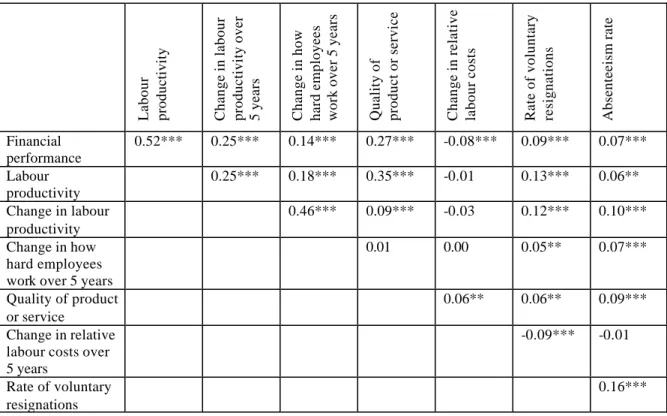
The financial performance data has been used by a number of writers (Addison and Belfield, 2000; Machin and Stewart, 1996; McNabb and Whitfield, 1998; McNabb and Whitfield, 2000). In addition, Perotin and Robinson (2000) considered the data on labour productivity, and Fernie and Metcalf (1995) used a number of performance indicators from the 1990 WIRS. In this paper it was decided to use a range of performance measures to capture the relationship between family- friendly policies and various aspects of workplace performance. Table 3 shows the degree of correlation between each of the performance measures and suggests that there are sufficient differences between the measures to justify the approach of examining each performance measure separately.
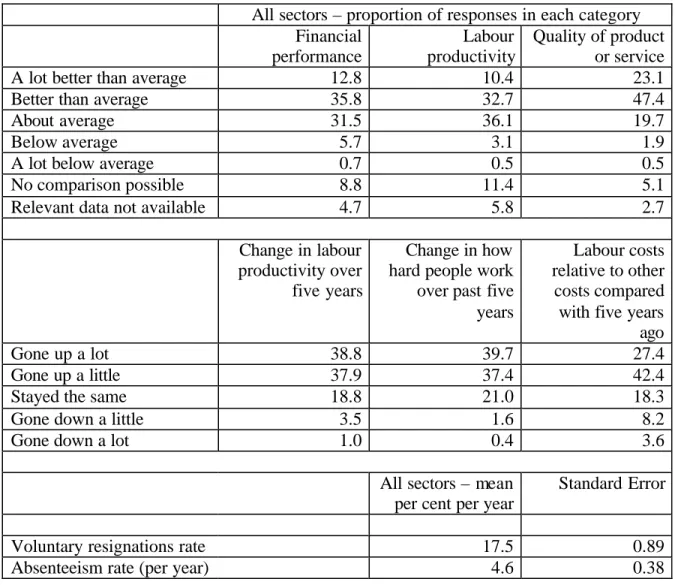
Table 2 shows the distribution of responses for the eight dependent variables from the Management Questionnaire. Clearly there is a tendency for managers to rate the performance of their workplace as above-average, but this data is still useful. Machin and Stewart find evidence to support the view that managers do assess performance reasonably accurately, as workplaces where lower levels of performance were reported in the 1984 WIRS were more likely than others to have closed down by 1990 (Machin and Stewart, 1996: 219-220). A subjective assessment of performance is easier to interpret than workplace accounts, and
Pencavel makes the point that as most workers are employed in the service sector, it is extremely difficult to find an objective measure of labour productivity that can be consistently applied across sectors (Pencavel, 2000: 45). However, as management responses are not evenly distributed between the five categories, it was decided to focus on whether the response was above-average, or average or below, thus reducing each five-point scale to just two categories, mirroring McNabb and Whitfield’s approach to the financial performance data (McNabb and Whitfield, 1998). It was then possible to run probit regressions on the categorical dependent variables, and logistic weighted least squares regressions on the rate of voluntary resignations and absenteeism data.
The Survey of Employees was used to look at additional questions on the feelings of employees about their job and employer. It was decided to use the whole sample rather than just the responses of employees with children to reflect the possibility that those without children, or excluded from access to the policies, might resent others receiving special benefits. By considering all responses, it was possible to consider the relationship between the availability of family- friendly policies and the views of the whole workforce.
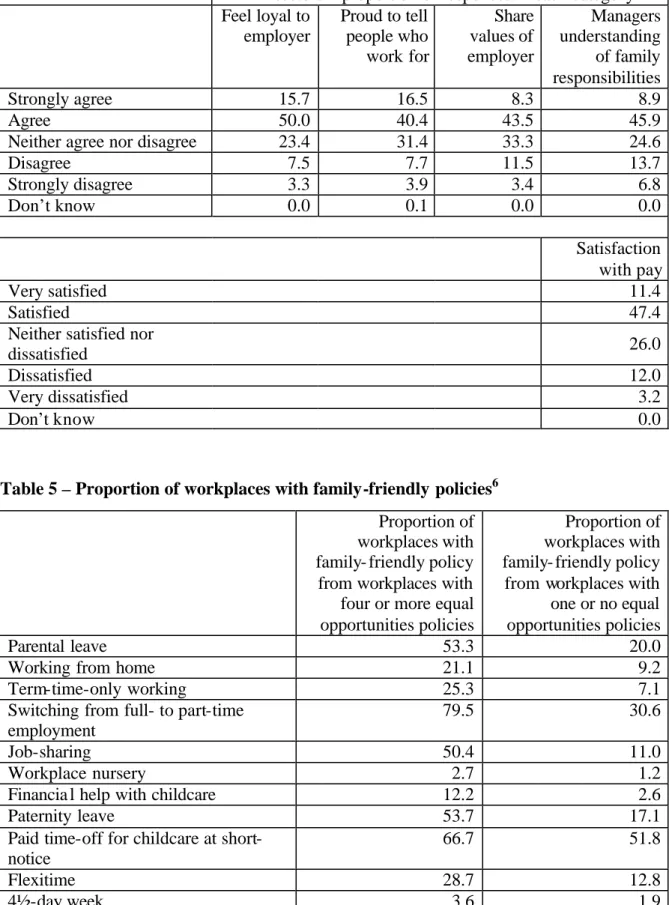
Employees were asked to rate, on a five point-scale, their level of satisfaction with the amount of pay they received. This question was used because it was thought that employees might be happier with their monetary rewards where the non- monetary benefits of family-friendly working were available. Employees also stated the extent to which they shared the values of their employer, whether they felt that managers were understanding of their family responsibilities, and whether they felt loyal to, or proud to tell people that they worked for, their employer. These variables were used as indirect performance measures, based on the expectation that if employees felt that they were treated well, they would be more productive. The responses, again on a five-point scale, were reduced to either agreement with the statements, or satisfaction with particular aspects of the job, in the same way as the Management Questionnaire data, as again the responses were not evenly distributed. Table 4 shows the distribution of responses. Probit regressions were run on the collapsed scales.
3.2 The independent variables
The Management Questionnaire provides information on the types of family- friendly policies available within a workplace (see Appendix for a detailed description of the variables). However, it is not apparent whether all non- managerial employees are able to take up the policies on offer. One option is to use the data on the availability of family- friendly practices
from the Survey of Employees instead. However, there are two main problems with this. Firstly, the Survey of Employees contains data on a smaller range of family- friendly policies than those we have information on from the Management Questionnaire (only flexitime, job-sharing, parental leave, working from home, a workplace nursery or financial help with childcare, grouped as one category, and whether they can take paid time-off at short notice; but not term-time only contracts, switching from full- to part-time working, 4½-day weeks, or parental leave). The second problem with using the Survey of Employees is the difference in the reporting of the availability of family- friendly policies between the Employee and Management Questionnaires. The Survey of Employees data suggests less widespread availability of family- friendly practices than that reported by managers. Whilst this could suggest that family- friendly policies are not available to employees in practice, an alternative option is that perhaps employees who do not have responsibility for childcare are not aware
of the policies on offer in their workplace. Indeed, Cully et al suggest that this may be the
case (Cully et al, 1999: 145). Whilst the management respondent might exaggerate the
number of family- friendly policies offered to make the employer seem more progressive, they should also be in a better position to know exactly which family- friendly policies are available. For this reason, data from the Management Questionnaire is used.
There is also scope for the value of the policies to employees to vary depending on the restrictions which employers place on individual policies. For example, there may be a requirement to work “core hours” where flexitime is available, and this could limit the ability of employees to use flexitime to meet childcare commitments. The generosity of financial help with childcare could also vary from workplace to workplace. However, despite the lack of detailed information on the family- friendly measures, it seems reasonable to assume that where such policies are offered employees are likely to be better able to balance their work and family lives than those in workplaces without family- friendly initiatives.
3.3 The control variables
Many factors affect workplace performance, and it is necessary to control for these influences in order to observe the relationship between family- friendly policies and performance. Table 5 demonstrates that workplaces with four or more equal opportunities policies (from a list of six) are more likely to have any of the family- friendly policies than those with one or no equal opportunities policies. As the business case literature argues that having equal opportunities policies affects performance, it is necessary to control for the existence of these
policies in order to observe the effects of the family- friendly practices (see Appendix for a full description of all the variables). Machin and Stewart (1996) demonstrate the effect that trade unions can have on financial performance using WIRS3, and Fernie and Metcalf (1995) show that both the presence of a union and employee involvement practices have an affect on a range of performance measures. For the purposes of this paper I focus on whether or not a union is recognised for the purposes of negotiating pay and conditions in the workplace, and consider the relationship between human resource management (HRM) practices and performance, rather than employee involvement alone. The HRM measures used are whether most employees in the largest occupational group were trained in a job other than their own, whether there was performance pay, and whether strategic HRM, or HRM recruitment, or communication methods were used (see Appendix). These practices are not unique to HRM workplaces, but we would expect them to be more widespread in HRM workplaces.
The performance of the workplace might also be expected to depend on whether a collective dispute had taken place over the previous year and whether it was situated in a growing market. As the WERS98 Management Questionnaire only asks about the state of the product market for workplaces in the trading sector, the results in this paper only reflect the findings for this part of the economy. A control for workplaces where more than half of all employees were in the managerial, professional or technical categories was introduced, on the grounds that as these workers would probably have already demonstrated a high level of commitment in order to have achieved their position, qualifications or training, they might be more strongly motivated towards work than other employees, causing them to be more productive. Whether the workplace had attained ISO9000 was used to control for the quality of processes within the workplace. In addition, it was thought that employees who experienced greater variety in their work might perform better because of greater interest in their job, resulting in a lower quit rate and lower replacement costs for the establishment.
It might be expected that employees whose most recent pay rise was less than the average for similar workers in the locality would be less productive than those with an above-average pay increase, and so there is a control for the size of the most recent pay rise. It is necessary to control for the proportion of the workforce that is female, because as Gershuny demonstrates, women still take greater responsibility for the home than men, so it would be expected that employers are more likely to experience performance effects from providing family- friendly working where a greater proportion of the workforce is female (Gershuny, 1997: 148). The performance of the workplace could also vary according to its size, as economies of scale might be experienced. Finally, it would be expected that performance
would vary between industrial sectors. For example, there may be much greater potential to raise labour productivity in a capital- intensive industry than one that is labour-intensive. By controlling for each of the factors outlined above, we reduce the likelihood that the relationship observed between the availability of family- friendly policies and performance is due to a separate factor, say that perhaps larger establishments might be more likely to have above-average performance, and are also more likely to offer family- friendly policies.
3.4 Other data considerations
The fact that the WERS data is cross-sectional means that we do not know when the family-friendly policies were introduced, and whether performance has changed in response to the policies. It is possible that workplaces with better performance are more likely to introduce family- friendly policies as they can afford to do so, meaning that better performance leads to the introduction of family- friendly policies rather than vice versa. However, there are a number of factors to bear in mind in response to this problem. Firstly, the assumption that a workplace with above-average performance is more likely to introduce new policies than one which is performing less well could be flawed. Whilst an employer with better performance is better able to afford new policies, they also have less incentive to do so. The additional resources could be invested in capital or training to produce more easily-quantifiable benefits.
The suggestion that there might be reverse causation is less convincing in relation to the data on the satisfaction of employees with the employer. Employers might choose to reward more loyal, dedicated employees with friendly policies, but given that family-friendly policies might also ha ve negative effects, such as creating dissatisfaction amongst employees unable to benefit from the policies, there are other ways of rewarding employees which might be much more attractive to the employer. For example, the employer could reward employees for loyalty through higher pay, or the provision of benefits which can be used by all staff, rather than just those with families.
Even if family- friendly policies were found to be associated with better performance because having good performance facilitates the introduction of family- friendly initiatives, it could still be argued that if family- friendly policies were detrimental to the interests of employers, over time the performance of workplaces with such policies would deteriorate. Therefore evidence that family- friendly policies are linked to above-average performance would argue against a significant disadvantage for firms offering family- friendly working.
4. Results and Discussion
4.1 Marginal effects for the Management Questionnaire
Table 6 reports the marginal effects of each of the independent variables - that is the proportional increase or decrease in the dependent variable due to a particular policy or workplace characteristic. The interpretation of the marginal effects reported in Ta ble 6 is that the probability that financial performance is above-average in a workplace which offers paternity leave is 93 per cent higher than that for a workplace without such a policy. All of the family- friendly policies, apart from term-time-only contracts, have a significant relationship with at least one of the performance measures. Managers are more likely to report that labour costs as a proportion of total costs have fallen compared with five years previously where homeworking is offered. The fact that the rate of voluntary resignations has a negative relationship with homeworking perhaps gives an explanation for this, as it is likely that if the quit rate is lower where some employees are allowed to work from home, this would reduce the costs associated with hiring and perhaps training, new employees.
Switching from full- to part-time employment is positively associated with there having been an increase in labour productivity over the previous five years, but also with a 43 per cent reduction in the likelihood that financial performance is above-average. This suggests that whilst productivity has risen in workplaces with this policy on offer, overall, financial performance is more likely to be below average. This negative relationship provides some support for the argument that whilst part-time employees may have greater enthusiasm for their work than they had as full- time workers, over the longer-term the fact that they accumulate less experience and have reduced access to training may have implications for the financial performance of the workplace. Job-sharing also has a significant negative relationship with labour productivity being above-average. If employees working reduced hours are less likely to receive training and are less likely to be promoted, and as a result suffer demotivation, it is apparent why this might be the case. There may also be some loss of productivity in the handover between job-sharing partners.
There is no obvious explanation as to why labour productivity is 78 per cent less likely to be above-average in a workplace with nursery facilities. However, it is important to note that both the rate of voluntary resignations and the absenteeism rate are lower where employees have access to a workplace nursery, and this could produce significant savings for the employer, outweighing the costs of lower labour productivity. Offering financial help
with childcare seems to result in the clearest benefits to the employer, as it is associated with above-average financial performance, labour productivity, and quality, and there having been an increase in labour productivity over the previous five years. The rate of voluntary resignations is also lower where the employer offers financial help with childcare. This suggests that, as might be expected, financial help with childcare is likely to produce benefits in terms of retention and raised productivity whilst providing no evidence of significant costs.
Flexitime and 4½-day weeks are both associated with an increase in labour productivity over the previous five years, and a lower rate of voluntary resignations. Quality is more likely to be above-average where there is flexitime. Managers are 61 per cent more likely to report that employees work harder now than five years ago where employees are able to work a 4½-day week, which is consistent with the idea that employees working shorter hours may be more productive during the time they do spend at work. Offering paid time-off work at short-notice is associated with a lower absenteeism rate, which suggests that this type of leave reduces the costs of un-notified absences.
There is mixed evidence on the relationship between performance and the use of equal opportunities policies, and between workplace governance and performance, but it seems that whilst union recognition is associated with a reduced likelihood that the quality of the product or service is above-average, there is evidence of above-average performance in unionised workplaces. Labour productivity is 31 per cent more likely to have risen over the previous five years than in workplaces without union recognition, and relative labour costs are more likely to have fallen. The quit rate is also 39 per cent lower than average in workplaces with union recognition. Where the HRM variables are significant, strategic HRM, HRM recruitment methods and training in a second job are all associated with improved workplace performance. However, the performance pay variable does not have a significant relationship with any of the performance measures, and HRM communication methods are associated with managers being less likely to report that employees work harder now than five years earlier, and with a higher absenteeism rate. This suggests that overall there is no clear-cut relationship between HRM and improved performance.
The quality of a product or service is less likely to be reported as above-average where there has been a collective dispute over the previous twelve months, and it is less likely that employees are reported as working harder now than five years earlier where there has been a dispute. It does indeed seem that workplace performance is better where the employer conforms to ISO9000, as financial performance and quality are more likely to be above-average in these workplaces, although the probability that the workplace has
experienced an increase in labour productivity over the previous five years is reduced by six per cent. Unsurprisingly, financial performance and labour productivity are more likely to be above-average where managers report that employees have a lot of variety in their work. The findings on the performance of workplaces in a growing market are also unsurprising. Financial performance is more likely to be above-average where the market is growing, and labour productivity is more likely to have increased over the previous five years, with it also being reported that employees work harder in a growing market.
There is evidence that having a more highly skilled workforce is associated with higher quality production, but there is no other significant evidence that workplaces with a more skilled workforce perform better. It also seems that newer workplaces have higher quit and absenteeism rates. The likelihood of a workplace having above-average financial performance is raised by 83 per cent where a greater proportion of the workforce is female, but there is little other evidence to link performance and gender. The probability of financial performance and labour productivity being above-average are raised by over eighty per cent where the most recent pay increase was above the average for the locality, and the workplace is more likely to have increased it's productivity over the previous five years where there has been an above-average pay rise. Finally, there is some evidence that larger workplaces have better performance than those in the 10-24 employees category.
4.2 Marginal effects for the Survey of Employees Questionnaire
Turning to Table 7, employees are more likely to be satisfied with the amount of pay they receive where there is parental leave, homeworking or a workplace nursery. They are also more likely to feel loyal to an organisation where there is homeworking or flexitime, and are more likely to report that they share the values of the organisation and that managers are understanding of family responsibilities where flexitime is available. Allowing employees to switch from full- to part-time employment is positively associated with managers being thought understanding of family responsibilities, and job-sharing is associated with employees sharing the values of the organisation; affirming that employees with families value these practices. They are also more likely to say that they are proud to tell people who they work for where there is a workplace nursery, homeworking or paid time-off at short-notice, and share the values of the organisation where there is a workplace nursery or paid time-off at short notice. The implication is perhaps that employees are more likely to feel proud of, or loyal to, their employer where they are given some autonomy over the
organization of work through homeworking or flexitime, or where the employer offers actual family- friendly benefits, such as a workplace nursery or paid time-off at short-notice.
Employees are less likely to say that they are proud to tell people who they work for where some are employed on term-time-only contracts, and they are also less likely to report that managers are understanding of their family responsibilities and that they share the values of the organisation. This is surprising, because it might have been expected that this policy would have been designed specifically to help those with family responsibilities and so would have been taken as a demonstration of the understanding of the employer. However, it may be that employers offering such contracts are less understanding of employees with families who do not take up term- time-only contracts, or that those on term- time contracts receive less understanding from managers when they experience problems with childcare during term-time. As term-time-only working is negatively associated with attitudes towards the employer, managers may need to consider carefully the policies offered and the way in which they are impleme nted to ensure that they have a positive effect on the feelings of employees.
The marginal effects for the equal opportunities policies show a positive relationship between the employer reviewing selection procedures to identify discrimination and greater satisfaction with pay, increased loyalty and pride, and a greater likelihood that employees share the values of the organisation. They are also more likely to feel proud of their employer where there are special procedures to encourage applications from women returners, but employees are less likely to share the values of the organisation where promotions are monitored by gender.
Turning to workplace governance, the marginal effects suggest that union recognition is associated with a lower likelihood of employees feeling loyal to, or proud of, their employer and being less likely to share the values of the organisation. Employees in workplaces where there is union recognition are also less likely to believe that managers are understanding of family responsibilities. It could be that unionised workers are more likely than others to feel discontented with their employer as they join the union in response to their existing feelings of discontent, or that the union highlights the problems with the workplace for employees. Fernie and Gray (2002) found that workplaces with union recognition were more likely to offer family- friendly policies than workplaces without a recognized union, so the higher levels of discontent cannot be explained by fewer family- friend ly policies being on offer in unionised workplaces (Fernie and Gray, 2002). It seems that HRM governance has little effect on the attitudes of employees to their employer, as only performance pay has a significant impact on any of the dependent variables, showing that managers are less likely to
be considered understanding of family responsibilities where there is performance pay. This result suggests that there may be a trade-off between the use of performance pay and the extent to which managers acknowledge the responsibilities of employees outside work.
Employees are more likely to say that they are proud to tell people who they work for where they have a lot of variety in their job, and conforming to ISO9000 is consistent with managers being more understanding of family responsibilities. This confirms evidence from the Management Questionnaire that quality and family- friendly employment are positively associated. The fact that women tend to report higher levels of job satisfaction than men is fairly well-established (Ward and Sloane, 2000: 273), but it is worth noting that whilst this relationship is quite clear in the evidence from the Survey of Employees, there is only weak evidence to link above-average performance with the employment of a greater proportion of female workers in the Management Questionnaire. This suggests that higher levels of job satisfaction are not necessarily translated into above-average performance, although if the convenience of the work is traded-off against other disadvantages, such as fewer prospects for advancement and less training, female employees could be satisfied with their work whilst not being fully utilised by their employer. The evidence that employees can be satisfied with their employment in the face of obvious disadvantage is highlighted by the fact that employees in workplaces where the most recent pay increase was less than the average for similar workers in the locality are more likely to report that they are satisfied with their pay than those given the average pay rise. Finally, it seems that employees in larger workplaces are less likely to report that managers understand their family responsibilities than those workplaces with between 10 and 24 employees, perhaps suggesting that because policies are formalised in larger workplaces to ensure procedural justice, the lack of scope for managerial discretion means that managers appear less sympathetic towards those with families.
4.3 Benchmarking
It is clear from the marginal effects that some family- friendly policies are associated with a lower likelihood that a workplace has above-average performance, whilst others are associated with a greater chance of above-average performance. Given that family- friendly
policies are not all associated with better performance per se, the question is whether on
average we can expect workplaces which offer the full range of family- friendly policies under investigation to perform better than those with no such policies. It is possible to consider this by using the regression equations to calculate the probability of a workplace
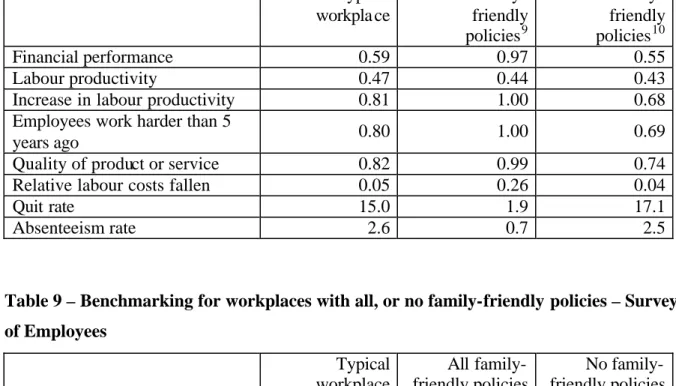
having above-average performance on each of the measures, for different sets of workplace characteristics. Firstly the probability of above-average performance for the average workplace is calculated, and this can then be compared against a workplace with all the family- friendly policies, and then workplaces with no such policies. For example, Table 8 shows that 59 per cent of workplaces with typical characteristics have above-average financial performance, compared to 97 per cent of workplaces with all the family- friendly policies and only 55 per cent of workplaces with no family- friendly policies.
The results give a strong indication that workplaces which offer the full range of family- friend ly policies perform better than those which do not offer any such policies, with the average workplace lying somewhere between the two extremes, although closer to the workplace with no family- friendly policies than that with the full range. The exception is that 44 per cent of workplaces which offer all the family- friendly policies have above-average labour productivity, compared with 43 per cent of workplaces without any such policies.
Benchmark workplaces for the Survey of Employees dependent variables are shown in Table 9. The results for satisfaction with pay, pride in the employer and sharing the values of the organisation follow a similar pattern to the majority of the Management Questionnaire variables, with the most family- friendly workplaces ha ving better performance on all these measures, and the typical workplace performing only slightly better than those with no family- friendly policies at all. The exception is the loyalty measure, where the typical workplace actually performs worse than either the family- friendly or non- family- friendly workplace, although employees are more likely to feel loyal to the employer where more family- friendly policies are offered. However, it seems that employees are least likely to believe that managers are understanding of family responsibilities where a large number of family- friendly policies are on offer. This is perhaps because, as was mentioned in respect to larger workplaces, where family- friendly policies are formalised, the ability of managers to accommodate the needs of individual employees in a more informal way may be reduced, making them seem less understanding in response to individual requests from employees.
Given the evidence that workplaces with a wide range of family- friendly policies have better performance, it is necessary to consider why certain policies are negatively associated with particular performance measures. One explanation offered earlier was that because some policies result in employees being marginalized and regarded as less committed, they can ultimately result in demotivation and mean that talent is lost to the firm through higher quit rates or a failure to maximize labour productivity. This proposition can be tested by considering whether workplaces which offer family- friendly policies expected to be less
damaging to the careers of employees with families are more likely to experience superior
performance than those using policies which reduce workplace visibility3.
The policies thought least likely to have a negative impact on the careers of employees with families are access to a workplace nursery, financial help with childcare,
flexitime and 4½-day weeks4. The reasons for believing that these policies may be superior
to homeworking, switching to part-time employment, job-sharing and term-time-only contracts were explained earlier, but the general hypothesis is that policies which allow employees to be seen to work full-time or almost full- time, whilst making it easier to meet caring commitments though flexible hours, or the employer taking some responsibility for childcare, do more to ensure that employees with families can compete on an equal basis with their colleagues than policies which reduce their visibility in the workplace.
As policies which do most to advance the careers of employees with family
responsibilities could also do most to benefit the employer, I consider the relationship between the two sets of family- friendly policies and performance. Table 10 suggests that policies which do more to allow employees with families to maintain their presence in the workplace are associated with better performance than those which result in reduced-visibility, although the change in relative labour costs is an exception to this.
Only 14 per cent of workplaces with the greater-visibility family- friendly policies are likely to have experienced a fall in relative labour costs, compared to 21 per cent of workplaces with the reduced-visibility policies. This suggests that the greater-visibility policies impose higher labour costs on the firm. However, financial performance and labour productivity in workplaces which offer a workplace nursery, financial help with childcare, flexitime and 4½-day weeks are double that for workplaces which only offer job-sharing, switching from full- to part-time employment, homeworking and term-time-only working. The quit rate is much lower where the greater-visibility policies are on offer, and the absenteeism rate is also relatively low. This suggests that even if labour costs are more likely to rise relative to other costs where such policies are available, there are many other performance benefits for the workplace which could outweigh the increase in costs.
The benchmarking results from the Survey of Employees (Table 11) also show that
employees are more likely to be satisfied with their pay and feel satisfaction with their
3
The means for a typical workplace were used for all variables other than the eight family-friendly policies of interest. This made it possible to observe the different effects of the variables in the two different characterisations where all other workplace characteristics were held constant.
4
For ease, these policies will be referred to throughout as “greater-visibility policies”, due to the fact that in comparison to home-working, term-time -only contracts, switching from full- to part-time employment and
job-employer where the family- friendly policies available are less likely to have a detrimental impact on their career. However, it seems that workers are less likely to believe that managers are understanding of family responsibilities where the greater-visibility policies are on offer. This is surprising given that part-time workers in Skinner’s study complained that they were denied access to training and information, suggesting that employers offering part-time work may not demonstrate understanding of family responsibilities when deciding where and when training and meetings should be held. However, if employees work part-time or on term-part-time-only contracts they can be easily identified as employees with families, and as a result, consideration may be taken of their responsibilities in this respect. It may be less obvious to the employer that full-time workers have caring roles outside work, and where employees have access to a workplace nursery or financial help with childcare, there may be an expectation that they should be more flexible than part-time workers without access to such facilities. If this were the case, it is possible to see how workplaces offering the greater-visibility family- friendly policies might also find their managers less understanding of family responsibilities. This is consistent with the satisfaction which employees with access to the greater- visibility policies express on the other measures, as they could be quite satisfied by the policies on offer, whilst still being unhappy with management behaviour.
5. Conclusions
There is strong evidence to suggest that family- friendly policies are associated with superior, rather than inferior, performance when controlling for a wide range of workplace characteristics. Within this general pattern there are very few exceptions. These findings are born out not just by the benchmarking for workplaces with and without the full range of family- friendly policies, but also by the marginal effects of individual policies, where the vast majority of significant results show a positive relationship between the workplace offering a particular family- friendly policy and above-average performance. However, it seems that there is a distinction between policies which reduce the visibility of employees with family responsibilities, and those which enable them to maintain a full-time, or almost full-time, presence in the workplace. It seems that workplaces where the reduced-visibility policies are on offer experience lower levels of performance than workplaces where the greater-visibility sharing, they allow employees to maintain greater visibility in the workplace.