2016 Joint International Conference on Artificial Intelligence and Computer Engineering (AICE 2016) and International Conference on Network and Communication Security (NCS 2016)
ISBN: 978-1-60595-362-5
Social-level Macro-governed Collaborative Manufacturing Processes
Ji GAO
1,2,a,*, He-Xin LV
1,b, Zhi-Yong JIN
1,c, Ping XU
1,d1Zhejiang Shuren University, Hangzhou, Zhejiang, China
2Zhejiang University, Hangzhou, Zhejiang, China
a[email protected], b[email protected], c[email protected], d[email protected]
*Corresponding author
Keywords: Macro-Governance, Collaborative Manufacturing, Norm, Social Dependence.
Abstract.This paper proposes the social-level macro-governance mode for innovating the popular centralized control for CoM (Collaborative Manufacturing) processes, and makes this mode depend on the support from three aspects of technologies standalone and complementary: social–level CoM process norms, CoM process supervision system, and rational agents as the brokers of enterprises. It is the close coupling of those technologies that not only redounds to removing effectively the uncontrollability obstacle confronted with by cross-management-domain CoM processes, but also enables CoM applications to be implemented by uniting the centralized control of CoM partners for respective CoM activities, and therefore provides a new destributed CoM process control mode to push forward the convenient development and large-scale deployment of SME-oriented CoM applications.
Introduction
Faced with progressing globalization and intense market competition, Collaborative Manufacturing (CoM, for short) becomes the promising approach for small and medium size enterprises (SMEs, for short) to win the market competition. Meanwhile, along with the development of SOC (Service-Oriented Computing) and Cloud Computing technologies, the mechanisms for supplying manufacturing (mfg, for short) services through Internet such as ASP (Application Service Provider) [1,2], CMfg (Cloud Manufacturing) [3,4], etc. have occurred. Those mechanisms provide the effective support for SMEs to develop CoM applications, and facilitate the research of SME-oriented CoM application development architectures, such as Dynamic Manufacturing Network [5], collaborative business ecosystem [6], cluster supply chain [7], non-hierarchical manufacturing networks [8], situational collaborative business process Modeling [9], and so on.
However, a common characteristic of those architectures is to focus only on the dynamic on-demand formation of CoM applications, but the execution and supervision of CoM processes after the formation still adopts the centralized control mechanism dependent on artificial static customization. Therefore, though the optimization of CoM partners and enterprise alliances achieved by the Dynamic on-demand formation can promote the market compitition ability of SMEs, the manpower and time consuming for customizing CoM processes severely weakened the ability for SMEs to quickly respond to the changes of market environments and client requirements. Besides, the centralized control mechanism is also confronted with the obstacle of uncontrollability for cross-management-domain CoM activities since collaborative partners usually work in different management domains while pursuing respective benefits. Moreover, the characteristic of “dynamic on-demand formation” aggravates the difficulty for removing this obstacle.
CoM process norms as the governance basis. Evidently, as long as CoM participators make their macro-behaviors for providing and consuming mfg services conform to relevant norms, their CoM activities are transformed into predicable and controllable ones.Therefore, the macro-governance mode not only redounds to removing the uncontrollability obstacle, but also enables cross-management-domain CoM applications, though CoM activities executed by CoM participators are distributed, to be implemented by uniting the centralized control of those participators for respective CoM activities, and thereby removes the requirement for creating the centralized control mechanism. Due to no need for concerning with the implementation detail of CoM activities, the macro-governance mode can reduce largely the difficulty for developing and maintaining CoM applications, and thereby facilitates effectively the convenient development and large-scale deployment of CoM applications.
The layout of this paper is as follows. We first discuss the countermeasure for realizing the macro-governance mode in Section 2. Then in Sections 3 the three support technologies for this mode are specified. Finally, the evaluation and conclusions are given in Section 4.
Countermeasure for Realizing Macro-Governance Mode
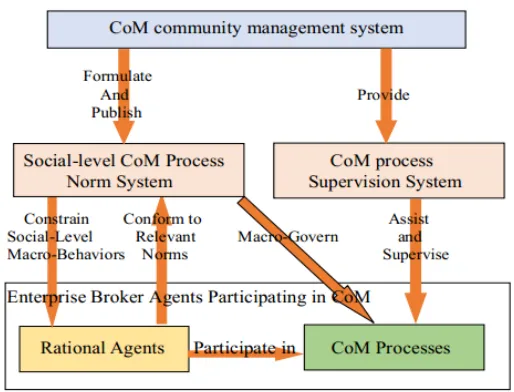
As mentioned above, the social-level macro-governance mode redounds to removing the obstacle of uncontrollability for cross-management-domain CoM activities. However, how to make enterprises conform to social-level CoM process norms is also the challenging problem which must be solved. Therefore, we propose that enterprises should be constructed into the rational individuals which have both ability and desire for conforming to norms in order to ensure that their CoM activities can comply with the macro-behavior constraints prescribed by relevant norms. Meanwhile, enterprises should register into a CoM community in order to accept the assistance and supervision from this community, and thereby restraining possible norm-violating behaviors.
In order to enable enterprises to have high autonomy and intelligence to compute and reason how to conform to norms, it is advisable adopting software agents as brokers for enterprises to provide / consume mfg services through Internet. Moreover, in order to promote those agents into rational individuals, called rational agents, social-level norms should specify accurately the constraints for agent social-level macro-behaviors so that how to make the CoM activities of agents conform to norms can be determined by inspecting whether CoM states satisfy those constraints.
In human society, the popular CoM applications are the enterprise alliances created dynamically on demand. Such an alliance often includes multiple bilateral collaborations for obtaining different mfg services, called multi-service collaboration, so that the enterprise sponsoring the alliance can compose those services, by using a local business process, to accomplish the mfg tasks dynamically occurring and beyond the enterprise’s own ability, and thereby responds successfully to market changes and wins the competition. Because a multi-party collaboration can be transformed into multiple bilateral collaborations and nested alliances can be created for suiting complicated collaboration demand, we focus our research work on the dynamic alliances which are oriented to the multi-service collaborations and whose members are the agents, without loss of generality. Obviously, bilateral collaborations oriented to single services should become the core for achieving the macro-governance
Social-Level Macro-Governance Mode
Figure 1. Social-level norm-governance mode and its support technologies.
Social-LevelCoM Process Norm system
Because social activities are the means for maintaining social relationships, the social-level norms for governing those activities should be formulated based on the abstract concepts oriented to social relationships.Since Social Dependence (SD, for short) is a basic social relationship in human society, and occurs in every social activity [10-12]. We propose to represent CoM process norms in terms of SDs. An SD means that some social individual (e.g., an enterprise participating in CoM) depends on the assistance of another one to achieve an expectant goal, and the assistance is a social activity (e.g., a CoM activity) executed by the latter. Therefore formulating norms in the form of SDs, called SD norms, redounds to describing deeply and in the round social relationships and their evolution which should be complied with in CoM activities.
Since the CoM process for a mfg service often includes multiple CoM activities executed in succession, the norms for constraining those activities form the norm set called CoM process pattern for macro-governing the CoM process. However, every CoM instance needs to be created dynamically on demand, and this makes creating, by negotiation, the pattern for an instance from scratch face the predicament that computation complexity and space-time consumption are too large. Therefore, we propose that the more convenient and effective approach should be: formulating the parameterized CoM process template for a mfg service first, then instantiating dynamically this template, by negotiating and signing, into the shared pattern adopted by CoM partners for this instance (i.e., the two broker agents for providing / consuming this service).
Define the CoM process norm system as the set of norm subsystems for mfg areas: = ( 1, 2,
… w), and k (k=1, 2, …, w) is the set of CoM process templates: k ={ΜS1, ΜS2, …, ΜSn}. Every
template MSi (i=1, 2, …, n) includes a group of SDNs (SD Norms) corresponding to a specific mfg
service Si: ΜSi ={SDN
A1Si, SDNA2Si, …, SDNAmSi}. Wherein, SDNAjSi is used to constrain CoM
activity Aj (j =1, 2, …, m) and Aj may be an activity regular or for transacting abnormity. As an example, for a mfg service “CPUSupply” (defined in the mfg area “Computing Equipment”), the CoM process includes not only the regular activities executed alternately by the provider and consumer of this service: pay deposit, notice the pick-up of goods, pay for goods, provide goods, etc., but also the activities for transacting abnormity: complement deposit, defer the provision of goods, amerce, withdraw CoM relationship, etc. By formulating relevant SDNs, MSi provides CoM
Define SDNAjSi = PSDeo(ρ≤δ|σ), which is used to represent the Parameterized SD (PSD) of CoM
activity Aj expected to maintain in the process performing bilateral (providing-consuming) collaboration oriented to service Si, and is endowed with the following meanings:
Under the condition that the current collaboration state satisfies σ and before the deadline δ is reached, party (agent) o depends on Aj' executer e (the other party) to transform this state into satisfying ρ.
Here, σ and ρ are also called the trigger for activating a norm and the postcondition for executing the norm respectively, and thereby make the execution of the norm possess the explicit start-up occasion and success-determining standard. An SDN defined in the description language corresponding to PSDeo(ρ≤δ|σ) is shown in Figure 2. This norm is taken from the template MCPUSupply
oriented to mfg
(eio:SDNorm //The norm for CoM activity “PayDeposit”
NormPurpose:“Backbone” //This is the norm for driving a regular CoM activity NormNo:1
Description:“Specify the performer, σ, δ, and ρ of this norm” NormTransactionType:“dmo:CENormTransaction”
//The name of enumeration set of regular CoM activities NormTransaction:“dmo:DepositProviding” //The name of this activity in the set Performer:“InitiatingRole” //This norm is performed by the service consumer Trigger:(@eio:ContractInuring ContractRegisterNo:?x Service:CPUSupply
InuringDate:?y) //?x and ?y are variables with “?” as their prefixes Deadline:(@eio:dateTimePeriod Type:RD BeginDate:?y Period:?nego_11) Postcondition:(@dmo:DepositStatus ContractRegisterNo:?x DepositLowLimit:
?nego_12 Currency:“$” DepositSatisfactionStatus:“Satisfying”) )
Figure 2 The social dependence norm for CoM activity “PayDeposit”
Service “CPUSupply”, and is represented as the structured description including a group of attribute slots.
“Parameterized” means that o and e are played by the provider and consumer of service Si respectively, but bound to the agents as their brokers only when the CoM process of a CoM instance starts up. And ρ, δ, and σ are all the collaboration state patterns described in logic expressions, which are the logical combination of predicate expressions, relation expressions, and true functions. Therein, the parameters of a predicate expression may be variables whose value range can limited by relation expressions and true functions while the concepts, attributes, and relations referred to by predicate expressions are defined in the ontologies of mfg areas. Therefore, SDNAjSi prescribes
accurately the constraints which the social-level macro-behaviors of CoM activity Aj should conform to, and thus can be used as the basis for computing and reasoning how to comply with norms.
Since SDNs only constrain the social-level visible Macro-behaviors of broker agents for executing CoM activities: activity-activated occasion, activity-ended time, and activity post-effect, but does not prescribe the execution details, this enables template ΜSi to be formulated in the highly abstract form
in which agent mental models and internal micro-operators are invisible. Such a platform-independent description mode not only makes ΜSi adopted and conformed to easily by
heterogeneous agents, but also enables ΜSi to be created on the basis of deep analysis and synthetic
investigation for CoM objectives and possible benefit relations or conflicts. Moreover, the SDNs contained in ΜSi can express explicitly the expected collaboration state transition and reveal the SD
relationship evolution happening along with the successive execution of CoM activities, this redounds to abstracting and describing, in systematic mode, the benefit-transferred relationships between CoM participators and the changes, and thereby makes creating perfect ΜSi become
possible.
After created, ΜSi is published in the CoM community, becoming the negotiation foundation for
creating CoM relationships. Once the negotiation successes, ΜSi is instantiated into CoM process
pattern ΜΥSi, which is used to govern the current CoM instance Υ, and a contract for the two parties of
appropriate to Υ: o and e in the definition of SDNAjSi are enacted by the agents participating in Υ while the
variables occurring in ΜΥSi are instantiated into constants or the limit of variable values are increased.
Rational Agents
Enterprise broker agents are configured into the rational agents which have both ability and desire to make their CoM activities accept the constraints from ΜΥSi, and therefore the outer observers (i.e.,
people or other agents) can believe those agents reasonable and trustable. The key for achieving rationality is to install those agents the local management policies for driving CoM activities in order to enable those agents to know how to execute those activities by using local micro-operators and decide how to conform to the constraints from ΜΥSi, including the norm-violating in an unavoidable
situation. Since the SDNs included in ΜΥSi have already prescribed accurately the constraints agent
social-level macro-behaviors should conform to, those constraints, as the basis for agents to compute and reason how to conform to norms, can be incorporated into the CoM activities driven by policies.
A management policy p is represented in BNF as follows: <p > ::= <trigger> <processing>
<processing> ::= {< micro-operator > | <rule> | <rule-group>}+
<rule> ::= (→ <condition> {< m-operator>}+)
<rule-group> ::= <selection-mode-for-activated-rules> {< rule >}+
The main parts of a policy are its trigger and the transaction driven by it. The former is set as a trigger pattern (it and the condition part of a rule are all represented as the logical expressions similar to the collaboration state patterns mentioned in section 3.1), enabling the policy to be triggered by a state-change event. The latter is represented as a sequence of micro-operators, condition-action rules (conditional operators), and rule groups (for selecting executed rules), enabling an agent to make the decision analysis by detecting the activation of rules in order to drive appropriate local micro-operators for executing a CoM activity.
The policy-driven management for CoM processes is illustrated in figure 3. The backbone of process management is divided into three stages: generating the state-change event for triggering a policy, triggering the relevant management policies, driving appropriate local micro-operators. Once a CoM process starts or the previous CoM activity finishes, a state-change event is generated to trigger a policy in order to drive the local micro-operators for examining state transition and activating subsequent norms, including to detect whether the post-effect for executing the current CoM activity satisfies the postcondition prescribed by the corresponding norm, to examine which norms can be activated by this post-effect, to solve a possible conflict of multi-norm activation, and to drive the planning and execution of CoM activity constrained by the subsequent activated norms.
[image:5.612.145.488.521.577.2]
Figure 3. The agent CoM process management driven by policies (which is divided into three stages). Since template ΜSi and the SD norms included in it has been published in the agent community,
this enables the desire for rational agents to conform to norms to be embodied by setting relevant management policies while the local micro-operators embedded into the policy transaction parts and the executing software for implementing those operators make those agents possess the abilities for performing the norms constraining CoM activities (include executing and monitoring those activities), in order to achieve the governance effect of those norms for these activities.
CoM Process Supervision System
assist the enterprise broker agents as community members to perform the social commitment for complying with CoM process patterns. This system is configured with five supervision roles: community manager, service matchmaker, CoM arbitrator, CoM monitor, and reputation manager (new roles may be added on requirement), and creates a group of supervision agents enacting those roles. An agent enacting community manager role provides services for registering as a community member, enquiring the membership of CoM partners, making the sanction of CoM norm violation (e.g. the suspending, cancel, or expelling of memberships), etc.; service matchmaker advertising the capability of business services, recommending CoM partners (used to support the self-organization of CoM relationships), etc.; CoM arbitrator notarizing the contracts for adopting CoM process patterns, arbitrating norm violation, punishing norm violation, etc.; CoM monitor (promising multiple agents to enact this role) monitoring CoM processes, analyzing norm violation (and recording it), etc.; reputation manager evaluating the reputation of community members (and updating reputation levels), enquiring reputation status, etc.
Social Commitment. This mechanism promises broker agents to create the social commitment for conforming to a CoM process pattern, say ΜΥSi, by registering into the connunity and signing the
contract for adopting ΜΥSi. Note, once the negotiation for creating CoM relationships successes,
broker agents can sign such contracts by invoking the signing transaction provided by relevant mfg services. As a result, this brings on the Parameterized representation form of norm SDNAjSi in ΜΥSi:
PSDeo(ρ≤δ|σ) to be transformed into social commitment SCommiteo(ρ≤δ|σ) / social trust
STrusteo(ρ≤δ|σ). Such a transformation has following semantics: the executer e of CoM activity Aj
commits the CoM partner o to / o trust e for that under the condition that the CoM state satisfies σ and before the deadline δ is reached, e transforms this state into satisfying ρ.
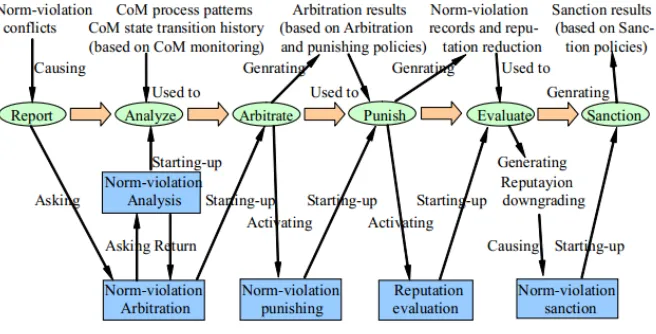
Commitment Supervision. By executing the supervision services provided by the community, such as CoM process monitoring, norm-violation arbitration, norm-violation analysis, norm-violation punishing, reputation evaluation, norm-violation sanction, etc., and the CoM supervision policies of norm-violation punishing, reputation reduction, and norm-violation sanction published in the community, the commitment supervision mechanism, based on social commitments represented as SCommiteo(ρ≤δ|σ), aims at supervising CoM processes, arbitrating conflicts of norm-violation
identification, and sanctioning norm-violation agents in order to generate the deterrent force for driving agents to perform social commitments and make the equitable transaction for norm-violation events (Figure 4). Evidently, this force can drive CoM participators to comply with social commitments, reduce greatly the CoM indeterminacy, and thereby make the CoM activities executed in CoM processes transform into being predicable, controllable, and then trustable, and in turn restrain the requirements for transacting abnormi- ty. Although CoM process patterns contain the norms for norm-violation transaction activities, it is also necessary asking the communi- ty, as the third party, to arbitrate conflicts of norm-violation identification and sanction norm- violation agents.
[image:6.612.146.474.550.717.2]
Figure 4. Commitment supervision mechanism.
Reputation Management. The reputation management mechanism aims to inspect, evaluate, and maintain the reputation for CoM participators to perform social commitments by executing supervision services: norm-violation analysis, norm-violation punishing, reputation evaluation, reputation enquiry, etc., and the punishing policies for decreasing reputation levels. Because the broker agents with bad reputation would lose the chance for participating in CoM, the reputation evaluation itself also generates the deterrent force for driving broker agents to perform social commitments, and therefore can be used as the important means for commitment supervision. Meanwhile, selecting the providers with good reputation as the CoM partners can also prevent the occurrence of norm-violation events effectively.
Note, the work of the above three mechanisms is complementary, so only by coupling them closely, their work can exert fully the effects of CoM supervision. First, based on the social commitment mechanism, both parties participating in a CoM instance Υ create the commitments for complying with ΜΥSi respectively, making the commitments become the basis for the supervision mechanism to
monitor those parties. Then the commitment supervision mechanism supervises and assists the performing of the social commitment and generate, together with the reputation management mechanism, the deterrent force for repressing the norm-violation behaviors.
Evaluation and Conclusions
This paper proposes the social-level macro-governance mode for innovating the popular centralized control for CoM processes, and makes this mode depend on the support from three aspects of technologies standalone and complementary: social–level CoM process norms, CoM process supervision system, and rational agents as the brokers of enterprises.
We have already created an architecture prototype based on the social-level macro-governance mode, which is divided into two layers: CoM community for providing social–level CoM process norms and CoM process supervision and enterprise broker agents participating in CoM. Meanwhile, we have designed a representation language for SD norms and the relevant visualized editing interfaces to support the formulation of CoM process templates for mfg services, and provided the developing and running platform of rational agents [13]. Then, a test case of CoM application oriented to the mfg area “Computing Equipment” has been developed, including to formulate and publish, in the CoM community, the CoM process norm subsystem for this mfg area, to create the rational agents as the enterprise brokers for providing / consuming mfg services, and to sponsor and perform several dynamic enterprise alliances based on multi-service collaborations.
The results for running this case demonstrate: the macro-governance effect of social-level norms can be exerted reliably into CoM processes by rational agents. Therefore, not only the uncontrollability obstacle confronted with by cross-management-domain CoM processes can be removed, but also the control for CoM processes can be implemented by uniting the centralized control of CoM partners for respective CoM activities. This, plus automatically creating CoM process patterns by instantiating relevant templates, can remove the requirement for customizing statically and artificially the centralized control mechanism, and thereby promote the ability for SMEs to quickly respond to the changes of market environments and client requirements.
traditional structures for representing SDs do not accommodate state transition and SD evolution [12, 17], but also provide the reliable basis for agents to compute and reason how to conform to norms. Besides, by integrating the technologies of “policy-driven” and SOC (Service-oriented Computing), the developing and running platform of rational agents mentioned above has already achieved the seamless connection between agent intelligence and conventional software.
The limitation of our research work is that the feasibility and performance of the social-level macro-governance mode is examined only based on the simulation test case. Although the key characteristics and main circumstance of CoM applications can be simulated well, many real-life problems required to be solved have still been ignored yet. Moreover, the completeness verification of CoM process templates also is a both important and challenging task. Therefore, developing real applications and solving the verification and other real-life problems will be our further research work.
Acknowledgment
We gratefully acknowledge the support of the National Science Foundation of China (Grant 61375071), the Natural Science Finds of Zhejiang Province, China (Grant LZ15F020001), and the Natural Science Finds of Zhejiang Province, China (Grant LY14F020008).
References
[1] G. Flammia, Application service providers: challenges and opportunities. IEEE Intelligent Systems and Their Applications, 16(1): 22-23, 2001.
[2] D. Smitha, W.T. Rupp, Application service providers (ASP): moving downstream to enhance competitive advantage, Information Management and Computer Security, 10(2/3): 64-72, 2002. [3] B. Li, L. Zhang, S. Wang, et al. Cloud manufacturing: a new service-oriented networked manufacturing mode. Computer Integrated Manufacturing Systems, 16 (1): 1-16, 2010.
[4] X. Xu, From cloud computing to cloud manufacturing. Robotics and Computer-Integrated Manufacturing, 28 (2012): 75–86, 2012.
[5] N. Papakostas, K. Georgoulias, S. Koukas and G. Chryssolouris, Organisation and operation of dynamic manufacturing networks, International Journal of Computer Integrated Manufacturing, 28 (8): 893–901, 2015.
[6] T. Cardoso and L.M. Camarinha-Matos, Pro-Active Service Ecosystem Framework, International Journal of Computer Integrated Manufacturing, 26 (11): 1021-1041, 2013.
[7] X. Xue, Z.Z. Liu, and S.F. Wang, Manufacturing service composition for the mass customised production, International Journal of Computer Integrated Manufacturing, 29 (2): 119–135, 2016. [8] B. Andres and Ra. Poler, Models, guidelines and tools for the integration of collaborative processes in non-hierarchical manufacturing networks: a review, International Journal of Computer Integrated Manufacturing, 29 (2): 166–201, 2016.
[9] L. Xua, P. de Vriezea, K. Phalpa, S. Jearya and P. Liangb, Interoperative end-user process modelling for process collaborative manufacturing, International Journal of Computer Integrated Manufacturing, 26 (11): 990–1002, 2013.
[12] B. Lau, A. Singh, T. Tan, A review on dependence graph in social reasoning mechanism, Artif Intell Rev, 16 (November): 1-14, 2012.
[13] J. Gao and H. Lv, Institution-governed cross-domain agent service cooperation: a model for trusted and autonomic service cooperation, Applied Intelligence, 37(2): 223-238, 2012.
[14] N. Criado, E. Argente, and V. Botti, Open issues for normative multi-agent systems, Ai Communications, 24(3): 233-264, 2011.
[15] G. Boella, G. Pigozzi, and L. van der Torre, Normative systems in computer science – ten guidelines for normative multiagent systems, in: Normative Multi-Agent Systems, Dagstuhl Seminar Proceedings, No. 09121, 2009.
[16] M. Sergot, Norms, Action and Agency in Multi-agent Systems, Deontic Logic in Computer, Lecture Notes in Artificial Intelligence, Volume: 6181, 2010.