USING COMBINATION METHODS FOR AUTOMATIC
RECOGNITION OF WORDS IN ARABIC
1AHLAM MAQQOR, 2AKRAM HALLI, 3KHALID SATORI, 4HAMID TAIRI
1,2,3,4
Sidi Mohamed Ben Abdellah University, Faculty of Science Dhar EL Mahraz, LIIAN Laboratory, Fez, Morocco
E-mail: [email protected], [email protected], [email protected], [email protected]
ABSTRACT
In this paper, we propose an analytical approach for an off-line Arabic handwritten recognition system. The system is based on combining methods of decision fusion approach. The proposed approach introduces a methodology using the HMM-Toolkit (HTK) for a rapid implementation of our designed recognition system. First, a pre-processing phase is done toprepare the image of the introduced text (eliminate or reduce noise, thresholding, screening, detection of the inclination angle and the segmentation of the image of the text line). The obtained images are then used for features extraction with Sliding window technique. These features are modeled separately using Hidden Markov Models classifiers. The combination of the multiple HMMs classifiers was applied by using the different methods of decision fusion approach. The proposed system is evaluated using the IFN/ENIT database.
Keywords: Hmms, Sliding Window Technique, Hough Transform, Horizontal Projection, Decision Fusion Approach, HMM Toolkit (HTK), VH2D.
1. INTRODUCTION
Writing Arabic is naturally cursive writing isolated characters in 'block letters', their recognition is difficulty of everyone who needed data entry in a computer. To recognize Arabic printed script, the majority of the proposed solutions have been tested Latin script [1]. These methods generally assume that characters can be isolated using a segmentation step, this segmentation step is possible in the case of a Latin text printed, but it is very difficult when the text is cursive or semi-cursive and dots are placed above or below most letters.
Two mainly methods have been used for Handwritten Recognition: global approaches and analytical approaches. The first approach treats the word in its entity. Its own advantage is that keeps the character in its context, but its disadvantage, is limited to the recognition of small and static vocabulary [3][4][5][6]. The analytical approach divides the word into smaller units, the segmentation word in units i.e each units represents character or pseudo-character. This approach depends to the results of the segmentation [11][12].
The main approaches of the combination: the fusion of representations i.e feature combination [17] and fusion of decisions [18]. The first family gathers techniques using projection representations
of different sources of information in a space, such as Hidden Markov Models (HMM). The methods of the second family are based on the combination of independent decisions on different information sources. Several studies have been made in the domain of combination of classifiers, in particular, authors in [18][19] showed the importance of having robust solutions to the problems of handwriting recognition. The different methods of the decision fusion approach of multiple classifiers gives better results than single classifiers [20].
2. CHARACTERISTIC OF ARABIC SCRIPT
Arabic script is different when compared to other types of writing (Latin, Chinese, English....) by their own structure and linking method to form words.
Difficulties related to the morphology of Arabic writing are:
• Arabic script is written from right to left in a
cursive way, i.e the letters are usually interconnected (Figure 1).
Figure 1: Image of Handwritten Arabic text
• The Arabic alphabet consists of 28
characters.
• Arabic script is inherently cursive.
• In Arabic handwriting, some characters (in a
[image:2.595.318.514.180.515.2]word) can be overlapped vertically with their neighboring characters and multiple characters can be combined vertically to form a ligature (Figure 2).
Figure 2 :A sample of the “ligatures” and “overlaps” in the Traditional Arabic font
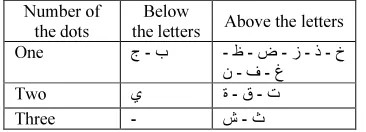
• Sixteen of Arabic characters contain dots in
[image:2.595.94.291.239.489.2]addition to the characters body (a dot may be placed above or below the body of the character) (Table 1).
Table 1: characters depending on the diacritical body
• Some characters can only be distinguished
by their graphemes (the main body the Arabic Letters). for example, Qaf (ـﻗ ) and Fa
( ـﻓ ) differ only by the number of dots above
the characters, and Ba ( ـﺑ ) ,Nun ( ـﻧ ) differ
only by the position of the one dot.
• Twenty-two Arabic characters can take four
different forms (beginning, middle, end,
isolated) depending on its position in the word (Table 2).
Table 2: different forms of the characters according to their position in the word
• An Arabic word usually consists of one or
more connected components (sub words) each containing one or more characters for example the Arabic word نﻮﻧﺎﻤﺛ ‘Eighty’ consists of 6 letters(from right to left):ث(tha) realized initially ـﺛ , م (m) realized medially ـﻤـ ,ا(Alef) realized finally ﺎـ , ن(Nun) realized initially ـﻧ , و(waw) realized finally ﻮـ,ن(Nun) realized in isolated shape ن , this word has three sub-words(connected components) (from right to left) : ﺎﻤﺛ , ﻮﻧand ن.(Figure 3).
Figure 3 : Example Of Arabic Word (نﻮﻧﺎﻤﺛ Eighty) With Connected Components
Number of the dots
Below
the letters Above the letters One ج- ب - ظ- ض- ز- ذ- خ
غ ف -ن Two ي ة- ق- ت Three - ش- ث
Letter Name
Beginning Middle End Isolated
Ba ـﺑ ـﺒـ ﺐـ ب
Ta ـﺗ ـﺘـ ﺖـ ت
Tha ـﺛ ـﺜـ ﺚـ ث
Jeem ـﺟ ـﺠـ ﺞـ ج
Ha ـﺣ ـﺤـ ﺢـ ح
Kha ـﺧ ـﺨـ ﺦـ خ
Seen ـﺳ ـﺴـ ﺲـ س
Sheen ـﺷ ـﺸـ ﺶـ ش
Sad ـﺻ ـﺼـ ﺺـ ص
Dad ـﺿ ـﻀـ ﺾـ ض
Ta ـط ـﻄـ ﻂـ ط
Zha ـظ ـﻈـ ﻆـ ظ
Ain ـﻋ ـﻌـ ﻊـ ع
Ghain ـﻏ ـﻐـ ﻎـ غ
Fa ـﻓ ـﻔـ ﻒـ ف
Qaf ـﻗ ـﻘـ ﻖـ ق
Kaf ـﻛ ـﻜـ ﻚـ ك
Lam ـﻟ ـﻠـ ﻞـ ل
Meem ـﻣ ـﻤـ ﻢـ م
Nun ـﻧ ـﻨـ ﻦـ ن
Ha ـھ ـﮭـ ﮫـ ه
[image:2.595.95.278.588.654.2]HTK
3. RECOGNITION SYSTEM
[image:3.595.50.355.98.369.2]نﻮﺘﺳوﺪﺣاوﺔﺋﺎﻣوﺲﻤﺧ Figure 4 : Description of the recognition system
The proposed recognition system is based on combination of decision fusion approach. The first step consists of applying series of preprocessing operations to enhance the text image. The operations applied for reducing noise to text image including: thresholding, filtering, smoothing, skew detection, and removing horizontal space (inter sub-words) of the line image. The next step is segmentation of the text image into line images, described in section 4. The next step is the extraction of features using vertical sliding windows technique along the line image. The sequence of features vectors is represented in four stream’s group: 1) Density values of pixels concatenated with the local configurations of feature’s pixels. 2) The VH2D features. 3) The grey level of feature’s pixel. 4) Moment invariant features. The different features obtained are modeled separately by HMMs classifiers. These classifiers output are then combined by different methods. The decision fusion approach is used to recognize text line. HTK process may be divided into two major blocks, training procedure and the recognition procedure. In the next section, the proposed system will be discussed in details.
4. PRE-PROCESSING
The text is scanned and stored as a binary image. The preprocessing step consists on :
• Eliminate or reduce noise in the image. • Thresholding or binarization, screening,
filtering, smoothing.
• Skew detection and correction, detects the
skewing angle (any tilt at which the document may have been scanned) for align the text image in true horizontal for simplify the feature extraction.
• Segmentation the text image in line images.
Once the text page is scanned, the text lines are inclined to the true horizontal axis. We used the Hough transform method of skew detection [15][23].Each text in the data corpus is then transformed in line image. In the proposed system, we use horizontal projection methods that are based on the analysis of the histogram of horizontal projection, as described in [15].
5. FEATURE EXTRACTION
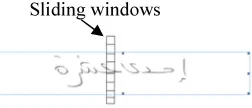
Each line image is transformed into a sequence of feature vectors extracted from right to left (the direction of the Arabic writing) along the line image by sliding window technique [13].of size N pixel successively offset and £ of pixels (£ parameter that takes values between 1 and N-1). Each window is divided vertically into a number of fixed cells and the horizontal sliding window has the same height of the line image “h”.
Sliding windows
Figure 5 : Description of sliding window technique along the line image
We use four feature extraction methods, which are applied directly to line image. The different features are chosen after the study of the literature review of feature extraction in off-line handwriting recognition system.
5.1 Densities Of Pixels & Local Configurations Of Pixels
The features of densities are constructed using the density of pixels and the local configuration of pixels in the method given in [20], the advantage of using this type of feature is its independence of the used language. Moreover, it can be used for any type of cursive including poles and legs (like Arabic and Latin writing).
The characteristics of the local densities of pixels are as follows:
Models Training
Pre-Processing
VH2D Moment
Invariants
Grey Level of Pixel Densities of
pixels & local configurations of pixels
HMMs
[image:3.595.349.475.464.518.2]• : Density of black pixels in the window t.
• : Density of white pixels in the window t.
• : Number of black / white transitions
between cells.
| 1|
∶ intensity of cells i : Number of cells
•
݂
ସ: Difference between position the center ofgravity G the pixels for two consecutive Sliding Windows t:
1 where ∑ .
∑
∶number of black pixels in the i row in the window
• to densities of pixels in each writing column for each window t .
• Center of gravity of the pixels writing.
The characteristics of the local configurations of pixels:
• to : The number of white pixels that
[image:4.595.173.504.76.454.2]belong to one of five configurations of the figure in each window t.
5.2 VH2D
The VH2D approach proposed in (Xia and Cheng, 1996) consists of projecting every character on the abscissa, on the ordinate and the diagonals 45° and 135°. We used the features VH2D for the recognition off-line the Arabic Words, as described in [15]. The vertical, horizontal and diagonal projections take place while calculating the sum of the values of the pixels ixy according to a given direction of each cell.
5.3 Moment Invariants
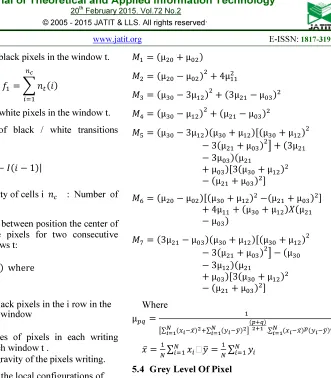
The moment invariants of Hu are used by Hu.Ming-Kuei [21] as discriminating feature to visual pattern recognition. The moment invariants proposed by Hu are a family of primitive statistics widely used in handwriting recognition and calculated for each sliding window. These primitives are invariant under translation, rotation and scaling. Seven times introduced by Hu are presented in [22]:
μ μ
μ μ 4μ
μ 3μ 3μ μ
μ μ μ μ
μ 3μμ μ"μ μ
3μ μ# 3μ
3μμ
μ"3μ μ
μ μ$
μ μ"μ μμ μ$
4μ μ μ%μ
μ
3μ μμ μ"μ μ
3μ μ# μ
3μμ
μ"3μ μ
μ μ$
Where
μ
∑̅∑ .∑̅
&̅ ∑ & L() ∑ (
5.4 Grey Level Of Pixel
The fourth group of characteristics is statistical, these type of feature take a short processing time compared to structural characteristics [23] and are very easy to compute. We used these features of the systems by using HMM Toolkit (HTK) to recognize Arabic manuscripts characters as described in [16].
• * : The average grey level represents the
average with two functions the Gaussian
filter G!et G".
• * - : The horizontal gray level derivative
is calculated as the slope of the line which best fits the horizontal function of column-average gray level per the sliding window in y-direction. The fitting criterion is the sum of squared errors weighted by Gaussian filter.
• * - #: The vertical gray level derivative is
computed in a similar way in x-direction.
6. HMM AND HTK
observable the implicit segmentation of the Arabic handwriting, the temporal information of the input data, the resistance to noise…) for more information about HMM, refer to [8][9].
We used the HTK Toolkit [2] for the evaluation of our approach. It is a portable toolkit for building and manipulating Hidden Markov Models. HTK is a set of C library modules and tools that was initially used for speech recognition research and developed at the Speech Vision and Robotics Group
of the Cambridge University Engineering
Department (CUED) in 1989 by Steve Young.
Two major blocks of the HTK are briefly presented in this paper, classifier HMM for training block and the recognizing block.
In the training phase, HTK allows HMMs to be built with any desired topology using simple text files. The training tools will adjust HMM parameters using the training text image lines, parallel with the data transcription. The Baum-Welch re-estimation procedure is used to obtain the maximum probability estimation of the HMM [10].
In the recognition phase, the recognition tool implements the Viterbi Algorithm. The sequence of extracted feature vectors are passed to a network of lexicon of character models to describe the transition probabilities, and the character sequence providing the maximum probability and this gives the recognized word correct.
The word models are constructed by
concatenating the models character patterns. The topology of character models is in the direction of the writing the Arabic language right-left with four states. The initial probability of densities of the observations in each state are modeled by continuous distribution Gamma and Gaussian [7].
• Distribution Gaussian : the density of state
is ܘܒሺ܌ሻ ൌ
ܒሺሻ܍
ି
where .$ and /the mean and variance of the
Gaussian distribution
• Distribution Gamma : the density of state is
ሺࢊሻ ൌ ࢊࢋ
In this paper, we study the combination efficiency based on multiple classifiers HMMs because it is more beneficial than exploiting a single classifier. Different combination methods was applied to Arabic handwriting recognition [23], such as Majority Voting (MV), Weighted Majority Voting (WMV), Borda Count (BC), Combination on Measurement Level (CML). We use two
methods of combination. The choice of these methods is based on the study of the state of the art.
Each output of all classifier is linearly from 1 to 0
(number of modules), module 1 is denoted as &% ,
for systems.
• Weighted Majority Voting (WMV):
Weighted Majority Voting methods
determine a fixed weight for each classifier with a set training data. This method assigns, to each classifier module, different weight according to its performance and the consideration of the confidences in the
combination. The discriminate function for
the 23can be defined as :
23&% & max
,∈,,…….,,7 ,&%8
• BordaCount(BC) : the BordaCount method
is the generalization of MajortyVoting Method. This methods is used for ranked the
lists of combination i.e ranking the results
provided by the different classifiers. The
discriminate function for the 23can be
defined as :
()* + ,-.,,,/∑ 0 1 0234 /5, *, 6, *7 8 97
7. EXPERIENCES AND RESULTS
The proposed recognition system is evaluated
using the IFN/ENIT-database for Arabic
handwritten words version 2.0 with patch level (v2.0ple) [14]. It consists of 32 492 images of Arabic handwritten words made by more than 1000 writers. The database was divided into five sets (a,b,c,d,e). 4 sets (a,b,c,d) was used for the training and 2 sets (d and e) for the test.
The topology of character models from right to left and HMMs are modeled by continuous distribution Gamma and Gaussian. We have applied two combination methods: Weighted Majority Voting (WMV) methods and BordaCount (BC) method.
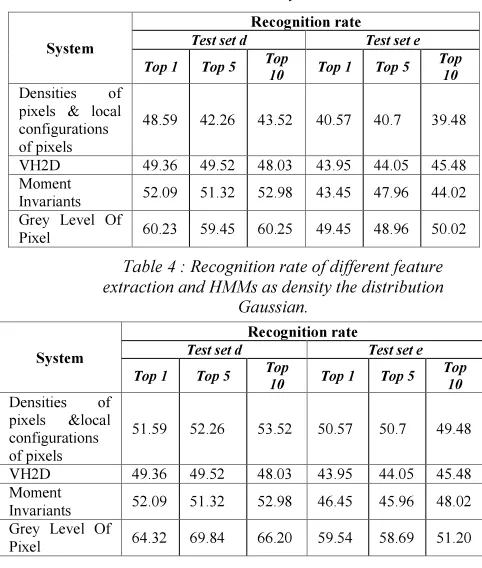
In this study, several tests have been performed to evaluate the recognition rate of the proposed system, depending on: 1) the distribution used to
modeling the continuous density. 2) The
combination methods of multiple HMMs classifiers. The results of these tests was summarizes in the tables 1 to 6.
distribution deduct a better decision. It means that performances of the used density’ distribution is a factor that contributes to the performances of the system, but they are not sufficient. Indeed, the combination methods get the highest performances. We noted that “Weighted Majority Voting” (WMV) method gives the best results.
Finally, the performance of handwritten Arabic recognition system is significantly improved when the combination methods of multiple classifiers HMMs with different feature are used.
[image:6.595.316.551.161.249.2]Table 3 : Recognition rate of different feature extraction and HMMs as density the distribution Gamma.
Table 4 : Recognition rate of different feature extraction and HMMs as density the distribution
Gaussian.
Table 5 : Recognition rate of the concatenation the different features extraction with HMMs as density the
distribution Gamma.
Table 6 :Recognition rate of the concatenation the different features extraction with HMMs as density the
[image:6.595.53.294.281.565.2]distribution Gaussian.
Table 7 :Recognition rate of the two combination method with HMMs as density the distribution Gamma
Table 8:Recognition rate of the two combination method with HMMs as density the distribution Gaussian.
8. CONCLUSION
We have presented, in this paper, an off-line handwritten Arabic recognition system based on decision fusion approach and HMM Toolkit (HTK) and we have described several methods of
combining multiple classifiers HMMs of
distribution density with different features and their application to IFN/ENIT database. Based upon the experimental results, we have demonstrated that the performance of handwritten Arabic recognition system is significantly improved and the methods of combining multiple classifiers with different features described in this paper not only the individual classifiers but also the methods of combining multiple classifiers with the same feature. The new method can be applied in conjunction with Weighted Majority Voting (WMV) methods and BordaCount (BC). The
System
Recognition rate
Test set d Test set e
Top 1 Top 5 Top
10 Top 1 Top 5
Top 10
Densities of
pixels & local configurations of pixels
48.59 42.26 43.52 40.57 40.7 39.48
VH2D 49.36 49.52 48.03 43.95 44.05 45.48
Moment
Invariants 52.09 51.32 52.98 43.45 47.96 44.02
Grey Level Of
Pixel 60.23 59.45 60.25 49.45 48.96 50.02
System
Recognition rate
Test set d Test set e
Top 1 Top 5 Top
10 Top 1 Top 5
Top 10
Densities of
pixels &local
configurations of pixels
51.59 52.26 53.52 50.57 50.7 49.48
VH2D 49.36 49.52 48.03 43.95 44.05 45.48
Moment
Invariants 52.09 51.32 52.98 46.45 45.96 48.02
Grey Level Of
Pixel 64.32 69.84 66.20 59.54 58.69 51.20
System
Recognition rate
Test set d Test set e
Top 1 Top 5 Top
10 Top 1 Top 5 Top 10
Concatenati
on the
features extraction.
55.21 54.06 53.48 51.62 49.22 48.52
System
Recognition rate
Test set d Test set e
Top 1 Top 5 Top
10 Top 1 Top 5 Top 10
Concatenat
ion the
features extraction
56.64 56.96 54.57 53.04 52.14 50.52
System
Recognition rate
Test set d Test set e
Top 1 Top 5 Top
10 Top 1 Top 5 Top 10
Weighted Majority Voting (WMV)
75.21 75.36 75.40 63.42 62.43 65.75
Borda
Count(BC) 70.60 72.63 71.69 58.14 51.96 54.20
System
Recognition rate
Test set d Test set e
Top 1 Top 5 Top
10 Top 1 Top 5 Top 10
Weighted Majority Voting (WMV)
76.54 75.96 76.47 73.04 72.44 70.52
Borda
[image:6.595.321.552.282.385.2]system was capable to learn the complexity of ligature and overlaps the characteristics of the Arabic script. The results of the proposed approach are among the best ones when HMM Toolkit classifier is used. However, there are the problems in the combination of multiple classifiers with different features related to the issues : for specific application what type of classifiers should be used ?, for combining multiple classifiers what type of combining methods should be used so that a better result can be obtained?, for each classifier what type of features should we use?. We shall explore on these problems in our ongoing research.
REFRENCES:
[1] G. Ben Amara, A. Belaïd and N. Ellouze,
Utilisation des modèles markoviens en
reconnaissance de l’écriture arabe : Etat de l’art, CIFED, 2000.
[2] S. Young, G. Evermann, D. Kershaw, D.
Moore, J. Odell, D. Ollason, V. Valtchev, P. Woodland, 2001. The HTK Book. Cambridge University Engineering Dept .
[3] A. Amin, H.B. Al-Sadoun, S. Fisher:
HandPrinted Arabic Character Recognition system using an artificial network. Pattern Recognition, 29( 4) :663-675, 1996.
[4] A. Amin, S. Al-Fedaghi, Machine recognition
of printed Arabic text utilizing natural language morphology, Int. Journal Man-Machine Studies, IJMMS’91, 35 :769-788, 1991.
[5] A. Schlapbach, H. Bunke, Using HMM-based
recognizers for writer identification and verification, Proc. 9th Int. Work. on Frontiers in Handwriting Recognition, 167-172, 2004.
[6] B. Al-Badr, S.A. Mahmoud, Survey and
bibliography of Arabic Optical Text
Recognition, Signal processing, 41 :49-77, 1995.
[7] Levinson. S.E. “Continuously Variable
Duration Hidden Markov Models for
Automatic Speech Recognition Computer”, Speech & Language, Vol 1.N° 1, pp: 29-45, 1986.
[8] X. Huang et al., Hidden Markov Modells for
Speech Recognition, Edinburgh Universal Press, 1990.
[9] L. R. Rabiner, A Tutorial on Hidden Markov
Models and Selected applications in speech Recognition, A. Wailbel, Lee K.-F., Readings
in Speech Recognition, pp. 267-296,
Kaufmann, San Mateo, CA, 1990.
[10]Rabiner, L., Juang, B., 1993. Fundamentals of
Speech Recognition Prentice Hall.
[11]M. S. Khorsheed, Off-line arabic character
recognition– a review, Pattern Analysis and Applications, 5: 31–45, 2002.
[12]M. S. Khorsheed, W.F., Cocksin, Multi-font
arabic word recognition using spectral feature.
In 15th Internat. Conf. on Pattern Recognition,
vol. 4, Barecelona, Spain. September 2000, pp.543-546.
[13]R. Schwartz, C. LaPre, J. Makhoul, C.
Raphael, and Y.Zhao. Language-independent OCR using a continuous speech recognition. In
Proc. Of the 13th Inter.Conf. On Pattern
Recognition (ICPR), volume 3, pages 99-103, 1996.
[14]R. EL-HAJJ, L. LIKFORMAN-SULEM, C.
MOKBEL, Arabic handwriting recognition using baseline dependent features and Hidden Markov Modeling, ICDAR 2005, Seoul, Corée du Sud.
[15]A. Maqqor, A. Halli, K. Satori, and H. Tairi, A
Slippery window and VH2D Approach to Recognition Offline Arabic Words, pages 269-279. Spring, 2013.
[16]A. Maqqor, A. Halli, K. Satori, and H. Tairi,
Using HMM Toolkit (HTK) for Recognition of
Arabic Manuscripts Characters , In 4th Internat.
Conf.on Multimedia Computing and Systems, ICMCS 2014, Marrakesh, Morocco.
[17]S. OKAWA, E. BOCCHIERI, and A.
POTAMIANOS, Multiband speech recognition in noisy environments. In Proceedings of IEEE International Conference on Acoustic, Speech, and Signal Processing, p. 641.644, Seattle, Washington (1998).
[18]L. PREVOST, C. MICHEL-SENDIS, A.
MOISES, L. OUDOT,and M. MILGRAM,
Combining model-based and
discriminativeclassifiers: application to
handwritten character recognition. In
7thInternational Conference on Document
Analysis and Recognition,volume 1, p. 31-35 (2003).
[19]J. KIM, K. KIM, C. NADAL, and C. SUEN, A
methodology of combining hmm and mlp classifiers for cursive word recognition. International Conference Document Analysis and Recognition (ICDAR), vol 2, p. 319-322 (2000).
[20]T.M. Hamdani and A. M. Alimi. Artificial
chapter β –SVM a new support vector machine, pages 63-68, Springer, 2003.
[21]H. Ming-Kuei, “Visual pattern recognition by
moment invariants”, information Theory, IRE Transactions on, vol. 8, pp. 179-187, 1962.
[22]S. Theodoridis and K.Koutroumbs. Pattern
Recognition, Second Edition. Copyright 2003, Elsevier(USA). Academic Press. 2003.
[23]L. Xu, A.Kryzak, and C. Y. Suen. Méthods of