A NOVEL APPROACH OF FIC FOR COMPRESSION OF
LARGE SCALE REMOTE SENSING COLOR IMAGES
1D.SOPHIN SEELI, 2DR.M.K.JEYAKUMAR 1
Research Scholar, Department of Computer Applications, Noorul Islam University,Kumaracoil, TamilNadu, India.
2
Professor, Department of Computer Applications , Noorul Islam University, Kumaracoil, Tamil Nadu, India.
ABSTRACT
Image compression has become an important issue in the storage and the transmission of images including satellite and aerial photographs. A new approach was used for compressing satellite images is to construct compression algorithms by using the fractal theory. This paper is based on a novel image structure, Spiral Architecture, which has hexagonal instead of square pixels as the basic element. In the proposed work, we use only two codebooks for all images. Open and private code book is generated for the remote sensing image gallery, instead of using separate codebook for each during the process; hence high compression ratio can be achieved. Introducing Spiral Architecture into fractal image compression for remote sensing images will improve the compression performance in compression ratio, reduction of memory and bandwidth cost of large-scale remote sensing images.
Keywords: Fractal Image Compression; Compression Ratio; Large-Scale Remote Sensing Image; Hexagonal Structure; Spiral Architecture; Codebook.
1. INTRODUCTION
Transmission of information is the way to obtain data related to particular event such as, video conferences, medical data transfer, business data transfer, remote sensing image transfer etc. Due to the Internet, the huge information transmissions took place, since transmissions involve much more storage, computer processor speed and added bandwidth for transmission. Image compression has been one of the most challenging fields in the image processing research. Large-scale remote sensing images, including both satellite and aerial photographs, are widely used in real-time geographic visualization systems. Such systems often require large memories in order to store fine landscape details. In our approach we efficiently compress and decompress the remote sensing images. This leads to memory reduction. The whole process of image compression concentrate the images that are nature generated and the human eye may not receive the lost details in the image coding process. Compressing an image is significantly different than other binary data [24].
Nowadays the satellite remote sensing data is widely used for natural resource mapping/monitoring, disaster management etc.
There is a need for satellite image compression as these data occupy considerable disk space. Conventional fractal compression schemes can easily be extended to satellite image compression. In this paper a novel approach on fractal image compression using spiral architecture for coding satellite images.
Fractal coding is one of the most efficient compression techniques. Fractal coding method finds the similarity regions in the different parts of the image, in which the image can be represented as fixed points of Iterated Function System (IFS). Here the image can be represented in terms of fractals rather than pixels [3]. Collage Theorem is employed for Partitioned Iterated Function System (PIFS) and gray scale images which is equivalent to IFS for binary images. The collage theorem performs the encoding of gray scale images in an effective manner.
assumption that natural images are self similar
and are formed from a systematic repetition of a primary block. Fractal Image coding attempts to find a set of contractive transformations that map overlapping domain cells onto a set of range cells with the aid of affine transformation. The key point for fractal coding is to extract the fractals which are suitable for approximating the original image and these fractals are represented as set of affine transformation [4]. In most cases fractal coding is applied to the gray scale images. In the case of color images gray scale fractal image is achieved by splitting the RGB values of a color image into three planes of Red, Green, and Blue. This is compressed by treating that each of the three color channel as a single gray scale image. This is called three components Separated Fractal image Code (SFC) [22].
One attractive feature of fractal image compression is that it is resolution independent when decompressing, it is not necessary that the dimensions of the decompressed image be the same as that of original image. In traditional, the pixels in an image can be represented as a rectangular shape. In our approach each vision unit is considered as a set of seven hexagons called spiral architecture.This hexagonal image structure was proposed by Sheridan in 1996, on which each hexagonal pixel is identified by a designated positive seven-based integer [23]. Here we propose a progressive texture compression system by incrementally decomposing new images into codebooks and transformation maps. Our specific contribution in this study is Codebooks. The Specific Purpose is to classify remote sensing images into different categories based on their contents, and we construct codebooks separately for each category. In each category, we use a public codebook to store common features among images, and a private codebook to store distinctive contents in each individual image. Compared with using a single codebook for all images, this structure is more efficient to build for large-scale images with varying contents.
1.1 Previous Work
Some existing methods involves fractal coding with Discrete Cosine Transform(DCT) [5] or with Wavelet transform [6], or based on utilization schema genetic algorithm for fractal image compression[7], or using some classification criteria to classify range-domain blocks . Truong et al.[36] proposed a kind of neighborhood matching method based on spatial
correlation which makes use of the information of matched range blocks and effectively reduced the encoding time. Some other researchers have combined fractal with other algorithms such as ant colony optimization [34], neural network [35], genetic algorithm [14], fractal wavelet [13], etc. A schema genetic algorithm for fractal image compression is proposed in [7] to find the best self similarity in fractal image compression. Wu et al. [15] proposed a Spatial Correlation Genetic Algorithm (SC-GA), which speeded up the encoding time and increased compression ratio.
Bo li et al. [8] proposed a 2-D Oriented Wavelet Transform for remote sensing image compression, which performs integrated oriented transform in arbitrary direction and achieve a significant transform coding gain. JPEG and other DCT based compression techniques [9] have been employed in many space missions. Pan Wei et al.[10] proposed 3-D Fractal coding to compress the hyperspectral remote sensing image. An improved method of remote sensing image compression based on fractal and wavelet domain was introduced by Yu Jie et al.[11].
represented in Spiral Architecture for compression.
On this Spiral Architecture image, proposed modified Fractal grey level image coding algorithm (MFCSA) is applied to get encoded image.
The rest of this paper is organized as follows. In section 2, The role of domain and range block matching in fractal image encoder is discussed. Section 3 discusses the novel approach of fractal image compression with spiral along with codebook approach. In addition we provide a frame algorithm of the novel approach. In section 4, experimental results are reported. Finally, section 5 concludes this paper and draws some key issues for future work.
2. THE ROLE OF DOMAIN AND RANGE BLOCK MATCHING IN FRACTAL IMAGE ENCODER
The act of coding an image is in the way that at first the original one (Range Image) is divided into a set of block with identical size (Range Block). An image with less detail is also divided into blocks with identical size (Domain Block). For each block, choose a suitable block among the range blocks and transforming in the way that by applying on the range block, the produced image is to be closed to the related Domain block. For obeying the Contractive Mapping Fixed-Point Theorem, the domain block must exceed the range block in length. Let the domain pool D be defined as the set of all possible blocks of size 2n ×2n of the image f, which makes up (m −2n+ 1) blocks. For m is 256 and n is 8, the range pool R is composed of (256/8) × (256/8) = 1024 blocks of size 8 ×8 and the domain pool D is composed of (256 −16 + 1) × (256 −16 + 1) = 58081 blocks of size 16 ×16.
For each range block from the range pool R, the fractal affine transformation is constructed by searching all of the domain blocks in the D to find the most similar one and the parameters representing the fractal affine transformation will form the fractal compression code. Suppose that we are dealing with a 128 x 128 image in which each pixel can be one of 256 levels of gray. We call this picture Range Image, then reduce by averaging the original image to 64 x 64. We called this new image Domain Image. Each Domain Block is transformed and then compared to each Range Block. Each transformed domain block Γ (Di, j) is compared to each range block Rk,l in order to find the closest domain
block to each range block. This comparison is performed using distortion measure. The encoding procedure is described in fig. 1. The encoding procedure is time-consuming due to the full search mechanism. For the standard full search method, the encoding process is time-consuming because a large amount of computations of similarity measure are required.
Figure1: Flow Chart of Fractal Image Encoding
3. FRACTAL IMAGE COMPRESSION USING SPIRAL
3.1. Overview of the Proposed Work
In traditional method the image is partitioned into non overlapping range cells which is in rectangular or any other shape such as triangles. In our proposed algorithm hexa range of cells are used. The image is covered with a sequence of over-lapping domain cells. The domain cells occur in variety of sizes and they may be in large number. For each range cell the domain cell and corresponding transformation that best covers the range cell is identified. The transformations are generally the affine transformations. The code for fractal encoded image is a list consisting of information for each range cell which includes the location of range cell, the domain that map onto that range cell and parameters that describe the transformation mapping the domain onto the range [22].
each address by 10. Initially we separate the image
into non-overlapping range blocks of seven pixels and define the overlapping domain blocks of seven times more in general, i.e. 49 pixels or 343 pixels [22].
(a) (b)
Figure 2:(a) Rectangular Srchitecture (b) Spiral Architecture
3.2. Range and Domain Block Matching in Spiral
Range block domain block
Figure 3: A Collection of 72=49 Hexagons With
Labelled Address
The range block contains seven pixels and the domain block will have seven times large as the range block that is 49 pixels. For each range block we only search for up to 343 domain blocks, which are around this range block. Each of those range blocks has at most 343 domain blocks in the domain pool and the centres of domain blocks in the pool are the first 343 pixels counting from the centre of range block through the Spiral direction. The sub sampled domain block can be represented as,
Bi = µ(Di)
To form the Codebook blocks, the domain blocks are optimized to specific number, then filtered and sub-sampled using pixel median so that it shrinks to match the size of the range blocks. The matching between the range and domain block can be done by the following,
(
)
(
)
2
1 2
,
∑
=
−
=
n
i
i i i
i
B
r
b
R
d
n = number of pixels in Ri and Bi block
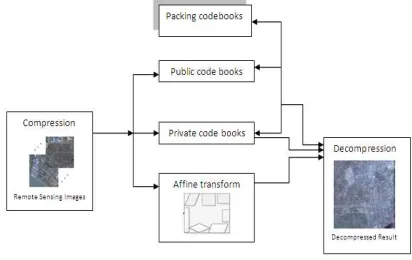
[image:4.595.316.522.302.432.2]We separate images into two components [23], a codebook and a transformation map. The codebook contains representative small samples from original images; the transformation map indicates how an image can be recovered from the codebook.
Figure 4: Pipeline of the Novel Approach
Figure 4 shows the pipeline of our system. It contains two components, compression and decompression. The compression process produces a codebook bank that contains both public and private codebooks for images in different categories, and transformation maps that instruct the renderer how to recover images using random texture access.
3.3 Algorithm:
For the encoding of any color image, the whole encoding process is divided into two parts. First, the one plane image formation and average trichromatic coefficient calculation of relevant homogeneous blocks which formed according to the tolerance value. Then only one color-plane needs to be coded, while the other two can be automatically reconstructed from the encoded color plane and correlation among them.
[image:4.595.92.282.325.443.2]• Find RGB mean of the color images to
convert into grayscale images. • Split input image.
• Construct spiral architecture and find domain blocks and range blocks
• Resize domain block to range block size for mapping.
• Set to range block nearest domain block. • Compute fractal image compression by
forming public and private code books • Retrieve the image by applying fractal
image decompression with the public and private code books and with the transformation map.
• Calculate PSNR and compression size.
3.4. Codebook Construction
There are two types in codebook. We use a public codebook to store common features among images, and a private codebook to store distinctive contents in each individual image. Compared with using a single codebook for all images, this structure is more efficient to build for large-scale images with varying contents. Compared with using a single codebook for all images, this structure is more efficient to build for large-Scale image. The basic idea behind this system is to incrementally update the contents in codebooks, if and only if its content is not sufficient to recover a new image. This dynamic feature is used to reduce the computational cost when dealing with a varying data set of multiple image scale images with varying contents. A public codebook is used to recover multiple images during the decompression process. A simple solution here is to directly insert new contents into a single codebook when the system receives a new image. However, it is likely to produce a huge codebook and slow down the compression process. So we propose to use two codebooks instead of one. We use a public codebook to contain common contents among images and it will be used to recover multiple images during the decompression process. To further reduce the public codebook size and accelerate the codebook construction process, we classify remote sensing images into different categories and construct public codebooks separately for each category.
We use a private codebook to store and recover distinctive contents in each image. Finally with the aid of affine transform range block is mapped from their best domain block in the codebook. Examples of affine transformations
include translation, scaling, homothetic, similarity transformation, reflection, rotation, shear
mapping, and compositions of them in any combination and sequence [2].
Given a new image and an existing public codebook, we take the following steps to update the public codebook and construct a private codebook. We first separate the image into a set of blocks, each of which contains 16×16 pixels. We then run similarity search between each image block and the public codebook [17]. If a match exists, we compute and store the appropriate transformation, with which the block can be directly recovered from the existing codebook. For these remaining blocks that cannot be represented by the public codebook, we build a similarity match list for each block as in [23] and count how representative a repeated content is. If the reused times are more than a threshold, the block will be added into the public codebook bank. Otherwise, we think it is not representative enough and it will be assembled into the private codebook instead. Details on the assembling process can be found in [23].
4. RESULTS AND DISCUSSION
This proposed method was realized in MATLAB to encode and decode the satellite images. First the color image was partitioned into 4*4 pixels then mean value is calculated for each block. Then the resultant image is converted into a gray scale image. Followed by the spiral architecture, domain construction takes place. In that spiral architecture domain and range block was selected, for each domain, fractal coding was computed then stored on the codebook. Here we are using only two codebooks for all the images. Through this code book generation the original image was reconstructed, and the use of spiral architecture, these two codebooks gives high compression ratio.
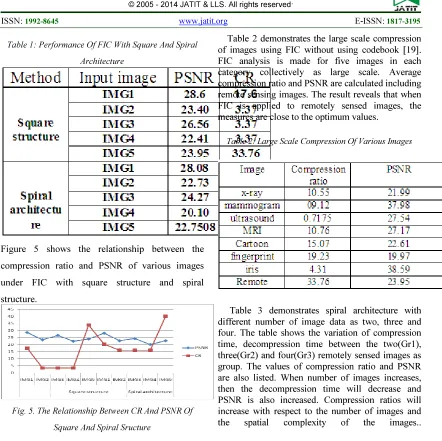
Table 1: Performance Of FIC With Square And Spiral
Architecture
Figure 5 shows the relationship between the
compression ratio and PSNR of various images
under FIC with square structure and spiral
structure.
Fig. 5. The Relationship Between CR And PSNR Of
Square And Spiral Sructure
Table 2 demonstrates the large scale compression of images using FIC without using codebook [19]. FIC analysis is made for five images in each category collectively as large scale. Average compression ratio and PSNR are calculated including remote sensing images. The result reveals that when FIC is applied to remotely sensed images, the measures are close to the optimum values.
Table 2: Large Scale Compression Of Various Images
[image:6.595.87.506.566.643.2]Table 3 demonstrates spiral architecture with different number of image data as two, three and four. The table shows the variation of compression time, decompression time between the two(Gr1), three(Gr2) and four(Gr3) remotely sensed images as group. The values of compression ratio and PSNR are also listed. When number of images increases, then the decompression time will decrease and PSNR is also increased. Compression ratios will increase with respect to the number of images and the spatial complexity of the images..
Table 3. Performance Of FIC With Spiral Codebook For Different Number Of Images
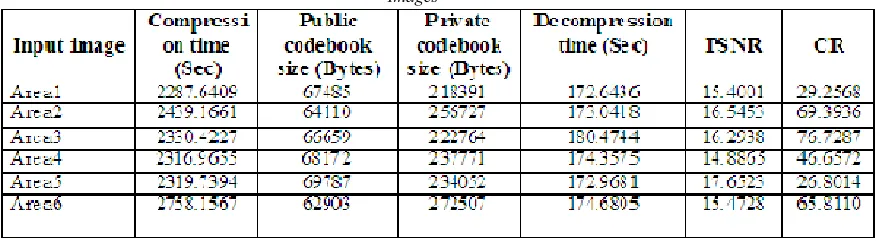
Table 4: Performance Of FIC With Spiral Codebook For Different Land Cover Types Of Remote Sensing
Images
Table 5 compares the methods image compression by use of codebooks[23], FIC with codebook[17], FIC without using codebook[33] and the proposed method FIC using spiral architecture with the codebook for large scale remote sensing images. The results reveal that Area4 is having high compression ratio and acceptable Peak Signal-to-Noise Ratio for the proposed method , because of te lower spatial
[image:7.595.90.502.435.757.2]complexity for the water area.
5. CONCLUSION
The proposed compression scheme is mainly designed for remote sensing images. According to the experiments, it is found that the spiral architecture has great potential in improving fractal image compression. In our approach we introduced simple code book generation for a large scale image in order to increase the compression ratio. The replacement of traditional square structure by the spiral architecture achieve better compression ratio. In computer vision the pixel can be represented as a digit. Here each pixel will take 8 bit storage. As colorcan be represented by three values, each pixel occupies 27 bits in memory. In our approach we used fractal compression and two code books on the spiral architecture its result in high compression ratio. Here we used four images for each category of satellite images as input; instead of using separate codebook for these four images we used only two codebooks for these images. This is based on the concept of remote sensing images will have more similar regions. Hence from this public and private codebook the image can be reconstructed and in our approach we obtained high compression ratio. Findings of this study reveal that:
• In comparison with the previous compression methods, such as FIC and FIC with spiral, the FIC with spiral codebook has higher compression rate.
• FIC with spiral codebook can be applied to compress and decompress remote sensing images.
• The compression can be influenced by spatial complexity due to this we achieved that water area has high compression rates. The results are compared in terms of PSNR and compression ratio. From the result, it is very clear that remote sensing images have better compression ratio than other type of images.
In our future work, the following issues can further be investigated. First, the limitation of spiral addressing is lack of capturing hexagonal grid. Due to this, researchers are trying to imitate the hexagonal grid on rectangular grid itself. For the square images, the spiral architecture ignores the corner of the images. This can be resolved to obtain the square decoded images. Second, more images having different degree of complexity will need to be analyzed with more quantifiable parameters. This study can be extended to kinds of remote sensing images from different platforms such as SPOT, RADAR, IKONOS etc., and for different
band images. The proposed approach can be useful for the huge image data transmission where the image quality does not matter much for example, video conference. Third, web based image data can be managed using the proposed approach. The search of domain blocks for the spiral codebook can be optimized using any of the optimization algorithms. Optimization of domain blocks gives rise to have the more accuracy in the formation of codebook blocks and save the processing time.
REFERENCES
[1] M. F. Barnsley and S. Demko, “Iterated function systems and the global construction of fractals,” Proc. Roy. Soc. London A, vol. 399, pp. 243–275, 1985.
[2] A.J. Crilly, R. A. Earnshaw, and H. Jones,
Fractals and Chaos. NewYork:
Springer-Verlag, 1991.
[3] Y. Fisher, Fractal Image Compression: Theory and Application. NewYork: Springer-Verlag, 1994.
[4] A.E. Jacquin, Image coding based on a fractal theory of iterated contractive image transformations”, IEEE Transaction on Image Processing, Jan 1992.
[5] R.M. Gouda, Priya Pise, “Compression Technique Using DCT & Fractal Compression – A Survey”, Advances in Physics Theories and Applications, ISSN 2224-719X (Paper) ISSN 2225-0638 (Online) ,Vol 3, 2012. [6] Y.Iano,F.Silvestre, A.L.Mendes Cruz, “ A Fast
and Efficient Hybrid Fractal Fractal –Wavelet Image Coder”, IEEE Transactions on Image Processing, vol.15,no.1, pp.98-105,2006. [7] M.S.Wu, J.H.Jeng,J.G.Hseieh, “Schema
Genetic Algorithm for Fractal Image Compression”, Engineering Applications of Artificial Intelligence, vol. 20, pp.531-538, 2007.
[8] Bo Li, Rui Yang, and Hongxu Jiang, “Remote Sensing Image Compression Using Two-Dimensional Oriented Wavelet Transform” IEEE Transactions on Geoscience and Remote sensing, vol. 49, no. 1, pp. 236-249,Jan. 2011. [9] P.Hou,M.Petrrou, C.I.Underwood, and
A.Hojjatoleslami, “Improving JPEG Performance in Conjunction with Cloud Editing for Remote Sensing Applications”, IEEE Transactions on Geoscience and Remote sensing, vol. 38, no. 1, pp. 515-524, Jan. 2000. [10] Pan Wei, Zou Yi and Ao Lu, “ A
Remote sensing Image Based on 3-D Wavelet
Transform and Fractal”, proceedings of 3rd international conference on intelligent system and knowledge engineering, pp. 1237-1241. [11]Yu Jie, Zhang Zhongshan, Qin Huiling, Guo
Peihuang, and Zhang Guoning, “An Improved Method of Remote Sensing Image Compression Based on Fractal And Wavelet Domain”, The international Archives of the Photogrammatry, Remote Sensing and Spatial Information Sciences, vol. XXXVII, Part B2,Beijing, 2008.
[12]Muhammad Kamran, Amna Irshad Sipra, Muhammed Nadeem, “A novel domain Optimization technique in Fractal Image Compression”, Proc. Of the World Congress on Intelligent Control and Automation, pp.994-999, Jul 2010.
[13]Y. Iano, F. Silvestre , A. L. Mendes Cruz, “A Fast and Efficient Hybrid Fractal-Wavelet Image Coder,” IEEE Transactions on Image Processing, vol.15, no.1, pp. 98-105, 2006. [14]S.K. Mitra, C.A. Murthy, M.K. Kundu,
“Technique for fractal image compression using genetic algorithm,” IEEE Trans. Image Process, vol. 7, no. 4, pp. 586–593, 1998.. [15]M. S. Wu , W. C. Teng, J. H. Jeng, J. G.
Hsieh, “Spatial correlation genetic algorithm for fractal image compression”, Chaos, Solutions and Fractals, vol. 28, pp. 497-510, 2006
[16]J. Kennedy and R. C. Eberhart, “Particle swarm optimization,” in Proceedings of IEEE International Conference on Neural Networks, Vol. 4, 1995, pp. 1942-1948.
[17]Wei Hua Rui, Wang Xusheng, Zeng Ying, Tang Huamin and Wang Hujun Bao, “Compressing repeated content within large-scale remote sensing images”,© Springer-Verlag, April 2012.
[18]Huaqing Wang, Meiqing Wang, Tom Hintz, Xiangjian He, Qiang Wu, “ Fractal Image Compression On Pseudo Spiral Architecture”, Australian computer science conference, vol. 38, 2005.
[19]D.Sophin Seeli, M.K.JeyaKumar, “Performance Assessment of Fractal Coding on Remote Sensing Images with Different Imaging Modalities”, International Journal of Engineering and Advanced Technology, ISSN: 2249 – 8958, Volume-2, Issue-6, August 2013. [20]Manoj Kumar, Poonam Saini, “Image
Compression with Efficient Codebook Initialization Using LBG Algorithm”, IJACT, September 2011.
[21]Zhaohuili, Liang zhao and Neiy. Soma, “Fractal Color Image Compression”, May 2000.
[22]Nileshsingh V. Thakur and Dr. O. G. Kakde, “Color Image Compression with Modified Fractal Coding on Spiral Architecture”, Journal of Multimedia, Vol. 2, No. 4, August 2007.
[23]Wang, H., Wexler, Y., Ofek, E., Hoppe, H., “Factoring Repeated Content Within And Among Images”, ACM Trans.Graph., SIGGRAPH 2008.
[24]Huaqing Wang, Qiang Wu, Xiangjian He and Tom Hintz, “Preliminary Research on Fractal Video Compression on Spiral Architecture”, IPCV, pp- 557-562, April 2006.
[25]Huaqing Wang, Meiqing Wang, Tom Hintz, Qiang Wu, and Xiangjian He, “VSA-based Fractal Image Compression”, The Journal of WSCG, Vol.13, ISSN 1213-6964,2005.
[26]Gaganpreet Kaur, Hitashi, Gurdev Singh,
“Performance Evaluation of Image Quality Based on Fractal Image Compression”
International Journal of Computers &
Technology, vol.2, No.1, 2012.
[27]S. Immanuel Alex Pandian1, J.Anitha, “A Neural Network Approach for Color Image Compression in Transform Domain”, International Journal of Recent Trends in Engineering, Vol 2, No. 2, pg 152-154,November 2009.
[28]Brendt Wohlberg and Gerhard de Jager, “A Review of the Fractal Image Coding Literature”, IEEE Transactions on Image Processing, Vol. 8, No. 12, December 1999. [29]Ning Zhang, Longxu Jin, Yinhua Wu, Ke
Zhang, “ An Improved Fast SPIHT Image Compression, Algorithm for Aerial Applications”, Journal of Multimedia, Vol. 6, No. 6, pg494-501, December 2011.
[30]Mohan Awasthy ,Yagwendra Dicsena, “Multi-Channel Image Compression Using JPEG-DCT with RGB Color Model”, International Journal of Engineering Research & Technology (IJERT) Vol. 1 Issue 10, ISSN: 2278-0181, December- 2012.
[31]K. Kuppusamy , R.Ilackiya, “Fractal Image Compression &Algorithmic Techniques”, International Journal of Computer & Organization Trends –Volume3 Issue4 , ISSN: 2249-2593, May 2013.
Vol. 1, Issue 1, March 2013.
[33]B.Sankaragomathi, L.Ganesan and S.Arumugam, “Fractal Image Compression Applied to Remote Sensing”, World Academy of Science, Engineering and Technology,2007.
[34]J. Li, D. Yuan, Q. Xie, C. Zhang, “Fractal Image Compression by Ant Colony Algorithm”, Proceedings of the 9th International Conference for Young Computer Scientists, IEEE , pp. 1890-94, 2008
.
[35]Y. Chakrapani, K. Soundera Rajan, “Implementation of fractal image compression employing artificial neural networks ,” World Journal of Modelling and Simulation ISSN 1 746-7233, vol. 4, no. 4, pp. 287- 295, 2008.