4886
ENVIRONMENT ANALYSIS OF LAYING HENS BASED ON
DETAILED SOUND CLASSIFICATION USING SVM
1DAEYOUNG NA, 2SANG HO MOON, 3CHEOL WON LEE, 4HEUNG SEOK JEON
1School of Global Leadership, Handong Global University, Korea
2Department of Biomedical and Health Science, Konkuk University, Korea
3,4 Department of Computer Engineering, Konkuk University, Korea
E-mail: 1[email protected], 2[email protected], 3[email protected](Corresponding Author)
ABSTRACT
This paper suggests a classification model to analyze the status of environment of henhouse or circumstances of laying hens in real-time by inspecting the sound of laying hens. In this model, the sound of laying hens which has entered in real-time through the sound sensor installed in the henhouse classified into seven categories of sound. The goal is to analyze the classified sound of laying hens in diverse potential circumstances measuring the status of laying hens and environmental conditions of henhouses. Environmental status has been designed to detect high and low temperature, high density, and high pollution. This model was implemented by using SVM. According to the result of experiments, sound category analysis of laying hens showed the accuracy of 70.3% in average, and the estimation of environmental status showed 60.8% of accuracy in average.
Keywords: Classification, Laying Hens, Sound Analysis, Support Vector Machine
1. INTRODUCTION
Recently, as there has been an increasing concern on healthy food and welfare of animals, various researches are being conducted to improve the feeding environment of livestock in the use of IOT. Among researches conducted in the use of IOT, there are studies to identify the health conditions by analyzing living body signals or behavioral patterns of livestock in non-invasive manner with installed sensor in livestock. Representative examples include the analysis of living body signal of cow from Zigbee-based sensor network [1], research for analyzing behaviors of pets in the use of accelerometer sensor [2], study for analyzing behaviors of laying hens based on accelerometer sensor data [3], research for detecting limping cows [4], and the mechanism study for learning health conditions of livestock according to the body temperature [5].
These researches have been conducted mainly on large sized livestock to analyze their behaviors. However, as for small-sized livestock such as chickens or ducks, it is realistically difficult to attach sensor in their body.
In order to solve these issues, researches have recently been conducted to analyze sound other than
living body signals or behaviors of livestock and identify their status. Sound of livestock such as laying hens include various types of information. Therefore, it is feasible to acquire various types of information related to livestock if analyzing the sound. The field for analyzing the behaviors and health conditions in the use of sound from animals is called as Bioacoustics [6].
Bioacoustics researches recently conducted in the use of sound of livestock include the studies for using Mel-frequency cepstral coefficients(MFCCs) and detecting symptoms of disease of chickens [7], researches for using probabilistic neural network and detecting the conditions of cough of pigs [8], studies for using the Hidden Markov model and translating the sound of cow [9], and also the researches for classifying the sound of laying hens based on SVM and analyzing the circumstances of stress [10].
4887
battles from inside, and
temperature/density/pollution of environment for laying hens additionally, we can handle the situations more efficiently.
Therefore, this study suggests a model for detecting various environmental changes of henhouses according to the sound from laying hens. It classifies the sounds from laying hens into seven categories and analyzes them. Specifically, classification model suggested in this study is designed to identify environmental circumstances including the temperature of henhouses, air pollution, and high density as well as psychological conditions of laying hens such as panic, fright, and vigilance.
In addition, the previous the sound of laying hens analysis system is used linear SVM for laying hens sound classification. However, the sound data of the laying hens have a nonlinear data characteristic, which makes it difficult to analyze the sound by binary classification. Therefore, in this study, a system using nonlinear SVM to classify sound of laying hens proceed with the study.
In this study, sounds from specific situations have been recorded at an actual farm to collect sound samples from laying hens. In order to classify the sounds, Support Vector Machines (SVM) frequently used in the pattern recognition was used to analyze the pattern of features-based data of the sounds and to estimate the status and environment of laying hens.
The remaining sections of this paper are organized as follows. In the second section, explanation of sounds from laying hens and sound features are provided. Section 3 explains about fundamental
theories to analyze the sounds from laying hens and laying hens sound classification model. In addition, section 4 states the results of experiments, and section 5 draws a conclusion and suggests the direction of future research.
2. LAYING HENS SOUND ANALYSIS
MODEL
2.1 Sound Class of Laying Hens
In this study, sounds from laying hens are classified into seven categories as shown in Table 1. To be specific, sounds from laying hens are classified into ordinary call or special vocalizations. Ordinary call (OC) vocalized by laying hens is a normal sound occurring when eating feed, exploring the place, and taking a rest.
Special vocalizations indicate various types of sound spontaneously coming out when laying hens are in particular situations. Poly Contact Call (PCC), Alarm Call (AC), Moan and Threat Call (MTC), High Intensity Call (HIC), Gakel Call (GC), and Squawk Call (SC) are examples. Details of each call are as follows.
Poly Contact Call is similar with ordinary call but tends to have a longer sound in higher level of intensity while vocalization lasts as a special vocalization. High frequency is represented at before or after spawning, feeding, or when manager shows up. However, it is significantly lowered after four pm.
[image:2.612.95.530.73.274.2]Alarm Call is a short sound representing the emergency situations. It mostly occurs in case when there are unfamiliar objects or sounds. There is a tendency for showing orienting response if Alarm Call sounds.
Table 1: Sound Class of Laying Hens
Class Feature
Ordinary Call(OC) Regular vocalization of ‘Guu’ or any other normal sound
Special Vocalizations
Poly Contact Call(PCC) Long and repetitive vocalization with strong sound similar with regular sound
Alarm Call(AC) periods including short alerting sound of Ggok, Ggok, Ggok Sound continuously vocalized by laying hens in normal
Moan and Threat Call(MTC) Sound of ‘Gurrrr’
High Intensity Call(HIC) Sound vocalized by the entire laying hens and also maintained in high intensity.
Gakel Call(GC) Repetitive sound such as ‘Gwak Gwak Gwak’
4888 Moan Threat Call mostly occurs during the evening or in the morning. Laying hens tend to make this sound when they hear some sound from natural enemy, after squawk call or alarm call, or when they are surprised, or with the flap of their wings.
High Intensity Call is mostly occurred immediate after turning on the light or providing feed. It represents the characteristics of multiple sounds (OC+ PCC) simultaneously occurred.
Gakel Call frequently occurs while laying hens find place to spawn. It is closely related to frustration of laying hens, but frequency of occurrence is very low.
Squawk Call is a vocalization in the sound of “gwak”. This mostly occurs when laying hens are frightened due to the flaps of the wings of other hens, feather pecking, and sound. The length of this sound tends to be very short.
Table 2: Potential Special Vocalizations Occurring in Each of the Situations by Laying Hens
Situations special vocalizations Types of potential Immediately before
spawning Gakel call Immediately after
turning on the light or providing feed
High intensity call, Poly contact call
Frightened, aggressive,
or feather pecking Squawk call, Alarm call
Emergency of unfamiliar existence or
sound
Alarm call, High intensity call,
Poly contact call, Moan and threat call
2.2 Acoustic Feature
In this study, seven characteristics, frequently used in the analysis of sounds, have been selected to analyze the sounds from laying hens among all the features of sound.
‐ Pitch: means the basic frequency of sound. As for humans, it means the frequency of vocal cord for a second. However, chickens do not have vocal cord but vibrate syrinx to vocalize. Hz is used for the unit.
‐ Duration: means the duration of sound. In this study, it means the time interval between starting and ending point of segmental sound. Duration of the sound is indicated as sec.
‐ Intensity: means the intensity of sound, in other words; the magnitude of sound. Intensity of sound is a calculated amount from root mean square of sample by selecting the sound signal with a certain amount of duration. It is also possible to measure by analyzing height amplitude of spectrum and is indicated as dB. ‐ Formant 1-4: Formant is a feature that means
the changes in articulator. Sound of an animal is relevant to complex sound and is analyzed by representing spectrogram converted in Fourier. Hz is used for the unit.
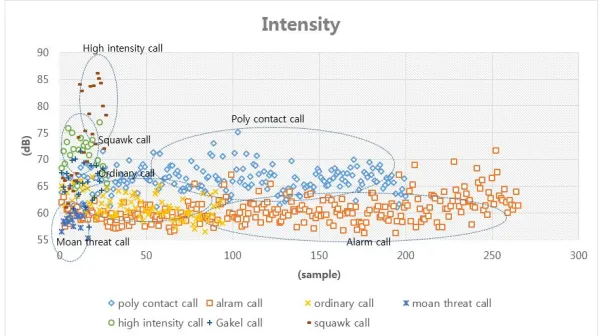
In order to analyze the sounds from laying hens, it should be possible to distinguish features of each sound of laying hens from other sounds. Figure 1 is a graph representing the intensity of sounds from laying hens in general circumstances and is also an example for how each type of sound from laying hens is classified with intensity.
2.3 Environment Analysis
[image:3.612.156.458.547.715.2]Problems that can occur in the environment of
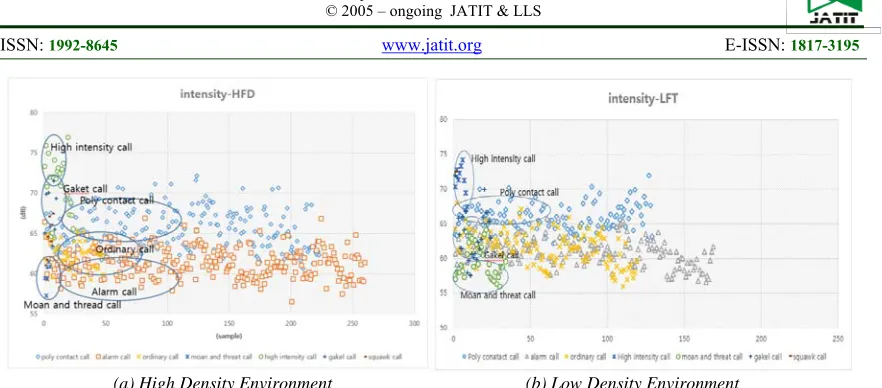
4889 henhouse of laying hens include high and low temperature, air pollution, and high density of henhouses. If environment of henhouse changes, features of sound for vocalization can change. Figure 2 is an example of representing the intensity features according to changes in environment. If comparing the Figure 2 with Figure 1, overall pattern of sound turned out to change.
Analysis of the sounds from laying hens has been proceeded on circumstances where features of sound are varied according to changes in environment. For the experiments of sound variation from laying hens, the appropriate temperature of 22±2℃ was maintained in the environment of control group, and the proper density was set as 450cm2/ea for the feed. As for indoor air, ammonia (NH3) was set as 3ppm, while the carbon dioxide (Co2) was set below 1000pm.
In addition, treatment group for the experiment was in the environment with high fixed temperature (HFT) as 30±2℃ and low fixed temperature (LFT) as 10±4℃. The criteria for high fixed density (HFD) and high fixed air (HFA) were 350cm2/ea but above NH3 20ppm and Co2 2000ppm.
[image:4.612.90.531.56.250.2]Changes in sound features are represented in the Figure 3 to Figure 5. They show that average values were compared on the changes in data according to environment representing feature data with meaningful changes for more than 1% in graph.
Figure 3 is the graph that features data of ordinary call varies according to the changes in environment. On the high temperature environment, values in formant 2 and 3 were increased, while only formant 2 was increased in the low temperature environment. In the high density environment, pitch was increased, but formant 1-4 were decreased. In case of air pollution, particular data was decreased in formant
1-3.
Figure 4 is the graph representing changes in features data of poly contact call according to the environment. In the high fixed temperature environment, the length of entire sound tended to be prolonged while pitch and formant 1-3 values were increased. In addition, pitch and formant 2-4 values were increased in the low fixed temperature environment. In the high fixed density environment, pitch and formant 2 and 3 values were increased. In case of air pollution, the length of sound was prolonged, and pitch and formant 1 value were increased.
Figure 5 is the graph representing how features data of alarm call are varied according to changes in environment. As for alarm call, formant 1-4 values were increased in the high fixed temperature environment, and pitch and formant 1-3 values were increased in the low fixed temperature. In the high fixed density environment, pitch and intensity tended to increase. In case of air pollution, formant 2-4 values were increased.
Figure 3: Changes in Features of Ordinary Call from Environment
[image:4.612.316.522.542.668.2]4890
Figure4: Changes in Features of Poly Contact Call from Environment
3. LAYING-HENS SOUND CLASSIFICATION 3.1 Sound Classification Technique
In this paper, Support Vector Machine (SVM) was used for sound classification model of laying hens. SVM is a classifier that has been frequently used in the machine learning and pattern recognition and is hence a linear classifier in the use of hyperplane with the maximum margin as decision boundary [12]. Linear classification SVM model is shown in the equation 1.
d w, x, b 𝑤 ∙ 𝑥 𝑏 𝑤 𝑥 𝑏 1
Here, S is the number of Support Vector.
x is feature vector representing sample data . w
and b are parameter values that determine the hyperplane. Linear classifier tends to show high performance if feature vector is categorized into linear.
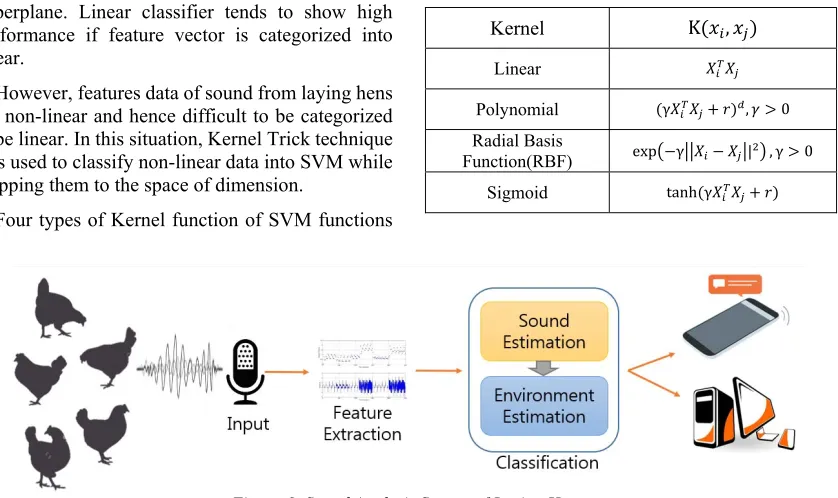
However, features data of sound from laying hens are non-linear and hence difficult to be categorized to be linear. In this situation, Kernel Trick technique was used to classify non-linear data into SVM while mapping them to the space of dimension.
Four types of Kernel function of SVM functions
Figure 5: Changes in Features of Alarm Call from Environment
were mainly used and represented in the Table 3. The most commonly used kernel is Radial Basis Function (RBF) kernel [12]. So, in this paper, we used RBF kernel to classify sounds from laying hens.
[image:5.612.89.308.72.226.2]3.2 Laying-hens Sound Classification System The entire system for analyzing the sounds from laying hens is shown in Figure 6. Sounds from laying hens are entered through the mic, and the processing equipment with entered sound reduces noise. Sound with reduced noise is entered to the phase for extracting features data while classifying the sound based on features data of acquired sound. When notifying the result of classified sound to consumers (high fixed temperature or invasion from outside, etc.), a warning signal is sent out to users for making them recognize the situation of henhouses of laying hens.
Table 3: SVM Kernel Formulas
Kernel K 𝑥 , 𝑥
Linear 𝑋 𝑋
Polynomial γ𝑋 𝑋 𝑟 , 𝛾 0 Radial Basis
[image:5.612.311.529.75.224.2]Function(RBF) exp γ 𝑋 𝑋 | , γ 0 Sigmoid tanh γ𝑋 𝑋 𝑟
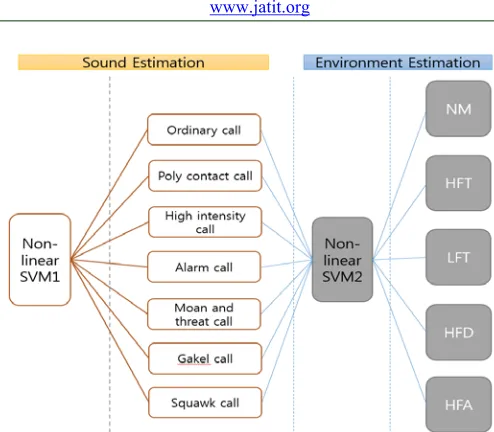
[image:5.612.103.522.470.719.2]4891 Figure 7 shows the classification model for analyzing sound from laying hens. Analysis model for laying hens is comprised of two stages for measuring the sound from laying hens and environment of henhouses.
First, seven types of sound from laying hens are identified in the stage of Sound Estimation step. Based on the features data of sound, types of sound from laying hens are determined to analyze circumstances of laying hens. In the stage of Environment Estimation, it aims to identify whether sound occurs in high or low fixed temperature, high fixed density, or high pollution depending on sound classified in the stage of Sound Estimation. Therefore, it estimates the current status of henhouse. 3.3 Laying-hens Sound Classification Program
We implemented the sound classification model as shown in Figure 8. The main module of this system consists of Sound Analysis part for analyzing characteristics of laying sound and Classification part for classifying sound based on characteristics of analyzed sound.
The Sound Analysis part consists of Wave File Reader module, FFT (Fast Fourier Transform) module, Feature Detect module, and Graph module. Wave File Reader reads wav file information from a wav file. FFT module converts a signal from its original time domain to a representation in the frequency domain. Feature Detect module analyzes features of the wav file that has duration, pitch, intensity, formant1-4. Graph module plots the frequency domain curve on the graph.
The Classification part consists of Problem Create module, Support Vector Machine(SVM) Main
[image:6.612.176.423.75.291.2]module, Model Create module, Radial Basis Function(RBF) Kernel module, and Predict module. Problem Create module converts a training data file to data set for SVM classification. SVM Main module classifies a laying hens sound by features from Feature Detect module. RBF Kernel module transforms linear data to non-linear data. Predict module represents the result of laying hens sound classification
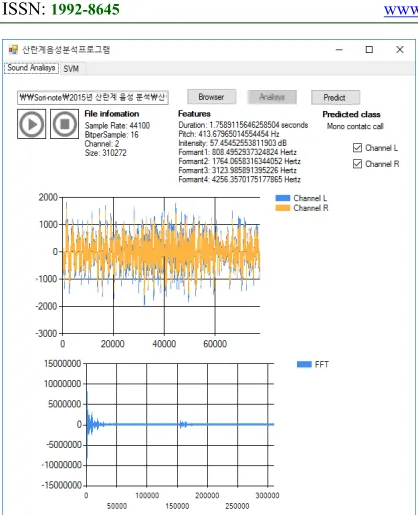
[image:6.612.314.524.547.695.2]Figure 9 shows an example of Sound Analysis tab of Laying hens sound classification program. File information in Figure 9 shows basic information of wav file as sample rate, channel etc. Features part represents the result of feature extraction (duration, pitch, intensity, formant1-4). The graph above in Figure 9 shows the waveform of the wav file. The graph below in Figure 9 represents the result of the FFT of wav file. Predicted Class shows the result of laying hens sound classification.
Figure 7: Sound & Environment Classification Model
4892
Figure 9: An Example of Sound Analysis of Laying Hens Sound Classification Program
Figure 10: An Example of Classification Parameter Setting of Laying hens Sound Classification Program
3.4 Laying Hens Sound Classification Parameter Figure 10 is a SVM tab for parameters setting. RBF kernel non-linear SVM needs gamma and C parameters. The gamma parameters define how far the influence of a single training example reaches, with low values meaning ‘far’ and high values meaning ‘close’. The gamma parameters can be seen
as the inverse of the radius of influence of samples selected by the model as support vectors[13].
The C parameter trades off correct classification of training examples against maximization of the decision function’s margin. For larger values of C, a smaller margin will be accepted if the decision function is better at classifying all training points correctly. A lower C will encourage a larger margin, therefore a simpler decision function, at the cost of training accuracy. In other words `C` behaves as a regularization parameter in the SVM[13].
As mentioned above, in order to improve the accuracy of the non-linear SVM classification with RBF kernel, it is necessary to set appropriate gamma that is an influence of one training example sets and C that is determine the size of the SVM margin.
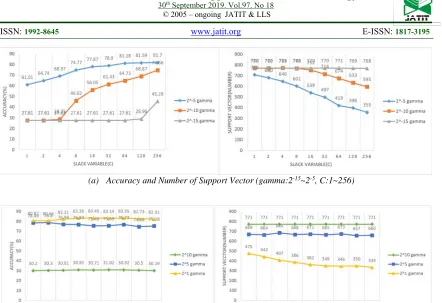
In Figure 11, experiments to find the appropriate gamma and C values were performed. Figure 11 (a) shows the results of measuring laying hens sound classification accuracy and number of support vectors by gamma 2-15 ~ 2-5 and C 1 ~ 256 values.
Figure 11(b) represents the results of measuring laying hens sound classification accuracy and number of support vectors by gamma 2 ~ 210 and C
1 ~ 256 values. Laying hens sound classification parameter experiment shows that the highest accuracy was 83.45% and the lowest accuracy was 27.61%. Then the highest number of support vectors was 771 and the lowest number of support vectors was 334.
If gamma is too large, the radius of the area of influence of the support vectors only includes the support vector itself and no amount of regularization with C will be able to prevent overfitting. In practice though it might still be interesting to simplify the decision function with a lower value of C so as to favor models that use less memory and that are faster to predict [13]. Under the conditions described above, we need to find the C(slack variable) and gamma value with high accuracy and a small number of support vector. Therefore, we used C value was 16 and gamma was 2.
[image:7.612.90.298.360.603.2]4893 divide the sample data into N parts and how many times iterative evaluation. Figure 12 explains the cross-validation method.
4. IMPLEMENTATION AND EXPERIMENTAL RESULTS
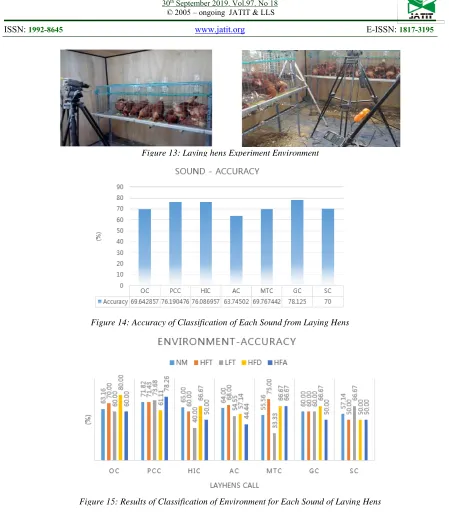
Experiment for evaluating the sound analysis model of laying hens has been proceeded in the environment in the Figure 12.
For the laying hens, the experiment has been proceeded for the specific of Hy-line Brown. PCM (wave file) voice recorder (PCM-M10, Sony) was
used to record the sound from laying hens for 24 hours. Collection of basic data for classifying the sound was made while humans listened to them and classified behaviors of laying hens with reference to real video data. Praat, the sound analysis program, was used for featuring data of classified sound. The number of samples collected for the experiment were 714.
Sound analysis program for laying hens was written in Windows environment by using LIBSVM and operated in CPU 3.4Ghz, RAM 8GB environment. In addition, accuracy evaluation
(a) Accuracy and Number of Support Vector (gamma:2-15~2-5, C:1~256)
[image:8.612.90.532.47.350.2](b) Accuracy and Number of Support Vector (gamma:2~210, C:1~256)
[image:8.612.148.464.422.551.2]Figure 11: Laying hens Classification Accuracy and Number of Support Vector
4894
Figure 14: Accuracy of Classification of Each Sound from Laying Hens
method of SVM model is evaluated by using the equation 2.
Precision 𝑇𝑃
𝑇𝑃 𝐹𝑃 100 2
The number of cases for sound from laying hens accurately classified to the given class is TP (true positives), while the case of vice versa is FP (false positives).
4.1 Sound Classification Experiment
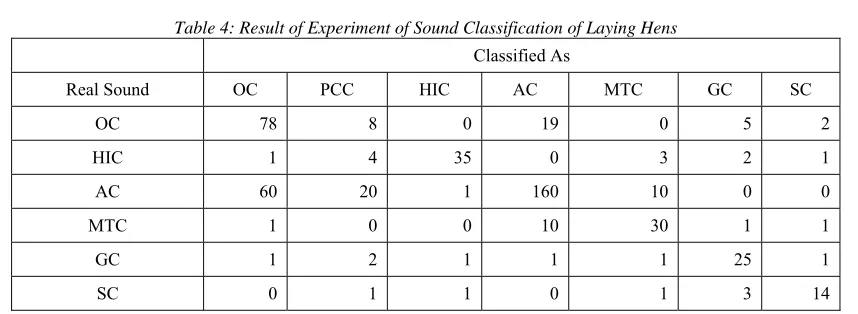
Results of experiment for analyzing the classification of sound from laying hens are shown
in the Table 4. It shows the result of classifying 714 samples in the model. Real Sound part is the result derived from human works. The result of classifying the same sound in the model of laying hens is shown in Classified As part.
Accuracy of sound classification of laying hens is shown in Figure 14. Accuracy of each sound was expressed in graph. According to the result of experiment, the accuracy of model classification turned out to be 70.3% in average.
[image:9.612.174.464.402.536.2]
Figure 13: Laying hens Experiment Environment
4895 4.2 Environment Classification Experiment
Results of experiment for classification the environmental status of house of laying hens is shown in Figure 15. In the experiment, estimation was proceeded by using sound determined in the Sound Classification stage of laying hens. The overall accuracy in the stage of environment classification turned out to be 60.77% in average. Specifically, as for the accuracy of each environment, the accuracy of normal condition (NM) was shown as 62.38% followed by 64.92% in high fixed temperature (HFT), 55.46% in low fixed temperature (LFT), 64.04% in high fixed density (HFD), and 57.05% in high fixed pollution (HFA). 5. CONCLUSION
In this study, various types of sound from laying hens were classified into seven categories while suggesting the model for estimating the conditions of laying hens and environment according to them. In order to classify the sounds from laying hens, characteristics of sound were identified while statistically analyzing transitions in feature data from changes of environment. In addition, non-linear SVM technique was an available option to be used on diverse sounds of laying hens to classify them.
Follow-up researches are required to deal with other characteristics of sound from laying hens, and apply the sound classification model of laying hens in the agricultural environment in order to improve the accuracy of laying hens model
ACKNOWLEDGEMENT:
This research was supported by Basic Science Research Program through the National Research Foundation of Korea(NRF) funded by the Ministry of Education(2018R1D1A1B07043417)
REFERENCES:
[1] Kumar, A.; Hancke, G.P., "A Zigbee-Based Animal Health Monitoring System," Sensors
Journal, vol.15, no.1, pp.610,617, Jan. 2015.
[2] Santha, G.; Hermann, G., "Accelerometer based activity monitoring system for behavioural analysis of free-roaming animals," Intelligent
Systems and Informatics (SISY), 2013 IEEE 11th
International Symposium on , pp.199,203, 26-28 Sept. 2013.
[3] D. Banerjee, S. Biswas, C. Daigle and J. M. Siegford, "Remote Activity Classification of Hens Using Wireless Body Mounted Sensors,"
2012 Ninth International Conference on Wearable and Implantable Body Sensor
Networks, London, pp. 107-112, 2012.
[4] Gupta, R.K.; Lathwal, S.S.; Mohanty, T.K.; Ruhil, A.P.; Singh, Y., "Detection of lameness of cow based on body weight using artificial neural network," Computing for Sustainable Global
Development (INDIACom), 2014 International
Conference on , pp.337,341, 5-7 March 2014. [5] Celia Rosline.A; Felix Enigo, V.S., "Fuzzy query
processing in wireless sensor networks for Animal Health Monitoring," Advanced Communication Control and Computing
Technologies (ICACCCT), 2014 International
Conference on , vol., no., pp.1094,1098, 8-10 May 2014.
[6] Melaku Tefera, “Acoustic Signals in Domestic Chicken (Gallus gallus): A Tool for Teaching Veterinary Ethology and Implication for language learning”, Ethiop. Vet. J. 16:77-84,
2012.
[image:10.612.92.521.89.246.2][7] M. Lin, S. Zhong and L. Lin, "Chicken Sound Recognition Using Anti-noise Mel Frequency Cepstral Coefficients," 2015 Third International Conference on Robot, Vision and Signal Table 4: Result of Experiment of Sound Classification of Laying Hens
Classified As
Real Sound OC PCC HIC AC MTC GC SC
OC 78 8 0 19 0 5 2
HIC 1 4 35 0 3 2 1
AC 60 20 1 160 10 0 0
MTC 1 0 0 10 30 1 1
GC 1 2 1 1 1 25 1
4896
Processing (RVSP), Kaohsiung, pp. 224-227,
2015.
[8] Chedad A, Moshou D, Aerts J M, et al. "AP— Animal Production Technology: Recognition System for Pig Cough based on Probabilistic Neural Networks," Journal of agricultural
engineering research, 79(4): 449-457, 2001.
[9] G. Jahns, "Call recognition to identify cow conditionsa call recogniser translating calls to text," Computers and Electronics in Agriculture,
vol. 62, no. 1, pp. 54–48, Jun. 2008.
[10] jonguk Lee, Byeongjoon Noh, Suin Jang Daihee Park, Yongwha Chung, and Hong-Hee Chang, “Stress Detection and Classification of Laying Hens by Sound Analysis” Asian Australas. J.
Anim. Sci. Vol. 28, No. 4: 592-598 April 2015.
[11] Boersma, P. “Praat, a system for doing phonetics by computer.”, Glot Int. 5:341-345, 2001.
[12] Chih-Chung Chang and Chih-Jen Lin, “LIBSVM : a library for support vector machines.” ACM Transactions on Intelligent
Systems and Technology, 2:27:1--27:27, 2011.